
Autofrettage
Autofrettage is a work-hardening process in which a pressure vessel (thick walled) is subjected to enormous pressure, causing internal portions of the part to yield plastically, resulting in internal compressive residual stresses once the pressure is released.
Overview
The goal of autofrettage is to increase the pressure-carrying capacity of the final product. Inducing residual compressive stresses into materials can also increase their resistance to stress corrosion cracking; that is, non-mechanically assisted cracking that occurs when a material is placed in a corrosive environment in the presence of tensile stress. The technique is commonly used in manufacture of high-pressure pump cylinders, warship and gun barrels, and fuel injection systems for diesel engines. Due to work-hardening process it also enhances wear life of the barrel marginally. While autofrettage will induce some work hardening, that is not the primary mechanism of strengthening.
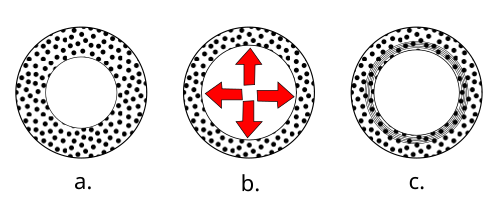
تبدأ العملية بأنبوب فولاذي واحد بقطر داخلي أقل بقليل من القطر المطلوب. يُعرَّض الأنبوب لضغط داخلي كافٍ لتوسيع تجويفه، وخلال هذه العملية، تتمدد الطبقات الداخلية للمعدن بفعل الشد إلى ما يتجاوز حد مرونتها. هذا يعني أن الطبقات الداخلية قد تمددت إلى درجة لا يستطيع الفولاذ عندها العودة إلى شكله الأصلي بمجرد زوال الضغط الداخلي. على الرغم من تمدد الطبقات الخارجية للأنبوب أيضًا، إلا أن درجة الضغط الداخلي المُطبَّق خلال العملية لا تسمح بتمددها إلى ما يتجاوز حد مرونتها. والسبب في ذلك هو أن توزيع الإجهاد عبر جدران الأنبوب غير منتظم. تبلغ قيمته القصوى في المعدن المجاور لمصدر الضغط، ثم تتناقص بشكل ملحوظ باتجاه الطبقات الخارجية للأنبوب. يتناسب الانفعال طرديًا مع الإجهاد المُطبَّق ضمن حد المرونة؛ لذلك يكون التمدد في الطبقات الخارجية أقل منه في التجويف. ولأن الطبقات الخارجية تظل مرنة، فإنها تحاول العودة إلى شكلها الأصلي؛ إلا أن الطبقات الداخلية الجديدة المتمددة بشكل دائم تمنعها من ذلك تمامًا. تتمثل النتيجة في تعرض الطبقات الداخلية للمعدن للضغط من قبل الطبقات الخارجية، تمامًا كما لو تم تقليص طبقة خارجية من المعدن كما هو الحال في البنادق المركبة . ويمكن فهم ذلك بشكل أفضل بافتراض أن الأنبوب ذو الجدران السميكة هو أنبوب متعدد الطبقات. تتمثل الخطوة التالية في تعريض الطبقات الداخلية المشدودة بالضغط لمعالجة حرارية منخفضة الحرارة (LTT)، مما يؤدي إلى رفع حد المرونة إلى ما لا يقل عن ضغط التصليد الذاتي المستخدم في المرحلة الأولى من العملية. أخيرًا، يمكن اختبار مرونة الماسورة بتطبيق ضغط داخلي مرة أخرى، ولكن هذه المرة مع الحرص على عدم تمديد الطبقات الداخلية إلى ما بعد حد المرونة الجديد. والنتيجة النهائية هي سطح داخلي لماسورة البندقية مع إجهاد ضغط متبقٍ قادر على موازنة إجهاد الشد الذي سيحدث عند إطلاق النار. بالإضافة إلى ذلك، تتمتع المادة بمقاومة شد أعلى نتيجة للتصلب بالتشكيل. [ 1 ]
تاريخ
Early in the history of artillery, people observed that, after firing a small number of rounds, the bore of a new gun slightly enlarges and hardens.[2] Historically, the first type of autofrettage avant la lettre was mandrelling bronze gun barrels, invented and patented in 1869 by Samuel B. Dean of the South Boston Iron Company.[3] But it found no use on the American continent and was copied[4] without a license[5] by Franz von Uchatius in mid-1870s. It found some use in several European countries lacking steel industry, but was quickly displaced by cast steel everywhere except Austro-Hungary, which stuck to the obsolete technology until WWI[6] and therefore had their artillery handicapped.[7]
The problem of strengthening steel gun barrels using the same principle was tackled by French colonial artillery colonel Louis Frédéric Gustave Jacob, who suggested in 1907 to pressurize them hydraulically and coined the term "autofrettage". In 1913, Schneider-Creusot made a 14 cm L/50 naval gun by such a method[8] and applied for a patent.[9] However, implementing such a technique on an industrial scale required numerical methods to approximate the solutions of transcedental equations of plastic deformation, which were developed in France during WWI by math professor Maurice d'Ocagne and Schneider engineer Louis Potin.[10]
In modern practice, a slightly oversized die is pushed slowly through the barrel by a hydraulically driven ram. The amount of initial underbore and oversize of the die are calculated to strain the material around the bore past its elastic limit into plastic deformation. A residual compressive stress remains on the barrel's inner surface, even after final honing and rifling.
The technique has been applied to the expansion of tubular components down hole in oil and gas wells. The method has been patented by the Norwegian oil service company, Meta, which uses it to connect concentric tubular components with sealing and strength properties outlined above.
The term autofrettage is also used to describe a step in manufacturing of composite overwrapped pressure vessel (COPV) where the liner is expanded (by plastic deformation), inside the composite overwrap.[11]
See also
- عملية التشكيل بالخردق ، والتي تُحدث أيضًا إجهادات ضغط متبقية.
- البندقية المُدعّمة ، وهي طريقة قديمة لتقوية سبطانات البنادق
مراجع
- ↑ أنظمة وتكنولوجيا أسلحة ساحة المعركة من براسي،المجلد الثاني، البنادق وقذائف الهاون والصواريخ بقلم جيه دبليو رايان، الكلية العسكرية الملكية للعلوم، شريفينهام، المملكة المتحدة.
- ↑ جاي، ألبرت إي. (1920). "التصليد الذاتي" . ذخائر الجيش . 1 (3): 126-129 . JSTOR 45354430 .
- ↑ براءة اختراع أمريكية رقم 90244A
- ↑ "الميكانيكا الإنجليزية وعالم العلوم" . 1881.
- ↑ فان سلايك، جيه دي (1879). "مصنعي ومصانع نيو إنجلاند: ثلاثمائة وخمسون من كبار المصنعين في نيو إنجلاند" .
- ↑ دريدجر، جون أ. (11 أغسطس 2017). التكتيكات والمشتريات في الجيش الهابسبورغي، 1866-1918: الإنفاق الهجومي . سبرينغر. ISBN 9783319576787.
- ↑ "الصفحة: EB1922 - المجلد 30.djvu/274 - ويكي مصدر، المكتبة الإلكترونية المجانية" .
- ^ "Revue d'artillerie : Paraissant le 15 de chaque mois" . يوليو 1920.
- ↑ FR 472169A
- ↑ أوبين، ديفيد؛ غولدشتاين، كاثرين (7 أكتوبر 2014). حرب البنادق والرياضيات: الممارسات الرياضية والمجتمعات في فرنسا وحلفائها الغربيين خلال الحرب العالمية الأولى . الجمعية الأمريكية للرياضيات. ISBN 9781470414696.
- ↑ بات ب. ماكلوغلان؛ سكوت س. فورث؛ لوري ر. غرايمز-ليديسما (مارس 2011). "أوعية الضغط المركبة المغلفة، مقدمة" (ملف PDF) . وكالة ناسا . مؤرشف من الأصل (ملف PDF) بتاريخ 21 أبريل 2015. تم الاطلاع عليه بتاريخ 4 يوليو 2015 .
روابط خارجية
- تشكيل المعادن
- صناعة الأسلحة النارية