
حوض خلف القوس

حوض ما وراء القوس هو نوع من الأحواض الجيولوجية ، يوجد عند بعض حدود الصفائح المتقاربة . حاليًا، جميع أحواض ما وراء القوس هي تضاريس بحرية مرتبطة بأقواس الجزر ومناطق الاندساس ، ويوجد العديد منها في غرب المحيط الهادئ . ينشأ معظمها نتيجة قوى الشد ، الناجمة عن عملية تُعرف باسم تراجع الخندق المحيطي ، حيث تتحرك منطقة الاندساس باتجاه الصفيحة المندسة. [ 1 ] كانت أحواض ما وراء القوس في البداية ظاهرة غير متوقعة في علم تكتونيات الصفائح ، حيث كان يُتوقع أن تكون حدود التقارب مناطق ضغط بشكل عام. ومع ذلك، في عام 1970، نشر دان كاريج نموذجًا لأحواض ما وراء القوس يتوافق مع علم تكتونيات الصفائح. [ 2 ]
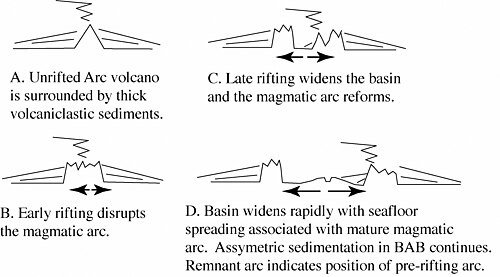
الخصائص الهيكلية
Back-arc basins are typically very long and relatively narrow, often thousands of kilometers long while only being a few hundred kilometers wide at most. For back-arc extension to form, a subduction zone is required, but not all subduction zones have a back-arc extension feature.[3] Back-arc basins are found in areas where the subducting plate of oceanic crust is very old.[3] The restricted width of back-arc basins is due to magmatic activity being reliant on water and induced mantle convection, limiting their formation to along subduction zones.[3] Spreading rates vary from only a few centimeters per year (as in the Mariana Trough), to 15 cm/year in the Lau Basin.[4] Spreading ridges within the basins erupt basalts that are similar to those erupted from the mid-ocean ridges; the main difference being back-arc basin basalts are often very rich in magmatic water (typically 1–1.5 weight % H2O), whereas mid-ocean ridge basalt magmas are very dry (typically <0.3 weight % H2O). The high water contents of back-arc basin basalt magmas is derived from water carried down the subduction zone and released into the overlying mantle wedge.[1] Additional sources of water could be the eclogitization of amphiboles and micas in the subducting slab. Similar to mid-ocean ridges, back-arc basins have hydrothermal vents and associated chemosynthetic communities.
Seafloor spreading
Evidence of seafloor spreading has been seen in cores of the basin floor. The thickness of sediment that collected in the basin decreased toward the center of the basin, indicating a younger surface. The idea that thickness and age of sediment on the sea floor is related to the age of the oceanic crust was proposed by Harry Hess.[5]Magnetic anomalies of the crust that had formed in back-arc basins deviated in form from the crust formed at mid-ocean ridges.[2] In many areas the anomalies do not appear parallel, as well as the profiles of the magnetic anomalies in the basin lacking symmetry or a central anomaly as a traditional ocean basin does, indicating asymmetric seafloor spreading.[2]
This has prompted some to characterize the spreading in back-arc basins to be more diffused and less uniform than at mid-ocean ridges.[6] The idea that back-arc basin spreading is inherently different from mid-ocean ridge spreading is controversial and has been debated through the years.[6] Another argument put forward is that the process of seafloor spreading is the same in both cases, but the movement of seafloor spreading centers in the basin causes the asymmetry in the magnetic anomalies.[6] This process can be seen in the Lau back-arc basin.[6] Though the magnetic anomalies are more complex to decipher, the rocks sampled from back-arc basin spreading centers do not differ very much from those at mid-ocean ridges.[7] In contrast, the volcanic rocks of the nearby island arc differ significantly from those in the basin.[7]
Back-arc basins are different from normal mid-ocean ridges because they are characterized by asymmetric seafloor spreading, but this is quite variable even within single basins. For example, in the central Mariana Trough, current spreading rates are 2–3 times greater on the western flank,[8] whereas at the southern end of the Mariana Trough the position of the spreading center adjacent to the volcanic front suggests that overall crustal accretion has been nearly entirely asymmetric there.[9] This situation is mirrored to the north where a large spreading asymmetry is also developed.[10]
Other back-arc basins such as the Lau Basin have undergone large rift jumps and propagation events (sudden changes in relative rift motion) that have transferred spreading centers from arc-distal to more arc-proximal positions.[11] Conversely, study of recent spreading rates appear to be relatively symmetric with perhaps small rift jumps.[12] The cause of asymmetric spreading in back-arc basins remains poorly understood. General ideas invoke asymmetries relative to the spreading axis in arc melt generation processes and heat flow, hydration gradients with distance from the slab, mantle wedge effects, and evolution from rifting to spreading.[13][14][15]
Formation and tectonics
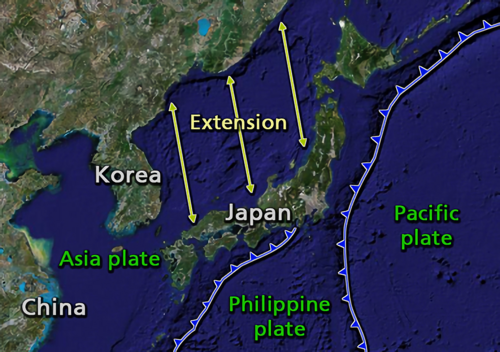
يُعتقد أن امتداد القشرة الأرضية خلف الأقواس البركانية ناتج عن عمليات مرتبطة بالانغماس. [ 1 ] عندما تغوص الصفيحة المنغمسة في الغلاف المائع، فإنها تُطلق الماء، مما يُسبب انصهار الوشاح، والنشاط البركاني، وتكوين الأقواس الجزرية. ومن نتائج ذلك أيضًا تكوّن خلية حمل حراري. [ 1 ] يؤدي صعود الصهارة والحرارة، بالإضافة إلى الشد الخارجي في القشرة الأرضية الملامسة لخلية الحمل الحراري، إلى تكوّن منطقة منصهرة، مما ينتج عنه صدع . تدفع هذه العملية القوس الجزري نحو منطقة الانغماس، وبقية الصفيحة بعيدًا عنها. [ 1 ] تُسمى الحركة العكسية لمنطقة الانغماس بالنسبة لحركة الصفيحة المنغمسة بانحسار الخندق (المعروف أيضًا بانحسار المفصلة ) . ومع انحسار منطقة الانغماس والخندق المرتبط بها، تتمدد الصفيحة العلوية، مما يُرقق القشرة الأرضية ويُشكل حوضًا خلف القوس. في بعض الحالات، يحدث التمدد نتيجة دخول جسم طافٍ في منطقة الاندساس، مما يبطئ الاندساس محليًا ويحفز الصفيحة المندسة على الدوران بجواره. ويرتبط هذا الدوران بانحسار الخندق وتمدد الصفيحة العلوية. [ 9 ]
وُجد أن عمر القشرة المنغرزة اللازمة لتكوين امتداد ما وراء القوس يبلغ 55 مليون سنة أو أكثر. [ 15 ] [ 3 ] ولهذا السبب تبدو مراكز امتداد ما وراء القوس مُركّزة في غرب المحيط الهادئ. [ 3 ] قد تكون زاوية ميل الصفيحة المنغرزة مهمة أيضًا، إذ تبيّن أنها أكبر من 30 درجة في مناطق امتداد ما وراء القوس؛ ويرجع ذلك على الأرجح إلى أن القشرة المحيطية تزداد كثافةً مع ازدياد عمرها، مما ينتج عنه زاوية انحدار أكثر حدة. [ 3 ]
يؤدي ترقق الصفيحة العلوية نتيجة التصدع في منطقة ما وراء القوس البركاني إلى تكوين قشرة محيطية جديدة (أي، التوسع في منطقة ما وراء القوس البركاني). ومع تمدد الغلاف الصخري ، يرتفع الغلاف المائع أسفله إلى أعماق ضحلة وينصهر جزئيًا نتيجةً لانصهار انخفاض الضغط الأديباتي . وعندما يقترب هذا المصهور من السطح، يبدأ التوسع.
الترسيب
Sedimentation is strongly asymmetric, with most of the sediment supplied from the active volcanic arc which regresses in step with the rollback of the trench.[16] From cores collected during the Deep Sea Drilling Project (DSDP) nine sediment types were found in the back-arc basins of the western Pacific.[16] Debris flows of thick to medium bedded massive conglomerates account for 1.2% of sediments collected by the DSDP.[16] The average size of the sediments in the conglomerates are pebble sized but can range from granules to cobbles.[16] Accessory materials include limestone fragments, chert, shallow water fossils and sandstoneclasts.[16]
Submarine fan systems of interbedded turbidite sandstone and mudstone made up 20% of the total thickness of sediment recovered by the DSDP.[16] The fans can be divided into two sub-systems based on the differences in lithology, texture, sedimentary structures, and bedding style.[16] These systems are inner and midfan subsystem and the outer fan subsystem.[16] The inner and midfan system contains interbedded thin to medium bedded sandstones and mudstones.[16] Structures that are found in these sandstones include load clasts, micro-faults, slump folds, convolute laminations, dewatering structures, graded bedding, and gradational tops of sandstone beds.[16] Partial Bouma sequences can be found within the subsystem.[16] The outer fan subsystem generally consists of finer sediments when compared to the inner and midfan system.[16] Well sorted volcanoclastic sandstones, siltstones and mudstones are found in this system.[16] Sedimentary structures found in this system include parallel laminae, micro-cross laminae, and graded bedding.[16] Partial Bouma sequences can be identified in this subsystem.[16]
شكّلت الطينات البحرية التي تحتوي على عقيدات دقيقة من الحديد والمنغنيز ، والكوارتز ، والبلاجيوكلاز ، والأورثوكلاز ، والماغنيتيت ، والزجاج البركاني ، والمونتوموريلونيت ، والإيليت ، والسميكتيت ، وبقايا المنخربات ، والدياتومات ، وشويكات الإسفنج ، الطبقةَ العليا من الرواسب في كل موقع وُجدت فيه. وشكّل هذا النوع من الرواسب 4.2% من إجمالي سُمك الرواسب التي استُخرجت بواسطة برنامج الحفر في أعماق البحار (DSDP). [ 16 ]
تتكون الرواسب السيليكا البيوجينية البحرية من رواسب شعاعية، ودياتومية، وسيليكوفلاجيلات ، وصوان. [ 16 ] وتشكل 4.3% من سُمك الرواسب المستخرجة. [ 16 ] تُعد الكربونات البيوجينية البحرية أكثر أنواع الرواسب شيوعًا في أحواض ما وراء القوس في غرب المحيط الهادئ. [ 16 ] وشكل هذا النوع من الرواسب 23.8% من إجمالي سُمك الرواسب المستخرجة بواسطة برنامج الحفر في أعماق البحار (DSDP). [ 16 ] تتكون الكربونات البحرية من الطمي، والطباشير، والحجر الجيري. [ 16 ] وتشكل الأحافير النانوية والمنخربات غالبية الرواسب. [ 16 ] وشكلّت الكربونات المُعاد ترسيبها 9.5% من إجمالي سُمك الرواسب المستخرجة بواسطة برنامج الحفر في أعماق البحار (DSDP). [ 16 ] كان لهذا النوع من الرواسب نفس تركيب الرواسب الكربوناتية البحرية ذات الأصل البيولوجي، ولكنه خضع لإعادة تشكيل ذات بنى رسوبية متطورة. [ 16 ] شكلت المواد البركانية الفتاتية ، المكونة من الرماد البركاني والتوف ومجموعة من المكونات الأخرى، بما في ذلك الأحافير النانوية والبيريت والكوارتز وبقايا النباتات والزجاج، 9.5% من الرواسب المستخرجة. [ 16 ] وقد أتت هذه الرواسب البركانية من النشاط البركاني الإقليمي الخاضع للتحكم التكتوني ومن مصادر قوس الجزر القريبة. [ 16 ]
المواقع

توجد أحواض خلفية نشطة في جزر ماريانا ، وكيرماديك-تونغا ، وجنوب سكوتيا ، ومانوس ، وشمال فيجي ، ومنطقة البحر التيراني ، لكن معظمها يقع في غرب المحيط الهادئ. ولا تحتوي جميع مناطق الاندساس على أحواض خلفية؛ فبعضها، مثل جبال الأنديز الوسطى ، يرتبط بانضغاط القوس الخلفي .
There are a number of extinct or fossil back-arc basins, such as the Parece Vela-Shikoku Basin, Sea of Japan, and Kurile Basin. Compressional back-arc basins are found, for example, in the Pyrenees and the Swiss Alps.[17]
History of thought
With the development of plate tectonic theory, geologists thought that convergent plate margins were zones of compression, thus zones of strong extension above subduction zones (back-arc basins) were not expected. The hypothesis that some convergent plate margins were actively spreading was developed by Dan Karig in 1970, while a graduate student at the Scripps Institution of Oceanography.[2] This was the result of several marine geologic expeditions to the western Pacific.
See also
Citations
- 12345Forsyth, D; Uyeda, S (1975). "On the Relative Importance of the Driving Forces of Plate Motion". Geophysical Journal International. 7 (4): 163–200. Bibcode:1975GeoJ...43..163F. doi:10.1111/j.1365-246X.1975.tb00631.x.
- 1234Karig, Daniel (1970). "Ridges and basins of the Tonga-Kermadec island arc system". Journal of Geophysical Research. 75 (2): 239–254. Bibcode:1970JGR....75..239K. doi:10.1029/JB075i002p00239.
- 123456Sdrolias, M; Muller, R.D. (2006). "Controls on back-arc basin formations". Geochemistry, Geophysics, Geosystems. 7 (4): Q04016. Bibcode:2006GGG.....7.4016S. doi:10.1029/2005GC001090. S2CID 129068818.
- ↑Taylor, B.; Zellmer, K.; Martinez, F.; Goodliffe, A. (1996). "Sea-floor Spreading in the Lau Back-arc Basin". Earth and Planetary Science Letters. 144 (1–2): 35–40. Bibcode:1996E&PSL.144...35T. doi:10.1016/0012-821X(96)00148-3. Retrieved 26 December 2016.
- ↑ هيس، هنري هـ (1962). "تاريخ أحواض المحيطات". دراسات بترولوجية: مجلد تكريمًا لـ أ. ف. بودينغتون . ص 599-620 . OCLC 881288 .
- 1 2 3 4 تايلور، ب؛ زيلر، ك؛ مارتينيز، ف؛ غودليف، أ (1996). "توسع قاع البحر في حوض لاو الخلفي". رسائل علوم الأرض والكواكب . 144 ( 1-2 ): 35-40 . Bibcode : 1996E & PSL.144...35T . doi : 10.1016/0012-821x(96)00148-3 .
- 1 2 جيل، ج. ب. (1976). "تركيب وعمر الصخور البركانية لحوض لاو وتلاله: دلالات على تطور حوض بين الأقواس وقوس متبقٍ". نشرة الجمعية الجيولوجية الأمريكية . 87 (10): 1384-1395 . رمز Bibcode : 1976GSAB...87.1384G . doi : 10.1130/0016-7606(1976)87 < 1384:CAAOLB > 2.0.CO ; 2 .
- ↑ ديشامب، أ.؛ فوجيوارا، ت. (2003). "التراكم غير المتناظر على طول سلسلة جبال ماريانا بطيئة الانتشار". الجيوكيمياء. الجيوفيزياء. الجيولوجيا . 4 (10): 8622. Bibcode : 2003GGG.....4.8622D . doi : 10.1029/2003GC000537 .
- 1 2 مارتينيز، ف.؛ فراير، ب.؛ بيكر، ن. (2000). "الخصائص الجيوفيزيائية لحوض ماريانا الجنوبي، 11 شمالاً - 13 شمالاً" . مجلة البحوث الجيوفيزيائية 105 (B7): 16591-16607 . Bibcode : 2000JGR...10516591M . doi : 10.1029/2000JB900117 .
- ↑ يامازاكي، ت.؛ سيما، ن.؛ أوكينو، ك.؛ كيتادا، ك.؛ جوشيما، م.؛ أودا، هـ.؛ ناكا، ج. (2003). "عملية انتشار خندق ماريانا الشمالي: الانتقال من التصدع إلى الانتشار عند خط عرض 22 شمالاً" . الجيوكيمياء، الجيوفيزياء، الجيولوجيا . 4 (9): 1075. Bibcode : 2003GGG.....4.1075Y . doi : 10.1029/2002GC000492 .
- ↑Parson, L.M.; Pearce, J.A.; Murton, B.J.; Hodkinson, R.A.; RRS Charles Darwin Scientific Party (1990). "Role of ridge jumps and ridge propagation in the tectonic evolution of the Lau back-arc basin, southwest Pacific". Geology. 18 (5): 470–473. Bibcode:1990Geo....18..470P. doi:10.1130/0091-7613(1990)018<0470:RORJAR>2.3.CO;2.
- ↑Zellmer, K.E.; Taylor, B. (2001). "A three-plate kinematic model for Lau Basin opening". Geochem. Geophys. Geosyst. 2 (5): 1020. Bibcode:2001GGG.....2.1020Z. doi:10.1029/2000GC000106. 2000GC000106.
- ↑Barker, P.F.; Hill, I.A. (1980). "Asymmetric spreading in back-arc basins". Nature. 285 (5767): 652–654. Bibcode:1980Natur.285..652B. doi:10.1038/285652a0. S2CID 4233630.
- ↑Martinez, F.; Fryer, P.; Baker, N.A.; Yamazaki, T. (1995). "Evolution of backarc rifting: Mariana Trough, 20–24N". J. Geophys. Res. 100 (B3): 3807–3827. Bibcode:1995JGR...100.3807M. doi:10.1029/94JB02466. Archived from the original on 2011-08-27. Retrieved 2010-05-08.
- 12Molnar, P.; Atwater, T. (1978). "Interarc spreading and Cordilleran tectonics as alternates related to the age of subducted oceanic lithosphere". Earth Planet. Sci. Lett. 41 (3): 330–340. Bibcode:1978E&PSL..41..330M. doi:10.1016/0012-821X(78)90187-5.
- 1234567891011121314151617181920212223242526Klein, G.D. (1985). "The Control of Depositional Depth, Tectonic Uplift, and Volcanism on Sedimentation Processes in the Back-Arc Basins of the Western Pacific Ocean". Journal of Geology. 93 (1): 1–25. Bibcode:1985JG.....93....1D. doi:10.1086/628916. S2CID 129527339.
- ↑Munteanu, I.; et al. (2011). "Kinematics of back-arc inversion of the Western Black Sea Basin". Tectonics. 30 (5): n/a. Bibcode:2011Tecto..30.5004M. doi:10.1029/2011tc002865.
General and cited references
- Barker, P.F.; Hill, I.A. (1980). "Asymmetric spreading in back-arc basins". Nature. 285 (5767): 652–654. Bibcode:1980Natur.285..652B. doi:10.1038/285652a0. S2CID 4233630.
- Deschamps, A.; Fujiwara, T. (2003). "Asymmetric accretion along the slow-spreading Mariana Ridge". Geochem. Geophys. Geosyst. 4 (10): 8622. Bibcode:2003GGG.....4.8622D. doi:10.1029/2003GC000537.
- Forsyth, D.; Uyeda, S. (1975). "On the Relative Importance of the Driving Forces of Plate Motion*". Geophysical Journal International. 43 (1): 163–200. Bibcode:1975GeoJ...43..163F. doi:10.1111/j.1365-246x.1975.tb00631.x.
- Gill, J.B. (1976). "Composition and age of Lau Basin and Ridge volcanic rocks: Implications for evolution of an interarc basin and remnant arc". GSA Bulletin. 87 (10): 1384–1395. Bibcode:1976GSAB...87.1384G. doi:10.1130/0016-7606(1976)87<1384:caaolb>2.0.co;2.
- Hess, Henry H. (1962). "History of Ocean Basins". Petrological Studies: A Volume to Honor A .F. Buddington. 599–620. OCLC 881288.
- Karig, Daniel E (1970). "Ridges and basins of the Tonga-Kermadec island arc system". Journal of Geophysical Research. 75 (2): 239–254. Bibcode:1970JGR....75..239K. doi:10.1029/JB075i002p00239.
- Klein, G.D. (1985). "The Control of Depositional Depth, Tectonic Uplift, and Volcanism on Sedimentation Processes in the Back-Arc Basins of the Western Pacific Ocean". Journal of Geology. 93 (1): 1–25. Bibcode:1985JG.....93....1D. doi:10.1086/628916. S2CID 129527339.
- Martinez, F.; Fryer, P.; Baker, N.A.; Yamazaki, T. (1995). "Evolution of backarc rifting: Mariana Trough, 20–24N". J. Geophys. Res. 100 (B3): 3807–3827. Bibcode:1995JGR...100.3807M. doi:10.1029/94JB02466.
- Martinez, F.; Fryer, P.; Becker, N. (2000). "Geophysical Characteristics of the Southern Mariana Trough, 11N–13N". J. Geophys. Res.105 (B7): 16591–16607. Bibcode:2000JGR...10516591M. doi:10.1029/2000JB900117.
- Molnar, P.; Atwater, T. (1978). "Interarc spreading and Cordilleran tectonics as alternates related to the age of subducted oceanic lithosphere". Earth Planet. Sci. Lett. 41 (3): 330–340. Bibcode:1978E&PSL..41..330M. doi:10.1016/0012-821X(78)90187-5.
- Parson, L.M.; Pearce, J.A.; Murton, B.J.; Hodkinson, R.A. (1990). "Role of ridge jumps and ridge propagation in the tectonic evolution of the Lau back-arc basin, southwest Pacific". Geology. 18 (5): 470–473. Bibcode:1990Geo....18..470P. doi:10.1130/0091-7613(1990)018<0470:RORJAR>2.3.CO;2.
- سدرولياس، م.؛ مولر، ر. د. (2006). "عوامل التحكم في تكوينات أحواض ما وراء القوس" . الكيمياء الجيولوجية، الجيوفيزياء، الجيولوجيا النظامية . 7 (4): 1-40 . رمز Bibcode : 2006GGG.....7.4016S . doi : 10.1029/2005GC001090 . S2CID 129068818 .
- تايلور، برايان (1995). أحواض ما وراء القوس: التكتونيات والنشاط البركاني. نيويورك: مطبعة بلينوم. ISBN 9780306449376. OCLC 32464941 .
- تايلور، ب.؛ زيلر، ك.؛ مارتينيز، ف.؛ غودليف، أ. (1996). "توسع قاع البحر في حوض لاو الخلفي". رسائل علوم الأرض والكواكب . 144 ( 1-2 ): 35-40 . رمز Bibcode : 1996E و PSL.144...35T . doi : 10.1016/0012-821x(96)00148-3 .
- أويدا، س. (1984). "مناطق الاندساس: تنوعها، وآليتها، وتأثيرها البشري". مجلة الجغرافيا . 8 (1): 381-406 . رمز Bibcode : 1984GeoJo...8..381U . doi : 10.1007/BF00185938 . S2CID 128986436 .
- والاس، لورا م .؛ إليس، سوزان ؛ مان، بول (2009). "نموذج تصادمي للدوران السريع لكتل مقدمة القوس، وانحناء القوس، والتصدع الدوري في منطقة ما وراء القوس في بيئات الاندساس" . الكيمياء الجيولوجية، الجيوفيزياء، الجيولوجيا النظامية . 10 (5): غير متوفر. رمز Bibcode : 2009GGG....10.5001W . doi : 10.1029/2008gc002220 .
- يامازاكي، ت.؛ سيما، ن.؛ أوكينو، ك.؛ كيتادا، ك.؛ جوشيما، م.؛ أودا، هـ.؛ ناكا، ج. (2003). "عملية انتشار خندق ماريانا الشمالي: الانتقال من التصدع إلى الانتشار عند خط عرض 22 شمالًا" . الجيوكيمياء، الجيوفيزياء، الجيولوجيا . 4 (9): 1075. رمز Bibcode : 2003GGG.....4.1075Y . doi : 10.1029/2002GC000492 .
- زيلر، ك. إي.؛ تايلور، ب. (2001). "نموذج حركي ثلاثي الصفائح لفتح حوض لاو". الجيوكيمياء، الجيوفيزياء، الجيولوجيا . 2 (5): 1020. رمز Bibcode : 2001GGG.....2.1020Z . doi : 10.1029/2000GC000106 .
روابط خارجية
- عرض متحرك لعملية الاندساس، وتراجع الخندق، وتوسع حوض القوس الخلفي في مؤتمر EGU GIFT2017: تشكيل البحر الأبيض المتوسط من الداخل إلى الخارج، عبر يوتيوب
- Back-arc basins
- Marine geology
- Plate tectonics
- Sedimentology