
Castanea crenata
Castanea crenata, the Japanese chestnut[2][3] or Korean chestnut,[4] is a species of chestnut native to Japan and Korea.[1]Castanea crenata exhibits resistance to Phytophthora cinnamomi, the fungal pathogen that causes ink disease in several Castanea species. The mechanism of resistance of Castanea crenata to Phytophthora cinnamomi may derive from its expression of the Cast_Gnk2-like gene.[5]
Description
Castanea crenata is a small to medium-sized deciduoustree growing to 10–15 m (30–50 ft) tall. The leaves are similar to those of the sweet chestnut, though usually a little smaller, 8–19 cm (3+1⁄4–7+1⁄2 in) long and 3–5 cm (1+1⁄4–2 in) broad. The flowers of both sexes are borne in 7–20 cm (2+3⁄4–7+3⁄4 in) long, upright catkins, the male flowers in the upper part and female flowers in the lower part. They appear in summer, and by autumn, the female flowers develop into spiny cupules containing 3–7 brownish nuts that are shed during October.
Cultivation and uses
Castanea crenata is an important tree in Japan and Korea for its heavy production of sweet, edible nuts. A number of cultivars have been selected for large nut size. It is also widely cultivated in eastern China and Taiwan.
It is resistant to chestnut blight and to ink disease, and for these reasons is of importance in North America in the development of disease-resistant hybrids and genetic engineering of the American chestnut, which is susceptible to both fungal pathogens.
Examples of Japanese chestnut cultivars[6] are:
- 'Tsukuba'
- 'Tanzawa'
- جينيوز
- 'أريما'
- "إيشيزوتشي"
- أوكوانغ
- 'بوروتان'
- 'سانداي'
أمثلة على الأصناف الهجينة الأوروبية × اليابانية [ 7 ] هي:
- " ضخم "
- ' بوش دو بيتيزاك '
- ' Precoce Migoule '
- 'عيد العمال'
تنتج شجرة C. crenata كتلة حيوية أكبر في سيقانها عندما تكون المكسرات أصغر حجماً وتُزرع على عمق أكبر. [ 8 ]
معرض
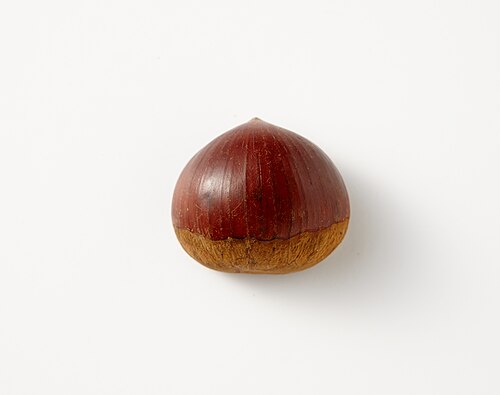 ثمرة الكستناء
 كستناء مقشرة
 زهرة ذكرية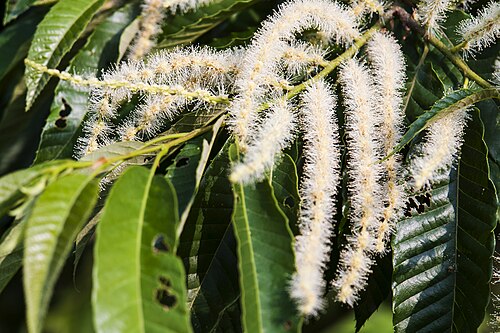

 انفتحت الصدفة بشكل طبيعي على الأرض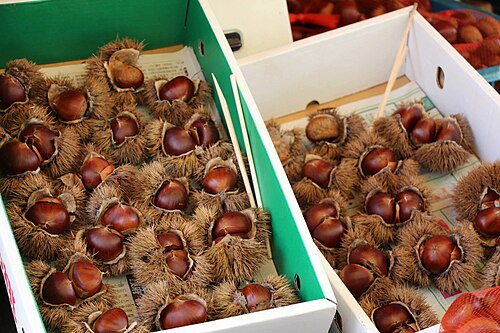
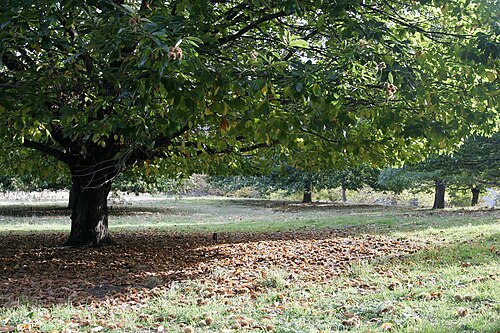 الأشجار
مراجع
- 1 2 بارستو، م. (2018). " كستناء كرينا " . القائمة الحمراء للأنواع المهددة بالانقراض التابعة للاتحاد الدولي لحفظ الطبيعة . 2018 e.T62004433A62004435. doi : 10.2305/IUCN.UK.2018-1.RLTS.T62004433A62004435.en . تاريخ الاسترجاع: 19 نوفمبر 2021 .
- ↑ "الكستناء الياباني - موسوعة الحياة" . eol.org .
- ↑ قائمة الجمعية النباتية البريطانية والأيرلندية لعام ٢٠٠٧ (ملف إكسل) . الجمعية النباتية البريطانية والأيرلندية . مؤرشفة من الأصل (ملف إكسل) بتاريخ ٢٦ يونيو ٢٠١٥. تم الاطلاع عليها بتاريخ ١٧ أكتوبر ٢٠١٤ .
- ↑ فالك، بن (2003). المزرعة والمسكن المرن: نهج مبتكر للزراعة المستدامة وتصميم الأنظمة المتكاملة . وايت ريفر جانكشن، فيرمونت: دار نشر تشيلسي غرين . ص 199. ISBN 978-1-60358-444-9فيما
يلي أنواع الكستناء التي يمكن زراعتها في المنطقة الرابعة، شمال شرق الولايات المتحدة: ... كستناء كرينا (الكستناء الكوري)
- ↑ سانتوس سي، نيلسون سي دي، زيبينتييفا تي، ماتشادو إتش، غوميز-لارانجو جيه، كوستا آر إل (2017). " أول خريطة ارتباط جيني بين الأنواع لـ Castanea sativa x Castanea crenata تكشف عن مواقع جينية كمية لمقاومة فطر Phytophthora cinnamomi " . PLOS ONE . 12 (9) e0184381. Bibcode : 2017PLoSO..1284381S . doi : 10.1371/journal.pone.0184381 . PMC 5589223. PMID 28880954 .
- ↑ كرادوك، ج. هيل؛ بيركنز، م. تايلور (2019). "تهجين الكستناء (Castanea spp. Miller)" (ملف PDF) . سبرينغر نيتشر سويسرا إيه جي 2019 : 105-156 .
- ↑ أصناف ميشيغان ( مؤرشفة بتاريخ 25 مايو 2013 في أرشيف الإنترنت، تم الاطلاع عليها في يونيو 2015)
- ↑Seiwa, K.; Watanabe, A.; Saitoh, T.; Kannu, H.; Akasaka, S. (2002-07-01). "Effects of burying depth and seed size on seedling establishment of Japanese chestnuts, Castanea crenata". Forest Ecology and Management. 164 (1): 149–156. doi:10.1016/S0378-1127(01)00607-7. ISSN 0378-1127.
- American Phytopathological Society: chestnut breeding
- IUCN Red List least concern species
- Castanea
- Trees of Japan
- Trees of Korea
- Least concern flora of Asia
- Edible nuts and seeds
- Plants described in 1846
- Taxa named by Philipp Franz von Siebold
- Taxa named by Joseph Gerhard Zuccarini