
Diatreme

A diatreme, sometimes known as a maar-diatreme volcano, is a volcanic pipe associated with a gaseous explosion. When magma rises up through a crack in Earth's crust and makes contact with a shallow body of groundwater, rapid expansion of heated water vapor and volcanic gases can cause a series of explosions. A relatively shallow crater (known as a maar) is left, and a rock-filled fracture (the actual diatreme) in the crust. Where diatremes breach the surface they produce a steep, inverted cone shape.
Etymology and geology
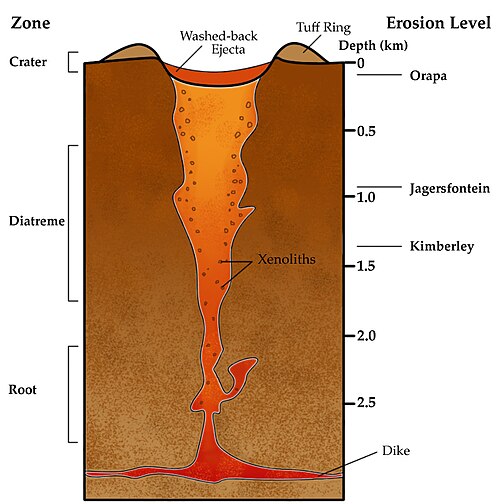
The word comes fromAncient Greekδία- (dia-) 'through, across, over'andτρῆμα (trêma) 'hole, aperture'. The term diatreme has been applied more generally to any concave body of broken rock formed by explosive or hydrostatic forces, whether or not it is related to volcanism. Even within volcanology, the term has been used more generally by some than others, and in kimberlite terminology continues to be contentious.[2] A current geological understanding is that diatreme describes the overall structure cut into the substrate (some have used the term “pipe” for this hence the common term volcanic pipe).[2] In a simple diatreme, the structure narrows fairly regularly with depth and eventually terminates in the dike (dyke), or part of a dike, that fed the eruption. The transition from diatreme to dike occurs in a “root zone” that is the lowest part of the diatreme structure, immediately above the dike, which comprises coherent igneous rock. Maar-diatreme volcanoes are volcanoes produced by explosive eruptions that cut deeply into the country rock, with the maar being "the crater cut into the ground and surrounded by an ejecta ring".[2]
Global distribution
تُعدّ البراكين المارية-الدياتريمية شائعة، إذ تُصنّف كثاني أكثر أنواع البراكين شيوعاً في القارات والجزر. قد يصعب تمييزها على السطح إذا كانت ضحلة وجافة أو متآكلة، وقد يصل عرضها إلى 3 كيلومترات (1.9 ميل) ، ولكنها غالباً ما تكون أصغر بكثير. [ 3 ] [ 4 ]
تتسبب الانفجارات النارية في تكوين الدياتريم فقط في البيئة المحددة التي توجد فيها المياه الجوفية؛ وبالتالي فإن معظم التداخلات النارية لا تنتج الدياتريم لأنها لا تصل إلى السطح لتصبح انفجارات، كما أنها لا تعترض كمية كبيرة من المياه الجوفية عندما تصبح انفجارات.
ومن أمثلة الدياتريمات دياتريم بلاكفوت ودياتريم كروس في كولومبيا البريطانية، كندا.
الأهمية الاقتصادية
ترتبط الفوهات البركانية أحيانًا بترسبات معدنية ذات أهمية اقتصادية، مثل صهارة الكيمبرلايت التي تنشأ في الوشاح العلوي . وعندما تتشكل الفوهة البركانية نتيجة لتداخل صهارة الكيمبرلايت، فمن المحتمل أن تُحمل معها الماسات إلى السطح، إذ تتشكل الماسات في الوشاح العلوي على أعماق تتراوح بين 150 و200 كيلومتر. وقد تحتوي صهارة الكيمبرلايت أحيانًا على قطع من الماس كشوائب صخرية ، مما يجعلها ذات أهمية اقتصادية.
مراجع
- ↑ ماكجيتشين، تي آر (1968). "سد صخرة موسى: جيولوجيا، وبترولوجيا، وطريقة وضع سد بريشيا حامل للكيمبرلايت، مقاطعة سان خوان، يوتا" . أطروحة دكتوراه . معهد كاليفورنيا للتكنولوجيا . تاريخ الاسترجاع: 14 يونيو 2019 .
- 1 2 3 وايت، جيه دي إل؛ روس، بي-إس. (2011). "براكين مار-دياتريم: مراجعة" (ملف PDF) . مجلة علم البراكين والبحوث الحرارية الأرضية . 201 ( 1-4 ): 1-29 . doi : 10.1016/j.jvolgeores.2011.01.010 . ISSN 0377-0273 .
- ↑ لورنز، ف. (أكتوبر 1986). "حول نمو الفوهات البركانية والأنابيب البركانية وأهميتها في تكوين حلقات التوف". نشرة علم البراكين . 48 (5): 265-274 . Bibcode : 1986BVol...48..265L . doi : 10.1007/BF01081755 . S2CID 128423499 .
- ^ لورينز ، فولكر (يناير 2007). “المخاطر الاصطناعية والمخاطر اللاحقة لبراكين مار-دياتريم”. مجلة أبحاث علم البراكين والطاقة الحرارية الأرضية . 159 ( 1 – 3): 285 – 312. بيب كود : 2007JVGR..159..285L . دوى : 10.1016/j.jvolgeores.2006.02.015 .
للمزيد من القراءة
- نماذج مواقع دفن الكيمبرلايت، مؤرشفة بتاريخ 18 فبراير 2014 في أرشيف الإنترنت (Wayback Machine).
- غانون، ميغان، أبحاث بركان مار-دياتريم قد تساعد الجيولوجيين على التنبؤ بالانفجارات البركانية والعثور على الماس، هافينغتون بوست، نُشر بتاريخ: 10/07/2012
- فوهات كيمبرلايت، هيئة المسح الجيولوجي في كولورادو، 17-10-2012
- لورنز، فولكر، براكين مار-دياتريم، تكوينها، وموقعها في بيئات الصخور الصلبة أو اللينة، جيولاينز، المجلد 15، 2003، الصفحات 72-83. مؤرشف بتاريخ 30 يناير 2012 في أرشيف الإنترنت (Wayback Machine).
روابط خارجية
- النشاط البركاني
- الانقباضات