
Gottorf Castle

Gottorf Castle (German: Schloss Gottorf, Danish: Gottorp Slot, Low German: Slott Gottorp) is a castle and estate in the city of Schleswig, Schleswig-Holstein, Germany. It is one of the most important secular buildings in Schleswig-Holstein, and has been rebuilt and expanded several times in its over eight hundred years of history, changing from a medieval castle to a Renaissance fortress to a Baroque palace.[1]
It is the ancestral home of the Holstein-Gottorp branch of the House of Oldenburg, from which emerged in the 18th century, among other things, four Swedish kings and several Russian Emperors. It is situated on an island in the Schlei, about 40 km from the Baltic Sea.
History


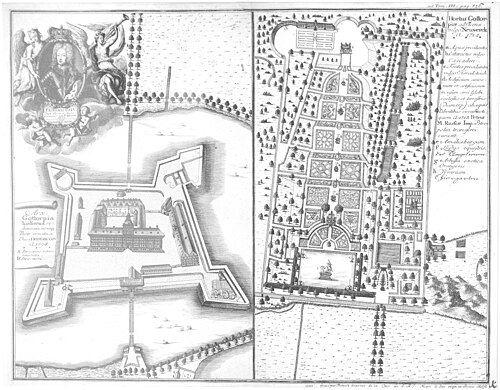
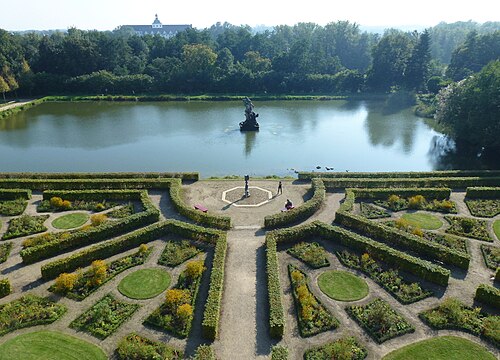
It was first settled as an estate in 1161 as the residence of Bishop Occo of Schleswig when his former residence was destroyed. The Danish Duke of Schleswig acquired it through a purchase in 1268, and in 1340 it was transferred to the Count of Holstein at Rendsburg of the House of Schauenburg. The manor later, through maternal inheritance, became the possession of Christian I of Denmark, the first Danish monarch from the House of Oldenburg, in 1459.
Both the island and the structure were extended through the years, and particularly during the 16th century. Frederick I, younger son of Christian I, made it his primary residence. In 1544 the duchies of Schleswig and Holstein were divided in three parts; Frederick's third son Adolf received one of these parts and made his residence at Gottorp. This state became known as the Duchy of Schleswig-Holstein-Gottorp.
The estate became a European cultural centre during the 1616–1659 reign of Frederick III, Duke of Holstein-Gottorp. The castle was built between 1697 and 1703 by the famous Swedish architect Nicodemus Tessin the Younger.
بعد إجبار سلالة دوق غوتورب على مغادرة القصر عام 1702، أصبح القصر، الذي كان يشغله الدنماركيون آنذاك، مهجورًا ومتداعيًا عام 1713 في عهد فريدريك الرابع ملك الدنمارك . ونُقلت قطع الأثاث والتحف الفنية وغيرها من محتويات القصر تدريجيًا، واستُخدمت المباني كثكنات عسكرية دنماركية وبروسية في القرن التاسع عشر.
خلال الحرب العالمية الثانية ، تم استخدام العقار كمخيم للنازحين .
منذ عام 1947، خضع القصر لعمليات ترميم وتجديد عبر سلسلة من المبادرات. واعتُبرت أعمال الترميم مكتملة في عام 1996. ويملك القصر الآن مؤسسة تابعة لولاية شليسفيغ هولشتاين، ويضم متحف الدولة للفنون والتاريخ الثقافي ومتحف الدولة للآثار.
انظر أيضاً
مراجع
- ^ ديهيو: Handbuch der Deutschen Kunstdenkmäler. هامبورغ، شليسفيغ هولشتاين، ص. 800. (نص ألماني)
روابط خارجية
54°30′42″ شمالاً 9°32′29″ شرقاً / 54.51167° شمالاً 9.54139° شرقاً / 54.51167; 9.54139
- بيت هولشتاين-غوتورب
- المتاحف والمعارض الفنية في ألمانيا
- مخيمات النازحين في أعقاب الحرب العالمية الثانية
- مؤسسات القرن الثاني عشر في الإمبراطورية الرومانية المقدسة
- 1161 منشأة في أوروبا
- تاريخ شليسفيغ هولشتاين
- قلاع في شليسفيغ هولشتاين
- متاحف في شليسفيغ هولشتاين
- حدائق في شليسفيغ هولشتاين
- المتاحف الأثرية في ألمانيا
- المباني والمنشآت في شليسفيغ-فلنسبورغ
- شليسفيغ، شليسفيغ هولشتاين