
Information model

An information model in software engineering is a representation of concepts and the relationships, constraints, rules, and operations to specify data semantics for a chosen domain of discourse. Typically it specifies relations between kinds of things, but may also include relations with individual things. It can provide sharable, stable, and organized structure of information requirements or knowledge for the domain context.[1]
Overview
The term information model in general is used for models of individual things, such as facilities, buildings, process plants, etc. In those cases, the concept is specialised to facility information model, building information model, plant information model, etc. Such an information model is an integration of a model of the facility with the data and documents about the facility.
Within the field of software engineering and data modeling, an information model is usually an abstract, formal representation of entity types that may include their properties, relationships and the operations that can be performed on them. The entity types in the model may be kinds of real-world objects, such as devices in a network, or occurrences, or they may themselves be abstract, such as for the entities used in a billing system. Typically, they are used to model a constrained domain that can be described by a closed set of entity types, properties, relationships and operations.
An information model provides formalism to the description of a problem domain without constraining how that description is mapped to an actual implementation in software. There may be many mappings of the information model. Such mappings are called data models, irrespective of whether they are object models (e.g. using UML), entity relationship models or XML schemas.
Information modeling languages
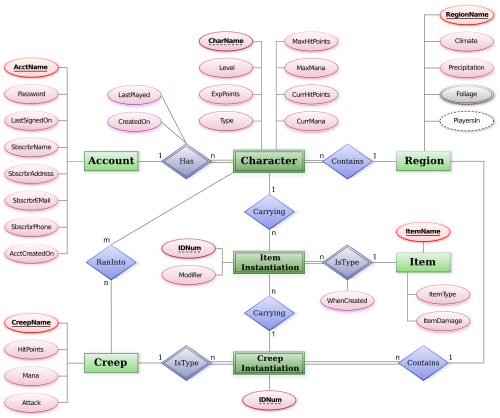

في عام 1976، قدّم بيتر تشين تدوينًا بيانيًا للعلاقات بين الكيانات (ER) . وأكد أنه أسلوب نمذجة "دلالي" ومستقل عن أي من أساليب نمذجة قواعد البيانات، مثل الهرمية، وCODASYL، والعلائقية، وغيرها. [ 2 ] ومنذ ذلك الحين، استمرت لغات نماذج المعلومات في التطور. ومن الأمثلة على ذلك لغة التعريف المتكاملة 1 الموسعة ( IDEF1X )، ولغة EXPRESS ، ولغة النمذجة الموحدة (UML). [ 1 ]
أدت أبحاث معاصري بيتر تشين، مثل جيه آر أبريال (1974) وجي إم نايسن (1976)، إلى ظهور لغات نمذجة الحقائق (FOM) الحالية، والتي تعتمد على القضايا اللغوية بدلاً من "الكيانات". يمكن استخدام أدوات FOM لإنشاء نموذج علاقات الكيانات (ER)، مما يُمكّن مصمم النموذج من تجنب عملية التطبيع اليدوي المُستهلكة للوقت والمعرضة للأخطاء. وتُعد لغة نمذجة أدوار الكائنات ( ORM ) ونمذجة المعلومات الموجهة بالكامل نحو الاتصال ( FCO-IM ) نتاجًا لأبحاث طُوّرت في أوائل التسعينيات، استنادًا إلى أبحاث سابقة.
في ثمانينيات القرن العشرين، ظهرت عدة مناهج لتوسيع نموذج تشين للعلاقات بين الكيانات. ومن بين المناهج المهمة الأخرى في هذا العقد نموذج ريمورا لكوليت رولاند . [ 3 ]
طُوِّرت لغة تعريف ICAM (IDEF) من برنامج ICAM التابع لسلاح الجو الأمريكي خلال الفترة من 1976 إلى 1982. [ 4 ] كان هدف برنامج ICAM، وفقًا للي (1999)، هو زيادة إنتاجية التصنيع من خلال التطبيق المنهجي لتكنولوجيا الحاسوب. تتضمن IDEF ثلاث طرق نمذجة مختلفة: IDEF0 و IDEF1 و IDEF2 لإنتاج نموذج وظيفي، ونموذج معلومات، ونموذج ديناميكي على التوالي. تُعد IDEF1X نسخة موسعة من IDEF1. اللغة متاحة للجميع. وهي تمثيل رسومي مصمم باستخدام منهجية ER ونظرية العلاقات. تُستخدم لتمثيل "العالم الحقيقي" من حيث الكيانات والخصائص والعلاقات بينها. يتم فرض التطبيع من خلال هياكل المفاتيح وترحيل المفاتيح. تُحدد اللغة مجموعات الخصائص (التجميع) لتشكيل تعريفات كاملة للكيانات. [ 1 ]
تم ابتكار لغة EXPRESS وفقًا لمعيار ISO 10303-11 لتحديد متطلبات المعلومات لنموذج بيانات المنتج بشكل رسمي. وهي جزء من مجموعة معايير تُعرف بشكل غير رسمي باسم معيار تبادل بيانات نموذج المنتج (STEP). وقد طُرحت لأول مرة في أوائل التسعينيات. [ 5 ] [ 6 ] ووفقًا للي (1999)، فإن اللغة عبارة عن تمثيل نصي. بالإضافة إلى ذلك، تتوفر مجموعة فرعية رسومية من EXPRESS تُسمى EXPRESS-G. تعتمد EXPRESS على لغات البرمجة ونموذج البرمجة الكائنية. وقد ساهمت عدة لغات في تطوير EXPRESS، ولا سيما Ada وAlgol وC وC++ وEuler وModula-2 وPascal وPL/1 وSQL. تتكون EXPRESS من عناصر لغوية تسمح بتعريف الكائنات وتحديد القيود المفروضة عليها بشكل واضح. وتستخدم تعريف SCHEMA لتوفير التقسيم، كما تدعم تحديد خصائص البيانات والقيود والعمليات. [ 1 ]
لغة النمذجة الموحدة (UML) هي لغة نمذجة لتحديد وتصوير وبناء وتوثيق مكونات أنظمة البرمجيات، بدلاً من عملياتها. وقد ابتكرها في الأصل كل من جرادي بوتش وجيمس رامبو وإيفار جاكوبسون . اعتمدت مجموعة إدارة الكائنات (OMG) لغة UML كمعيار في عام 1997. ووفقًا للي (1999)، فإن هذه اللغة غير احتكارية ومتاحة للجميع. وهي تمثيل رسومي. وتستند اللغة إلى نموذج البرمجة الكائنية التوجه. تحتوي UML على رموز وقواعد، وهي مصممة لتمثيل متطلبات البيانات باستخدام مخططات البرمجة الكائنية التوجه. تنظم UML النموذج في عدد من العروض التي تُظهر جوانب مختلفة من النظام. ويتم وصف محتويات كل عرض في مخططات عبارة عن رسوم بيانية تحتوي على عناصر النموذج. يحتوي المخطط على عناصر نموذج تمثل مفاهيم البرمجة الكائنية التوجه الشائعة، مثل الفئات والكائنات والرسائل والعلاقات بين هذه المفاهيم. [ 1 ]
يمكن استخدام كل من IDEF1X وEXPRESS وUML لإنشاء نموذج مفاهيمي، ولكل منها، وفقًا للي (1999)، خصائصها المميزة. ورغم أن بعضها قد يُسهّل الاستخدام الطبيعي (مثل التنفيذ)، إلا أن إحداها ليست بالضرورة أفضل من الأخرى. عمليًا، قد يتطلب تطوير جميع نماذج المعلومات استخدام أكثر من لغة واحدة عندما يكون التطبيق معقدًا. في الواقع، غالبًا ما تكون ممارسة النمذجة أهم من اللغة المختارة. [ 1 ]
Information models can also be expressed in formalized natural languages, such as Gellish. Gellish, which has natural language variants Gellish Formal English, Gellish Formal Dutch (Gellish Formeel Nederlands), etc. is an information representation language or modeling language that is defined in the Gellish smart Dictionary-Taxonomy, which has the form of a Taxonomy/Ontology. A Gellish Database is not only suitable to store information models, but also knowledge models, requirements models and dictionaries, taxonomies and ontologies. Information models in Gellish English use Gellish Formal English expressions. For example, a geographic information model might consist of a number of Gellish Formal English expressions, such as:
- the Eiffel tower <is located in> Paris - Paris <is classified as a> city
whereas information requirements and knowledge can be expressed for example as follows:
- tower <shall be located in a> geographical area - city <is a kind of> geographical area
Such Gellish expressions use names of concepts (such as 'city') and relation types (such as ⟨is located in⟩ and ⟨is classified as a⟩) that should be selected from the Gellish Formal English Dictionary-Taxonomy (or of your own domain dictionary). The Gellish English Dictionary-Taxonomy enables the creation of semantically rich information models, because the dictionary contains definitions of more than 40000 concepts, including more than 600 standard relation types. Thus, an information model in Gellish consists of a collection of Gellish expressions that use those phrases and dictionary concepts to express facts or make statements, queries and answers.
Standard sets of information models
The Distributed Management Task Force (DMTF) provides a standard set of information models for various enterprise domains under the general title of the Common Information Model (CIM). Specific information models are derived from CIM for particular management domains.
The TeleManagement Forum (TMF) has defined an advanced model for the Telecommunication domain (the Shared Information/Data model, or SID) as another. This includes views from the business, service and resource domains within the Telecommunication industry. The TMF has established a set of principles that an OSS integration should adopt, along with a set of models that provide standardized approaches.
The models interact with the information model (the Shared Information/Data Model, or SID), via a process model (the Business Process Framework (eTOM), or eTOM) and a life cycle model.
See also
Notes
- 123456Y. Tina Lee (1999). "Information modeling from design to implementation" National Institute of Standards and Technology.
- ↑Peter Chen (1976). "The Entity-Relationship Model - Towards a Unified View of Data". In: ACM Transactions on database Systems, Vol. 1, No.1, March, 1976.
- ↑The history of conceptual modelingArchived 2012-02-15 at the Wayback Machine at uni-klu.ac.at.
- ↑D. Appleton Company, Inc. (1985). "Integrated Information Support System: Information Modeling Manual, IDEF1 - Extended (IDEF1X)". ICAM Project Priority 6201, Subcontract #013-078846, USAF Prime Contract #F33615-80-C-5155, Wright-Patterson Air Force Base, Ohio, December, 1985.
- ↑ISO 10303-11:1994(E), Industrial Automation Systems and Integration - Product Data Representation and Exchange - Part 11: The EXPRESS Language Reference Manual.
- ↑D. Schenck and P. Wilson (1994). Information Modeling the EXPRESS Way. Oxford University Press, New York, NY, 1994.
References
- ISO/IEC TR9007 Conceptual Schema, 1986
- Andries van Renssen, Gellish, A Generic Extensible Ontological Language, (PhD, Delft University of Technology, 2005)
 This article incorporates public domain material from theNational Institute of Standards and Technology
Further reading
- Richard Veryard (1992). Information modelling : practical guidance. New York : Prentice Hall.
- Repa, Vaclav (2012). Information Modeling of Organizations. Bruckner Publishing. ISBN 978-80-904661-3-5.
- Berner, Stefan (2019). Information modelling, A method for improving understanding and accuracy in your collaboration. vdf Zurich. ISBN 978-3-7281-3943-6.
External links
- RFC 3198 – Terminology for Policy-Based Management
- Data modeling
- Information technology management