
Pulse dialing
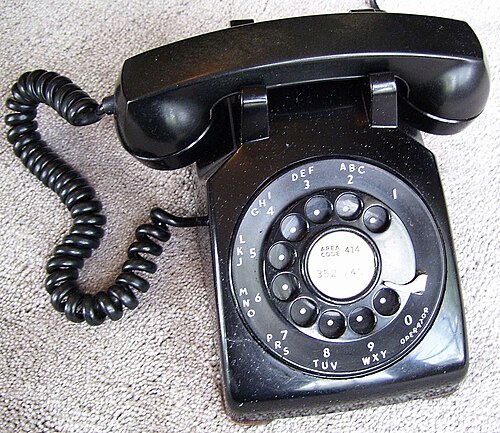
Pulse dialing is a signaling technology in telecommunications in which the direct current flowing in the telephone local loop circuit is interrupted in a pattern according to a coding system for each signal (digit) transmitted. This lends the technology the name loop disconnect signaling. In the most common variant of pulse dialing, decadic dialing[1], each of the ten Arabic numerals is encoded in a sequence of up to ten current pulses. The most common version decodes the digits 1 through 9 as one to nine pulses, respectively, and the digit 0 as ten pulses. Historically, the most common device to produce such pulse trains is the rotary dial of the telephone, lending the technology another name: rotary dialing[2].
The pulse repetition rate was historically determined based on the response time needed for electromechanical switching systems to operate reliably. Most telephone systems used the nominal rate of ten pulses per second, but operator dialing within and between central offices often used pulse rates up to twenty per second.
Early automatic exchanges
Automatic telephone exchange systems were developed in the late 19th and early 20th century. Telephone subscribers were assigned a telephone number unique to each circuit or telephone. Various methods evolved to signal the desired destination telephone number for each telephone call directly dialed by the subscriber. An automatic switch-hook was designed by Hilborne Roosevelt.[3]
The first commercial automatic telephone exchange, designed by Almon Brown Strowger, opened in La Porte, Indiana on 3 November 1892 and used two telegraph-type keys on the telephone, which had to be operated the correct number of times to control the vertical and horizontal relay magnets in the exchange. But the use of separate keys with separate conductors to the exchange was not practical. The most common signaling system became a system of using direct-current pulse trains generated in the telephone sets of subscribers by interrupting the single-pair wire loop of the telephone circuit.
Rotary dial
The first rotary dials worked by creating current interruptions on two separate direct-current circuits (three-wire system) to actuate stepping motors in a vertical and horizontal (rotational) switch arrangement. Operating the dial error-free required smooth rotary motion of the finger wheel by the user, but was found to be too unreliable. Later dials after c.1907 produced just a single pulse train on a 2-wire circuit as the user rotated the dial to the finger stop, starting at a different position for each digit transmitted. This mechanism was refined to include a recoil spring and a centrifugal governor to control the recoil speed. The user selected a digit to be dialed by inserting a finger into the corresponding hole and rotated the dial to the finger stop. When released from this position, the dial pulsing contacts were opened and closed repeatedly, thus interrupting the loop current in a pattern on the return to the home position. The exchange switch decoded the pattern for each digit, thus transmitted by stepping relays or by accumulation in digit registers.
Pulse rate and coding

The mechanical nature of the stepping switches or relays employed at the switching system generally limited the speed of operation – the pulsing rate – to ten pulses per second.
The specifications of the Bell System in the US required service personnel to adjust dials in customer stations to a precision of 9.5 to 10.5 pulses per second (PPS), but the tolerance of the switching equipment was generally between 8 and 11 PPS.[4] The British (GPO, later Post Office Telecommunications) standard for Strowger switch exchanges has been 10 impulses per second (allowable range 7 to 12) and a 66% break ratio (allowable range 63% to 72%).[5][6]

In most switching systems, one pulse is used for the digit 1, two pulses for 2, and so on, with ten pulses for the digit 0; this makes the code unary, excepting the digit 0. Exceptions to this are Sweden, with one pulse for 0, two pulses for 1, and so on, and New Zealand, with ten pulses for 0, nine pulses for 1, etc. Oslo, the capital city of Norway, used the New Zealand system, but the rest of the country did not. Systems that used this encoding of the ten digits in a sequence of up to ten pulses are known as decadic dialing systems.
استخدمت بعض أنظمة التبديل سجلات رقمية ضاعفت معدل النبضات المسموح به إلى عشرين نبضة في الثانية، مما سمح بتقليل فترة التوقف بين الأرقام، حيث لم يكن من الضروري إكمال اختيار المفتاح خلال هذه الفترة. وشملت هذه الأنظمة خطوط الوصول إلى مفتاح اللوحة في عشرينيات القرن الماضي، وأنظمة المصفوفة المتقاطعة، والإصدار الأحدث (7A2) من النظام الدوار ، ومبادلات التحكم بالبرنامج المخزن في أوائل سبعينيات القرن الماضي .
في بعض الهواتف، قد تُسمع النبضات في السماعة على شكل أصوات نقر. ومع ذلك، بشكل عام، كانت هذه التأثيرات غير مرغوب فيها، وقد قام مصممو الهواتف بكبحها باستخدام مفاتيح إيقاف التشغيل على القرص لاستبعاد السماعة من الدائرة، أو قاموا بتخفيفها بشكل كبير بوسائل كهربائية باستخدام مقاوم متغير موصول عبر السماعة.
الخلفاء
أُدرك منذ عشرينيات القرن العشرين أن الأزرار الضاغطة أسرع من الأقراص الدوارة، وذلك عندما استخدمت لوحات المفاتيح الأولى مفاتيح للاتصال في محطات المشغلين. وفي أربعينيات القرن العشرين، أجرت مختبرات بيل تجارب ميدانية على هواتف الأزرار الضاغطة للاتصال بالعملاء لتحديد دقتها وكفاءتها. إلا أن تقنية استخدام المرحلات الميكانيكية ذات الصمامات المغناطيسية كانت غير موثوقة بما يكفي حتى أحدثت الترانزستورات ثورة في هذا المجال. وفي عام 1963، قدمت شركة بيل سيستم للجمهور تقنية النغمات المزدوجة متعددة الترددات (DTMF) تحت اسم "تاتش تون"، والتي كانت علامة تجارية مسجلة في الولايات المتحدة حتى عام 1984. [ 7 ] استخدم نظام تاتش تون هواتف الأزرار الضاغطة . وفي العقود التي تلت عام 1963، تم الاستغناء تدريجيًا عن الأقراص الدوارة في طرازات الهواتف الجديدة لصالح لوحات المفاتيح، وأصبحت طريقة الاتصال الرئيسية بالمركز المركزي هي الاتصال عبر نظام تاتش تون. ولا تزال معظم أنظمة المراكز المركزية تدعم الهواتف الدوارة حتى اليوم. تحتوي بعض الهواتف ذات لوحة المفاتيح على مفتاح أو طريقة تهيئة لاختيار نغمة أو نبضة الاتصال.
تستخدم الهواتف المحمولة ومعظم أنظمة الصوت عبر بروتوكول الإنترنت (VoIP) إشارات خارج النطاق ، ولا ترسل أي أرقام حتى يُدخل المستخدم الرقم بالكامل. وتعتمد العديد من أنظمة VoIP على بروتوكول بدء الجلسة (SIP)، الذي يستخدم شكلاً من أشكال مُعرّفات الموارد الموحدة (URI) للعنونة، بدلاً من الأرقام وحدها.
الاتصال عبر خطاف التبديل
بما أن الاتصال النبضي يتم عن طريق قطع الدائرة المحلية ، فقد كان من الممكن طلب الأرقام بالنقر السريع، أي الضغط على زر القفل، بالعدد المطلوب من المرات بمعدل عشر نقرات تقريبًا في الثانية. [ 8 ] ومع ذلك، قام العديد من مصنعي الهواتف بتطبيق آلية تحرير بطيئة لزر القفل لمنع التبديل السريع.
In the United Kingdom, it was once possible to make calls from coin-box phones by tapping the switch hook without depositing coins. Unlawfully obtaining a free telephone call was deemed a criminal offence, abstracting electricity[9] from the General Post Office, which operated the telephone system, and several cases were prosecuted.
In popular culture, tapping is shown in the film Red Dragon, when prisoner Hannibal Lecter dials out on a telephone without a dialing mechanism. The technique is also used by the character Phantom Phreak in the film Hackers.
References
- ↑https://www.vintagephones.com.au/ccp0-display/difference-between-decadic-tone-dialling.html
- ↑https://theoldtimey.com/rotary-phones/
- ↑Isa Carrington Cabell (1900). . Appletons' Cyclopædia of American Biography.
- ↑AT&T Specification No. 4566, February 1926, p. 113.
- ↑J. Atkinson, Telephony, vol. 1, p. 142 (1948, Pitman, London).
- ↑Current UK standard BT SIN 351. Archived 2016-08-04 at the Wayback Machine.
- ↑The Trademark Electronic Search System on the U.S. Patent and Trademark Officeweb site shows the trademark with serial number 72109459, registered 1962-09-04 and cancelled 1984-03-13.
- ↑The Jolly Roger (2000). "147.Phone Dial Locks -- How to Beat'em". Anarchy Cookbook version 2000(PDF). Archived from the original(PDF) on 2022-03-07.
- ↑"Abstracting electricity". Oxford Reference. Retrieved 6 October 2020.
 This article incorporates public domain material from Federal Standard 1037C. General Services Administration. Archived from the original on 2022-01-22.
- Obsolete technologies
- Telephony signals