
BICEP و Keck Array
يُعدّ مشروع BICEP ( التصوير الخلفي للاستقطاب الكوني خارج المجرة ) ومصفوفة كيك سلسلة من التجارب لدراسة إشعاع الخلفية الكونية الميكروي (CMB) ، وقد نُشرت بالقرب من القطب الجنوبي . وهي عبارة عن تلسكوبات مبردة مزودة بمصفوفات من الكواشف الحساسة لترددات متعددة من إشعاع الميكروويف . تهدف هذه التجارب إلى قياس استقطاب إشعاع الخلفية الكونية الميكروي، وذلك بهدف رصد إشارات من موجات الجاذبية البدائية التي تنبأت بها نماذج "التضخم البطيء" للتضخم الكوني . وحتى عام 2025، لم يتم رصد الاستقطاب ذي الصلة من موجات الجاذبية البدائية.
شهدت التجارب خمسة أجيال من الأجهزة، تتألف من BICEP1 (أو BICEP اختصارًا )، و BICEP2 ، ومصفوفة كيك ، و BICEP3 ، ومصفوفة BICEP . جمع BICEP1 البيانات من عام 2006 إلى عام 2008، بينما رصد BICEP2 البيانات من عام 2010 إلى عام 2012. بدأت مصفوفة كيك، المكونة من خمسة تلسكوبات، عمليات الرصد في عام 2012، وأصبح BICEP3 يعمل بكامل طاقته منذ مايو 2016. يجري حاليًا بناء مصفوفة BICEP المكونة من أربعة تلسكوبات؛ بدأ أول تلسكوب فيها بجمع البيانات في عام 2019، والثاني في عام 2022. [ 1 ]
الهدف والتعاون

تهدف تجارب BICEP إلى قياس استقطاب إشعاع الخلفية الكونية الميكروي. [ 6 ] وتحديدًا، تسعى هذه التجارب إلى قياس أنماط B ( المكون الحلزوني ) لاستقطاب إشعاع الخلفية الكونية الميكروي. [ 7 ] تعمل BICEP من القارة القطبية الجنوبية ، في محطة أموندسن-سكوت للقطب الجنوبي . [ 6 ] وقد قامت الأجهزة الثلاثة برسم خريطة لنفس الجزء من السماء، حول القطب السماوي الجنوبي . [ 6 ] [ 8 ]
The institutions involved in the various instruments are Caltech, Cardiff University, University of Chicago, Center for Astrophysics | Harvard & Smithsonian, Jet Propulsion Laboratory, CEA Grenoble (FR), University of Minnesota and Stanford University (all experiments); UC San Diego (BICEP1 and 2); National Institute of Standards and Technology (NIST), University of British Columbia and University of Toronto (BICEP2, Keck Array and BICEP3); and Case Western Reserve University (Keck Array).[7][9][10][11][12]
The series of experiments began at the California Institute of Technology in 2002. In collaboration with the Jet Propulsion Laboratory, physicists Andrew Lange, Jamie Bock, Brian Keating, and William Holzapfel began the construction of the BICEP1 telescope which deployed to the Amundsen-Scott South Pole Station in 2005 for a three-season observing run.[13] Immediately after deployment of BICEP1, the team, which now included Caltech postdoctoral fellows John Kovac and Chao-Lin Kuo, among others, began work on BICEP2. The telescope remained the same, but new detectors were inserted into BICEP2 using a completely different technology: a printed circuit board on the focal plane that could filter, process, image, and measure radiation from the cosmic microwave background. BICEP2 was deployed to the South Pole in 2009 to begin its three-season observing run which yielded the detection of B-mode polarization in the cosmic microwave background.
| Instrument | Start | End | Frequency | Resolution | Sensors (pixels) | Refs |
|---|---|---|---|---|---|---|
| BICEP | 2006 | 2008 | 100 GHz | 0.93° | 50 (25) | [6][7] |
| 150 GHz | 0.60° | 48 (24) | [6] | |||
| BICEP2 | 2010 | 2012 | 150 GHz | 0.52° | 500 (250) | [14] |
| Keck Array | 2011 | 2011 | 150 GHz | 0.52° | 1488 (744) | [8][15] |
| 2012 | 2012 | 2480 (1240) | ||||
| 2013 | 2018 | 1488 (744) | [15] | |||
| 95 GHz | 0.7° | 992 (496) | ||||
| BICEP3 | 2015 | — | 95 GHz | 0.35° | 2560 (1280) | [16] |
BICEP1
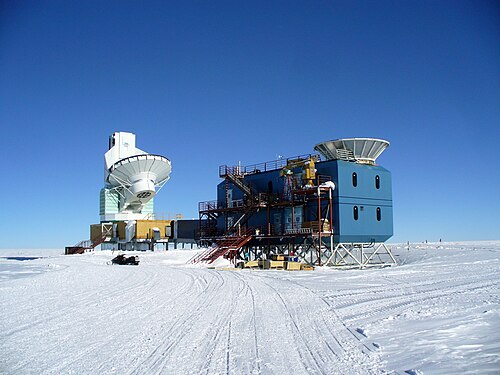
The first BICEP instrument (known during development as the "Robinson gravitational wave background telescope" and later as "BICEP1") was installed on top of the Dark Sector Laboratory, right next to the South Pole Telescope in the "dark sector", where electromagnetic noise is minimized. It is located about 1 kilometer from the main South Pole Station.
The instrument, a prototype for future instruments, was first described in Keating et al. 2003,[17] started observing in January 2006[7] and ran until the end of 2008.[6]
It observed the sky at 100 and 150 GHz (3 mm and 2 mm wavelength) with an angular resolution of 1.0 and 0.7 degrees. It had an array of 98 detectors (50 at 100 GHz and 48 at 150 GHz), which were sensitive to the polarisation of the CMB.[6] A pair of detectors constitutes one polarization-sensitive pixel.
BICEP2
The second-generation instrument was BICEP2.[18] Featuring a greatly improved focal-plane transition edge sensor (TES) bolometer array of 512 sensors (256 pixels) operating at 150 GHz, this 26 cm aperture telescope replaced the BICEP1 instrument, and observed from 2010 to 2012.[14][19]
Reports stated in March 2014 that BICEP2 had detected B-modes from gravitational waves in the early universe (called primordial gravitational waves), a result reported by the four co-principal investigators of BICEP2: John M. Kovac of the Center for Astrophysics | Harvard & Smithsonian; Chao-Lin Kuo of Stanford University; Jamie Bock of the California Institute of Technology; and Clem Pryke of the University of Minnesota. An announcement was made on 17 March 2014 from the Center for Astrophysics | Harvard & Smithsonian.[2][3][4][5][20] The reported detection was of B-modes at the level of r = 0.20 +0.07 −0.05 ، مما يُضعف الفرضية الصفرية ( r = 0 ) عند مستوى 7 سيجما (5.9 σ بعد طرح المقدمة). [ 14 ]
مع ذلك، في 19 يونيو 2014، أُبلغ عن انخفاض في مستوى الثقة في تأكيد نتائج التضخم الكوني ؛ [ 21 ] [ 22 ] إذ تحتوي النسخة المقبولة والمراجعة من ورقة الاكتشاف على ملحق يناقش إمكانية إنتاج الإشارة بواسطة الغبار الكوني . [ 14 ] ونظرًا جزئيًا للقيمة الكبيرة لنسبة الموتر إلى الكمية القياسية، والتي تتعارض مع حدود بيانات بلانك ، [ 23 ] يعتبر العديد من العلماء هذا التفسير الأكثر ترجيحًا للإشارة المكتشفة. على سبيل المثال، في 5 يونيو 2014، في مؤتمر للجمعية الفلكية الأمريكية ، جادل عالم الفلك ديفيد سبيرجل بأن استقطاب النمط B الذي رصده مرصد BICEP2 قد يكون ناتجًا عن ضوء منبعث من الغبار بين النجوم في مجرتنا درب التبانة . [ 24 ]
قدمت دراسة أولية نشرها فريق بلانك في سبتمبر 2014، وقُبلت نهائيًا في عام 2016، أدق قياس للغبار حتى ذلك الحين، وخلصت إلى أن إشارة الغبار لها نفس قوة الإشارة التي رصدها مرصد BICEP2. [ 25 ] [ 26 ] وفي 30 يناير 2015، نُشر تحليل مشترك لبيانات BICEP2 وبلانك ، وأعلنت وكالة الفضاء الأوروبية أن الإشارة تُعزى بالكامل إلى الغبار في مجرة درب التبانة. [ 27 ]
قام مشروع BICEP2 بدمج بياناته مع بيانات مصفوفة كيك وبلانك في تحليل مشترك. [ 28 ] وقد حددت دراسة نُشرت في مارس 2015 في مجلة Physical Review Letters حدًا لنسبة الموتر إلى الكمية القياسية عند r < 0.12 .
تشكل قضية BICEP2 موضوع كتاب من تأليف برايان كيتينغ .

مصفوفة كيك
Immediately next to the BICEP telescope at the Martin A. Pomerantz Observatory building was an unused telescope mount previously occupied by the Degree Angular Scale Interferometer.[29] The Keck Array was built to take advantage of this larger telescope mount. This project was funded by $2.3 million from W. M. Keck Foundation, as well as funding from the National Science Foundation, the Gordon and Betty Moore Foundation, the James and Nelly Kilroy Foundation and the Barzan Foundation.[7] The Keck Array project was originally led by Andrew Lange.[7]
The Keck Array consists of five polarimeters, each very similar to the BICEP2 design, but using a pulse tube refrigerator rather than a large liquid helium cryogenic storage dewar.
The first three started observations in the austral summer of 2010–11; another two started observing in 2012. All of the receivers observed at 150 GHz until 2013, when two of them were converted to observe at 100 GHz.[15] Each polarimeter consists of a refracting telescope (to minimise systematics) cooled by a pulse tube cooler to 4 K, and a focal-plane array of 512 transition edge sensors cooled to 250 mK, giving a total of 2560 detectors, or 1280 dual-polarization pixels.[8]
In October 2018, the first results from the Keck Array (combined with BICEP2 data) were announced, using observations up to and including the 2015 season. These yielded an upper limit on cosmological B-modes of (95% confidence level), which reduces to in combination with Planck data.[30]


In October 2021, new results were announced giving (at 95% confidence level) based on BICEP/Keck 2018 observation season combined with Planck and WMAP data.[31][32]

BICEP3
Once the Keck array was completed in 2012, it was no longer cost-effective to continue to operate BICEP2. However, using the same technique as the Keck array to eliminate the large liquid helium dewar, a much larger telescope has been installed on the original BICEP telescope mount.
BICEP3 consists of a single telescope with the same 2560 detectors (observing at 95 GHz) as the five-telescope Keck array, but a 68 cm aperture,[33] providing roughly twice the optical throughput of the entire Keck array. One consequence of the large focal plane is a larger 28° field of view,[34] which will necessarily mean scanning some foreground-contaminated portions of the sky. It was installed (with initial configuration) at the pole in January 2015.[16][35] It was upgraded for the 2015-2016 Austral summer season to a full 2560 detector configuration. BICEP3 is also a prototype for the BICEP Array.[36]
BICEP Array
The Keck array is being succeeded by the BICEP array, which consists of four BICEP3-like telescopes on a common mount, operating at 30/40, 95, 150 and 220/270 GHz.[37] Installation began between the 2017 and 2018 observing seasons. It was originally scheduled to be fully installed by the 2020 observing season.[38][39]
According to the project website: "BICEP Array will measure the polarized sky in five frequency bands to reach an ultimate sensitivity to the amplitude of IGW [inflationary gravitational waves] of σ(r) < 0.005" and "This measurement will be a definitive test of slow-roll models of inflation, which generally predict a gravitational-wave signal above approximately 0.01."[38]
The first telescope of the BICEP Array, termed BA1, has been collecting data at 30/40 GHz since 2019/2020. The second one, BA2, operating at 150GHz, was deployed in 2022/2023.[31]
See also
- Cosmology
- Inflation (cosmology)
- Atacama Cosmology Telescope
- South Pole Telescope
- Cosmology Large Angular Scale Surveyor
- POLARBEAR
- LiteBIRD, space-based CMB B-mode polarization search project
- Spider, balloon-based CMB B-mode polarization project
References
- ↑Schillaci, Alessandro; Ade, P. A. R.; Ahmed, Z.; Amiri, M.; Barkats, D.; Basu Thakur, R.; Bischoff, C. A.; Beck, D.; Bock, J. J.; Buza, V.; Cheshire, J.; Connors, J.; Cornelison, J.; Crumrine, M.; Cukierman, A. (2023-12-01). "BICEP Array: 150 GHz Detector Module Development". Journal of Low Temperature Physics. 213 (5): 317–326. arXiv:2111.14785. Bibcode:2023JLTP..213..317S. doi:10.1007/s10909-023-03005-w.
- 12Staff (17 March 2014). "BICEP2 2014 Results Release". National Science Foundation. Retrieved 18 March 2014.
- 12Clavin, W. (17 March 2014). "NASA Technology Views Birth of the Universe". NASA. Retrieved 17 March 2014.
- 12Overbye, D. (17 March 2014). "Detection of Waves in Space Buttresses Landmark Theory of Big Bang". The New York Times. Retrieved 17 March 2014.
- 12Overbye, D. (24 March 2014). "Ripples From the Big Bang". The New York Times. Retrieved 24 March 2014.
- 1234567"BICEP: Robinson Gravitational Wave Background Telescope". Caltech. Retrieved 2022-10-07.
- 123456"W.M. Keck Foundation Gift to Enable Caltech and JPL Scientists to Research the Universe's Violent Origin". Caltech. Archived from the original on 2012-03-02.
- 123"Instrument – Keck Array South Pole". Harvard–Smithsonian Center for Astrophysics. Retrieved 2014-03-14.
- ↑"BICEP1 Collaboration". Harvard–Smithsonian Center for Astrophysics. Retrieved 2014-03-14.
- ↑"Collaboration – BICEP2 South Pole". Harvard–Smithsonian Center for Astrophysics. Retrieved 2014-03-14.
- ↑"Collaboration – Keck Array South Pole". Harvard–Smithsonian Center for Astrophysics. Retrieved 2014-03-14.
- ↑"BICEP3 Collaboration". Harvard–Smithsonian Center for Astrophysics. Retrieved 2014-03-14.
- ↑"NSF Award Abstract #0230438". National Science Foundation. Retrieved 2014-03-26.
- 1 2 3 4 بيتر آر أدي؛ آر دبليو أيكين . دينيس بركاتس؛ وآخرون . (تعاون BICEP2) (19 يونيو 2014). “الكشف عن استقطاب الوضع B عند المقاييس الزاويّة للدرجات بواسطة BICEP2”. رسائل المراجعة البدنية . 112 (24) 241101. أرخايف : 1403.3985 . دوى : 10.1103/PHYSREVLETT.112.241101 . ISSN 0031-9007 . بميد 24996078 . ويكي بيانات Q27012172 .
- 1 2 3 "مصفوفة كيك القطب الجنوبي" . مركز هارفارد-سميثسونيان للفيزياء الفلكية . تم الاطلاع عليه بتاريخ 14-03-2014 .
- 1 2 "BICEP3" . مركز هارفارد-سميثسونيان للفيزياء الفلكية . تم الاسترجاع في 14-03-2014 .
- ↑ كيتينغ، برايان؛ وآخرون (2003). "BICEP: مقياس استقطاب واسع النطاق لإشعاع الخلفية الكونية الميكروي" (ملف PDF) . في: فينيسكي، سيلفانو (محرر). الاستقطاب في علم الفلك . وقائع SPIE . المجلد 4843. الصفحات 284-295 . Bibcode : 2003SPIE.4843..284K . doi : 10.1117/12.459274 . S2CID 122838031 .
- ↑ أوغبورن، ر. و . وآخرون (2010). "تجربة استقطاب إشعاع الخلفية الكونية الميكروي BICEP2" . في: هولاند، واين س.؛ زمويدزيناس، جوناس (محرران). أجهزة الكشف والقياسات في نطاق الموجات المليمترية ودون المليمترية والأشعة تحت الحمراء البعيدة لعلم الفلك، المجلد الخامس . وقائع SPIE . المجلد 7741. ص 77411G. رمز Bibcode : 2010SPIE.7741E..1GO . doi : 10.1117/12.857864 . S2CID 29118984 .
- ↑ آدي، بار؛ وآخرون (2014). "BICEP2. II. التجربة ومجموعة بيانات ثلاث سنوات". المجلة الفيزيائية الفلكية . 792 (1): 62. arXiv : 1403.4302 . Bibcode : 2014ApJ...792...62B . doi : 10.1088/0004-637X/792/1/62 . S2CID 18486247 .
- ↑ «الموجات الثقالية: هل سمع علماء أمريكيون أصداء الانفجار العظيم؟» صحيفة الغارديان . ١٤ مارس ٢٠١٤. تاريخ الاطلاع: ١٤ مارس ٢٠١٤ .
- ↑ أوفرباي، د. (19 يونيو 2014). "علماء الفلك يحذرون من مزاعم اكتشاف الانفجار العظيم" . صحيفة نيويورك تايمز . تم الاطلاع عليه بتاريخ 20 يونيو 2014 .
- ↑ آموس، ج. (19 يونيو 2014). "التضخم الكوني: تراجع الثقة في إشارة الانفجار العظيم" . بي بي سي نيوز . تم الاطلاع عليه بتاريخ 20 يونيو 2014 .
- ↑ تعاون بلانك (2014). "نتائج بلانك 2013. السادس عشر. المعلمات الكونية". علم الفلك والفيزياء الفلكية . 571 : 16. arXiv : 1303.5076 . Bibcode : 2014A & A...571A..16P . doi : 10.1051/0004-6361/201321591 . S2CID 118349591 .
- ↑ أوري، م. (5 يونيو 2014). "ما الذي يقف وراء جدل الانفجار العظيم؟" . سي إن إن . تم الاسترجاع في 6 يونيو 2014 .
- ↑ تعاون بلانك (2016). "نتائج بلانك الوسيطة. XXX. طيف القدرة الزاوي لانبعاث الغبار المستقطب عند خطوط العرض المجرية المتوسطة والعالية". علم الفلك والفيزياء الفلكية . 586 (133): A133. arXiv : 1409.5738 . Bibcode : 2016A & A...586A.133P . doi : 10.1051/0004-6361/201425034 . S2CID 9857299 .
- ↑ أوفرباي، د. (22 سبتمبر 2014). "دراسة تؤكد الانتقادات الموجهة لنظرية الانفجار العظيم" . صحيفة نيويورك تايمز . تم الاطلاع عليه بتاريخ 22-09-2014 .
- ↑ كوين، رون (30 يناير 2015). "اكتشاف الموجات الثقالية أصبح الآن ميتاً رسمياً". مجلة نيتشر . doi : 10.1038/nature.2015.16830 . S2CID 124938210 .
- ↑ P. A. R. Ade; N. Aghanim; Z. Ahmed; R. W. Aikin; K. D. Alexander; M. Arnaud; J. Aumont; C. Baccigalupi; A. J. Banday; et al. (BICEP2/Keck Array and Planck Collaborations) (2015). " تحليل مشترك لبيانات BICEP2/Keck Array وPlanck". Physical Review Letters . 114 (10) 101301. arXiv : 1502.00612 . Bibcode : 2015PhRvL.114j1301B . doi : 10.1103/PhysRevLett.114.101301 . PMID 25815919. S2CID 218078264 .
- ↑ "يوم مفتوح في MAPO" . kateinantarctica.wordpress.com. 14-12-2014 . تم الاطلاع عليه بتاريخ 22-03-2018 .
- ↑ P. A. R. Ade; Z. Ahmed; R. W. Aikin; K. D. Alexander; D. Barkats; S. J. Benton; C. A. Bischoff; J. J. Bock; R. Bowens-Rubin; et al. (Keck Array, BICEP2 Collaborations) (11 أكتوبر 2018). "BICEP2 / Keck Array x: Considents on Primial Gravational Waves using Planck, WMAP, and New BICEP2/Keck Observations through 2015 season". Phys. Rev. Lett . 121 (22) 221301. arXiv : 1810.05216 . doi : 10.1103/PhysRevLett.121.221301 . PMID 30547645 . S2CID 56174788 .
- 1 2 تعاون BICEP/Keck؛ آدي، بار؛ أحمد، ز.؛ أميري، م.؛ باركاتس، د.؛ ثاكور، ر. باسو؛ بيشوف، سي. أ.؛ بيك، د.؛ بوك، ج. ج.؛ بونيش، هـ.؛ بولوك، إ. (2021-10-04). "تحسين القيود المفروضة على موجات الجاذبية البدائية باستخدام عمليات رصد Planck وWMAP وBICEP/Keck خلال موسم الرصد لعام 2018" . رسائل المراجعة الفيزيائية . 127 (15) 151301. arXiv : 2110.00483 . Bibcode : 2021PhRvL.127o1301A . doi : 10.1103/PhysRevLett.127.151301 . PMID 34678017 . S2CID 238253204 .
- ↑ ميربورغ، دانيال (2021-10-04). "تضييق نطاق نظرية التضخم الكوني" . الفيزياء . 14 135. Bibcode : 2021PhyOJ..14..135M . doi : 10.1103/Physics.14.135 . S2CID 239251554 .
- ↑ تحديثات من تعاون BICEP/Keck Array، زيشان أحمد، مركز كيباك، جامعة ستانفورد، 8 يونيو 2015
- ↑ أحمد، ز.؛ أميري، م.؛ بنتون، س. ج.؛ بوك، ج. ج.؛ بوينز-روبين، ر.؛ بودر، إ.؛ بولوك، إ.؛ كونورز، ج.؛ فيليبيني، ج. ب.؛ غرايسون، ج. أ.؛ هالبرن، م.؛ وآخرون . (2014). "BICEP3: تلسكوب انكساري بتردد 95 جيجاهرتز لاستقطاب إشعاع الخلفية الكونية الميكروي على مستوى الدرجات". في: هولاند، واين س.؛ زمويدزيناس، جوناس (محرران). أجهزة الكشف والقياسات المليمترية ودون المليمترية والأشعة تحت الحمراء البعيدة لعلم الفلك VII . وقائع SPIE . المجلد 9153. الصفحات 91531N. arXiv : 1407.5928 . Bibcode : 2014SPIE.9153E..1NA . دوى : 10.1117/12.2057224 . S2CID 7249387 .
- ↑Briggs, D. (10 March 2015). "BICEP: From the South Pole to the beginning of time". BBC News.
- ↑"BICEP3 - Caltech Observational Cosmology".
- ↑Schillaci, Alessandro; et al. (17 February 2020). "Design and Performance of the First BICEP Array Receiver"(PDF). Journal of Low Temperature Physics. 199 (3–4): 976–984. arXiv:2002.05228. Bibcode:2020JLTP..199..976S. doi:10.1007/s10909-020-02394-6. S2CID 204954127.
- 12"BICEP Array - Caltech Observational Cosmology". cosmology.caltech.edu.
- ↑Rini, Mateo (October 30, 2020). "Hunting Season for Primordial Gravitational Waves". Physics. 13 164. Bibcode:2020PhyOJ..13..164R. doi:10.1103/Physics.13.164. Retrieved 10 November 2020.
External links
- BICEP2 winter-over (2009–2012) Steffen Richter (9 winters at the South Pole).
- Keck winter-over (2010-current) Robert Schwarz (12 winters at the South Pole).
- Radio telescopes
- Physics experiments
- Cosmic microwave background experiments
- Astronomical experiments in the Antarctic
- Cosmic inflation