
Hidden linear function problem
The hidden linear function problem, is a search problem that generalizes the Bernstein–Vazirani problem.[1] In the Bernstein–Vazirani problem, the hidden function is implicitly specified in an oracle; while in the 2D hidden linear function problem (2D HLF), the hidden function is explicitly specified by a matrix and a binary vector. 2D HLF can be solved exactly by a constant-depth quantum circuit restricted to a 2-dimensional grid of qubits using bounded fan-in gates but can't be solved by any sub-exponential size, constant-depth classical circuit using unbounded fan-in biased threshold gates.[2][3] While Bernstein–Vazirani's problem was designed to prove an oracle separation between complexity classesBQP and BPP, 2D HLF was designed to prove an explicit separation between the circuit classes and ().[1]


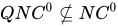
2D HLF problem statement
Given (an upper- triangularbinary matrix of size ) and (a binary vector of length ),


define a function :


and

There exists a such that


Find .[1]

2D HLF algorithm
With 3 registers; the first holding , the second containing and the third carrying an -qubit state, the circuit has controlled gates which implement from the first two registers to the third.


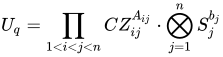
This problem can be solved by a quantum circuit, , where H is the Hadamard gate, S is the S gate and CZ is CZ gate. It is solved by this circuit because with , iff is a solution.[1]



References
- 1234Bravyi, Sergey; Gosset, David; Robert, König (2018-10-19). "Quantum advantage with shallow circuits". Science. 362 (6412): 308–311. arXiv:1704.00690. Bibcode:2018Sci...362..308B. doi:10.1126/science.aar3106. PMID 30337404. S2CID 16308940.
- ↑ واتس، آدم بيني؛ كوثاري، روبن؛ شيفر، لوك؛ تال، أفيشاي (23-06-2019). "الفصل الأسي بين الدوائر الكمومية الضحلة والدوائر الكلاسيكية الضحلة ذات عدد المدخلات غير المحدود" . ACM: 515–526 . arXiv : 1906.08890 . doi : 10.1145/3313276.3316404 . ISBN 978-1-4503-6705-9.
{{cite journal}}يتطلب الاستشهاد بالمجلة ( مساعدة )|journal= - ↑ دي أوليفيرا، مايكل؛ سوبرامانيان، ساتياواجسوار؛ مينديز، لياندرو؛ هسيه، مين-هسيو (15 أبريل 2025). "ميزة مطلقة لدوائر الكم ذات الـ qudit الضوضائية على دوائر العتبة المتحيزة في عمق ثابت" . نيتشر كوميونيكيشنز . 16 (1): 3559. doi : 10.1038/ s41467-025-58545-4 . ISSN 2041-1723 . PMC 12000609. PMID 40234377 .
روابط خارجية
- الخوارزميات الكمومية
- نظرية التعقيد الكمي
- نظرية التعقيد الحسابي