
Homogenizer
A homogenizer is a laboratory or industrial device used to break down and evenly distribute particles within a liquid mixture, creating a stable and uniform emulsion, suspension, or solution. Homogenization is a key process in many fields, including food and beverage production, pharmaceuticals, biotechnology, and materials science. It is used to process substances such as tissue, cells, soil, plant matter, and emulsified products like creams, lotions, or milk.
Applications
Homogenizers are widely used in both laboratory research and commercial manufacturing. Common applications include:
- Cell disruption for DNA, RNA, and protein extraction
- Food and beverage production (e.g., milk, juices, sauces)
- Cosmetic product formulation (e.g., creams, gels, lotions)
- Pharmaceutical suspensions and emulsions
- Soil and plant sample processing for environmental testing
Types of homogenizers
A variety of technologies are used in homogenization, each with advantages and limitations depending on the material being processed and the desired results.[1]
Basic homogenization tools
Simple homogenization methods use basic tools and physical effort to break down samples. These techniques are commonly used in life sciences for sample processing, especially when cost or equipment availability is a concern.
Two common examples include:
- Mortar and pestle: One of the oldest and most accessible homogenization methods, commonly used as tissue grinders. The sample is ground between a container (the mortar) and a blunt object (the pestle). Mortar and pestle systems can be either manual or automated, and are often used for tissue homogenization, cell isolation, and processing cryogenic samples.[2]
- Frosted glass slides: These can be used to homogenize small and soft tissue specimens by applying circular motion and pressure between two frosted surfaces.[3]
While these methods are simple and inexpensive, they are limited in scale and consistency.
High shear (rotor/stator) homogenizers
High shear homogenizers use a rapidly spinning rotor inside a stationary stator to create high shear forces. These forces break down particles and droplets, typically reducing them to 2–5 microns.
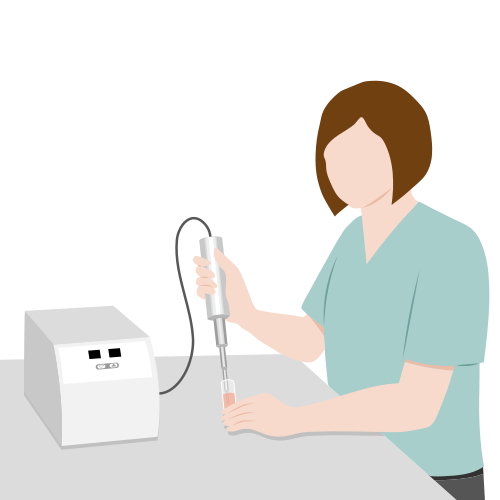
The rotor draws material into the workhead, where it is subjected to intense mixing in the narrow gap between the rotor and stator. As the product is forced through the stator screen, it experiences hydraulic shear and is recirculated back into the mix. This continuous cycle rapidly reduces particle or droplet size, producing a uniform and stable product.[4]
أظهرت الدراسات أن أجهزة التجنيس عالية القص يمكن أن تحسن استقرار المستحلب ولزوجته دون تغيير مكونات التركيبة، وهو أمر مهم للمنتجات الخاضعة للتنظيم أو التجارية. [ 5 ]
أجهزة التجنيس بالموجات فوق الصوتية
تُعرف أجهزة التجنيس بالموجات فوق الصوتية أيضاً باسم أجهزة السونيكاتور ، وهي تستخدم موجات صوتية عالية التردد لتحريك الجزيئات في العينة. وتُعد هذه الطريقة مفيدة بشكل خاص لتكسير جدران الخلايا وتشتيت الجسيمات النانوية.
أجهزة التجنيس عالية الضغط
في عملية التجنيس عالي الضغط، يُدفع المنتج عبر فتحة ضيقة بضغوط تتجاوز في كثير من الأحيان 15000 رطل لكل بوصة مربعة. ويؤدي هذا المزيج من القص والاضطراب والتجويف إلى تقليل حجم الجزيئات وإنتاج مخاليط متجانسة. وتُعد هذه الطريقة شائعة في معالجة الحليب .
قد تعمل أنظمة الضغط العالي للغاية (UHPH) على تحسين استقرار الميكروبات وإطالة فترة الصلاحية. [ 6 ]
مطاحن الخرز
تستخدم أجهزة التجنيس بالخرز خرزًا صغيرًا مصنوعًا من الزجاج أو السيراميك أو المعدن لسحق العينات من خلال الطحن وقوى الصدم. وهي فعالة بشكل خاص للأنسجة الصلبة والخلايا الميكروبية والعينات ذات الحجم الصغير.
اعتبارات السلامة والجودة
غالباً ما تتضمن تقنيات التجانس الحديثة ميزات للحد من التلوث وتوليد الرذاذ والضوضاء. كما قد يساعد تصميم المعدات على تقليل التلوث المتبادل بين العينات، وهو أمر بالغ الأهمية في البحوث البيولوجية والسريرية.
انظر أيضاً
- ↑ "تقنيات التجانس: مزاياها وعيوبها - رسم بياني" (ملف PDF) . مدير المختبر/PRO Scientific . تاريخ الاسترجاع: 7 مايو 2025 .
- ↑ تشوهان، توشار (2022-06-01). "تقنيات تجانس الأنسجة لاستخلاص الحمض النووي الريبي" . التعليم الجيني . تم الاسترجاع في 2025-05-07 .
- ↑ رازيغرايف، أ. ف. (2020). "دراسة مقارنة لنشاط الكاتالاز في البعوضة الحلقية (Culiseta annulata (Schrank)) والبعوضة الصغيرة (Culex pipiens L.) (Diptera, Culicidae)" . مجلة علم الحشرات . 100 (2): 162-169 . doi : 10.1134/S0013873820020037 . ISSN 1555-6689 . S2CID 219551607 .
- ↑ "التجانس" . آلات سيلفرسون . تم الاسترجاع في 2025-05-07 .
- ↑ سيلفا، تي إم؛ سيريز، إن إن بي؛ أوليفيرا، إيه إم. "تأثير التجنيس عالي القص على الاستقرار الفيزيائي للمستحلبات" . ريسيرش جيت . معهد البحوث التكنولوجية . تاريخ الاسترجاع: 7 مايو 2025 .
- ↑ فيراغوت، فيكتوريا؛ هيرنانديز-هيريرو، مانويلا؛ فيسيانا-نوغيس، ماريا تيريزا؛ بوراس-سواريز، ميكيل؛ غونزاليس-ليناريس، خافيير؛ فيدال-كارو، ماريا كارمن؛ غواميس، بوينافينتورا (30 مارس 2015). "نظام التجنيس فائق الضغط (UHPH) لإنتاج مشروبات نباتية عالية الجودة: الخصائص الفيزيائية والكيميائية والميكروبيولوجية والغذائية والسمية: مشروبات الصويا واللوز المنتجة بتقنية UHPH". مجلة علوم الأغذية والزراعة . 95 (5): 953-961 . doi : 10.1002/jsfa.6769 . PMID 24898984 .
- معدات المختبر