
Mir-2
Mir-2 was a Sovietspace station project which began in February 1976.[1] Some of the modules built for Mir-2 have been incorporated into the International Space Station (ISS). The project underwent many changes, but was always based on the DOS-8 base block space station core module, built as a back-up to the DOS-7 base block used in the Mir station. The DOS-8 base block was eventually used as the Zvezda module of the ISS. Its design lineage extends back to the original Salyut stations.[2][3][4]
Project history
The evolution of the Mir-2 project
1981 to 1987: KB Salyut Mir-2
The prototype of the central module was as Polyus. Mir-2 would be capable of docking at least four modules in ordinary operation.
December 14, 1987: NPO Energia Mir-2
Designated as OSETS (Orbital Assembly and Operations Centre). The station would be built in a 65 degree orbit and consist of 90 ton modules.
- Launch 1 – DOS 8, providing housing for the assembly crew.
- Launch 2 – 90 ton module.
- Launch 3 – Truss and solar arrays.
- Launches 4 to 6 – additional 90 ton modules.
1991: "Mir-1.5"
This would involve launch of the DOS-8, after which the Buran shuttle would grapple the module, rendezvous with Mir, and attach it to the old DOS-7 base block. This plan was later altered so that DOS-8 would maneuver and dock itself to Mir. It would remain attached for two years.
1992: "Mir-2"
The station would consist of the DOS-8 core module and a cross beam called the NEP (Science Power Platform). This was equipped with MSB retractable solar panels, Sfora thruster packages and small scientific packages.
Four 3 to 4 ton modules were planned:
- Docking Module - with the APDS universal androgynous docking system, and a side hatch for space walks
- Resource Module - Equipped with gyrodynes for orienting the station and a passive docking port for docking of Soyuz or Progress ferry spacecraft
- Technology Module - with materials experiments
- Biotechnology Module
November 1993: International Space Station built around Mir-2
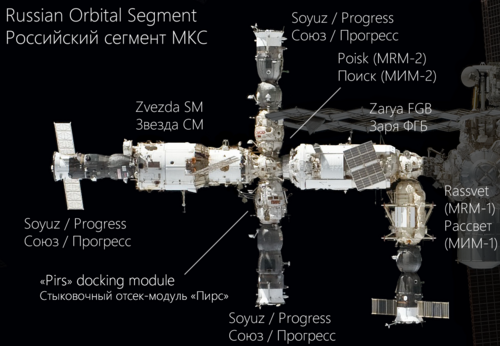
Russian elements of the International Space Station include:
- Zarya FGB, the first element launched. This was a US-funded TKS-derived propulsion module built by KB Salyut.
- وحدة خدمة زفيزدا - هذه هي كتلة DOS-8، والتي تم إطلاقها كوحدة رئيسية ثالثة لمحطة الفضاء الدولية في يوليو 2000.
- تمت إضافة SO-1 Pirs - إحدى وحدات الالتحام المصممة أصلاً لـ Buran / Mir -2 إلى المحطة في سبتمبر 2001، وتم إخراجها من المدار في يوليو 2021 لإفساح المجال لـ Nauka.
- وحدة SO-2 Poisk - وحدة مشابهة لوحدة Pirs. توفر Poisk أيضًا مساحة إضافية للتجارب العلمية، ومنافذ إمداد الطاقة وواجهات نقل البيانات للحمولات العلمية الخارجية.
- راسفيت - الوحدة الوحيدة التي سلمتها ناسا لمكوك الفضاء، في صفقة مقايضة مقابل إطلاق مركبة زاريا. بُنيت راسفيت من نموذج تجريبي للجزء المضغوط من مركبة نيب. تُستخدم لتخزين الشحنات، ولأغراض علمية، وكمحطة إرساء للمركبات الفضائية الزائرة.
- Nauka FGB-2 - هذه هي أكبر وحدة روسية والوحدة الوحيدة المخصصة بالكامل للعلوم، وتم إطلاقها في يوليو 2021، مع الذراع الروبوتية الأوروبية المرفقة.
- وحدة بريتشال يو إم - "الوحدة المحورية"، التي كان من المفترض أن تستضيف أربع وحدات مختبرية ووحدات طاقة إضافية ومنفذ إرساء كجزء من خطة أوبسيك التي تم إلغاؤها لاحقاً . تم إطلاقها في نوفمبر 2021.
انظر أيضاً
مراجع
- ↑ "مير-2" . أسترونوتكس. مؤرشف من الأصل في 20 أغسطس 2016. تم الاسترجاع في 12 فبراير 2011 .
- ↑ أناتولي زاك. "محطة الفضاء الدولية - مير-2: الجذور الروسية لبرنامج محطة الفضاء الدولية (1969-1992)" . موقع الفضاء الروسي . تاريخ الاسترجاع: 12 فبراير 2011 .
- ↑ "عناصر محطة الفضاء الدولية: وحدة الخدمة ("زفيزدا")" . SpaceRef.com . تم الاطلاع عليه بتاريخ 12 فبراير 2011 .
- ↑ هنري سبنسر (2 نوفمبر 2010). "الحياة الراقية: تاريخ موجز لمحطة الفضاء" . مجلة نيو ساينتست . تم الاطلاع عليه بتاريخ 12 فبراير 2011 .
روابط خارجية
- مير-2 على أسترونوتكس
- مير-2
- محطات الفضاء الملغاة
- مركبة فضائية سوفيتية ملغاة