
LAPCAT

LAPCAT (Long-Term Advanced Propulsion Concepts and Technologies) was a 36-month European FP6 study to examine ways to produce engines for a Mach number 4-8 hypersonic flight aircraft. The project ended in April 2008.[1] It was funded by the European Commission research and development fund (rather than ESA), and cost 7 million euros.[2][3]
LAPCAT II, a 10 million euro, four-year, follow on project, started in October 2008.[1][4] The study aims to refine some of the results of the first study "allowing the definition of a detailed development roadmap" of a Mach five vehicle.[5]
Objectives
Two major technologies were to be considered:[6]
- ram-compression, which needs an additional propulsion system to achieve its minimum working speed.
- active compression, which has an upper Mach number limitation but can accelerate a vehicle up to its cruise speed.
Key objectives were the definition and evaluation of:[6]
- different propulsion cycles and concepts for high-speed flight at Mach 4 to 8 such as turbine-based and rocket-based combined cycles
- critical technologies for:
- integrated engine/aircraft performance
- mass-efficient turbines and heat-exchangers
- high-pressure and supersonic combustion experiments
- modelling
Intended results were:[6]
- definition of requirements and operational conditions for high-speed flight at system level
- dedicated experimental data-base specific to high-speed aerodynamics for supersonic and high-pressure combustion and flow phenomena.
- setting-up and validating physical models supported by numerical simulation tools to address supersonic and high-pressure combustion, turbulence and transition phenomena.
- feasibility study of weight performance turbine and heat exchanger components
Results
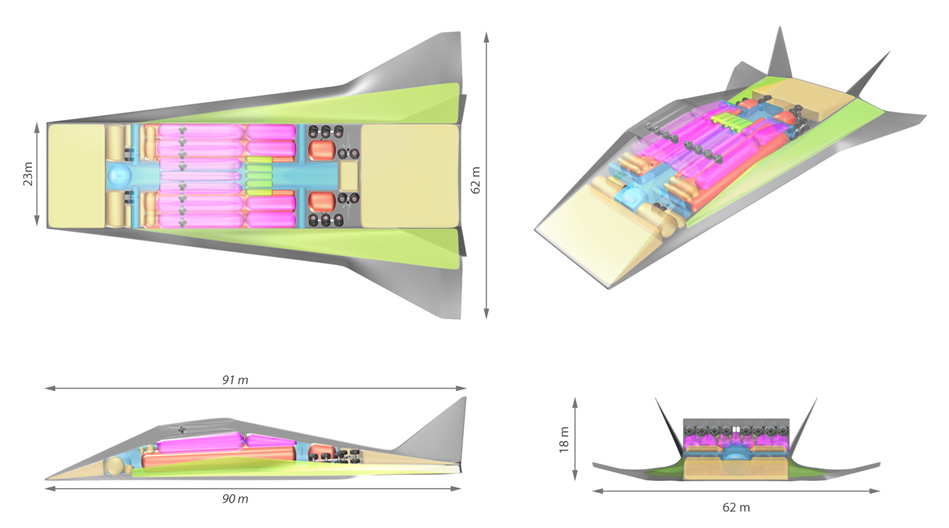
Among the several vehicles studied, only two novel concepts were retained for LAPCAT II: a Mach five vehicle and a Mach eight vehicle.[5]
Mach five vehicle

One possible supersonic transport aircraft being researched as part of this project was the A2 by Reaction Engines Limited.[7] The researchers studied at an aircraft capable of flying from Brussels (Belgium) to Sydney (Australia) in 2–4 hours,[8] significantly reducing journey times across the globe.
To attain and maintain such high speeds, Reaction Engines Limited would need to develop its newly designed concept engine called the Scimitar, which would exploit the thermodynamic properties of liquid hydrogen.[9] The engine would be theoretically capable of powering the A2 to a sustained Mach 5 throughout flight with an effective exhaust velocity of 40,900 m/s or specific impulse of 4170 s, SFC 0.86 lb/(lbf⋅h).[8]
"Results so far show the Mach 5 vehicle from Reaction Engines can avoid later technology pitfalls and could travel from Brussels to Sydney," says ESA's LAPCAT project coordinator Johan Steelant.[10] The developers said in 2009 that it would be able to fly from Europe to Australia in under five hours,[11] compared to around a complete day of travel with normal aircraft. The cost of a ticket was aspirationally roughly business class level.[12]
The A2 design did not have windows. The heat generated by the hypersonic airflow over the body puts constraints on window design which would make them too heavy. One solution Reaction Engines proposed was to install flat panel displays, showing images of the scene outside.[13]
Mach eight vehicle
Although the cruise flight of the scramjet based Mach eight vehicle seems feasible, the fuel consumption during acceleration requires a large fuel fraction, severely affecting gross take-off weight. Initial studies of a first-stage rocket ejector concept gave poor range with large take-off mass.[5][14]
See also
- Precooled jet engine
- Reaction Engines SABRE
- Reaction Engines A2
- Liquid air cycle engine
Notes
- 1 2 كوبينجر، روبرت "روب" (23 أكتوبر 2007). "الاتحاد الأوروبي يمول أبحاث النقل المدني فائق السرعة" . فلايت إنترناشونال . فلايت جلوبال . تم الاسترجاع في 3 يوليو 2009 .
- ↑ "مشروع LAPCAT يهدف إلى تحقيق طيران مدني أسرع من الصوت" . جيزمو واتش . 30 أغسطس 2007. مؤرشف من الأصل في 20 فبراير 2009. تم الاطلاع عليه بتاريخ 3 يوليو 2009 .
- ↑ "LAPCAT - مفاهيم وتقنيات الدفع المتقدمة طويلة الأجل" . المفوضية الأوروبية. مؤرشف من الأصل بتاريخ 5 أغسطس 2009. تم الاطلاع عليه بتاريخ 3 يوليو 2009 .
- ↑ باتروورث-هايز، فيليب (يونيو 2008). "أوروبا تُسرّع وتيرة الطيران فوق الصوتي" (ملف PDF) . مجلة الفضاء الأمريكية. المعهد الأمريكي للملاحة الجوية والفضائية. مؤرشف من الأصل ( ملف PDF ) بتاريخ 7 مارس 2010. تاريخ الاسترجاع: 3 يوليو 2009 .
- 1 2 3 "نظرة عامة على LAPCAT II" . وكالة الفضاء الأوروبية. 17 نوفمبر 2009. تم الاطلاع عليه بتاريخ 21 سبتمبر 2010 .
- 1 2 3 "نظرة عامة: مفاهيم وتقنيات الدفع المتقدمة طويلة المدى" . وكالة الفضاء الأوروبية. 24 نوفمبر 2005. تم الاطلاع عليه بتاريخ 3 يوليو 2009 .
{{cite web}}: CS1 maint: deprecated archiveal service ( link ) - ↑ شركة رياكشن إنجنز المحدودة - مطورو برنامج LAPCAT، مؤرشف بتاريخ 5 يوليو 2009 في أرشيف الإنترنت (Wayback Machine).
- 1 2 "LAPCAT: مفاهيم وتقنيات الدفع المتقدمة طويلة المدى" . شركة محركات التفاعل المحدودة. مؤرشف من الأصل بتاريخ 2009-07-05 . تم الاطلاع عليه بتاريخ 2009-07-03 .
- ↑ "محرك لابكات - محرك سيميتار" . شركة رياكشن إنجنز المحدودة. مؤرشف من الأصل بتاريخ 2009-07-06 . تم الاطلاع عليه بتاريخ 2009-07-03 .
- ↑ كوبينجر، روبرت "روب" (15 يونيو 2006). "خطة بحثية تفوق سرعة الصوت بقيمة 7 ملايين يورو للاتحاد الأوروبي تدرس استخدام طائرة بريطانية الصنع بسرعة 5 ماخ لنقل الركاب من بروكسل إلى سيدني في ساعتين" . مجلة فلايت إنترناشونال . تاريخ الاسترجاع: 3 يوليو 2009 .
- ↑ "تصميم طائرة ركاب أسرع من الصوت" . أخبار . المملكة المتحدة: بي بي سي. 5 فبراير 2008. تم الاطلاع عليه بتاريخ 3 يوليو 2009 .
- ↑ توم تشيفرز (5 فبراير 2008). "رحلة أسرع من الصوت: بروكسل - سيدني في 5 ساعات" . تم الاطلاع عليه بتاريخ 10 فبراير 2020 .
- ↑ موريس، ستيفن (5 فبراير 2008). "الطائرة الأسرع من الصوت المصممة للوصول إلى أستراليا في أقل من خمس ساعات" . صحيفة الغارديان . المملكة المتحدة . تاريخ الاسترجاع: 3 يوليو 2009 .
- ↑ تصميم مفاهيمي لمركبة من نوع دورسال بسرعة ماخ 8، تم إنتاجه بواسطة الدراسة ( صورة JPEG ) ، وكالة الفضاء الأوروبية، 5 ديسمبر 2008.
مراجع
- ستيلانت، ج. (أغسطس 2006)، انطلاق برنامج LAPCAT (ملف PDF) (شرائح)، مؤرشف من الأصل بتاريخ 27-09-2007 ، تم استرجاعه بتاريخ 15-03-2024
{{citation}}: CS1 maint: bot: حالة عنوان URL الأصلي غير معروفة ( رابط ) .
- وسائل النقل الأسرع من الصوت