
Thor-Able
The Thor-Able was an American expendable launch system used for a series of re-entry vehicle tests and spacecraft launches between 1958 and 1960.
It was a two-stagerocket, consisting of a ThorIRBM as a first stage and a Vanguard-derived Able second stage. For satellite or space probe launches, an Altairsolid rocket motor was added as a third stage. It was a member of the Thor family and an early predecessor of the Delta.[1][2]
The Able upper stage name represents its place as the first in the series, from the Joint Army/Navy Phonetic Alphabet.[3]
The Thor-Able vehicle had a stronger airframe than the standard Thor IRBM and had the inertial guidance system replaced by a radio guidance package mounted on the Able stages.
Launches
Sixteen Thor-Able were launched, nine on sub-orbital re-entry vehicle test flights, four on probe and three on orbital satellite launch attempts. Six of the launches resulted in failures, in which three of those were the result of the additional Altair upper stage, added to the rocket to allow it to launch spacecraft beyond a sub-orbital trajectory. All sixteen launches occurred from Cape Canaveral Air Force StationLaunch Complex 17A.[4]
The rocket saw its first test on 23 April 1958 when Thor-Able 116 was launched from LC-17A with a biological nose cone containing a mouse named MIA (Mouse In Able). At 19:10 EST, the Thor's engine ignited and drove the Able stage and its passenger into the sky. Two minutes and fifteen seconds after launch, at an altitude of 50 miles (80 km), the Thor exploded and sent the hapless rodent into the Atlantic Ocean instead of space. The cause of the failure was traced to a turbopump bearing coming loose and resulting in pump shutdown and instant loss of thrust. With no attitude control, the Thor pitched down and its LOX tank ruptured from aerodynamic loads. On 9 July, Thor-Able 118 lifted off for a second attempt with a mouse named MIA II. The booster, including the unproven Able stage, performed successfully and the biological nose cone was driven back into the atmosphere for a splashdown in the South Atlantic, but recovery crews failed to locate the capsule and it sank into the ocean. A third attempt was made on 23 July. The press refused to call the mouse by the name of MIA III, so she was instead christened "Wickie", after a local female news reporter who had covered the space program at Cape Canaveral. Unfortunately, Wickie was no luckier than her predecessors when recovery crews once again failed to locate the capsule after splashdown, but telemetry data confirmed the mouse's survival from liftoff through reentry and proved comprehensively that living organisms could survive space travel.
Attention now turned to Thor-Able 127 and Pioneer 0, the world's first lunar probe. This flight took place on 17 August, but ended embarrassingly when the Thor exploded 77 seconds into the launch due to another turbopump malfunction. After an Atlas missile test a month later also failed due to the turbopumps, the Air Force Ballistic Missile Division quickly replaced the pumps in all of their missiles and this problem did not repeat itself again.
On 10 October, Pioneer 1 was launched on Thor-Able 130. The second stage shut down too early and the probe did not have sufficient velocity to escape Earth's gravity. It re-entered the atmosphere and burned up 43 hours after launch.
Pioneer 2 was launched on 8 November (Thor-Able 129) and reentered the atmosphere less than an hour after launch when the third stage failed to ignite.
The next six Thor-Able flights were suborbital tests for the Air Force (23 January, 28 February, 21 March, 8 April, 20 May, and 11 June 1959). All of these were successful except the first one, which failed to stage due to an electrical problem and fell into the Atlantic Ocean.
On 7 August, Explorer 6 (a scientific satellite) was launched on Thor-Able 134 and successfully orbited.
On 17 September, Transit 1A on Thor-Able 136 failed to orbit due to the third stage again failing to ignite.
On 3 November, Pioneer 5 was successfully launched on Thor-Able 219. Intended originally as a Venus probe, technical delays caused it to be launched after the 1959 Venus window had closed so that it was instead sent into a heliocentric orbit.
The final Thor-Able launch was Thor-Able 148, orbiting Tiros-1 on 1 April 1960.
| Date/Time(GMT) | Rocket | S/N | Launch site | Payload | Function | Orbit | Outcome | Remarks |
|---|---|---|---|---|---|---|---|---|
| 1958-04-2400:10 | Thor DM-18 Able | Thor 116 | CCAFS LC-17A | RTV test | Suborbital | Failure | Maiden flight of Thor-Able. Turbopump failure T+146 seconds. | |
| 1958-07-1015:06 | Thor DM-18 Able | Thor 118 | CCAFS LC-17A | RTV test | Suborbital | Success | ||
| 1958-07-2322:13 | Thor DM-18 Able | Thor 119 | CCAFS LC-17A | RTV test | Suborbital | Success | Biological nose cone containing a mouse. The nose cone sank into the ocean and was not recovered. | |
| 1958-08-1712:18 | Thor DM-18 Able-I | Thor 127 | CCAFS LC-17A | Pioneer 0 | Lunar orbiter | High Altitude | Failure |  Maiden flight of Thor-Able I. First use of a Thor-based vehicle for an orbital launch. Turbopump failure, T+73,6 seconds. |
| 1958-10-1108:42:13 | Thor DM-18 Able-I | Thor 130 | CCAFS LC-17A | Pioneer 1 | Lunar orbiter | High Altitude | Failure |  Third stage underperformed |
| 1958-11-0808:42:13 | Thor DM-18 Able-I | Thor 129 | CCAFS LC-17A | Pioneer 2 | Lunar orbiter | High Altitude | Failure |  Third stage failed to ignite |
| 1959-01-23 | Thor DM-18 Able-II | Thor 128 | CCAFS LC-17A | RVX test | Suborbital | Failure | Thor portion of flight successful. Staging failed due to an electrical malfunction. Vehicle fell into the Atlantic Ocean. | |
| 1959-02-2807:58 | Thor DM-18 Able-II | Thor 131 | CCAFS LC-17A | RVX test | Suborbital | Success | ||
| 1959-03-2106:19 | Thor DM-18 Able-II | Thor 132 | CCAFS LC-17A | RVX test | Suborbital | Success | ||
| 1959-04-0806:35 | Thor DM-18 Able-II | Thor 133 | CCAFS LC-17A | RVX test | Suborbital | Success | ||
| 1959-05-2106:40 | Thor DM-18 Able-II | Thor 135 | CCAFS LC-17A | RVX test | Suborbital | Success | ||
| 1959-06-1106:44 | Thor DM-18 Able-II | Thor 137 | CCAFS LC-17A | RVX test | Suborbital | Success | ||
| 1959-08-0714:24:20 | Thor DM-18 Able-III | Thor 134 | CCAFS LC-17A | Explorer 6 | Radiation | HEO | Success |  |
| 1959-09-1714:34 | Thor DM-18 Able-II | Thor 136 | CCAFS LC-17A | Transit 1A | Navigation | LEO | Failure |  Third stage malfunctioned |
| 1960-03-1113:00 | Thor DM-18 Able-IV | Thor 219 | CCAFS LC 17A | Pioneer 5 | Scientific | Heliocentric | Success |  Only flight of Thor-Able IV |
| 1960-04-0111:40:09 | Thor DM-18 Able-II | Thor 148 | CCAFS LC-17A | TIROS-1 | Weather | SSO | Success | 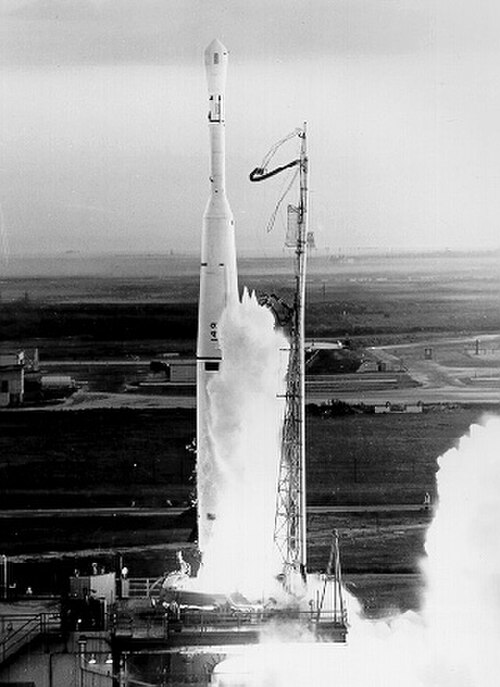 Final flight of Thor-Able |
See also
- List of Thor and Delta launches (includes Thor-Able)
- Thor (rocket family)
References
- ↑Krebs, Gunter. "Thor Able". Gunter's Space Page. Retrieved 2008-11-10.
- ↑Wade, Mark. "Delta". Encyclopedia Astronautica. Archived from the original on 2013-08-17. Retrieved 2008-11-10.
- ↑Wells, Helen T.; Whiteley, Susan H. & Karegeannes, Carrie E. (1976). Origins of NASA Names. NASA Science and Technical Information Office. p. 5. NASA SP-4402.
- ↑Lethbridge, Cliff. "Thor-Able Fact Sheet". Cape Canaveral Rocket and Missile Programs. Spaceline. Archived from the original on 2007-06-13. Retrieved 2008-11-10.
- ↑"Thor-DM18 Able". Gunter's Space Page. Retrieved 2021-08-03.
- ↑"Thor-DM18 Able-1". Gunter's Space Page. Retrieved 2021-08-03.
- ↑"Thor-DM18 Able-2". Gunter's Space Page. Retrieved 2021-08-03.
- ↑"Thor-DM18 Able-3". Gunter's Space Page. Retrieved 2021-08-03.
- ↑"Thor-DM18 Able-4". Gunter's Space Page. Retrieved 2021-08-03.
External links
- Thor (rocket family)