Opposite group

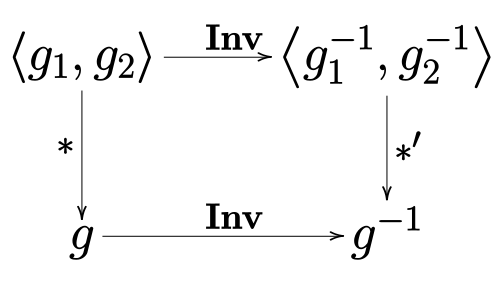
This is a natural transformation of binary operation from a group to its opposite. g1, g2 denotes the ordered pair of the two group elements. *' can be viewed as the naturally induced addition of +.

In group theory, a branch of mathematics, an opposite group is a way to construct a group from another group that allows one to define right action as a special case of left action.

Monoids, groups, rings, and algebras can be viewed as categories with a single object. The construction of the opposite category generalizes the opposite group, opposite ring, etc.

Definition

Let G{\displaystyle G} be a group under the operation {\displaystyle *}. The opposite group of G{\displaystyle G}, denoted Gop{\displaystyle G^{\mathrm {op} }}, has the same underlying set as G{\displaystyle G}, and its group operation {\displaystyle {\mathbin {\ast '}}} is defined by g1g2=g2g1{\displaystyle g_{1}{\mathbin {\ast '}}g_{2}=g_{2}*g_{1}}.[1]

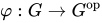
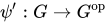
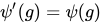
If G{\displaystyle G} is abelian, then it is equal to its opposite group. Also, every group G{\displaystyle G} (not necessarily abelian) is naturally isomorphic to its opposite group: An isomorphism φ:GGop{\displaystyle \varphi :G\to G^{\mathrm {op} }} is given by φ(x)=x1{\displaystyle \varphi (x)=x^{-1}}. More generally, any antiautomorphismψ:GG{\displaystyle \psi :G\to G} gives rise to a corresponding isomorphism ψ:GGop{\displaystyle \psi ':G\to G^{\mathrm {op} }} via ψ(g)=ψ(g){\displaystyle \psi '(g)=\psi (g)}, since

ψ(gh)=ψ(gh)=ψ(h)ψ(g)=ψ(g)ψ(h)=ψ(g)ψ(h).{\displaystyle \psi '(g*h)=\psi (g*h)=\psi (h)*\psi (g)=\psi (g){\mathbin {\ast '}}\psi (h)=\psi '(g){\mathbin {\ast '}}\psi '(h).}

Group action

Let X{\displaystyle X} be an object in some category, and ρ:GAut(X){\displaystyle \rho :G\to \mathrm {Aut} (X)} be a right action. Then ρop:GopAut(X){\displaystyle \rho ^{\mathrm {op} }:G^{\mathrm {op} }\to \mathrm {Aut} (X)} is a left action defined by ρop(g)x=xρ(g){\displaystyle \rho ^{\mathrm {op} }(g)x=x\rho (g)}, or gopx=xg{\displaystyle g^{\mathrm {op} }x=xg}.

See also

References

  1. Clark, Alan. Elements of Abstract Algebra. Dover Publications, Inc. p. 18. ISBN 0-486-64725-0.