
Audio analysis
Audio analysis refers to the extraction of information and meaning from audio signals for analysis, classification, storage, retrieval, synthesis, etc. The observation mediums and interpretation methods vary, as audio analysis can refer to the human ear and how people interpret the audible sound source, or it could refer to using technology such as an audio analyzer to evaluate other qualities of a sound source such as amplitude, distortion, frequency response. Once an audio source's information has been observed, the information revealed can then be processed for the logical, emotional, descriptive, or otherwise relevant interpretation by the user.
Natural Analysis
The most prevalent form of audio analysis is derived from the sense of hearing. A type of sensory perception that occurs in much of the planet's fauna, audio analysis is a fundamental process of many living beings. Sounds made by the surrounding environment or other living beings provide input to the hearing mechanism, for which the listener's brain can interpret the sound and how it should respond. Examples of functions include speech, startle response, music listening, and more.
An inherent ability of humans, hearing is fundamental in communication across the globe, and the process of assigning meaning and value to speech is a complex but necessary function of the human body. The study of the auditory system has been greatly centered on using mathematics and the analysis of sinusoidal vibrations and sounds. The Fourier transform has been an essential theorem in understanding how the human ear processes moving air and turns it into the audible frequency range, about 20 to 20,000 Hz.[1] The ear is able to take one complex waveform and process it into varying frequency ranges thanks to differences in the structures of the ear canal that are tuned to specific frequency ranges.[2] The initial sensory input is then analyzed further up in the neurological system where the perception of sound takes place.
The auditory system also works in tandem with the neural system so that the listener is capable of spatially locating the direction from which a sound source originated. This is known as the Haas or Precedence effect and is possible due to the nature of having two ears, or auditory receptors. The difference in time it takes for a sound to reach both ears provides the necessary information for the brain to calculate the spatial positioning of the source.[3]
Signal Analysis

يمكن تحليل الإشارات الصوتية بعدة طرق مختلفة، وذلك حسب نوع المعلومات المطلوبة من الإشارة.
تشمل أنواع تحليل الإشارات ما يلي:
- المستوى والتقدم
- تحليل المجال الترددي
- استجابة التردد
- التشوه التوافقي الكلي بالإضافة إلى الضوضاء (THD+N)
- مرحلة
- التداخل
- التشوه التوافقي (IMD)
- ستيريو ومحيطي
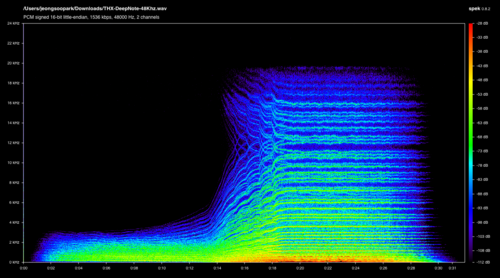
لطالما كانت أجهزة تحليل الصوت الوسيلة الأساسية لتحليل الإشارات منذ اختراع أول جهاز تحليل صوتي من إنتاج شركة هيوليت-باكارد ، وهو HP200A . تُستخدم هذه الأجهزة عادةً في هندسة واختبار وتصنيع المنتجات الاحترافية والاستهلاكية. ومع تطور تكنولوجيا الحاسوب، أُدمجت البرامج في هذه الأنظمة، ثم ظهرت لاحقًا أدوات تحليل صوتي لا تتطلب أي مكونات مادية باستثناء الحاسوب الذي يُشغل البرنامج. تُستخدم برامج تحليل الصوت بانتظام في مراحل مختلفة من إنتاج الموسيقى، مثل الصوت المباشر والمزج والماسترينغ. وتعتمد هذه المنتجات عادةً على خوارزميات ومعالجة تحويل فورييه السريع (FFT) لعرض الإشارة المراد تحليلها بصريًا. تشمل أنواع العرض والمعلومات طيف التردد، والمجال الاستريو ، ومجال الصوت المحيطي ، والمخطط الطيفي ، وغيرها.
انظر أيضاً
- اختبار السمع الحاسوبي – دراسة فهم الصوت بواسطة الآلة
- الصوت الدلالي – استخلاص المعنى من الصوت
- التعرف على الكلام – التحويل التلقائي للغة المنطوقة إلى نص
- التعرف على الصوت – التعرف على الأنماط في الإشارات الصوتية
مراجع
- ↑ أكتون، كياران؛ ميلر، روبرت؛ مالتبي، جون؛ فولرتون، ديردري (2009)، "تحليل التباين (ANOVA)"، SPSS لعلماء الاجتماع ، ماكميلان للتعليم في المملكة المتحدة، ص 183-198 ، doi : 10.1007/978-1-137-01390-3_9 (غير نشط في 11 يوليو 2025)، ISBN 9780230209930
{{citation}}: صيانة CS1: رقم التعريف الرقمي غير نشط اعتبارًا من يوليو 2025 ( رابط ) - ↑ غوها، مارتن (ديسمبر 2006). قاموس إلسيفير لنظريات علم النفس 2006، 405. جمعه جيه إي روكلين. قاموس إلسيفير لنظريات علم النفس. أمستردام: إلسيفير 2006. 12+679 صفحة. 90 جنيهًا إسترلينيًا؛ 143 دولارًا أمريكيًا . المجلد 20. الصفحات 10-11 . doi : 10.1108/09504120610709402 . ISBN 0-444-51750-2ISSN 0950-4125
{{cite book}}تم|journal=تجاهله ( مساعدة ) - ↑ فارمر، ليزلي (18 يناير 2011). من الألف إلى الياء: قاموس موسوعي للإعلام والترفيه والمصطلحات السمعية البصرية الأخرى. 2011. ريتشارد دبليو. كرون. من الألف إلى الياء: قاموس موسوعي للإعلام والترفيه والمصطلحات السمعية البصرية الأخرى. جيفرسون، كارولاينا الشمالية: ماكفارلاند 2010. 766 صفحة + 6 صفحات تمهيدية، 173.95 جنيهًا إسترلينيًا، 195 دولارًا أمريكيًا. متوفر في المملكة المتحدة وأوروبا والشرق الأوسط وأفريقيا من يوروسبان . المجلد 25، صفحة 50. doi : 10.1108/09504121111103335 . ISBN 978-0-7864-4405-2ISSN 0950-4125
{{cite book}}تم|journal=تجاهله ( مساعدة )
- هندسة الصوت