
Computational gene
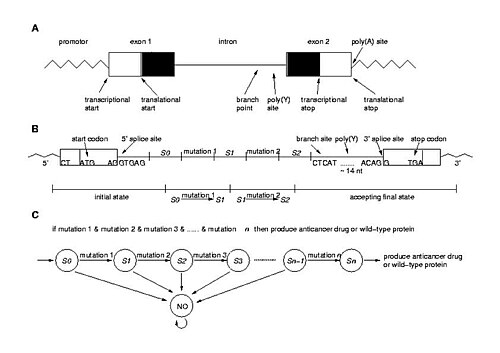
A computational gene[1][2][3] is a molecular automaton consisting of a structural part and a functional part; and its design is such that it might work in a cellular environment.
The structural part is a naturally occurring gene, which is used as a skeleton to encode the input and the transitions of the automaton (Fig. 1A). The conserved features of a structural gene (e.g., DNA polymerase binding site, start and stop codons, and splicing sites) serve as constants of the computational gene, while the coding regions, the number of exons and introns, the position of start and stop codon, and the automata theoretical variables (symbols, states, and transitions) are the design parameters of the computational gene. The constants and the design parameters are linked by several logical and biochemical constraints (e.g., encoded automata theoretic variables must not be recognized as splicing junctions). The input of the automaton are molecular markers given by single stranded DNA (ssDNA) molecules. These markers are signalling aberrant (e.g., carcinogenic) molecular phenotype and turn on the self-assembly of the functional gene. If the input is accepted, the output encodes a double stranded DNA (dsDNA) molecule, a functional gene which should be successfully integrated into the cellular transcription and translation machinery producing a wild type protein or an anti-drug (Fig. 1B). Otherwise, a rejected input will assemble into a partially dsDNA molecule which cannot be translated.
A potential application: in situ diagnostics and therapy of cancer
Computational genes might be used in the future to correct aberrant mutations in a gene or group of genes that can trigger disease phenotypes.[4] One of the most prominent examples is the tumor suppressor p53 gene, which is present in every cell, and acts as a guard to control growth. Mutations in this gene can abolish its function, allowing uncontrolled growth that can lead to cancer.[5] For instance, a mutation at codon 249 in the p53 protein is characteristic for hepatocellular cancer.[6] This disease could be treated by the CDB3 peptide which binds to the p53 core domain and stabilises its fold.[7]
يمكن بعد ذلك تشخيص وعلاج طفرة واحدة مرتبطة بمرض معين وفقًا لقاعدة التشخيص التالية:
if protein X_mutated_at_codon_Y then produce_drug fi(1)


يمكن تطبيق هذه القاعدة بواسطة آلية جزيئية تتكون من جزيئين من الحمض النووي المزدوج جزئيًا وجزيء واحد من الحمض النووي المفرد، والذي يُمثل الطفرة المرتبطة بالمرض، ويوفر مفتاحًا جزيئيًا للتجميع الذاتي الخطي للجين الوظيفي (الشكل 2). يُستكمل تركيب الجين بواسطة إنزيم ربط خلوي موجود في كل من الخلايا حقيقية النواة وبدائية النواة . بعد ذلك، تتولى آلية النسخ والترجمة في الخلية مسؤولية العلاج، حيث تُعطي إما بروتينًا طبيعيًا أو دواءً مضادًا (الشكل 3). يمكن تعميم القاعدة (1) لتشمل طفرات من بروتينات مختلفة، مما يسمح بالتشخيص والعلاج معًا.
بهذه الطريقة، قد تسمح الجينات الحاسوبية بتطبيق العلاج موضعيًا بمجرد أن تبدأ الخلية في إنتاج مادة معيبة. تجمع الجينات الحاسوبية بين تقنيات العلاج الجيني التي تسمح باستبدال الجين الشاذ في الجينوم بنظيره السليم، بالإضافة إلى كبح التعبير الجيني (على غرار تقنية مضادات التعبير الجيني ).
التحديات
على الرغم من بساطتها الميكانيكية وقوتها على المستوى الجزيئي، إلا أن هناك العديد من القضايا التي يجب معالجتها قبل النظر في تطبيق الجينات الحاسوبية في الجسم الحي .
أولًا، يجب إدخال مادة الحمض النووي (DNA) إلى داخل الخلية، وتحديدًا إلى النواة . في الواقع، يُعد نقل الحمض النووي (DNA) أو الحمض النووي الريبي (RNA) عبر الأغشية البيولوجية خطوةً أساسيةً في توصيل الدواء . [ 8 ] تُظهر بعض النتائج أن إشارات التموضع النووي يُمكن ربطها بشكلٍ لا رجعة فيه بأحد طرفي قليل النوكليوتيدات ، مُكَوِّنةً مُرَكَّبًا من قليل النوكليوتيدات والببتيد يسمح بإدخال الحمض النووي (DNA) بفعالية إلى النواة. [ 9 ]
بالإضافة إلى ذلك، ينبغي أن تتمتع مركبات الحمض النووي بانخفاض قدرتها على إثارة الاستجابة المناعية لضمان سلامتها داخل الخلية ومقاومتها للنيوكليازات الخلوية . تشمل الاستراتيجيات الحالية للتخلص من حساسية النيوكليازات تعديلات على هيكل الأوليغونوكليوتيد، مثل أوليغوديوكسي نيوكليوتيدات ميثيل فوسفونات [ 10 ] وفوسفوروثيوات (S-ODN) [ 11 ] ، ولكن إلى جانب زيادة استقرارها، غالبًا ما تُظهر الأوليغونوكليوتيدات المعدلة خصائص دوائية متغيرة [ 12 ] .
وأخيرًا، وكما هو الحال مع أي دواء آخر، قد تُسبب مُركبات الحمض النووي آثارًا جانبية غير مُحددة وسامة. وقد أظهرت التطبيقات الحيوية للأوليغونوكليوتيدات المضادة للجينات أن السمية تعود في الغالب إلى الشوائب الموجودة في مُستحضر الأوليغونوكليوتيدات، وإلى عدم خصوصية التسلسل المُستخدم. [ 13 ]
مما لا شك فيه أن التقدم في مجال التكنولوجيا الحيوية المضادة للحساسية سيؤدي أيضاً إلى فائدة مباشرة لنموذج الجينات الحاسوبية.
انظر أيضاً
مراجع
- ↑ مارتينيز-بيريز، إسرائيل م؛ تشانغ، غونغ؛ إغناتوفا، زويا؛ زيمرمان، كارل-هاينز (2007). " الجينات الحاسوبية: أداة للتشخيص الجزيئي وعلاج النمط الظاهري الطفري الشاذ" . BMC Bioinformatics . 8 : 365. doi : 10.1186/1471-2105-8-365 . PMC 2175521. PMID 17903261 .
- ^ براءة الاختراع رقم 102006009000 ، زيمرمان، كارل هاينز؛ إجناتوفا، زويا ومارتينيز بيريز، إسرائيل مارك، "Rechengen [جينات الكمبيوتر]"، تم النشر في 06/09/2007
- ↑ مارتينيز-بيريز، آي إم (2007). نماذج الحوسبة الجزيئية الحيوية لمسائل الرسوم البيانية وآلات الحالة المحدودة (أطروحة دكتوراه). هامبورغ، ألمانيا: جامعة هامبورغ للتكنولوجيا. ISBN 978-3-86664-326-0.
- ↑ "اللقاحات الذكية" - ملامح المستقبل (مؤرشف في 13 مارس 2009، على موقع Wayback Machine) - اهتمامات بحثية: جوشوا إي. ميندوزا-إلياس
- ↑ مونتيسانو، ر.؛ هينو، ب.؛ وايلد، س.ب. (1997). "سرطان الخلايا الكبدية: من الجينات إلى الصحة العامة" . مجلة المعهد الوطني للسرطان . 89 (24): 1844-1851 . doi : 10.1093/jnci/89.24.1844 . PMID 9414172 .
- ↑ جاكسون، بي إي؛ كوانغ، إس واي؛ وانغ، جيه بي؛ ستريكلاند، بي تي؛ مونوز، إيه؛ كينسلر، تي دبليو؛ تشيان، جي إس؛ غروبمان، جيه دي (2003). "الكشف الاستباقي عن طفرات الكودون 249 في بلازما مرضى سرطان الخلايا الكبدية" . التسرطن . 24 (10): 1657-1663 . doi : 10.1093/carcin/bgg101 . PMID 12869416 .
- ↑Friedler, Assaf; Hansson, Lars O.; Veprintsev, Dmitry B.; Freund, Stefan M. V.; Rippin, Thomas M.; Nikolova, Penka V.; Proctor, Mark R.; Rüdiger, Stefan; Fersht, Alan R. (2002). "A peptide that binds and stabilizes p53 core domain: Chaperone strategy for rescue of oncogenic mutants". Proceedings of the National Academy of Sciences. 99 (2): 937–42. Bibcode:2002PNAS...99..937F. doi:10.1073/pnas.241629998. JSTOR 3057669. PMC 117409. PMID 11782540.
- ↑Lambert, Gregory; Fattal, Elias; Couvreur, Patrick (2001). "Nanoparticulate systems for the delivery of antisense oligonucleotides". Advanced Drug Delivery Reviews. 47 (1): 99–112. doi:10.1016/S0169-409X(00)00116-2. PMID 11251248.
- ↑Zanta, Maria Antonietta; Belguise-Valladier, Pascale; Behr, Jean-Paul (1999). "Gene Delivery: A Single Nuclear Localization Signal Peptide is Sufficient to Carry DNA to the Cell Nucleus". Proceedings of the National Academy of Sciences of the United States of America. 96 (1): 91–6. Bibcode:1999PNAS...96...91Z. doi:10.1073/pnas.96.1.91. JSTOR 47127. PMC 15098. PMID 9874777.
- ↑Miller, PS; Ts'o, PO (1987). "A new approach to chemotherapy based on molecular biology and nucleic acid chemistry: Matagen (masking tape for gene expression)". Anti-Cancer Drug Design. 2 (2): 117–28. PMID 3329522.
- ↑Stec, Wojciech J.; Zon, Gerald; Egan, William (1984). "Automated solid-phase synthesis, separation, and stereochemistry of phosphorothioate analogs of oligodeoxyribonucleotides". Journal of the American Chemical Society. 106 (20): 6077–9. doi:10.1021/ja00332a054.
- ↑ بريش، فولفغانغ؛ شلينغنسيبن، كارل-هيرمان (1994). "تصميم وتطبيق قليل النوكليوتيدات المضادة للجينات في زراعة الخلايا، وفي الجسم الحي ، وكعوامل علاجية" . علم الأحياء العصبي الخلوي والجزيئي . 14 (5): 557-68 . doi : 10.1007/BF02088837 . PMC 11566981. PMID 7621513. S2CID 5836570 .
- ↑ ليبيديفا، إيرينا؛ شتاين، سي إيه (2001). "الأوليغونوكليوتيدات المضادة للجينات: الوعد والواقع". المراجعة السنوية لعلم الأدوية والسموم . 41 : 403-19 . doi : 10.1146/annurev.pharmtox.41.1.403 . PMID 11264463 .
- تقنية النانو