
EIDR
سجل معرّفات الترفيه ( EIDR ) هو نظام عالمي فريد لمعرّفات مجموعة واسعة من المواد السمعية والبصرية، بما في ذلك الأفلام والبرامج التلفزيونية والإذاعية. يربط هذا النظام المعرّف بسجل بيانات وصفية مرتبط بالعناوين الرئيسية، والتعديلات، وأقراص DVD ، والترميزات، والمقاطع، والمقاطع المدمجة . كما يوفر EIDR معرّفات لمزودي خدمات الفيديو، مثل شبكات البث التلفزيوني والإذاعي.
اعتبارًا من يونيو 2020، يحتوي EIDR على أكثر من مليوني سجل، بما في ذلك ما يقرب من 400 ألف فيلم وما يقرب من مليون حلقة من أكثر من 40 ألف مسلسل تلفزيوني.
EIDR هو تطبيق لمعرف الكائن الرقمي (DOI).
تاريخ
توجد أنظمة تعريف الأصول الإعلامية منذ عقود. والدافع المشترك لإنشائها هو تمكين إدارة الأصول الإعلامية من خلال تخصيص مُعرّف فريد لمجموعة من البيانات الوصفية التي تُمثل الخصائص البارزة لكل أصل. ومع مرور الوقت، تتكاثر هذه الأنظمة، حيث ينشأ كل نظام منها لمعالجة مجموعة محددة من المشكلات. ونتيجةً لذلك، يوجد تباين كبير بين الأنظمة من حيث تصنيف الأصول، والبيانات الوصفية المرتبطة بكل أصل، وحتى تعريف الأصل نفسه. على سبيل المثال، هل يجب أن تكون النسخة المُعدّلة من الفيلم مُختلفة عن النسخة الأصلية المعروضة في دور السينما؟ وكيف ينبغي مراعاة الاختلافات الإقليمية (مثل ترجمة العنوان أو الحوار إلى لغات أجنبية)؟ تشمل التعقيدات الأخرى الإجراءات (والبيانات المطلوبة) لإضافة أصول جديدة، وتعديل الأصول الموجودة، وإنشاء أصول مُشتقة.
تم إنشاء EIDR لمعالجة هذه المشكلات، بالإضافة إلى مشكلات أخرى تواجه سير عمل أصول الفيديو ، سواء في سياق الأعمال التجارية بين الشركات أو في أنشطة ما بعد الإنتاج الداخلية لمنتجي المحتوى. يتميز EIDR بالخصائص التالية:
- سجل مركزي متاح لجميع المشاركين
- القدرة على تسجيل الأصول الجديدة بسهولة
- معرف أصل غير قابل للتغيير (وخاصة فيما يتعلق بالتغييرات في ملكية الأصل أو موقع البيانات الوصفية أو الأصل نفسه)
- الكشف عن/منع إنشاء نسخ مكررة من نفس الأصل
- القدرة على إنشاء مجموعة من أصول الفيديو المستمدة من عمل فني تجريدي (مثل الإصدار المسرحي الأصلي، نسخة المخرج، النسخ اللغوية المختلفة).
- القدرة على تجميع ملفات الفيديو حسب علاقات أكثر عمومية (مثل حلقات موسم من مسلسل تلفزيوني)
- مجموعة أساسية من البيانات الوصفية لتمييز الأصول، حتى عندما تكون مترابطة بشكل وثيق
- قابل للتوسع، غير قابل للتغيير، مستمر
EIDR is intended to supplement, not replace, existing asset identification systems. To the contrary, a key feature is to allow an EIDR record to include references to that asset's ID under other systems. This feature is particularly useful for film and television archives, making it easy for them to cross-reference their holdings with other sources for the work and metadata about it. By design, EIDR does not replicate features of other asset ID systems, e.g. commercial systems that seek to add value through enhanced metadata (e.g. plot summaries, production details). It is also a non-goal to track ownership and rights information, which can, however, be implemented as applications that use the EIDR ID.
Content model
EIDR is built on a collection of records (which are further sub-divided into fields) that are stored in a central registry. These records are referenced externally by DOIs, which are assigned when a record is created, and each identifier is immutable thereafter. The identifier resolution system underlying DOIs is the Handle System and so each native EIDR Content ID is a handle formatted, in increasing specificity, to handle, DOI and EIDR standards.
Content ID format
The canonical form of an EIDR Content ID is an instance of a handle and has the format:
- 10.5240/XXXX-XXXX-XXXX-XXXX-XXXX-C
where
- 10.5240 is the DOI prefix for an EIDR asset. The "10" indicates the handle is a DOI; other prefixes are assigned to other asset types (e.g. academic publications). The digits between the "." and "/" form the sub-prefix, which indicates which registration agency within the International DOI Foundation (IDF) has rights to manage these handles. "5240" is assigned to the EIDR Association.
- XXXX-XXXX-XXXX-XXXX-XXXX-C is the DOI suffix. Each "X" denotes a hexadecimal digit (A-F), and "C" is an ISO 7064 Mod 37,36[1]check digit.
There is also a 96-bit compact binary form that is intended for embedding in small payloads such as watermarks. This form is generated from the canonical format as follows:
- 16-bit sub-prefix: generated by interpreting the sub-prefix as a binary value, e.g. B'0001010001111000'
- 80-bit suffix: the non-checksum part of the suffix, represented as 10 bytes
The Uniform Resource Name form for an EIDR ID is specified in RFC 7302.
For use on the web an EIDR content ID can be represented as a URI in one of these forms:
- https://doi.org/10.5240/XXXX-XXXX-XXXX-XXXX-XXXX-C: this is an EIDR ID represented as a DOI proxy reference (it will be redirected from DOI to the EIDR registry)
- info:doi:10.5240/XXXX-XXXX-XXXX-XXXX-XXXX-C [deprecated]: this is an EIDR ID represented as an RFC 4452 compliant "info" URI (remembering that all EIDR IDs are also DOI IDs, but not the converse).
Record types
There are four types of content records, each associated with a reserved prefix:
- Content ID (10.5240/XXXX-XXXX-XXXX-XXXX-XXXX-C): is associated with an entertainment asset such as a movie or TV series. Content records are hierarchical, allowing relationships to be expressed such as a Series, whose children would be Seasons, whose children in turn would be individual episodes. Many other relationships are supported, as described below. Content records form the bulk of the data in the EIDR registry.
- Party ID (10.5237/XXXX-XXXX): identifies entities such as registrants, content producers, and distributors.
- Video Service ID (10.5239/XXXX-XXXX): Identifies a video service, colloquially known as a "channel" or "network": a (usually) linear sequence of content scheduled to be broadcast at specified times (e.g. the Service ID for the Cartoon Network is 10.5239/8BE5-E3F6). Video services are hierarchical: for example, a parent may have several children to account for regional or language variations).
- User ID (10.5238/[0-9a-zA-Z_.#()]{2-32}): Identifies a user using a string of 2–32 alphanumeric and selected special characters (illustrated here with Perl syntax). A User is primarily an administrative concept that is subordinate to Parties (from whom they inherit access rights). Unlike the other EIDR DOIs, the User ID can only be used within EIDR (e.g. programming APIs).
The sub-prefixes 5237, 5238, 5239, and 5240 are all assigned to the EIDR Association.
Content Records
Content records are objects categorized by their types and relationships. Each has three different (orthogonal) kinds of type:
- Object Type: there are a total of 10 of these. First is the Basic Type, which has the minimal fields necessary to describe a content record. The other 9 are derived from the basic type, and contain extra fields for describing more complex objects.
- Structural Type: these distinguish representations of a work and are listed in increasing order of specificity:
- Abstraction: Used for objects having no reality, such as a series container or the most basic concept of the original work. This corresponds to the International Standard Musical Work Code (ISWC) for musical works, the International Standard Text Code (ISTC) for textual works, or the International Standard Audiovisual Number (ISAN) for audiovisual works.
- الأداء : يُستخدم هذا المصطلح للإشارة إلى النسخ الخاصة من العمل، مثل العرض السينمائي الأصلي أو النسخة المُعدّلة للمخرج من فيلم أو نسخة خاضعة للرقابة المحلية من برنامج تلفزيوني. ويتوافق هذا المصطلح تقريبًا مع رمز التسجيل الدولي القياسي (ISRC) للأعمال الموسيقية، ومع بعض استخدامات رمز الإصدار ISAN (V-ISAN) للأعمال السمعية البصرية.
- رقمي : تمثيل رقمي محدد لعمل ما، مثل ترميز MPEG-2 لفيلم. وهذا يتوافق مع بعض استخدامات V-ISAN.
- نوع المرجع : نوع أصل المحتوى، بغض النظر عن شكل العرض (على سبيل المثال، الفيلم المعروض على التلفزيون لا يزال فيلمًا):
- السلسلة : تجريد يحتوي على عناصر فردية مرتبة أو غير مرتبة.
- الموسم : مستوى ثانٍ من التجميع أسفل السلسلة، ويغطي عادةً فترة زمنية
- التلفزيون : المحتوى الذي ظهر لأول مرة عبر البث التلفزيوني.
- فيلم : محتوى طويل ظهر لأول مرة في دار سينما أو مسرح.
- قصير : يتم تعريفه بشكل فضفاض ليشمل عملاً مدته 40 دقيقة أو أقل، مثل مقاطع الفيديو الموسيقية ، أو الأفلام الإخبارية السينمائية ، أو أفلام الرسوم المتحركة القصيرة السينمائية أو الرقمية.
- الويب : المحتوى الذي ظهر لأول مرة على الويب. وهذا يختلف عن المحتوى الموجود في أماكن أخرى والذي تم نشره على الويب.
- المواد التفاعلية : هي المحتوى الذي لا يقتصر على المواد السمعية والبصرية فقط. وتشمل قوائم أقراص DVD، والطبقات التفاعلية على شاشات التلفزيون، والمشغلات المخصصة، وما إلى ذلك.
- التجميع : محتوى يتكون من أصول أخرى متعددة لا يمكن وصفها بدقة أكبر، مثل مجموعة أقراص لسلسلة أفلام.
- محتوى إضافي : هذا النوع مخصص للمحتوى الثانوي الذي يتمثل غرضه الأساسي في دعم أو إثراء أو الترويج لمحتوى آخر. ومن الأمثلة على ذلك الإعلانات الترويجية، والمشاهد المحذوفة، والأفلام الوثائقية الترويجية ("أفلام صناعة الأفلام").
البيانات الوصفية الأساسية
تتضمن الحقول التالية (المأخوذة من مجموعة أكبر) بيانات الكائن الأساسية لسجل المحتوى:
- النوع الهيكلي : على سبيل المثال التجريد
- النمط : على سبيل المثال، سمعي بصري (لفيلم أو برنامج تلفزيوني)؛ "صوتي" لبرنامج إذاعي؛ "مرئي" لعمل صامت.
- نوع المرجع : على سبيل المثال فيلم
- العنوان : العنوان الرئيسي. يتم التمييز بين العناوين والعناوين البديلة بشكل إضافي من خلال:
- اللغة : لغة العنوان معبر عنها برمز ISO 639-1
- التصنيف : إصدار أو إقليمي
- العنوان البديل 1..ن : عنوان بديل واحد أو أكثر (غالباً ما تكون متغيرات إقليمية أو لغوية)
- اللغة الأصلية : لغة الإصدار الأصلي معبر عنها برمز ISO 639-1
- المنظمة المرتبطة 1..N : معرف (معرفات) الطرف للمنتج، الاستوديو، إلخ.
- تاريخ الإصدار : تاريخ إصدار العنوان الأصلي
- بلد المنشأ : رمز ISO 3166-1 alpha 2 ، مع امتدادات للدول التي لم تعد موجودة
- الطول التقريبي : مُعبَّر عنه بصيغة XML Schema xs:duration [ 2 ] datatype
- المعرف البديل 1..N : معرف واحد أو أكثر مكافئ معبر عنه في نظام معرف أصول مختلف (انظر المناقشة أدناه).
- بيانات العمل : تُقدَّم بيانات عمل مختصرة فقط، تقتصر عادةً على المخرج وأربعة من الممثلين الرئيسيين كحد أقصى. وكما ذُكر، فإنّ هدف نظام EIDR ليس منافسة الأنظمة الاحتكارية التي تُقدِّم بيانات وصفية غنية (مثل ملخصات الحبكة). الهدف الرئيسي هو المساعدة في توضيح العنوان، ودعم جهود التحقق من صحة البيانات وإزالة التكرارات.
- المُسجِّل : الطرف الذي أنشأ سجل المحتوى هذا (على سبيل المثال "10.5237/superparty").
- تاريخ الإنشاء : تاريخ إنشاء سجل المحتوى هذا
- الحالة : عادةً "صالحة" (هناك حالات خاصة للسجلات المحذوفة)
- تاريخ آخر تعديل : آخر مرة تم فيها تغيير سجل المحتوى هذا
سجلات المحتوى المحذوفة
يجب أن يكون مُعرّف EIDR قابلاً للحل دائمًا، وبالتالي، في الظروف العادية، يكون سجل المحتوى المقابل دائمًا. هناك آليتان متاحتان للتعامل مع الأخطاء أو الظروف غير الاعتيادية الأخرى. الآلية المُفضّلة هي إعادة التوجيه، حيث يُعاد توجيه مُعرّف EIDR بشفافية إلى سجل محتوى آخر. تُستخدم إعادة التوجيه عادةً للتعامل مع تسجيل أصل مرتين.
الآلية الأخرى هي استخدام سجلات الحذف. تُستخدم هذه الآلية عندما يكون سجل المحتوى تالفًا، أو عند تسجيل أصل غير صالح عن طريق الخطأ. في هذه الحالة، يُعاد تعريف المعرّف بسجل حذف خاص. يمكن للتطبيقات التعرّف على سجل الحذف لأن حقل معرّف EIDR الخاص به يُعيّن إلى القيمة المميزة " 10.5240/0000-0000-0000-0000-0000-X ". لاحظ أن "X" تعني الحرف الرابع والعشرين من الأبجدية اللاتينية ( ASCII 0x58 أو Unicode U+0058).
معرف بديل
يُعدّ توفير مجموعة غنية من المعرّفات البديلة للمحتوى أحد الأهداف الرئيسية لـ EIDR. يسمح هذا باستخدام معرّفات EIDR في جميع مراحل سير العمل المتعلقة بالمحتوى؛ فإذا دعت الحاجة إلى معرّف بديل، يُمكن العثور عليه في البيانات الوصفية لمعرّف EIDR. يدعم EIDR تضمين كلٍّ من المعرّفات الخاصة والمعرّفات القياسية الأخرى (مثل ISAN). يُمكن إضافة معرّفات بديلة إضافية عند الحاجة (على سبيل المثال، من قِبل جهات ترغب في دعم سير عمل جديد). فيما يلي مثال على المعرّفات البديلة لأصل EIDR رقم 10.5240/EA73-79D7-1B2B-B378-3A73-M (فيلم Blade Runner ). إذا كان من الممكن تحديد معرّف بديل خوارزميًا، على سبيل المثال عن طريق وضعه بشكل مناسب في عنوان URL للقالب، فإن EIDR يُتيح هذا الرابط.
| معرف بديل | 0000-0000-14A9-0000-K-0000-0000-E |
| النوع: ISAN | |
| المعرف البديل رقم 2 | 89 |
| النوع: IVA | |
| المعرف البديل رقم 3 | B000SW4DLM |
| النوع: نطاق خاص : amazon.com | |
| معرف بديل #4 | 12886 |
| النوع: نطاق خاص : flixster.com | |
| رقم تعريف بديل #5 | 15042 |
| النوع: ملكية خاصة ، النطاق: thecinemasource.com | |
| رقم تعريف بديل #6 | tt0083658 |
| النوع: IMDb العلاقة: IsSameAs | |
| رقم التعريف البديل #7 | E0087486000 |
| النوع: نطاق خاص : spe.Sony.com/MPM | |
| المعرف البديل رقم 8 | 3929 |
| النوع: نطاق خاص : spe.Sony.com/ProductID | |
| المعرف البديل رقم 9 | 2002029 |
| النوع: نطاق خاص : warnerbros.com/MPM | |
| المعرف البديل رقم 10 | 389785 |
| النوع: نطاق خاص veronicamagazine.nl | |
| المعرف البديل رقم 11 | B001EC2J1G |
| النوع: نطاق خاص : amazon.com | |
| المعرف البديل رقم 12 | 150002645 |
| النوع: نطاق خاص : bfi.org.uk |
تُقسّم المعرّفات البديلة إلى معرّفات غير احتكارية ومعرّفات احتكارية. تتميّز المعرّفات غير الاحتكارية بأنواع مُحدّدة مُسبقًا (مثل تلك الصادرة عن ISAN و IMDb وIVA)، بينما المعرّفات الاحتكارية جميعها من نوع "احتكاري"، وتتميّز أيضًا بنطاق DNS مُرتبط بها. اعتبارًا من يوليو 2017، يتوفر أكثر من مليوني معرّف بديل مُباشرةً عبر EIDR.
العلاقات بين الأشياء
يمكن ربط عناصر المحتوى ببعضها وفقًا للجدول التالي. تُعبَّر هذه العلاقات كحقول إضافية في سجل المحتوى، وبالتالي فهي نسبية إلى ذلك العنصر. لاحظ أن العنصر المُستَخدَم هو العنصر الفرعي، والهدف هو العنصر الأصل (مثلاً: العنصر المُستَخدَم هو <نوع العلاقة>من العنصر الأصل</نوع العلاقة>). ترد قيود إضافية في الجدول.
| علاقات التوريث : يمكن للكائن الذي توجد عليه العلاقة أن يرث حقول البيانات الوصفية الأساسية من الكائن الذي تشير إليه العلاقة. لا يمكن أن توجد سوى علاقة توريث واحدة على الكائن الواحد. تُنتج هذه العلاقات بنية شجرية متأصلة في مُعرّف EIDR للتجريد. | |
| هو موسم | مجموعة من حلقات المسلسل التي تم إصدارها على مدى فترة زمنية متصلة (مثل سنة البث) على سبيل المثال، 10.5240/AB95-8734-5D98-A282-2DF0-C ("الموسم 9") هو موسم من 10.5240/C272-DA64-E2B5-0A78-2AC3-Z ("ملفات إكس"). |
| هي حلقة من | على سبيل المثال ، 10.5240/E008-224D-0397-0560-6300-8 ("أيام مشمسة") هي حلقة من 10.5240/AB95-8734-5D98-A282-2DF0-C ("الموسم 9"). |
| تعديل من | مثال على عنوان ذي خصائص فريدة تميزه عن أي نسخة أخرى. على سبيل المثال، 10.5240/7290-C8AD-12BA-4F93-3B07-7 ("Blade Runner: The Director's Cut") هو نسخة معدلة من 10.5240/EA73-79D7-1B2B-B378-3A73-M. |
| هو مظهر من | A manifestation is a more specific instance of a work that can be sold, transmitted, transferred or played. The parent of a manifestation should be an edit. For example, 10.5240/9CE1-DE39-5F3E-073D-4307-7 is the Ultraviolet Standard CFF (standard definition, English audio and subtitles) for "Blade Runner: The Director's Cut". It is a manifestation of the abstract work 10.5240/EA73-79D7-1B2B-B378-3A73-M. |
| isClipOf | One (and only one) contiguous fragment of an asset. |
| Dependence relationships: The objects to which the relationship refers have a strong bearing on the basic nature of the object on which the relationship exists. This means that the objects referred to in the relationship must be taken into account when checking for duplicates when an object is created or modified. These relationships produce directed graphs within and across trees. | |
| isCompositeOf | A single work composed of parts of multiple other records. |
| isCompilationOf | A collection of multiple whole works that is not more precisely describable. |
| Lightweight relationships: There is no inheritance; the objects to which they refer do not influence the underlying nature of the object on which the relationship exists. These relationships are used primarily when moving around within the object tree and connecting object trees to each other, producing a directed graph across elements of those trees. | |
| isPackagingOf | For creating a collection of assets that are released together e.g. 10.5240/F219-975E-5990-4570-BA75-2 ("Hannah Montana and Miley...") is a packaging of 10.5240/9ABE-2BF1-ACE7-EBA2-8E57-N. |
| isPromotionOf | Promotional objects such as a trailer. |
| isSupplementTo | Ancillary material that might be found on a DVD, such as an outtake or behind-the-scenes feature. |
| isAlternateContentFor | Content that in synchronized to the main asset, such as audio or an alternate camera angle. |
Use in standards and applications
EIDR has been incorporated into many standards. A few of the more significant ones are listed here:
- SMPTE/AMWA: SMPTE Recommended Practice RP 2079[3] standardizes use of EIDR in MXF media containers, at the heart of professional content workflows, including AMWA AS-03[4] and AS-11[5] specifications. SMTPE Recommended Practice 2021-5[6] allows an EIDR Identifier to be carried wherever BXF is used for exchange of data among broadcast systems.
- European Broadcasting Union (EBU): EBUCore[7] is a common core set of descriptive and technical metadata that describe media resources (audio, video, still images, subtitling, etc.). EBU and EIDR staff have produced a mapping of EBUCore for base records to EIDR root objects: .. EIDR and EBU are working together in the SMPTE Core working group to define descriptive metadata for SMPTE-based specifications and workflows. EIDR is one of the standards supported by the EBU Core.
- DVB: EIDR is referenced in draft DVB specifications for companion screens[8] (tm-sm-css-0017r14).
- MPEG: EIDR has been proposed as a content identifier in the Multimedia Preservation Application Format[9] that is being defined for archival use.
- CableLabs (US): EIDR is part of the CableLabs Metadata[10] standard for the distribution of video on demand assets. EIDR is one program identifier that can be present in an SCTE-35 2013[11] segmentation descriptor, a standard used in IP distribution over cable. EIDR is also used in Dynamic Ad Insertion (DAI) products using the SCTE 130[12] standard architecture.
- EIDR and Alternate IDs: In order to promote interoperability of EIDR with a wide variety of systems, EIDR includes an "AlternateID" field to cross-reference existing IDs systems. Alternate IDs may include, for example, CRID (RFC 4078), ISAN, ISRC, UPC, or URI, as well as commercial ID systems such as Ad-ID, Baseline, IMDb, etc. Currently about half of EIDR records carry an ID from at least one other system.
- Mapping from other Standard Metadata and Identifiers to EIDR: Other metadata and identifier systems can be directly mapped into EIDR:
- EN 15907 and EN 15744: These standards are under the auspices of the European Committee for Standardization CEN/TC 372 and filmstandards.org.[13] Best practices and mappings are available for EN 15907 and EN 15744 root objects. EIDR is also working with film archives to extend interoperability with these standards to a more granular level of detail, including a project with the British Film Institute (BFI) to register their EN 15907-based records with EIDR.
- International Standard Audiovisual Number (ISAN): ISAN is widely used in rights management and collection systems. A complete mapping of an ISAN registration to an EIDR registration is available. The UK Audio-Visual Registration Agency, a joint venture between EIDR and ISAN-UK provides joint registration services for both identifiers. Precursors to this service have been used to obtain EIDR IDs and ISANs for broadcast content from ITV (a commercial TV network in the United Kingdom).
EIDR identifiers have found their way into an increasing number of commercial applications. The following are illustrative of some of the advantages of using EIDR:
- Warner Brothers-Xbox integration: EIDR was used to improve the implementation of an Electronic Sell Through (EST) system for delivering Warner Theatrical titles to Microsoft Xbox Live customers. The operation of an electronic storefront requires several groups within Warner Brothers to coordinate their activities with the Xbox team. The outbound side of the distribution chain included publishing "Avails" (titles available for sale) and tracking order fulfillment; the inbound side included placing orders. Other functions such as reports spanned both sides of the distribution chain. The original system required manual intervention and supervision, particularly at boundaries between organizations. An example of the need for manual processing would be verifying that the correct version of an asset (which can vary depending on subtitles or content) was delivered. In the new system Warner Brothers created a new EIDR ID for each content variant, and these were used for all subsequent processing stages. This eliminated ambiguity and facilitated the automation of the inbound, outbound stages. Another advantage was the ability to create reports on the fly.
- Swisscom EPG integration: Swisscom operates a Pay TV service in Switzerland. In 2014 it completed the rollout of an Electronic Programming Guide (EPG) for its customers based on EIDR.[14] This is an end-to-end system where EIDR IDs are used to represent the assets displayed in the EPG. A key element of the system was that EIDR IDs were also used in the guide metadata supplied to Swisscom by media-press.tv. This included setting up a system for assigning EIDR IDs to assets that were not already in the registry. A key advantage of using EIDR is not having to translate between different identifier systems.
Operations & Administrative
EIDR is administered by the non-profit EIDR Association, which was founded in October 2010 by MovieLabs, CableLabs, Comcast and Rovi. Membership has grown steadily since then: as of late-2014 it has 79 members divided between the Industry Promoters and Industry Contributor levels. The fastest growing category is non-US companies, which now accounts for about 20% of membership. The EIDR Association operates two EIDR registries: Production and Sandbox. The former is the official site, and the latter is reserved for test and development. Both systems are available publicly online, but the contents of the sandbox are not guaranteed to be correct, complete, or even to refer to assets that exist. Only members of the EIDR association may modify the registry.
Registration
Registration of new assets can be done individually or in bulk (up to 100,000 assets at a time). In either case, the workflow comprises a combination of automated (to perform well-defined but tedious tasks) and manual (where human judgment is called for) processes. It is also iterative, as the initial matching process may identify a variety of gaps and errors that need to be dealt with.
Registering new assets is a complex process that requires some preparation, particularly in the case of bulk submission. The automated processes will check syntax, make sure that the basic metadata is supplied, and that any dependencies (e.g. series records created before constituent episodes) are honored. Manual steps include making sure the correct Parties are associated with the asset. One of the most important steps is ensuring that a new asset does not already exist in the registry: this is covered in the next section.
In order to register a new asset a user must be associated with a party that has been granted the "Registrant" role by the EIDR operator. A registrant may be a principal agent, such as a studio or an encoding house, but it may also be a Party doing bulk registration of back-catalogue items, or a Party acting on behalf of someone else. It is also a requirement that a registrant be an EIDR member. In general, content ownership, metadata authority, and registration capability are separate and unrelated concepts.
Deduplication
This refers to flagging assets being submitted to the registry as falling into one of the following three categories:
- Candidate asset is unique (with respect to existing registry assets).
- Candidate asset is a duplicate of an existing record.
- Candidate asset has a high probability of being a duplicate.
This assessment is based on applying a (large) set of rules to the candidate asset, which results a numerical score. Bucketing occurs as the result of comparing the score to two thresholds:
- Low Threshold: any asset with a score below this value is deemed not to be a duplicate. This is the only case when a proposed record addition or modification will succeed.
- High Threshold: any asset with a score above this value is deemed to (almost certainly) be a duplicate. The proposed record addition/modification will not proceed, and an error status will be returned. Registrants will generally use the pre-existing ID for the item they tried to register, and can add missing information and Alternate IDs to the existing record.
Assets falling between the low and high threshold are deemed to have a high possibility of being a duplicate: the proposed record addition/modification will not proceed until manually reviewed by EIDR operations staff.
Architecture
The components of the EIDR system are shown below.
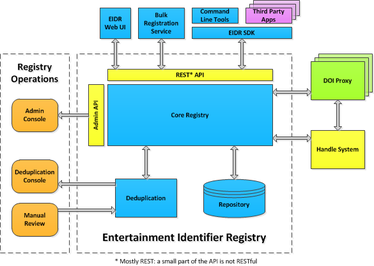
The principal functional blocks are as follows:
- Core Registry: This module is a customization and configuration of the CNRI Digital Object Repository. It performs various functions including registration, generation of unique identifiers, indexing, object storage management, and access control.
- Repository: This stores and provides access to registered objects; for EIDR, these objects are collections of metadata, not the media assets themselves. The metadata includes standard object information, relationships, and access control settings.
- REST API: A REST interface that provides access to the full set of non-administrative registry features. Services can make individual or batched calls, which can be dispatched synchronously or asynchronously. A general query syntax enables the retrieval (and in some cases modification) of registry records satisfying a set of criteria specified by the caller.
- EIDR SDK: this is provided to developers to facilitate the creation of third-party applications (usually in support of a B2B or intramural workflow). It comprises a Java SDK, a .NET SDK, and sample programs built upon the two SDKs. Using the SDK is recommended over direct calls to the REST API.
- Command Line Tools: these are simple Java and .NET applications, built on the SDK, each of which provides a single function, such as resolve, query, match, and register.
- Web UI: a Web-based user interface primarily for search, lookup, and browsing the object hierarchy. It also supports simple registrations.
- DOI Proxy: Using the handle prefix, this forwards EIDR DOI resolution requests to the EIDR registry.
- Handle System: Provides distributed lookup and resolution services
Relation to DOI and Handle System
An EIDR ID is a specialized example of a Digital Object Identifier (DOI), which in turn is built on top of the Handle System developed by the Corporation for National Research Initiatives (CNRI). The EIDR-specific aspects of the lower layers are described in more detail below.
Digital Object Identifier (EIDR Aspects)
A Digital Object Identifier, standardized as ISO 26324,[15] seeks to uniquely identify a wide range of digital artifacts including books, recordings, research data, and other digital content. The goal is not just for the IDs to be unique, but persistent and immutable. As opposed to URLs, DOI identifiers stay the same even if the objects move to another location, or become owned by another organization. Here are some of the characteristics of DOI:
- The International DOI Foundation (IDF) enforces previously agreed rules on the constituent Registration Agencies (e.g. EIDR) to ensure continuity. In particular, if an RA ceases operation, the names it hosts will be taken over by another RA.
- The IDF defines rules to which all DOI names must adhere (what kinds of object may be named by a specific RA)
- The DOI system provides a data model, based on a data dictionary, to enable a structured means of expressing metadata (and inter-object relationships).
- The DOI system has its own highly redundant and distributed set of handle and proxy servers.
- All DOI prefixes are of the form "10.NNNN" where 10 is a directory indicator and "NNNN" is a registrant code in the range 1-65535 (e.g. EIDR content records use is 10.5240)
The DOI data model provides the means to associate metadata with each object, as well as policies governing its use. In the words of the DOI Handbook, metadata may include "names, identifiers, descriptions, types, classifications, locations, times, measurements, relationships and any other kind of information related to [an object]." Metadata flows between the following entities:
- Resource Provider: usually the owner of media asset, which is responsible for inputting metadata to the system.
- Registration Agency: the entities that serves as the repository of the assets (and associated metadata). As noted DOI supports a federation of independent RA's, each responsible for a set of assets. EIDR is one such RA. Others include CrossRef for scholarly articles, DataCite for research data, and OPOCE for official publications of the European Union.
- Service User: the entities making queries to RA's retrieve metadata associated with assets. The DOI resolution framework is responsible for dispatching a query to the appropriate RA (the Service User doesn't need to know this).
لتعزيز التوافق بين أنظمة إدارة الأصول، يتبنى نظام DOI مفهوم نواة البيانات الوصفية. وهي مجموعة أساسية من البيانات الوصفية التي يجب أن تتضمنها جميع الكائنات المخزنة ضمن إطار عمل DOI. يمكن الاطلاع على المجموعة الكاملة في دليل DOI. يُعد التوافق موضوعًا واسعًا يتجاوز نطاق EIDR، ولكن المجموعة الفرعية التالية ذات صلة خاصة بأصول EIDR:
referent: كائن يتم الاحتفاظ به في نظام DOI.referentNameاسم المرجع (مثلاً عنوان فيلم)primaryReferentTypeبالنسبة لـ EIDR، يشمل ذلك الإنشاء (مثل الأصول الترفيهية) والطرف (مثل منشئها).structuralTypeهذه فئات حصرية متبادلة تحدد شكل الأصل. ومن بين الفئات ذات الصلة بأصول EIDR، هناك فئتان: التجريد (كائن مثل فيلم قد يوجد بأشكال متعددة) والأداء (حالة محددة من كائن مثل نسخة المخرج).principalAgent: بالنسبة للإبداعات، الكيان المسؤول بشكل أساسي عن وجودها.registrationAuthorityCodeيشير الرمز : إلى الوكالة التي أصدرت وثيقة تعريف الأصول (DOI). وهذا ما يُعرف بـ EIDR RA لأصول EIDR.
تتوفر بيانات تعريف EIDR بتنسيق بيانات تعريف DOI القياسي، بالإضافة إلى تنسيقات خاصة بـ EIDR. معرّف DOI لمخطط بيانات تعريف DOI هو doi : 10.1000/276 .
نظام المناولة (جوانب EIDR)
يتم تطبيق نظام DOI بدوره على نظام Handle، وهو خدمة موزعة وقابلة للتوسع بدرجة كبيرة لحل أسماء النطاقات. ويُعرَّف المعرّف (Handle) على النحو التالي:
- <Handle> ::= <Handle Naming Authority> "/" <Handle Local Name>
تُعدّ هيئة التسمية فريدة عالميًا، وتُحدد كلًا من النطاق الإداري وبنية اسم المعرّف المحلي. بالنسبة لـ EIDR في التعريف أعلاه، فإنّ "10.5240" هي هيئة تسمية EIDR، وهي المسؤولة عن تحديد اللاحقة (بما في ذلك ضمان توافقها مع البنية المتوقعة لأصل EIDR). ويُعدّ نطاق هيئات التسمية المسموح بها أكثر عمومية من النطاق المُستخدم في DOI (أو EIDR).
تتيح الطبيعة الموزعة لنظام Handle استضافة كل مساحة اسم محلية على مواقع خدمة متعددة موزعة جغرافيًا. هذا نموذج اتحادي حيث تتمتع كل مساحة اسم محلية بالتحكم الكامل في موقع وتشغيل مواقع الخدمة الخاصة بها. علاوة على ذلك، قد يحتوي كل موقع خدمة على عدة خوادم حلّ: سيتم توزيع الطلبات الموجهة إلى موقع خدمة معين بالتساوي عبر خوادمه المكونة له.
نموذج بيانات نظام المقابض بسيط ولكنه مرن. يمكن ربط عدد غير محدود من القيم بكل مقبض. بمرور الوقت، يمكن إنشاء هذه القيم وتعديلها وحذفها. لكل قيمة من هذه القيم السمات التالية:
- الفهرس : عدد صحيح غير موقع يحدد قيمة البيانات من بين القيم الأخرى التي قد تكون موجودة لهذا المقبض.
- type: a UTF-8 string identifying the type. The type system is extensible and common types are maintained as handles in the "0.TYPE" naming authority. There are no restrictions on the creation of new types, although using resolvable handles as type names is recommended best practice. Common types include URL for a single of indirection, "10320/loc" for a set of context-based resolution alternatives, and various administrative types for Handle System management, all of which are based on handle resolution.
- data: the value itself, represented as a sequence of octets which are interpreted in the context of the associated type
- permission: access rights to this particular value. Note that different data values of a handle may have different permissions
- TTL: an integer that specifies how long a value may be cached
- timestamp: an integer (expressed as milliseconds from the Unix epoch) that records the last time the value was updated
- reference: a list of references to other handle values. These are usually used to add credentials (e.g. a digital signature).
Accessing the Handle System is done via a wire protocol defined in RFC 3652; EIDR applications don't have to be concerned with this because of the layering of protocols.
See also
- Authority control
- WikidataProperty:P2704
Further reading
- R. Kroon, R. Drewry, A. Leigh, S. McConnachie. "Content Identification for Audiovisual Archives". International Association of Sound and Audiovisual Archives Journal, Summer 2015 (No. 45).
- R. Kroon. "Bringing Order to Digital Identifiers". Media and Entertainment Journal Winter 2014-2015: 148–150.
- R. Drewry, D. Dulchinos. "Transforming Entertainment Through Technology". Media and Entertainment Journal Winter 2013-2014: 81–88.
- D. Agranoff, W. Michel, T. Wakai. "Streamlined Content Metadata Integration and Management Using Entertainment ID Registry (EIDR)". SCTE Cable-Tec Expo 2012.
External links
References
- ↑ISO/IEC 7064:2003: Information technology -- Security techniques -- Check character systems. 2002
- ↑W3C XML Schema Part 2: Datatypes Second Edition
- ↑SMPTE RP 2079Archived 2015-04-02 at the Wayback Machine. DOI Name and EIDR Identifier Representation.
- ↑Advanced Media Workflow Association AS-03 MXF Program Delivery Specification.
- ↑Advanced Media Workflow Association AS-11 MFX for Contribution Specification.
- ↑SMPTE RP 2021-5:2013. Using Ad-ID and EIDR as Alternate Identifiers in SMPTE BXF and ATSC PMCP.
- ↑ EBU TECH 3293. مجموعة بيانات EBU الأساسية الإصدار 1.5.
- ↑ وثيقة DVB A167-2. البث الرقمي للفيديو (DVB)؛ الشاشات والتدفقات المصاحبة؛ الجزء 2: تحديد المحتوى ومزامنة الوسائط، يوليو 2014. ص 52.
- ↑ ISO/IEC CD 23000-15 . تكنولوجيا المعلومات - تنسيق تطبيق الوسائط المتعددة (MPEG-A) - الجزء 15: تنسيق تطبيق حفظ الوسائط المتعددة.
- ↑ MD-SP-AMIv3.0-I02-121210 مؤرشف بتاريخ 2015-04-02 في Wayback Machine . مواصفات واجهة إدارة الأصول من CableLabs الإصدار 3.0.
- ↑ ANSI/SCTE 35 2013 مؤرشف بتاريخ 2015-04-02 في Wayback Machine . رسالة إشارة إدخال البرنامج الرقمي للكابل.
- ↑ SCTE 130-10 2013 مؤرشف بتاريخ 24-09-2015 في Wayback Machine . إدراج البرامج الرقمية - واجهات أنظمة الإعلان، الجزء 10.
- ↑ ملخص ورشة العمل TC 372. كيف نشأت المواصفة EN 15744 والمواصفة EN 15907.
- ↑ بيان صحفي . شركة سويسكوم تُكمل أول عملية نشر أوروبية لسجل هوية الترفيه مع media-press.tv.
- ↑ ISO 26324:2012 : المعلومات والتوثيق -- نظام تعريف الكائنات الرقمية، 2012.
- تكنولوجيا الأفلام والفيديو
- تعريف
- المعرفات
- المعرفات الفريدة