
Multivariate gamma function
In mathematics, the multivariate gamma function Γp is a generalization of the gamma function. It is useful in multivariate statistics, appearing in the probability density function of the Wishart and inverse Wishart distributions, and the matrix variate beta distribution.[1]
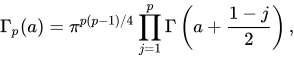
It has two equivalent definitions. One is given as the following integral over the positive-definite real matrices:


where denotes the determinant of . The other one, more useful to obtain a numerical result is:



In both definitions, is a complex number whose real part satisfies . Note that reduces to the ordinary gamma function. The second of the above definitions allows to directly obtain the recursive relationships for :





Thus


and so on.
This can also be extended to non-integer values of with the expression:


Where G is the Barnes G-function, the indefinite product of the Gamma function.
The function is derived by Anderson[2] from first principles who also cites earlier work by Wishart, Mahalanobis and others.
There also exists a version of the multivariate gamma function which instead of a single complex number takes a -dimensional vector of complex numbers as its argument. It generalizes the above defined multivariate gamma function insofar as the latter is obtained by a particular choice of multivariate argument of the former.[3]
Derivatives
We may define the multivariate digamma function as

and the general polygamma function as

Calculation steps
- Since
- it follows that

- By definition of the digamma function, ψ,

- it follows that
![{\displaystyle {\begin{aligned}{\frac {\partial \Gamma _{p}(a)}{\partial a}}&=\pi ^{p(p-1)/4}\prod _{j=1}^{p}\Gamma (a+(1-j)/2)\sum _{i=1}^{p}\psi (a+(1-i)/2)\\[4pt]&=\Gamma _{p}(a)\sum _{i=1}^{p}\psi (a+(1-i)/2).\end{aligned}}}](https://wikimedia.org/api/rest_v1/media/math/render/svg/53be1f08a21a67f4a4d96fa959255f792b5071d1)
References
- ↑James, Alan T. (June 1964). "Distributions of Matrix Variates and Latent Roots Derived from Normal Samples". The Annals of Mathematical Statistics. 35 (2): 475–501. doi:10.1214/aoms/1177703550. ISSN 0003-4851.
- ↑Anderson, T W (1984). An Introduction to Multivariate Statistical Analysis. New York: John Wiley and Sons. pp. Ch. 7. ISBN 0-471-88987-3.
- ↑D. St. P. Richards (n.d.). "Chapter 35 Functions of Matrix Argument". Digital Library of Mathematical Functions. Retrieved 23 May 2022.
- 1. James, A. (1964). "Distributions of Matrix Variates and Latent Roots Derived from Normal Samples". Annals of Mathematical Statistics. 35 (2): 475–501. doi:10.1214/aoms/1177703550. MR 0181057. Zbl 0121.36605.
- 2. A. K. Gupta and D. K. Nagar 1999. "Matrix variate distributions". Chapman and Hall.
- Gamma and related functions