التقييم p -adic

في نظرية الأعداد ، يُعرف التقييم p -adic أو الرتبة p -adic للعدد الصحيح n بأنه أس أعلى قوة للعدد الأولي p الذي يقسم n . ويُرمز له بـνص(ن){\displaystyle \nu _{p}(n)}أو بعبارة أخرى،νص(ن){\displaystyle \nu _{p}(n)}هو الأس الذيص{\displaystyle p}يظهر في التحليل إلى العوامل الأولية لـن{\displaystyle n}.

التقييم p -adic هو تقييم ويؤدي إلى نظير للقيمة المطلقة المعتادة ، على الرغم من أنه على عكس الأخيرة، فإن القيمة المطلقة p -adic ليست أرخميدية . بينما ينتج عن إكمال الأعداد النسبية بالنسبة للقيمة المطلقة المعتادة الأعداد الحقيقية.R{\displaystyle \mathbb {R} }إكمال الأعداد النسبية بالنسبة للقيمة المطلقة p -adic ينتج عنه الأعداد p -adicسؤالص{\displaystyle \mathbb {Q} _{p}}[ 1 ]

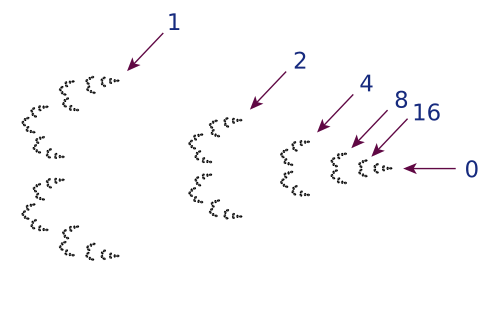
توزيع الأعداد الطبيعية حسب قيمتها الثنائية، مع الإشارة إلى قوى العدد اثنين المقابلة لها في النظام العشري. الصفر له قيمة لانهائية.

التعريف والخصائص

ليكن p عددًا أوليًا .

الأعداد الصحيحة

التقييم p -adic لعدد صحيحن{\displaystyle n}يُعرَّف بأنه

νص(ن)={مأx{كشمال0:صك|ن}لو ن0لو ن=0،{\displaystyle \nu _{p}(n)={\begin{cases}\mathrm {max} \{k\in \mathbb {N} _{0}:p^{k}\mid n\}&{\text{if }}n\neq 0\\\infty &{\text{if }}n=0,\end{cases}}}

أينشمال0{\displaystyle \mathbb {N} _{0}}يرمز إلى مجموعة الأعداد الطبيعية (بما في ذلك الصفر) وم|ن{\displaystyle m\mid n}يدل على قابلية القسمةن{\displaystyle n}بواسطةم{\displaystyle m}. بخاصة،νص{\displaystyle \nu _{p}}هي دالةνص:Zشمال0{}{\displaystyle \nu _{p}\colon \mathbb {Z} \to \mathbb {N} _{0}\cup \{\infty \}}[ 2 ]

على سبيل المثال،ν2(-12)=2{\displaystyle \nu _{2}(-12)=2}،ν3(-12)=1{\displaystyle \nu _{3}(-12)=1}، وν5(-12)=0{\displaystyle \nu _{5}(-12)=0}منذ|-12|=12=223150{\displaystyle |{-12}|=12=2^{2}\cdot 3^{1}\cdot 5^{0}}.

الترميزصكن{\displaystyle p^{k}\parallel n}يُستخدم أحيانًا بمعنىك=νص(ن){\displaystyle k=\nu _{p}(n)}[ 3 ]

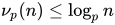
لون{\displaystyle n}إذا كان عددًا صحيحًا موجبًا، فإنνص(ن)سجلصن{\displaystyle \nu _{p}(n)\leq \log _{p}n}وهذا يتبع مباشرة مننصνص(ن){\displaystyle n\geq p^{\nu _{p}(n)}}.

الأعداد النسبية

يمكن توسيع التقييم p-adic ليشمل الأعداد النسبية كدالة

νص:سؤالZ{}{\displaystyle \nu _{p}:\mathbb {Q} \to \mathbb {Z} \cup \{\infty \}}[ 4 ] [ 5 ]

محدد بواسطة

νص(رs)=νص(ر)-νص(s).{\displaystyle \nu _{p}\left({\frac {r}{s}}\right)=\nu _{p}(r)-\nu _{p}(s).}

على سبيل المثال،ν2(98)=-3{\displaystyle \nu _{2}{\bigl (}{\tfrac {9}{8}}{\bigr )}=-3}وν3(98)=2{\displaystyle \nu _{3}{\bigl (}{\tfrac {9}{8}}{\bigr )}=2}منذ98=2-332{\displaystyle {\tfrac {9}{8}}=2^{-3}\cdot 3^{2}}.

بعض الخصائص هي:

νص(رs)=νص(ر)+νص(s){\displaystyle \nu _{p}(r\cdot s)=\nu _{p}(r)+\nu _{p}(s)}
νص(ر+s)مين{νص(ر)،νص(s)}{\displaystyle \nu _{p}(r+s)\geq \min {\bigl \{}\nu _{p}(r),\nu _{p}(s){\bigr \}}}

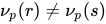
علاوة على ذلك، إذاνص(ر)νص(s){\displaystyle \nu _{p}(r)\neq \nu _{p}(s)}، ثم

νص(ر+s)=مين{νص(ر)،νص(s)}{\displaystyle \nu _{p}(r+s)=\min {\bigl \{}\nu _{p}(r),\nu _{p}(s){\bigr \}}}

أينمين{\displaystyle \min }هو الحد الأدنى (أي الأصغر من الاثنين).

صيغة التقييم p -adic للأعداد الصحيحة

تُظهر معادلة ليجندر أنνص(ن!)=أنا=1نصأنا{\displaystyle \nu _{p}(n!)=\sum _{i=1}^{\infty {}}{\left\lfloor {\frac {n}{p^{i}}}\right\rfloor {}}}.

لأي عدد صحيح موجب n ،ن=ن!(ن-1)!{\displaystyle n={\frac {n!}{(n-1)!}}}وهكذاνص(ن)=νص(ن!)-νص((ن-1)!){\displaystyle \nu _{p}(n)=\nu _{p}(n!)-\nu _{p}((n-1)!)}.

لذلك،νص(ن)=أنا=1(نصأنا-ن-1صأنا){\displaystyle \nu {}_{p}(n)=\sum _{i=1}^{\infty {}}{{\bigg (}\left\lfloor {\frac {n}{p^{i}}}\right\rfloor {}-\left\lfloor {\frac {n-1}{p^{i}}}\right\rfloor {}{\bigg )}}}.

يمكن اختزال هذا المجموع اللانهائي إلىأنا=1سجلص(ن)(نصأنا-ن-1صأنا){\displaystyle \sum _{i=1}^{\lfloor {\log _{p}{(n)}\rfloor {}}}{{\bigg (}\left\lfloor {\frac {n}{p^{i}}}\right\rfloor {}-\left\lfloor {\frac {n-1}{p^{i}}}\right\rfloor {}{\bigg )}}}.

يمكن توسيع هذه الصيغة لتشمل قيم الأعداد الصحيحة السالبة، لنحصل على:

νص(ن)=أنا=1سجلص(|ن|)(|ن|صأنا-|ن|-1صأنا){\displaystyle \nu {}_{p}(n)=\sum _{i=1}^{\lfloor {\log _{p}{(|n|)}\rfloor {}}}{{\bigg (}\left\lfloor {\frac {|n|}{p^{i}}}\right\rfloor {}-\left\lfloor {\frac {|n|-1}{p^{i}}}\right\rfloor {}{\bigg )}}}

القيمة المطلقة p -adic

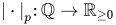
القيمة المطلقة p -adic (أو المعيار p -adic، [ 6 ] على الرغم من أنه ليس معيارًا بمعنى التحليل) علىسؤال{\displaystyle \mathbb {Q} }هي الوظيفة

||ص:سؤالR0{\displaystyle |\cdot |_{p}\colon \mathbb {Q} \to \mathbb {R} _{\geq 0}}

محدد بواسطة

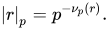
|ر|ص=ص-νص(ر).{\displaystyle |r|_{p}=p^{-\nu _{p}(r)}.}

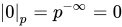
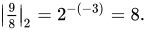
وبذلك،|0|ص=ص-=0{\displaystyle |0|_{p}=p^{-\infty }=0} for all p{\displaystyle p} and for example, |12|2=22=14{\displaystyle |{-12}|_{2}=2^{-2}={\tfrac {1}{4}}} and |98|2=2(3)=8.{\displaystyle {\bigl |}{\tfrac {9}{8}}{\bigr |}_{2}=2^{-(-3)}=8.}

The p-adic absolute value satisfies the following properties.

Non-negativity|r|p0{\displaystyle |r|_{p}\geq 0}
Positive-definiteness|r|p=0r=0{\displaystyle |r|_{p}=0\iff r=0}
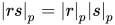
Multiplicativity|rs|p=|r|p|s|p{\displaystyle |rs|_{p}=|r|_{p}|s|_{p}}
Non-Archimedean|r+s|pmax(|r|p,|s|p){\displaystyle |r+s|_{p}\leq \max \left(|r|_{p},|s|_{p}\right)}

From the multiplicativity|rs|p=|r|p|s|p{\displaystyle |rs|_{p}=|r|_{p}|s|_{p}} it follows that |1|p=1=|1|p{\displaystyle |1|_{p}=1=|{-1}|_{p}} for the roots of unity1{\displaystyle 1} and 1{\displaystyle -1} and consequently also |r|p=|r|p.{\displaystyle |{-r}|_{p}=|r|_{p}.} The subadditivity|r+s|p|r|p+|s|p{\displaystyle |r+s|_{p}\leq |r|_{p}+|s|_{p}} follows from the non-Archimedeantriangle inequality|r+s|pmax(|r|p,|s|p){\displaystyle |r+s|_{p}\leq \max \left(|r|_{p},|s|_{p}\right)}.

Product formula

The choice of base p in the exponentiationpνp(r){\displaystyle p^{-\nu _{p}(r)}} makes no difference for most of the properties, but supports the product formula:

0,p|r|p=1{\displaystyle \prod _{0,p}|r|_{p}=1}

where the product is taken over all primes p and the usual absolute value, denoted |r|0{\displaystyle |r|_{0}}. This follows from simply taking the prime factorization: each prime power factor pk{\displaystyle p^{k}} contributes its reciprocal to its p-adic absolute value, and then the usual Archimedean absolute value cancels all of them.

By Ostrowski's theorem, the usual and p-adic absolute values occurring in the formula are all the absolute values on the rational numbers up to equivalence. An analogous product formula can be used to axiomatically define global fields, of which the rational numbers are the simplest example.

Metric and completion

A metric space can be formed on the set Q{\displaystyle \mathbb {Q} } with a (non-Archimedean, translation-invariant) metric

d:Q×QR0{\displaystyle d\colon \mathbb {Q} \times \mathbb {Q} \to \mathbb {R} _{\geq 0}}

defined by

d(r,s)=|rs|p.{\displaystyle d(r,s)=|r-s|_{p}.}

The completion of Q{\displaystyle \mathbb {Q} } with respect to this metric leads to the set Qp{\displaystyle \mathbb {Q} _{p}} of p-adic numbers. Like the rationals, they form a field, and the p-adic valuation and absolute value can be extended to Qp{\displaystyle \mathbb {Q} _{p}}, making it a complete valued field.

See also

References

  1. Dummit, David S.; Foote, Richard M. (2003). Abstract Algebra (3rd ed.). Wiley. pp. 758–759. ISBN 0-471-43334-9.
  2. Ireland, K.; Rosen, M. (2000). A Classical Introduction to Modern Number Theory. New York: Springer-Verlag. p. 3.
  3. Niven, Ivan; Zuckerman, Herbert S.; Montgomery, Hugh L. (1991). An Introduction to the Theory of Numbers (5th ed.). John Wiley & Sons. p. 4. ISBN 0-471-62546-9.
  4. with the usual order relation, namely
    >n{\displaystyle \infty >n},
    and rules for arithmetic operations,
    +n=n+={\displaystyle \infty +n=n+\infty =\infty },
    على خط الأعداد الممتد.
  5. خرينيكوف، أ.؛ نيلسون، م. (2004). الديناميكا الحتمية والعشوائية من الرتبة p -adic . دار نشر كلوير الأكاديمية. ص 9. 
  6. مورتي، م. رام (2001). مسائل في نظرية الأعداد التحليلية . نصوص الدراسات العليا في الرياضيات. المجلد 206. سبرينغر-فيرلاغ، نيويورك. الصفحات 147-148 . doi : 10.1007/978-1-4757-3441-6 . ISBN   0-387-95143-1MR 1803093