
Golf course


A golf course is the grounds on which the sport of golf is played. It consists of a series of holes, each consisting of a tee box, a fairway, the rough and other hazards, and a green with a cylindrical hole in the ground, known as a "cup". The cup holds a flagstick, known as a "pin". A standard round of golf consists of 18 holes,[1] and as such most courses contain 18 distinct holes; however, there are many 9-hole courses and some that have holes with shared fairways or greens. There are also courses with a non-standard number of holes, such as 12 or 14.[2][3]
The vast majority of golf courses have holes of varying length and difficulty that are assigned a standard score, known as par, that a proficient player should be able to achieve; this is usually three, four or five strokes. Par-3 courses consist of holes all of which have a par of three. Short courses have gained in popularity; these consist of mostly par 3 holes, but often have some short par 4 holes.[4]
Many older courses are links, often coastal. The first golf courses were based on the topography of sand dunes and dune slacks with a ground cover of grasses, exposed to the wind and sea.[5] Courses are private, public, or municipally owned, and typically feature a pro shop. Many private courses are found at country clubs.
History
Today there are approximately 38,000-40,000 golf courses in the world, spanning 200+ countries. United States has over 40% of all golf courses in the world. [6]
Design
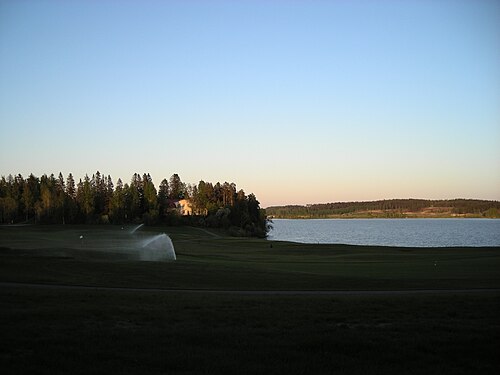
على الرغم من أن تصميم ملاعب الغولف يُعد تخصصًا ضمن تصميم المناظر الطبيعية أو هندسة المناظر الطبيعية ، إلا أنه يُعتبر مجالًا دراسيًا مستقلًا. بعض مصممي ملاعب الغولف يكتسبون شهرةً واسعةً بفضل جهودهم، مثل أليستر ماكنزي ؛ بينما يُعد آخرون لاعبين محترفين ذوي مكانة مرموقة، ويُظهرون تقديرًا كبيرًا لتصميم ملاعب الغولف، مثل جاك نيكلاوس . يُمثل هذا المجال جزئيًا الجمعية الأمريكية لمهندسي ملاعب الغولف ، والمعهد الأوروبي لمهندسي ملاعب الغولف ، وجمعية مهندسي ملاعب الغولف الأسترالية ، مع أن العديد من أفضل مهندسي ملاعب الغولف في العالم يختارون عدم الانضمام إلى أي من هذه الجمعيات، لأن جمعيات المهندسين المعماريين ليست هيئات ترخيص حكومية، بل هي مجموعات خاصة. في حين أن ملاعب الغولف غالبًا ما تتبع المناظر الطبيعية الأصلية، إلا أن بعض التعديلات أمر لا مفر منه. ويزداد هذا الأمر أهميةً مع ازدياد احتمالية إنشاء ملاعب جديدة على أراضٍ أقل مثالية. يقوم المهندسون المعماريون دائمًا ببناء المخابئ الرملية وحواجز الرمال، إلا إذا كانت هذه العناصر موجودة بالفعل في التضاريس الطبيعية للملعب. [ 7 ]
يتبع تصميم ملعب الغولف مبادئ تقليدية محددة، مثل عدد الحفر (تسع حفر وثماني عشرة حفرة هي الأكثر شيوعًا)، وقيمها القياسية، وعدد الحفر من كل قيمة قياسية في الملعب. كما يُفضّل أن تكون المساحات الخضراء قريبة من نقطة انطلاق الحفرة التالية، لتقليل مسافة التنقل أثناء اللعب، ولتنويع مزيج الحفر القصيرة والطويلة. ونظرًا لضرورة حصر جميع الممرات ضمن مساحة أرضية مربعة أو مستطيلة صغيرة في الغالب، تميل ممرات الملعب إلى تشكيل نمط تبليط متقابل. في المناطق المعقدة، قد تشترك حفرتان في نفس نقطة الانطلاق أو الممر أو حتى المساحة الخضراء. ومن الشائع أيضًا تخصيص نقاط انطلاق منفصلة للرجال والنساء والهواة، بحيث تكون كل نقطة أقرب إلى المساحة الخضراء. تُقسّم ملاعب الغولف ذات الثماني عشرة حفرة تقليديًا إلى "التسع حفر الأمامية" (الحفر من 1 إلى 9) و"التسع حفر الخلفية" (الحفر من 10 إلى 18). في ملاعب الغولف القديمة (وخاصةً ملاعب الروابط، مثل ملعب سانت أندروز القديم)، قد تُصمم الحفر في مسار دائري طويل واحد، يبدأ وينتهي عند النادي، ولذلك يُشار إلى التسع حفر الأمامية في بطاقة النتائج بـ "خارج" (أي الخروج من النادي) والتسع حفر الخلفية بـ "داخل" (أي العودة إلى النادي). أما الملاعب الأحدث (وخاصةً الملاعب الداخلية) فتميل إلى أن يكون مسارها بحيث تُشكل التسع حفر الأمامية والتسع حفر الخلفية مسارًا دائريًا منفصلاً يبدأ وينتهي عند النادي. يُعزى ذلك جزئيًا إلى تسهيل الأمر على اللاعبين والنادي، حيث يُصبح من الأسهل لعب جولة من تسع حفر فقط، إذا رغب اللاعب بذلك، أو التوقف عند النادي لتناول وجبة خفيفة بين التسع حفر الأمامية والتسع حفر الخلفية. [ 8 ]
Landscape design involves the integration of aesthetic and functional elements. The process includes the arrangement of vegetation, water features, pathways, and structural materials such as stone and wood.[9]
New environmentally responsible design practices mean that a successful design more than harmonizes with the landscaping; it benefits the environment. A successful design also not just pleasing and playable, but is environmentally responsible.[10]
Par
Most golf courses have only par-3, −4, and −5 holes, although some courses include par-6 holes. The Ananti CC and the Satsuki golf course in Sano, Japan, are the only courses with par-7 holes.[11]
Par is primarily determined by the playing length of each hole from the teeing ground to the putting green. Holes are generally assigned par values between three and five, which includes a regulation number of strokes to reach the green based on the average distance a proficient golfer hits the ball, and two putts.[12] On occasion, factors other than distance are taken into account when setting the par for a hole; these include altitude, terrain and obstacles that result in a hole playing longer or shorter than its measured distance, e.g. route is significantly uphill or downhill, or requiring play of a stroke to finish short of a body of water before hitting over it.[13]
Under the United States Golf Association, the typical distances for the various holes from standard tees are as follows:[13]
Men
- Par 3 – Under 260 yards (240 m)
- Par 4 – 240–490 yards (220–450 m)
- Par 5 – 450–710 yards (410–650 m)
- Par 6 – 670 yards (610 m) or longer
Women
- Par 3 – Under 220 yards (200 m)
- Par 4 – 200–420 yards (180–380 m)
- Par 5 – 370–600 yards (340–550 m)
- Par 6 – 570 yards (520 m) or longer
Features
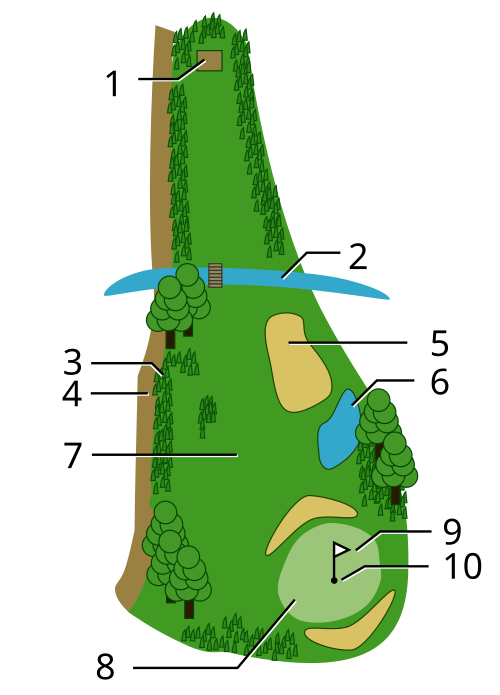
Teeing area
يتألف الجزء الأول من كل حفرة من منطقة الانطلاق ، أو ما يُعرف بصندوق الانطلاق. عادةً ما يتوفر أكثر من صندوق لوضع الكرة ، ويختلف كل صندوق عن الآخر في المسافة من الحفرة (وربما في زاوية الاقتراب من المنطقة الخضراء أو الممر) لتوفير مستويات صعوبة متفاوتة. تكون منطقة الانطلاق مستوية قدر الإمكان، مغطاة بعشب قصير يشبه عشب منطقة وضع الكرة، ومعظمها مرتفع قليلاً عن الممر المحيط.
تحتوي كل منطقة انطلاق على علامتين تُحددان حدود منطقة الانطلاق القانونية. تمتد منطقة الانطلاق على المسافة بين العلامتين، وتتجاوز طول عصاتين خلفهما. يجوز للاعب الوقوف خارج منطقة الانطلاق، ولكن يجب وضع الكرة وضربها من داخلها. [ 14 ] يمكن للاعب وضع كرته مباشرةً على سطح منطقة الانطلاق (ويُسمى ذلك ضربها "من على الأرض")، أو يمكن تثبيت الكرة على حامل كرة صناعي (بارتفاع لا يتجاوز أربع بوصات)، أو على أي مادة طبيعية، مثل كومة رمل موضوعة على سطح منطقة الانطلاق.
الممر والمنطقة الخشنة
بعد الضربة الأولى من نقطة الانطلاق، يضرب اللاعب الذي تكون كرته الأبعد عن المنطقة الخضراء الكرة من مكان استقرارها؛ وتُعرف هذه النقطة بـ"موضعها". عندما تكون الكرة في اللعب وليست خارج حدود الملعب أو في منطقة خطرة، يجب على اللاعب لعبها من موضعها. [ 15 ] تُسمى المنطقة بين نقطة الانطلاق والمنطقة الخضراء حيث يكون العشب قصيرًا ومستويًا بالممر . أما المنطقة بين الممر وعلامات الخروج عن حدود الملعب، وكذلك بين حافة مُقَصَّة تُحيط بالمنطقة الخضراء وخارج حدود الملعب، فتُسمى المنطقة الخشنة ؛ حيث يكون العشب فيها أطول وأكثر خشونة من الممرات، مما يجعلها مناطق غير مواتية للضرب. في الحفر ذات الثلاث ضربات، يُتوقع من اللاعب أن يكون قادرًا على توجيه الكرة إلى المنطقة الخضراء من الضربة الأولى من نقطة الانطلاق. أما في الحفر الأطول من ثلاث ضربات، فيُتوقع من اللاعبين أن يحتاجوا إلى ضربة إضافية واحدة على الأقل للوصول إلى مناطقهم الخضراء.
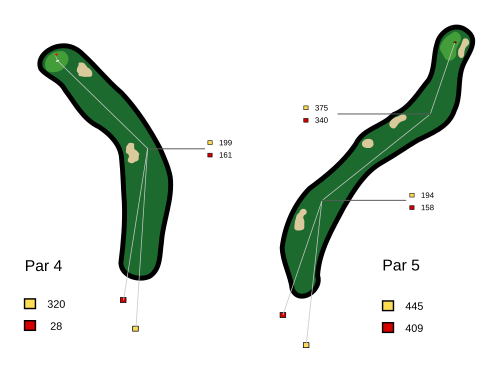
على الرغم من أن العديد من الحفر مصممة بخط رؤية مباشر من نقطة الانطلاق إلى المنطقة الخضراء، إلا أن الحفرة قد تنحني إما إلى اليسار أو إلى اليمين. يُطلق على هذا اسم "الانحناء"، تشبيهًا بانحناء كاحل الكلب. تُسمى الحفرة "انحناء يساري" إذا كانت مائلة نحو اليسار، و"انحناء يميني" إذا كانت مائلة نحو اليمين. قد ينحني اتجاه الحفرة مرتين، وهو ما يُسمى "انحناء مزدوج".

كما توجد أنواع ممتازة من الأعشاب للمساحات الخضراء المخصصة للضربات القصيرة، توجد أيضًا أنواع ممتازة للممرات الخضراء والمناطق الخشنة. تؤثر جودة العشب على تدحرج الكرة، بالإضافة إلى قدرة اللاعب على "حفر قطعة صغيرة" (أي القدرة على ضرب الكرة من الأعلى إلى الأسفل، ثم ضرب العشب وإزالة جزء منه أثناء استمرار حركة المضرب). تُقصّ الممرات الخضراء في البطولات المرموقة، مثل جولة PGA، على ارتفاع منخفض. يؤثر ارتفاع القص على أداء الملعب. على سبيل المثال، يتم تغيير ارتفاع العشب في بطولات الولايات المتحدة المفتوحة من حفرة إلى أخرى لزيادة صعوبة الملعب. ومن الأمثلة على ذلك المناطق الخشنة سيئة السمعة في بطولات الولايات المتحدة المفتوحة، والتي غالبًا ما يتراوح ارتفاعها بين 7.5 و12.5 سم، اعتمادًا على مدى قربها من الممر الأخضر أو المساحة الخضراء. هذا يجعل من الصعب على اللاعب التعويض بعد ضربة سيئة.
تشمل أنواع العشب المستخدمة في الممرات والمناطق الخشنة عشب البنت ، وعشب تيفواي 419 برمودا ، [ 16 ] وعشب الجاودار ، وعشب كنتاكي الأزرق ، وعشب زويزيا . وكما هو الحال في أنواع عشب ملاعب الجولف، لا تتلاءم جميع أنواع العشب بنفس الكفاءة مع جميع أنواع المناخ.
الخضراوات
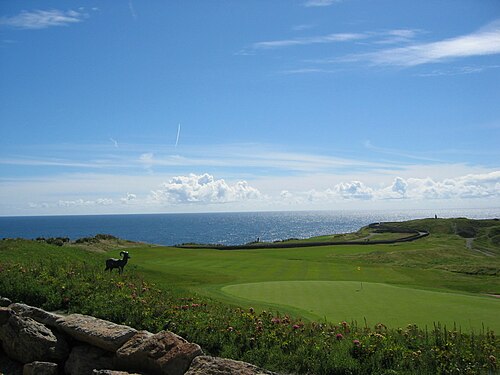
منطقة التهديف ، أو ببساطة "المنطقة الخضراء "، هي مساحة من العشب المشذب بدقة على أرض مستوية وناعمة نسبيًا تحيط بالحفرة، مما يسمح للاعبين بتسديد ضربات دقيقة عليها. "التهديف" هو لعب ضربة على هذه المنطقة، عادةً باستخدام مضرب " التهديف " الخاص بها، والذي يتميز بزاوية ميل منخفضة جدًا بحيث تتدحرج الكرة بسلاسة على الأرض، ونأمل أن تدخل في الحفرة. يمكن أن يختلف شكل وتضاريس المنطقة الخضراء بشكل كبير، ولكن عمليًا، عادةً ما تكون المنطقة الخضراء أكثر استواءً من المناطق الأخرى في الملعب، على الرغم من أن المنحدرات والتموجات الطفيفة يمكن أن تضيف تحديًا إضافيًا للاعبين الذين يجب عليهم مراعاة هذه الاختلافات في خط التهديف. لا تحتوي المنطقة الخضراء عادةً على أي عوائق مغلقة تمامًا مثل الرمل أو الماء؛ ومع ذلك، يمكن وضع هذه العوائق - وغالبًا ما يتم ذلك - بجوار المنطقة الخضراء، واعتمادًا على شكل المنطقة الخضراء والعوائق المحيطة بها، وموقع الحفرة (الذي غالبًا ما يتغير من يوم لآخر لضمان تآكل متساوٍ لعشب المنطقة الخضراء)، قد لا يكون هناك خط تهديف مباشر من نقطة على المنطقة الخضراء إلى الحفرة.
Golfers use a method known as "reading" the green to enhance their chances of making a putt. Reading a green involves determining the speed, grain, incline, decline and tilt of the green on the line of the putt. Most putts are not struck directly at the hole, instead they must be struck to take into account the characteristics of the green to arrive at the hole at the proper angle and speed. The best players will read the green by walking around the green and studying the characteristics of the green before addressing the ball. Many golfers consider reading the green and putting to be the most difficult part of the game.
The green is typically surrounded by slightly higher grass, cut at a height between that of the green and fairway, and then by the fairway and/or rough. This longer grass surrounding the green is known as the fringe and is designed to slow and stop balls rolling along the green from an approach shot or errant putt, preventing them from exiting the green. Though putting strokes can be made on it, the higher grass can interfere with the path of the ball, so players often choose to use a lofted club such as an iron to make a "chip shot" or a "bump and run", where the ball carries in the air for a few yards and then rolls along the green like a normal putt.
The grass of the putting green (more commonly just "green") is cut very short so that a ball can roll for a long distance. The most common types of greens are for cold winter, but warmer summer regions (i.e., not extremely warm, as in the Southern and Southwestern United States) are bent grass greens. A green may consist of a thin carpet so that bad weather is not allowed to become a serious factor in maintaining the course. These are considered the best greens because they may be cut to an extremely low height, and because they may be grown from seed. Bent grass does not have grain, which makes it superior as a putting surface. However, bent grass may become infested with Poa annua, a costly and time-consuming weed. Augusta National is one of many golf courses to use this type of green. The original design of Augusta National did not include bent grass greens, but in the early 1980s the greens were converted from Bermuda to bent grass. This affected the speed of the greens, making them too quick, and several areas were subsequently remodelled to reduce the slopes and make them more playable.[17] Many other golf courses subsequently made the decision to change from Bermuda to bent grass when they observed increased business at courses that had already changed over.[18]
Another type of grass common for greens is TifDwarf Hybrid Bermuda (other variants exist, but TifDwarf is one of the most common), or simply Bermuda grass. Bermuda is more common in regions that have very warm summers and mild winters, such as the Southern and Southwestern United States. Red Bridge Golf Course was the first course in North Carolina to utilize a special Bermuda called Mini Verde. A green is generally established from sod which has had the soil washed off of it (to avoid soil compatibility problems) and which is then laid tightly over the green, then rolled and topdressed with fine sand. Another common and more economical approach for establishing a putting green is to introduce hybrid Bermuda sprigs (the stolon of the grass which are raked out at the sod farm), which are laid out on the green.

Two downside factors of Bermuda greens are cost of maintenance, and also the existence of grain (the growth direction of the blades of grass), which affects the ball's roll and which is called "the grain of the green" and not to be confused with "the rub of the green" which are idiosyncrasies encountered getting through the hole. The slope or break of the green also affects the roll of the ball. The hole, or cup, is always found within the green and must have a diameter of 108 millimeters (4.25 in) and a depth of at least 10 centimeters (3.94 in). Its position on the green is not fixed and typically is changed daily by a greenskeeper in order to prevent excessive localized wear and damage to the turf. A new hole will be cut by a device that removes a plug of the turf from the ground, and the reinforced cup is then moved, before the old hole is filled in with the plug cut from the new hole and levelled. The hole has a flag on a pole positioned in it so that it may be seen from a distance, but not necessarily from the tee. This location marker is officially called the "flagstick" but is also commonly referred to as the "pin". Flagsticks are made of either coated fiberglass, metal, or wood and have a metal or synthetic bottom (called a ferrule) that is designed to fit in the hole cup.
لا تتمتع جميع ملاعب الجولف بنفس الجودة. تتميز أفضل الملاعب بصيانتها الدقيقة التي تضمن انسيابية حركة الكرة على العشب القصير. ويمكن إزالة المياه الزائدة من ملعب الجولف باستخدام آلة خاصة تُسمى " مُزيل المياه" . يصف لاعبو الجولف الملعب بأنه سريع إذا كانت ضربة خفيفة على الكرة كافية لتدحرجها لمسافة طويلة؛ وعلى العكس، في الملعب البطيء ، يلزم ضربة أقوى لتدحرج الكرة لنفس المسافة. ويمكن تحديد السرعة الدقيقة للملعب باستخدام مقياس سرعة الكرة (Stimp Meter ). ومن خلال جمع قياسات عشوائية، يمكن مقارنة ملاعب الجولف من حيث متوسط سرعة الملعب. ومع ذلك، يُحظر بموجب قواعد الجولف اختبار سرعة الملعب أثناء اللعب عن طريق دحرجة الكرة عليه، أو عن طريق لمسه أو فركه.
تُشكّل تكلفة تركيب وصيانة الملاعب العشبية نسبةً كبيرةً من إجمالي نفقات إنشاء وصيانة ملعب الغولف. ولتوفير المال، تلجأ العديد من ملاعب الغولف منخفضة التكلفة، التي تستهدف اللاعبين الهواة، إلى استخدام الملاعب الرملية بدلاً من العشب الطبيعي. وفي السنوات الأخيرة، أصبح العشب الصناعي خيارًا شائعًا بشكل متزايد كبديل أقل تكلفة للعشب الطبيعي، إذ يُحاكي مظهره وملمسه بشكلٍ أفضل من الرمل.
يُطلق على تصميم المساحة الخضراء ذات المقدمة المرتفعة اسم المقدمة الزائفة ، لأنها تتسبب بشكل خادع في تدحرج الكرات التي تصطدم بهذا الجزء من المساحة الخضراء إلى الخلف. [ 19 ]
المخاطر
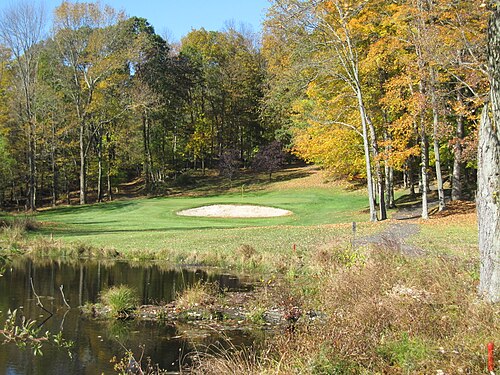
غالباً ما تتضمن الحفر مخاطر، وهي مناطق خاصة لها قواعد إضافية للعب، وهي بشكل عام من نوعين: (1) مخاطر المياه، مثل البرك والبحيرات والأنهار؛ و(2) المخابئ الرملية أو مصائد الرمال.
Special rules apply to playing a ball that falls in a hazard. For example, a player may not touch the ground or water with their club before playing the ball, not even for a practice swing. A ball in any hazard may be played as it lies without penalty. If it cannot be played from the hazard, the ball may be hit from another location, generally with a penalty of one stroke. The Rules of Golf specify exactly the point from which the ball may be played outside a hazard. Bunkers are small to medium areas, usually lower than the fairway but of varying topography, that are filled with sand and generally incorporate a raised lip or barrier. It is more difficult to play the ball from sand than from grass, as the ball may embed itself into the sand, and the loose nature of the sand and more severe sloping of many bunkers make taking one's stance more difficult. As in any hazard, a ball in a bunker must be played without touching the sand with the club except during the stroke, and loose impediments (leaves, stones, twigs) must not be moved before making the stroke.
Courses may also have other design features which the skilled player will avoid; there are earth bunkers (pits or depressions in the ground that are not filled with sand but require a lofted shot to escape), high grass and other dense vegetation, trees or shrubs, ravines and other rocky areas, steep inclines, etc.; while disadvantageous to play from, these are typically not considered "hazards" unless specifically designated so by the course (a ravine or creek bed may be termed a "water hazard" even if completely dry)
Driving range
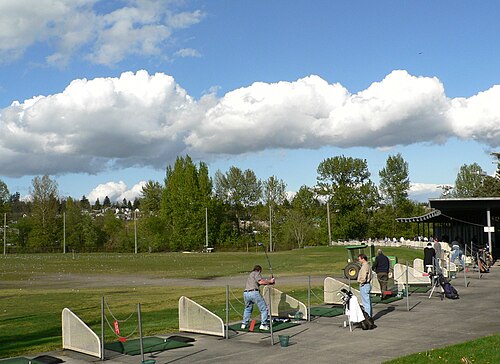
Often, a golf course will include among its facilities a practice range or driving range, usually with practice greens, bunkers, and driving areas. Markers showing distances are usually included on a practice range for the golfer's information. Driving ranges are also commonly found as separate facilities, unattached to a golf course, where players may simply hit balls into the range for practice or enjoyment.
There may even be a practice course (often shorter and easier to play than a full-scale course), where players may measure the distance they can obtain with a specific club, or in order to improve their swing technique. Practice courses often consist of old holes of a previous design that are kept and maintained for practice purposes or as substitute holes if one or more holes become unplayable; a 21-hole golf course, for instance, will have three additional holes that can be used for practice or as substitutes for a flooded or otherwise damaged hole.
Signature hole
Many golf courses have what may be referred to as a "signature hole". This will commonly be the most memorable, aesthetically pleasing or photogenic hole.[20]
Types
Links

Links is a Scottish term, from the Old English word hlinc : "rising ground, ridge", describing coastal sand dunes and sometimes similar areas inland.[21] It is on links land near the towns of central eastern Scotland that golf has been played since the 15th century.[22]
The shallow topsoil and sandy subsoil made links land unsuitable for the cultivation of crops or for urban development and was of low economic value. The links were often treated as common land by the residents of the nearby towns and were used by them for recreation, animal grazing and other activities such as laundering clothes.
The closely grazed turf and naturally good drainage of the links was ideal for golf, and areas of longer grass, heather, low growing bushes and exposed sand provided the hazards that are familiar on modern courses. Although early links courses were often close to the sea it was rarely used as a hazard, perhaps due to the instability of the dunes closest to the water and the high cost of hand-made golf balls precluding anything that could result in their irrecoverable loss. The land is naturally treeless and this combined with their coastal location makes wind and weather an important factor in links golf.
Traditional links courses are often arranged with holes in pairs along the coastline; players would play "out" from the town through a series of holes to the furthest point of the course, and then would return "in" along the second set of holes.[22] The holes may share fairways and sometimes greens (such as at St Andrews to economize on land use, but in modern times this is rare due to the potential for injury from balls coming the other way.
Famous links courses include the Old Course at St. Andrews, often described as the "Home of Golf", and Musselburgh Links, which is generally regarded as the first recorded golf course. The Open Championship, the oldest of golf's major championships, is always played on a links course.[23] Links and links-style golf courses have been developed throughout the world, reproducing the broken, treeless terrain with deep bunkers of their Scottish prototypes.
Executive
An executive course or short course is a course with a total par significantly less than that of a typical 18-hole course. Two main types exist:
- ملعب "9 حفر"، وهو عادةً النوع الذي يشار إليه باسم "ملعب تنفيذي"، يحتوي على 9 حفر فقط بدلاً من 18، ولكن مع المزيج الطبيعي من حفر البار 3 والبار 4 والبار 5 (والتي تنتج عادةً نتيجة بار تتراوح بين 34 و36)، ويمكن لعب الملعب مرة واحدة للعبة قصيرة، أو مرتين لجولة كاملة.
- يتكون ملعب "بار 3" من 9 أو 18 حفرة، ويبلغ طول كل حفرة فيه 240 ياردة أو أقل من نقطة انطلاق الرجال، ولا توجد فيه حفر من نوع بار 4 أو بار 5 تتطلب ضربات مباشرة فوق المنطقة الخضراء (مع أن ملعب "بار 3" قد يحتوي أحيانًا على حفرة من نوع بار 4 أو حتى بار 5). ونتيجة لذلك، يكون مجموع الضربات في ملعب بار 3 ذي 18 حفرة هو 54 ضربة بدلًا من 68-72 ضربة المعتادة. ولا تزال بعض ملاعب بار 3 تتطلب استخدام مضرب خشبي في بعض ضربات الانطلاق، وبالتالي يتم استخدام مجموعة كاملة من مضارب الجولف.
- يُعدّ ملعب " بيتش آند بوت " أحد أنواع ملاعب الجولف القياسية الشائعة ذات الثلاث ضربات ، حيث لا تتجاوز المسافة من نقطة الانطلاق إلى الحفرة في كل حفرة من الحفر التسع أو الثماني عشرة 100 ياردة، ولا يتجاوز إجمالي مسافة الملعب المكون من 18 حفرة 1200 ياردة (أي أن متوسط طول كل حفرة 67 ياردة). يسمح هذا التصميم بلعب الملعب دون الحاجة إلى مجموعة كاملة من مضارب الجولف؛ فعادةً ما يكفي استخدام مضارب الودج ، وربما مضرب حديدي رقم 9 للحفر الأطول، بالإضافة إلى مضرب التهديف. تنصّ قواعد مسابقات "بيتش آند بوت" الرسمية على حد أقصى لثلاثة مضارب، تتكون من مضربين حديديين ومضرب تهديف واحد.
توفر هذه الملاعب وتيرة لعب أسرع من الملاعب التقليدية، وقد سُميت بهذا الاسم لأنها تستهدف فئة من رجال الأعمال الذين يمارسون اللعبة خلال استراحة غداء طويلة أو كجزء من اجتماع. كما أنها تحظى بشعبية بين المهنيين الشباب، لأنه خلال موسم الجولف المعتاد، يمكن عادةً ممارسة اللعبة في الفترة ما بين نهاية يوم العمل وغروب الشمس.
تراجعت شعبية ملاعب الجولف ذات التسع حفر في العقود الأخيرة؛ إذ لا يزال ملعب الجولف الكامل ذو الثماني عشرة حفرة يتيح للاعب لعب التسع حفر الأولى أو التسع الأخيرة فقط كلعبة أقصر، بينما يجذب في الوقت نفسه المزيد من لاعبي الجولف الذين يسعون إلى لعب جولة كاملة تقليدية من ثماني عشرة حفرة. وقد تم تحديث العديد من ملاعب الجولف التنفيذية القديمة في مواقعها لتصبح ثمانية عشر حفرة مع احتساب نقاط البار التقليدية، أو تم بيع الملعب الأصلي لأغراض تطوير أخرى، وتم شراء أرض جديدة وبناء ملعب جديد ذي ثماني عشرة حفرة عليها. في المقابل، تشهد ملاعب البار 3، وخاصة ملاعب "بيتش آند بوت"، إقبالاً متزايداً كحل وسط بين وقت اللعب الطويل ومستويات المهارة العالية المطلوبة في ملعب الجولف التقليدي ذي الثماني عشرة حفرة، وبين الطبيعة الاصطناعية والتركيز الشديد على التسديد في لعبة الجولف المصغرة . وقد تلقت لعبة "بيتش آند بوت"، وتحديداً جمعيتها المنظمة "IPPA"، دعماً مالياً وحقوق استخدام شعارها من "R&A".
في عام 2014، أقامت جولة PGA حدثًا لجولة الأبطال على ملعب من تسع حفر من نوع بار 3، وهو ملعب Big Cedar Lodge Legends of Golf في ريدجديل، ميسوري ، مع أربع جولات (للفئة العادية) أو ثلاث جولات (للفئة فوق 65 عامًا) على ملعب بار 3، وجولة واحدة على ملعب نظامي قريب من 18 حفرة بمعدل 71.
لعبة الرمي والضربة المصغرة

لعبة "بيتش آند بوت" رياضة هواة ، تشبه لعبة الغولف ، وتُعرف أيضاً باسم "تشيب آند بوت". يبلغ الحد الأقصى لطول الحفرة في المسابقات الدولية 90 متراً (100 ياردة)، بينما يبلغ الحد الأقصى لطول الملعب الإجمالي 1200 متر (1310 ياردة) . يُسمح للاعبين باستخدام ثلاثة مضارب فقط ، أحدها مضرب التهديف . تُلعب اللعبة من منصات انطلاق اصطناعية مرتفعة باستخدام حامل الكرة، ولها نظام خاص لتحديد مستوى اللاعبين. [ 24 ]
الملكية والإدارة
توجد ثلاث فئات رئيسية لملكية وإدارة ملعب الجولف: خاصة، وتجارية، وبلدية. [ 25 ]
خاص
الملعب الخاص هو ملعب مملوك ومدار من قبل نادٍ للجولف نيابةً عن أعضائه، على أساس غير ربحي. العديد من الملاعب التي افتُتحت خلال فترات ازدهار رياضة الجولف في أواخر القرن التاسع عشر وأوائل القرن العشرين هي من هذا النوع. [ 26 ] بعض الملاعب، مثل ملعب أوغستا الوطني ، حصرية للغاية ولا تسمح للزوار باللعب إلا بدعوة من أحد أعضاء النادي وبالتزامن معه. بينما تسمح ملاعب أخرى للزوار باللعب في أوقات محددة، ولكنها قد تشترط الحجز المسبق وإثبات الكفاءة في رياضة الجولف.
تجاري
ملعب الغولف التجاري مملوك ومدار من قبل منظمة خاصة، ويُشغّل بهدف الربح. قد يُنشأ ليكون عامل جذب رئيسي أو إضافي لزوار فندق أو منتجع تجاري، أو ليكون محور مشروع عقاري، أو كنادٍ ريفي حصري ، أو كملعب "ادفع والعب" مفتوح للجمهور. ومن الأمثلة البارزة على ذلك ملعب باينهرست في الولايات المتحدة الأمريكية وملعب غلين إيغلز في اسكتلندا.
البلدية
A municipal course is owned and managed by a local government body for the benefit of residents and visitors. Some of the historic Scottish golf courses, including St Andrews and Carnoustie fall into this category along with Bethpage and Pebble Beach in the US and many others of less renown. It is increasingly common for the management of municipal courses to be contracted out to commercial or other organisations or the course to be sold or shut down completely.[27]
Associated clubs
Many commercial and municipal establishments have associated golf clubs, who arrange competitions for their members on the courses and may provide clubhouse facilities. In the UK particularly, some older private members clubs have an associated "Artisan" club, originally established to provide low-cost golf with limited playing rights in exchange for unpaid work on the course.[26] These associated clubs may be totally independent organizations from the course management, or may have various degrees of formal or informal links.
Golf courses around the world
As per 2019 there were 38,864 golf courses around the world. A 2019 study[28] revealed that 78% of the world's supply of golf courses are located in 10 countries: the United States, Japan, Canada, England, Australia, Germany, France, South Korea, Sweden and Scotland.[28]
| Country | Golf courses | Percentage of total world golf courses |
|---|---|---|
| USA | 16,752 | 43.10% |
| Japan | 3,169 | 8.15% |
| Canada | 2,633 | 6.77% |
| England | 2,270 | 5.84% |
| Australia | 1,616 | 4.16% |
| Germany | 1,050 | 2.70% |
| France | 804 | 2.07% |
| South Korea | 798 | 2.05% |
| Sweden | 662 | 1.70% |
| Scotland | 614 | 1.58% |
| China | 599 | 1.54% |
| Spain | 497 | 1.28% |
| Ireland | 494 | 1.27% |
| South Africa | 489 | 1.26% |
| New Zealand | 418 | 1.08% |
| Argentina | 349 | 0.90% |
| Denmark | 346 | 0.89% |
| Netherlands | 330 | 0.85% |
| Italy | 321 | 0.83% |
| Thailand | 315 | 0.81% |
Environmental impact

Environmental concerns over the use of land for golf courses have grown since the 1960s. Specific issues include the amount of water required for irrigation and the use of chemical pesticides and fertilizers in maintenance, as well as the destruction of wetlands and other environmentally important areas during construction.
Pesticides and fertilizers
These pesticides run off into bodies of water and cause over flowing of pesticides into water which causes algae blooms that destroys whole ecosystem shutdowns.
The U.S. Environmental Protection Agency prohibited the use of Diazinon on golf courses and sod farms because of its negative impact on bird species in 1988.[29][30]
Irrigation
The United States Golf Association (USGA) reported in 2012 that in the U.S. golf course irrigation used approximately 2.08 billion gallons of water per day to irrigate its golf courses.[31] The United Nations estimates that, worldwide, golf courses consume about 2.5 billion gallons/9.5 billion litres of water per day.
In 2022 the U.S. Geological Survey reported that the state of Utah uses about 38 million gallons of water on its golf courses per day - enough water to fill almost 58 Olympic-sized swimming pools.[32]
In 2025 a survey data by the Golf Course Superintendents Association of America that was funded in part by the United States Golf Association Golf courses used 31% less water compared to 2005, with two-thirds of the reported decline likely being caused by operational golf facilities applying water more efficiently, through the use of new watering technology as well as through increased use of best management practices to water courses.[33]
Carbon footprint
Studies have also found that golf courses take up 2,244,415 acres of land nationwide. A golf course's carbon footprint is ten times greater than an average person's everyday life.
A result of modern equipment is that today's players can hit the ball much farther than previously. As a result, because of demand from course customers who possess this enhanced equipment, and also out of an expressed concern for safety, golf course architects have had to lengthen and widen golf courses. Where a 7,000-yard course used to be a great rarity, courses measuring 7,500-yards are now common, and courses of 8,000-yards are being contemplated. All this has led to a ten-percent increase in the acreage required to build a typical course.
Environmental concerns, along with concerns about cost and human health, have led to research into more environmentally sound practices and turf grasses. The USGA shares best management practices and case studies of U.S. golf courses, on topics such as irrigation efficiency, use of recycled water, storm water infrastructure, native grasses, and increasing pollinator habitat.[34] Golf course superintendents are often trained in the uses of these practices and grasses. This has led to significant reduction in the amount of water and chemicals on courses. Golf course turf is an excellent filter for water and has been used in communities to cleanse grey water, such as incorporating them into bioswales.
The use of natural creeks and ponds is generally desirable when designing a golf course for their aesthetics and the increase in playing difficulty. However, such areas also typically include wetlands within the flood plain that are unsuitable for golfing and are often filled in and raised to remain dry. In arid areas, dry creek beds can be marked as "water hazards", but the importation of non-native grasses and other plant life can have a detrimental effect on native landscapes, often requiring non-native soil and large quantities of water and fertilizer to maintain the course. In these areas, course builders are often prohibited from growing and maintaining non-native grass on areas of the course other than the fairway, or even on the fairway itself, in which case only greens are allowed to have grass.
Water restrictions established by communities have forced courses to limit the amount of maintained turf grass. While most modern 18-hole golf courses occupy as much as 60 hectares (150 acres) of land, the average course has 30 hectares (74 acres) of maintained turf.[35][36]
Golf courses can be built on sandy areas along coasts, on abandoned farms, among strip mines, and quarries, and in deserts and forests. Many Western countries have instituted environmental restrictions on where and how courses are allowed to be built.[37][38] The problem in today's society with building multibillion-dollar courses is that it takes the place for much better use of land. Those methods of use include building communities for the homeless and under privileged, national parks and forests for tourism, growth of wildlife, and animals to roam free. There is also a problem with giving up farm land which is a top necessity in the US economy which causes problems in the supply chain.[39]
In some parts of the world, attempts to build courses and resorts have led to protests, vandalism, and violence. Populists perceive golf as an elitist activity, and thus golf courses become a target for popular opposition. Resisting golf tourism and golf's expansion has become an objective of some land-reform movements, especially in the Philippines and Indonesia.
In The Bahamas, opposition to golf developments has become a national issue. Residents of Great Guana Cay and Bimini, for example, are engaged in legal and political opposition to golf developments on their islands, for fear the golf courses will destroy the nutrient-poor balance on which their coral reef and mangrove systems depend.

In Saudi Arabia and elsewhere in arid regions, golf courses have been constructed on nothing more than oil-covered sand. Players may use a roller on the "greens" to smooth the intended path before putting. In November 2022, four Saudi Arabian golf courses were certified by the GEO foundation that solidifies those courses pledge and to higher the sustainability in the courses in the area and to improve economic output. This act was supported by very strict laws in Saudi Arabia including stewardship, carbon and climate footprint reduction, and restoration of the economy as well.[41]
A course in Coober Pedy, Australia, consists of nine holes dug into mounds of sand, diesel fuel, and oil, with no grass appearing anywhere on the course. Players carry a small piece of astroturf from which they tee the ball. Other Australian golf courses in locations where water is scarce or water conservation is a priority sometimes feature "scrapes" in place of greens. These are made of fine dirt which requires raking between uses but does not require watering.
Programs to address environmental issues
Audubon International has an educational and certification program for golf courses to achieve higher environmental standards and become a Certified Audubon Cooperative Sanctuary.[42] The Golf Course Superintendents Association of America (GCSAA) has developed a program to provide best environmentally sustainable management practices for each state in the U.S.[43]
While golf courses are a big contributor to pollution and global warming, there have been good efforts to evolve golf into a game which helps the environment and not the opposite, of destroying it. Golf courses often create large green spaces that serve as habitats for various plants and animals. Some courses incorporate natural features and wildlife corridors, contributing to biodiversity. This is a big step forward in the movement towards a greener environment. Golf courses as a whole also typically require substantial water for irrigation. Properly managed courses can showcase efficient water management practices, such as the use of reclaimed water or sustainable irrigation systems. These are the first crucial stages to conquer environmental issues and the problems within the golf industry. The sustainability issue hits when animals and non-invasive plant life are displaced and there are alteration and distortion to many prominent swamps, wetlands, and other prominent wildlife fixtures.[44]
Land use and taxation
Various people have proposed taking the extensive land used for golf courses and converting that land to affordable housing.[45][46][47]
In many states, the method of taxation of the land used for the golf course is controversial. Real and personal property is, in most states, assessed based on fair market value, the value of its "highest and best use." However, in some states golf courses are taxed by current use assessment.[48]
Abandoned golf courses
The closure of golf courses has increased in recent decades, particularly in the United States, where more than 1,500 facilities shut down during the early 21st century.[49] Similar patterns have been reported in parts of Asia and Australia, where participation rates have declined and the rising cost of land has made golf less financially viable.[50] The closure of these facilities creates a set of ecological and social considerations that vary by region and land management practices.
من بين العواقب البيئية للهجر انتشار الأنواع الغازية . فبدون قص العشب وريّه وصيانته، يمكن للنباتات سريعة النمو أن تهيمن على الممرات الخضراء السابقة، وغالبًا ما تحل محل النباتات المحلية وتغير بنية الموائل. [ 50 ] في المناطق الاستوائية، يمكن أن يحدث تعاقب نباتي سريع؛ فعلى سبيل المثال، لوحظ انتشار نبات الكرومولاينا أودوراتا عبر الأراضي غير المُدارة. [ 50 ] كما أن التوقف عن استخدام المبيدات والأسمدة قد يسمح للتربة والمجاري المائية القريبة بالتعافي من آثار الاستخدام الكيميائي السابق، على الرغم من أن النتائج تعتمد على ظروف الموقع وإدارته بعد الإغلاق.
قد تتدهور البنية التحتية المبنية بمجرد توقف الصيانة. تضم العديد من ملاعب الغولف بركًا اصطناعية وقنوات وأنظمة تصريف مصممة للري. إذا تُركت هذه الأنظمة دون إدارة، فقد تتراكم المياه فيها، مما يؤثر على جودتها ويخلق بيئة مناسبة لتكاثر البعوض أو غيره من الآفات. [ 51 ] في المناطق الساحلية، قد يزداد التعرية عندما يذبل العشب والنباتات المثبتة للتربة نتيجة فقدان الري.
يمكن أن تؤثر ملاعب الغولف المهجورة على المجتمعات المحيطة بها أيضًا. ففي المناطق السكنية، تُوصف هذه الملاعب أحيانًا بأنها تشوه المنظر العام، وقد تنخفض قيمة العقارات المجاورة بعد إغلاقها. [ 52 ] أما في المناطق التي تعتمد على السياحة، فقد تؤثر المرافق المهجورة على الاقتصادات المحلية وصورة المشاريع السياحية. وغالبًا ما تواجه الحكومات المحلية وجمعيات ملاك المنازل قرارات بشأن إعادة تطوير هذه المواقع أو الحفاظ عليها أو بيعها.
تم تحويل بعض ملاعب الغولف السابقة إلى استخدامات بديلة. تشمل الأمثلة الموثقة تحويلها إلى حدائق عامة، أو أراضٍ رطبة مُستعادة، أو ممرات خضراء مجتمعية توفر وظائف بيئية وترفيهية. [ 49 ] [ 50 ] [ 52 ] في الولايات المتحدة، أفادت الجمعية الأمريكية لمهندسي المناظر الطبيعية أنه منذ عام 2010، تم تحويل ما لا يقل عن 20 ملعبًا مهجورًا إلى حدائق عامة ومناطق طبيعية. [ 49 ] ومن الأمثلة على ذلك نادي رانشو فيستوسو للغولف في أورو فالي، أريزونا ، الذي أُغلق في عام 2018 وحُوِّل إلى محمية طبيعية تبلغ مساحتها 202 فدانًا تضم مسارات للمشي لمسافات طويلة ونباتات محلية. [52] ركزت مشاريع أخرى في فلوريدا وتكساس وكاليفورنيا على استعادة الأراضي الرطبة ، وإدارة مياه الأمطار ، وإنشاء مساحات مفتوحة مجتمعية.
Research has identified potential environmental benefits from such reuse, including improved stormwater absorption, reduced runoff, and habitat connectivity.[49] The extent of these benefits depends on local ecological conditions and management objectives. Because many golf courses are located in densely developed or flood-prone areas, their reuse has been examined within broader discussions of urban planning and green infrastructure.
In some countries, redevelopment takes different forms. In Japan and South Korea, where golf expanded during the late 20th century but later declined, closed courses have been repurposed for solar power installations or agricultural production.[50] These projects illustrate how the outcomes of course closures vary with local policy, economic incentives, and environmental priorities.
Although golf facilities have been criticized for high water use, chemical inputs, and land conversion, abandonment and reuse can offer opportunities to mitigate some of these effects. Managing closed courses is part of ongoing discussions on sustainable land use and community planning.[50][52]
Gallery
 |  |  |
 |  |
See also
References
- ↑ "Why does a golf course have 18 holes?", www.ScottishGolfHistory.org, 2003–2007, webpage: SGH18.
- ↑"Do 12-hole golf courses have a chance". 18 August 2010. Archived from the original on 14 April 2021.
- ↑Lu, Garry (14 April 2021). "Barnbougle Opens 'Bougle Run': A Stunning 14-Hole Short Course".
- ↑"Short Courses Are Gaining Favor With Golfing Families". The New York Times. 1 April 2022.
- ↑European Institute of Golf Course Architects (EIGCA) (2017). "Golf Courses as Designed Landscapes of Historic Interest. Historic England Research Report 42/2017". research.historicengland.org.uk. Archived from the original on 6 May 2021. Retrieved 16 June 2020.
- ↑"Golf Around the World - National Golf Foundation". www.ngf.org. Retrieved 9 June 2026.
- ↑"The Ghost Course - Links to the past on a Scottish island". The New Yorker. 13 April 2009.
- ↑Richardson, Forrest (29 July 2002). Routing the Golf Course. John Wiley & Sons. ISBN 978-0-471-43480-1.
- ↑Reviriego, Javier; Brown, Thomas (22 February 2020). "Who is the most underrated golf architect of all time?". Golf Magazine.
- ↑Love, Bill. "An Environmental Approach to Golf Course Development"(PDF). American Society of Golf Course Architects. asgca.org. Retrieved 15 May 2025.
- ↑Victoria Robb (13 April 2007). "The World's Longest Golf Hole". Esquire. Retrieved 10 September 2015.
- ↑"How is par on a golf course determined?". Sporting News. 23 March 2015. Retrieved 26 June 2022.
- 12"Rules of Handicapping | Appendix F: Establishing Par". USGA. Retrieved 26 June 2022.
- ↑Rules of Golf and the Rules of Amateur Status 2008–2011(PDF). St Andrews, Fife, Scotland: The Royal and Ancient Golf Club of St Andrews and United States Golf Association. September 2007. p. 67. Archived from the original(PDF) on 29 October 2008. Retrieved 16 September 2008.
- ↑"USGA Rules of Golf Experience". Usga.org. Retrieved 23 May 2018.
- ↑"Tifway 419 Bermuda". Phillip Jennings Turf Farms. Retrieved 2 March 2009.
- ↑Madden, Michael (10 April 1986). "Master builders change course". The Boston Globe. p. 56. Retrieved 11 August 2023– via Newspapers.com.
- ↑"Bermuda, bent, rye: Grass types make big difference". USA Today. Retrieved 12 November 2016.
- ↑Mallon, Bill; Jerris, Randon (21 January 2011). Historical Dictionary of Golf. Bloomsbury Publishing USA. p. 103. ISBN 979-8-216-31019-8. Retrieved 25 September 2025.
- ↑Kelley, Brent (23 September 2016). "What Is a 'Signature Hole' on a Golf Course?". About.com. Archived from the original on 13 February 2017. Retrieved 6 July 2022.
- ↑"Links". Dictionary of the Scots Language. Scottish Language Dictionaries, Edinburgh. Retrieved 16 July 2012.
- 12"A Brief History of The Links". St Andrews Links Trust. Archived from the original on 4 July 2012. Retrieved 16 July 2012.
- ↑"Open Venues". The Open Championship. The R&A. Archived from the original on 3 August 2012. Retrieved 16 July 2012.
- ↑"Pitch and putt rules". EPPA. Archived from the original on 27 October 2013.
- ↑MW Associates, Edinburgh (February 2003). "Golf Audit Summary Report"(PDF). sportscotland. Retrieved 25 February 2015.
- 12Lowerson, John (5 May 1983). "Scottish Croquet: The English Golf Boom, 1880–1914". History Today. Retrieved 25 February 2015.
- ↑Harte, Nigel (24 June 2014). "The decline of municipal golf clubs during the economic downturn". Golf Club Management. Archived from the original on 2 May 2015. Retrieved 25 February 2015.
- 12Heath, Elliott (29 July 2022). "How Many Golf Courses Are There In The World?". Golf Monthly Magazine. Retrieved 4 April 2024.
- ↑"EPA PROHIBITS USE OF DIAZINON ON GOLF COURSES AND SOD FARMS". Deseret News. 31 March 1988. Retrieved 3 July 2023.
- ↑"Sân golf". Archived from the original on 1 June 2011. Retrieved 3 July 2023.
- ↑ ليمان، غريغوري ت. "استخدام المياه في رياضة الغولف: حلول من أجل لعبة أكثر استدامة" (ملف PDF) . سجل قسم المساحات الخضراء التابع لاتحاد الغولف الأمريكي . اتحاد الغولف الأمريكي . تاريخ الاطلاع: 6 يونيو 2025 .
- ↑ باور، إيثان (23 مارس 2022). "واحة غير منطقية" . ديزيريت نيوز . شركة ديزيريت نيوز للنشر . تم الاطلاع عليه بتاريخ 22 يونيو 2022 .
- ↑ تايلور، كايل (31 ديسمبر 2025). "ملاعب الغولف تقلل من استهلاك المياه بنسبة 31% وفقًا لمسح وطني" . ذا غولف واير . تم الاطلاع عليه في 16 فبراير 2026 .
- ↑ "دراسات حالة لأفضل ممارسات الإدارة" . رابطة الجولف الأمريكية (USGA) . تم الاطلاع عليه بتاريخ 10 مايو 2023 .
- ↑ شاكلفورد، جيف (2005). مستقبل الجولف: كيف ضلّت رياضة الجولف طريقها وكيفية استعادته . ساسكواتش. ISBN 978-1-57061-456-9تم الاطلاع عليه بتاريخ 17 نوفمبر 2022 .
- ↑ تشمل المصادر المؤسسة الوطنية للجولف ورابطة مشرفي ملاعب الجولف في أمريكا (GCSAA) .
- ↑ سي إم هوجان؛ جي. ديغي؛ إم. بابينو؛ وآخرون (1992). تقرير الأثر البيئي لمشروع بيبل بيتش بروبرتيز التابع لشركة ديل مونتي فورست . شركة إيرث ميتريكس، أُعدّ لمدينة مونتيري ومركز تبادل المعلومات التابع لولاية كاليفورنيا.
- ↑ السجل الفيدرالي الأمريكي: 2 أغسطس 1995 (المجلد 60، العدد 148، الصفحات 39326-39337)
- ↑ "رأي: لقد تحولت رياضة الغولف إلى "شرير بيئي"" . يورونيوز . 17 يوليو 2022. تم الاطلاع عليه بتاريخ 13 نوفمبر 2023. "
- ↑ فوت، كريس (6 سبتمبر 2023). "هل ملاعب الغولف جنة للتماسيح؟" . أخبار العلوم المتقدمة . تم الاطلاع عليه بتاريخ 13 أبريل 2025 .
- ↑ "غولف السعودية" . golfsaudi.com . تم الاطلاع عليه بتاريخ 8 ديسمبر 2023 .
- ↑ "ACSP للجولف" . أودوبون الدولية . تم الاطلاع عليه بتاريخ 10 مايو 2023 .
- ↑ "أدلة أفضل الممارسات الإدارية للولايات" . رابطة مشرفي ملاعب الجولف الأمريكية . تم الاطلاع عليه في 6 يونيو 2025 .
- ↑ "آلة الزمن" (ملف PDF) . auduboninternational.org . مؤرشف من النسخة الأصلية (ملف PDF) بتاريخ 27 مارس 2024. تم الاطلاع عليه بتاريخ 13 نوفمبر 2023 .
{{cite web}}يستخدم Cite عنوانًا عامًا ( مساعدة ) - ↑ جورج كارلين يتحدث عن رياضة الغولف . 5 يناير 2011 – عبر يوتيوب.
- ↑ ديلون، ليام (18 أبريل 2022). ""أعطني مأوى": هل ينبغي تحويل ملاعب الغولف في لوس أنجلوس إلى مساكن بأسعار معقولة؟" . صحيفة لوس أنجلوس تايمز .
- ↑ «افتتاحية: تحويل ملاعب الغولف إلى مساكن؟ نحن في حاجة ماسة إلى هذا الحل، لذا يجب أن يكون مطروحاً على الطاولة» . صحيفة لوس أنجلوس تايمز . 22 أبريل 2022.
- ↑ هاميلتون، بيلي. "المنطق غير المنطقي تمامًا للإعفاءات الضريبية لملاعب الغولف" . ملاحظات ضريبية . محللو الضرائب 2025. تم الاطلاع عليه في 4 أبريل 2025 .
- 1 2 3 4 سيدربيرغ، سي. (2019). "إخراج رياضة الغولف من ملاعب الغولف: مسارات لتحويل المرافق إلى حدائق ومحميات طبيعية" (ملف PDF) . مجلس معلمي هندسة المناظر الطبيعية . تم الاطلاع عليه بتاريخ 5 أكتوبر 2025 .
- 1 2 3 4 5 6 ستوكوفسكي، ب. (2019). "مع إغلاق مئات ملاعب الغولف، تُتاح للطبيعة فرصة للتعافي" . إنسيا . تم الاسترجاع في 5 أكتوبر 2025 .
- ↑ "مصير ملاعب الغولف في ظل تغير المناظر الطبيعية" . تايلور وفرانسيس. doi : 10.1080/01426397.2018.1550753 (غير نشط في 13 أكتوبر 2025) . تم الاطلاع عليه في 5 أكتوبر 2025 .
{{cite web}}: صيانة CS1: رقم التعريف الرقمي غير نشط اعتبارًا من أكتوبر 2025 ( رابط ) - 1 2 3 4 شنايدر، ك. (2022). "إعادة تطوير ملعب الغولف والإسكان" . صحيفة نيويورك تايمز . تم الاسترجاع في 5 أكتوبر 2025 .
روابط خارجية
- دليل تصنيف ملاعب الجولف التابع لاتحاد الجولف الأمريكي (USGA) - مؤرشف بتاريخ 3 أغسطس 2020 على موقع Wayback Machine التابع لاتحاد الجولف الأمريكي
- نوادي وملاعب الجولف
- أسطح الملاعب العشبية