
Identity theorem
In real analysis and complex analysis, branches of mathematics, the identity theorem for analytic functions states: given functions f and g analytic on a domainD (open and connected subset of or ), if f = g on some , where has an accumulation point in D, then f = g on D.[1]


Thus an analytic function is completely determined by its values on a single open neighborhood in D, or even a countable subset of D with an accumulation point (provided this contains a converging sequence together with its limit). This is not true in general for real-differentiable functions, even infinitely real-differentiable functions. In comparison, analytic functions are a much more rigid notion.
The underpinning fact from which the theorem is established is the expandability of a holomorphic function into its Taylor series.
The connectedness assumption on the domain D is necessary. For example, if D consists of two disjoint open sets, can be on one open set, and on another, while is on one, and on another.


Lemma
If two holomorphic functions and on a domain D agree on a set S which has an accumulation point in , then on a disk in centered at .


To prove this, it is enough to show that for all , since both functions are analytic.
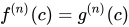

If this is not the case, let be the smallest nonnegative integer with . By holomorphy, we have the following Taylor series representation in some open neighborhood U of :


![{\displaystyle {\begin{aligned}(f-g)(z)&{}=(z-c)^{m}\cdot \left[{\frac {(f-g)^{(m)}(c)}{m!}}+{\frac {(z-c)\cdot (f-g)^{(m+1)}(c)}{(m+1)!}}+\cdots \right]\\[6pt]&{}=(z-c)^{m}\cdot h(z).\end{aligned}}}](https://wikimedia.org/api/rest_v1/media/math/render/svg/923abd4b57f8e6ec53edf4035f95117acff7174b)
By continuity, is non-zero in some small open disk around . But then on the punctured set . This contradicts the assumption that is an accumulation point of .


This lemma shows that for a complex number , the fiber is a discrete (and therefore countable) set, unless .


Proof
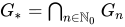
Define the set on which and have the same Taylor expansion:

We'll show is nonempty, open, and closed. Then by connectedness of , must be all of , which implies on .


By the lemma, in a disk centered at in , they have the same Taylor series at , so , hence is nonempty.

As and are holomorphic on , , the Taylor series of and at have non-zero radius of convergence. Therefore, the open disk also lies in for some . So is open.


By holomorphy of and , they have holomorphic derivatives, so all are continuous. This means that is closed for all . is an intersection of closed sets, so it's closed.


Full characterisation
Since the identity theorem is concerned with the equality of two holomorphic functions, we can simply consider the difference (which remains holomorphic) and can simply characterise when a holomorphic function is identically . The following result can be found in.[2]

Claim
Let denote a non-empty, connected open subset of the complex plane. For analytic the following are equivalent.


- on ;
- the set contains an accumulation point, ;
- the set is non-empty, where .





Proof
(1 2) holds trivially.

(2 3) is shown in section Lemma in part with Taylor expansion at accumulation point, just substitute g=0.
(3 1) is shown in section Proof with set where all derivatives of f-g vanishes, just substitute g=0.
See also
References
- ↑For real functions, see Krantz, Steven G.; Parks, Harold R. (2002). A Primer of Real Analytic Functions (Second ed.). Boston: Birkhäuser. Corollary 1.2.7. ISBN 0-8176-4264-1.
- ↑Guido Walz, ed. (2017). Lexikon der Mathematik (in German). Vol. 2. Mannheim: Springer Spektrum Verlag. p. 476. ISBN 978-3-662-53503-5.
- Ablowitz, Mark J.; Fokas A. S. (1997). Complex variables: Introduction and applications. Cambridge, UK: Cambridge University Press. p. 122. ISBN 0-521-48058-2.
- Theorems in real analysis
- Theorems in complex analysis