
عتبة الترشيح
عتبة الترشيح مفهوم رياضي في نظرية الترشيح يصف تكوين الاتصال بعيد المدى في الأنظمة العشوائية . تحت هذه العتبة، لا يوجد مكون متصل عملاق ؛ بينما فوقها، يوجد مكون عملاق بحجم النظام تقريبًا. في الهندسة وصناعة القهوة ، يُمثل الترشيح تدفق السوائل عبر الأوساط المسامية ، لكن في الرياضيات والفيزياء، يشير عمومًا إلى نماذج شبكية مبسطة للأنظمة أو الشبكات العشوائية ( الرسوم البيانية )، وطبيعة الاتصال فيها. عتبة الترشيح هي القيمة الحرجة لاحتمالية الإشغال p ، أو بشكل أعم ، سطح حرج لمجموعة من المعاملات p1 ، p2 ، ...، بحيث يحدث الاتصال اللانهائي ( الترشيح ) أولًا. [ 1 ]
نموذج الترشيح
يُعدّ نموذج الترشيح الأكثر شيوعًا هو تحويل شبكة منتظمة، كشبكة مربعة مثلاً ، إلى شبكة عشوائية عن طريق "شغل" المواقع (الرؤوس) أو الروابط (الحواف) عشوائيًا باحتمالية مستقلة إحصائيًا p . عند عتبة حرجة p<sub> c</sub> ، تظهر التجمعات الكبيرة والترابط بعيد المدى لأول مرة، وتُسمى هذه العتبة عتبة الترشيح . اعتمادًا على طريقة الحصول على الشبكة العشوائية، يُفرّق بين عتبة ترشيح المواقع وعتبة ترشيح الروابط . تحتوي الأنظمة الأكثر عمومية على عدة احتمالات p <sub>1</sub> ، p<sub> 2 </sub>، إلخ، ويتميز الانتقال بسطح أو متشعب حرج . يمكن أيضًا دراسة الأنظمة المتصلة، مثل الأقراص والكرات المتداخلة الموضوعة عشوائيًا، أو الفضاء السالب ( نماذج الجبن السويسري ).
لفهم العتبة، يمكنك التفكير في كمية مثل احتمال وجود مسار متصل من حد إلى آخر على طول المواقع أو الروابط المشغولة، أي داخل مجموعة واحدة. على سبيل المثال، يمكن اعتبار نظام مربع، والسؤال عن احتمال P لوجود مسار من الحد العلوي إلى الحد السفلي. كدالة لاحتمال الإشغال p ، نجد منحنى سيغموي ينتقل من P=0 عند p=0 إلى P=1 عند p=1 . كلما كبر المربع مقارنةً بتباعد الشبكة، كان الانتقال أكثر حدة. عندما يؤول حجم النظام إلى اللانهاية، ستكون P(p) دالة متدرجة عند قيمة العتبة p<sub> c</sub> . بالنسبة للأنظمة الكبيرة المحدودة، فإن P(p<sub>c</sub> ) ثابت تعتمد قيمته على شكل النظام؛ بالنسبة للنظام المربع المذكور أعلاه، فإن P(p<sub> c </sub> ) = 1/2 بالضبط لأي شبكة ، وذلك استنادًا إلى حجة تناظر بسيطة.
توجد مؤشرات أخرى للعتبة الحرجة. على سبيل المثال، يتناقص توزيع الحجم (عدد التجمعات ذات الحجم s ) وفقًا لقانون القوة عند قيم s الكبيرة عند العتبة، n s (p c ) ~ s −τ ، حيث τ هو أس حرج للترشيح يعتمد على الأبعاد . بالنسبة لنظام لانهائي، تتوافق العتبة الحرجة مع النقطة الأولى (مع ازدياد p ) التي يصبح عندها حجم التجمعات لانهائيًا.
في الأنظمة الموصوفة حتى الآن، يُفترض أن شغل موقع أو رابطة ما عشوائي تمامًا، وهذا ما يُعرف بترشيح برنولي . بالنسبة لنظام متصل، يتوافق الشغل العشوائي مع وضع النقاط وفقًا لعملية بواسون . تتضمن الاختلافات الأخرى الترشيح المترابط، مثل تجمعات الترشيح المرتبطة بنماذج إيزينغ وبوتس للمواد المغناطيسية الحديدية، حيث تُحدد الروابط باستخدام طريقة فورتوين-كاستيلين . [ 2 ] في ترشيح بوتستراب أو ترشيح k-sat ، تُشغل المواقع و/أو الروابط أولًا، ثم تُستبعد تباعًا من النظام إذا لم يكن للموقع k جار على الأقل. نموذج آخر مهم للترشيح، في فئة عالمية مختلفة تمامًا، هو الترشيح الموجه ، حيث تعتمد الاتصالية على طول الرابطة على اتجاه التدفق. من الاختلافات الأخرى التي حظيت باهتمام حديث الترشيح الانفجاري ، وتُدرج عتباته في تلك الصفحة.
على مدى العقود القليلة الماضية، بُذلت جهودٌ جبارةٌ لإيجاد قيم دقيقة وتقريبية لعتبات الترشيح لمجموعة متنوعة من هذه الأنظمة. ولا تُعرف العتبات الدقيقة إلا لبعض الشبكات ثنائية الأبعاد التي يمكن تقسيمها إلى مصفوفة ذاتية التناظر، بحيث يبقى النظام على حاله عند تحويله إلى مثلث-مثلث. وقد أدت الدراسات التي استخدمت الأساليب العددية إلى تحسينات عديدة في الخوارزميات واكتشافات نظرية عديدة.
الازدواجية البسيطة في بعدين تعني أن جميع الشبكات المثلثية بالكامل (مثل المثلثية، وعلم الاتحاد، والشبكة المزدوجة المتقاطعة، والشبكة المزدوجة مارتيني، وشبكة أسانوها أو الشبكة المزدوجة 3-12، وتثليث ديلاوناي) لها جميعًا عتبات موقع تبلغ 1/2 ، والشبكات المزدوجة الذاتية (المربعة ، مارتيني-ب ) لها عتبات رابطة تبلغ 1/2 .
يُستمد الترميز (4,8 2 ) من غرونباوم وشيبارد [ 3 ] ، ويشير إلى أنه عند التحرك باتجاه عقارب الساعة حول رأس معين، يُصادف المرء أولًا مربعًا ثم شكلين ثماني الأضلاع. إلى جانب الشبكات الأرخميدية الإحدى عشرة المكونة من مضلعات منتظمة ذات مواقع متكافئة، دُرست العديد من الشبكات الأخرى الأكثر تعقيدًا ذات مواقع من فئات مختلفة.
تُشير الأرقام بين قوسين إلى هامش الخطأ في الرقم أو الأرقام الأخيرة. فعلى سبيل المثال، يُشير 0.729724(3) إلى 0.729724 ± 0.000003، بينما يُشير 0.74042195(80) إلى 0.74042195 ± 0.00000080. وتُمثل هذه الهوامش، بحسب المصدر، انحرافًا معياريًا واحدًا أو اثنين في صافي الخطأ (بما في ذلك الخطأ الإحصائي والخطأ المنهجي المتوقع)، أو فترة ثقة تجريبية.
الترشيح على الشبكات
بالنسبة لشبكة عشوائية شبيهة بالشجرة (أي شبكة متصلة بدون دورة) بدون ارتباط بين درجاتها، يمكن إثبات أن هذه الشبكة قد تحتوي على مكون عملاق ، ويتم تحديد عتبة الترشيح (احتمالية الانتقال) بواسطة
.
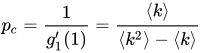
أينهي الدالة المولدة المقابلة لتوزيع الدرجة الزائدة ،هو متوسط درجة الشبكة ويمثل العزم الثاني لتوزيع الدرجات . فعلى سبيل المثال، بالنسبة لشبكة ER ، بما أن توزيع الدرجات هو توزيع بواسون ، حيثيقع الحد الأدنى عند.


في الشبكات ذات التجميع المنخفض ،، يتم تغيير مقياس النقطة الحرجة بواسطةبحيث: [ 4 ]


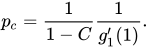
يشير هذا إلى أنه بالنسبة لتوزيع درجات معين، يؤدي التجميع إلى عتبة ترشيح أكبر، ويرجع ذلك أساسًا إلى أنه بالنسبة لعدد ثابت من الروابط، يعزز هيكل التجميع مركز الشبكة على حساب إضعاف الاتصالات العالمية. بالنسبة للشبكات ذات التجميع العالي، قد يؤدي التجميع القوي إلى ظهور بنية مركزية-محيطية، حيث قد يتخلل المركز والمحيط نقاطًا حرجة مختلفة، ولا ينطبق عليها المعالجة التقريبية المذكورة أعلاه. [ 5 ]
الترشيح في بعدين
عتبات على شبكات أرخميدس
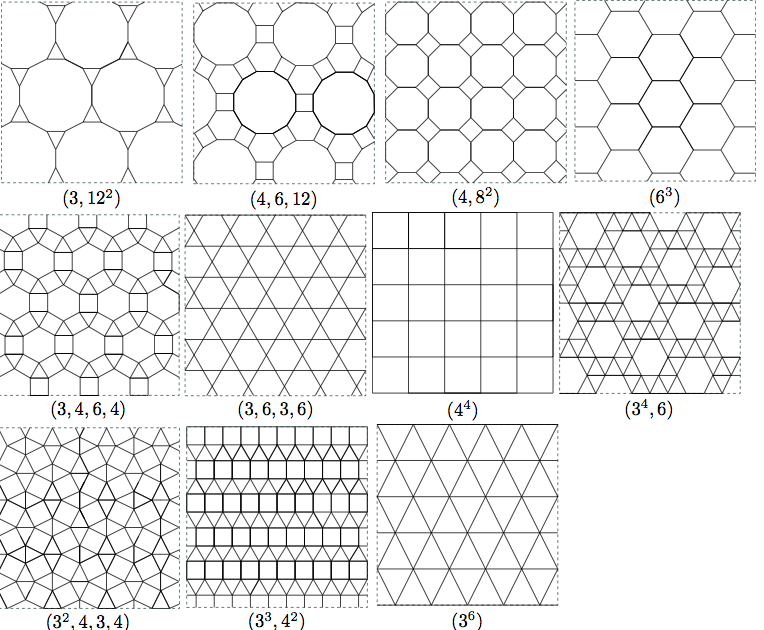
| شعرية | z | عتبة ترشيح الموقع | عتبة ترشيح الرابطة | |
|---|---|---|---|---|
| 3-12 أو سوبر كاغومي، (3، 12 2 ) | 3 | 3 | 0.807900764... = (1 − 2 خطيئة ( π /18)) 1 ⁄ 2 [ 7 ] | 0.74042195(80), [ 8 ] 0.74042077(2), [ 9 ] 0.740420800(2), [ 10 ] 0.7404207988509(8), [ 11 ] [ 12 ] 0.740420798850811610(2), [ 13 ] |
| صليب، ثلاثي سداسي مقطوع (4، 6، 12) | 3 | 3 | 0.746، [ 14 ] 0.750، [ 15 ] 0.747806(4)، [ 7 ] 0.7478008(2) [ 11 ] | 0.6937314(1)، [ 11 ] 0.69373383(72)، [ 8 ] 0.693733124922(2) [ 13 ] |
| بلاط حمام مربع مثمن الأضلاع، 4-8، مربع مقطوع (4, 8 2 ) | 3 | - | 0.729، [ 14 ] 0.729724(3)، [ 7 ] 0.7297232(5) [ 11 ] | 0.6768، [ 16 ] 0.67680232(63)، [ 8 ] 0.6768031269(6)، [ 11 ] 0.6768031243900113(3)، [ 13 ] |
| قرص العسل (6 3 ) | 3 | 3 | 0.6962(6)، [ 17 ] 0.697040230(5)، [ 11 ] 0.6970402(1)، [ 18 ] 0.6970413(10)، [ 19 ] 0.697043(3)، [ 7 ] | 0.652703645... = 1-2 خطيئة (π/18)، 1+ ص 3 -3 ع 2 =0 [ 20 ] |
| كاغومي (3، 6، 3، 6) | 4 | 4 | 0.652703645... = 1 − 2 خطيئة( π /18) [ 20 ] | 0.5244053(3)، [ 21 ] 0.52440516(10)، [ 19 ] 0.52440499(2)، [ 18 ] 0.524404978(5)، [ 9 ] 0.52440572...، [ 22 ] 0.52440500(1)، [ 10 ] 0.524404999173(3)، [ 11 ] [ 12 ] 0.524404999167439(4) [ 23 ] 0.52440499916744820(1) [ 13 ] |
| روبي، [ 24 ] معيني سداسي (3، 4، 6، 4) | 4 | 4 | 0.620، [ 14 ] 0.621819(3)، [ 7 ] 0.62181207(7) [ 11 ] | 0.52483258(53)، [ 8 ] 0.5248311(1)، [ 11 ] 0.524831461573(1) [ 13 ] |
| مربع (4 4 ) | 4 | 4 | 0.59274(10)، [ 25 ] 0.59274605079210(2)، [ 23 ] 0.59274601(2)، [ 11 ] 0.59274605095(15)، [ 26 ] 0.59274621(13)، [ 27 ] 0.592746050786(3)، [ 28 ] 0.5927460507896(1)، [ 29 ] 0.59274605079016(1)، [ 30 ] 0.59274621(33)، [ 31 ] 0.59274598(4)، [ 32 ] [ 33 ] 0.59274605(3)، [ 18 ] 0.593(1), [ 34 ] 0.591(1), [ 35 ] 0.569(13), [ 36 ] 0.59274(5) [ 37 ] | نصف |
| ورقة قيقب سداسية الشكل [ 38 ] (3 4 ,6) | 5 | 5 | 0.579 [ 15 ] 0.579498(3) [ 7 ] | 0.43430621(50), [ 8 ] 0.43432764(3), [ 11 ] 0.4343283172240(6), [ 13 ] |
| مربع الاستبعاد ، لغز، شاستري-ساذرلاند [ 39 ] (3 2 ، 4، 3، 4) | 5 | 5 | 0.550، [ 14 ] [ 40 ] 0.550806(3) [ 7 ] | 0.41413743(46), [ 8 ] 0.4141378476(7), [ 11 ] 0.4141378565917(1), [ 13 ] |
| إفريز، تعريشة، مثلث ممدود (3 3 ، 4 2 ) | 5 | 5 | 0.549، [ 14 ] 0.550213(3)، [ 7 ] 0.5502(8) [ 41 ] | 0.4196(6)، [ 41 ] 0.41964191(43)، [ 8 ] 0.41964044(1)، [ 11 ] 0.41964035886369(2) [ 13 ] |
| مثلثي (3 6 ) | 6 | 6 | نصف | 0.347296355... = 2 خطيئة ( π /18), 1 + ص 3 − 3 ع = 0 [ 20 ] |

ملاحظة: يُستخدم مصطلح "سداسي" أحيانًا بدلاً من "قرص العسل"، على الرغم من أنه في بعض السياقات يُطلق على الشبكة المثلثية أيضًا اسم الشبكة السداسية . z = عدد التنسيق الكلي .
شبكات ثنائية الأبعاد ذات نطاقات جوار ممتدة ومعقدة
في هذا القسم، يُقابل المربع (1، 2، 3) المربع (NN+2NN+3NN)، [ 42 ] وهكذا. وهو مكافئ للمربع (2N+3N+4N)، [ 43 ] المربع (1، 2، 3). [ 44 ] المثلث = مثلث، hc = خلية نحل.
| شعرية | z | عتبة ترشيح الموقع | عتبة ترشيح الرابطة |
|---|---|---|---|
| المربع 1، المربع 2، المربع 3، المربع 5 | 4 | 0.5927... [ 42 ] [ 43 ] (موقع مربع) | |
| مربع ١، ٢، مربع ٢، ٣، مربع ٣، ٥... مربع ٣×٣ | 8 | 0.407... [ 42 ] [ 43 ] [ 45 ] (مطابقة المربعات) | 0.25036834(6)، [ 18 ] 0.2503685، [ 46 ] 0.25036840(4) [ 47 ] |
| مربع-1.3 | 8 | 0.337 [ 42 ] [ 43 ] | 0.2214995 [ 46 ] |
| مربع-2.5: 2NN+5NN | 8 | 0.337 [ 43 ] | |
| hc-1,2,3: خلية نحل-NN+2NN+3NN | 12 | 0.300، [ 44 ] 0.300، [ 15 ] 0.302960... = 1-p c (site, hc) [ 48 ] | |
| tri-1,2: triangular-NN+2NN | 12 | 0.295، [ 44 ] 0.289، [ 15 ] 0.290258(19) [ 49 ] | |
| tri-2,3: triangular-2NN+3NN | 12 | 0.232020(36), [ 50 ] 0.232020(20) [ 49 ] | |
| مربع-4: مربع-4NN | 8 | 0.270... [ 43 ] | |
| sq-1,5: square-NN+5NN (r ≤ 2) | 8 | 0.277 [ 43 ] | |
| مربع-1،2،3: مربع-NN+2NN+3NN | 12 | 0.292، [ 51 ] 0.290(5) [ 52 ] 0.289، [ 15 ] 0.288، [ 42 ] [ 43 ] 0.2891226(14) [ 53 ] | 0.1522203 [ 46 ] |
| مربع-2،3،5: مربع-2NN+3NN+5NN | 12 | 0.288 [ 43 ] | |
| مربع-1،4: مربع-NN+4NN | 12 | 0.236 [ 43 ] | |
| مربع-2،4: مربع-2NN+4NN | 12 | 0.225 [ 43 ] | |
| tri-4: triangular-4NN | 12 | 0.192450(36), [ 50 ] 0.1924428(50) [ 49 ] | |
| hc-2,4: قرص العسل-2NN+4NN | 12 | 0.2374 [ 54 ] | |
| tri-1,3: triangular-NN+3NN | 12 | 0.264539(21) [ 49 ] | |
| ثلاثي 1،2،3: مثلث-NN+2NN+3NN | 18 | 0.225، [ 51 ] 0.215، [ 15 ] 0.215459(36) [ 50 ] 0.2154657(17) [ 49 ] | |
| sq-3,4: 3NN+4NN | 12 | 0.221 [ 43 ] | |
| sq-1,2,5: NN+2NN+5NN | 12 | 0.240 [ 43 ] | 0.13805374 [ 46 ] |
| sq-1,3,5: NN+3NN+5NN | 12 | 0.233 [ 43 ] | |
| sq-4,5: 4NN+5NN | 12 | 0.199 [ 43 ] | |
| sq-1,2,4: NN+2NN+4NN | 16 | 0.219 [ 43 ] | |
| sq-1,3,4: NN+3NN+4NN | 16 | 0.208 [ 43 ] | |
| مربع-2،3،4: 2NN+3NN+4NN | 16 | 0.202 [ 43 ] | |
| sq-1,4,5: NN+4NN+5NN | 16 | 0.187 [ 43 ] | |
| مربع-2،4،5: 2NN+4NN+5NN | 16 | 0.182 [ 43 ] | |
| مربع-3،4،5: 3NN+4NN+5NN | 16 | 0.179 [ 43 ] | |
| نمط النجمة sq-1,2,3,5 | 16 | 0.208 [ 43 ] | 0.1032177 [ 46 ] |
| tri-4,5: 4NN+5NN | 18 | 0.140250(36), [ 50 ] | |
| sq-1,2,3,4: NN+2NN+3NN+4NN () | 20 | 0.19671(9)، [ 55 ] 0.196، [ 43 ] 0.196724(10)، [ 56 ] 0.1967293(7) [ 53 ] | 0.0841509 [ 46 ] |
| sq-1,2,4,5: NN+2NN+4NN+5NN | 20 | 0.177 [ 43 ] | |
| sq-1,3,4,5: NN+3NN+4NN+5NN | 20 | 0.172 [ 43 ] | |
| مربع-2،3،4،5: 2NN+3NN+4NN+5NN | 20 | 0.167 [ 43 ] | |
| نمط النجمة sq-1,2,3,5,6 | 20 | 0.0783110 [ 46 ] | |
| sq-1,2,3,4,5: NN+2NN+3NN+4NN+5NN ((أيضًا داخل مربع 5 × 5) | 24 | 0.164، [ 15 ] 0.164، [ 43 ] 0.1647124(6) [ 53 ] | |
| مربع-1،2،3،4،6: NN+2NN+3NN+4NN+6NN (معين)) | 24 | 0.16134، [ 57 ] | |
| tri-1,4,5: NN+4NN+5NN | 24 | 0.131660(36) [ 50 ] | |
| sq-1,...,6: NN+...+6NN (r≤3) | 28 | 0.142، [ 15 ] 0.1432551(9) [ 53 ] | 0.0558493 [ 46 ] |
| tri-2,3,4,5: 2NN+3NN+4NN+5NN | 30 | 0.117460(36) [ 50 ] 0.135823(27) [ 49 ] | |
| ثلاثي 1،2،3،4،5: NN+2NN+3NN+4NN+5NN | 36 | 0.115، [ 15 ] 0.115740(36)، [ 50 ] 0.1157399(58) [ 49 ] | |
| sq-1,...,7: NN+...+7NN () | 36 | 0.113، [ 15 ] 0.1153481(9) [ 53 ] | 0.04169608 [ 46 ] |
| خط العرض المربع، حدود ماسية: المسافة ≤ 4 | 40 | 0.105(5) [ 52 ] | |
| sq-1,...,8: NN+..+8NN () | 44 | 0.095، [ 40 ] 0.095765(5)، [ 56 ] 0.09580(2)، [ 55 ] 0.0957661(9) [ 53 ] | |
| sq-1,...,9: NN+..+9NN (r≤4) | 48 | 0.086 [ 15 ] | 0.02974268 [ 46 ] |
| sq-1,...,11: NN+...+11NN () | 60 | 0.02301190(3) [ 46 ] | |
| sq-1,...,23 (r ≤ 7) | 148 | 0.008342595 [ 47 ] | |
| sq-1,...,32: NN+...+32NN () | 224 | 0.0053050415(33) [ 46 ] | |
| sq-1,...,86: NN+...+86NN (r≤15) | 708 | 0.001557644(4) [ 58 ] | |
| sq-1,...,141: NN+...+141NN () | 1224 | 0.000880188(90) [ 46 ] | |
| sq-1,...,185: NN+...+185NN (r≤23) | 1652 | 0.000645458(4) [ 58 ] | |
| sq-1,...,317: NN+...+317NN (r≤31) | 3000 | 0.000349601(3) [ 58 ] | |
| sq-1,...,413: NN+...+413NN () | 4016 | 0.0002594722(11) [ 46 ] | |
| مربع خط العرض، حدود ماسية: المسافة ≤ 6 | 84 | 0.049(5) [ 52 ] | |
| خط العرض المربع، حدود ماسية: المسافة ≤ 8 | 144 | 0.028(5) [ 52 ] | |
| خط العرض المربع، حدود ماسية: المسافة ≤ 10 | 220 | 0.019(5) [ 52 ] | |
| مربعات شبكية متلامسة 2x2* (نفس المربعات 1، 2، 3، 4) | 20 | φ ج = 0.58365(2)، [ 56 ] ص ج = 0.196724(10)، [ 56 ] 0.19671(9)، [ 55 ] | |
| مربعات شبكية متلامسة 3x3* (نفس المربعات من 1 إلى 8) | 44 | φ ج = 0.59586(2)، [ 56 ] ص ج = 0.095765(5)، [ 56 ] 0.09580(2) [ 55 ] | |
| مربعات شبكية متلامسة 4x4* | 76 | φ ج = 0.60648(1)، [ 56 ] ص ج = 0.0566227(15)، [ 56 ] 0.05665(3)، [ 55 ] | |
| مربعات شبكية متلامسة 5x5* | 116 | φ ج = 0.61467(2)، [ 56 ] ص ج = 0.037428(2)، [ 56 ] 0.03745(2)، [ 55 ] | |
| مربعات شبكية متلامسة 6x6* | 220 | p c = 0.02663(1), [ 55 ] | |
| مربعات شبكية متلامسة 10x10* | 436 | φ ج = 0.63609(2)، [ 56 ] ص ج = 0.0100576(5) [ 56 ] | |
| داخل مربع 11 × 11 (r=5) | 120 | 0.01048079(6) [ 58 ] | |
| داخل مربع 15 × 15 (نصف القطر = 7) | 224 | 0.005287692(22) [ 58 ] | |
| مربعات شبكية متلامسة 20x20* | 1676 | φ ج = 0.65006(2), [ 56 ] ص ج = 0.0026215(3) [ 56 ] | |
| داخل مربع 31 × 31 (r=15) | 960 | 0.001131082(5) [ 58 ] | |
| مربعات شبكية متلامسة 100×100* | 40396 | φ ج = 0.66318(2), [ 56 ] ص ج = 0.000108815(12) [ 56 ] | |
| 1000x1000 مربع شبكي متلاصق* | 4003996 | φ ج = 0.66639(1), [ 56 ] ص ج = 1.09778(6)E-06 [ 56 ] | |


هنا NN = أقرب جار، 2NN = ثاني أقرب جار (أو الجار التالي الأقرب)، 3NN = ثالث أقرب جار (أو الجار التالي التالي الأقرب)، إلخ. وتُسمى هذه أيضًا 2N و3N و4N على التوالي في بعض الأبحاث. [ 42 ]
- بالنسبة للمربعات المتداخلة أو المتلامسة،(الموقع) المذكور هنا هو النسبة الصافية للمواقع المشغولةعلى غرارفي عملية الترشيح المستمر. حالة المربع 2×2 تُكافئ ترشيح شبكة مربعة NN+2NN+3NN+4NN أو sq-1,2,3,4 مع عتبةمع[ 56 ] يتوافق المربع 3×3 مع المربعات 1، 2، 3، 4، 5، 6، 7، 8 حيث z = 44 وقيمة z لمربع k × k هي (2 k +1) 2 -5.




شبكات مشوهة ثنائية الأبعاد
هنا، يتم تشويه شبكة منتظمة ذات تباعد وحدة عن طريق تحريك الرؤوس بشكل منتظم داخل الصندوق.ويأخذ في الاعتبار الترشيح عندما تكون المواقع ضمن مسافة إقليديةعن بعضهم البعض.


| شعرية | عتبة ترشيح الموقع | عتبة ترشيح الرابطة | |||
|---|---|---|---|---|---|
| مربع | 0.2 | 1.1 | 0.8025(2) [ 59 ] | ||
| 0.2 | 1.2 | 0.6667(5) [ 59 ] | |||
| 0.1 | 1.1 | 0.6619(1) [ 59 ] | |||

أشكال متداخلة على شبكات ثنائية الأبعاد
عتبة الموقع هي عدد الأجسام المتداخلة لكل موقع شبكي. k هو الطول (المساحة الصافية). تظهر المربعات المتداخلة في قسم الجوار المعقد. هنا، z هو عدد التنسيق لـ k-mers من أي اتجاه، معلالعصي.


| نظام | ك | z | تغطية الموقع φ c | عتبة ترشيح الموقع p c |
|---|---|---|---|---|
| ثنائي 1 × 2، شبكة مربعة | 2 | 22 | 0.54691 [ 55 ] 0.5483(2) [ 60 ] | 0.17956(3) [ 55 ] 0.18019(9) [ 60 ] |
| ثنائي متراصف 1 × 2، شبكة مربعة | 2 | 14(?) | 0.5715(18) [ 60 ] | 0.3454(13) [ 60 ] |
| ثلاثي 1 × 3، شبكة مربعة | 3 | 37 | 0.49898 [ 55 ] 0.50004(64) [ 60 ] | 0.10880(2) [ 55 ] 0.1093(2) [ 60 ] |
| عصا مربعة الشكل مقاس 1 × 4 | 4 | 54 | 0.45761 [ 55 ] | 0.07362(2) [ 55 ] |
| 1 × 5 عصا، شبكة مربعة | 5 | 73 | 0.42241 [ 55 ] | 0.05341(1) [ 55 ] |
| 1 × 6 عصا، شبكة مربعة | 6 | 94 | 0.39219 [ 55 ] | 0.04063(2) [ 55 ] |
يتم حساب التغطية منبواسطةل العصي، لأن هناك المواقع التي قد يتسبب فيها وضع عصا في تداخل مع موقع معين.


للمحاذاةالعصي:

صيغ تقريبية لعتبات الشبكات الأرخميدية
| شعرية | z | عتبة ترشيح الموقع | عتبة ترشيح الرابطة |
|---|---|---|---|
| (3, 12 2 ) | 3 | ||
| (4، 6، 12) | 3 | ||
| (4, 8 2 ) | 3 | 0.676835..., 4 p 3 + 3 p 4 − 6 p 5 − 2 p 6 = 1 [ 61 ] | |
| قرص العسل (6 3 ) | 3 | ||
| كاغومي (3، 6، 3، 6) | 4 | 0.524430..., 3 p 2 + 6 p 3 − 12 p 4 + 6 p 5 − p 6 = 1 [ 62 ] | |
| (3، 4، 6، 4) | 4 | ||
| مربع (4 4 ) | 4 | نصف ( بالضبط ) | |
| (3 4 ,6 ) | 5 | 0.434371..., 12 p 3 + 36 p 4 − 21 p 5 − 327 p 6 + 69 p 7 + 2532 p 8 − 6533 p 9 + 8256 p 10 − 6255 p 11 + 2951 p 12 − 837 p 13 + 126 p 14 − 7 p 15 = 1 | |
| مربع قصير، لغز (3 2 ، 4، 3، 4) | 5 | ||
| (3 3 , 4 2 ) | 5 | ||
| مثلثي (3 6 ) | 6 | نصف ( بالضبط ) | |
الترشيح AB والترشيح الملون في بُعدين
في عملية الترشيح AB، أتمثل نسبة مواقع A بين مواقع B، وتُرسم الروابط بين مواقع الأنواع المتقابلة. [ 63 ] ويُطلق عليها أيضًا اسم الترشيح المضاد.

في عملية الترشيح الملون، يتم تخصيص أحد المواقع المشغولة لـ[ 64 ] يتم ربط الألوان باحتمالية متساوية، ويتم إنشاء الاتصال على طول الروابط بين الجيران ذوي الألوان المختلفة.

| شعرية | z | عتبة ترشيح الموقع | |
|---|---|---|---|
| المثلث AB | 6 | 6 | 0.2145، [ 63 ] 0.21524(34)، [ 65 ] 0.21564(3) [ 66 ] |
| AB على شبكة تغطي مربعًا | 6 | 6 | [ 67 ] |
| مربع ثلاثي الألوان | 4 | 4 | 0.80745(5) [ 64 ] |
| مربع بأربعة ألوان | 4 | 4 | 0.73415(4) [ 64 ] |
| مربع بخمسة ألوان | 4 | 4 | 0.69864(7) [ 64 ] |
| مربع بستة ألوان | 4 | 4 | 0.67751(5) [ 64 ] |
| مثلث ثنائي اللون | 6 | 6 | 0.72890(4) [ 64 ] |
| مثلث ثلاثي الألوان | 6 | 6 | 0.63005(4) [ 64 ] |
| مثلث الشكل بأربعة ألوان | 6 | 6 | 0.59092(3) [ 64 ] |
| مثلث الشكل بخمسة ألوان | 6 | 6 | 0.56991(5) [ 64 ] |
| مثلث الشكل بستة ألوان | 6 | 6 | 0.55679(5) [ 64 ] |

ترشيح الروابط الموضعية في بُعدين
نفاذية روابط الموقع. هنااحتمالية شغل الموقع وتمثل احتمالية شغل الرابطة، ولا يتم إنشاء الاتصال إلا إذا كانت كل من المواقع والروابط على طول المسار مشغولة. يصبح شرط الحرج منحنى= 0، وبعض الأزواج الحرجة المحددةمدرجة أدناه.


شبكة مربعة:
| شعرية | z | عتبة ترشيح الموقع | عتبة ترشيح الرابطة | |
|---|---|---|---|---|
| مربع | 4 | 4 | 0.615185(15) [ 68 ] | 0.95 |
| 0.667280(15) [ 68 ] | 0.85 | |||
| 0.732100(15) [ 68 ] | 0.75 | |||
| 0.75 | 0.726195(15) [ 68 ] | |||
| 0.815560(15) [ 68 ] | 0.65 | |||
| 0.85 | 0.615810(30) [ 68 ] | |||
| 0.95 | 0.533620(15) [ 68 ] |
شبكة قرص العسل (سداسية الشكل):
| شعرية | z | عتبة ترشيح الموقع | عتبة ترشيح الرابطة | |
|---|---|---|---|---|
| قرص العسل | 3 | 3 | 0.7275(5) [ 69 ] | 0.95 |
| 0. 0.7610(5) [ 69 ] | 0.90 | |||
| 0.7986(5) [ 69 ] | 0.85 | |||
| 0.80 | 0.8481(5) [ 69 ] | |||
| 0.8401(5) [ 69 ] | 0.80 | |||
| 0.85 | 0.7890(5) [ 69 ] | |||
| 0.90 | 0.7377(5) [ 69 ] | |||
| 0.95 | 0.6926(5) [ 69 ] |
شبكة كاغومي:
| شعرية | z | عتبة ترشيح الموقع | عتبة ترشيح الرابطة | |
|---|---|---|---|---|
| كاغومي | 4 | 4 | 0.6711(4)، [ 69 ] 0.67097(3) [ 70 ] | 0.95 |
| 0.6914(5)، [ 69 ] 0.69210(2) [ 70 ] | 0.90 | |||
| 0.7162(5)، [ 69 ] 0.71626(3) [ 70 ] | 0.85 | |||
| 0.7428(5)، [ 69 ] 0.74339(3) [ 70 ] | 0.80 | |||
| 0.75 | 0.7894(9) [ 69 ] | |||
| 0.7757(8)، [ 69 ] 0.77556(3) [ 70 ] | 0.75 | |||
| 0.80 | 0.7152(7) [ 69 ] | |||
| 0.81206(3) [ 70 ] | 0.70 | |||
| 0.85 | 0.6556(6) [ 69 ] | |||
| 0.85519(3) [ 70 ] | 0.65 | |||
| 0.90 | 0.6046(5) [ 69 ] | |||
| 0.90546(3) [ 70 ] | 0.60 | |||
| 0.95 | 0.5615(4) [ 69 ] | |||
| 0.96604(4) [ 70 ] | 0.55 | |||
| 0.9854(3) [ 70 ] | 0.53 |
* للاطلاع على القيم المتعلقة بالشبكات المختلفة، انظر "دراسة ترشيح الروابط الموضعية على العديد من الشبكات". [ 69 ]
الصيغة التقريبية لنفاذية الروابط الموضعية على شبكة قرص العسل
| شعرية | z | عتبة | ملحوظات | |
|---|---|---|---|---|
| (6 3 ) قرص العسل | 3 | 3 | عندما يتساوى: p s = p b = 0.82199 | الصيغة التقريبية، p s = احتمال الموقع، p b = احتمال الرابطة، p bc = 1 − 2 sin ( π /18)، [ 19 ] دقيقة عند p s =1، p b =p bc . |
![{\displaystyle p_{b}p_{s}[1-({\sqrt {p_{bc}}}/(3-p_{bc}))({\sqrt {p_{b}}}-{\sqrt {p_{bc}})]=p_{bc}}](https://wikimedia.org/api/rest_v1/media/math/render/svg/841ca3acd9efa5a314d4308e4cae70eacb5fd1e5)
الثنائيات الأرخميدية (شبكات لافيس)
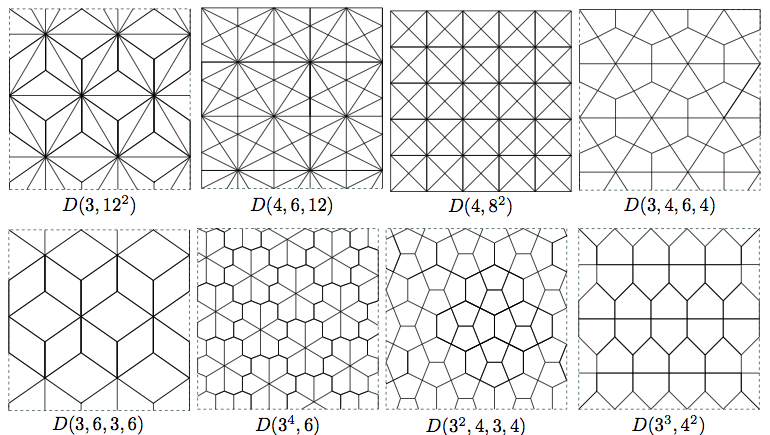
تُعدّ شبكات لافيس نظيراً لشبكات أرخميدس. الرسومات مأخوذة من [ 6 ]. انظر أيضاً: التبليطات المنتظمة .
| شعرية | z | عتبة ترشيح الموقع | عتبة ترشيح الرابطة | |
|---|---|---|---|---|
| خماسي القاهرة D(3 2 ,4,3,4)=( 2 ⁄ 3 )(5 3 )+( 1 ⁄ 3 )(5 4 ) | 3.4 | 3 1/3 | 0.6501834(2)، [ 11 ] 0.650184(5) [ 6 ] | 0.585863... = 1 − رابطة p c (3 2 ,4,3,4) |
| الشكل الخماسي D(3 3 ,4 2 )=( 1 ⁄ 3 )(5 4 )+( 2 ⁄ 3 )(5 3 ) | 3.4 | 3 1/3 | 0.6470471(2)، [ 11 ] 0.647084(5)، [ 6 ] 0.6471(6) [ 41 ] | 0.580358... = 1 − رابطة p c (3 3 ,4 2 ), 0.5800(6) [ 41 ] |
| D(3 4 ,6)=( 1 ⁄ 5 )(4 6 )+( 4 ⁄ 5 )(4 3 ) | 3.6 | 3 3/5 | 0.639447 [ 6 ] | 0.565694... = 1 − رابطة p c (3 4 ,6 ) |
| النرد، تبليط معيني الشكل D(3,6,3,6) = ( 1 ⁄ 3 )(4 6 ) + ( 2 ⁄ 3 )(4 3 ) | 3.6 | 4 | 0.5851(4)، [ 71 ] 0.585040(5) [ 6 ] | 0.475595... = 1 − رابطة p c (3,6,3,6 ) |
| روبي ثنائي D(3,4,6,4) = ( 1 ⁄ 6 )(4 6 ) + ( 2 ⁄ 6 )(4 3 ) + ( 3 ⁄ 6 )(4 4 ) | 3، 4، 6 | 4 | 0.582410(5) [ 6 ] | 0.475167... = 1 − رابطة p c (3,4,6,4 ) |
| علم المملكة المتحدة، بلاط مربع رباعي D(4,8 2 ) = ( 1 ⁄ 2 )(3 4 ) + ( 1 ⁄ 2 )(3 8 ) | 4.8 | 6 | نصف | 0.323197... = 1 − رابطة p c (4,8 2 ) |
| سداسي منصف، [ 72 ] متقاطع مزدوج D(4,6,12)= ( 1 ⁄ 6 )(3 12 )+( 2 ⁄ 6 )(3 6 )+( 1 ⁄ 2 )(3 4 ) | 4، 6، 12 | 6 | نصف | 0.306266... = 1 − رابطة p c (4,6,12) |
| أسانوها (ورقة القنب) [ 73 ] D(3, 12 2 )=( 2 ⁄ 3 )(3 3 )+( 1 ⁄ 3 )(3 12 ) | 3.12 | 6 | نصف | 0.259579... = 1 − رابطة p c (3, 12 2 ) |
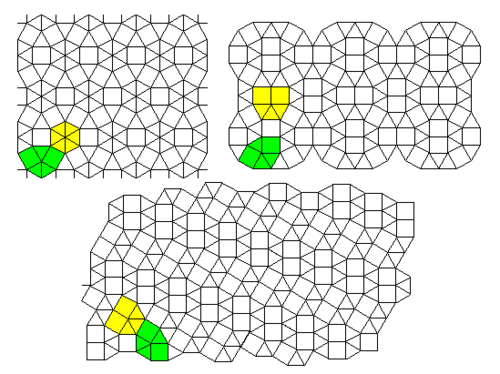
2-شبكات منتظمة
الشبكات الثلاث العلوية:131236 الشبكات الثلاث السفلية:343711
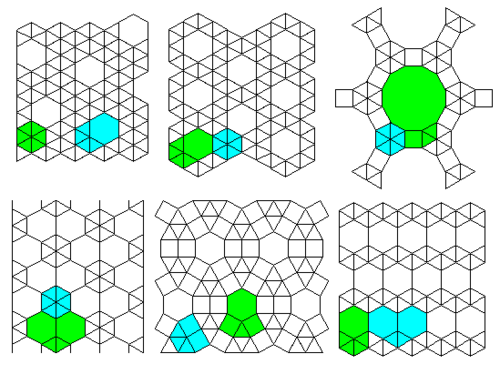
الشبكتان العلويتان:3530 الشبكتان السفليتان:4142
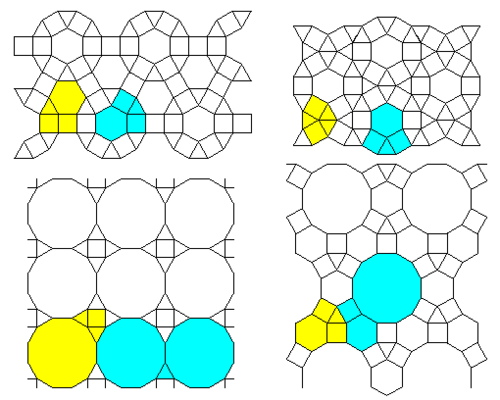
الشبكات الأربع العلوية:22232120 الشبكات الثلاث السفلية:161715
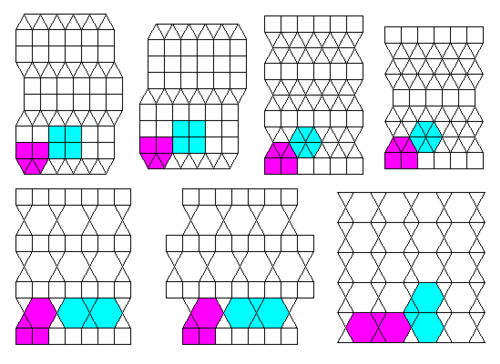
الشبكتان العلويتان:3132 الشبكة السفلية:33
| 8 | شعرية | z | عتبة ترشيح الموقع | عتبة ترشيح الرابطة | |
|---|---|---|---|---|---|
| 41 | ( 1 ⁄ 2 )(3,4,3,12) + ( 1 ⁄ 2 )(3, 12 2 ) | 4.3 | 3.5 | 0.7680(2) [ 74 ] | 0.67493252(36) |
| 42 | ( 1 ⁄ 3 )(3,4,6,4) + ( 2 ⁄ 3 )(4,6,12) | 4.3 | 3 1/3 | 0.7157(2) [ 74 ] | 0.64536587(40) |
| 36 | ( 1 ⁄ 7 )(3 6 ) + ( 6 ⁄ 7 )(3 2 ,4,12) | 6.4 | 4 2 ⁄ 7 | 0.6808(2) [ 74 ] | 0.55778329(40) |
| 15 | ( 2 ⁄ 3 )(3 2 ,6 2 ) + ( 1 ⁄ 3 )(3,6,3,6) | 4.4 | 4 | 0.6499(2) [ 74 ] | 0.53632487(40) |
| 34 | ( 1 ⁄ 7 )(3 6 ) + ( 6 ⁄ 7 )(3 2 ,6 2 ) | 6.4 | 4 2 ⁄ 7 | 0.6329(2) [ 74 ] | 0.51707873(70) |
| 16 | ( 4 ⁄ 5 )(3,4 2 ,6) + ( 1 ⁄ 5 )(3,6,3,6) | 4.4 | 4 | 0.6286(2) [ 74 ] | 0.51891529(35) |
| 17 | ( 4 ⁄ 5 )(3,4 2 ,6) + ( 1 ⁄ 5 )(3,6,3,6)* | 4.4 | 4 | 0.6279(2) [ 74 ] | 0.51769462(35) |
| 35 | ( 2 ⁄ 3 )(3,4 2 ,6) + ( 1 ⁄ 3 )(3,4,6,4) | 4.4 | 4 | 0.6221(2) [ 74 ] | 0.51973831(40) |
| 11 | ( 1 ⁄ 2 )(3 4 ,6) + ( 1 ⁄ 2 )(3 2 ,6 2 ) | 5.4 | 4.5 | 0.6171(2) [ 74 ] | 0.48921280(37) |
| 37 | ( 1 ⁄ 2 )(3 3 ,4 2 ) + ( 1 ⁄ 2 )(3,4,6,4) | 5.4 | 4.5 | 0.5885(2) [ 74 ] | 0.47229486(38) |
| 30 | ( 1 ⁄ 2 )(3 2 ,4,3,4) + ( 1 ⁄ 2 )(3,4,6,4) | 5.4 | 4.5 | 0.5883(2) [ 74 ] | 0.46573078(72) |
| 23 | ( 1 ⁄ 2 )(3 3 ,4 2 ) + ( 1 ⁄ 2 )(4 4 ) | 5.4 | 4.5 | 0.5720(2) [ 74 ] | 0.45844622(40) |
| 22 | ( 2/3 ) ( 33,42 ) + ( 1/3 ) ( 44 ) | 5.4 | 4 2 ⁄ 3 | 0.5648(2) [ 74 ] | 0.44528611(40) |
| 12 | ( 1 ⁄ 4 )(3 6 ) + ( 3 ⁄ 4 )(3 4 ,6) | 6.5 | 5 1/4 | 0.5607(2) [ 74 ] | 0.41109890(37) |
| 33 | ( 1 ⁄ 2 )(3 3 ,4 2 ) + ( 1 ⁄ 2 )(3 2 ,4,3,4) | 5.5 | 5 | 0.5505(2) [ 74 ] | 0.41628021(35) |
| 32 | ( 1 ⁄ 3 )(3 3 ,4 2 ) + ( 2 ⁄ 3 )(3 2 ,4,3,4) | 5.5 | 5 | 0.5504(2) [ 74 ] | 0.41549285(36) |
| 31 | ( 1 ⁄ 7 )(3 6 ) + ( 6 ⁄ 7 )(3 2 ,4,3,4) | 6.5 | 5 1/7 | 0.5440(2) [ 74 ] | 0.40379585(40) |
| 13 | ( 1 ⁄ 2 )(3 6 ) + ( 1 ⁄ 2 )(3 4 ,6) | 6.5 | 5.5 | 0.5407(2) [ 74 ] | 0.38914898(35) |
| 21 | ( 1 ⁄ 3 )(3 6 ) + ( 2 ⁄ 3 )(3 3 ,4 2 ) | 6.5 | 5 1/3 | 0.5342(2) [ 74 ] | 0.39491996(40) |
| 20 | ( 1 ⁄ 2 )(3 6 ) + ( 1 ⁄ 2 )(3 3 ,4 2 ) | 6.5 | 5.5 | 0.5258(2) [ 74 ] | 0.38285085(38) |
شبكة غير متجانسة ثنائية التماثل
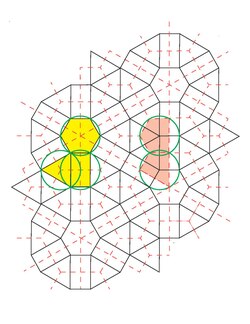
يُظهر هذا الشكل شيئًا مشابهًا للشبكة المنتظمة الثنائية رقم 37، باستثناء أن المضلعات ليست جميعها منتظمة - إذ يوجد مستطيل مكان المربعين - كما تم تغيير حجم المضلعات. هذه الشبكة في تمثيل متساوي الأقطار، حيث يُحاط كل مضلع بدائرة نصف قطرها وحدة واحدة. يجب الآن تمثيل المربعين في الشبكة المنتظمة الثنائية كمستطيل واحد لتحقيق شرط تساوي الأقطار. تُظهر الحواف السوداء الشبكة، بينما تُظهر الخطوط الحمراء المتقطعة الشبكة الثنائية. تُظهر الدوائر الخضراء قيد تساوي الأقطار على كل من الشبكة الأصلية والثنائية. تُبرز المضلعات الصفراء الأنواع الثلاثة من المضلعات على الشبكة، بينما تُبرز المضلعات الوردية النوعين من المضلعات على الشبكة الثنائية. تحتوي الشبكة على أنواع الرؤوس ( 1 ⁄ 2 )(3 3 ,4 2 ) + ( 1 ⁄ 2 )(3,4,6,4 )، بينما تحتوي الشبكة المزدوجة على أنواع الرؤوس ( 1 ⁄ 15 )(4 6 )+( 6 ⁄ 15 )(4 2 ,5 2 )+( 2 ⁄ 15 )(5 3 )+( 6 ⁄ 15 )(5 2 ,4 ). تكمن النقطة الحرجة في النقطة التي يكون فيها احتمال شغل الروابط الأطول (على كل من الشبكة والشبكة المزدوجة) p = 2 sin (π/18) = 0.347296...، وهو عتبة ترشيح الروابط على الشبكة المثلثية، بينما يكون احتمال شغل الروابط الأقصر 1 − 2 sin(π/18) = 0.652703...، وهو ترشيح الروابط على الشبكة السداسية. وتستند هذه النتائج إلى شرط تساوي الأقطار [ 75 ] ، كما تستند أيضًا إلى تطبيق تحويل النجمة-المثلث على نجوم معينة على شبكة قرص العسل. وأخيرًا، يمكن تعميمها بحيث يكون لها ثلاثة احتمالات مختلفة في الاتجاهات الثلاثة المختلفة، p 1 و p 2 و p 3 للروابط الطويلة، و 1 − p 1 و 1 − p 2 و 1 − p 3 للروابط القصيرة، حيث تحقق p 1 و p 2 و p 3 السطح الحرج للشبكة المثلثية غير المتجانسة.
عتبات على شبكات ربطة العنق ثنائية الأبعاد وشبكات المارتيني
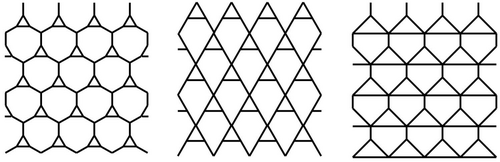
على اليسار والوسط واليمين: شبكة مارتيني، وشبكة مارتيني-أ، وشبكة مارتيني-ب. في الأسفل: شبكة مارتيني التغطية/الوسطى، وهي نفسها الشبكة الفرعية 2×2 و1×1 لشبكات كاغومي (تمت إزالتها).
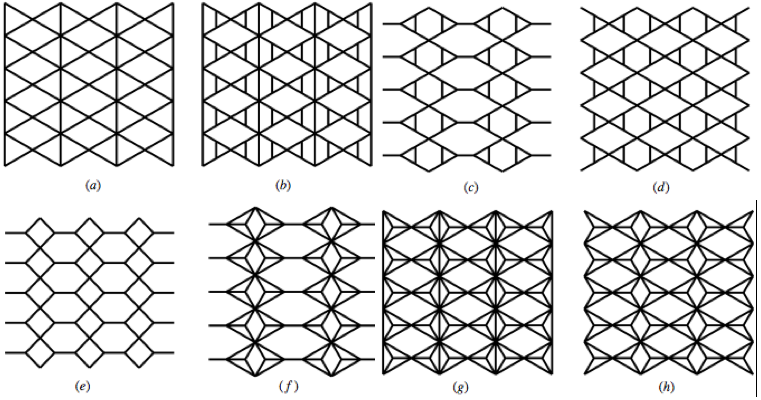
بعض الأمثلة الأخرى على الشبكات ذات الشكل الفراشي المعمم (ad) والشبكات الثنائية (eh):
| شعرية | z | عتبة ترشيح الموقع | عتبة ترشيح الرابطة | |
|---|---|---|---|---|
| مارتيني ( 3 ⁄ 4 )(3,9 2 )+( 1 ⁄ 4 )(9 3 ) | 3 | 3 | 0.764826..., 1 + p 4 − 3 p 3 = 0 [ 76 ] | 0.707107... = 1/ √ 2 [ 77 ] |
| ربطة عنق (ج) | 3.4 | 3 1/7 | 0.672929..., 1 − 2 p 3 − 2 p 4 − 2 p 5 − 7 p 6 + 18 p 7 + 11 p 8 − 35 p 9 + 21 p 10 − 4 p 11 = 0 [ 78 ] | |
| ربطة عنق (د) | 3.4 | 3 1/3 | 0.625457..., 1 − 2 p 2 − 3 p 3 + 4 p 4 − p 5 = 0 [ 78 ] | |
| مارتيني-أ ( 2 ⁄ 3 )(3,7 2 )+( 1 ⁄ 3 )(3,7 3 ) | 3.4 | 3 1/3 | 1/ √ 2 [ 78 ] | 0.625457..., 1 − 2 p 2 − 3 p 3 + 4 p 4 − p 5 = 0 [ 78 ] |
| ربطة عنق مزدوجة (هـ) | 3.4 | 3 2 ⁄ 3 | 0.595482..., 1-p c bond (bobotie (a)) [ 78 ] | |
| ربطة عنق (ب) | 3، 4، 6 | 3 2 ⁄ 3 | 0.533213..., 1 − p − 2 p 3 -4p 4 -4p 5 +15 6 + 13p 7 -36p 8 +19p 9 + p 10 + p 11 =0 [ 78 ] | |
| غطاء مارتيني/وسطي ( 1 ⁄ 2 )(3 3 ,9) + ( 1 ⁄ 2 )(3,9,3,9) | 4 | 4 | 0.707107... = 1/ √ 2 [ 77 ] | 0.57086651(33) |
| مارتيني-ب ( 1 ⁄ ) ( 3,5,3,5 2 ) + ( 1 ⁄ ) (3,5 2 ) | 3، 5 | 4 | 0.618034... = 2/(1 + √ 5 ), 1- p 2 − p = 0 [ 76 ] [ 78 ] | 1/2 [ 77 ] [ 78 ] |
| ربطة عنق مزدوجة (أنثى) | 3، 4، 8 | 4 2 ⁄ 5 | 0.466787..., 1 − رابطة p c (ربطة عنق (b)) [ 78 ] | |
| ربطة عنق (أ) ( 1 ⁄ 2 )(3 2 ,4,3 2 ,4) + ( 1 ⁄ 2 )(3,4,3) | 4.6 | 5 | 0.5472(2)، [ 41 ] 0.5479148(7) [ 79 ] | 0.404518..., 1 − p − 6 p 2 + 6 p 3 − p 5 = 0 [ 78 ] [ 80 ] |
| ربطة عنق مزدوجة (ح) | 3،6،8 | 5 | 0.374543..., 1 − رابطة p c (ربطة عنق (d)) [ 78 ] | |
| ربطة عنق مزدوجة (g) | 3، 6، 10 | 5 1 ⁄ 2 | 0.547... = p c site (bow-tie(a)) | 0.327071..., 1 − رابطة p c (ربطة عنق (c)) [ 78 ] |
| ثنائي مارتيني ( 1 ⁄ 2 )(3 3 ) + ( 1 ⁄ 2 )(3 9 ) | 3.9 | 6 | نصف | 0.292893... = 1 − 1/ √ 2 [ 77 ] |
عتبات التغطية ثنائية الأبعاد، والشبكات المتوسطة، وشبكات المطابقة
| شعرية | z | عتبة ترشيح الموقع | عتبة ترشيح الرابطة | |
|---|---|---|---|---|
| (4، 6، 12) تغطية/وسطي | 4 | 4 | رابطة π -c (4، 6، 12) = 0.693731... | 0.5593140(2), [ 11 ] 0.559315(1) |
| (4، 8 2 ) تغطية/وسطي، كاغومي مربع | 4 | 4 | رابطة p c (4,8 2 ) = 0.676803... | 0.544798017(4), [ 11 ] 0.54479793(34) |
| (3 4 , 6) وسطي | 4 | 4 | 0.5247495(5) [ 11 ] | |
| (3،4،6،4) وسطي | 4 | 4 | 0.51276 [ 11 ] | |
| (3 2 , 4, 3, 4) وسطي | 4 | 4 | 0.512682929(8) [ 11 ] | |
| (3 3 ، 4 2 ) وسطي | 4 | 4 | 0.5125245984(9) [ 11 ] | |
| غطاء مربع (غير مستوٍ) | 6 | 6 | نصف | 0.3371(1) [ 61 ] |
| شبكة مطابقة مربعة (غير مستوية) | 8 | 8 | 1 − p c site (square) = 0.407253... | 0.25036834(6) [ 18 ] |


عتبات على الشبكات غير المستوية ثنائية الأبعاد
| شعرية | z | عتبة ترشيح الموقع | عتبة ترشيح الرابطة | |
|---|---|---|---|---|
| K(2,2) | 4 | 4 | 0.51253(14) [ 83 ] | 0.44778(15) [ 83 ] |
| K(3,3) | 6 | 6 | 0.43760(15) [ 83 ] | 0.35502(15) [ 83 ] |
| K(4,4) | 8 | 8 | 0.38675(7) [ 83 ] | 0.29427(12) [ 83 ] |
| K(5,5) | 10 | 10 | 0.35115(13) [ 83 ] | 0.25159(13) [ 83 ] |
| K(6,6) | 12 | 12 | 0.32232(13) [ 83 ] | 0.21942(11) [ 83 ] |
| K(7,7) | 14 | 14 | 0.30052(14) [ 83 ] | 0.19475(9) [ 83 ] |
| K(8,8) | 16 | 16 | 0.28103(11) [ 83 ] | 0.17496(10) [ 83 ] |
عتبات على شبكات فرعية
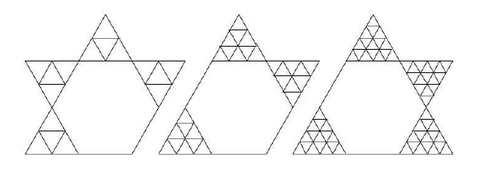
شبكات كاجومي الفرعية 2 × 2 و3 × 3 و4 × 4. تُعرف الشبكة الفرعية 2 × 2 أيضًا باسم شبكة "كاجومي المثلثية". [ 84 ]
| شعرية | z | عتبة ترشيح الموقع | عتبة ترشيح الرابطة | |
|---|---|---|---|---|
| شبكة فرعية رقعة الشطرنج – 2 × 2 | 4.3 | 0.596303(1) [ 85 ] | ||
| شبكة فرعية رقعة الشطرنج – 4 × 4 | 4.3 | 0.633685(9) [ 85 ] | ||
| شبكة فرعية 8 × 8 بنمط رقعة الشطرنج | 4.3 | 0.642318(5) [ 85 ] | ||
| شبكة فرعية بنمط رقعة الشطرنج – 16 × 16 | 4.3 | 0.64237(1) [ 85 ] | ||
| شبكة فرعية بنمط رقعة الشطرنج – 32 × 32 | 4.3 | 0.64219(2) [ 85 ] | ||
| رقعة الشطرنج –الشبكة الفرعية | 4.3 | 0.642216(10) [ 85 ] | ||
| كاغومي – شبكة فرعية 2 × 2 = (3، 12 2 ) تغطية/وسطية | 4 | رابطة p c (3, 12 2 ) = 0.74042077... | 0.600861966960(2), [ 11 ] 0.6008624(10), [ 19 ] 0.60086193(3) [ 9 ] | |
| كاغومي – شبكة فرعية 3 × 3 | 4 | 0.6193296(10), [ 19 ] 0.61933176(5), [ 9 ] 0.61933044(32) | ||
| كاجومي – شبكة فرعية 4 × 4 | 4 | 0.625365(3)، [ 19 ] 0.62536424(7) [ 9 ] | ||
| كاغومي –الشبكة الفرعية | 4 | 0.628961(2) [ 19 ] | ||
| كاغومي – الشبكة الفرعية (1 × 1):(2 × 2) = مارتيني تغطي/وسطى | 4 | رابطة π -c (مارتيني) = 1/ √2 = 0.707107 ... | 0.57086648(36) | |
| كاغومي – شبكة فرعية (1 × 1):(3 × 3) | 4.3 | 0.728355596425196... [ 9 ] | 0.58609776(37) | |
| كاغومي – شبكة فرعية (1 × 1):(4 × 4) | 0.738348473943256... [ 9 ] | |||
| كاغومي – الشبكة الفرعية (1 × 1):(5 × 5) | 0.743548682503071... [ 9 ] | |||
| كاغومي – شبكة فرعية (1 × 1):(6 × 6) | 0.746418147634282... [ 9 ] | |||
| كاغومي – شبكة فرعية (2 × 2):(3 × 3) | 0.61091770(30) | |||
| شبكة فرعية مثلثة – 2 × 2 | 6.4 | 0.471628788 [ 85 ] | ||
| شبكة فرعية مثلثة – 3 × 3 | 6.4 | 0.509077793 [ 85 ] | ||
| شبكة فرعية مثلثة – 4 × 4 | 6.4 | 0.524364822 [ 85 ] | ||
| شبكة فرعية مثلثة – 5 × 5 | 6.4 | 0.5315976(10) [ 85 ] | ||
| مثلث الشكل –الشبكة الفرعية | 6.4 | 0.53993(1) [ 85 ] |

عتبات الأجسام الممتصة بشكل عشوائي ومتسلسل
(للاطلاع على المزيد من النتائج والمقارنة مع كثافة التكدس، انظر الامتزاز التسلسلي العشوائي )
| نظام | z | عتبة الموقع |
|---|---|---|
| ثنائيات على شبكة قرص العسل | 3 | 0.69، [ 86 ] 0.6653 [ 87 ] |
| ثنائيات على شبكة مثلثية | 6 | 0.4872(8)، [ 86 ] 0.4873، [ 87 ] |
| ثنائيات خطية متراصة على شبكة مثلثية | 6 | 0.5157(2) [ 88 ] |
| رباعيات خطية متراصة على شبكة مثلثية | 6 | 0.5220(2) [ 88 ] |
| ثماني وحدات خطية متراصة على شبكة مثلثية | 6 | 0.5281(5) [ 88 ] |
| سلاسل خطية متراصة مكونة من 12 وحدة على شبكة مثلثية | 6 | 0.5298(8) [ 88 ] |
| وحدات خطية مكونة من 16 وحدة على شبكة مثلثية | 6 | محاذاة 0.5328(7) [ 88 ] |
| وحدات خطية مكونة من 32 وحدة على شبكة مثلثية | 6 | محاذاة 0.5407(6) [ 88 ] |
| وحدات خطية مكونة من 64 وحدة على شبكة مثلثية | 6 | محاذاة 0.5455(4) [ 88 ] |
| سلاسل خطية متراصة مكونة من 80 وحدة على شبكة مثلثية | 6 | 0.5500(6) [ 88 ] |
| خطي محاذي kعلى شبكة مثلثة | 6 | 0.582(9) [ 88 ] |
| ثنائيات و5% شوائب، شبكة مثلثة | 6 | 0.4832(7) [ 89 ] |
| ثنائيات متوازية على شبكة مربعة | 4 | 0.5863 [ 90 ] |
| ثنائيات على شبكة مربعة | 4 | 0.5617، [ 90 ] 0.5618(1)، [ 91 ] 0.562، [ 92 ] 0.5713 [ 87 ] |
| ثلاثيات خطية على شبكة مربعة | 4 | 0.528 [ 92 ] |
| زاوية 120 درجة في 3 مواقع، شوائب بنسبة 5%، شبكة مثلثية | 6 | 0.4574(9) [ 89 ] |
| مثلثات ثلاثية المواقع، شوائب بنسبة 5%، شبكة مثلثية | 6 | 0.5222(9) [ 89 ] |
| ثلاثيات خطية و5% شوائب، شبكة مثلثة | 6 | 0.4603(8) [ 89 ] |
| وحدات رباعية خطية على شبكة مربعة | 4 | 0.504 [ 92 ] |
| وحدات خطية خماسية على شبكة مربعة | 4 | 0.490 [ 92 ] |
| وحدات سداسية خطية على شبكة مربعة | 4 | 0.479 [ 92 ] |
| ثماني وحدات خطية على شبكة مربعة | 4 | 0.474، [ 92 ] 0.4697(1) [ 91 ] |
| وحدات خطية مكونة من 10 وحدات على شبكة مربعة | 4 | 0.469 [ 92 ] |
| وحدات خطية مكونة من 16 وحدة على شبكة مربعة | 4 | 0.4639(1) [ 91 ] |
| وحدات خطية مكونة من 32 وحدة على شبكة مربعة | 4 | 0.4747(2) [ 91 ] |

تُحدد العتبة نسبة المواقع التي تشغلها الكائنات عند بدء عملية ترشيح المواقع (وليس عند الوصول إلى حالة التكدس الكامل). للاطلاع على سلاسل k-mers الأطول، انظر المرجع [ 93 ] .
عتبات التغطية الكاملة للثنائيات في الشبكات ثنائية الأبعاد
هنا، نتعامل مع شبكات يتم الحصول عليها بتغطية شبكة بلورية بثنائيات، ثم ندرس انتقال الروابط على الروابط المتبقية. في الرياضيات المتقطعة، تُعرف هذه المسألة باسم " المطابقة المثالية " أو "مسألة تغطية الثنائيات".
| نظام | z | عتبة الرابطة |
|---|---|---|
| تغطية متوازية، شبكة مربعة | 6 | 0.381966... [ 94 ] |
| غطاء مُزاح، شبكة مربعة | 6 | 0.347296... [ 94 ] |
| غطاء متداخل، شبكة مربعة | 6 | 0.376825(2) [ 94 ] |
| غطاء عشوائي، شبكة مربعة | 6 | 0.367713(2) [ 94 ] |
| تغطية متوازية، شبكة مثلثة | 10 | 0.237418... [ 94 ] |
| غطاء متداخل، شبكة مثلثة | 10 | 0.237497(2) [ 94 ] |
| غطاء عشوائي، شبكة مثلثة | 10 | 0.235340(1) [ 94 ] |
عتبات البوليمرات (المسارات العشوائية) على شبكة مربعة
يتكون النظام من مسارات عشوائية عادية (غير متجنبة) بطول l على الشبكة المربعة. [ 95 ]
| ل (طول البوليمر) | z | ترشيح الرابطة |
|---|---|---|
| 1 | 4 | 0.5 (بالضبط) [ 96 ] |
| 2 | 4 | 0.47697(4) [ 96 ] |
| 4 | 4 | 0.44892(6) [ 96 ] |
| 8 | 4 | 0.41880(4) [ 96 ] |
عتبات المسارات ذاتية التجنب بطول k المضافة عن طريق الامتزاز التسلسلي العشوائي
| ك | z | عتبات الموقع | عتبات السندات |
|---|---|---|---|
| 1 | 4 | 0.593(2) [ 97 ] | 0.5009(2) [ 97 ] |
| 2 | 4 | 0.564(2) [ 97 ] | 0.4859(2) [ 97 ] |
| 3 | 4 | 0.552(2) [ 97 ] | 0.4732(2) [ 97 ] |
| 4 | 4 | 0.542(2) [ 97 ] | 0.4630(2) [ 97 ] |
| 5 | 4 | 0.531(2) [ 97 ] | 0.4565(2) [ 97 ] |
| 6 | 4 | 0.522(2) [ 97 ] | 0.4497(2) [ 97 ] |
| 7 | 4 | 0.511(2) [ 97 ] | 0.4423(2) [ 97 ] |
| 8 | 4 | 0.502(2) [ 97 ] | 0.4348(2) [ 97 ] |
| 9 | 4 | 0.493(2) [ 97 ] | 0.4291(2) [ 97 ] |
| 10 | 4 | 0.488(2) [ 97 ] | 0.4232(2) [ 97 ] |
| 11 | 4 | 0.482(2) [ 97 ] | 0.4159(2) [ 97 ] |
| 12 | 4 | 0.476(2) [ 97 ] | 0.4114(2) [ 97 ] |
| 13 | 4 | 0.471(2) [ 97 ] | 0.4061(2) [ 97 ] |
| 14 | 4 | 0.467(2) [ 97 ] | 0.4011(2) [ 97 ] |
| 15 | 4 | 0.4011(2) [ 97 ] | 0.3979(2) [ 97 ] |
العتبات على الشبكات غير المتجانسة ثنائية الأبعاد
| شعرية | z | عتبة ترشيح الموقع | عتبة ترشيح الرابطة |
|---|---|---|---|
| ربطة عنق مع p = 1 ⁄ 2 على رابطة غير قطرية واحدة | 3 | 0.3819654(5), [ 98 ][ 61 ] | |

عتبات نماذج الاستمرارية ثنائية الأبعاد
| نظام | Φ c | η c | ن ج | |
|---|---|---|---|---|
| أقراص نصف قطرها r | 0.67634831(2)، [ 99 ] 0.6763475(6)، [ 100 ] 0.676339(4)، [ 101 ] 0.6764(4)، [ 102 ] 0.6766(5)، [ 103 ] 0.676(2)، [ 104 ] 0.679، [ 105 ] 0.674 ، [ 106 ] 0.676، [ 107 ] 0.680، [ 108 ] | 1.1280867(5)، [ 109 ] 1.1276(9)، [ 110 ] 1.12808737(6)، [ 99 ] 1.128085(2)، [ 100 ] 1.128059(12)، [ 101 ] 1.13، 0.8 [ 111 ] | 1.43632505(10)، [ 112 ] 1.43632545(8)، [ 99 ] 1.436322(2)، [ 100 ] 1.436289(16)، [ 101 ] 1.436320(4)، [ 113 ] 1.436323(3)، [ 114 ] 1.438(2)، [ 115 ] 1.216 (48) [ 116 ] | |
| أقراص ذات نصف قطر منتظم (0، r) | 0.686610(7), [ 117 ] 0.6860(12), [ 102 ] 0.680 [ 106 ] | = 1.108010(7) [ 117 ] | ||
| القطع الناقصة، ε = 1.5 | 0.0043 [ 105 ] | 0.00431 | 2.059081(7) [ 114 ] | |
| القطع الناقصة، ε = 5 ⁄ 3 | 0.65 [ 118 ] | 1.05 [ 118 ] | 2.28 [ 118 ] | |
| القطع الناقصة، ε = 2 | 0.6287945(12), [ 114 ] 0.63 [ 118 ] | 0.991000(3), [ 114 ] 0.99 [ 118 ] | 2.523560(8)، [ 114 ] 2.5 [ 118 ] | |
| القطع الناقص، ε = 3 | 0.56 [ 118 ] | 0.82 [ 118 ] | 3.157339(8), [ 114 ] 3.14 [ 118 ] | |
| القطع الناقصة، ε = 4 | 0.5 [ 118 ] | 0.69 [ 118 ] | 3.569706(8)، [ 114 ] 3.5 [ 118 ] | |
| القطع الناقص، ε = 5 | 0.455، [ 105 ] 0.455، [ 107 ] 0.46 [ 118 ] | 0.607 [ 105 ] | 3.861262(12)، [ 114 ] 3.86 [ 105 ] | |
| القطع الناقصة، ε = 6 | 4.079365(17) [ 114 ] | |||
| القطع الناقصة، ε = 7 | 4.249132(16) [ 114 ] | |||
| القطع الناقصة، ε = 8 | 4.385302(15) [ 114 ] | |||
| القطع الناقصة، ε = 9 | 4.497000(8) [ 114 ] | |||
| القطع الناقصة، ε = 10 | 0.301، [ 105 ] 0.303، [ 107 ] 0.30 [ 118 ] | 0.358 [ 105 ] 0.36 [ 118 ] | 4.590416(23) [ 114 ] 4.56, [ 105 ] 4.5 [ 118 ] | |
| القطع الناقصة، ε = 15 | 4.894752(30) [ 114 ] | |||
| القطع الناقصة، ε = 20 | 0.178، [ 105 ] 0.17 [ 118 ] | 0.196 [ 105 ] | 5.062313(39)، [ 114 ] 4.99 [ 105 ] | |
| القطع الناقصة، ε = 50 | 0.081 [ 105 ] | 0.084 [ 105 ] | 5.393863(28)، [ 114 ] 5.38 [ 105 ] | |
| القطع الناقص، ε = 100 | 0.0417 [ 105 ] | 0.0426 [ 105 ] | 5.513464(40)، [ 114 ] 5.42 [ 105 ] | |
| القطع الناقص، ε = 200 | 0.021 [ 118 ] | 0.0212 [ 118 ] | 5.40 [ 118 ] | |
| القطع الناقصة، ε = 1000 | 0.0043 [ 105 ] | 0.00431 | 5.624756(22)، [ 114 ] 5.5 | |
| القطع الناقص الفائق، ε = 1، m = 1.5 | 0.671 [ 107 ] | |||
| القطع الناقص الفائق، ε = 2.5، m = 1.5 | 0.599 [ 107 ] | |||
| القطع الناقص الفائق، ε = 5، m = 1.5 | 0.469 [ 107 ] | |||
| القطع الناقص الفائق، ε = 10، m = 1.5 | 0.322 [ 107 ] | |||
| مستطيلات الديسكو، ε = 1.5 | 1.894 [ 113 ] | |||
| مستطيلات الديسكو، ε = 2 | 2.245 [ 113 ] | |||
| مستطيل منحني غير منتظم، α=5، θ= | 0.461 [ 119 ] | |||
| مستطيل منحني غير منتظم، α=10,θ= | 0.336 [ 119 ] | |||
| مستطيل منحني غير منتظم، α=100,θ= | 0.059 [ 119 ] | |||
| مستطيل منحني غير منتظم، α=10,θ= | 0.376 [ 119 ] | |||
| مستطيل منحني غير منتظم، α=10، θ= 2 | 0.567 [ 119 ] | |||
| مربعات متوازية من الجانب | 0.66675(2)، [ 56 ] 0.66674349(3)، [ 99 ] 0.66653(1)، [ 120 ] 0.6666(4)، [ 121 ] 0.668 [ 106 ] | 1.09884280(9)، [ 99 ] 1.0982(3)، [ 120 ] 1.098(1) [ 121 ] | 1.09884280(9)، [ 99 ] 1.0982(3)، [ 120 ] 1.098(1) [ 121 ] | |
| مربعات ذات اتجاهات عشوائية | 0.62554075(4)، [ 99 ] 0.6254(2) [ 121 ] 0.625، [ 107 ] | 0.9822723(1)، [ 99 ] 0.9819(6) [ 121 ] 0.982278(14) [ 122 ] | 0.9822723(1)، [ 99 ] 0.9819(6) [ 121 ] 0.982278(14) [ 122 ] | |
| مربعات ذات اتجاهات عشوائية ضمن زاوية | 0.6255(1) [ 121 ] | 0.98216(15) [ 121 ] | ||
| المستطيلات، ε = 1.1 | 0.624870(7) | 0.980484(19) | 1.078532(21) [ 122 ] | |
| المستطيلات، ε = 2 | 0.590635(5) | 0.893147(13) | 1.786294(26) [ 122 ] | |
| المستطيلات، ε = 3 | 0.5405983(34) | 0.777830(7) | 2.333491(22) [ 122 ] | |
| المستطيلات، ε = 4 | 0.4948145(38) | 0.682830(8) | 2.731318(30) [ 122 ] | |
| المستطيلات، ε = 5 | 0.4551398(31), 0.451 [ 107 ] | 0.607226(6) | 3.036130(28) [ 122 ] | |
| المستطيلات، ε = 10 | 0.3233507(25), 0.319 [ 107 ] | 0.3906022(37) | 3.906022(37) [ 122 ] | |
| المستطيلات، ε = 20 | 0.2048518(22) | 0.2292268(27) | 4.584535(54) [ 122 ] | |
| المستطيلات، ε = 50 | 0.09785513(36) | 0.1029802(4) | 5.149008(20) [ 122 ] | |
| المستطيلات، ε = 100 | 0.0523676(6) | 0.0537886(6) | 5.378856(60) [ 122 ] | |
| المستطيلات، ε = 200 | 0.02714526(34) | 0.02752050(35) | 5.504099(69) [ 122 ] | |
| المستطيلات، ε = 1000 | 0.00559424(6) | 0.00560995(6) | 5.609947(60) [ 122 ] | |
| أعواد (إبر) بطول | 5.637348(10)، [ 123 ] 5.63726(2)، [ 124 ] 5.6372858(6)، [ 99 ] 5.637263(11)، [ 122 ] 5.63724(18) [ 125 ] | |||
| عصي ثلاثية الأبعاد مكدسة بطولوالقطر | 5.850923(14) [ 123 ] | |||
| أعواد ذات توزيع طول لوغاريتمي طبيعي. الانحراف المعياري = 0.5 | 4.756(3) [ 125 ] | |||
| عصي ذات مسافة زاوية مترابطة s=0.5 | 6.6076(4) [ 125 ] | |||
| أقراص ذات قانون القوة، x = 2.05 | 0.993(1) [ 126 ] | 4.90(1) | 0.0380(6) | |
| أقراص ذات قانون قوة، x = 2.25 | 0.8591(5) [ 126 ] | 1.959(5) | 0.06930(12) | |
| أقراص ذات قانون القوة، x = 2.5 | 0.7836(4) [ 126 ] | 1.5307(17) | 0.09745(11) | |
| أقراص قانون القوة، x = 4 | 0.69543(6) [ 126 ] | 1.18853(19) | 0.18916(3) | |
| أقراص قانون القوة، x = 5 | 0.68643(13) [ 126 ] | 1.1597(3) | 0.22149(8) | |
| أقراص قانون القوة، x = 6 | 0.68241(8) [ 126 ] | 1.1470(1) | 0.24340(5) | |
| أقراص قانون القوة، x = 7 | 0.6803(8) [ 126 ] | 1.140(6) | 0.25933(16) | |
| أقراص قانون القوة، x = 8 | 0.67917(9) [ 126 ] | 1.1368(5) | 0.27140(7) | |
| أقراص قانون القوة، x = 9 | 0.67856(12) [ 126 ] | 1.1349(4) | 0.28098(9) | |
| الفراغات حول أقراص نصف قطرها r | 1 − Φ c (disk) = 0.32355169(2), [ 99 ] 0.318(2), [ 127 ] 0.3261(6) [ 128 ] | |||


بالنسبة للأقراص،يساوي العدد الحرج للأقراص لكل وحدة مساحة، مقاسًا بوحدات القطر، أينهو عدد الأشياء وحجم النظام
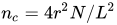


بالنسبة للأقراص،يساوي إجمالي مساحة القرص الحرجة.

يعطي عدد مراكز الأقراص داخل دائرة التأثير (نصف القطر 2 r).

هو نصف قطر القرص الحرج.
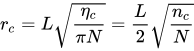
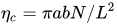
للقطع الناقصة ذات المحورين شبه الرئيسيين a و b على التوالي. نسبة العرض إلى الارتفاعمع.


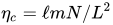
بالنسبة للمستطيلات ذات الأبعادونسبة العرض إلى الارتفاعمع.


بالنسبة للأقراص الموزعة وفقًا لقانون القوة مع،.



يساوي نسبة المساحة الحرجة.
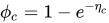
بالنسبة للأقراص، راجع المرجع [ 104 ]أينهي كثافة الأقراص ذات نصف القطر.


يساوي عدد الكائنات ذات الطول الأقصى لكل وحدة مساحة.
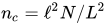

بالنسبة للقطع الناقصة،
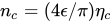
بالنسبة لتسرب الفراغات،يمثل نسبة الفراغ الحرجة.

لمزيد من قيم القطع الناقص، انظر [ 114 ] [ 118 ]
لمزيد من قيم المستطيل، انظر [ 122 ]
ينتمي كل من القطع الناقص والمستطيلات إلى القطع الناقص الفائق، مع. لمزيد من قيم الترشيح للأشكال البيضاوية الفائقة، انظر [ 107 ]

بالنسبة لأنظمة الجسيمات أحادية التشتت، يتم الحصول على عتبات الترشيح للأقراص الفائقة المقعرة الشكل كما هو موضح في [ 129 ].
للاطلاع على التشتت الثنائي للأقراص، انظر [ 100 ] [ 130 ] [ 117 ]
عتبات على الشبكات العشوائية وشبه الشبكات ثنائية الأبعاد

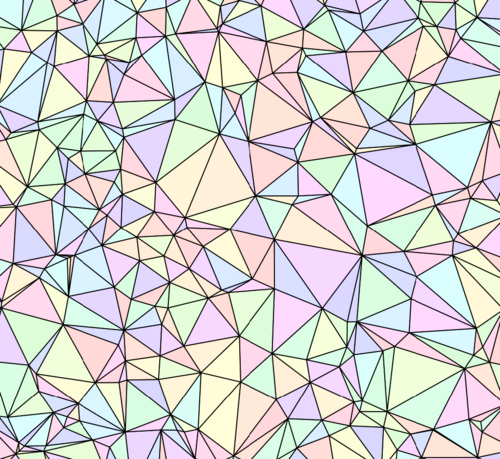

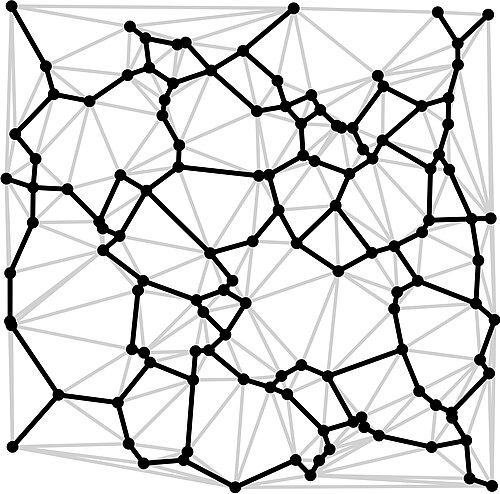
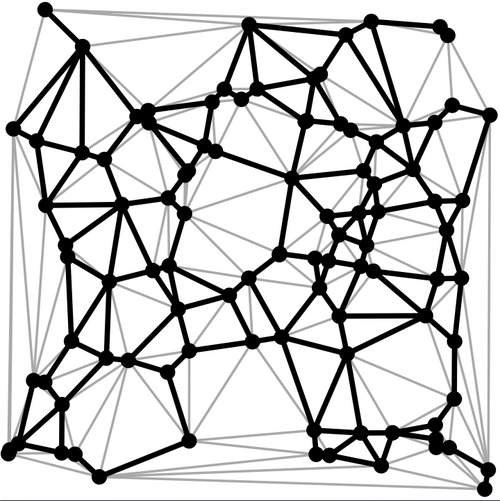
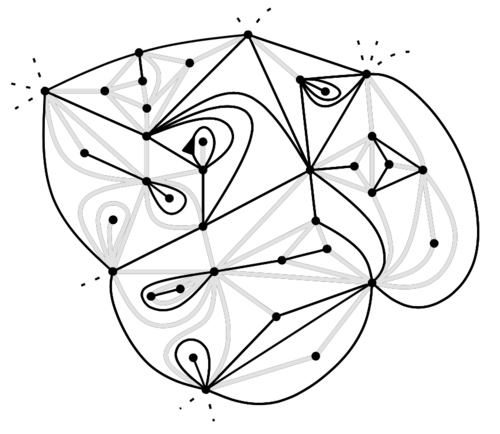
| شعرية | z | عتبة ترشيح الموقع | عتبة ترشيح الرابطة | |
|---|---|---|---|---|
| رسم بياني للجوار النسبي | 2.5576 | 0.796(2) [ 131 ] | 0.771(2) [ 131 ] | |
| تبليط فورونوي | 3 | 0.71410(2)، [ 133 ] 0.7151* [ 74 ] | 0.68، [ 134 ] 0.6670(1)، [ 135 ] 0.6680(5)، [ 136 ] 0.666931(5) [ 133 ] | |
| غطاء فورونوي / الوسائط | 4 | 0.666931(2) [ 133 ] [ 135 ] | 0.53618(2) [ 133 ] | |
| شكل كاغومي / مربع-ثماني عشوائي، الكسر r = 1/2 | 4 | 0.6599 [ 16 ] | ||
| معين بنروز المزدوج | 4 | 0.6381(3) [ 71 ] | 0.5233(2) [ 71 ] | |
| رسم بياني لغابرييل | 4 | 0.6348(8)، [ 137 ] 0.62 [ 138 ] | 0.5167(6)، [ 137 ] 0.52 [ 138 ] | |
| التبليط بخطوط عشوائية، ثنائي | 4 | 0.586(2) [ 139 ] | ||
| معين بنروز | 4 | 0.5837(3)، [ 71 ] 0.0.5610(6) (الروابط الموزونة) [ 140 ] 0.58391(1) [ 141 ] | 0.483(5)، [ 142 ] 0.4770(2) [ 71 ] | |
| شبكة ثمانية الأضلاع، روابط "كيميائية" ( تبليط أمان-بينكر ) | 4 | 0.585 [ 143 ] | 0.48 [ 143 ] | |
| شبكة ثمانية الأضلاع، روابط "مغناطيسية حديدية" | 5.17 | 0.543 [ 143 ] | 0.40 [ 143 ] | |
| شبكة اثني عشرية، روابط "كيميائية" | 3.63 | 0.628 [ 143 ] | 0.54 [ 143 ] | |
| شبكة اثني عشرية، روابط "مغناطيسية حديدية" | 4.27 | 0.617 [ 143 ] | 0.495 [ 143 ] | |
| التثليث ديلاوناي | 6 | 1 ⁄ 2 [ 144 ] | 0.3333(1) [ 135 ] 0.3326(5), [ 136 ] 0.333069(2) [ 133 ] | |
| التثليث المستوي اللانهائي المنتظم [ 145 ] | 6 | نصف | (2 √ 3 – 1)/11 ≈ 0.2240 [ 132 ] [ 146 ] | |
* تقدير نظري
العتبات على الأنظمة المترابطة ثنائية الأبعاد
بافتراض وجود ارتباطات تخضع لقانون القوة
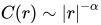
| شعرية | α | عتبة ترشيح الموقع | عتبة ترشيح الرابطة |
|---|---|---|---|
| مربع | 3 | 0.561406(4) [ 147 ] | |
| مربع | 2 | 0.550143(5) [ 147 ] | |
| مربع | 0.1 | 0.508(4) [ 147 ] | |
عتبات على ألواح
يمثل h سمك البلاطة، h × ∞ × ∞. تشير الشروط الحدية (bc) إلى المستويين العلوي والسفلي للبلاطة.
| شعرية | ح | z | عتبة ترشيح الموقع | عتبة ترشيح الرابطة | |
|---|---|---|---|---|---|
| مكعب بسيط (مفتوح bc) | 2 | 5 | 5 | 0.47424، [ 148 ] 0.4756 [ 149 ] | |
| bcc (open bc) | 2 | 0.4155 [ 149 ] | |||
| hcp (open bc) | 2 | 0.2828 [ 149 ] | |||
| الماس (مفتوح bc) | 2 | 0.5451 [ 149 ] | |||
| مكعب بسيط (مفتوح bc) | 3 | 0.4264 [ 149 ] | |||
| bcc (open bc) | 3 | 0.3531 [ 149 ] | |||
| bcc (الشرط الدوري bc) | 3 | 0.21113018(38) [ 150 ] | |||
| hcp (open bc) | 3 | 0.2548 [ 149 ] | |||
| الماس (مفتوح bc) | 3 | 0.5044 [ 149 ] | |||
| مكعب بسيط (مفتوح bc) | 4 | 0.3997، [ 148 ] 0.3998 [ 149 ] | |||
| bcc (open bc) | 4 | 0.3232 [ 149 ] | |||
| bcc (الشرط الدوري bc) | 4 | 0.20235168(59) [ 150 ] | |||
| hcp (open bc) | 4 | 0.2405 [ 149 ] | |||
| الماس (مفتوح bc) | 4 | 0.4842 [ 149 ] | |||
| مكعب بسيط (دوري bc) | 5 | 6 | 6 | 0.278102(5) [ 150 ] | |
| مكعب بسيط (مفتوح bc) | 6 | 0.3708 [ 149 ] | |||
| مكعب بسيط (دوري bc) | 6 | 6 | 6 | 0.272380(2) [ 150 ] | |
| bcc (open bc) | 6 | 0.2948 [ 149 ] | |||
| hcp (open bc) | 6 | 0.2261 [ 149 ] | |||
| الماس (مفتوح bc) | 6 | 0.4642 [ 149 ] | |||
| مكعب بسيط (دوري bc) | 7 | 6 | 6 | 0.3459514(12) [ 150 ] | 0.268459(1) [ 150 ] |
| مكعب بسيط (مفتوح bc) | 8 | 0.3557، [ 148 ] 0.3565 [ 149 ] | |||
| مكعب بسيط (دوري bc) | 8 | 6 | 6 | 0.265615(5) [ 150 ] | |
| bcc (open bc) | 8 | 0.2811 [ 149 ] | |||
| hcp (open bc) | 8 | 0.2190 [ 149 ] | |||
| الماس (مفتوح bc) | 8 | 0.4549 [ 149 ] | |||
| مكعب بسيط (مفتوح bc) | 12 | 0.3411 [ 149 ] | |||
| bcc (open bc) | 12 | 0.2688 [ 149 ] | |||
| hcp (open bc) | 12 | 0.2117 [ 149 ] | |||
| الماس (مفتوح bc) | 12 | 0.4456 [ 149 ] | |||
| مكعب بسيط (مفتوح bc) | 16 | 0.3219، [ 148 ] 0.3339 [ 149 ] | |||
| bcc (open bc) | 16 | 0.2622 [ 149 ] | |||
| hcp (open bc) | 16 | 0.2086 [ 149 ] | |||
| الماس (مفتوح bc) | 16 | 0.4415 [ 149 ] | |||
| مكعب بسيط (مفتوح bc) | 32 | 0.3219، [ 148 ] | |||
| مكعب بسيط (مفتوح bc) | 64 | 0.3165، [ 148 ] | |||
| مكعب بسيط (مفتوح bc) | 128 | 0.31398، [ 148 ] | |||
الترشيح ثلاثي الأبعاد
| شعرية | z | عامل التعبئة* | كسر التعبئة* | عتبة ترشيح الموقع | عتبة ترشيح الرابطة | |
|---|---|---|---|---|---|---|
| (10,3)-أكسيد (أو رابطة الموقع) [ 151 ] | 2 3 3 2 | 2.4 | 0.748713(22) [ 151 ] | = ( p c,bond (10,3) – a ) 1 ⁄ 2 = 0.742334(25) [ 152 ] | ||
| أكسيد (10,3)-ب (أو الرابطة الموقعية) [ 151 ] | 2 3 3 2 | 2.4 | 0.233 [ 153 ] | 0.174 | 0.745317(25) [ 151 ] | = ( p c,bond (10,3) – b ) 1 ⁄ 2 = 0.739388(22) [ 152 ] |
| ثاني أكسيد السيليكون (رابطة موقع الماس) [ 151 ] | 4.2 2 | 2 2 ⁄ 3 | 0.638683(35) [ 151 ] | |||
| (10,3)-ب المعدل [ 154 ] | 3 2 ,2 | 2 2 ⁄ 3 | 0.627 [ 154 ] | |||
| (8,3)-أ [ 152 ] | 3 | 3 | 0.577962(33) [ 152 ] | 0.555700(22) [ 152 ] | ||
| (10,3)-a [ 152 ] gyroid [ 155 ] | 3 | 3 | 0.571404(40) [ 152 ] | 0.551060(37) [ 152 ] | ||
| (10,3)-ب [ 152 ] | 3 | 3 | 0.565442(40) [ 152 ] | 0.546694(33) [ 152 ] | ||
| أكسيد مكعب (رابطة الموقع المكعب) [ 151 ] | 6.2 3 | 3.5 | 0.524652(50) [ 151 ] | |||
| ثنائي bcc | 4 | 0.4560(6) [ 156 ] | 0.4031(6) [ 156 ] | |||
| آيس إيه | 4 | 4 | π √ 3 / 16 = 0.340087 | 0.147 | 0.433(11) [ 157 ] | 0.388(10) [ 158 ] |
| الماس (آيس آيك) | 4 | 4 | π √ 3 / 16 = 0.340087 | 0.1462332 | 0.4299(8), [ 159 ] 0.4299870(4), [ 160 ]0.426 +0.08 −0.02 ، [ 161 ] 0.4297(4) [ 162 ] 0.4301(4)، [ 163 ] 0.428(4)، [ 164 ] 0.425(15)، [ 165 ] 0.425، [ 44 ] [ 51 ] 0.436(12) [ 157 ] | 0.3895892(5)، [ 160 ] 0.3893(2)، [ 163 ] 0.3893(3)، [ 162 ] 0.388(5)، [ 165 ] 0.3886(5)، [ 159 ] 0.388(5) [ 164 ] 0.390(11) [ 158 ] |
| ثنائي الألماس | 6 2 ⁄ 3 | 0.3904(5) [ 156 ] | 0.2350(5) [ 156 ] | |||
| كاجومي ثلاثية الأبعاد (رسم بياني يغطي شبكة الماس) | 6 | π √ 2 / 12 = 0.37024 | 0.1442 | 0.3895(2) [ 166 ] =p c (الموقع) للماس المزدوج و p c (الرابطة) لشبكة الماس [ 156 ] | 0.2709(6) [ 156 ] | |
| مجموعة مزدوجة على شكل ربطة عنق | 5 1/3 | 0.3480(4) [ 41 ] | 0.2853(4) [ 41 ] | |||
| كومة قرص العسل | 5 | 5 | 0.3701(2) [ 41 ] | 0.3093(2) [ 41 ] | ||
| مكدس ثماني الأضلاع مزدوج | 5 | 5 | 0.3840(4) [ 41 ] | 0.3168(4) [ 41 ] | ||
| مجموعة خماسية | 5 1/3 | 0.3394(4) [ 41 ] | 0.2793(4) [ 41 ] | |||
| مجموعة كاغومي | 6 | 6 | 0.453450 | 0.1517 | 0.3346(4) [ 41 ] | 0.2563(2) [ 41 ] |
| لجنة الاتصالات الفيدرالية المزدوجة | 4 2 ,8 | 5 1/3 | 0.3341(5) [ 156 ] | 0.2703(3) [ 156 ] | ||
| مكعب بسيط | 6 | 6 | π / 6 = 0.5235988 | 0.1631574 | 0.307(10)، [ 165 ] 0.307، [ 44 ] 0.3115(5)، [ 167 ] 0.3116077(2)، [ 168 ] 0.311604(6)، [ 169 ] 0.311605(5)، [ 170 ] 0.311600(5)، [ 171 ] 0.3116077(4)، [ 172 ] 0.3116081(13)، [ 173 ] 0.3116080(4)، [ 174 ] 0.3116060(48)، [ 175 ] 0.3116004(35)، [ 176 ] 0.31160768(15 ) 160 ] | 0.247(5)، [ 165 ] 0.2479(4)، [ 159 ] 0.2488(2)، [ 177 ] 0.24881182(10)، [ 168 ] 0.2488125(25)، [ 178 ] 0.2488126(5)، [ 179 ] |
| ثنائي hcp | 4 4 ,8 2 | 5 1/3 | 0.3101(5) [ 156 ] | 0.2573(3) [ 156 ] | ||
| كومة النرد | 5.8 | 6 | π √ 3 / 9 = 0.604600 | 0.1813 | 0.2998(4) [ 41 ] | 0.2378(4) [ 41 ] |
| مجموعة ربطة عنق | 7 | 7 | 0.2822(6) [ 41 ] | 0.2092(4) [ 41 ] | ||
| مثلثات متراصة / سداسي بسيط | 8 | 8 | 0.26240(5)، [ 180 ] 0.2625(2)، [ 181 ] 0.2623(2) [ 41 ] | 0.18602(2)، [ 180 ] 0.1859(2) [ 41 ] | ||
| مكدس ثماني الأضلاع (علم الاتحاد) | 6.10 | 8 | 0.2524(6) [ 41 ] | 0.1752(2) [ 41 ] | ||
| bcc | 8 | 8 | 0.243(10)، [ 165 ] 0.243، [ 44 ] 0.2459615(10)، [ 174 ] 0.2460(3)، [ 182 ] 0.2464(7)، [ 159 ] 0.2458(2) [ 163 ] | 0.178(5)، [ 165 ] 0.1795(3)، [ 159 ] 0.18025(15)، [ 177 ] 0.1802875(10) [ 179 ] | ||
| مكعب بسيط مع 3 أقارب (نفس مكعب الجسم المكعب) | 8 | 8 | 0.2455(1)، [ 183 ] 0.2457(7) [ 184 ] | |||
| لجنة الاتصالات الفيدرالية، D 3 | 12 | 12 | π / (3 √ 2 ) = 0.740480 | 0.147530 | 0.195، [ 44 ] 0.198(3)، [ 185 ] 0.1998(6)، [ 159 ] 0.1992365(10)، [ 174 ] 0.19923517(20)، [ 160 ] 0.1994(2)، [ 163 ] 0.199236(4) [ 186 ] | 0.1198(3)، [ 159 ] 0.1201635(10) [ 179 ] 0.120169(2) [ 186 ] |
| مقدم الرعاية الصحية | 12 | 12 | π / (3 √ 2 ) = 0.740480 | 0.147545 | 0.195(5)، [ 165 ] 0.1992555(10) [ 187 ] | 0.1201640(10), [ 187 ] 0.119(2) [ 165 ] |
| La 2−x Sr x Cu O 4 | 12 | 12 | 0.19927(2) [ 188 ] | |||
| مكعب بسيط مع أقرب جارين (نفس مكعب مركزي الوجه) | 12 | 12 | 0.1991(1) [ 183 ] | |||
| مكعب بسيط مع NN+4NN | 12 | 12 | 0.15040(12)، [ 189 ] 0.1503793(7) [ 53 ] | 0.1068263(7) [ 190 ] | ||
| مكعب بسيط مع 3NN+4NN | 14 | 14 | 0.20490(12) [ 189 ] | 0.1012133(7) [ 190 ] | ||
| bcc NN+2NN (= sc(3,4) sc-3NN+4NN) | 14 | 14 | 0.175، [ 44 ] 0.1686، (20) [ 191 ] 0.1759432 (8) | 0.0991(5)، [ 191 ] 0.1012133(7)، [ 48 ] 0.1759432(8) [ 48 ] | ||
| ألياف الأنابيب النانوية على FCC | 14 | 14 | 0.1533(13) [ 192 ] | |||
| مكعب بسيط مع NN+3NN | 14 | 14 | 0.1420(1) [ 183 ] | 0.0920213(7) [ 190 ] | ||
| مكعب بسيط مع 2NN+4NN | 18 | 18 | 0.15950(12) [ 189 ] | 0.0751589(9) [ 190 ] | ||
| مكعب بسيط مع NN+2NN | 18 | 18 | 0.137، [ 51 ] 0.136، [ 193 ] 0.1372(1)، [ 183 ] 0.13735(5)، 0.1373045(5) [ 53 ] | 0.0752326(6) [ 190 ] | ||
| fcc مع NN+2NN (=sc-2NN+4NN) | 18 | 18 | 0.136، [ 44 ] 0.1361408(8) [ 53 ] | 0.0751589(9) [ 48 ] | ||
| مكعب بسيط ذو ارتباط قصير الطول | 6+ | 6+ | 0.126(1) [ 194 ] | |||
| مكعب بسيط مع NN+3NN+4NN | 20 | 20 | 0.11920(12) [ 189 ] | 0.0624379(9) [ 190 ] | ||
| مكعب بسيط مع 2NN+3NN | 20 | 20 | 0.1036(1) [ 183 ] | 0.0629283(7) [ 190 ] | ||
| مكعب بسيط مع NN+2NN+4NN | 24 | 24 | 0.11440(12) [ 189 ] | 0.0533056(6) [ 190 ] | ||
| مكعب بسيط مع 2NN+3NN+4NN | 26 | 26 | 0.11330(12) [ 189 ] | 0.0474609(9) | ||
| مكعب بسيط مع NN+2NN+3NN | 26 | 26 | 0.097، [ 44 ] 0.0976(1)، [ 183 ] 0.0976445(10)، 0.0976444(6) [ 53 ] | 0.0497080(10) [ 190 ] | ||
| bcc مع NN+2NN+3NN | 26 | 26 | 0.095، [ 51 ] 0.0959084(6) [ 53 ] | 0.0492760(10) [ 48 ] | ||
| مكعب بسيط مع NN+2NN+3NN+4NN | 32 | 32 | 0.10000(12), [ 189 ] 0.0801171(9) [ 53 ] | 0.0392312(8) [ 190 ] | ||
| fcc مع NN+2NN+3NN | 42 | 42 | 0.061، [ 51 ] 0.0610(5)، [ 193 ] 0.0618842(8) [ 48 ] | 0.0290193(7) [ 48 ] | ||
| fcc مع NN+2NN+3NN+4NN | 54 | 54 | 0.0500(5) [ 193 ] | |||
| sc-1,2,3,4,5 مكعب بسيط مع NN+2NN+3NN+4NN+5NN | 56 | 56 | 0.0461815(5) [ 53 ] | 0.0210977(7) [ 48 ] | ||
| sc-1,...,6 (مكعب 2x2x2 [ 55 ] ) | 80 | 80 | 0.0337049(9)، [ 53 ] 0.03373(13) [ 55 ] | 0.0143950(10) [ 48 ] | ||
| sc-1,...,7 | 92 | 92 | 0.0290800(10) [ 53 ] | 0.0123632(8) [ 48 ] | ||
| sc-1,...,8 | 122 | 122 | 0.0218686(6) [ 53 ] | 0.0091337(7) [ 48 ] | ||
| sc-1,...,9 | 146 | 146 | 0.0184060(10) [ 53 ] | 0.0075532(8) [ 48 ] | ||
| sc-1,...,10 | 170 | 170 | 0.0064352(8) [ 48 ] | |||
| sc-1,...,11 | 178 | 178 | 0.0061312(8) [ 48 ] | |||
| sc-1,...,12 | 202 | 202 | 0.0053670(10) [ 48 ] | |||
| sc-1,...,13 | 250 | 250 | 0.0042962(8) [ 48 ] | |||
| مكعب 3×3×3 | 274 | 274 | φ ج = 0.76564(1)، [ 56 ] ص ج = 0.0098417(7)، [ 56 ] 0.009854(6) [ 55 ] | |||
| مكعب 4x4x4 | 636 | 636 | φ ج =0.76362(1), [ 56 ] ص ج = 0.0042050(2), [ 56 ] 0.004217(3) [ 55 ] | |||
| مكعب 5x5x5 | 1214 | 1250 | φ ج =0.76044(2), [ 56 ] ص ج = 0.0021885(2), [ 56 ] 0.002185(4) [ 55 ] | |||
| مكعب 6x6x6 | 2056 | 2056 | 0.001289(2) [ 55 ] | |||
عامل التعبئة = نسبة الفراغ الذي تشغله الكرات المتلامسة في كل موقع من مواقع الشبكة (للأنظمة ذات طول الرابطة المنتظم فقط). ويُسمى أيضاً عامل التعبئة الذرية .
نسبة التعبئة (أو نسبة التعبئة الحرجة) = عامل التعبئة * p c (الموقع).
NN = أقرب جار، 2NN = الجار التالي الأقرب، 3NN = الجار التالي التالي الأقرب، إلخ.
مكعبات kxkxk هي مكعبات من المواقع المشغولة على شبكة، وهي تعادل الترشيح الممتد لمكعب طوله (2k+1)، مع إزالة الحواف والزوايا، مع z = (2k+1) 3 -12(2k-1)-9 (الموقع المركزي غير محسوب في z).
السؤال: تتفق عتبات الروابط لشبكتي hcp و fcc ضمن هامش الخطأ الإحصائي الصغير. هل هي متطابقة، وإن لم تكن كذلك، فما هو الفرق بينهما؟ أي عتبة يُتوقع أن تكون أكبر؟ وبالمثل بالنسبة لشبكتي الجليد والماس. انظر [ 195 ]
| نظام | بوليمر Φ c |
|---|---|
| حجم الاستبعاد المتخلل لمصفوفة البوليمر غير الحرارية (نموذج تقلب الروابط على الشبكة المكعبة) | 0.4304(3) [ 196 ] |
شبكات ثلاثية الأبعاد مشوهة
هنا، يتم تشويه شبكة منتظمة ذات تباعد وحدة عن طريق تحريك الرؤوس بشكل منتظم داخل المكعبويأخذ في الاعتبار الترشيح عندما تكون المواقع ضمن مسافة إقليديةعن بعضهم البعض.

| شعرية | عتبة ترشيح الموقع | عتبة ترشيح الرابطة | |||
|---|---|---|---|---|---|
| مكعب | 0.05 | 1.0 | 0.60254(3) [ 197 ] | ||
| 0.1 | 1.00625 | 0.58688(4) [ 197 ] | |||
| 0.15 | 1.025 | 0.55075(2) [ 197 ] | |||
| 0.175 | 1.05 | 0.50645(5) [ 197 ] | |||
| 0.2 | 1.1 | 0.44342(3) [ 197 ] | |||
أشكال متداخلة على شبكات ثلاثية الأبعاد
عتبة الموقع هي عدد الأجسام المتداخلة لكل موقع في الشبكة. التغطية φc هي النسبة الصافية للمواقع المغطاة، و v هو الحجم (عدد المكعبات). ترد معلومات عن المكعبات المتداخلة في قسم عتبات الشبكات ثلاثية الأبعاد. هنا، z هو عدد التنسيق لوحدات k-mers من أي اتجاه، مع

| نظام | ك | z | تغطية الموقع φ c | عتبة ترشيح الموقع p c |
|---|---|---|---|---|
| ثنائي 1 × 2، شبكة مكعبة | 2 | 56 | 0.24542 [ 55 ] | 0.045847(2) [ 55 ] |
| ثلاثي 1 × 3، شبكة مكعبة | 3 | 104 | 0.19578 [ 55 ] | 0.023919(9) [ 55 ] |
| عصا 1 × 4، شبكة مكعبة | 4 | 164 | 0.16055 [ 55 ] | 0.014478(7) [ 55 ] |
| 1 × 5 عصا، شبكة مكعبة | 5 | 236 | 0.13488 [ 55 ] | 0.009613(8) [ 55 ] |
| 1 × 6 عصا، شبكة مكعبة | 6 | 320 | 0.11569 [ 55 ] | 0.006807(2) [ 55 ] |
| لوحة 2 × 2، شبكة مكعبة | 2 | 0.22710 [ 55 ] | 0.021238(2) [ 55 ] | |
| لوحة 3 × 3، شبكة مكعبة | 3 | 0.18686 [ 55 ] | 0.007632(5) [ 55 ] | |
| لوحة 4 × 4، شبكة مكعبة | 4 | 0.16159 [ 55 ] | 0.003665(3) [ 55 ] | |
| لوحة 5 × 5، شبكة مكعبة | 5 | 0.14316 [ 55 ] | 0.002058(5) [ 55 ] | |
| لوحة 6 × 6، شبكة مكعبة | 6 | 0.12900 [ 55 ] | 0.001278(5) [ 55 ] | |
يتم حساب التغطية منبواسطة للعصي، وللألواح الصغيرة.


ترشيح ثنائي الأبعاد
| نظام | عتبة ترشيح الموقع | عتبة ترشيح الرابطة |
|---|---|---|
| مكعب بسيط | 0.2555(1) [ 198 ] | |
عتبات نماذج الاستمرارية ثلاثية الأبعاد
جميعها متداخلة باستثناء الكرات المتشابكة ومصفوفة البوليمر.
| نظام | Φ c | η c |
|---|---|---|
| كرات نصف قطرها r | 0.289، [ 199 ] 0.293، [ 200 ] 0.286، [ 201 ] 0.295، [ 106 ] 0.2895(5)، [ 202 ] 0.28955(7)، [ 203 ] 0.2896(7)، [ 204 ] 0.289573(2)، [ 205 ] 0.2896، [ 206 ] 0.2854، [ 207 ] 0.290، [ 208 ] 0.290، [ 209 ] 0.2895693(26) [ 210 ] | 0.3418(7)، [ 202 ] 0.3438(13)، [ 211 ] 0.341889(3)، [ 205 ] 0.3360، [ 207 ] 0.34189(2) [ 120 ] [مصحح]، 0.341935(8)، [ 212 ] 0.335، [ 213 ] |
| أشكال بيضاوية مفلطحة بنصف قطر رئيسي r ونسبة أبعاد 4/3 | 0.2831 [ 207 ] | 0.3328 [ 207 ] |
| أشكال بيضاوية متطاولة بنصف قطر أصغر r ونسبة أبعاد 3/2 | 0.2757، [ 206 ] 0.2795، [ 207 ] 0.2763 [ 208 ] | 0.3278 [ 207 ] |
| أشكال بيضاوية مفلطحة بنصف قطر رئيسي r ونسبة أبعاد 2 | 0.2537، [ 206 ] 0.2629، [ 207 ] 0.254 [ 208 ] | 0.3050 [ 207 ] |
| أشكال بيضاوية متطاولة بنصف قطر أصغر r ونسبة أبعاد 2 | 0.2537، [ 206 ] 0.2618، [ 207 ] 0.25(2)، [ 214 ] 0.2507 [ 208 ] | 0.3035، [ 207 ] 0.29(3) [ 214 ] |
| أشكال بيضاوية مفلطحة بنصف قطر رئيسي r ونسبة أبعاد 3 | 0.2289 [ 207 ] | 0.2599 [ 207 ] |
| أشكال بيضاوية متطاولة بنصف قطر أصغر r ونسبة أبعاد 3 | 0.2033، [ 206 ] 0.2244، [ 207 ] 0.20(2) [ 214 ] | 0.2541، [ 207 ] 0.22(3) [ 214 ] |
| أشكال بيضاوية مفلطحة بنصف قطر رئيسي r ونسبة أبعاد 4 | 0.2003 [ 207 ] | 0.2235 [ 207 ] |
| أشكال بيضاوية متطاولة بنصف قطر أصغر r ونسبة أبعاد 4 | 0.1901، [ 207 ] 0.16(2) [ 214 ] | 0.2108، [ 207 ] 0.17(3) [ 214 ] |
| أشكال بيضاوية مفلطحة بنصف قطر رئيسي r ونسبة أبعاد 5 | 0.1757 [ 207 ] | 0.1932 [ 207 ] |
| أشكال بيضاوية متطاولة بنصف قطر أصغر r ونسبة أبعاد 5 | 0.1627، [ 207 ] 0.13(2) [ 214 ] | 0.1776، [ 207 ] 0.15(2) [ 214 ] |
| أشكال بيضاوية مفلطحة بنصف قطر رئيسي r ونسبة أبعاد 10 | 0.0895، [ 206 ] 0.1058 [ 207 ] | 0.1118 [ 207 ] |
| أشكال بيضاوية متطاولة بنصف قطر أصغر r ونسبة أبعاد 10 | 0.0724، [ 206 ] 0.08703، [ 207 ] 0.07(2) [ 214 ] | 0.09105، [ 207 ] 0.07(2) [ 214 ] |
| أشكال بيضاوية مفلطحة بنصف قطر رئيسي r ونسبة أبعاد 100 | 0.01248 [ 207 ] | 0.01256 [ 207 ] |
| أشكال بيضاوية متطاولة بنصف قطر أصغر r ونسبة أبعاد 100 | 0.006949 [ 207 ] | 0.006973 [ 207 ] |
| أشكال بيضاوية مفلطحة بنصف قطر رئيسي r ونسبة أبعاد 1000 | 0.001275 [ 207 ] | 0.001276 [ 207 ] |
| أشكال بيضاوية مفلطحة بنصف قطر رئيسي r ونسبة أبعاد 2000 | 0.000637 [ 207 ] | 0.000637 [ 207 ] |
| أسطوانات كروية بنسبة ارتفاع إلى قطر تساوي 1 | 0.2439(2) [ 204 ] | |
| أسطوانات كروية بنسبة ارتفاع إلى قطر = 4 | 0.1345(1) [ 204 ] | |
| أسطوانات كروية بنسبة ارتفاع إلى قطر = 10 | 0.06418(20) [ 204 ] | |
| أسطوانات كروية بنسبة ارتفاع إلى قطر = 50 | 0.01440(8) [ 204 ] | |
| أسطوانات كروية بنسبة ارتفاع إلى قطر = 100 | 0.007156(50) [ 204 ] | |
| أسطوانات كروية بنسبة ارتفاع إلى قطر = 200 | 0.003724(90) [ 204 ] | |
| أسطوانات ذات اتجاهات عشوائية | 0.000233 [ 215 ] | |
| أسطوانات متوازية | 0.2819(2) [ 216 ] | 0.3312(1) [ 216 ] |
| مكعبات متراصة ذات جوانب | 0.2773(2) [ 121 ] 0.27727(2), [ 56 ] 0.27730261(79) [ 175 ] | 0.3247(3)، [ 120 ] 0.3248(3)، [ 121 ] 0.32476(4) [ 216 ] 0.324766(1) [ 175 ] |
| مجسمات عشرينية الوجوه ذات اتجاهات عشوائية | 0.3030(5) [ 217 ] | |
| مجسمات اثني عشرية الوجوه ذات اتجاهات عشوائية | 0.2949(5) [ 217 ] | |
| ثماني السطوح ذات التوجه العشوائي | 0.2514(6) [ 217 ] | |
| مكعبات ذات اتجاهات عشوائية ذات جوانب | 0.2168(2) [ 121 ] 0.2174, [ 206 ] | 0.2444(3)، [ 121 ] 0.2443(5) [ 217 ] |
| رباعيات الأوجه ذات التوجه العشوائي | 0.1701(7) [ 217 ] | |
| أقراص ذات اتجاهات عشوائية بنصف قطر r (في ثلاثة أبعاد) | 0.9614(5) [ 218 ] | |
| ألواح مربعة الشكل ذات اتجاهات عشوائية | 0.8647(6) [ 218 ] | |
| صفائح مثلثة الشكل ذات اتجاهات عشوائية | 0.7295(6) [ 218 ] | |
| ألياف منحنية ثلاثية الأبعاد بنسبة أبعاد α=4 وزاوية انحناء مركزية θ= | 0.13207 [ 219 ] | |
| ألياف منحنية ثلاثية الأبعاد بنسبة أبعاد α=4 وزاوية انحناء مركزية θ= | 0.18497 [ 219 ] | |
| ألياف منحنية ثلاثية الأبعاد بنسبة أبعاد α=4 وزاوية انحناء مركزية θ=2 | 0.28692 [ 219 ] | |
| ألياف منحنية ثلاثية الأبعاد بنسبة أبعاد α=10 وزاوية انحناء مركزية θ= | 0.06872 [ 219 ] | |
| ألياف منحنية ثلاثية الأبعاد بنسبة أبعاد α=50 وزاوية انحناء مركزية θ= | 0.01391 [ 219 ] | |
| ألياف منحنية ثلاثية الأبعاد بنسبة أبعاد α=100 وزاوية انحناء مركزية θ= | 0.00881 [ 219 ] | |
| كرات محشورة (متوسط z = 6) | 0.183(3)، [ 220 ] 0.1990، [ 221 ] انظر أيضًا شبكة الاتصال للكرات المتشابكة أدناه. | 0.59(1) [ 220 ] (الكسر الحجمي لجميع الكرات) |


يمثل الحجم الكلي (للكرات)، حيث N هو عدد الأجسام و L هو حجم النظام.

يمثل هذا الكسر الحجمي الحرج، وهو صالح للأجسام المتداخلة الموضوعة عشوائياً.
بالنسبة للأقراص والصفائح، هذه هي الأحجام الفعالة وكسور الحجم.
بالنسبة لنموذج "الجبن السويسري" الفارغ)،يمثل نسبة الفراغ الحرجة.
للاطلاع على المزيد من النتائج حول تسرب الفراغات حول الأشكال الإهليلجية والصفائح الإهليلجية، انظر [ 222 ] .
للاطلاع على المزيد من قيم ترشيح القطع الناقص، انظر [ 207 ] .
لمناقشة التأثير التآزري لتعدد أشكال وأحجام الأشكال البيضاوية ثنائية الأبعاد على عتبة ترشيح شبكات الشقوق في الفضاء ثلاثي الأبعاد، انظر [ 223 ] . يُعد تأثير تعدد أشكال وأحجام المسام والجسيمات الصلبة عاملاً حاسماً يجب مراعاته في التطبيقات الصناعية. قد تُسهم الدراسات الأولية في هذا المجال [ 224 ] و[ 225 ] في تحسين فهمنا لأهميتها بالنسبة للخصائص الماكروية للمواد المركبة.
بالنسبة للأسطوانات الكروية، فإن H/D هي نسبة الارتفاع إلى قطر الأسطوانة، والتي تُغطى بعد ذلك بنصفي كرة. ترد قيم إضافية في [ 204 ] .
بالنسبة للكرات الفائقة، فإن m هو معامل التشوه، وقيم الترشيح معطاة في [ 226 ] [ 227 ] بالإضافة إلى ذلك، تم تحديد عتبات الكرات الفائقة ذات الشكل المقعر أيضًا في [ 129 ].
بالنسبة للجسيمات الشبيهة بالمكعبات (القطع الناقص الفائق)، فإن m هو معامل التشوه، ويتم إعطاء المزيد من قيم الترشيح في [ 206 ] .
استخلصت دراسة قانونًا للخلط في عملية الترشيح في الأوساط المسامية المتشققة، يجمع بين المسام ثلاثية الأبعاد المتداخلة (الأشكال البيضاوية الفائقة) والتشققات ثنائية الأبعاد (الأشكال البيضاوية الفائقة) [ 228 ] . يأخذ النموذج في الحسبان تباين الأحجام والأشكال، وقد تم التحقق من صحته من خلال عمليات المحاكاة وبيانات منشورة. يربط هذا النموذج بين الترشيح النظري والتطبيقي، مما يُسهم في فهم هيدرولوجيا باطن الأرض، والمواد الأسمنتية، وتصميم المواد النانوية المركبة.
ترشيح الفراغ في ثلاثة أبعاد
يشير مصطلح "تسرب الفراغ" إلى التسرب في المساحة المحيطة بالأجسام المتداخلة. هنا يشير إلى نسبة الحيز الذي تشغله الفراغات (وليس الجسيمات) عند النقطة الحرجة، ويرتبط بـبواسطة . يتم تعريفها كما هو موضح في قسم ترشيح الاستمرارية أعلاه.

| نظام | Φ c | η c |
|---|---|---|
| الفراغات حول أقراص نصف قطرها r | 22.86(2) [ 222 ] | |
| فراغات حول رباعيات الأوجه ذات التوجه العشوائي | 0.0605(6) [ 229 ] | |
| الفراغات المحيطة بالأشكال الإهليلجية المفلطحة ذات نصف القطر الأكبر r ونسبة العرض إلى الطول 32 | 0.5308(7) [ 230 ] | 0.6333 [ 230 ] |
| الفراغات المحيطة بالأشكال الإهليلجية المفلطحة ذات نصف القطر الأكبر r ونسبة العرض إلى الطول 16 | 0.3248(5) [ 230 ] | 1.125 [ 230 ] |
| الفراغات المحيطة بالأشكال الإهليلجية المفلطحة ذات نصف القطر الأكبر r ونسبة العرض إلى الطول 10 | 1.542(1) [ 222 ] | |
| الفراغات المحيطة بالأشكال الإهليلجية المفلطحة ذات نصف القطر الأكبر r ونسبة العرض إلى الطول 8 | 0.1615(4) [ 230 ] | 1.823 [ 230 ] |
| الفراغات المحيطة بالأشكال الإهليلجية المفلطحة ذات نصف القطر الأكبر r ونسبة العرض إلى الطول 4 | 0.0711(2) [ 230 ] | 2.643، [ 230 ] 2.618(5) [ 222 ] |
| الفراغات المحيطة بالأشكال الإهليلجية المفلطحة ذات نصف القطر الأكبر r ونسبة العرض إلى الطول 2 | 3.239(4) [ 222 ] | |
| الفراغات المحيطة بالأشكال الإهليلجية المتطاولة ذات نسبة العرض إلى الطول 8 | 0.0415(7) [ 231 ] | |
| الفراغات المحيطة بالأشكال الإهليلجية المتطاولة ذات نسبة العرض إلى الطول 6 | 0.0397(7) [ 231 ] | |
| الفراغات المحيطة بالأشكال الإهليلجية المتطاولة ذات نسبة العرض إلى الطول 4 | 0.0376(7) [ 231 ] | |
| الفراغات المحيطة بالأشكال الإهليلجية المتطاولة ذات نسبة العرض إلى الطول 3 | 0.03503(50) [ 231 ] | |
| الفراغات المحيطة بالأشكال الإهليلجية المتطاولة ذات نسبة العرض إلى الطول 2 | 0.0323(5) [ 231 ] | |
| فراغات حول موشورات مربعة متراصة بنسبة أبعاد 2 | 0.0379(5) [ 232 ] | |
| فراغات حول موشورات مربعة ذات اتجاهات عشوائية بنسبة أبعاد 20 | 0.0534(4) [ 232 ] | |
| فراغات حول موشورات مربعة ذات اتجاهات عشوائية بنسبة أبعاد 15 | 0.0535(4) [ 232 ] | |
| فراغات حول موشورات مربعة ذات اتجاهات عشوائية بنسبة أبعاد 10 | 0.0524(5) [ 232 ] | |
| فراغات حول موشورات مربعة ذات اتجاهات عشوائية بنسبة أبعاد 8 | 0.0523(6) [ 232 ] | |
| فراغات حول موشورات مربعة ذات اتجاهات عشوائية بنسبة أبعاد 7 | 0.0519(3) [ 232 ] | |
| فراغات حول موشورات مربعة ذات اتجاهات عشوائية بنسبة أبعاد 6 | 0.0519(5) [ 232 ] | |
| فراغات حول موشورات مربعة ذات اتجاهات عشوائية بنسبة أبعاد 5 | 0.0515(7) [ 232 ] | |
| فراغات حول موشورات مربعة ذات اتجاهات عشوائية ونسبة أبعاد 4 | 0.0505(7) [ 232 ] | |
| فراغات حول موشورات مربعة ذات اتجاهات عشوائية ونسبة أبعاد 3 | 0.0485(11) [ 232 ] | |
| فراغات حول موشورات مربعة ذات اتجاهات عشوائية بنسبة أبعاد 5/2 | 0.0483(8) [ 232 ] | |
| فراغات حول موشورات مربعة ذات اتجاهات عشوائية ونسبة أبعاد 2 | 0.0465(7) [ 232 ] | |
| فراغات حول موشورات مربعة ذات اتجاهات عشوائية بنسبة أبعاد 3/2 | 0.0461(14) [ 232 ] | |
| الفراغات المحيطة بنصفي الكرة الأرضية | 0.0455(6) [ 233 ] | |
| فراغات حول رباعيات الأوجه المتراصة | 0.0605(6) [ 229 ] | |
| فراغات حول رباعيات الأوجه ذات التوجه العشوائي | 0.0605(6) [ 229 ] | |
| الفراغات المحيطة بالمكعبات المتراصة | 0.036(1)، [ 56 ] 0.0381(3) [ 229 ] | |
| فراغات حول مكعبات ذات اتجاهات عشوائية | 0.0452(6)، [ 229 ] 0.0449(5) [ 232 ] | |
| فراغات حول ثماني السطوح المتراصة | 0.0407(3) [ 229 ] | |
| فراغات حول ثماني السطوح ذات التوجه العشوائي | 0.0398(5) [ 229 ] | |
| فراغات حول المجسمات الاثني عشرية المتراصة | 0.0356(3) [ 229 ] | |
| فراغات حول مجسمات اثني عشرية الوجوه ذات اتجاهات عشوائية | 0.0360(3) [ 229 ] | |
| فراغات حول المجسمات العشرية الوجوه المتراصة | 0.0346(3) [ 229 ] | |
| فراغات حول مجسمات عشرينية الوجوه ذات اتجاهات عشوائية | 0.0336(7) [ 229 ] | |
| الفراغات المحيطة بالكرات | 0.034(7)، [ 234 ] 0.032(4)، [ 235 ] 0.030(2)، [ 127 ] 0.0301(3)، [ 236 ] 0.0294، [ 231 ] 0.0300(3)، [ 237 ] 0.0317(4)، [ 238 ] 0.0308(5) [ 233 ] 0.0301(1)، [ 230 ] 0.0301(1) [ 229 ] | 3.506(8)، [ 237 ] 3.515(6)، [ 222 ] 3.510(2) [ 110 ] |
عتبات على الشبكات العشوائية ثلاثية الأبعاد وشبه الشبكات
| شعرية | z | عتبة ترشيح الموقع | عتبة ترشيح الرابطة | |
|---|---|---|---|---|
| شبكة تلامس من الكرات المعبأة | 6 | 0.310(5)، [ 220 ] 0.287(50)، [ 239 ] 0.3116(3)، [ 221 ] | ||
| تجزئة المستوى العشوائي، ثنائي | 6 | 0.290(7) [ 240 ] | ||
| بنروز ذو العشرين وجهاً | 6 | 0.285 [ 241 ] | 0.225 [ 241 ] | |
| بنروز مع قطرين | 6.764 | 0.271 [ 241 ] | 0.207 [ 241 ] | |
| بنروز بثمانية أقطار | 12.764 | 0.188 [ 241 ] | 0.111 [ 241 ] | |
| شبكة فورونوي | 15.54 | 0.1453(20) [ 191 ] | 0.0822(50) [ 191 ] |
عتبات النماذج ثلاثية الأبعاد الأخرى
| شعرية | z | عتبة ترشيح الموقع | نسبة التغطية الحرجة | عتبة ترشيح الرابطة | |
|---|---|---|---|---|---|
| ترشيح الحفر، شبكة مكعبة بسيطة* | 6 | 6 | 0.6345(3)، [ 242 ] 0.6339(5)، [ 243 ] 0.633965(15) [ 244 ] | 0.25480 | |
| قم بالحفر في اتجاه المحور z على الشبكة المكعبة، ثم قم بإزالة المواقع الفردية | 6 | 6 | 0.592746 (أعمدة)، 0.4695 (10) (مواقع) [ 245 ] | 0.2784 | |
| نموذج الأنبوب العشوائي، شبكة مكعبة بسيطة † | 0.231456(6) [ 246 ] | ||||
| ترشيح باك مان، شبكة مكعبة بسيطة | 0.139(6) [ 247 ] | ||||
في عملية ترشيح الحفر، عتبة الموقعيمثل هذا النسبة المئوية للأعمدة في كل اتجاه التي لم تتم إزالتها، وبالنسبة للحفر أحادي البعد، لدينا(أعمدة)(مواقع).


† في عملية ترشيح الأنابيب، يمثل حد الربط قيمة المعاملبحيث يكون احتمال إنشاء رابطة بين أجزاء الأنابيب الرأسية المتجاورة هو، أينيمثل ارتفاع التداخل بين جزأين متجاورين من الأنبوب. [ 246 ]


العتبات في فضاءات ذات أبعاد مختلفة
نماذج متصلة في أبعاد أعلى
| د | نظام | Φ c | η c |
|---|---|---|---|
| 4 | الكرات الفائقة المتداخلة | 0.1223(4) [ 120 ] | 0.1300(13)، [ 211 ] 0.1304(5)، [ 120 ] 0.1210268(19) [ 210 ] |
| 4 | مكعبات فائقة متراصفة | 0.1132(5)، [ 120 ] 0.1132348(17) [ 175 ] | 0.1201(6) [ 120 ] |
| 4 | الفراغات المحيطة بالكرات الفائقة | 0.00211(2) [ 128 ] | 6.161(10) [ 128 ] 6.248(2), [ 110 ] |
| 5 | الكرات الفائقة المتداخلة | 0.0544(6)، [ 211 ] 0.05443(7)، [ 120 ] 0.0522524(69) [ 210 ] | |
| 5 | مكعبات فائقة متراصفة | 0.04900(7), [ 120 ] 0.0481621(13) [ 175 ] | 0.05024(7) [ 120 ] |
| 5 | الفراغات المحيطة بالكرات الفائقة | 1.26(6) × 10 −4 [ 128 ] | 8.98(4)، [ 128 ] 9.170(8) [ 110 ] |
| 6 | الكرات الفائقة المتداخلة | 0.02391(31)، [ 211 ] 0.02339(5) [ 120 ] | |
| 6 | مكعبات فائقة متراصفة | 0.02082(8), [ 120 ] 0.0213479(10) [ 175 ] | 0.02104(8) [ 120 ] |
| 6 | الفراغات المحيطة بالكرات الفائقة | 8.0(6) × 10 −6 [ 128 ] | 11.74(8)، [ 128 ] 12.24(2)، [ 110 ] |
| 7 | الكرات الفائقة المتداخلة | 0.01102(16)، [ 211 ] 0.01051(3) [ 120 ] | |
| 7 | مكعبات فائقة متراصفة | 0.00999(5)، [ 120 ] 0.0097754(31) [ 175 ] | 0.01004(5) [ 120 ] |
| 7 | الفراغات المحيطة بالكرات الفائقة | 15.46(5) [ 110 ] | |
| 8 | الكرات الفائقة المتداخلة | 0.00516(8)، [ 211 ] 0.004904(6) [ 120 ] | |
| 8 | مكعبات فائقة متراصفة | 0.004498(5) [ 120 ] | |
| 8 | الفراغات المحيطة بالكرات الفائقة | 18.64(8) [ 110 ] | |
| 9 | الكرات الفائقة المتداخلة | 0.002353(4) [ 120 ] | |
| 9 | مكعبات فائقة متراصفة | 0.002166(4) [ 120 ] | |
| 9 | الفراغات المحيطة بالكرات الفائقة | 22.1(4) [ 110 ] | |
| 10 | الكرات الفائقة المتداخلة | 0.001138(3) [ 120 ] | |
| 10 | مكعبات فائقة متراصفة | 0.001058(4) [ 120 ] | |
| 11 | الكرات الفائقة المتداخلة | 0.0005530(3) [ 120 ] | |
| 11 | مكعبات فائقة متراصفة | 0.0005160(3) [ 120 ] |
![{\displaystyle \eta _{c}=(\pi ^{d/2}/\Gamma [d/2+1])r^{d}N/L^{d}.}](https://wikimedia.org/api/rest_v1/media/math/render/svg/90173c0ef117e66cd6feaf99b7e0f615aa0d83b7)
في أربعة أبعاد،.

في 5d،.

في 6د،.

يمثل هذا الكسر الحجمي الحرج، وهو صالح للأجسام المتداخلة.
بالنسبة للنماذج الفارغة،يمثل نسبة الفراغ الحرجة، ويمثل الحجم الكلي للأجسام المتداخلة
العتبات على الشبكات المكعبة الفائقة
| د | z | عتبات الموقع | عتبات السندات |
|---|---|---|---|
| 4 | 8 | 0.198(1) [ 248 ] 0.197(6), [ 249 ] 0.1968861(14), [ 250 ] 0.196889(3), [ 251 ] 0.196901(5), [ 252 ] 0.19680(23), [ 253 ] 0.1968904(65), [ 175 ] 0.19688561(3) [ 254 ] | 0.1600(1)، [ 255 ] 0.16005(15)، [ 177 ] 0.1601314(13)، [ 250 ] 0.160130(3)، [ 251 ] 0.1601310(10)، [ 178 ] 0.1601312(2)، [ 256 ] 0.16013122(6) [ 254 ] |
| 5 | 10 | 0.141(1)، 0.198(1) [ 248 ] 0.141(3)، [ 249 ] 0.1407966(15)، [ 250 ] 0.1407966(26)، [ 175 ] 0.14079633(4) [ 254 ] | 0.1181(1)، [ 255 ] 0.118(1)، [ 257 ] 0.11819(4)، [ 177 ] 0.118172(1)، [ 250 ] 0.1181718(3) [ 178 ] 0.11817145(3) [ 254 ] |
| 6 | 12 | 0.106(1),[248] 0.108(3),[249] 0.109017(2),[250] 0.1090117(30),[175] 0.109016661(8)[254] | 0.0943(1),[255] 0.0942(1),[258] 0.0942019(6),[250] 0.09420165(2)[254] |
| 7 | 14 | 0.05950(5),[258] 0.088939(20),[259] 0.0889511(9),[250] 0.0889511(90),[175] 0.088951121(1),[254] | 0.0787(1),[255] 0.078685(30),[258] 0.0786752(3),[250] 0.078675230(2)[254] |
| 8 | 16 | 0.0752101(5),[250] 0.075210128(1)[254] | 0.06770(5),[258] 0.06770839(7),[250] 0.0677084181(3)[254] |
| 9 | 18 | 0.0652095(3),[250] 0.0652095348(6)[254] | 0.05950(5),[258] 0.05949601(5),[250] 0.0594960034(1)[254] |
| 10 | 20 | 0.0575930(1),[250] 0.0575929488(4)[254] | 0.05309258(4),[250] 0.0530925842(2)[254] |
| 11 | 22 | 0.05158971(8),[250] 0.0515896843(2)[254] | 0.04794969(1),[250] 0.04794968373(8)[254] |
| 12 | 24 | 0.04673099(6),[250] 0.0467309755(1)[254] | 0.04372386(1),[250] 0.04372385825(10)[254] |
| 13 | 26 | 0.04271508(8),[250] 0.04271507960(10)[254] | 0.04018762(1),[250] 0.04018761703(6)[254] |
For thresholds on high dimensional hypercubic lattices, we have the asymptotic series expansions [249][257][260]


where . For 13-dimensional bond percolation, for example, the error with the measured value is less than 10−6, and these formulas can be useful for higher-dimensional systems.

Thresholds in other higher-dimensional lattices
| d | lattice | z | Site thresholds | Bond thresholds |
|---|---|---|---|---|
| 4 | diamond | 5 | 0.2978(2)[163] | 0.2715(3)[163] |
| 4 | kagome | 8 | 0.2715(3)[166] | 0.177(1)[163] |
| 4 | bcc | 16 | 0.1037(3)[163] | 0.074(1),[163] 0.074212(1)[256] |
| 4 | fcc, D4, hypercubic 2NN | 24 | 0.0842(3),[163] 0.08410(23),[253] 0.0842001(11)[186] | 0.049(1),[163] 0.049517(1),[256] 0.0495193(8)[186] |
| 4 | hypercubic NN+2NN | 32 | 0.06190(23),[253] 0.0617731(19)[261] | 0.035827(1),[256] 0.0338047(27)[261] |
| 4 | hypercubic 3NN | 32 | 0.04540(23)[253] | |
| 4 | hypercubic NN+3NN | 40 | 0.04000(23)[253] | 0.0271892(22)[261] |
| 4 | hypercubic 2NN+3NN | 56 | 0.03310(23)[253] | 0.0194075(15)[261] |
| 4 | hypercubic NN+2NN+3NN | 64 | 0.03190(23),[253] 0.0319407(13)[261] | 0.0171036(11)[261] |
| 4 | hypercubic NN+2NN+3NN+4NN | 88 | 0.0231538(12)[261] | 0.0122088(8)[261] |
| 4 | hypercubic NN+...+5NN | 136 | 0.0147918(12)[261] | 0.0077389(9)[261] |
| 4 | hypercubic NN+...+6NN | 232 | 0.0088400(10)[261] | 0.0044656(11)[261] |
| 4 | hypercubic NN+...+7NN | 296 | 0.0070006(6)[261] | 0.0034812(7)[261] |
| 4 | hypercubic NN+...+8NN | 320 | 0.0064681(9)[261] | 0.0032143(8)[261] |
| 4 | hypercubic NN+...+9NN | 424 | 0.0048301(9)[261] | 0.0024117(7)[261] |
| 5 | diamond | 6 | 0.2252(3)[163] | 0.2084(4)[166] |
| 5 | kagome | 10 | 0.2084(4)[166] | 0.130(2)[163] |
| 5 | bcc | 32 | 0.0446(4)[163] | 0.033(1)[163] |
| 5 | fcc, D5, hypercubic 2NN | 40 | 0.0431(3),[163] 0.0435913(6)[186] | 0.026(2),[163] 0.0271813(2)[186] |
| 5 | hypercubic NN+2NN | 50 | 0.0334(2)[262] | 0.0213(1)[262] |
| 6 | diamond | 7 | 0.1799(5)[163] | 0.1677(7)[166] |
| 6 | kagome | 12 | 0.1677(7)[166] | |
| 6 | fcc, D6 | 60 | 0.0252(5),[163] 0.02602674(12)[186] | 0.01741556(5)[186] |
| 6 | bcc | 64 | 0.0199(5)[163] | |
| 6 | E6[186] | 72 | 0.02194021(14)[186] | 0.01443205(8)[186] |
| 7 | fcc, D7 | 84 | 0.01716730(5)[186] | 0.012217868(13)[186] |
| 7 | E7[186] | 126 | 0.01162306(4)[186] | 0.00808368(2)[186] |
| 8 | fcc, D8 | 112 | 0.01215392(4)[186] | 0.009081804(6)[186] |
| 8 | E8[186] | 240 | 0.00576991(2)[186] | 0.004202070(2)[186] |
| 9 | fcc, D9 | 144 | 0.00905870(2)[186] | 0.007028457(3)[186] |
| 9 | [186] | 272 | 0.00480839(2)[186] | 0.0037006865(11)[186] |
| 10 | fcc, D10 | 180 | 0.007016353(9)[186] | 0.005605579(6)[186] |
| 11 | fcc, D11 | 220 | 0.005597592(4)[186] | 0.004577155(3)[186] |
| 12 | fcc, D12 | 264 | 0.004571339(4)[186] | 0.003808960(2)[186] |
| 13 | fcc, D13 | 312 | 0.003804565(3)[186] | 0.0032197013(14)[186] |

Thresholds in one-dimensional long-range percolation

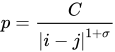
In a one-dimensional chain we establish bonds between distinct sites and with probability decaying as a power-law with an exponent . Percolation occurs[263][264] at a critical value for . The numerically determined percolation thresholds are given by:[265]




| Critical thresholds as a function of .[265]The dotted line is the rigorous lower bound.[263] | ||
| 0.1 | 0.047685(8) | 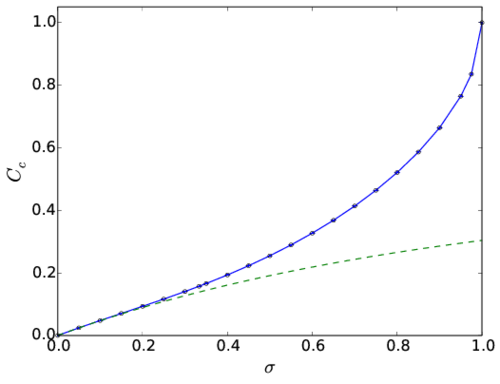 |
| 0.2 | 0.093211(16) | |
| 0.3 | 0.140546(17) | |
| 0.4 | 0.193471(15) | |
| 0.5 | 0.25482(5) | |
| 0.6 | 0.327098(6) | |
| 0.7 | 0.413752(14) | |
| 0.8 | 0.521001(14) | |
| 0.9 | 0.66408(7) |


Thresholds on hyperbolic, hierarchical, and tree lattices
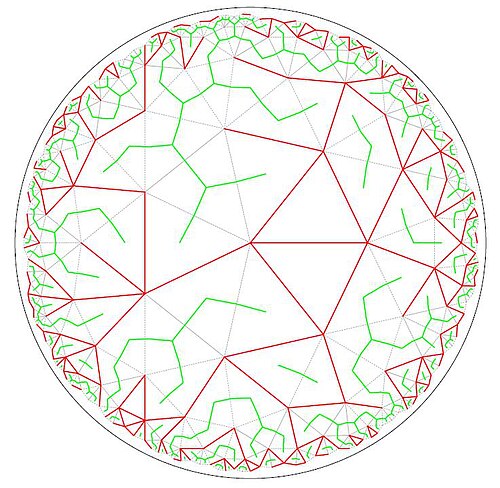
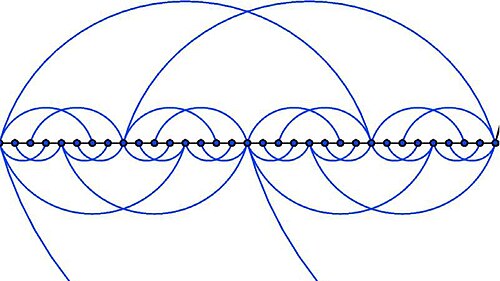
In these lattices there may be two percolation thresholds: the lower threshold is the probability above which infinite clusters appear, and the upper is the probability above which there is a unique infinite cluster.
| Lattice | z | Site percolation threshold | Bond percolation threshold | |||
|---|---|---|---|---|---|---|
| Lower | Upper | Lower | Upper | |||
| {3,7} hyperbolic | 7 | 7 | 0.26931171(7),[268] 0.20[269] | 0.73068829(7),[268] 0.73(2)[269] | 0.20,[270] 0.1993505(5)[268] | 0.37,[270] 0.4694754(8)[268] |
| {3,8} hyperbolic | 8 | 8 | 0.20878618(9)[268] | 0.79121382(9)[268] | 0.1601555(2)[268] | 0.4863559(6)[268] |
| {3,9} hyperbolic | 9 | 9 | 0.1715770(1)[268] | 0.8284230(1)[268] | 0.1355661(4)[268] | 0.4932908(1)[268] |
| {4,5} hyperbolic | 5 | 5 | 0.29890539(6)[268] | 0.8266384(5)[268] | 0.27,[270] 0.2689195(3)[268] | 0.52,[270] 0.6487772(3)[268] |
| {4,6} hyperbolic | 6 | 6 | 0.22330172(3)[268] | 0.87290362(7)[268] | 0.20714787(9)[268] | 0.6610951(2)[268] |
| {4,7} hyperbolic | 7 | 7 | 0.17979594(1)[268] | 0.89897645(3)[268] | 0.17004767(3)[268] | 0.66473420(4)[268] |
| {4,8} hyperbolic | 8 | 8 | 0.151035321(9)[268] | 0.91607962(7)[268] | 0.14467876(3)[268] | 0.66597370(3)[268] |
| {4,9} hyperbolic | 8 | 8 | 0.13045681(3)[268] | 0.92820305(3)[268] | 0.1260724(1)[268] | 0.66641596(2)[268] |
| {5,5} hyperbolic | 5 | 5 | 0.26186660(5)[268] | 0.89883342(7)[268] | 0.263(10),[271] 0.25416087(3)[268] | 0.749(10)[271] 0.74583913(3)[268] |
| {7,3} hyperbolic | 3 | 3 | 0.54710885(10)[268] | 0.8550371(5),[268] 0.86(2)[269] | 0.53,[270] 0.551(10),[271] 0.5305246(8)[268] | 0.72,[270] 0.810(10),[271] 0.8006495(5)[268] |
| {∞,3} Cayley tree | 3 | 3 | 1⁄2 | 1⁄2[270] | 1[270] | |
| Enhanced binary tree (EBT) | 0.304(1),[272] 0.306(10),[271] (√13 − 3)/2 = 0.302776[273] | 0.48,[270] 0.564(1),[272] 0.564(10),[271]1⁄2[273] | ||||
| Enhanced binary tree dual | 0.436(1),[272] 0.452(10)[271] | 0.696(1),[272] 0.699(10)[271] | ||||
| Non-Planar Hanoi Network (HN-NP) | 0.319445[267] | 0.381996[267] | ||||
| Cayley tree with grandparents | 8 | 0.158656326[274] | ||||
Note: {m,n} is the Schläfli symbol, signifying a hyperbolic lattice in which n regular m-gons meet at every vertex
For bond percolation on {P,Q}, we have by duality . For site percolation, because of the self-matching of triangulated lattices.


Cayley tree (Bethe lattice) with coordination number

Thresholds for directed percolation

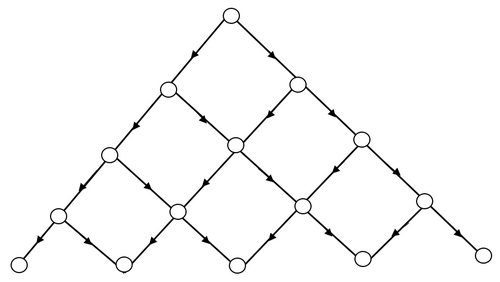
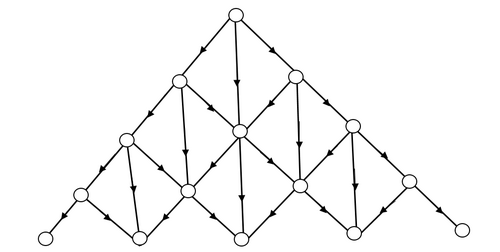


| Lattice | z | Site percolation threshold | Bond percolation threshold |
|---|---|---|---|
| (1+1)-d honeycomb | 1.5 | 0.8399316(2),[275] 0.839933(5),[276] of (1+1)-d sq. | 0.8228569(2),[275] 0.82285680(6)[275] |
| (1+1)-d kagome | 2 | 0.7369317(2),[275] 0.73693182(4)[277] | 0.6589689(2),[275] 0.65896910(8)[275] |
| (1+1)-d square, diagonal | 2 | 0.705489(4),[278] 0.705489(4),[279] 0.70548522(4),[280] 0.70548515(20),[277] 0.7054852(3),[275] | 0.644701(2),[281] 0.644701(1),[282] 0.644701(1),[278] 0.6447006(10),[276] 0.64470015(5),[283] 0.644700185(5),[280] 0.6447001(2),[275] 0.643(2)[284] |
| (1+1)-d triangular | 3 | 0.595646(3),[278] 0.5956468(5),[283] 0.5956470(3)[275] | 0.478018(2),[278] 0.478025(1),[283] 0.4780250(4)[275] 0.479(3)[284] |
| (2+1)-d simple cubic, diagonal planes | 3 | 0.43531(1),[285] 0.43531411(10)[275] | 0.382223(7),[285] 0.38222462(6)[275] 0.383(3)[284] |
| (2+1)-d square nn (= bcc) | 4 | 0.3445736(3),[286] 0.344575(15)[287] 0.3445740(2)[275] | 0.2873383(1),[288] 0.287338(3)[285] 0.28733838(4)[275] 0.287(3)[284] |
| (2+1)-d fcc | 0.199(2))[284] | ||
| (3+1)-d hypercubic, diagonal | 4 | 0.3025(10),[289] 0.30339538(5)[275] | 0.26835628(5),[275] 0.2682(2)[284] |
| (3+1)-d cubic, nn | 6 | 0.2081040(4)[286] | 0.1774970(5)[178] |
| (3+1)-d bcc | 8 | 0.160950(30),[287] 0.16096128(3)[275] | 0.13237417(2)[275] |
| (4+1)-d hypercubic, diagonal | 5 | 0.23104686(3)[275] | 0.20791816(2),[275] 0.2085(2)[284] |
| (4+1)-d hypercubic, nn | 8 | 0.1461593(2),[286] 0.1461582(3)[290] | 0.1288557(5)[178] |
| (4+1)-d bcc | 16 | 0.075582(17),[287] 0.0755850(3),[290] 0.07558515(1)[275] | 0.063763395(5)[275] |
| (5+1)-d hypercubic, diagonal | 6 | 0.18651358(2)[275] | 0.170615155(5),[275] 0.1714(1)[284] |
| (5+1)-d hypercubic, nn | 10 | 0.1123373(2)[286] | 0.1016796(5)[178] |
| (5+1)-d hypercubic bcc | 32 | 0.035967(23),[287] 0.035972540(3)[275] | 0.0314566318(5)[275] |
| (6+1)-d hypercubic, diagonal | 7 | 0.15654718(1)[275] | 0.145089946(3),[275] 0.1458[284] |
| (6+1)-d hypercubic, nn | 12 | 0.0913087(2)[286] | 0.0841997(14)[178] |
| (6+1)-d hypercubic bcc | 64 | 0.017333051(2)[275] | 0.01565938296(10)[275] |
| (7+1)-d hypercubic, diagonal | 8 | 0.135004176(10)[275] | 0.126387509(3),[275] 0.1270(1)[284] |
| (7+1)-d hypercubic,nn | 14 | 0.07699336(7)[286] | 0.07195(5)[178] |
| (7+1)-d bcc | 128 | 0.008 432 989(2)[275] | 0.007 818 371 82(6)[275] |

nn = nearest neighbors. For a (d + 1)-dimensional hypercubic system, the hypercube is in d dimensions and the time direction points to the 2D nearest neighbors.
Directed percolation with multiple neighbors
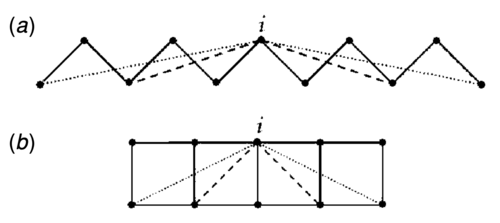
(1+1)-d square with z NN, square lattice for z odd, tilted square lattice for z even
| Lattice | z | Site percolation threshold | Bond percolation threshold |
|---|---|---|---|
| (1+1)-d square | 3 | 0.4395(3),[291] | |
| (1+1)-d square | 5 | 0.2249(3)[291] | |
| (1+1)-d square | 7 | 0.1470(2)[291] | |
| (1+1)-d square | 9 | 0.1081(2)[291] | |
| (1+1)-d square | 11 | 0.0851(2)[291] | |
| (1+1)-d square | 13 | 0.0701(2)[291] | |
| (1+1)-d tilted sq | 2 | 0.6447(2)[291] | |
| (1+1)-d tilted sq | 4 | 0.3272(2)[291] | |
| (1+1)-d tilted sq | 6 | 0.2121(3)[291] | |
| (1+1)-d tilted sq | 8 | 0.1553(3)[291] | |
| (1+1)-d tilted sq | 10 | 0.1220(2)[291] | |
| (1+1)-d tilted sq | 12 | 0.0999(2)[291] | |
For large z, pc ~ 1/z [291]
Site-Bond Directed Percolation
pb = bond threshold
ps = site threshold
Site-bond percolation is equivalent to having different probabilities of connections:
P0 = probability that no sites are connected = (1-ps) + ps(1-pb)2
P2 = probability that exactly one descendant is connected to the upper vertex (two connected together) = ps pb (1-pb)
P3 = probability that both descendants are connected to the original vertex (all three connected together)= ps pb2
Normalization: P0 + 2P2 + P3 = 1
| Lattice | z | ps | pb | P0 | P2 | P3 |
|---|---|---|---|---|---|---|
| (1+1)-d square [292] | 3 | 0.644701 | 1 | 0.126237 | 0.229062 | 0.415639 |
| 0.7 | 0.93585 | 0.148376 | 0.196529 | 0.458567 | ||
| 0.75 | 0.88565 | 0.169703 | 0.166059 | 0.498178 | ||
| 0.8 | 0.84135 | 0.192304 | 0.134616 | 0.538464 | ||
| 0.85 | 0.80190 | 0.216143 | 0.102242 | 0.579373 | ||
| 0.9 | 0.76645 | 0.241215 | 0.068981 | 0.620825 | ||
| 0.95 | 0.73450 | 0.267336 | 0.034889 | 0.662886 | ||
| 1 | 0.705489 | 0.294511 | 0 | 0.705489 | ||
Isotropic/Directed Percolation
Here we have a cross between ordinary bond percolation (OP) and directed percolation (DP)[293]. On an oriented system such as shown in the figure "(1+1)d Square Lattice" above, we consider the down probability p↓ = p pd and the up probability p↑ = p(1 − pd ), with p representing the average bond occupation probability and pd controlling the anisotropy. When pd = 0 or 1, we have pure DP, while when pd = 1/2 we have the random diode model or essentially OP, with the threshold twice the OP value. For other values of pd, we have a mixture of the two types of percolation. For a given pd, the critical values of p = pc are given below:
| Lattice | d | z | pd | pc | p↓ | p↑ |
|---|---|---|---|---|---|---|
| (1+1)-d DP | 2 | 2 | 1 | 0.644700185(5)[280] | 0.644700185(5) | 0 |
| diagonal square [293] | 2 | 4 | 0.8 | 0.768708(1) | 0.614966 | 0.153742 |
| diagonal square [293] | 2 | 4 | 0.6 | 0.929668(3) | 0.557801s | 0.371867 |
| 2d ordinary perc. | 2 | 4 | 0.5 | 1.0 | 0.5 | 0.5 |
| (2+1)-d diagonal DP | 3 | 3 | 1 | 0.38222462(6)[275] | 0.38222462 | 0 |
| diagonal cubic | 3 | 6 | 0.8 | 0.430941(2)[293] | 0.34475282 | 0.086188 |
| diagonal cubic | 3 | 6 | 0.6 | 0.481310(2)[293] | 0.288786 | 0.192524 |
| 3d Ordinary perc. | 3 | 6 | 0.5 | 0.49762364(20)[168] | 0.24881182 | 0.24881182 |
Exact critical manifolds of inhomogeneous systems
Inhomogeneous triangular lattice bond percolation[20]

Inhomogeneous honeycomb lattice bond percolation = kagome lattice site percolation[20]

Inhomogeneous (3,12^2) lattice, site percolation[7][294]
or


Inhomogeneous union-jack lattice, site percolation with probabilities [295]


Inhomogeneous martini lattice, bond percolation[78][296]

Inhomogeneous martini lattice, site percolation. r = site in the star

Inhomogeneous martini-A (3–7) lattice, bond percolation. Left side (top of "A" to bottom): . Right side: . Cross bond: .



Inhomogeneous martini-B (3–5) lattice, bond percolation
Inhomogeneous martini lattice with outside enclosing triangle of bonds, probabilities from inside to outside, bond percolation[296]

![{\displaystyle 1-3z+z^{3}-(1-z^{2})[3x^{2}y(1+y-y^{2})(1+z)+x^{3}y^{2}(3-2y)(1+2z)]=0}](https://wikimedia.org/api/rest_v1/media/math/render/svg/bca37fb3504d909546e2e4e7311696782d08b37c)
Inhomogeneous checkerboard lattice, bond percolation[62][98]

Inhomogeneous bow-tie lattice, bond percolation[61][98]

where are the four bonds around the square and is the diagonal bond connecting the vertex between bonds and .


Rigidity percolation
Assuming a finite graph with unbending bonds, rigidity percolation refers to a situation where the entire graph is rigid everywhere with respect to shear forces being put on it.[297][298][299][300] Another way to say this is that constraints are sufficient to eliminate all zero-frequency vibrational modes, transforming a mechanically floppy network into one capable of supporting stress[301].
The Geiringer–Laman theorem gives a combinatorial characterization of generically rigid graphs in 2-dimensional Euclidean space
Generic lattices have bonds of different lengths, and can be made by randomly displacing the sites of a regular lattice.
Numerical results:
Feng, Sen (1984)[302] pc = 0.58, f = 2.4 ± 0.4.
Lemieux, Breton, Tremblay (1985)[303] pc= 0.649, f = 1.4
Sahimi, Goddard (1985) bond triangular pc=0.65[304]
Arababi, Sahimi (1988): [305]. 3d bond cubic elastic network pc = 0.2492,
Roux, Hansen (1988): central force elastic network: p* = 0.642(2), flv = 3.0(4) , glv = 0.97(2)[306]
Jacobs and Thorpe (1996)[307] Bond threshold, triangular lattice: pc = 0.6602(3), pc = 0.69755(3)
Site percolation, triangular lattice pc = 0.69755(3),[307] 0.6975(3)[308]
Correlation-length exponent: ν = 1.16(3), 1.19(1),[309] 1.21(6)[307], 1/ν = 0.850(3)[301]
Arbibi Sahimi (1993)[310]: 2d bond tri: pc = 0.641(1), site: pc = 0.713(2).
Moukarzel and Duxbury (1995)[308]: 0.6975(3) 𝛼 = -0.48(5) β = 0.175(2)
Fractal dimension df = 1.86(2)[307]. 1.853(5)[311], 1.850(2)[301]
Backbone fractal dimension db = 1.80(3),[307] 1.78(2)[308]
Duxbury, Jacobs, Thorpe, Moukarzel (1999)[312] Bethe lattice z = 6, pc = 0.656
Chubynsky and Thorpe (2007)[313]. 3d: bond fcc, pc = 0.495. bcc: pc = 0.7485
Javerzat (2024) [314] 2d hull fractal dimension: df =1.355(10).
A fast algorithm for 2D Rigidity Percolation, Javerzat and Notarmuzi.[315] (2026) ν = 1.1694(8), df = 1.8423(7), pc = 0.6602741(4).
Lu, Song, Shi, Li, Deng (2026)[316] pc = 0.6602778(10), 1/ν = 0.850(3), and df = 1.850(2),
See also
References
- ↑Stauffer, Dietrich; Aharony, Amnon (2003). Introduction to percolation theory (Rev. 2nd ed.). London: Taylor & Francis. ISBN 978-0-7484-0253-3.
- ↑Kasteleyn, P. W.; Fortuin, C. M. (1969). "Phase transitions in lattice systems with random local properties". Journal of the Physical Society of Japan Supplement. 26: 11–14. Bibcode:1969JPSJS..26...11K.
- 12345Grünbaum, Branko & Shephard, G. C. (1987). Tilings and Patterns. New York: W. H. Freeman. ISBN 978-0-7167-1193-3.
- ↑Berchenko, Yakir; Artzy-Randrup, Yael; Teicher, Mina; Stone, Lewi (March 30, 2009). "Emergence and Size of the Giant Component in Clustered Random Graphs with a Given Degree Distribution". Physical Review Letters. 102 (13) 138701. Bibcode:2009PhRvL.102m8701B. doi:10.1103/PhysRevLett.102.138701. ISSN 0031-9007. PMID 19392410.
- ↑Li, Ming; Liu, Run-Ran; Lü, Linyuan; Hu, Mao-Bin; Xu, Shuqi; Zhang, Yi-Cheng (April 25, 2021). "Percolation on complex networks: Theory and application". Physics Reports. 907: 1–68. arXiv:2101.11761. Bibcode:2021PhR...907....1L. doi:10.1016/j.physrep.2020.12.003. ISSN 0370-1573. S2CID 231719831.
- 1234567Parviainen, Robert (2005). Connectivity Properties of Archimedean and Laves Lattices. Vol. 34. Uppsala Dissertations in Mathematics. p. 37. ISBN 978-91-506-1751-1.
- 123456789Suding, P. N.; R. M. Ziff (1999). "Site percolation thresholds for Archimedean lattices". Physical Review E. 60 (1): 275–283. Bibcode:1999PhRvE..60..275S. doi:10.1103/PhysRevE.60.275. PMID 11969760.
- 1234567Parviainen, Robert (2007). "Estimation of bond percolation thresholds on the Archimedean lattices". Journal of Physics A. 40 (31): 9253–9258. arXiv:0704.2098. Bibcode:2007JPhA...40.9253P. doi:10.1088/1751-8113/40/31/005. S2CID 680787.
- 123456789Ding, Chengxiang; Zhe Fu. Wenan Guo; F. Y. Wu (2010). "Critical frontier for the Potts and percolation models on triangular-type and kagome-type lattices II: Numerical analysis". Physical Review E. 81 (6) 061111. arXiv:1001.1488. Bibcode:2010PhRvE..81f1111D. doi:10.1103/PhysRevE.81.061111. PMID 20866382. S2CID 29625353.
- 12Scullard, C. R.; J. L. Jacobsen (2012). "Transfer matrix computation of generalised critical polynomials in percolation". arXiv:1209.1451 [cond-mat.stat-mech].
- 12345678910111213141516171819202122Jacobsen, J. L. (2014). "High-precision percolation thresholds and Potts-model critical manifolds from graph polynomials". Journal of Physics A. 47 (13) 135001. arXiv:1401.7847. Bibcode:2014JPhA...47m5001G. doi:10.1088/1751-8113/47/13/135001. S2CID 119614758.
- 12Jacobsen, Jesper L.; Christian R. Scullard (2013). "Critical manifolds, graph polynomials, and exact solvability"(PDF). StatPhys 25, Seoul, Korea July 21–26.
- 12345678Scullard, Christian R.; Jesper Lykke Jacobsen (2020). "Bond percolation thresholds on Archimedean lattices from critical polynomial roots". Physical Review Research. 2 (1) 012050. arXiv:1910.12376. Bibcode:2020PhRvR...2a2050S. doi:10.1103/PhysRevResearch.2.012050. S2CID 204904858.
- 12345d'Iribarne, C.; Rasigni, M.; Rasigni, G. (1995). "Determination of site percolation transitions for 2D mosaics by means of the minimal spanning tree approach". Physics Letters A. 209 (1–2): 95–98. Bibcode:1995PhLA..209...95D. doi:10.1016/0375-9601(95)00794-8.
- 1234567891011d'Iribarne, C.; Rasigni, M.; Rasigni, G. (1999). "From lattice long-range percolation to the continuum one". Phys. Lett. A. 263 (1–2): 65–69. Bibcode:1999PhLA..263...65D. doi:10.1016/S0375-9601(99)00585-X.
- 12Schliecker, G.; C. Kaiser (1999). "Percolation on disordered mosaics". Physica A. 269 (2–4): 189–200. Bibcode:1999PhyA..269..189S. doi:10.1016/S0378-4371(99)00093-X.
- ↑Djordjevic, Z. V.; H. E. Stanley; Alla Margolina (1982). "Site percolation threshold for honeycomb and square lattices". Journal of Physics A. 15 (8): L405–L412. Bibcode:1982JPhA...15L.405D. doi:10.1088/0305-4470/15/8/006.
- 12345Feng, Xiaomei; Youjin Deng; H. W. J. Blöte (2008). "Percolation transitions in two dimensions". Physical Review E. 78 (3) 031136. arXiv:0901.1370. Bibcode:2008PhRvE..78c1136F. doi:10.1103/PhysRevE.78.031136. PMID 18851022. S2CID 29282598.
- 1234567Ziff, R. M.; Hang Gu (2008). "Universal condition for critical percolation thresholds of kagomé-like lattices". Physical Review E. 79 (2) 020102. arXiv:0812.0181. doi:10.1103/PhysRevE.79.020102. PMID 19391694. S2CID 18051122.
- 12345Sykes, M. F.; J. W. Essam (1964). "Exact critical percolation probabilities for site and bond problems in two dimensions". Journal of Mathematical Physics. 5 (8): 1117–1127. Bibcode:1964JMP.....5.1117S. doi:10.1063/1.1704215.
- ↑Ziff, R. M.; P. W. Suding (1997). "Determination of the bond percolation threshold for the kagome lattice". Journal of Physics A. 30 (15): 5351–5359. arXiv:cond-mat/9707110. Bibcode:1997JPhA...30.5351Z. doi:10.1088/0305-4470/30/15/021. S2CID 28814369.
- ↑Scullard, C. R. (2012). "Percolation critical polynomial as a graph invariant". Physical Review E. 86 (4) 041131: 1131. arXiv:1111.1061. Bibcode:2012PhRvE..86d1131S. doi:10.1103/PhysRevE.86.041131. PMID 23214553. S2CID 33348328.
- 12Jacobsen, J. L. (2015). "Critical points of Potts and O(N) models from eigenvalue identities in periodic Temperley-Lieb algebras". Journal of Physics A. 48 (45) 454003. arXiv:1507.03027. Bibcode:2015JPhA...48S4003L. doi:10.1088/1751-8113/48/45/454003. S2CID 119146630.
- ↑Lin, Keh Ying; Wen Jong Ma (1983). "Two-dimensional Ising model on a ruby lattice". Journal of Physics A. 16 (16): 3895–3898. Bibcode:1983JPhA...16.3895L. doi:10.1088/0305-4470/16/16/027.
- ↑Derrida, B.; D. Stauffer (1985). "Corrections to scaling and phenomenological renormalization for 2-dimensional percolation and lattice animal problems"(PDF). Journal de Physique. 46 (45): 1623. doi:10.1051/jphys:0198500460100162300. S2CID 8289499.
- ↑Yang, Y.; S. Zhou.; Y. Li. (2013). "Square++: Making a connection game win-lose complementary and playing-fair". Entertainment Computing. 4 (2): 105–113. doi:10.1016/j.entcom.2012.10.004.
- ↑Newman, M. E. J.; R. M. Ziff (2000). "Efficient Monte-Carlo algorithm and high-precision results for percolation". Physical Review Letters. 85 (19): 4104–7. arXiv:cond-mat/0005264. Bibcode:2000PhRvL..85.4104N. CiteSeerX 10.1.1.310.4632. doi:10.1103/PhysRevLett.85.4104. PMID 11056635. S2CID 747665.
- ↑Mertens, Stephan (2022). "Exact site-percolation probability on the square lattice". Journal of Physics A: Mathematical and Theoretical. 55 (33): 334002. arXiv:2109.12102. Bibcode:2022JPhA...55G4002M. doi:10.1088/1751-8121/ac4195. ISSN 1751-8113.
- ↑Yang, Yi; Zhou, Shuigeng (2024). "Comment on 'Critical points of Potts and O(N) models from eigenvalue identities in periodic Temperley–Lieb algebras'". Journal of Physics A: Mathematical and Theoretical. 57 (25): 258001. Bibcode:2024JPhA...57y8001Y. doi:10.1088/1751-8121/ad4d2c.
- ↑Jacobsen, Jesper Lykke (June 21, 2024). "Reply to Comment on 'Critical points of Potts and O(N) models from eigenvalue identities in periodic Temperley–Lieb algebras'". Journal of Physics A: Mathematical and Theoretical. 57 (25): 258002. Bibcode:2024JPhA...57y8002J. doi:10.1088/1751-8121/ad4d33. ISSN 1751-8113.
- ↑de Oliveira, P.M.C.; R. A. Nobrega; D. Stauffer (2003). "Corrections to finite size scaling in percolation". Brazilian Journal of Physics. 33 (3): 616–618. arXiv:cond-mat/0308525. Bibcode:2003BrJPh..33..616O. doi:10.1590/S0103-97332003000300025. S2CID 8972025.
- ↑Lee, M. J. (2007). "Complementary algorithms for graphs and percolation". Physical Review E. 76 (2) 027702. arXiv:0708.0600. Bibcode:2007PhRvE..76b7702L. doi:10.1103/PhysRevE.76.027702. PMID 17930184. S2CID 304257.
- ↑Lee, M. J. (2008). "Pseudo-random-number generators and the square site percolation threshold". Physical Review E. 78 (3) 031131. arXiv:0807.1576. Bibcode:2008PhRvE..78c1131L. doi:10.1103/PhysRevE.78.031131. PMID 18851017. S2CID 7027694.
- ↑Levenshteĭn, M. E.; B. I. Shklovskiĭ; M. S. Shur; A. L. Éfros (1975). "The relation between the critical exponents of percolation theory". Zh. Eksp. Teor. Fiz. 69: 386–392. Bibcode:1975JETP...42..197L.
- ↑Dean, P.; Bird, N. F. (1967). "Monte Carlo estimates of critical percolation probabilities". Mathematical Proceedings of the Cambridge Philosophical Society. 63 (2): 477–479. Bibcode:1967PCPS...63..477D. doi:10.1017/s0305004100041438. S2CID 137386357.
- ↑Dean, P. (1963). "A new Monte Carlo method for percolation problems on a lattice". Mathematical Proceedings of the Cambridge Philosophical Society. 59 (2): 397–410. Bibcode:1963PCPS...59..397D. doi:10.1017/s0305004100037026. S2CID 122985645.
- ↑Tencer, John; Forsberg, Kelsey Meeks (2021). "Postprocessing techniques for gradient percolation predictions on the square lattice". Physical Review E. 103 (1) 012115. Bibcode:2021PhRvE.103a2115T. doi:10.1103/PhysRevE.103.012115. OSTI 1778027. PMID 33601521. S2CID 231961701.
- ↑Betts, D. D. (1995). "A new two-dimensional lattice of coordination number five". Proc. Nova Scotian Inst. Sci. 40: 95–100. hdl:10222/35332.
- ↑Sriram Shastry, B.; Sutherland, Bill (1981). "Exact ground state of a quantum mechanical antiferromagnet". Physica B+C. 108 (1–3): 1069–1070. Bibcode:1981PhyBC.108.1069S. doi:10.1016/0378-4363(81)90838-X.
- 12d'Iribarne, C.; Rasigni, M.; Rasigni, G. (1999). "Minimal spanning tree and percolation on mosaics: graph theory and percolation". J. Phys. A: Math. Gen. 32 (14): 2611–2622. Bibcode:1999JPhA...32.2611D. doi:10.1088/0305-4470/32/14/002.
- 1234567891011121314151617181920212223van der Marck, Steven C. (1997). "Percolation thresholds and universal formulas". Physical Review E. 55 (2): 1514–1517. Bibcode:1997PhRvE..55.1514V. doi:10.1103/PhysRevE.55.1514.
- 123456Malarz, K.; S. Galam (2005). "Square-lattice site percolation at increasing ranges of neighbor bonds". Physical Review E. 71 (1) 016125. arXiv:cond-mat/0408338. Bibcode:2005PhRvE..71a6125M. doi:10.1103/PhysRevE.71.016125. PMID 15697676. S2CID 119087463.
- 123456789101112131415161718192021222324252627Majewski, M.; K. Malarz (2007). "Square lattice site percolation thresholds for complex neighbourhoods". Acta Phys. Pol. B. 38 (38): 2191. arXiv:cond-mat/0609635. Bibcode:2007AcPPB..38.2191M.
- 12345678910Dalton, N. W.; C. Domb; M. F. Sykes (1964). "Dependence of critical concentration of a dilute ferromagnet on the range of interaction". Proc. Phys. Soc. 83 (3): 496–498. doi:10.1088/0370-1328/83/3/118.
- ↑Collier, Andrew. "Percolation Threshold: Including Next-Nearest Neighbours".
- 1234567891011121314Ouyang, Yunqing; Y. Deng; Henk W. J. Blöte (2018). "Equivalent-neighbor percolation models in two dimensions: Crossover between mean-field and short-range behavior". Physical Review E. 98 (6) 062101. arXiv:1808.05812. Bibcode:2018PhRvE..98f2101O. doi:10.1103/PhysRevE.98.062101. S2CID 119328197.
- 12Xu, Wenhui; Junfeng Wang; Hao Hu; Youjin Deng (2021). "Critical polynomials in the nonplanar and continuum percolation models". Physical Review E. 103 (2) 022127. arXiv:2010.02887. Bibcode:2021PhRvE.103b2127X. doi:10.1103/PhysRevE.103.022127. ISSN 2470-0045. PMID 33736116. S2CID 222140792.
- 12345678910111213141516Xun, Zhipeng; DaPeng Hao; Robert M. Ziff (2022). "Site and bond percolation thresholds on regular lattices with compact extended-range neighborhoods in two and three dimensions". Physical Review E. 105 (2) 024105. arXiv:2111.10975. Bibcode:2022PhRvE.105b4105X. doi:10.1103/PhysRevE.105.024105. PMID 35291074. S2CID 244478657.
- 1234567Malarz, Krzysztop (2021). "Percolation thresholds on a triangular lattice for neighborhoods containing sites up to the fifth coordination zone". Physical Review E. 103 (5) 052107. arXiv:2102.10066. Bibcode:2021PhRvE.103e2107M. doi:10.1103/PhysRevE.103.052107. PMID 34134312. S2CID 231979514.
- 1234567Malarz, Krzysztof (2020). "Site percolation thresholds on triangular lattice with complex neighborhoods". Chaos: An Interdisciplinary Journal of Nonlinear Science. 30 (12) 123123. arXiv:2006.15621. Bibcode:2020Chaos..30l3123M. doi:10.1063/5.0022336. PMID 33380057. S2CID 220250058.
- 123456Domb, C.; N. W. Dalton (1966). "Crystal statistics with long-range forces I. The equivalent neighbour model". Proc. Phys. Soc. 89 (4): 859–871. Bibcode:1966PPS....89..859D. doi:10.1088/0370-1328/89/4/311.
- 12345Gouker, Mark; Family, Fereydoon (1983). "Evidence for classical critical behavior in long-range site percolation". Physical Review B. 28 (3): 1449. Bibcode:1983PhRvB..28.1449G. doi:10.1103/PhysRevB.28.1449.
- 1234567891011121314151617Xun, Zhipeng; Dapeng Hao; Robert M. Ziff (2021). "Site percolation on square and simple cubic lattices with extended neighborhoods and their continuum limit". Physical Review E. 103 (2) 022126. arXiv:2010.02895. Bibcode:2021PhRvE.103b2126X. doi:10.1103/PhysRevE.103.022126. PMID 33735955. S2CID 222141832.
- ↑Malarz, Krzysztof (2022). "Random site percolation on honeycomb lattices with complex neighborhoods". Chaos: An Interdisciplinary Journal of Nonlinear Science. 32 (8) 083123. arXiv:2204.12593. Bibcode:2022Chaos..32h3123M. doi:10.1063/5.0099066. PMID 36049902. S2CID 248405741.
- 12345678910111213141516171819202122232425262728293031323334353637383940414243Mecke, K. R.; Seyfried, A (2002). "Strong dependence of percolation thresholds on polydispersity". Europhysics Letters. 58 (1): 28–34. Bibcode:2002EL.....58...28M. doi:10.1209/epl/i2002-00601-y. S2CID 250737562.
- 12345678910111213141516171819202122232425262728Koza, Zbigniew; Kondrat, Grzegorz; Suszczyński, Karol (2014). "Percolation of overlapping squares or cubes on a lattice". Journal of Statistical Mechanics: Theory and Experiment. 2014 (11) P11005. arXiv:1606.07969. Bibcode:2014JSMTE..11..005K. doi:10.1088/1742-5468/2014/11/P11005. S2CID 118623466.
- ↑Malarz, Krzysztof (2023). "Random site percolation thresholds on square lattice for complex neighborhoods containing sites up to the sixth coordination zone". Physica A. 632 (1) 129347. arXiv:2303.10423. Bibcode:2023PhyA..63229347M. doi:10.1016/j.physa.2023.129347.
- 123456Deng, Youjin; Yunqing Ouyang; Henk W. J. Blöte (2019). "Medium-range percolation in two dimensions". J. Phys.: Conf. Ser. 1163 (1) 012001. Bibcode:2019JPhCS1163a2001D. doi:10.1088/1742-6596/1163/1/012001. hdl:1887/82550.
- 123Mitra, S.; D. Saha; A. Sensharma (2019). "Percolation in a distorted square lattice". Physical Review E. 99 (1) 012117. arXiv:1808.10665. Bibcode:2019PhRvE..99a2117M. doi:10.1103/PhysRevE.99.012117. PMID 30780325.
- 123456Jasna, C. K.; V. Sasidevan (2024). "Effect of shape asymmetry on percolation of aligned and overlapping objects on lattices". Phys. Rev. E. 109 (6–1) 064118. arXiv:2308.12932. doi:10.1103/PhysRevE.109.064118. PMID 39020917.
- 1234Scullard, C. R.; R. M. Ziff (2010). "Critical surfaces for general inhomogeneous bond percolation problems". Journal of Statistical Mechanics: Theory and Experiment. 2010 (3) P03021. arXiv:0911.2686. Bibcode:2010JSMTE..03..021S. doi:10.1088/1742-5468/2010/03/P03021. S2CID 119230786.
- 12Wu, F. Y. (1979). "Critical point of planar Potts models". Journal of Physics C. 12 (17): L645–L650. Bibcode:1979JPhC...12L.645W. doi:10.1088/0022-3719/12/17/002.
- 12Mai, T.; Halley, J. W. (1980). Sinha, S. K. (ed.). Ordering in two dimensions. North-Holland, Amsterdam. pp. 369–371.
- 12345678910Kundu, Sumanta; Manna, S. S. (May 15, 2017). "Colored percolation". Physical Review E. 95 (5) 052124. arXiv:1709.00887. Bibcode:2017PhRvE..95e2124K. doi:10.1103/PhysRevE.95.052124. ISSN 2470-0045. PMID 28618459.
- ↑Nakanishi, H (1987). "Critical behaviour of AB percolation in two dimensions". Journal of Physics A: Mathematical and General. 20 (17): 6075–6083. Bibcode:1987JPhA...20.6075N. doi:10.1088/0305-4470/20/17/040. ISSN 0305-4470.
- ↑Debierre, J -M; Bradley, R M (1992). "Scaling properties of antipercolation hulls on the triangular lattice". Journal of Physics A: Mathematical and General. 25 (2): 335–343. Bibcode:1992JPhA...25..335D. doi:10.1088/0305-4470/25/2/014. ISSN 0305-4470.
- ↑Wu, Xian-Yuan; Popov, S. Yu. (2003). "On AB Bond Percolation on the Square Lattice and AB Site Percolation on Its Line Graph". Journal of Statistical Physics. 110 (1/2): 443–449. Bibcode:2003JSP...110..443W. doi:10.1023/A:1021091316925.
- 1234567Hovi, J.-P.; A. Aharony (1996). "Scaling and universality in the spanning probability for percolation". Physical Review E. 53 (1): 235–253. Bibcode:1996PhRvE..53..235H. doi:10.1103/PhysRevE.53.235. PMID 9964253.
- 12345678910111213141516171819Tarasevich, Yuriy Yu; Steven C. van der Marck (1999). "An investigation of site-bond percolation on many lattices". Int. J. Mod. Phys. C. 10 (7): 1193–1204. arXiv:cond-mat/9906078. Bibcode:1999IJMPC..10.1193T. doi:10.1142/S0129183199000978. S2CID 16917458.
- 12345678910González-Flores, M. I.; A. A. Torres; W. Lebrecht; A. J. Ramirez-Pastor (2021). "Site-bond percolation in two-dimensional kagome lattices: Analytical approach and numerical simulations". Physical Review E. 104 (1) 014130. Bibcode:2021PhRvE.104a4130G. doi:10.1103/PhysRevE.104.014130. PMID 34412224. S2CID 237243188.
- 12345Sakamoto, S.; F. Yonezawa; M. Hori (1989). "A proposal for the estimation of percolation thresholds in two-dimensional lattices". J. Phys. A. 22 (14): L699–L704. Bibcode:1989JPhA...22L.699S. doi:10.1088/0305-4470/22/14/009.
- ↑Deng, Y.; Y. Huang; J. L. Jacobsen; J. Salas; A. D. Sokal (2011). "Finite-temperature phase transition in a class of four-state Potts antiferromagnets". Physical Review Letters. 107 (15) 150601. arXiv:1108.1743. Bibcode:2011PhRvL.107o0601D. doi:10.1103/PhysRevLett.107.150601. PMID 22107278. S2CID 31777818.
- ↑Syozi, I (1972). "Transformation of Ising Models". In Domb, C.; Green, M. S. (eds.). Phase Transitions in Critical Phenomena. Vol. 1. Academic Press, London. pp. 270–329.
- 123456789101112131415161718192021Neher, Richard; Mecke, Klaus; Wagner, Herbert (2008). "Topological estimation of percolation thresholds". Journal of Statistical Mechanics: Theory and Experiment. 2008 (1) P01011. arXiv:0708.3250. Bibcode:2008JSMTE..01..011N. doi:10.1088/1742-5468/2008/01/P01011. S2CID 8584164.
- ↑Grimmett, G.; Manolescu, I (2012). "Bond percolation on isoradial graphs: Criticality and universality". Probability Theory and Related Fields. 159 (1–2): 273–327. arXiv:1204.0505. doi:10.1007/s00440-013-0507-y. S2CID 15031903.
- 12Scullard, C. R. (2006). "Exact site percolation thresholds using a site-to-bond transformation and the star-triangle transformation". Physical Review E. 73 (1) 016107. arXiv:cond-mat/0507392. Bibcode:2006PhRvE..73a6107S. doi:10.1103/PhysRevE.73.016107. PMID 16486216. S2CID 17948429.
- 1234Ziff, R. M. (2006). "Generalized cell–dual-cell transformation and exact thresholds for percolation". Physical Review E. 73 (1) 016134. Bibcode:2006PhRvE..73a6134Z. doi:10.1103/PhysRevE.73.016134. PMID 16486243.
- 12345678910111213Scullard, C. R.; Robert M Ziff (2006). "Exact bond percolation thresholds in two dimensions". Journal of Physics A. 39 (49): 15083–15090. arXiv:cond-mat/0610813. Bibcode:2006JPhA...3915083Z. doi:10.1088/0305-4470/39/49/003. S2CID 14332146.
- ↑Ding, Chengxiang; Yancheng Wang; Yang Li (2012). "Potts and percolation models on bowtie lattices". Physical Review E. 86 (2) 021125. arXiv:1203.2244. Bibcode:2012PhRvE..86b1125D. doi:10.1103/PhysRevE.86.021125. PMID 23005740. S2CID 27190130.
- ↑Wierman, John (1984). "A bond percolation critical probability determination based on the star-triangle transformation". J. Phys. A: Math. Gen. 17 (7): 1525–1530. Bibcode:1984JPhA...17.1525W. doi:10.1088/0305-4470/17/7/020.
- ↑Mahmood Maher al-Naqsh (1983). "MAH 007". The Design and Execution of Drawings in Iranian Tilework. Archived from the original on January 9, 2017. Retrieved November 18, 2019.
- ↑"Western tomb tower, Kharraqan".
- 1234567891011121314Melchert, Oliver; Helmut G. Katzgraber; Mark A. Novotny (2016). "Site and bond percolation thresholds in Kn,n-based lattices: Vulnerability of quantum annealers to random qubit and coupler failures on Chimera topologies". Physical Review E. 93 (4) 042128. arXiv:1511.07078. Bibcode:2016PhRvE..93d2128M. doi:10.1103/PhysRevE.93.042128. PMID 27176275. S2CID 206249608.
- ↑Okubo, S.; M. Hayashi; S. Kimura; H. Ohta; M. Motokawa; H. Kikuchi; H. Nagasawa (1998). "Submillimeter wave ESR of triangular-kagome antiferromagnet Cu9X2(cpa)6 (X=Cl, Br)". Physica B. 246–247 (2): 553–556. Bibcode:1998PhyB..246..553O. doi:10.1016/S0921-4526(97)00985-X.
- 1234567891011Haji Akbari, Amir; R. M. Ziff (2009). "Percolation in networks with voids and bottlenecks". Physical Review E. 79 (2) 021118. arXiv:0811.4575. Bibcode:2009PhRvE..79b1118H. doi:10.1103/PhysRevE.79.021118. PMID 19391717. S2CID 2554311.
- 12Cornette, V.; A. J. Ramirez-Pastor; F. Nieto (2003). "Dependence of the percolation threshold on the size of the percolating species". Physica A. 327 (1): 71–75. Bibcode:2003PhyA..327...71C. doi:10.1016/S0378-4371(03)00453-9. hdl:11336/138178.
- 123Lebrecht, W.; P. M. Centres; A. J. Ramirez-Pastor (2019). "Analytical approximation of the site percolation thresholds for monomers and dimers on two-dimensional lattices". Physica A. 516: 133–143. Bibcode:2019PhyA..516..133L. doi:10.1016/j.physa.2018.10.023. hdl:11336/117898. S2CID 125418069.
- 123456789Longone, Pablo; P.M. Centres; A. J. Ramirez-Pastor (2019). "Percolation of aligned rigid rods on two-dimensional triangular lattices". Physical Review E. 100 (5) 052104. arXiv:1906.03966. Bibcode:2019PhRvE.100e2104L. doi:10.1103/PhysRevE.100.052104. PMID 31870027. S2CID 182953009.
- 1234Budinski-Petkovic, Lj; I. Loncarevic; Z. M. Jacsik; S. B. Vrhovac (2016). "Jamming and percolation in random sequential adsorption of extended objects on a triangular lattice with quenched impurities". Journal of Statistical Mechanics: Theory and Experiment. 2016 (5) 053101. Bibcode:2016JSMTE..05.3101B. doi:10.1088/1742-5468/2016/05/053101. S2CID 3913989.
- 12Cherkasova, V. A.; Yu. Yu. Tarasevich; N. I. Lebovka; N.V. Vygornitskii (2010). "Percolation of the aligned dimers on a square lattice". Eur. Phys. J. B. 74 (2): 205–209. arXiv:0912.0778. Bibcode:2010EPJB...74..205C. doi:10.1140/epjb/e2010-00089-2. S2CID 118485353.
- 1234Leroyer, Y.; E. Pommiers (1994). "Monte Carlo analysis of percolation of line segments on a square lattice". Physical Review B. 50 (5): 2795–2799. arXiv:cond-mat/9312066. Bibcode:1994PhRvB..50.2795L. doi:10.1103/PhysRevB.50.2795. PMID 9976520. S2CID 119495907.
- 1234567Vanderwalle, N.; S. Galam; M. Kramer (2000). "A new universality for random sequential deposition of needles". Eur. Phys. J. B. 14 (3): 407–410. arXiv:cond-mat/0004271. Bibcode:2000EPJB...14..407V. doi:10.1007/s100510051047. S2CID 11142384.
- ↑Kondrat, Grzegorz; Andrzej Pękalski (2001). "Percolation and jamming in random sequential adsorption of linear segments on a square lattice". Physical Review E. 63 (5) 051108. arXiv:cond-mat/0102031. Bibcode:2001PhRvE..63e1108K. doi:10.1103/PhysRevE.63.051108. PMID 11414888. S2CID 44490067.
- 1234567Haji-Akbari, A.; Nasim Haji-Akbari; Robert M. Ziff (2015). "Dimer Covering and Percolation Frustration". Physical Review E. 92 (3) 032134. arXiv:1507.04411. Bibcode:2015PhRvE..92c2134H. doi:10.1103/PhysRevE.92.032134. PMID 26465453. S2CID 34100812.
- ↑Zia, R. K. P.; W. Yong; B. Schmittmann (2009). "Percolation of a collection of finite random walks: a model for gas permeation through thin polymeric membranes". Journal of Mathematical Chemistry. 45: 58–64. doi:10.1007/s10910-008-9367-6. S2CID 94092783.
- 1234Wu, Yong; B. Schmittmann; R. K. P. Zia (2008). "Two-dimensional polymer networks near percolation". Journal of Physics A. 41 (2): 025008. Bibcode:2008JPhA...41b5004W. doi:10.1088/1751-8113/41/2/025004. S2CID 13053653.
- 123456789101112131415161718192021222324252627282930Cornette, V.; A.J. Ramirez-Pastor; F. Nieto (2003). "Percolation of polyatomic species on a square lattice". European Physical Journal B. 36 (3): 391–399. Bibcode:2003EPJB...36..391C. doi:10.1140/epjb/e2003-00358-1. S2CID 119852589.
- 123Ziff, R. M.; C. R. Scullard; J. C. Wierman; M. R. A. Sedlock (2012). "The critical manifolds of inhomogeneous bond percolation on bow-tie and checkerboard lattices". Journal of Physics A. 45 (49) 494005. arXiv:1210.6609. Bibcode:2012JPhA...45W4005Z. doi:10.1088/1751-8113/45/49/494005. S2CID 2121370.
- 1234567891011Mertens, Stephan; Cristopher Moore (2012). "Continuum percolation thresholds in two dimensions". Physical Review E. 86 (6) 061109. arXiv:1209.4936. Bibcode:2012PhRvE..86f1109M. doi:10.1103/PhysRevE.86.061109. PMID 23367895. S2CID 15107275.
- 1234Quintanilla, John A.; R. M. Ziff (2007). "Asymmetry in the percolation thresholds of fully penetrable disks with two different radii". Physical Review E. 76 (5): 051115 [6 pages]. Bibcode:2007PhRvE..76e1115Q. doi:10.1103/PhysRevE.76.051115. PMID 18233631.
- 123Quintanilla, J; S. Torquato; R. M. Ziff (2000). "Efficient measurement of the percolation threshold for fully penetrable discs". J. Phys. A: Math. Gen. 33 (42): L399–L407. Bibcode:2000JPhA...33L.399Q. CiteSeerX 10.1.1.6.8207. doi:10.1088/0305-4470/33/42/104.
- 12Lorenz, B; I. Orgzall; H.-O. Heuer (1993). "Universality and cluster structures in continuum models of percolation with two different radius distributions". J. Phys. A: Math. Gen. 26 (18): 4711–4712. Bibcode:1993JPhA...26.4711L. doi:10.1088/0305-4470/26/18/032.
- ↑Rosso, M (1989). "Concentration gradient approach to continuum percolation in two dimensions". J. Phys. A: Math. Gen. 22 (4): L131–L136. Bibcode:1989JPhA...22L.131R. doi:10.1088/0305-4470/22/4/004.
- 12Gawlinski, Edward T; H. Eugene Stanley (1981). "Continuum percolation in two dimensions: Monte Carlo tests of scaling and universality for non-interacting discs". J. Phys. A: Math. Gen. 14 (8): L291–L299. Bibcode:1981JPhA...14L.291G. doi:10.1088/0305-4470/14/8/007.
- 123456789101112131415161718Yi, Y.-B.; A. M. Sastry (2004). "Analytical approximation of the percolation threshold for overlapping ellipsoids of revolution". Proceedings of the Royal Society A. 460 (5): 2353–2380. Bibcode:2004RSPSA.460.2353Y. doi:10.1098/rspa.2004.1279. S2CID 2475482.
- 1234Pike, G. E.; C. H. Seager (1974). "Percolation and conductivity: A computer study I". Physical Review B. 10 (4): 1421–1434. Bibcode:1974PhRvB..10.1421P. doi:10.1103/PhysRevB.10.1421.
- 1234567891011Lin, Jianjun; Chen, Huisu (2019). "Measurement of continuum percolation properties of two-dimensional particulate systems comprising congruent and binary superellipses". Powder Technology. 347: 17–26. doi:10.1016/j.powtec.2019.02.036. S2CID 104332397.
- ↑Li, Mingqi; Chen, Huisu; Lin, Jianjun; Zhang, Rongling; Liu, Lin (July 2021). "Effects of the pore shape polydispersity on the percolation threshold and diffusivity of porous composites: Theoretical and numerical studies". Powder Technology. 386: 382–393. doi:10.1016/j.powtec.2021.03.055. ISSN 0032-5910. S2CID 233675695.
- ↑Koza, Zbigniew; Piotr Brzeski; Grzegorz Kondrat (2023). "Percolation of fully penetrable disks using the three-leg cluster method". J. Phys. A: Math. Theor. (in press) (16): 165001. Bibcode:2023JPhA...56p5001K. doi:10.1088/1751-8121/acc3d0. S2CID 257524315.
- 12345678Charbonneau, Benoit; Patrick Charbonneau; Yi Hu; Zhen Yang (2021). "High-dimensional percolation criticality and hints of mean-field-like caging of the random Lorentz gas". Physical Review E. 104 (2) 024137. arXiv:2105.04711. Bibcode:2021PhRvE.104b4137C. doi:10.1103/PhysRevE.104.024137. PMID 34525662. S2CID 234357912.
- ↑Gilbert, E. N. (1961). "Random Plane Networks". J. Soc. Indust. Appl. Math. 9 (4): 533–543. doi:10.1137/0109045.
- ↑Xu, Wenhui; Junfeng Wang; Hao Hu; Youjin Deng (2021). "Critical polynomials in the nonplanar and continuum percolation models". Physical Review E. 103 (2) 022127. arXiv:2010.02887. Bibcode:2021PhRvE.103b2127X. doi:10.1103/PhysRevE.103.022127. ISSN 2470-0045. PMID 33736116. S2CID 222140792.
- 123Tarasevich, Yuri Yu.; Andrei V. Eserkepov (2020). "Percolation thresholds for discorectangles: numerical estimation for a range of aspect ratios". Physical Review E. 101 (2) 022108. arXiv:1910.05072. Bibcode:2020PhRvE.101b2108T. doi:10.1103/PhysRevE.101.022108. PMID 32168641. S2CID 204401814.
- 12345678910111213141516171819Li, Jiantong; Mikael Östling (2016). "Precise percolation thresholds of two-dimensional random systems comprising overlapping ellipses". Physica A. 462: 940–950. Bibcode:2016PhyA..462..940L. doi:10.1016/j.physa.2016.06.020.
- ↑Nguyen, Van Lien; Enrique Canessa (1999). "Finite-size scaling in two-dimensional continuum percolation models". Modern Physics Letters B. 13 (17): 577–583. arXiv:cond-mat/9909200. Bibcode:1999MPLB...13..577N. doi:10.1142/S0217984999000737. S2CID 18560722.
- ↑Roberts, F. D. K. (1967). "A Monte Carlo Solution of a Two-Dimensional Unstructured Cluster Problem". Biometrika. 54 (3/4): 625–628. doi:10.2307/2335053. JSTOR 2335053. PMID 6064024.
- 123Quintanilla, John A. (2001). "Measurement of the percolation threshold for fully penetrable disks of different radii". Physical Review E. 63 (6) 061108. Bibcode:2001PhRvE..63f1108Q. doi:10.1103/PhysRevE.63.061108. PMID 11415069.
- 123456789101112131415161718192021Xia, W.; M. F. Thorpe (1988). "Percolation properties of random ellipses". Physical Review A. 38 (5): 2650–2656. Bibcode:1988PhRvA..38.2650X. doi:10.1103/PhysRevA.38.2650. PMID 9900674.
- 12345Yuan, Hui; Chen, Huisu; Li, Mingqi; Liu, Lin; Liu, Zhiyong (2023). "Percolation threshold and electrical conductivity of conductive polymer composites filled with curved fibers in two-dimensional space". Soft Matter. 19 (37): 7149–7160. doi:10.1039/D3SM00963G. ISSN 1744-683X.
- 1234567891011121314151617181920212223242526Torquato, S.; Y. Jiao (2012). "Effect of dimensionality on the continuum percolation of overlapping hyperspheres and hypercubes. II. Simulation results and analyses". J. Chem. Phys. 137 (7): 074106. arXiv:1208.3720. Bibcode:2012JChPh.137g4106T. doi:10.1063/1.4742750. PMID 22920102. S2CID 13188197.
- 123456789101112Baker, Don R.; Gerald Paul; Sameet Sreenivasan; H. Eugene Stanley (2002). "Continuum percolation threshold for interpenetrating squares and cubes". Physical Review E. 66 (4): 046136 [5 pages]. arXiv:cond-mat/0203235. Bibcode:2002PhRvE..66d6136B. doi:10.1103/PhysRevE.66.046136. PMID 12443288. S2CID 9561586.
- 123456789101112131415Li, Jiantong; Mikael Östling (2013). "Percolation thresholds of two-dimensional continuum systems of rectangles". Physical Review E. 88 (1) 012101. Bibcode:2013PhRvE..88a2101L. doi:10.1103/PhysRevE.88.012101. PMID 23944408. S2CID 21438506.
- 12Daniels, Ryan K. (July 1, 2026). "Finite-size scaling in quasi-three-dimensional stick percolation". Phys. Rev. E. 114 (1). arXiv:2603.05374. doi:10.1103/nr7x-t2kn. ISSN 2470-0045.
- ↑Li, Jiantong; Shi-Li Zhang (2009). "Finite-size scaling in stick percolation". Physical Review E. 80 (4): 040104(R). Bibcode:2009PhRvE..80d0104L. doi:10.1103/PhysRevE.80.040104. PMID 19905260.
- 123Tarasevich, Yuri Yu.; Andrei V. Eserkepov (2018). "Percolation of sticks: Effect of stick alignment and length dispersity". Physical Review E. 98 (6) 062142. arXiv:1811.06681. Bibcode:2018PhRvE..98f2142T. doi:10.1103/PhysRevE.98.062142. S2CID 54187951.
- 123456789Sasidevan, V. (2013). "Continuum percolation of overlapping discs with a distribution of radii having a power-law tail". Physical Review E. 88 (2) 022140. arXiv:1302.0085. Bibcode:2013PhRvE..88b2140S. doi:10.1103/PhysRevE.88.022140. PMID 24032808. S2CID 24046421.
- 12van der Marck, Steven C. (1996). "Network approach to void percolation in a pack of unequal spheres". Physical Review Letters. 77 (9): 1785–1788. Bibcode:1996PhRvL..77.1785V. doi:10.1103/PhysRevLett.77.1785. PMID 10063171.
- 1234567Jin, Yuliang; Patrick Charbonneau (2014). "Mapping the arrest of the random Lorentz gas onto the dynamical transition of a simple glass former". Physical Review E. 91 (4) 042313. arXiv:1409.0688. Bibcode:2015PhRvE..91d2313J. doi:10.1103/PhysRevE.91.042313. PMID 25974497. S2CID 16117644.
- 12Lin, Jianjun; Zhang, Wulong; Chen, Huisu; Zhang, Rongling; Liu, Lin (2019). "Effect of pore characteristic on the percolation threshold and diffusivity of porous media comprising overlapping concave-shaped pores". International Journal of Heat and Mass Transfer. 138: 1333–1345. Bibcode:2019IJHMT.138.1333L. doi:10.1016/j.ijheatmasstransfer.2019.04.110. S2CID 164424008.
- ↑Meeks, Kelsey; J. Tencer; M.L. Pantoya (2017). "Percolation of binary disk systems: Modeling and theory". Physical Review E. 95 (1) 012118. Bibcode:2017PhRvE..95a2118M. doi:10.1103/PhysRevE.95.012118. PMID 28208494.
- 123Melchert, Oliver (2013). "Percolation thresholds on planar Euclidean relative-neighborhood graphs". Physical Review E. 87 (4) 042106. arXiv:1301.6967. Bibcode:2013PhRvE..87d2106M. doi:10.1103/PhysRevE.87.042106. PMID 23679372. S2CID 9691279.
- 12Bernardi, Olivier; Curien, Nicolas; Miermont, Grėgory (2019). "A Boltzmann approach to percolation on random triangulations". Canadian Journal of Mathematics. 71: 1–43. arXiv:1705.04064. doi:10.4153/CJM-2018-009-x. S2CID 6817693.
- 12345Becker, A.; R. M. Ziff (2009). "Percolation thresholds on two-dimensional Voronoi networks and Delaunay triangulations". Physical Review E. 80 (4) 041101. arXiv:0906.4360. Bibcode:2009PhRvE..80d1101B. doi:10.1103/PhysRevE.80.041101. PMID 19905267. S2CID 22549508.
- ↑Shante, K. S.; S. Kirkpatrick (1971). "An introduction to percolation theory". Advances in Physics. 20 (85): 325–357. Bibcode:1971AdPhy..20..325S. doi:10.1080/00018737100101261.
- 123Hsu, H. P.; M. C. Huang (1999). "Percolation thresholds, critical exponents, and scaling functions on planar random lattices and their duals". Physical Review E. 60 (6): 6361–6370. Bibcode:1999PhRvE..60.6361H. doi:10.1103/PhysRevE.60.6361. PMID 11970550. S2CID 8750738.
- 12Huang, Ming-Chang; Hsiao-Ping Hsu (2002). "Percolation thresholds, critical exponents, and scaling functions on spherical random lattices". International Journal of Modern Physics C. 13 (3): 383–395. doi:10.1142/S012918310200319X.
- 12Norrenbrock, C. (2014). "Percolation threshold on planar Euclidean Gabriel Graphs". Journal of Physics A. 40 (31): 9253–9258. arXiv:0704.2098. Bibcode:2007JPhA...40.9253P. doi:10.1088/1751-8113/40/31/005. S2CID 680787.
- 12Bertin, E; J.-M. Billiot; R. Drouilhet (2002). "Continuum percolation in the Gabriel graph". Adv. Appl. Probab. 34 (4): 689. doi:10.1239/aap/1037990948. S2CID 121288601.
- ↑Lepage, Thibaut; Lucie Delaby; Fausto Malvagi; Alain Mazzolo (2011). "Monte Carlo simulation of fully Markovian stochastic geometries". Progress in Nuclear Science and Technology. 2: 743–748. doi:10.15669/pnst.2.743.
- ↑Zhang, C.; K. De'Bell (1993). "Reformulation of the percolation problem on a quasilattice: Estimates of the percolation threshold, chemical dimension, and amplitude ratio". Physical Review B. 47 (14): 8558–8564. Bibcode:1993PhRvB..47.8558Z. doi:10.1103/PhysRevB.47.8558. PMID 10004894.
- ↑Ziff, R. M.; F. Babalievski (1999). "Site percolation on the Penrose rhomb lattice". Physica A. 269 (2–4): 201–210. Bibcode:1999PhyA..269..201Z. doi:10.1016/S0378-4371(99)00166-1.
- ↑Lu, Jian Ping; Joseph L. Birman (1987). "Percolation and Scaling on a Quasilattice". Journal of Statistical Physics. 46 (5/6): 1057–1066. Bibcode:1987JSP....46.1057L. doi:10.1007/BF01011156. S2CID 121645524.
- 12345678Babalievski, F. (1995). "Percolation thresholds and percolation conductivities of octagonal and dodecagonal quasicrystalline lattices". Physica A. 220 (1995): 245–250. Bibcode:1995PhyA..220..245B. doi:10.1016/0378-4371(95)00260-E.
- ↑Bollobás, Béla; Oliver Riordan (2006). "The critical probability for random Voronoi percolation in the plane is 1/2". Probab. Theory Relat. Fields. 136 (3): 417–468. arXiv:math/0410336. doi:10.1007/s00440-005-0490-z. S2CID 15985691.
- ↑Angel, Omer; Schramm, Oded (2003). "Uniform infinite planar triangulation". Commun. Math. Phys. 241 (2–3): 191–213. arXiv:math/0207153. Bibcode:2003CMaPh.241..191A. doi:10.1007/s00220-003-0932-3. S2CID 17718301.
- ↑Angel, O.; Curien, Nicolas (2014). "Percolations on random maps I: Half-plane models". Annales de l'Institut Henri Poincaré, Probabilités et Statistiques. 51 (2): 405–431. arXiv:1301.5311. Bibcode:2015AIHPB..51..405A. doi:10.1214/13-AIHP583. S2CID 14964345.
- 123Zierenberg, Johannes; Niklas Fricke; Martin Marenz; F. P. Spitzner; Viktoria Blavatska; Wolfhard Janke (2017). "Percolation thresholds and fractal dimensions for square and cubic lattices with long-range correlated defects". Physical Review E. 96 (6) 062125. arXiv:1708.02296. Bibcode:2017PhRvE..96f2125Z. doi:10.1103/PhysRevE.96.062125. PMID 29347311. S2CID 22353394.
- 1234567Sotta, P.; D. Long (2003). "The crossover from 2D to 3D percolation: Theory and numerical simulations". Eur. Phys. J. E. 11 (4): 375–388. Bibcode:2003EPJE...11..375S. doi:10.1140/epje/i2002-10161-6. PMID 15011039. S2CID 32831742.
- 12345678910111213141516171819202122232425262728Horton, M. K.; Moram, M. A. (April 17, 2017). "Alloy composition fluctuations and percolation in semiconductor alloy quantum wells". Applied Physics Letters. 110 (16): 162103. Bibcode:2017ApPhL.110p2103H. doi:10.1063/1.4980089. ISSN 0003-6951.
- 1234567Gliozzi, F.; S. Lottini; M. Panero; A. Rago (2005). "Random percolation as a gauge theory". Nuclear Physics B. 719 (3): 255–274. arXiv:cond-mat/0502339. Bibcode:2005NuPhB.719..255G. doi:10.1016/j.nuclphysb.2005.04.021. hdl:2318/5995. S2CID 119360708.
- 12345678Yoo, Ted Y.; Jonathan Tran; Shane P. Stahlheber; Carina E. Kaainoa; Kevin Djepang; Alexander R. Small (2014). "Site percolation on lattices with low average coordination numbers". Journal of Statistical Mechanics: Theory and Experiment. 2014 (6) P06014. arXiv:1403.1676. Bibcode:2014JSMTE..06..014Y. doi:10.1088/1742-5468/2014/06/p06014. S2CID 119290405.
- 1234567891011Tran, Jonathan; Ted Yoo; Shane Stahlheber; Alex Small (2013). "Percolation thresholds on 3-dimensional lattices with 3 nearest neighbors". Journal of Statistical Mechanics: Theory and Experiment. 2013 (5) P05014. arXiv:1211.6531. Bibcode:2013JSMTE..05..014T. doi:10.1088/1742-5468/2013/05/P05014. S2CID 119182062.
- ↑Wells, A. F. (1984). "Structures Based on the 3-Connected Net 103 – b". Journal of Solid State Chemistry. 54 (3): 378–388. Bibcode:1984JSSCh..54..378W. doi:10.1016/0022-4596(84)90169-5.
- 12Pant, Mihir; Don Towsley; Dirk Englund; Saikat Guha (2017). "Percolation thresholds for photonic quantum computing". Nature Communications. 10 (1): 1070. arXiv:1701.03775. doi:10.1038/s41467-019-08948-x. PMC 6403388. PMID 30842425.
- ↑Hyde, Stephen T.; O'Keeffe, Michael; Proserpio, Davide M. (2008). "A short history of an elusive yet ubiquitous structure in chemistry, materials, and mathematics". Angew. Chem. Int. Ed. 47 (42): 7996–8000. Bibcode:2008ACIE...47.7996H. doi:10.1002/anie.200801519. PMID 18767088.
- 12345678910van der Marck, Steven C. (1997). "Percolation thresholds of the duals of the face-centered-cubic, hexagonal-close-packed, and diamond lattices". Physical Review E. 55 (6): 6593–6597. Bibcode:1997PhRvE..55.6593V. doi:10.1103/PhysRevE.55.6593.
- 12Frisch, H. L.; E. Sonnenblick; V. A. Vyssotsky; J. M. Hammersley (1961). "Critical Percolation Probabilities (Site Problem)". Physical Review. 124 (4): 1021–1022. Bibcode:1961PhRv..124.1021F. doi:10.1103/PhysRev.124.1021.
- 12Vyssotsky, V. A.; S. B. Gordon; H. L. Frisch; J. M. Hammersley (1961). "Critical Percolation Probabilities (Bond Problem)". Physical Review. 123 (5): 1566–1567. Bibcode:1961PhRv..123.1566V. doi:10.1103/PhysRev.123.1566.
- 1234567Gaunt, D. S.; M. F. Sykes (1983). "Series study of random percolation in three dimensions". J. Phys. A. 16 (4): 783. Bibcode:1983JPhA...16..783G. doi:10.1088/0305-4470/16/4/016.
- 1234Xu, Xiao; Junfeng Wang; Jian-Ping Lv; Youjin Deng (2014). "Simultaneous analysis of three-dimensional percolation models". Frontiers of Physics. 9 (1): 113–119. arXiv:1310.5399. Bibcode:2014FrPhy...9..113X. doi:10.1007/s11467-013-0403-z. S2CID 119250232.
- ↑Silverman, Amihal; J. Adler (1990). "Site-percolation threshold for a diamond lattice with diatomic substitution". Physical Review B. 42 (2): 1369–1373. Bibcode:1990PhRvB..42.1369S. doi:10.1103/PhysRevB.42.1369. PMID 9995550.
- 12van der Marck, Steven C. (1997). "Erratum: Percolation thresholds and universal formulas [Phys. Rev. E 55, 1514 (1997)]". Physical Review E. 56 (3): 3732. Bibcode:1997PhRvE..56.3732V. doi:10.1103/PhysRevE.56.3732.2.
- 1234567891011121314151617181920van der Marck, Steven C. (1998). "Calculation of Percolation Thresholds in High Dimensions for FCC, BCC and Diamond Lattices". International Journal of Modern Physics C. 9 (4): 529–540. arXiv:cond-mat/9802187. Bibcode:1998IJMPC...9..529V. doi:10.1142/S0129183198000431. S2CID 119097158.
- 12Sykes, M. F.; D. S. Gaunt; M. Glen (1976). "Percolation processes in three dimensions". J. Phys. A: Math. Gen. 9 (10): 1705–1712. Bibcode:1976JPhA....9.1705S. doi:10.1088/0305-4470/9/10/021.
- 12345678Sykes, M. F.; J. W. Essam (1964). "Critical percolation probabilities by series method". Physical Review. 133 (1A): A310–A315. Bibcode:1964PhRv..133..310S. doi:10.1103/PhysRev.133.A310.
- 123456van der Marck, Steven C. (1998). "Site percolation and random walks on d-dimensional Kagome lattices". Journal of Physics A. 31 (15): 3449–3460. arXiv:cond-mat/9801112. Bibcode:1998JPhA...31.3449V. doi:10.1088/0305-4470/31/15/010. S2CID 18989583.
- ↑Sur, Amit; Joel L. Lebowitz; J. Marro; M. H. Kalos; S. Kirkpatrick (1976). "Monte Carlo studies of percolation phenomena for a simple cubic lattice". Journal of Statistical Physics. 15 (5): 345–353. Bibcode:1976JSP....15..345S. doi:10.1007/BF01020338. S2CID 38734613.
- 123Wang, J; Z. Zhou; W. Zhang; T. Garoni; Y. Deng (2013). "Bond and site percolation in three dimensions". Physical Review E. 87 (5) 052107. arXiv:1302.0421. Bibcode:2013PhRvE..87e2107W. doi:10.1103/PhysRevE.87.052107. PMID 23767487. S2CID 14087496.
- ↑Grassberger, P. (1992). "Numerical studies of critical percolation in three dimensions". J. Phys. A. 25 (22): 5867–5888. Bibcode:1992JPhA...25.5867G. doi:10.1088/0305-4470/25/22/015.
- ↑Acharyya, M.; D. Stauffer (1998). "Effects of Boundary Conditions on the Critical Spanning Probability". Int. J. Mod. Phys. C. 9 (4): 643–647. arXiv:cond-mat/9805355. Bibcode:1998IJMPC...9..643A. doi:10.1142/S0129183198000534. S2CID 15684907.
- ↑Jan, N.; D. Stauffer (1998). "Random Site Percolation in Three Dimensions". Int. J. Mod. Phys. C. 9 (4): 341–347. Bibcode:1998IJMPC...9..341J. doi:10.1142/S0129183198000261.
- ↑Deng, Youjin; H. W. J. Blöte (2005). "Monte Carlo study of the site-percolation model in two and three dimensions". Physical Review E. 72 (1) 016126. Bibcode:2005PhRvE..72a6126D. doi:10.1103/PhysRevE.72.016126. PMID 16090055.
- ↑Ballesteros, P. N.; L. A. Fernández; V. Martín-Mayor; A. Muñoz Sudepe; G. Parisi; J. J. Ruiz-Lorenzo (1999). "Scaling corrections: site percolation and Ising model in three dimensions". Journal of Physics A. 32 (1): 1–13. arXiv:cond-mat/9805125. Bibcode:1999JPhA...32....1B. doi:10.1088/0305-4470/32/1/004. S2CID 2787294.
- 123Lorenz, C. D.; R. M. Ziff (1998). "Universality of the excess number of clusters and the crossing probability function in three-dimensional percolation". Journal of Physics A. 31 (40): 8147–8157. arXiv:cond-mat/9806224. Bibcode:1998JPhA...31.8147L. doi:10.1088/0305-4470/31/40/009. S2CID 12493873.
- 1234567891011Koza, Zbigniew; Jakub Poła (2016). "From discrete to continuous percolation in dimensions 3 to 7". Journal of Statistical Mechanics: Theory and Experiment. 2016 (10) 103206. arXiv:1606.08050. Bibcode:2016JSMTE..10.3206K. doi:10.1088/1742-5468/2016/10/103206. S2CID 118580056.
- ↑Škvor, Jiří; Ivo Nezbeda (2009). "Percolation threshold parameters of fluids". Physical Review E. 79 (4) 041141. Bibcode:2009PhRvE..79d1141S. doi:10.1103/PhysRevE.79.041141. PMID 19518207.
- 1234Adler, Joan; Yigal Meir; Amnon Aharony; A. B. Harris; Lior Klein (1990). "Low-Concentration Series in General Dimension". Journal of Statistical Physics. 58 (3/4): 511–538. Bibcode:1990JSP....58..511A. doi:10.1007/BF01112760. S2CID 122109020.
- 12345678Dammer, Stephan M; Haye Hinrichsen (2004). "Spreading with immunization in high dimensions". Journal of Statistical Mechanics: Theory and Experiment. 2004 (7) P07011. arXiv:cond-mat/0405577. Bibcode:2004JSMTE..07..011D. doi:10.1088/1742-5468/2004/07/P07011. S2CID 118981083.
- 123Lorenz, C. D.; R. M. Ziff (1998). "Precise determination of the bond percolation thresholds and finite-size scaling corrections for the sc, fcc, and bcc lattices". Physical Review E. 57 (1): 230–236. arXiv:cond-mat/9710044. Bibcode:1998PhRvE..57..230L. doi:10.1103/PhysRevE.57.230. S2CID 119074750.
- 12Schrenk, K. J.; N. A. M. Araújo; H. J. Herrmann (2013). "Stacked triangular lattice: percolation properties". Physical Review E. 87 (3) 032123. arXiv:1302.0484. Bibcode:2013PhRvE..87c2123S. doi:10.1103/PhysRevE.87.032123. S2CID 2917074.
- ↑Martins, P.; J. Plascak (2003). "Percolation on two- and three-dimensional lattices". Physical Review. 67 (4) 046119. arXiv:cond-mat/0304024. Bibcode:2003PhRvE..67d6119M. doi:10.1103/physreve.67.046119. PMID 12786448. S2CID 31891392.
- ↑Bradley, R. M.; P. N. Strenski; J.-M. Debierre (1991). "Surfaces of percolation clusters in three dimensions". Physical Review B. 44 (1): 76–84. Bibcode:1991PhRvB..44...76B. doi:10.1103/PhysRevB.44.76. PMID 9998221.
- 123456Kurzawski, Ł.; K. Malarz (2012). "Simple cubic random-site percolation thresholds for complex neighbourhoods". Rep. Math. Phys. 70 (2): 163–169. arXiv:1111.3254. Bibcode:2012RpMP...70..163K. CiteSeerX 10.1.1.743.1726. doi:10.1016/S0034-4877(12)60036-6. S2CID 119120046.
- ↑Gallyamov, S. R.; S.A. Melchukov (2013). "Percolation threshold of a simple cubic lattice with fourth neighbors: the theory and numerical calculation with parallelization"(PDF). Third International Conference "High Performance Computing" HPC-UA 2013 (Ukraine, Kyiv, October 7–11, 2013). Archived from the original(PDF) on August 23, 2019. Retrieved August 23, 2019.
- ↑Sykes, M. F.; D. S. Gaunt; J. W. Essam (1976). "The percolation probability for the site problem on the face-centred cubic lattice". Journal of Physics A. 9 (5): L43–L46. Bibcode:1976JPhA....9L..43S. doi:10.1088/0305-4470/9/5/002.
- 12345678910111213141516171819202122232425262728293031323334Hu, Yi; Patrick Charbonneau (2021). "Percolation thresholds on high-dimensional Dn and E8-related lattices". Physical Review E. 103 (6) 062115. arXiv:2102.09682. Bibcode:2021PhRvE.103f2115H. doi:10.1103/PhysRevE.103.062115. PMID 34271715. S2CID 231979212.
- 12Lorenz, C. D.; R. May; R. M. Ziff (2000). "Similarity of Percolation Thresholds on the HCP and FCC Lattices"(PDF). Journal of Statistical Physics. 98 (3/4): 961–970. arXiv:cond-mat/9908034. Bibcode:2000JSP....98..961L. doi:10.1023/A:1018648130343. hdl:2027.42/45178. S2CID 10950378.
- ↑Tahir-Kheli, Jamil; W. A. Goddard III (2007). "Chiral plaquette polaron theory of cuprate superconductivity". Physical Review B. 76 (1) 014514. arXiv:0707.3535. Bibcode:2007PhRvB..76a4514T. doi:10.1103/PhysRevB.76.014514. S2CID 8882419.
- 1234567Malarz, Krzysztof (2015). "Simple cubic random-site percolation thresholds for neighborhoods containing fourth-nearest neighbors". Physical Review E. 91 (4) 043301. arXiv:1501.01586. Bibcode:2015PhRvE..91d3301M. doi:10.1103/PhysRevE.91.043301. PMID 25974606. S2CID 37943657.
- 12345678910Xun, Zhipeng; Robert M. Ziff (2020). "Bond percolation on simple cubic lattices with extended neighborhoods". Physical Review E. 102 (4) 012102. arXiv:2001.00349. Bibcode:2020PhRvE.102a2102X. doi:10.1103/PhysRevE.102.012102. PMID 32795057. S2CID 209531616.
- 1234Jerauld, G. R.; L. E. Scriven; H. T. Davis (1984). "Percolation and conduction on the 3D Voronoi and regular networks: a second case study in topological disorder". J. Phys. C: Solid State Phys. 17 (19): 3429–3439. Bibcode:1984JPhC...17.3429J. doi:10.1088/0022-3719/17/19/017.
- ↑Xu, Fangbo; Zhiping Xu; Boris I. Yakobson (2014). "Site-Percolation Threshold of Carbon Nanotube Fibers---Fast Inspection of Percolation with Markov Stochastic Theory". Physica A. 407: 341–349. arXiv:1401.2130. Bibcode:2014PhyA..407..341X. doi:10.1016/j.physa.2014.04.013. S2CID 119267606.
- 123Gawron, T. R.; Marek Cieplak (1991). "Site percolation thresholds of the FCC lattice"(PDF). Acta Physica Polonica A. 80 (3): 461. Bibcode:1991AcPPA..80..461G. doi:10.12693/APhysPolA.80.461.
- ↑Harter, T. (2005). "Finite-size scaling analysis of percolation in three-dimensional correlated binary Markov chain random fields". Physical Review E. 72 (2) 026120. Bibcode:2005PhRvE..72b6120H. doi:10.1103/PhysRevE.72.026120. PMID 16196657. S2CID 2708506.
- ↑Sykes, M. F.; Rehr, J. J.; Glen, Maureen (1996). "A note on the percolation probabilities of pairs of closely similar lattices". Mathematical Proceedings of the Cambridge Philosophical Society. 76: 389–392. doi:10.1017/S0305004100049021. S2CID 96528423.
- ↑Weber, H.; W. Paul (1996). "Penetrant diffusion in frozen polymer matrices: A finite-size scaling study of free volume percolation". Physical Review E. 54 (4): 3999–4007. Bibcode:1996PhRvE..54.3999W. doi:10.1103/PhysRevE.54.3999. PMID 9965547.
- 12345Mitra, S.; D. Saha; A. Sensharma (2022). "Percolation in a simple cubic lattice with distortion". Physical Review E. 106 (3) 034109. arXiv:2207.12079. Bibcode:2022PhRvE.106c4109M. doi:10.1103/PhysRevE.106.034109. PMID 36266842.
- ↑Tarasevich, Yu. Yu.; V. A. Cherkasova (2007). "Dimer percolation and jamming on simple cubic lattice". European Physical Journal B. 60 (1): 97–100. arXiv:0709.3626. Bibcode:2007EPJB...60...97T. doi:10.1140/epjb/e2007-00321-2. S2CID 5419806.
- ↑Holcomb, D F..; J. J. Rehr, Jr. (1969). "Percolation in heavily doped semiconductors*". Physical Review. 183 (3): 773–776. Bibcode:1969PhRv..183..773H. doi:10.1103/PhysRev.183.773.
- ↑Holcomb, D F.; F. Holcomb; M. Iwasawa (1972). "Clustering of randomly placed spheres". Biometrika. 59: 207–209. doi:10.1093/biomet/59.1.207.
- ↑Shante, Vinod K. S.; Scott Kirkpatrick (1971). "An introduction to percolation theory". Advances in Physics. 20 (85): 325–357. Bibcode:1971AdPhy..20..325S. doi:10.1080/00018737100101261.
- 12Rintoul, M. D.; S. Torquato (1997). "Precise determination of the critical threshold and exponents in a three-dimensional continuum percolation model". J. Phys. A: Math. Gen. 30 (16): L585. Bibcode:1997JPhA...30L.585R. CiteSeerX 10.1.1.42.4284. doi:10.1088/0305-4470/30/16/005.
- ↑Consiglio, R.; R. Baker; G. Paul; H. E. Stanley (2003). "Continuum percolation of congruent overlapping spherocylinders". Physica A. 319: 49–55. doi:10.1016/S0378-4371(02)01501-7.
- 12345678Xu, Wenxiang; Xianglong Su; Yang Jiao (2016). "Continuum percolation of congruent overlapping spherocylinders". Physical Review E. 93 (3) 032122. Bibcode:2016PhRvE..94c2122X. doi:10.1103/PhysRevE.94.032122. PMID 27078307.
- 12Lorenz, C. D.; R. M. Ziff (2000). "Precise determination of the critical percolation threshold for the three dimensional Swiss cheese model using a growth algorithm"(PDF). J. Chem. Phys. 114 (8): 3659. Bibcode:2001JChPh.114.3659L. doi:10.1063/1.1338506. hdl:2027.42/70114.
- 123456789Lin, Jianjun; Chen, Huisu; Xu, Wenxiang (2018). "Geometrical percolation threshold of congruent cuboidlike particles in overlapping particle systems". Physical Review E. 98 (1) 012134. Bibcode:2018PhRvE..98a2134L. doi:10.1103/PhysRevE.98.012134. PMID 30110832. S2CID 52017287.
- 1234567891011121314151617181920212223242526272829303132333435Garboczi, E. J.; K. A. Snyder; J. F. Douglas (1995). "Geometrical percolation threshold of overlapping ellipsoids". Physical Review E. 52 (1): 819–827. Bibcode:1995PhRvE..52..819G. doi:10.1103/PhysRevE.52.819. PMID 9963485.
- 1234Li, Mingqi; Chen, Huisu; Lin, Jianjun (January 2020). "Efficient measurement of the percolation threshold for random systems of congruent overlapping ovoids". Powder Technology. 360: 598–607. doi:10.1016/j.powtec.2019.10.044. ISSN 0032-5910. S2CID 208693526.
- ↑Li, Mingqi; Chen, Huisu; Lin, Jianjun (April 2020). "Numerical study for the percolation threshold and transport properties of porous composites comprising non-centrosymmetrical superovoidal pores". Computer Methods in Applied Mechanics and Engineering. 361 112815. Bibcode:2020CMAME.36112815L. doi:10.1016/j.cma.2019.112815. ISSN 0045-7825. S2CID 213152892.
- 123Brzeski, Piotr; Kondrat, Grzegorz (2022). "Percolation of hyperspheres in dimensions 3 to 5: from discrete to continuous". Journal of Statistical Mechanics: Theory and Experiment. 2022 (5): 053202. Bibcode:2022JSMTE2022e3202B. doi:10.1088/1742-5468/ac6519. ISSN 1742-5468.
- 123456Dall, Jesper; Michael Christensen (2002). "Random geometric graphs". Physical Review E. 66 (1) 016121. arXiv:cond-mat/0203026. Bibcode:2002PhRvE..66a6121D. doi:10.1103/PhysRevE.66.016121. PMID 12241440. S2CID 15193516.
- ↑Gori, Giacomo; Andrea Trombettoni (2015). "Conformal invariance in three dimensional percolation". Journal of Statistical Mechanics: Theory and Experiment. 2015 (7) P07014. arXiv:1504.07209. Bibcode:2015JSMTE..07..014G. doi:10.1088/1742-5468/2015/07/P07014. S2CID 119292052.
- ↑Balberg, I.; N. Binenbaum (1984). "Percolation thresholds in the three-dimensional sticks system". Physical Review Letters. 52 (17): 1465. Bibcode:1984PhRvL..52.1465B. doi:10.1103/PhysRevLett.52.1465.
- 12345678910Yi, Y.-B.; A. M. Sastry (2004). "Analytical approximation of the percolation threshold for overlapping ellipsoids of revolution". Proc. R. Soc. Lond. A. 460 (2048): 2353–2380. Bibcode:2004RSPSA.460.2353Y. doi:10.1098/rspa.2004.1279. S2CID 2475482.
- ↑Grujicic, M.; Cao, G.; Roy, W. N. (2004). "A computational analysis of the percolation threshold and the electrical conductivity of carbon nanotubes filled polymeric materials". Journal of Materials Science. 39 (14): 4441–4449. doi:10.1023/B:JMSC.0000034136.11779.96. ISSN 0022-2461.
- 123Hyytiä, E.; J. Virtamo; P. Lassila; J. Ott (2012). "Continuum percolation threshold for permeable aligned cylinders and opportunistic networking". IEEE Communications Letters. 16 (7): 1064–1067. Bibcode:2012IComL..16.1064H. doi:10.1109/LCOMM.2012.051512.120497. S2CID 1056865.
- 12345Torquato, S.; Y. Jiao (2012). "Effect of Dimensionality on the Percolation Threshold of Overlapping Nonspherical Hyperparticles". Physical Review E. 87 (2) 022111. arXiv:1210.0134. Bibcode:2013PhRvE..87b2111T. doi:10.1103/PhysRevE.87.022111. PMID 23496464. S2CID 11417012.
- 123Yi, Y. B.; E. Tawerghi (2009). "Geometric percolation thresholds of interpenetrating plates in three-dimensional space". Physical Review E. 79 (4) 041134. Bibcode:2009PhRvE..79d1134Y. doi:10.1103/PhysRevE.79.041134. PMID 19518200.
- 123456Yuan, Hui; Chen, Huisu; Sun, Shaobo; Li, Mingqi; Liu, Zhiyong; Liu, Lin (2024). "Numerical modeling of the effects of the shape and aspect ratio of 3D curved fiber on the percolation threshold and electrical conductivity of conductive polymer composites". Soft Matter. 20 (8): 1746–1759. doi:10.1039/D3SM01708G. ISSN 1744-683X.
- 123Powell, M. J. (1979). "Site percolation in randomly packed spheres". Physical Review B. 20 (10): 4194–4198. Bibcode:1979PhRvB..20.4194P. doi:10.1103/PhysRevB.20.4194.
- 12Ziff, R. M.; Salvatore Torquato (2016). "Percolation of disordered jammed sphere packings". Journal of Physics A: Mathematical and Theoretical. 50 (8): 085001. arXiv:1611.00279. Bibcode:2017JPhA...50h5001Z. doi:10.1088/1751-8121/aa5664. S2CID 53003822.
- 123456Yi, Y. B.; K. Esmail (2012). "Computational measurement of void percolation thresholds of oblate particles and thin plate composites". J. Appl. Phys. 111 (12): 124903–124903–6. Bibcode:2012JAP...111l4903Y. doi:10.1063/1.4730333.
- ↑Li, Mingqi; Chen, Huisu; Liu, Lin; Lin, Jianjun; Ullah, Karim (January 2022). "Permeability of concrete considering the synergetic effect of crack's shape- and size-polydispersities on the percolation". Construction and Building Materials. 315 125684. doi:10.1016/j.conbuildmat.2021.125684.
- ↑Li, Mingqi; Qing, Longbang; Chen, Huisu; Xu, Wenxiang; Lin, Jianjun (February 2023). "Diffusivity of porous media considering the coupling influence of pore shape- and size-polydispersities on the percolation: Theoretical and numerical studies". Computer Methods in Applied Mechanics and Engineering. 404 115830. doi:10.1016/j.cma.2022.115830.
- ↑Li, Mingqi; Chen, Huisu; Qing, Longbang; Lin, Jianjun (January 2023). "Generalized implicit solution of ITZ percolation threshold and its effect on the diffusivity of concrete: Influence of aggregate shape- and size-polydispersities". International Journal of Heat and Mass Transfer. 200 123514. doi:10.1016/j.ijheatmasstransfer.2022.123514.
- ↑Lin, Jianjun; Chen, Huisu (2018). "Continuum percolation of porous media via random packing of overlapping cube-like particles". Theoretical & Applied Mechanics Letters. 8 (5): 299–303. Bibcode:2018TAML....8..299L. doi:10.1016/j.taml.2018.05.007.
- ↑Lin, Jianjun; Chen, Huisu (2018). "Effect of particle morphologies on the percolation of particulate porous media: A study of superballs". Powder Technology. 335: 388–400. doi:10.1016/j.powtec.2018.05.015. S2CID 103471554.
- ↑Yuan, Hui; Chen, Huisu; Li, Mingqi; Lin, Jianjun; Liu, Lin (February 24, 2026). "Universal Percolation Threshold Mixing Law in Fractured Porous Media: Unifying Shape and Size Polydispersity and Dimensionality Coupling". Physical Review Letters. 136 (8). doi:10.1103/8phh-rl9x. ISSN 0031-9007.
- 123456789101112Priour, Jr., D. J.; N. J. McGuigan (2018). "Percolation through voids around randomly oriented polyhedra and axially symmetric grains". Physical Review Letters. 121 (22) 225701. arXiv:1801.09970. Bibcode:2018PhRvL.121v5701P. doi:10.1103/PhysRevLett.121.225701. PMID 30547614. S2CID 119185480.
- 123456789Novak, Igor L.; Fei Gao; Pavel Kraikivski; Boris M. Slepchenko (2011). "Diffusion amid random overlapping obstacles: Similarities, invariants, approximations". J. Chem. Phys. 134 (15): 154104. Bibcode:2011JChPh.134o4104N. doi:10.1063/1.3578684. PMC 3094463. PMID 21513372.
- 123456Yi, Y. B. (2006). "Void percolation and conduction of overlapping ellipsoids". Physical Review E. 74 (3) 031112. Bibcode:2006PhRvE..74c1112Y. doi:10.1103/PhysRevE.74.031112. PMID 17025599.
- 1234567891011121314Ballow, A.; P. Linton; D. J. Priour Jr. (2023). "Percolation through voids around toroidal inclusions". Physical Review E. 107 (1) 014902. arXiv:2208.10582. Bibcode:2023PhRvE.107a4902B. doi:10.1103/PhysRevE.107.014902. PMID 36797924. S2CID 251741342.
- 12Priour, Jr., D. J.; N. J. McGuigan (2017). "Percolation through voids around randomly oriented faceted inclusions". arXiv:1712.10241 [cond-mat.stat-mech].
- ↑Kertesz, Janos (1981). "Percolation of holes between overlapping spheres: Monte Carlo calculation of the critical volume fraction"(PDF). Journal de Physique Lettres. 42 (17): L393–L395. doi:10.1051/jphyslet:019810042017039300. S2CID 122115573.
- ↑Elam, W. T.; A. R. Kerstein; J. J. Rehr (1984). "Critical properties of the void percolation problem for spheres". Physical Review Letters. 52 (7): 1516–1519. Bibcode:1984PhRvL..52.1516E. doi:10.1103/PhysRevLett.52.1516.
- ↑Rintoul, M. D. (2000). "Precise determination of the void percolation threshold for two distributions of overlapping spheres". Physical Review E. 62 (6): 68–72. Bibcode:2000PhRvE..62...68R. doi:10.1103/PhysRevE.62.68. OSTI 751216. PMID 11088435.
- 12Höfling, F.; T. Munk; E. Frey; T. Franosch (2008). "Critical dynamics of ballistic and Brownian particles in a heterogeneous environment". J. Chem. Phys. 128 (16): 164517. arXiv:0712.2313. Bibcode:2008JChPh.128p4517H. doi:10.1063/1.2901170. PMID 18447469. S2CID 25509814.
- ↑Priour, Jr., D.J. (2014). "Percolation through voids around overlapping spheres: A dynamically based finite-size scaling analysis". Physical Review E. 89 (1) 012148. arXiv:1208.0328. Bibcode:2014PhRvE..89a2148P. doi:10.1103/PhysRevE.89.012148. PMID 24580213. S2CID 20349307.
- ↑Clerc, J. P.; G. Giraud; S. Alexander; E. Guyon (1979). "Conductivity of a mixture of conducting and insulating grains: Dimensionality effects". Physical Review B. 22 (5): 2489–2494. doi:10.1103/PhysRevB.22.2489.
- ↑C. Larmier; E. Dumonteil; F. Malvagi; A. Mazzolo; A. Zoia (2016). "Finite-size effects and percolation properties of Poisson geometries". Physical Review E. 94 (1) 012130. arXiv:1605.04550. Bibcode:2016PhRvE..94a2130L. doi:10.1103/PhysRevE.94.012130. PMID 27575099. S2CID 19361619.
- 123456Zakalyukin, R. M.; V. A. Chizhikov (2005). "Calculations of the Percolation Thresholds of a Three-Dimensional (Icosahedral) Penrose Tiling by the Cubic Approximant Method". Crystallography Reports. 50 (6): 938–948. Bibcode:2005CryRp..50..938Z. doi:10.1134/1.2132400. S2CID 94290876.
- ↑Kantor, Yacov (1986). "Three-dimensional percolation with removed lines of sites". Physical Review B. 33 (5): 3522–3525. Bibcode:1986PhRvB..33.3522K. doi:10.1103/PhysRevB.33.3522. PMID 9938740.
- ↑Schrenk, K. J.; M. R. Hilário; V. Sidoravicius; N. A. M. Araújo; H. J. Herrmann; M. Thielmann; A. Teixeira (2016). "Critical Fragmentation Properties of Random Drilling: How Many Holes Need to Be Drilled to Collapse a Wooden Cube?". Physical Review Letters. 116 (5) 055701. arXiv:1601.03534. Bibcode:2016PhRvL.116e5701S. doi:10.1103/PhysRevLett.116.055701. PMID 26894717. S2CID 3145131.
- ↑Grassberger, P. (2017). "Some remarks on drilling percolation". Physical Review E. 95 (1) 010103. arXiv:1611.07939. doi:10.1103/PhysRevE.95.010103. PMID 28208497. S2CID 12476714.
- ↑Grassberger, Peter; Marcelo R. Hilário; Vladas Sidoravicius (2017). "Percolation in Media with Columnar Disorder". J. Stat. Phys. 168 (4): 731–745. arXiv:1704.04742. Bibcode:2017JSP...168..731G. doi:10.1007/s10955-017-1826-7. S2CID 15915864.
- 12Szczygieł, Bartłomiej; Kamil Kwiatkowski; Maciej Lewenstein; Gerald John Lapeyre, Jr.; Jan Wehr (2016). "Percolation thresholds for discrete-continuous models with nonuniform probabilities of bond formation". Physical Review E. 93 (2) 022127. arXiv:1509.07401. Bibcode:2016PhRvE..93b2127S. doi:10.1103/PhysRevE.93.022127. PMID 26986308. S2CID 18110437.
- ↑Abete, T.; A. de Candia; D. Lairez; A. Coniglio (2004). "Percolation Model for Enzyme Gel Degradation". Physical Review Letters. 93 (22) 228301. arXiv:cond-mat/0402551. Bibcode:2004PhRvL..93v8301A. doi:10.1103/PhysRevLett.93.228301. PMID 15601123.
- 123Kirkpatrick, Scott (1976). "Percolation phenomena in higher dimensions: Approach to the mean-field limit". Physical Review Letters. 36 (2): 69–72. Bibcode:1976PhRvL..36...69K. doi:10.1103/PhysRevLett.36.69.
- 1234Gaunt, D. S.; Sykes, M. F.; Ruskin, Heather (1976). "Percolation processes in d-dimensions". J. Phys. A: Math. Gen. 9 (11): 1899–1911. Bibcode:1976JPhA....9.1899G. doi:10.1088/0305-4470/9/11/015.
- 1234567891011121314151617181920Grassberger, Peter (2003). "Critical percolation in high dimensions". Physical Review E. 67 (3) 036101: 4. arXiv:cond-mat/0202144. Bibcode:2003PhRvE..67c6101G. doi:10.1103/PhysRevE.67.036101. PMID 12689126. S2CID 43707822.
- 12Paul, Gerald; Robert M. Ziff; H. Eugene Stanley (2001). "Percolation threshold, Fisher exponent, and shortest path exponent for four and five dimensions". Physical Review E. 64 (2): 8. arXiv:cond-mat/0101136. Bibcode:2001PhRvE..64b6115P. doi:10.1103/PhysRevE.64.026115. PMID 11497659. S2CID 18271196.
- ↑Ballesteros, H. G.; L. A. Fernández; V. Martín-Mayor; A. Muñoz Sudupe; G. Parisi; J. J. Ruiz-Lorenzo (1997). "Measures of critical exponents in the four dimensional site percolation". Phys. Lett. B. 400 (3–4): 346–351. arXiv:hep-lat/9612024. Bibcode:1997PhLB..400..346B. doi:10.1016/S0370-2693(97)00337-7. S2CID 10242417.
- 1234567Kotwica, M.; P. Gronek; K. Malarz (2019). "Efficient space virtualisation for Hoshen–Kopelman algorithm". International Journal of Modern Physics C. 30 (8): 1950055–1950099. arXiv:1803.09504. Bibcode:2019IJMPC..3050055K. doi:10.1142/S0129183119500554. S2CID 4418563.
- 1234567891011121314151617181920Mertens, Stephan; Cristopher Moore (2018). "Percolation Thresholds and Fisher Exponents in Hypercubic Lattices". Physical Review E. 98 (2) 022120. arXiv:1806.08067. Bibcode:2018PhRvE..98b2120M. doi:10.1103/PhysRevE.98.022120. PMID 30253462. S2CID 52821851.
- 1234Harris, A. B.; Fisch, R. (1977). "Critical Behavior of Random Resistor Networks". Physical Review Letters. 38 (15): 796–799. Bibcode:1977PhRvL..38..796H. doi:10.1103/PhysRevLett.38.796.
- 1234Xun, Zhipeng (2020). "Precise bond percolation thresholds on several four-dimensional lattices". Physical Review Research. 2 (1) 013067. arXiv:1910.11408. Bibcode:2020PhRvR...2a3067X. doi:10.1103/PhysRevResearch.2.013067. S2CID 204915841.
- 12Gaunt, D. S.; Ruskin, Heather (1978). "Bond percolation processes in d-dimensions". J. Phys. A: Math. Gen. 11 (7): 1369. Bibcode:1978JPhA...11.1369G. doi:10.1088/0305-4470/11/7/025.
- 12345Adler, Joan; Yigal Meir; Amnon Aharony; A. B. Harris (1990). "Series Study of Percolation Moments in General Dimension". Physical Review B. 41 (13): 9183–9206. Bibcode:1990PhRvB..41.9183A. doi:10.1103/PhysRevB.41.9183. PMID 9993262.
- ↑Stauffer, Dietrich; Robert M. Ziff (1999). "Reexamination of Seven-Dimensional Site Percolation Thresholds". International Journal of Modern Physics C. 11 (1): 205–209. arXiv:cond-mat/9911090. Bibcode:2000IJMPC..11..205S. doi:10.1142/S0129183100000183. S2CID 119362011.
- ↑Mertens, Stephan; Moore, Cristopher (2018). "Series Expansion of Critical Densities for Percolation on ℤd". J. Phys. A: Math. Theor. 51 (47): 475001. arXiv:1805.02701. doi:10.1088/1751-8121/aae65c. S2CID 119399128.
- 123456789101112131415161718Zhao, Pengyu; Jinhong Yan; Zhipeng Xun; Dapeng Hao; Robert M. Ziff (2022). "Site and bond percolation on four-dimensional simple hypercubic lattices with extended neighborhoods". Journal of Statistical Mechanics: Theory and Experiment. 2022 (3): 033202. arXiv:2109.11195. Bibcode:2022JSMTE2022c3202Z. doi:10.1088/1742-5468/ac52a8. S2CID 237605083.
- 12Löbl, Matthias C. (2024). "Loss-tolerant architecture for quantum computing with quantum emitters". Quantum. 8 1302. arXiv:2304.03796. Bibcode:2024Quant...8.1302L. doi:10.22331/q-2024-03-28-1302.
- 12Schulman, L. S. (1983). "Long range percolation in one dimension". Journal of Physics A: Mathematical and General. 16 (17): L639–L641. Bibcode:1983JPhA...16L.639S. doi:10.1088/0305-4470/16/17/001. ISSN 0305-4470.
- ↑Aizenman, M.; Newman, C. M. (December 1, 1986). "Discontinuity of the percolation density in one dimensional 1/|x−y|2 percolation models". Communications in Mathematical Physics. 107 (4): 611–647. Bibcode:1986CMaPh.107..611A. doi:10.1007/BF01205489. ISSN 0010-3616. S2CID 117904292.
- 12Gori, G.; Michelangeli, M.; Defenu, N.; Trombettoni, A. (2017). "One-dimensional long-range percolation: A numerical study". Physical Review E. 96 (1) 012108. arXiv:1610.00200. Bibcode:2017PhRvE..96a2108G. doi:10.1103/physreve.96.012108. PMID 29347133. S2CID 9926800.
- ↑Baek, S.K.; Petter Minnhagen; Beom Jun Kim (2009). "Comment on 'Monte Carlo simulation study of the two-stage percolation transition in enhanced binary trees'". J. Phys. A: Math. Theor. 42 (47) 478001. arXiv:0910.4340. Bibcode:2009JPhA...42U8001B. doi:10.1088/1751-8113/42/47/478001. S2CID 102489139.
- 123Boettcher, Stefan; Jessica L. Cook; Robert M. Ziff (2009). "Patchy percolation on a hierarchical network with small-world bonds". Physical Review E. 80 (4) 041115. arXiv:0907.2717. Bibcode:2009PhRvE..80d1115B. doi:10.1103/PhysRevE.80.041115. PMID 19905281. S2CID 119265110.
- 12345678910111213141516171819202122232425262728293031323334353637383940Mertens, Stephan; Cristopher Moore (2017). "Percolation thresholds in hyperbolic lattices". Physical Review E. 96 (4) 042116. arXiv:1708.05876. Bibcode:2017PhRvE..96d2116M. doi:10.1103/PhysRevE.96.042116. PMID 29347529. S2CID 39025690.
- 123Lopez, Jorge H.; J. M. Schwarz (2017). "Constraint percolation on hyperbolic lattices". Physical Review E. 96 (5) 052108. arXiv:1512.05404. Bibcode:2017PhRvE..96e2108L. doi:10.1103/PhysRevE.96.052108. PMID 29347694. S2CID 44770310.
- 123456789Baek, S.K.; Petter Minnhagen; Beom Jun Kim (2009). "Percolation on hyperbolic lattices". Physical Review E. 79 (1) 011124. arXiv:0901.0483. Bibcode:2009PhRvE..79a1124B. doi:10.1103/PhysRevE.79.011124. PMID 19257018. S2CID 29468086.
- 12345678Gu, Hang; Robert M. Ziff (2012). "Crossing on hyperbolic lattices". Physical Review E. 85 (5) 051141. arXiv:1111.5626. Bibcode:2012PhRvE..85e1141G. doi:10.1103/PhysRevE.85.051141. PMID 23004737. S2CID 7141649.
- 1234Nogawa, Tomoaki; Takehisa Hasegawa (2009). "Monte Carlo simulation study of the two-stage percolation transition in enhanced binary trees". J. Phys. A: Math. Theor. 42 (14) 145001. arXiv:0810.1602. Bibcode:2009JPhA...42n5001N. doi:10.1088/1751-8113/42/14/145001. S2CID 118367190.
- 12Minnhagen, Petter; Seung Ki Baek (2010). "Analytic results for the percolation transitions of the enhanced binary tree". Physical Review E. 82 (1) 011113. arXiv:1003.6012. Bibcode:2010PhRvE..82a1113M. doi:10.1103/PhysRevE.82.011113. PMID 20866571. S2CID 21018113.
- ↑Kozáková, Iva (2009). "Critical percolation of virtually free groups and other tree-like graphs". Annals of Probability. 37 (6): 2262–2296. arXiv:0801.4153. doi:10.1214/09-AOP458.
- 1234567891011121314151617181920212223242526272829303132333435Wang, Junfeng; Zongzheng Zhou; Qingquan Liu; Timothy M. Garoni; Youjin Deng (2013). "A high-precision Monte Carlo study of directed percolation in (d + 1) dimensions". Physical Review E. 88 (4) 042102. arXiv:1201.3006. Bibcode:2013PhRvE..88d2102W. doi:10.1103/PhysRevE.88.042102. PMID 24229111. S2CID 43011467.
- 12Jensen, Iwan; Anthony J. Guttmann (1995). "Series expansions of the percolation probability for directed square and honeycomb lattices". J. Phys. A: Math. Gen. 28 (17): 4813–4833. arXiv:cond-mat/9509121. Bibcode:1995JPhA...28.4813J. doi:10.1088/0305-4470/28/17/015. S2CID 118993303.
- 12Jensen, Iwan (2004). "Low-density series expansions for directed percolation: III. Some two-dimensional lattices". J. Phys. A: Math. Gen. 37 (4): 6899–6915. arXiv:cond-mat/0405504. Bibcode:2004JPhA...37.6899J. CiteSeerX 10.1.1.700.2691. doi:10.1088/0305-4470/37/27/003. S2CID 119326380.
- 1234Essam, J. W.; A. J. Guttmann; K. De'Bell (1988). "On two-dimensional directed percolation". J. Phys. A. 21 (19): 3815–3832. Bibcode:1988JPhA...21.3815E. doi:10.1088/0305-4470/21/19/018.
- ↑Lübeck, S.; R. D. Willmann (2002). "Universal scaling behaviour of directed percolation and the pair contact process in an external field". J. Phys. A. 35 (48): 10205. arXiv:cond-mat/0210403. Bibcode:2002JPhA...3510205L. doi:10.1088/0305-4470/35/48/301. S2CID 11831269.
- 123Jensen, Iwan (1999). "Low-density series expansions for directed percolation: I. A new efficient algorithm with applications to the square lattice". J. Phys. A. 32 (28): 5233–5249. arXiv:cond-mat/9906036. Bibcode:1999JPhA...32.5233J. doi:10.1088/0305-4470/32/28/304. S2CID 2681356.
- ↑Essam, John; K. De'Bell; J. Adler; F. M. Bhatti (1986). "Analysis of extended series for bond percolation on the directed square lattice". Physical Review B. 33 (2): 1982–1986. Bibcode:1986PhRvB..33.1982E. doi:10.1103/PhysRevB.33.1982. PMID 9938508.
- ↑Baxter, R. J.; A. J. Guttmann (1988). "Series expansion of the percolation probability for the directed square lattice". J. Phys. A. 21 (15): 3193–3204. Bibcode:1988JPhA...21.3193B. doi:10.1088/0305-4470/21/15/008.
- 123Jensen, Iwan (1996). "Low-density series expansions for directed percolation on square and triangular lattices". J. Phys. A. 29 (22): 7013–7040. Bibcode:1996JPhA...29.7013J. doi:10.1088/0305-4470/29/22/007. S2CID 121332666.
- 12345678910Blease, J. (1977). "Series expansions for the directed-bond percolation problem". J. Phys. C: Solid State Phys. 10 (7): 917–924. Bibcode:1977JPhC...10..917B. doi:10.1088/0022-3719/10/7/003.
- 123Grassberger, P.; Y.-C. Zhang (1996). ""Self-organized" formulation of standard percolation phenomena". Physica A. 224 (1): 169–179. Bibcode:1996PhyA..224..169G. doi:10.1016/0378-4371(95)00321-5.
- 123456Grassberger, P. (2009). "Local persistence in directed percolation". Journal of Statistical Mechanics: Theory and Experiment. 2009 (8) P08021. arXiv:0907.4021. Bibcode:2009JSMTE..08..021G. doi:10.1088/1742-5468/2009/08/P08021. S2CID 119236556.
- 1234Lübeck, S.; R. D. Willmann (2004). "Universal scaling behavior of directed percolation around the upper critical dimension". J. Stat. Phys. 115 (5–6): 1231–1250. arXiv:cond-mat/0401395. Bibcode:2004JSP...115.1231L. CiteSeerX 10.1.1.310.8700. doi:10.1023/B:JOSS.0000028059.24904.3b. S2CID 16267627.
- ↑Perlsman, E.; S. Havlin (2002). "Method to estimate critical exponents using numerical studies". Europhys. Lett. 58 (2): 176–181. Bibcode:2002EL.....58..176P. doi:10.1209/epl/i2002-00621-7. S2CID 67818664.
- ↑Adler, Joan; J. Berger; M. A. M. S. Duarte; Y. Meir (1988). "Directed percolation in 3+1 dimensions". Physical Review B. 37 (13): 7529–7533. Bibcode:1988PhRvB..37.7529A. doi:10.1103/PhysRevB.37.7529. PMID 9944046.
- 12Grassberger, Peter (2009). "Logarithmic corrections in (4 + 1)-dimensional directed percolation". Physical Review E. 79 (5) 052104. arXiv:0904.0804. Bibcode:2009PhRvE..79e2104G. doi:10.1103/PhysRevE.79.052104. PMID 19518501. S2CID 23876626.
- 12345678910111213Soares, Danyel J. B.; José S Andrade Jr; Hans J. Herrmann (2006). "Precise calculation of the threshold of various directed percolation models on a square lattice". J. Phys. A: Math. Gen. 38 (21): L413–L415. arXiv:cond-mat/0503408. doi:10.1088/0305-4470/38/21/L06.
- ↑Tretyakov, A. Yu.; N Inui (1995). "Critical behaviour for mixed site-bond directed percolation". J. Phys. A: Math. Gen. 28 (14): 3985–3990. arXiv:cond-mat/9505019. Bibcode:1995JPhA...28.3985T. doi:10.1088/0305-4470/28/14/017.
- 12345Zhou, Zongzheng; Ji Yang; Robert M. Ziff; Youjin Deng (2012). "Crossover from isotropic to directed percolation". Physical Review E. 86 (2) 021102. arXiv:1109.6567v4. Bibcode:2012PhRvE..86b1102Z. doi:10.1103/PhysRevE.86.021102. PMID 23005718.
- ↑Wu, F. Y. (2010). "Critical frontier of the Potts and percolation models on triangular-type and kagome-type lattices I: Closed-form expressions". Physical Review E. 81 (6) 061110. arXiv:0911.2514. Bibcode:2010PhRvE..81f1110W. doi:10.1103/PhysRevE.81.061110. PMID 20866381. S2CID 31590247.
- ↑Damavandi, Ojan Khatib; Robert M. Ziff (2015). "Percolation on hypergraphs with four-edges". J. Phys. A: Math. Theor. 48 (40) 405004. arXiv:1506.06125. Bibcode:2015JPhA...48N5004K. doi:10.1088/1751-8113/48/40/405004. S2CID 118481075.
- 12Wu, F. Y. (2006). "New Critical Frontiers for the Potts and Percolation Models". Physical Review Letters. 96 (9) 090602. arXiv:cond-mat/0601150. Bibcode:2006PhRvL..96i0602W. CiteSeerX 10.1.1.241.6346. doi:10.1103/PhysRevLett.96.090602. PMID 16606250. S2CID 15182833.
- ↑Jacobs, D. J.; Thorpe, M. F. (November 27, 1995). "Generic Rigidity Percolation: The Pebble Game". Physical Review Letters. 75 (22): 4051–4054. Bibcode:1995PhRvL..75.4051J. doi:10.1103/PhysRevLett.75.4051. ISSN 0031-9007. PMID 10059802.
- ↑Thorpe, M.; D. Jacobs; M. Chubynsky; J. Phillips (2000). "Self-organization in network glasses". Journal of Non-Crystalline Solids. 266–269: 859–866. Bibcode:2000JNCS..266..859T. doi:10.1016/S0022-3093(99)00856-X.
- ↑Broedersz, Chase P.; Mao, Xiaoming; Lubensky, Tom C.; MacKintosh, Frederick C. (2011s). "Criticality and isostaticity in fibre networks". Nature Physics. 7 (12): 983–988. arXiv:1011.6535. Bibcode:2011NatPh...7..983B. doi:10.1038/nphys2127. ISSN 1745-2473.
- ↑Zhang, Shang; Zhang, Leyou; Bouzid, Mehdi; Rocklin, D. Zeb; Del Gado, Emanuela; Mao, Xiaoming (July 30, 2019). "Correlated Rigidity Percolation and Colloidal Gels". Physical Review Letters. 123 (5) 058001. arXiv:1807.08858. Bibcode:2019PhRvL.123e8001Z. doi:10.1103/PhysRevLett.123.058001. ISSN 0031-9007. PMID 31491284.
- 123Lu, Mingzhong; Yufeng Song; Qiyuan Shi; Ming Li; Youjin Deng (2026). "High-precision Dynamic Monte Carlo Study of Rigidity Percolation". arXiv:2601.21399v1 [cond-mat.stat-mech].
- ↑Feng, Shechao; Sen, Pabitra N. (January 16, 1984). "Percolation on Elastic Networks: New Exponent and Threshold". Physical Review Letters. 52 (3): 216–219. Bibcode:1984PhRvL..52..216F. doi:10.1103/PhysRevLett.52.216. ISSN 0031-9007.
- ↑Lemieux, M.A.; Breton, P.; Tremblay, A.-M.S. (1985). "Unified approach to numerical transfer matrix methods for disordered systems: applications to mixed crystals and to elasticity percolation". Journal de Physique Lettres. 46 (1): 1–7. doi:10.1051/jphyslet:019850046010100. ISSN 0302-072X.
- ↑Sahimi, Muhammad; Goddard, Joe D. (August 1, 1985). "Superelastic percolation networks and the viscosity of gels". Physical Review B. 32 (3): 1869–1871. Bibcode:1985PhRvB..32.1869S. doi:10.1103/PhysRevB.32.1869. ISSN 0163-1829. PMID 9937245.
- ↑Arbabi, Sepehr; Sahimi, Muhammad (October 1, 1988). "Elastic properties of three-dimensional percolation networks with stretching and bond-bending forces". Physical Review B. 38 (10): 7173–7176. Bibcode:1988PhRvB..38.7173A. doi:10.1103/PhysRevB.38.7173. ISSN 0163-1829. PMID 9945432.
- ↑Roux, S; Hansen, A (June 15, 1988). "Transfer-Matrix Study of the Elastic Properties of Central-Force Percolation". Europhysics Letters (EPL). 6 (4): 301–306. Bibcode:1988EL......6..301R. doi:10.1209/0295-5075/6/4/004. ISSN 0295-5075.
- 12345Jacobs, D. J.; Thorpe, M. F. (April 1, 1996). "Generic rigidity percolation in two dimensions". Physical Review E. 53 (4): 3682–3693. Bibcode:1996PhRvE..53.3682J. doi:10.1103/physreve.53.3682. ISSN 1063-651X. PMID 9964678.
- 123Moukarzel, C.; Duxbury, P. M. (November 27, 1995). "Stressed Backbone and Elasticity of Random Central-Force Systems". Physical Review Letters. 75 (22): 4055–4058. arXiv:cond-mat/9612237. Bibcode:1995PhRvL..75.4055M. doi:10.1103/physrevlett.75.4055. ISSN 0031-9007. PMID 10059803.
- ↑Javerzat, Nina; Bouzid, Mehdi (June 28, 2023). "Evidences of Conformal Invariance in 2D Rigidity Percolation". Physical Review Letters. 130 (26) 268201. arXiv:2210.06271. Bibcode:2023PhRvL.130z8201J. doi:10.1103/PhysRevLett.130.268201. ISSN 0031-9007. PMID 37450798.
- ↑Arbabi, Sepehr; Sahimi, Muhammad (January 1, 1993). "Mechanics of disordered solids. I. Percolation on elastic networks with central forces". Physical Review B. 47 (2): 695–702. Bibcode:1993PhRvB..47..695A. doi:10.1103/PhysRevB.47.695. ISSN 0163-1829. PMID 10005543.
- ↑Moukarzel, C.; Duxbury, P. M. (1999). "Comparison of rigidity and connectivity percolation in two dimensions". Physical Review E. 59 (3): 2614–2622. arXiv:cond-mat/9702249. Bibcode:1999PhRvE..59.2614M. doi:10.1103/physreve.59.2614. ISSN 1063-651X.
- ↑Duxbury, P. M.; Jacobs, D. J.; Thorpe, M. F.; Moukarzel, C. (February 1, 1999). "Floppy modes and the free energy: Rigidity and connectivity percolation on Bethe lattices". Physical Review E. 59 (2): 2084–2092. arXiv:cond-mat/9807073. Bibcode:1999PhRvE..59.2084D. doi:10.1103/PhysRevE.59.2084. ISSN 1063-651X.
- ↑ تشوبينسكي، إم في؛ ثورب، إم إف (25 أكتوبر 2007). "خوارزميات لتحليل الصلابة ثلاثية الأبعاد وانتقال الترشيح من الدرجة الأولى" . مجلة Physical Review E. 76 ( 4) 041135. arXiv : cond-mat/0702635 . Bibcode : 2007PhRvE..76d1135C . doi : 10.1103/PhysRevE.76.041135 . ISSN 1539-3755 . PMID 17994964 .
- ↑ جافيرزات، نينا (2 يناير 2024). "تطور شرام-لوينر في ترشيح الصلابة ثنائي الأبعاد" . رسائل المراجعة الفيزيائية . 132 (1) 018201. arXiv : 2301.07614 . Bibcode : 2024PhRvL.132a8201J . doi : 10.1103/PhysRevLett.132.018201 . ISSN 0031-9007 . PMID 38242671 .
- ↑ جافيرزات، نينا؛ نوتارموزي، دانييلي (1 يوليو 2025). "خوارزمية سريعة لتسرب الصلابة ثنائي الأبعاد". arXiv : 2507.00741 [ cond-mat.soft ].
- ^ لو، مينجزونج؛ سونغ، يوفينغ؛ شي، تشييوان؛ لي مينغ. دينغ ، يوجين (2026). “دراسة مونت كارلو الديناميكية عالية الدقة لترشيح الصلابة”. أرخايف : 2601.21399 [ cond-mat.stat-mech ].
- نظرية الترشيح
- الظواهر الحرجة
- الرسوم البيانية العشوائية