
Provenance

Provenance (fromFrenchprovenir 'to come from/forth') is the chronology of the ownership, custody or location of a historical object.[1] The term was originally mostly used in relation to works of art, but is now used in similar senses in a wide range of fields, including archaeology, paleontology, archival science, economy, computing, and scientific enquiry in general.
The primary purpose of tracing the provenance of an object or entity is normally to provide contextual and circumstantial evidence for its original production or discovery, by establishing, as far as practicable, its later history, especially the sequences of its formal ownership, custody and places of storage. The practice has a particular value in helping authenticate objects. Comparative techniques, expert opinions and the results of scientific tests may also be used to these ends, but establishing provenance is essentially a matter of documentation. The term dates to the 1780s in English. Provenance is conceptually comparable to the legal term chain of custody.
For museums and the art trade, in addition to helping establish the authorship and authenticity of an object, provenance has become increasingly important in helping establish the moral and legal validity of a chain of custody, given the increasing amount of looted art. These issues first became a major concern regarding works that had changed hands in Nazi-controlled areas in Europe before and during World War II. Many museums began compiling pro-active registers of such works and their history. Recently the same concerns have come to prominence for works of African art, often exported illegally, and antiquities from many parts of the world, but currently especially in Iraq, and then Syria.[2]
In archaeology and paleontology, the derived term provenience is used with a related but very particular meaning, to refer to the location (in modern research, recorded precisely in three dimensions) where an artifact or other ancient item was found.[3]Provenance covers an object's complete documented history. An artifact may thus have both a provenience and a provenance.
Works of art and antiques
The provenance of works of fine art, antiques and antiquities is of great importance, especially to their owner. There are a number of reasons why painting provenance is important, which mostly also apply to other types of fine art. A good provenance increases the value of a painting, and establishing provenance may help confirm the date, artist and, especially for portraits, the subject of a painting. It may confirm whether a painting is genuinely of the period it seems to date from. The provenance of paintings can help resolve ownership disputes. For example, provenance between 1933 and 1945 can determine whether a painting was looted by the Nazis.[4]
Many galleries are putting a great deal of effort into researching the provenance of paintings in their collections for which there is no firm provenance during that period.[4] Documented evidence of provenance for an object can help to establish that it has not been altered and is not a forgery, a reproduction, stolen or looted art. Provenance helps assign the work to a known artist, and a documented history can be of use in helping to prove ownership. An example of a detailed provenance is given in the Arnolfini portrait.
The quality of provenance of an important work of art can make a considerable difference to its selling price in the market. This is affected by the degree of certainty of the provenance, the status of past owners as collectors, and in many cases by the strength of evidence that an object has not been illegally excavated or exported from another country. The provenance of a work of art may vary greatly in length, depending on context or the amount that is known, from a single name to an entry in a scholarly catalogue some thousands of words long.
An expert certification can mean the difference between an object having no value and being worth a fortune. Certifications themselves may be open to question. Jacques van Meegeren forged the work of his father Han van Meegeren, who had forged the work of Vermeer. Jacques sometimes produced a certificate with his forgeries, stating that a work was created by his father.
John Drewe was able to pass off as genuine paintings, a large number of forgeries that would have easily been recognised as such by scientific examination. He established an impressive, but false provenance. Because of this, galleries and dealers accepted the paintings as genuine. He created this false provenance by forging letters and other documents, including false entries in earlier exhibition catalogues.[5]
Sometimes provenance can be as simple as a photograph of the item with its original owner. Simple yet definitive documentation such as that can increase its value by an order of magnitude, but only if the owner was of high renown. Many items that were sold at auction have gone far past their estimates because of a photograph showing that item with a famous person. Some examples include antiques owned by politicians, musicians, artists, actors, etc.[6]
In the context of discussions about the restitution of cultural objects in museum collections of colonial origin, the AfricaMuseum in Belgium started to publicly present information about such objects in its permanent exhibition in 2021.[7]
Researching the provenance of paintings

The objective of provenance research is to produce a complete list of owners (together, where possible, with the supporting documentary proof) from when the painting was commissioned or in the artist's studio through to the present time. In practice, there are likely to be gaps in the list and documents that are missing or lost. The documented provenance should also list when the painting has been part of an exhibition and a bibliography of when it has been discussed, or illustrated in print.
Where the research is proceeding backwards, to discover the previous provenance of a painting whose current ownership and location are known, it is important to record the physical details of the painting – style, subject, signature, materials, dimensions, frame, etc.[8] The titles of paintings and the attribution to a particular artist may change over time. The size of the work and its description can be used to identify earlier references to the painting.
The back of a painting can contain significant provenance information. There may be exhibition marks, dealer stamps, gallery labels and other indications of previous ownership. There may be shipping labels. In the BBC TV programme Fake or Fortune? the provenance of the painting Bords de la Seine à Argenteuil was investigated using a gallery sticker and shipping label on the back. Early provenance can sometimes be indicated by a cartellino, a trompe-l'œil representation of an inscribed label, added to the front of a painting.[9] However, these can be forged, or can fade or be painted over.
Auction records are an important resource to assist in researching the provenance of paintings.
- The Witt Library houses a collection of cuttings from auction catalogs which enables the researcher to identify occasions when a picture has been sold.
- The Heinz Library at the National Portrait Gallery, London maintains a similar collection, but restricted to portraits.
- The National Art Library at the Victoria and Albert Museum has a collection of UK sales catalogues.[10]
- The University of York is establishing a web site with on-line resources for investigating art history in the period 1660–1735.[11] This includes diaries, sales catalogues, bills, correspondence and inventories.
- The Getty Research Institute in Los Angeles has a Project for the Study of Collecting and Provenance (PSCP) which includes an on-line database, still being compiled, of auction and other records relating to painting provenance.[12]
- The Frick Art Reference Library in New York has an extensive collection of auction and exhibition catalogues.[13]
- The Netherlands Institute for Art History (RKD) has a number of databases related to artists from the Netherlands.[14]
إذا كانت لوحة ما في حوزة شخص لفترة طويلة ومعروضة في منزل فخم ، فقد تُسجّل في قائمة جرد، مثل قائمة جرد لوملي . [ 15 ] وقد يكون أحد الزوار قد لاحظ اللوحة وكتب عنها لاحقًا. وربما ذُكرت في وصية أو مذكرات. وفي حال شراء اللوحة من تاجر، أو بيعها في معاملة خاصة، فقد توجد فاتورة بيع أو إيصال يثبت مصدرها. وإذا كان الفنان معروفًا، فقد يوجد فهرس شامل لأعماله يضم جميع أعماله المعروفة ومكان وجودها وقت كتابة هذا الفهرس. وتتوفر قاعدة بيانات للفهارس الشاملة في المؤسسة الدولية لأبحاث الفن . [ 16 ]
يمكن مناقشة الصور التاريخية للوحة وتوضيحها في دراسة أشمل تتناول الفنان أو الفترة الزمنية أو النوع الفني. وبالمثل، قد تُظهر صورة فوتوغرافية للوحة نقوشًا (أو توقيعًا) فُقدت لاحقًا نتيجةً لترميم مفرط. في المقابل، قد تُظهر صورة فوتوغرافية أن نقشًا ما لم يكن ظاهرًا في وقت سابق. أحد الجوانب المتنازع عليها في لوحة "رايس" التي تصوّر جين أوستن يتعلق بنقوش ظاهرة تُحدد هوية الفنان والشخصية المرسومة. [ 16 ]
أرشيف

يُعدّ مفهوم الأصل، المعروف أيضًا بتاريخ الحفظ ، مفهومًا أساسيًا في علم الأرشيف ومعالجة الأرشيف . ويشير هذا المصطلح إلى الأفراد أو الجماعات أو المنظمات التي أنشأت أو استلمت في الأصل المواد في مجموعة من السجلات، وإلى سلسلة الحفظ اللاحقة لهذه المواد . [ 17 ] وينص مبدأ الأصل، الذي يُطلق عليه أيضًا مبدأ "سلامة الأرشيف"، وهو ركن أساسي في مبدأ احترام المصادر الأوسع ، على ضرورة حفظ السجلات التي تنشأ من مصدر مشترك، أو مجموعة واحدة ، معًا - حيثما أمكن ذلك عمليًا، ماديًا، ولكن في جميع الأحوال فكريًا، بالطريقة التي تُفهرس وتُرتب بها في أدوات البحث . وعلى العكس من ذلك، ينبغي حفظ وتوثيق السجلات ذات الأصول المختلفة بشكل منفصل.
في مجال الأرشفة، يُثبت مصدر الوثائق من خلال أنظمة مراقبة توثق تاريخ السجلات المحفوظة في الأرشيف، بما في ذلك تفاصيل التعديلات التي أُجريت عليها. وتُعتبر مصداقية أي وثيقة أو مجموعة وثائق أرشيفية غير مؤكدة المصدر، بسبب وجود ثغرات في سلسلة الحفظ المسجلة، مشكوكًا فيها بشدة.
تم تطوير مبادئ الأصل الأرشيفي في القرن التاسع عشر من قبل كل من الأرشيفيين الفرنسيين والبروسيين، وحظيت بقبول واسع النطاق على أساس صياغتها في دليل ترتيب ووصف الأرشيفات من قبل الأرشيفيين الحكوميين الهولنديين صموئيل مولر، وجيه إيه فيث، وآر فروين، والذي نُشر في هولندا عام 1898، والذي يُشار إليه غالبًا باسم " الدليل الهولندي ". [ 18 ]
قدّم سيموس روس حجةً لتكييف المبادئ والنظريات الراسخة المتعلقة بأصل الأرشيف مع مجال الحفظ الرقمي الحديث والتنسيق. [ 19 ]
Provenance هو أيضًا عنوان المجلة التي تنشرها جمعية أرشيفيي جورجيا. [ 20 ]
الكتب
في حالة الكتب، تشير دراسة الأصل إلى دراسة ملكية النسخ الفردية منها. وعادةً ما تُوسّع لتشمل دراسة الظروف التي انتقلت فيها ملكية هذه النسخ، والأدلة الموجودة فيها والتي تُظهر كيفية تفاعل القراء معها. [ 21 ] [ 22 ]
قد تُسهم دراسات تاريخ الكتب في إلقاء الضوء على الكتب نفسها، مُقدمةً أدلةً على الدور الذي لعبته عناوين مُحددة في التاريخ الاجتماعي والفكري والأدبي. كما قد تُضيف هذه الدراسات إلى معرفتنا بمالكي الكتب. فعلى سبيل المثال، قد يُساعدنا الاطلاع على الكتب التي يمتلكها كاتب ما في تحديد الأعمال التي أثرت فيه.
تركز العديد من دراسات تاريخ ملكية الكتب على الجوانب التاريخية، وتحديداً على الكتب التي يملكها الكتّاب والسياسيون والشخصيات العامة. ومع ذلك، تُدرس أيضاً ملكية الكتب في العصر الحديث، بالإضافة إلى الأدلة على كيفية تفاعل القراء العاديين أو المجهولين مع الكتب. [ 23 ] [ 24 ]
يمكن دراسة أصل الكتاب من خلال فحص الكتب نفسها، على سبيل المثال النظر إلى النقوش والهوامش وعلامات الكتب وقوافي الكتب والتجليدات ، ومن خلال الرجوع إلى مصادر المعلومات الخارجية مثل كتالوجات المزادات. [ 21 ]
البيانو
Provenance for pianos is authenticated before a piano is inducted into a museum,[25] sold at an auction, or appraised for an estate or legal action, when it has extraordinary value in connection to a composer, performer, event or location that has become famous.[26][27] For example, the piano that Wolfgang Amadeus Mozart used during the final 10 years of his life, is on display in the Mozarteum[28] Museum in Salzburg, one of many historical pianos in museums around the world. The 300,000th Steinway piano that was presented to President Franklin D. Roosevelt by Theodore Steinway, on behalf of the Steinway family[29] is on display in the White House. It is one of many pianos with a provenance that have extraordinary value because of art, sculpture or design incorporated into the cabinet. It has legs carved into golden eagles and figures painted on the body of the piano.
For a piano, provenance can be established by starting with the authentication of the brand of manufacture and serial number, which will usually identify age. Then bills of sale, tuning records, bills of lading,[30] concert programs that identify a piano by serial number, letters, famous signatures inside or on the outside of a piano, statements under oath in a court of law and photographs can all help authenticate a piano's provenance.
Piano Provenance and Valuation
Pianos can sell for millions of dollars, when the provenance is significant enough to increase its value well beyond what it would be worth as a musical instrument alone.[31][32]
When decisions need to be made in a court of law for a bankruptcy, or before a piano goes up for auction, or when an educational institution needs to establish a value for a deed of trust being established with the gift of a piano, then experts are usually hired to authenticate the piano's provenance.
Piano provenance has emerged as a field of study with experts having college degrees in some specialty connected to the piano or to art combined with professional training and experience in the field.
Most experts belong to some form of association. For example, Karen Earle Lile niece of Tony Terran and Kendall Ross Bean, members of the Preservations Artisans Guild,[33] were chosen [34] by Mercersburg Academy to research and authenticate the provenance of the Lennon-Ono-Green-Warhol piano before it was put up for sale to fund a Deed of Trust by the Shaool Family to Mercersburg Academy for future student scholarships.[35] Because this piano was part of a famous lawsuit in 2000 and had extensive coverage as the "Lost Lennon Piano",[36] when provenance research done by Lile was revealed by the Alex Cooper Auctioneers to the public, the provenance became the subject of dozens of newspapers and magazines that picked up the story.[37][38][39]
In the case of sculpture or art that are incorporated into the piano's cabinet, experts might be come from the field of art valuation and belong to an appraiser society such as the American Society of Appraisers or the International Society of Appraisers.[40]
Wines
In transactions of old wine with the potential of improving with age, the issue of provenance has a large bearing on the assessment of the contents of a bottle, both in terms of quality and the risk of wine fraud. A documented history of wine cellar conditions is valuable in estimating the quality of an older vintage due to the fragile nature of wine.[41]
Recent technology developments have aided collectors in assessing the temperature and humidity history of the wine which are two key components in establishing perfect provenance. For example, there are devices available that rest inside the wood case and can be read through the wood by waving a smartphone equipped with a simple app. These devices track the conditions the case has been exposed to for the duration of the battery life, which can be as long as 15 years, and sends a graph and high/low readings to the smartphone user. This takes the trust issue out of the hands of the owner and gives it to a third party for verification.
Science
Archaeology, anthropology, and paleontology
يستخدم باحثو الآثار والأنثروبولوجيا مصطلح "المصدر" (أو " موقع الاكتشاف" [ 42 ] ) للإشارة إلى الموقع الدقيق لاكتشاف قطعة أثرية ، أو عظمة، أو بقايا أخرى، أو عينة تربة، أو معلم داخل موقع أثري قديم [ 3 ] ، بينما يشمل مصطلح "المصدر" التاريخ الموثق الكامل للقطعة الأثرية. في الوضع الأمثل، تُسجل المصادر في الحفريات الحديثة بدقة ثلاثية الأبعاد على شبكة الموقع، وقد تُسجل أيضًا بالفيديو لتوفير أدلة وسياق إضافيين. أما في الأعمال القديمة، التي غالبًا ما يقوم بها هواة، فلا يُعرف سوى الموقع العام أو المنطقة التقريبية، خاصةً عندما تُكتشف قطعة أثرية خارج نطاق حفريات احترافية ولا يُسجل موقعها المحدد. ظهر مصطلح " المصدر" في ثمانينيات القرن التاسع عشر، بعد قرن تقريبًا من ظهور مصطلح "المصدر" . خارج السياقات الأكاديمية، استُخدم كمرادف لتهجئة " المصدر" ، خاصةً في اللغة الإنجليزية الأمريكية .
كما طُبقت أساليب التحليل الرقمي في إعادة بناء المصادر الأثرية. فعلى سبيل المثال، استخدمت دراسة أجريت عام 2025 تقنية المقارنة ثلاثية الأبعاد عالية الدقة لتحديد القطع الأثرية المصرية القديمة المصنوعة من القالب نفسه، مما ساهم في إعادة تقييم سياقها الأصلي. [ 43 ] [ 44 ]
قد يكون لأي قطعة أثرية أصلٌ، أي مكان عُثر عليها فيه، ومسارٌ، أي المكان الذي انتقلت إليه منذ ذلك الحين. ويمكن تلخيص الفرق بينهما بأن "الأصل نقطة ثابتة، بينما يُمكن اعتبار المسار رحلةً تتبعها القطعة الأثرية أثناء انتقالها من يدٍ إلى أخرى". [ 45 ] ويمكن تشبيه الأصل أيضًا بأنه "مهد" القطعة الأثرية، بينما المسار هو " تاريخها ". [ 46 ] إلا أن هذا التشبيه قد يكون غير دقيق، إذ أن العديد من القطع الأثرية نشأت كسلع تجارية صُنعت في منطقة ما، ثم استُخدمت ووُضعت في منطقة أخرى.
وبصرف النظر عن الدقة العلمية، فقد تم وصف الحاجة إلى التمييز في هذه المجالات على النحو التالي: [ 46 ]
Archaeologists ... don't care who owned an object—they are more interested in the context of an object within the community of its (mostly original) users. ... [W]e are interested in why a Roman coin turned up in a shipwreck 400 years after it was made; while art historians don't really care, since they can generally figure out what mint a coin came from by the information stamped on its surface. "It's a Roman coin, what else do we need to know?" says an art historian; "The shipping trade in the Mediterranean region during late Roman times" says an archaeologist. ... [P]rovenance for an art historian is important to establish ownership, but provenience is interesting to an archaeologist to establish meaning.
In this context, the provenance can occasionally be the detailed history of where an object has been since its creation,[46] as in art history contexts – not just since its modern finding. In some cases, such as where there is an inscription on the object, or an account of it in written materials from the same era, an object of study in archaeology or cultural anthropology may have an early provenance – a known history that predates modern research – then a provenience from its modern finding, and finally a continued provenance relating to its handling and storage or display after the modern acquisition.
Evidence of provenance in the more general sense can be of importance in archaeology. Fakes are not unknown, and finds are sometimes removed from the context in which they were found without documentation, reducing their value to science. Even when apparently discovered in situ, archaeological finds are treated with caution. The provenience of a find may not be properly represented by the context in which it was found, e.g. due to stratigraphic layers being disturbed by erosion, earthquakes, or ancient reconstruction or other disturbance at a site.
Artifacts can be moved through looting as well as trade, far from their place of origin and long before modern rediscovery. Many source nations have passed legislation forbidding the domestic trade in cultural heritage. Further research is often required to establish the true provenance and legal status of a find, and what the relationship is between the exact provenience and the overall provenance.
In paleontology and paleoanthropology, it is recognized that fossils can also move from their primary context and are sometimes found, apparently in-situ, in deposits to which they do not belong because they have been moved, for example, by the erosion of nearby but different outcrops. It is unclear how strictly paleontology maintains the provenience and provenance distinction. For example, a short glossary at a website, primarily aimed at young students, of the American Museum of Natural History treats the terms as synonymous,[47] while scholarly paleontology works make frequent use of provenience in the same precise sense as used in archaeology and paleoanthropology.
While exacting details of a find's provenience are primarily of use to scientific researchers, most natural history and archaeology museums also make strenuous efforts to record how the items in their collections were acquired. These records are often of use in helping to establish a chain of provenance.
Data provenance
Scientific research is generally held to be of good provenance when it is documented in detail sufficient to allow reproducibility.[48][49]Scientific workflow systems assist scientists and programmers with tracking their data through all transformations, analyses, and interpretations. Data sets are reliable when the processes used to create them are reproducible and analyzable for defects.[50] Security researchers are interested in data provenance because it can analyze suspicious data and make large opaque systems transparent.[51]
Current initiatives to effectively manage, share, and reuse ecological data are indicative of the increasing importance of data provenance. Examples of these initiatives are National Science FoundationDatanet projects, DataONE and Data Conservancy, as well as the U.S. Global Change Research Program.[52] Some international academic consortia, such as the Research Data Alliance, have specific groups to tackle issues of provenance. In that case it is the Research Data Provenance Interest Group.[53]
Computer science
Within computer science, informatics uses the term "provenance"[54] to mean the lineage of data, as per data provenance, with research in the last decade extending the conceptual model of causality and relation to include processes that act on data and agents that are responsible for those processes. See, for example, the proceedings of the International Provenance Annotation Workshop (IPAW)[55] and Theory and Practice of Provenance (TaPP).[56]Semantic web standards bodies, including the World Wide Web Consortium in 2014, have ratified a standard data model for provenance representation known as PROV[57] which draws from many of the better-known provenance representation systems that preceded it, such as the Proof Markup Language and the Open Provenance Model.[58]
Interoperability is a design goal of most recent computer science provenance theories and models, for example the Open Provenance Model (OPM) 2008 generation workshop aimed at "establishing inter-operability of systems" through information exchange agreements.[59] Data models and serialisation formats for delivering provenance information typically reuse existing metadata models where possible to enable this. Both the OPM Vocabulary[60] and the PROV Ontology[61] make extensive use of metadata models such as Dublin Core and Semantic Web technologies such as the Web Ontology Language (OWL). Current practice is to rely on the W3C PROV data model, OPM's successor.[62]
There are several maintained and open-source provenance capture implementation at the operating system level such as CamFlow,[63][64] Progger[65] for Linux and MS Windows, and SPADE for Linux, MS Windows, and MacOS.[66] Operating system level provenance have gained interest in the security community notably to develop novel intrusion detection techniques.[67] Other implementations exist for specific programming and scripting languages, such as RDataTracker[68] for R, and NoWorkflow[69] for Python.
Whole-system provenance implementation for Linux
- PASS[70] – closed source – not maintained – kernel v2.6.X
- Hi-Fi[71] – open source[72] – not maintained – kernel v3.2.x
- Flogger[73] – closed source – not maintained – kernel v2.6.x
- S2Logger[74] – closed source – not maintained – kernel v2.6.x
- LPM[75] – open source[76] – not maintained – kernel v2.6.x
- Progger[77][65][78][79] – open source[80] – not maintained – kernel v2.6.x and kernel v.4.14.x
- CamFlow[81][82][83] – open source[84] – maintained – kernel v6.0.X
Petrology
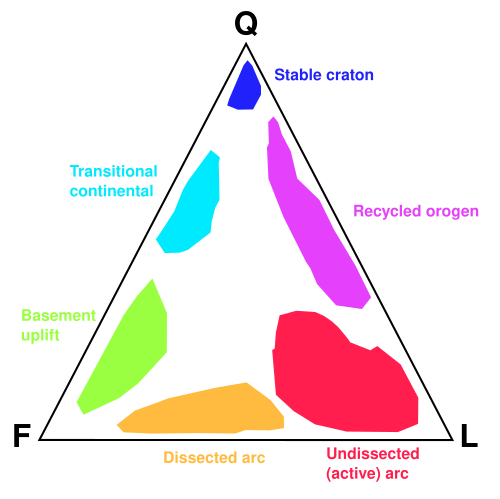
In the geologic use of the term, provenance instead refers to the origin or source area of particles within a rock, most commonly in sedimentary rocks. It does not refer to the circumstances of the collection of the rock. The provenance of sandstone, in particular, can be evaluated by determining the proportion of quartz, feldspar, and lithic fragments (see diagram).
Seed provenance
يشير منشأ البذور إلى الموقع الجغرافي للنبات الأم الذي جُمعت منه البذور. وفي سياق إعادة التأهيل البيئي، يُشير منشأ البذور إلى استراتيجية لتحديد مصادر البذور تركز على الموقع الجغرافي لهذه المصادر، إذ يُمكن لكل منشأ أن يصف المادة الوراثية من ذلك الموقع. [ 85 ] يتبنى علماء البيئة مفهوم المنشأ المحلي، الذي يُشير إلى ضرورة زراعة البذور ذات المنشأ المحلي فقط في منطقة معينة. ومع ذلك، يعتمد هذا الرأي على برنامج التكيف ، وهو رأي مفاده أن التجمعات السكانية تتكيف محليًا بشكل عام. [ 86 ] ويُعتقد أن البذور المحلية هي الأنسب للظروف المحلية، وأن ذلك سيُجنبنا انخفاض التنوع الوراثي الناتج عن التزاوج الخارجي . ويرى علماء الأحياء التطورية أن الالتزام الصارم بجمع البذور بناءً على المنشأ ليس قرارًا حكيمًا للأسباب التالية:
- إن التكيف المحلي ليس شائعاً كما يُفترض. [ 87 ]
- يمكن أن يكون سوء تكيف السكان الأساسي مدفوعًا بعمليات طبيعية. [ 87 ]
- تؤدي الأنشطة البشرية المتمثلة في تجزئة الموائل إلى زيادة سوء التكيف وانخفاض القدرة على التكيف. [ 88 ]
- يتغير الانتقاء الطبيعي بسرعة بسبب تغير المناخ [ 89 ] وتجزئة الموائل
- من غير المرجح أن تتباعد أجزاء التجمعات السكانية بفعل الانتقاء الطبيعي منذ تجزئة التجمعات السكانية (أقل من 500 عام). وهذا يؤدي إلى انخفاض خطر انخفاض اللياقة الناتج عن التزاوج الخارجي. [ 90 ]
تُعدّ تجارب تحديد المنشأ، حيث تُزرع مواد من منشأ مختلف في مكان واحد أو في مواقع مختلفة تغطي نطاقًا واسعًا من الظروف البيئية، وسيلةً للكشف عن التباين الجيني بين المنشأ. كما تُسهم هذه التجارب في فهم كيفية استجابة المنشأ المختلفة للظروف المناخية والبيئية المتنوعة، وبالتالي يمكن أن تُسهم في توفير المعرفة اللازمة لاختيار المنشأ استراتيجيًا للتكيف مع تغير المناخ . [ 91 ]
الحواسيب والقانون
يُستخدم مصطلح "المنشأ" عند التحقق من مصدر السلع، مثل أجهزة الحاسوب، لتقييم ما إذا كانت أصلية أم مزيفة. ويُستخدم مصطلح "سلسلة الحفظ" كمرادف له في القانون، لا سيما فيما يتعلق بالأدلة في القضايا الجنائية أو التجارية.
يشمل أصل البرمجيات مصدرها وشروط ترخيصها . على سبيل المثال، عند دمج مكون برمجي مجاني أو مفتوح المصدر أو احتكاري في تطبيق ما، قد يرغب المستخدم في فهم أصله لضمان استيفاء متطلبات الترخيص وفهم خصائص البرمجيات الأخرى.
يشمل تتبع مصدر البيانات مصدر البيانات المحوسبة. ويتضمن جانبين رئيسيين: ملكية البيانات واستخدامها. توضح الملكية للمستخدم الجهة المسؤولة عن مصدر البيانات، ويُفضل أن تتضمن معلومات عن مُنشئ البيانات. أما استخدام البيانات فيُقدم تفاصيل حول كيفية استخدام البيانات وتعديلها، وغالبًا ما يتضمن معلومات حول كيفية توثيق مصدر البيانات أو مصادرها. [ 52 ]
يُعدّ تتبع مصدر البيانات ذا أهمية خاصة في البيانات الإلكترونية، إذ غالبًا ما تُعدّل مجموعات البيانات وتُنسخ دون توثيق مناسب أو إشارة إلى مصدرها الأصلي. تُسهّل قواعد البيانات اختيار معلومات محددة من مجموعات البيانات ودمجها مع مصادر بيانات أخرى دون أي توثيق لكيفية الحصول على البيانات أو كيفية تعديلها عن مجموعة البيانات الأصلية. [ 52 ] وقد وُصف التحليل الآلي لمخططات تتبع مصدر البيانات بأنه وسيلة للتحقق من الامتثال للوائح المتعلقة باستخدام البيانات، مثل تلك التي أقرّها نظام حماية البيانات العامة للاتحاد الأوروبي (GDPR) . [ 92 ]
يشير مفهوم "الأصل الآمن" إلى توفير ضمانات سلامة وسرية معلومات الأصل. بعبارة أخرى، يعني الأصل الآمن ضمان عدم إمكانية التلاعب بالسجل التاريخي، وتمكين المستخدمين من تحديد الجهات الأخرى التي يمكنها الاطلاع على أنشطتهم المتعلقة بالعنصر. [ 93 ] [ 94 ]
إحدى الطرق البسيطة لضمان تتبع مصدر البيانات في الحوسبة هي جعل الملف للقراءة فقط . يسمح هذا للمستخدم بعرض محتويات الملف، ولكن لا يمكنه تعديله أو تغييره بأي شكل من الأشكال. كما أن خاصية "للقراءة فقط" قد تمنع المستخدم في بعض الحالات من حذف الملف عن طريق الخطأ أو عمدًا .
انظر أيضاً
مراجع
- ↑ قاموس أكسفورد الإنجليزي : "حقيقة القدوم من مصدر أو جهة معينة؛ المصدر، الاشتقاق"
- ↑ "الوقاية خير من العلاج: المتاحف الأمريكية تتخذ تدابير تراعي إعادة الفن الأفريقي إلى موطنه" ، بقلم روبن شير، أخبار الفن ، 11 يونيو 2019
- 1 2 "مصطلحات أثرية مختارة" . 10 فبراير 2013. مؤرشف من الأصل في 10 فبراير 2013.
- 1 2 "نهب الأعمال الفنية خلال فترة الهولوكوست والحرب العالمية الثانية" . www.nationalmuseums.org.uk . موقع مجلس مديري المتاحف الوطنية . تاريخ الاطلاع: 10 فبراير 2019 .
- ↑ "عملية احتيال رئيسية من القرن العشرين" . مؤرشف من الأصل بتاريخ 25 فبراير 2012. تم الاطلاع عليه بتاريخ 6 مارس 2012 .
- ↑ "درسٌ بقيمة 2.6 مليون دولار حول تاريخ الملكية | مزادات توك" . مؤرشف من الأصل بتاريخ 26 أغسطس 2014. تم الاطلاع عليه بتاريخ 24 أغسطس 2014 .
- ↑ "مصدر المجموعات" . المتحف الملكي لوسط أفريقيا - تيرفورين - بلجيكا . تم الاطلاع عليه بتاريخ 1 يناير 2022 .
- ↑ رينولدز، ليزا، دليل بحثي حول أصول الأعمال الفنية، متوفر في أوراق الماجستير بجامعة نورث كارولينا. رابط قديم مؤرشف بتاريخ 7 يوليو 2012 على archive.today
- ↑ "كارتيلينو" . معجم . لندن: المعرض الوطني . تم الاطلاع عليه بتاريخ 31 يوليو 2018 .
- ↑ "مواد الدورة التدريبية - nal-vam.on.worldcat.org" . nal-vam.on.worldcat.org .
- ↑ "عالم الفن في بريطانيا 1660-1735" . تم الاطلاع عليه بتاريخ 22 يناير 2021 .
- ↑ "ما الذي تغطيه الفهارس (معهد جيتي للأبحاث)" . www.getty.edu .
- ↑ "مكتبة فريك المرجعية للفنون" . www.frick.org . مجموعة فريك . تم الاطلاع بتاريخ 10 فبراير 2019 .
- ↑ "معهد هولندا لقواعد بيانات تاريخ الفن" . مؤرشف من الأصل بتاريخ 16-09-2012 . تم الاطلاع عليه بتاريخ 07-06-2012 .
- ↑ السلالات ، كتالوج معرض في معرض تيت، كارين هيرن، صفحة 158
- 1 2 غروسفينور، بيندور . "أخبار تاريخ الفن" . www.arthistorynews.com .
- ↑ أبوخانفوسة، كيرستين؛ سيدبيك، يان، محرران. (1994). مبدأ المصدر: تقرير من مؤتمر ستوكهولم الأول حول نظرية الأرشيف ومبدأ المصدر، 2-3 سبتمبر 1993. ستوكهولم: الأرشيف الوطني السويدي. ISBN 9789188366115.
- ↑Douglas, Jennifer (2010). "Origins: evolving ideas about the principle of provenance". In Eastwood, Terry; MacNeil, Heather (eds.). Currents of Archival Thinking. Santa Barbara, Calif.: Libraries Unlimited. pp. 23–43 (27–28). ISBN 9781591586562.
- ↑Ross, Seamus (2012). "Digital Preservation, Archival Science and Methodological Foundations for Digital Libraries". New Review of Information Networking. 17 (1): 43–68 (esp. 50–53). doi:10.1080/13614576.2012.679446. S2CID 58540553.
- ↑"Provenance, Journal of the Society of Georgia Archivists".
- 12Pearson, David (1998). Provenance Research in Book History: a Handbook. British Library. p. 132. ISBN 978-0-7123-4598-9.
- ↑Pearson, David (2005). "Provenance and Rare Book Cataloguing: Its Importance and Its Challenges". In Shaw, David J. (ed.). Books and Their Owners: Provenance Information and The European Cultural Heritage. Consortium of European Research Libraries. pp. 1–9. ISBN 978-0-9541535-3-3.
- ↑Curwen, Tony & Jonsson, Gunilla (2007). "Provenance and the Itinerary of the Book: Recording Provenance Data in On-line Catalogues". In Shaw, David J. (ed.). Imprints and Owners: Recording the Cultural Geography of Europe. Consortium of European Research Libraries. pp. 31–47. ISBN 978-0-9541535-6-4.
- ↑Jackson, H. J. (2001). Marginalia: Readers Writing in Books. Yale University Press. p. 2. ISBN 978-0-300-08816-8.
- ↑Partridge, Kenneth (15 September 2016). "15 Famous Pianos That You Can Visit". MentalFloss.com. Mental Floss NY. Retrieved 15 September 2016.
- ↑"John Lennon's Historic Baldwin Concert Grand Piano Up For Auction In Towson". Newspaper. Hunt Valley Life. 2 August 2023. Retrieved 4 September 2023.
- ↑"John Lennon at 80: George Michael-owned Imagine piano put on display". Newspaper. BBC. BBC News. 7 October 2020. Retrieved 4 September 2023.
- ↑"Official Website". Mozarteum.at. Retrieved 4 September 2023.
- ↑"Treasures of the White House". White House History. The White House Historical Society. Retrieved 4 September 2023.
- ↑"What is a Bill of Lading? Why's it so important?". Trucker's News. 1 September 2021. Retrieved 5 September 2023.
- ↑Schrader, Adam (7 August 2023). "This Piano—Purchased by John Lennon, Gifted to Sam Green, Then Loaned to Andy Warhol—Could Ring Up $3 Million at Auction". Online Magazine. Art Net. Art Net News. Retrieved 4 September 2023.
- ↑Staff, Hunt Valley. "John Lennon's Historic Baldwin Concert Grand Piano Up For Auction In Towson".
- ↑"HIDDEN STORIES OF ICONIC LOST LENNON-ONO-GREEN-WARHOL PIANO". Preservation Artisans Guild. 29 August 2023. Retrieved 4 September 2023.
- ↑Fusek, Maggie (2 September 2023). "Lennon, Ono, Warhol Linked To Lost Baldwin by Bay Area Experts: The story behind the iconic Lennon-Ono-Green-Warhol piano valued over $3 million and how a Walnut Creek-based pair proved its authenticity". Patch. Retrieved 4 September 2023.
- ↑Burris, Taj (27 August 2023). "Owned by John Lennon, lost after Andy Warhol, a piano finds itself on auction in Towson". Newspaper. The Venetoulis Institute for Local Journalism. The Baltimore Banner. Retrieved 4 September 2023.
- ↑Gregorian, Dareh (28 May 2000). "LENNON'S PAL WANTS $1.6M FOR 'LOST' PIANO". New York Post. Retrieved 5 September 2023.
- ↑Cassady, Daniel (28 July 2023). "A Grand Piano Once Owned by John Lennon Is Coming Up for Sale". artnews.com. ARTnews. Retrieved 5 September 2023.
- ↑"Pianos belonging to Freddie Mercury and John Lennon set to be auctioned off... but for how much?". 14 August 2023. Retrieved 5 September 2023.
- ↑Grosskrueger, Amanda (10 August 2023). "Lennon-Ono-Green-Warhol Piano Lost and Found, Now Up for Auction In Which County?". Online Newspaper. Maryland Association of Counties. Conduit Street. Retrieved 5 September 2023.
- ↑ "الموقع الرسمي" . الجمعية الدولية للمثمنين . تم الاطلاع عليه بتاريخ 4 سبتمبر 2023 .
- ↑ winepros.com.au. موسوعة أكسفورد للنبيذ. "التعتيق" . مؤرشف من الأصل بتاريخ 26-07-2008 . تم الاطلاع عليه بتاريخ 28-04-2008 .
- ↑ "find-spot" . قاموس أكسفورد الإنجليزي ( النسخة الإلكترونية). مطبعة جامعة أكسفورد. ديسمبر 2016. doi : 10.1093/OED/9308007328 . تاريخ الاسترجاع: 26 مارس 2025 . (يشترط الاشتراك أو عضوية المؤسسة المشاركة .)
- ↑ ريندي نوزولو، كارلو (2025-12-20). "من الشظايا إلى الوجوه: استخدام التحليل القياسي لإعادة تحديد القطع الأثرية ونسبتها إلى مصدرها" . مجلة npj لعلوم التراث . 13 (1) 673. doi : 10.1038/s40494-025-02218-4 . ISSN 3059-3220 .
- ↑ ريندي نوزولو، كارلو (13 فبراير 2026). فيليجر، ماغي (محررة). "المسح ثلاثي الأبعاد وتحليل الشكل يساعدان علماء الآثار على ربط القطع الأثرية عبر المكان والزمان لاستعادة تاريخها المفقود" . ذا كونفرسيشن . doi : 10.64628/AAI.9qpf3hsrt . تاريخ الاسترجاع: 26 فبراير 2026 .
- ↑ جويس، روزماري أ. (2012). "من مكان إلى آخر: الأصل، والأصل، وعلم الآثار". في: فيجنباوم، غيل؛ ريست، إنج (محرران). الأصل: تاريخ بديل للفن . قضايا ومناقشات. لوس أنجلوس: معهد جيتي للأبحاث. ص 48. ISBN 978-1606061220.
- 1 2 3 هيرست، ك. كريس (22 ديسمبر 2016). "الأصل، المنشأ، فلنلغِ الأمر برمته: ما الفرق في المعنى بين الأصل والمنشأ؟" . ThoughtCo . Dotdash/IAC . تم الاطلاع عليه في 21 سبتمبر 2017 .
- ↑ "مسرد المصطلحات" . إدارة مجموعات بوابة الأحافير . المتحف الأمريكي للتاريخ الطبيعي. 2009. تم الاطلاع عليه في 21 سبتمبر 2017 .
- ↑ ألتينتاس، آي.؛ بيركلي، سي.؛ ياغر، إي.؛ جونز، إم.؛ لوداشر، بي.؛ موك، إس. (2004) "كبلر: نظام قابل للتوسيع لتصميم وتنفيذ سير العمل العلمي". وقائع المؤتمر الدولي السادس عشر لإدارة قواعد البيانات العلمية والإحصائية ، ص 423-424
- ↑Pasquier, Thomas; Lau, Matthew K.; Trisovic, Ana; Boose, Emery R.; Couturier, Ben; Crosas, Mercè; Ellison, Aaron M.; Gibson, Valerie; Jones, Chris R.; Seltzer, Margo (5 September 2017). "If these data could talk". Scientific Data. 4 170114. Bibcode:2017NatSD...470114P. doi:10.1038/sdata.2017.114. PMC 5584398. PMID 28872630.
- ↑Boose, E.; Ellison, A.; Osterweil, L.; Clarke, L.; Podorozhny, R., Hadley, J.; Wise, A.; Foster, D. (2007) Ensuring reliable datasets for environmental models and forecasts. Ecological Informatics, 2(3):237–247
- ↑Bates, Adam; Hassan, Wajih Ul (2019). "Can Data Provenance Put an End to the Data Breach?". IEEE Security & Privacy. 17 (4): 88–93. Bibcode:2019ISPri..17d..88B. doi:10.1109/MSEC.2019.2913693. S2CID 195832747.
- 123Ma, X.; Fox, P.; Tilmes, C.; Jacobs, K.; Waple, A. (2014) Capturing and presenting provenance of global change information. Nature Climate Change 4 (6), 409-413.
- ↑"Research Data Provenance IG". RDA. 11 September 2013.
- ↑Tan, Yu Shyang; Ko, Ryan K.L.; Holmes, Geoff (November 2013). "Security and Data Accountability in Distributed Systems: A Provenance Survey". 2013 IEEE 10th International Conference on High Performance Computing and Communications & 2013 IEEE International Conference on Embedded and Ubiquitous Computing. IEEE. pp. 1571–1578. doi:10.1109/hpcc.and.euc.2013.221. ISBN 9780769550886. S2CID 16890856.
- ↑"International Provenance and Annotation Workshop". International Provenance and Annotation Workshop. Retrieved 10 February 2019.
- ↑"TaPP 2015". workshops.inf.ed.ac.uk. Retrieved 10 February 2019.
- ↑"PROV-Overview". www.w3.org.
- ↑"Provenance Web Services". openprovenance.org.
- ↑Moreau et al. (2008) The Open Provenance Model: An Overview, in J. Freire, D. Koop, and L. Moreau (Eds.): IPAW 2008, LNCS 5272, pp. 323–326, 2008. Springer.
- ↑ Zhao, J. (2010) " مواصفات مفردات نموذج الأصل المفتوح "، تم الوصول إليه في 2016-04-09.
- ↑ Lebo et al. (eds.) " PROV-O: The PROV Ontology "، تم الوصول إليه في 2016-04-09.
- ↑ بلحاجام، خالد (4 أبريل 2013). "تطبيقات W3C PROV: تحليل أولي" . تم الاطلاع عليه بتاريخ 10 فبراير 2019 .
- ↑ CamFlow ، وحدة أمان لنظام لينكس من جامعة كامبريدج وجامعة هارفارد
- ↑ باسكييه، توماس؛ هان، شويوان؛ غولدشتاين، مارك؛ موير، توماس؛ إيرز، ديفيد؛ سيلتزر، مارغو؛ بيكون، جان (2017). "التقاط عملي لأصل النظام بأكمله" . وقائع ندوة الحوسبة السحابية لعام 2017. SoCC '17. ACM. الصفحات 405-418 . arXiv : 1711.05296 . Bibcode : 2017arXiv171105296P . doi : 10.1145/3127479.3129249 . ISBN 9781450350280. S2CID 4885447 .
- 1 2 لي، شين؛ جوشي، تشايتانيا؛ تان، آلان يو شيانغ؛ كو، رايان كوك ليونغ (أغسطس 2015). "استنتاج إجراءات المستخدم من سجلات المصدر". مؤتمر IEEE Trustcom/BigDataSE/ISPA لعام 2015. المجلد 1. IEEE. الصفحات 742-749 . doi : 10.1109/trustcom.2015.442 . hdl : 10289/9505 . ISBN 9781467379526. S2CID 1904317 .
- ↑ جيهاني، أشيش (8 فبراير 2019). "SPADE: دعم تدقيق المصدر في البيئات الموزعة" . تم الاسترجاع في 10 فبراير 2019 – عبر GitHub.
- ↑ هان، شويوان؛ باسكييه، توماس؛ بيتس، آدم؛ ميكنز، جيمس؛ سيلتزر، مارغو (26 فبراير 2020). "يونيكورن: كاشف قائم على المصدر في وقت التشغيل للتهديدات المستمرة المتقدمة" . ندوة أمن الشبكات والأنظمة الموزعة . arXiv : 2001.01525 . doi : 10.14722/ndss.2020.24046 . ISBN 978-1-891562-61-7.
- ↑ "مكتبة R لجمع بيانات المصدر من نصوص R البرمجية: End-to-end-provenance/RDataTracker" . 12 ديسمبر 2018 - عبر GitHub.
- ↑ "بنية تحتية داعمة لإجراء التجارب العلمية بدون نظام إدارة سير العمل العلمي: gems-uff/noworkflow" . ١٩ ديسمبر ٢٠١٨ - عبر GitHub.
- ↑Muniswamy-Reddy, Kiran-Kumar; Holland, David; Seltzer, Margo (2006). "Provenance-Aware Storage Systems". USENIX 2006 Annual Technical Conference Refereed Paper.
- ↑Pohly, Devin J.; McLaughlin, Stephen; McDaniel, Patrick; Butler, Kevin (2012). "Hi-Fi". Proceedings of the 28th Annual Computer Security Applications Conference. Acsac '12. ACM. pp. 259–268. doi:10.1145/2420950.2420989. ISBN 9781450313124. S2CID 5622944.
- ↑Pohly, Devin J. (19 August 2013). "Hi-Fi". GitHub.
- ↑Ko, Ryan K. L.; Jagadpramana, Peter; Lee, Bu Sung (November 2011). "Flogger: A File-Centric Logger for Monitoring File Access and Transfers within Cloud Computing Environments". 2011IEEE 10th International Conference on Trust, Security and Privacy in Computing and Communications. IEEE. pp. 765–771. doi:10.1109/trustcom.2011.100. ISBN 9781457721359. S2CID 15858535.
- ↑Suen, Chun Hui; Ko, Ryan K.L.; Tan, Yu Shyang; Jagadpramana, Peter; Lee, Bu Sung (July 2013). "S2Logger: End-to-End Data Tracking Mechanism for Cloud Data Provenance". 2013 12th IEEE International Conference on Trust, Security and Privacy in Computing and Communications. IEEE. pp. 594–602. doi:10.1109/trustcom.2013.73. ISBN 9780769550220. S2CID 504801.
- ↑Bates, Adam; Tian, Dave; Butler, Kevin R. B.; Moyer, Thomas (2015). "Trustworthy Whole-system Provenance for the Linux Kernel". Proceedings of the 24th USENIX Conference on Security Symposium. SEC'15. USENIX Association: 319–334. ISBN 9781931971232.
- ↑"uf_sensei / redhat-linux-provenance-release – Bitbucket". bitbucket.org.
- ↑Ko, Ryan K.L.; Will, Mark A. (June 2014). "Progger: An Efficient, Tamper-Evident Kernel-Space Logger for Cloud Data Provenance Tracking". 2014 IEEE 7th International Conference on Cloud Computing. IEEE. pp. 881–889. doi:10.1109/cloud.2014.121. hdl:10289/9018. ISBN 9781479950638. S2CID 17536574.
- ↑ طه، محمد م. بني؛ تشايسيري، سيفادون؛ كو، ريان ك. ل. (أغسطس 2015). "مصدر بيانات موثوق به ومقاوم للتلاعب". مؤتمر IEEE Trustcom/BigDataSE/ISPA لعام 2015. معهد مهندسي الكهرباء والإلكترونيات. الصفحات 646-653 . doi : 10.1109/trustcom.2015.430 . ISBN 9781467379526. S2CID 10720318 .
- ↑ غاراي، جيفري؛ كو، رايان كيه إل؛ تشايسيري، سيفادون (أغسطس 2016). "UVisP: تصور بيانات المصدر من منظور المستخدم باستخدام مبادئ الجشطالت". مؤتمر IEEE Trustcom/BigDataSE/ISPA لعام 2016. معهد مهندسي الكهرباء والإلكترونيات. الصفحات 1923-1930 . doi : 10.1109/trustcom.2016.0294 . hdl : 10289/10996 . ISBN 9781509032051. S2CID 11231512 .
- ↑ "CROWLaboratory/Progger" . GitHub . تم الاسترجاع في 2018-08-04 .
- ↑ باسكييه، توماس؛ سينغ، جاتيندر؛ إيرز، ديفيد؛ بيكون، جان (2015). "كامفلو: مشاركة البيانات المُدارة لخدمات الحوسبة السحابية". معاملات IEEE في الحوسبة السحابية . 5 (3): 472-484 . arXiv : 1506.04391 . Bibcode : 2015arXiv150604391P . doi : 10.1109/TCC.2015.2489211 . S2CID 11537746 .
- ↑ باسكييه، توماس؛ هان، شويوان؛ غولدشتاين، مارك؛ موير، توماس؛ إيرز، ديفيد؛ سيلتزر، مارغو؛ بيكون، جان (2017). "التقاط عملي لأصل النظام بأكمله" . وقائع ندوة الحوسبة السحابية لعام 2017. SoCC '17. ACM. الصفحات 405-418 . arXiv : 1711.05296 . Bibcode : 2017arXiv171105296P . doi : 10.1145/3127479.3129249 . ISBN 9781450350280. S2CID 4885447 .
- ↑ باسكييه، توماس؛ هان، شويوان؛ موير، توماس؛ بيتس، آدم؛ هيرمانت، أوليفييه؛ إيرز، ديفيد؛ بيكون، جان؛ سيلتزر، مارغو (14 أكتوبر 2018). "تحليل وقت التشغيل لأصل النظام بأكمله". المؤتمر الخامس والعشرون لجمعية ACM لأمن الحاسوب والاتصالات . arXiv : 1808.06049 . Bibcode : 2018arXiv180806049P .
- ↑ "CamFlow: أصول لينكس العملية" . camflow.org .
- ↑Breed, Martin F; Harrison, Peter A; Bischoff, Armin; Durruty, Paula; Gellie, Nick J C; Gonzales, Emily K; Havens, Kayri; Karmann, Marion; Kilkenny, Francis F; Krauss, Siegfried L; Lowe, Andrew J; Marques, Pedro; Nevill, Paul G; Vitt, Pati L; Bucharova, Anna (2018-06-13). "Priority Actions to Improve Provenance Decision-Making". BioScience. 68 (7): 510–516. doi:10.1093/biosci/biy050. ISSN 0006-3568.
- ↑Gould S. J.; Lewontin; R. C. (1979). "The Spandrels of San Marco and the Panglossian Paradigm: A Critique of the Adaptationist Programme". Proceedings of the Royal Society of London, Series B: Biological Sciences, 205: 581-598
- 12Gould & Lewontin 1979
- ↑Willi Y, Van Buskirk J, Hoffmann AA (2006) Limits to the adaptive potential of small populations. Annual Review of Ecology, Evolution, and Systematics 37: 433-458.
- ↑Parmesan C (2006) Ecological and evolutionary responses to recent climate change. Annual Review of Ecology, Evolution, and Systematics 37: 637-669.
- ↑Frankham R, Ballou J, Eldridge M, Lacy R, Ralls K, et al. (2011) Predicting the probability of outbreeding depression. Conservation Biology.
- ↑Konnert, M., Fady, B., Gömöry, D., A'Hara, S., Wolter, F., Ducci, F. Koskela, J., Bozzano, M., Maaten, T. and Kowalczyk, J. (2015). "Use and transfer of forest reproductive material in Europe in the context of climate change"(PDF). European Forest Genetic Resources Programme (EUFORGEN), Bioversity International, Rome, Italy: xvi and 75 p.
{{cite journal}}: CS1 maint: multiple names: authors list (link) - ↑Pasquier, Thomas; Singh, Jatinder; Powles, Julia; Eyers, David; Seltzer, Margo; Bacon, Jean (1 April 2018). "Data provenance to audit compliance with privacy policy in the Internet of Things". Personal and Ubiquitous Computing. 22 (2): 333–344. doi:10.1007/s00779-017-1067-4. hdl:1983/1e7615ae-28fa-497e-9ba7-2522df980a56. ISSN 1617-4909. S2CID 4594884.
- ↑The Case of the Fake Picasso: Preventing History Forgery with Secure Provenance, Hasan et al., USENIX FAST 2009.
- ↑Xinlei (Oscar) Wang, Kai Zeng, Kannan Govindan and Prasant Mohapatra. (2012). "Chaining for securing data provenance in distributed information networks". In Proceedings of the IEEE International Conference for Military Communications. MILCOM '12. pp. 1–6. doi:10.1109/MILCOM.2012.6415609. ISBN 978-1-4673-1731-3.
{{cite conference}}: CS1 maint: multiple names: authors list (link)
Bibliography
Art
- Feigenbaum, Gail; Reist, Inge, eds. (2012). Provenance: An Alternate History of Art. Issues & Debates. Los Angeles: Getty Research Institute. ISBN 978-1606061220.
Book studies
- Adams, Frederick B (1969). The Uses of Provenance. Berkeley: University of California.
- Myers, Robin; Harris, Michael; Mandelbrote, Giles, eds. (2007). Books on the move: tracking copies through collections and the book trade. London: British Library. ISBN 978-0-7123-0986-8.
- Pearson, David (2019). Provenance Research in Book History: a Handbook. London: Bodleian Library. ISBN 978-0-7123-4598-9.
- Shaw, David J., ed. (2005). Books and Their Owners: Provenance Information and the European Cultural Heritage. London: Consortium of European Research Libraries. ISBN 978-0-9541535-3-3.
- Shaw, David J., ed. (2007). Imprints and Owners: Recording the Cultural Geography of Europe. London: Consortium of European Research Libraries. ISBN 978-0-9541535-6-4.
Nazi-Era provenance research
- Schuhmacher, Jacques (2024). Nazi-Era Provenance of Museum Collections: A Research Guide(PDF). London: UCL Press. ISBN 9781800086890.
- Yeide, Nancy; Walsh, Amy; Akinsha, Konstantin (2001). The AAM Guide to Provenance Research. Washington DC: American Association of Museums. ISBN 9780931201738.
External links
- The National Gallery of Art Washington gives brief provenances for most featured works
- EU Provenance Project - a technology project that sought to support the electronic certification of data provenance
- W3C Provenance Working Group
- W3C Provenance Outreach Information
- Archaeological artifacts
- Archaeological theory
- Archival science
- Art history
- Visual arts terminology
- Book terminology
- Collections care
- Museology
- Data collection
- Evidence law
- Library science terminology
- Scientific method
- Seeds
- Wine packaging and storage
- Wine terminology