
العنصر الصفري
في الرياضيات ، يُعدّ العنصر الصفري أحد التعميمات العديدة للعدد صفر في بنى جبرية أخرى . وقد تُختزل هذه المعاني البديلة إلى الشيء نفسه أو لا، وذلك بحسب السياق.
الهويات الجمعية
العنصر المحايد الجمعي هو العنصر المحايد في زمرة أو شبه زمرة جمعية . وهو يقابل العنصربحيث يكون ذلك لجميعفي المجموعة،تتضمن بعض الأمثلة على العنصر المحايد الجمعي ما يلي:



- المتجه الصفري في عملية جمع المتجهات : هو المتجه الذي تكون جميع مكوناته صفريةفي فضاء متجهي معياري ، يكون معياره (طوله) أيضًايُشار إليه غالبًا باسمأو[ 1 ]
- الدالة الصفرية أو الخريطة الصفرية المعرفة بواسطة، في ظل الجمع النقطي
- المجموعة الفارغة تحت اتحاد المجموعات
- مجموع فارغ أو ناتج مشترك فارغ
- كائن أولي في فئة (ناتج مشترك فارغ، وبالتالي عنصر محايد في ظل النواتج المشتركة )



عناصر امتصاص
يُعمم العنصر الممتص في شبه المجموعة الضربية أو شبه الحلقة الخاصيةومن الأمثلة على ذلك:

- المجموعة الفارغة ، وهي عنصر امتصاصي تحت الضرب الديكارتي للمجموعات، لأن
- الدالة الصفرية أو الخريطة الصفرية المعرفة بواسطةفي عملية الضرب النقطي


العديد من العناصر الممتصة هي أيضًا عناصر محايدة جمعية، بما في ذلك المجموعة الفارغة والدالة الصفرية. ومن الأمثلة المهمة الأخرى العنصر المميز.في حقل أو حلقة ، وهو كل من العنصر المحايد الجمعي والعنصر الممتص الضربي، ويكون مثالي الرئيسي هو أصغر مثالي.
كائن صفري
الكائن الصفري في فئة ما هو كائن ابتدائي ونهائي في آنٍ واحد (وبالتالي هو كائن محايد في كلٍّ من الضرب المشترك والضرب ). على سبيل المثال، البنية التافهة (التي تحتوي على الكائن المحايد فقط) هي كائن صفري في الفئات التي يجب أن تربط فيها التشكلات الكائنات المحايدة ببعضها. ومن الأمثلة المحددة ما يلي:
- المجموعة التافهة ، التي تحتوي فقط على العنصر المحايد (عنصر صفري في فئة المجموعات ).
- الوحدة الصفرية ، التي تحتوي فقط على العنصر المحايد (كائن صفري في فئة الوحدات فوق حلقة)
التشكلات الصفرية
A zero morphism in a category is a generalised absorbing element under function composition: any morphism composed with a zero morphism gives a zero morphism. Specifically, if is the zero morphism among morphisms from to , and and are arbitrary morphisms, then and .





If a category has a zero object , then there are canonical morphisms and , and composing them gives a zero morphism . In the category of groups, for example, zero morphisms are morphisms which always return group identities, thus generalising the function .


Least elements
A least element in a partially ordered set or lattice may sometimes be called a zero element, and written either as or .

Zero module
In mathematics, the zero module is the module consisting of only the additive identity for the module's addition function. In the integers, this identity is zero, which gives the name zero module. That the zero module is in fact a module is simple to show; it is closed under addition and multiplication trivially.
Zero ideal
In mathematics, the zero ideal in a ring is the ideal consisting of only the additive identity (or zero element). The fact that this is an ideal follows directly from the definition.

Zero matrix
In mathematics, particularly linear algebra, a zero matrix is a matrix with all its entries being zero. It is alternately denoted by the symbol .[2] Some examples of zero matrices are


The set of m × n matrices with entries in a ringK forms a module . The zero matrix in is the matrix with all entries equal to , where is the additive identity in K.


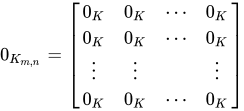
The zero matrix is the additive identity in . That is, for all :


There is exactly one zero matrix of any given size (with entries from a given ring), so when the context is clear, one often refers to the zero matrix. In a matrix ring, the zero matrix serves the role of both an additive identity and an absorbing element. In general, the zero element of a ring is unique, and typically denoted as without any subscript to indicate the parent ring. Hence the examples above represent zero matrices over any ring.

The zero matrix also represents the linear transformation which sends all vectors to the zero vector.
Zero tensor
In mathematics, the zero tensor is a tensor, of any order, all of whose components are zero. The zero tensor of order is sometimes known as the zero vector.

Taking a tensor product of any tensor with any zero tensor results in another zero tensor. Among tensors of a given type, the zero tensor of that type serves as the additive identity among those tensors.
See also
- Null semigroup
- Zero divisor
- Zero object
- Zero of a function
- Zero — non-mathematical uses
References
- ↑Nair, M. Thamban; Singh, Arindama (2018). Linear Algebra. Springer. p. 3. Bibcode:2018lial.book.....N. doi:10.1007/978-981-13-0926-7. ISBN 978-981-13-0925-0.
- ↑Lang, Serge (1987). Linear Algebra. Undergraduate Texts in Mathematics. Springer. p. 25. ISBN 9780387964126.
We have a zero matrix in which for all . ... We shall write it .


- 0 (number)
- Set index articles on mathematics