
Defective matrix
In linear algebra, a defective matrix is a square matrix that does not have a complete basis of eigenvectors, and is therefore not diagonalizable. In particular, an matrix is defective if and only if it does not have linearly independent eigenvectors.[1] A complete basis is formed by augmenting the eigenvectors with generalized eigenvectors, which are necessary for solving defective systems of ordinary differential equations and other problems.


An defective matrix always has fewer than distinct eigenvalues, since distinct eigenvalues always have linearly independent eigenvectors. In particular, a defective matrix has one or more eigenvalues with algebraic multiplicity (that is, they are multiple roots of the characteristic polynomial), but fewer than linearly independent eigenvectors associated with . If the algebraic multiplicity of exceeds its geometric multiplicity (that is, the number of linearly independent eigenvectors associated with ), then is said to be a defective eigenvalue.[1] However, every eigenvalue with algebraic multiplicity always has linearly independent generalized eigenvectors.


A realsymmetric matrix and more generally a Hermitian matrix, and a unitary matrix, is never defective; more generally, a normal matrix (which includes Hermitian and unitary matrices as special cases) is never defective.
Jordan block
Any nontrivial Jordan block of size or larger (that is, not completely diagonal) is defective. (A diagonal matrix is a special case of the Jordan normal form with all trivial Jordan blocks of size and is not defective.) For example, the Jordan block


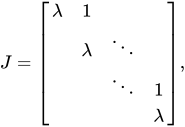
has an eigenvalue, with algebraic multiplicity (or greater if there are other Jordan blocks with the same eigenvalue), but only one distinct eigenvector , where The other canonical basis vectors form a chain of generalized eigenvectors such that for .

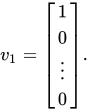
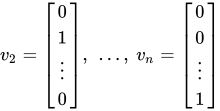


Any defective matrix has a nontrivial Jordan normal form, which is as close as one can come to diagonalization of such a matrix.
Example
A simple example of a defective matrix is

which has a double eigenvalue of 3 but only one distinct eigenvector

(and constant multiples thereof).
See also
- Jordan normal form – Form of a matrix indicating its eigenvalues and their algebraic multiplicities
Notes
- 12Golub & Van Loan (1996, p. 316)
References
- Golub, Gene H.; Van Loan, Charles F. (1996), Matrix Computations (3rd ed.), Baltimore: Johns Hopkins University Press, ISBN 978-0-8018-5414-9
- Strang, Gilbert (1988). Linear Algebra and Its Applications (3rd ed.). San Diego: Harcourt. ISBN 978-970-686-609-7.
- Linear algebra
- Matrices (mathematics)