
Horizon-class frigate
The Horizon class (French: Classe Horizon; Italian: Classe Orizzonte) is a class of air-defencedestroyers in service with the French and Italian navies. They are designated as destroyers by the Italians[8] and are referred to as "frigates" by the French but nonetheless also use the NATO classification "D" intended for destroyers. The programme started as the Common New Generation Frigate (CNGF), a three-nation collaboration between France, the United Kingdom, and Italy to develop a new generation of air-defence warships.[9] Differing national requirements, workshare disagreements and delays led to the UK withdrawing from the project in 1999 to develop the Type 45 destroyer.[10]
The FREMM multipurpose frigate were built using the same company structure as the Horizon project.
Development
France, Italy, and the UK issued a joint requirement in 1992 after the failure of the NATO Frigate Replacement for the 90s (NFR-90) project. In July 1993, the three countries signed a Memorandum of Understanding for a Common New Generation Frigate (CNGF).[11] The ships were to be armed with the Principal Anti Air Missile System (PAAMS). The UK intended to purchase twelve ships to replace its Type 42 destroyers. France was to purchase four to replace its Suffren class, and Italy would purchase six to replace its Andrea Doria and Audace-class ships.[12]
Problems emerged almost immediately. The primary problem was that of differing requirements: France wanted anti-aircraft warfare (AAW) escorts for its aircraft carriers, but only a limited range was necessary due to the self-defence capability of the French Charles de Gaulle. Italy too required only close-range capabilities, as in its home waters of the Mediterranean Sea the ships would operate under Italian Air Force cover or escorts for its aircraft carrier Cavour. The Royal Navy, however, required more capable ships which could throw a large defensive "bubble" over a fleet operating in hostile areas.[13] The compromise that largely solved this problem was the adoption of a standard radar interface, which allowed France and Italy to install the EMPAR multi-function passive electronically scanned array radar and the UK to install the more capable SAMPSONactive electronically scanned array radar—the SAMPSON radar has a higher data rate and an adaptive beam that allows a greater ability to track multiple targets, long-range detection of low-RCS targets, a lower false-alarm rate, and overall higher tracking accuracy.[14]
In March 1996, it was agreed that the PAAMS office would be based in Paris, and the Project Horizon project office would be based in London. The latter was to be responsible for the design of the ship, its command and control, and secondary weapons systems. Britain also agreed to contribute £100m in recognition of the development work already completed by Italy and France on PAAMS.[12] Construction would be carried out by DCN (France), GEC-Marconi (UK), and Orizzonte (Italy).[12]
UK withdrawal
On 26 April 1999, the UK announced that it was withdrawing from the CNGF project to pursue its own national design. At this point, the CNGF project was five years behind schedule.[15] The Financial Times summarised the main disagreements between the partner countries:[16]
- Vessel size – As noted above, the UK's requirements were out of step with those of France and Italy. An agreement was reached but the Financial Times reported that the issue "never entirely [went] away."
- Capability – The UK wanted the ships with a wide-area defence capability due to its experience in the Falklands War.
- الهيكل الصناعي – حاولت المملكة المتحدة استغلال متطلباتها الأكبر للتأثير؛ فقد وافقت فرنسا على رغبة المملكة المتحدة في تعيين شركة ماركوني كمقاول رئيسي، ولكن بشرط منح شركة DCN دور المقاول الرئيسي لنظام إدارة المعارك. ورفضت المملكة المتحدة هذا الشرط، إذ كانت ترغب في أن يتولى هذا الدور تحالف بقيادة شركة بريتش إيروسبيس .
تم تجهيز المدمرة من طراز 45 الناتجة بنظام صواريخ PAAMS ، وقد استفادت من الاستثمار في مشروع Horizon. [ 17 ]
مشروع فرنسي إيطالي
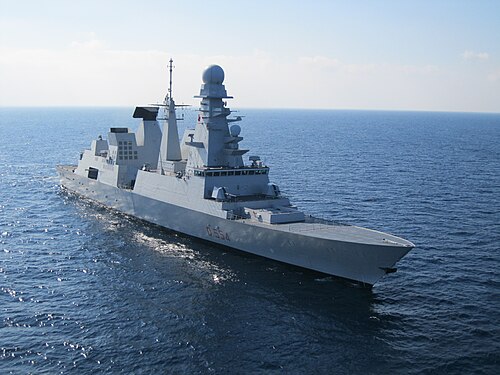
واصلت فرنسا وإيطاليا تعاونهما في إطار مشروع هورايزون. في سبتمبر/أيلول 2000، وقّع البلدان عقدًا لإنتاج أربع سفن بشكل مشترك، حيث طلب كل منهما سفينتين مزودتين بنظام صواريخ PAAMS. [ 18 ] طلبت البحرية الإيطالية سفينتين، هما أندريا دوريا وكايو دويليو ، لاستبدال فئة أوداس . تم استلام أندريا دوريا في 22 ديسمبر/كانون الأول 2007، ورُفعت عليها راية البحرية الإيطالية. ودخلت الخدمة بكامل طاقتها التشغيلية في صيف 2008. طلبت البحرية الفرنسية سفينتين، هما فوربان وشيفالييه بول ، لاستبدال سفن مرافقة حاملات الطائرات من فئة سوفرين . بلغت تكلفة المشروع على فرنسا 2.16 مليار يورو (حوالي 3 مليارات دولار أمريكي) بأسعار عام 2009. [ 1 ] تم إلغاء مشروعين آخرين من مشروع هورايزون؛ وبدلاً منهما، تم بناء فرقاطتين من فئة كاسارد .كان من المقرر استبدالها بنسخة الدفاع الجوي فريدا من الفرقاطة متعددة الأغراض الفرنسية الإيطالية فريم (المعروفة لاحقًا باسم ألزاس ولورين ). اشترت فرنسا 40 صاروخًا من طراز أستر 15 و80 صاروخًا من طراز أستر 30 لسفنها. [ 1 ] أما في الوحدات الإيطالية، فسيتم ترقية المدافع الثلاثة إلى نسخة ديفيد/ستراليس فائقة السرعة متعددة التغذية عيار 76 ملم/62، والتي تتمتع بالقدرة على استخدام قذيفة دارت الموجهة في دور مضاد للصواريخ. [ 19 ]
السفن
| اسم | رقم الراية | باني | تم وضعه | تم الإطلاق | بتكليف | حالة | شعار |
|---|---|---|---|---|---|---|---|
 البحرية الفرنسية البحرية الفرنسية | |||||||
| فوربين | D620 | دي سي إن إس لورينت | 4 أبريل 2002 | 10 مارس 2005 | ديسمبر 2008 | في الخدمة | Opra Sac Di Sou Kraam |
| الفارس بول | D621 | 23 أكتوبر 2003 | 12 يوليو 2006 | يونيو 2009 | في الخدمة | أوسر وفينكر | |
 البحرية الإيطالية البحرية الإيطالية | |||||||
| أندريا دوريا | د 553 | فينكانتيري ريفا تريجوسو وموجيانو ( لا سبيتسيا ) | 19 يوليو 2002 | 15 أكتوبر 2005 | 22 ديسمبر 2007 | في الخدمة | ألتيوس تيندام |
| كايو دويليو | د 554 | 19 سبتمبر 2003 | 23 أكتوبر 2007 | 3 أبريل 2009 | في الخدمة | الاسم رقم | |
انظر أيضاً
References
- 123"Projet de loi de finances pour 2013 : Défense : équipement des forces" (in French). Senate of France. 22 November 2012. Archived from the original on 26 March 2013. Retrieved 1 June 2015.
- ↑"Project Horizon". Globalsecurity.org. Archived from the original on 22 September 2015. Retrieved 1 June 2015.
- ↑"Forbin (D620)" (in French). Marine Nationale. Archived from the original on 31 May 2015. Retrieved 1 June 2015.
- ↑Groizeleau, Vincent (7 November 2025). "Des Simbad-RC avec missiles Mistral pour les frégates FREMM et FDA françaises". Mer et Marine (in French). Retrieved 7 November 2025.
- ↑"Frégate Forbin" (in French). Alabordache.fr. Archived from the original on 13 January 2015. Retrieved 1 June 2015.
- ↑"Frégate Chevalier Paul" (in French). Alabordache.fr. Archived from the original on 14 October 2014. Retrieved 1 June 2015.
- ↑"Narwhal : Deux nouveaux bâtiments français équipés". June 2018.
- ↑"Destroyer – Marina Militare".
- ↑Nicoll, Alexander (27 April 1999). "National differences scupper frigate project". Financial Times.
- ↑"Project to build warship agreed". Financial Times. London. 17 July 1993.
- 123Gray, Bernard (23 March 1996). "Britain, France and Italy agree £7bn frigate deal". Financial Times. London.
- ↑Gray, Bernard (23 March 1996). "Eurofrigate planned for a new world of regional conflicts". Financial Times. London.
- ↑ درانيديس، ديميتريس ف. (مايو 2003). "لوحات خلفية الأسطول: رادارات المصفوفة الطورية على متن السفن؛ دراسة استقصائية للمتطلبات والتقنيات والأنظمة التشغيلية". مجلة الدفاع الإلكتروني . 26 (5): 55.
- ↑ نيكول، ألكسندر؛ أوين، ديفيد (27 أبريل 1999). "انهيار مشروع السفينة الحربية الأوروبية مع انسحاب المملكة المتحدة". فايننشال تايمز . لندن.
- ↑ نيكول، ألكسندر (27 أبريل 1999). "الخلافات الوطنية تُفشل مشروع الفرقاطة". فايننشال تايمز .
- ↑ ووترز (2016)، ص 506.
- ↑ «فرنسا وإيطاليا توقعان اتفاقية لتصميم وبناء أربع فرقاطات من طراز هورايزون» . صحيفة ديفنس ديلي . 26 سبتمبر 2000. مؤرشف من الأصل في 24 سبتمبر 2015. تم الاطلاع عليه في 9 أغسطس 2015 .
- ↑ "نظام توجيه ستراليس لذخيرة عيار 76 ملم وذخيرة دارت" (ملف PDF) . أوتو ميلارا. مؤرشف من الأصل (ملف PDF) بتاريخ 16 أغسطس 2016. تم الاطلاع عليه بتاريخ 29 يوليو 2016 .
فهرس
- واترز، كونراد (2016). "القسم 6.2: سفن القتال السطحية الرئيسية - سفن الدفاع الجوي الأوروبية في القرن الحادي والعشرين". في: واترز، كونراد (محرر). القوات البحرية في القرن الحادي والعشرين . بارنسلي: دار سي فورث للنشر. ص 495-510. ISBN 978-1-4738-4992-1.
روابط خارجية
- (باللغة الإيطالية) Programma Orizzonte – مواصفات وصور Marina Militare
- (باللغة الإنجليزية) مواصفات وتاريخ وصورة أندريا دوريا وكايو دويليو
- (باللغة الإنجليزية) اكتمل الآن برنامج FREMM للبحرية الإيطالية
- فرقاطات من فئة هورايزون
- فئات الفرقاطات
- فئات السفن التابعة للبحرية الفرنسية
- سفن التخفي
- سفن كودوغ