
البنية الداخلية (الطوبولوجيا)
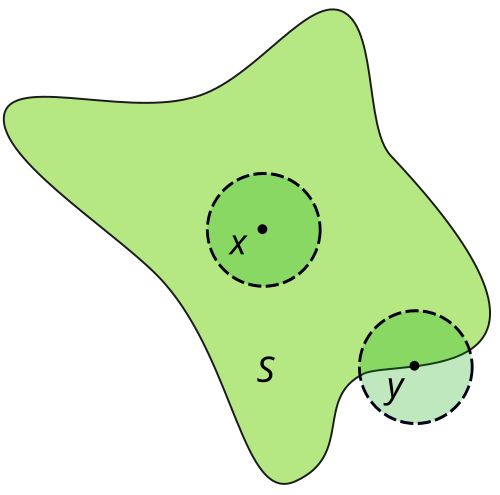
في الرياضيات ، وتحديدًا في الطوبولوجيا ، يُعرَّف باطن مجموعة جزئية S من فضاء طوبولوجي X بأنه اتحاد جميع المجموعات الجزئية المفتوحة من S في X. وتُسمى النقطة التي تقع في باطن S نقطة داخلية لـ S. كما أن باطن S هو مكمل إغلاق مكمل S. وبهذا المعنى ، يُعتبر كل من الباطن والإغلاق مفهومين متلازمين .
الجزء الخارجي لمجموعة S هو مكمل إغلاق S ؛ ويتكون من النقاط التي لا تنتمي إلى المجموعة ولا إلى حدودها . يقسم الجزء الداخلي والحدودي والخارجي لمجموعة جزئية الفضاء بأكمله إلى ثلاثة أقسام (أو أقل إذا كان واحد أو أكثر منها فارغًا ).
التعريفات
نقطة داخلية
لوإذا كانت مجموعة جزئية من فضاء إقليدي ، فإنهي نقطة داخلية منإذا وُجدت كرة مفتوحة مركزها عندوهو ما يحتوي عليه بالكامل (يتضح هذا في القسم التمهيدي لهذه المقالة.)


هذا التعريف قابل للتعميم على أي مجموعة جزئيةفي فضاء متريبالنظام المتري:هي نقطة داخلية منإذا كان هناك عدد حقيقيبحيثهو فيكلما كانت المسافة


يمكن تعميم هذا التعريف ليشمل الفضاءات الطوبولوجية باستبدال "الكرة المفتوحة" بـ " المجموعة المفتوحة ". إذاهي مجموعة جزئية من فضاء طوبولوجيثمهي نقطة داخلية منفيلويتم تضمينها في مجموعة فرعية مفتوحة منهذا موجود بالكامل في (بمعنى آخر،هي نقطة داخلية منلوهو حي من)

ديكور داخلي
الجزء الداخلي من مجموعة فرعيةفضاء طوبولوجييرمز إليه بـأوأويمكن تعريفها بأي من الطرق المتكافئة التالية:


- هي أكبر مجموعة فرعية مفتوحة منوارد في
- هو اتحاد جميع المجموعات المفتوحة منوارد في
- هي مجموعة جميع النقاط الداخلية لـ
إذا كانت المساحةإذا تم فهم ذلك من السياق، فإن الترميز الأقصريفضل عادة

أمثلة


- في أي فضاء، يكون الجزء الداخلي من المجموعة الفارغة هو المجموعة الفارغة نفسها.
- في أي مكانلوثم
- لوهذا هو الخط الحقيقي(مع الطوبولوجيا القياسية)، ثمبينما الجزء الداخلي من المجموعة of rational numbers is empty:
- If is the complex plane then :|z|\leq 1\})=\{z\in \mathbb {C} :|z|<1\}.}
- In any Euclidean space, the interior of any finite set is the empty set.


![{\displaystyle \operatorname {int} ([0,1])=(0,1)}](https://wikimedia.org/api/rest_v1/media/math/render/svg/eae21bcb101c4c8272c0dea5b702f6d45c4e41f3)



On the set of real numbers, one can put other topologies rather than the standard one:
- If is the real numbers with the lower limit topology, then
- If one considers on the topology in which every set is open, then
- If one considers on the topology in which the only open sets are the empty set and itself, then is the empty set.
![{\displaystyle \operatorname {int} ([0,1])=[0,1).}](https://wikimedia.org/api/rest_v1/media/math/render/svg/462127a25e835a105261d2ab1af21a58fa6a57dc)
![{\displaystyle \operatorname {int} ([0,1])=[0,1].}](https://wikimedia.org/api/rest_v1/media/math/render/svg/77c15a0009575dffc2fc463b2ee6906e0415a6c6)
![{\displaystyle \operatorname {int} ([0,1])}](https://wikimedia.org/api/rest_v1/media/math/render/svg/36bdb0cc1182aa30ceb94ec21112619da5096546)
These examples show that the interior of a set depends upon the topology of the underlying space. The last two examples are special cases of the following.
- In any discrete space, since every set is open, every set is equal to its interior.
- In any indiscrete space since the only open sets are the empty set and itself, and for every proper subset of is the empty set.

Properties
Let be a topological space and let and be subsets of


- is open in
- If is open in then if and only if
- is an open subset of when is given the subspace topology.
- is an open subset of if and only if
- Intensive:
- Idempotence:
- Preserves/distributes over binary intersection:
- However, the interior operator does not distribute over unions since only is guaranteed in general and equality might not hold.[note 1] For example, if and then is a proper subset of
- Monotone/nondecreasing with respect to : If then





![{\displaystyle X=\mathbb {R} ,S=(-\infty ,0],}](https://wikimedia.org/api/rest_v1/media/math/render/svg/469f60a07978dd867601ddc85db58d60a224b654)






Other properties include:
- If is closed in and then


Relationship with closure
The above statements will remain true if all instances of the symbols/words
- "interior", "int", "open", "subset", and "largest"
are respectively replaced by
- "closure", "cl", "closed", "superset", and "smallest"
and the following symbols are swapped:
- "" swapped with ""
- "" swapped with ""


For more details on this matter, see interior operator below or the article Kuratowski closure axioms.
Interior operator
The interior operator is dual to the closure operator, which is denoted by or by an overline —, in the sense that and also where is the topological space containing and the backslash يشير إلى الاختلاف في نظرية المجموعات . لذلك، يمكن ترجمة النظرية المجردة لمؤثرات الإغلاق وبديهيات إغلاق كوراتوفسكي بسهولة إلى لغة المؤثرات الداخلية، وذلك باستبدال المجموعات بمكملاتها في






بشكل عام، لا يتبادل عامل التداخل الداخلي مع الاتحادات. ومع ذلك، في فضاء متري كامل، تتحقق النتيجة التالية:
النظرية [ 1 ] (سي. أورسيسكو) — ليكن لتكن سلسلة من المجموعات الجزئية من فضاء متري كامل

- إذا كان كلمغلق فيثم
- إذا كان كلمفتوح فيثم



تشير النتيجة أعلاه إلى أن كل فضاء متري كامل هو فضاء باير .
الجزء الخارجي من مجموعة
الجزء الخارجي من مجموعة فرعيةفضاء طوبولوجييرمز إليه بـأو ببساطةهي أكبر مجموعة مفتوحة منفصلة عنأي أنها اتحاد جميع المجموعات المفتوحة فيالتي هي منفصلة عن الجزء الخارجي هو الجزء الداخلي للمكمل، وهو نفسه مكمل الإغلاق؛ [ 2 ] في الصيغ،



وبالمثل، فإن الجزء الداخلي هو الجزء الخارجي للمكمل:

الداخل والحدود والخارج لمجموعةيقسمون المساحة بأكملها إلى ثلاثة أقسام (أو أقل عندما يكون واحد أو أكثر منها فارغًا): أينيشير إلى حدود[ 3 ] الداخل والخارجمفتوحان، بينما الحدودمغلقة.


تختلف بعض خصائص المشغل الخارجي عن خصائص المشغل الداخلي:
- يقوم المشغل الخارجي بعكس عمليات الإدماج؛ إذاثم
- العامل الخارجي ليس متكرراً . ولكنه يمتلك الخاصية التالية:



أشكال داخلية منفصلة
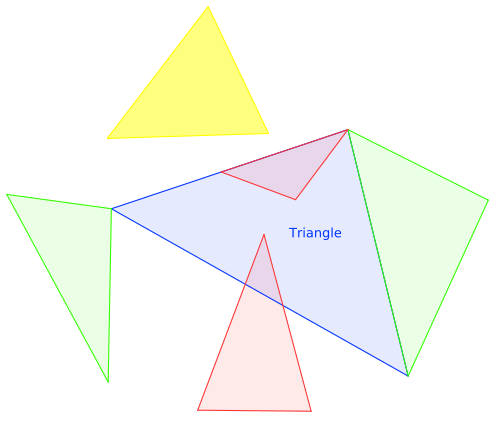
شكلانوتُسمى الأشكال الداخلية المنفصلة إذا كان تقاطع أجزائها الداخلية فارغًا. وقد تتقاطع الأشكال الداخلية المنفصلة عند حدودها أو لا تتقاطع.

انظر أيضاً
- الداخل الجبري – تعميم للداخل الطوبولوجي
- DE-9IM – النموذج الطوبولوجي
- الجبر الداخلي – البنية الجبرية
- نظرية منحنى جوردان – نظرية في علم الطوبولوجيا
- الداخلية شبه النسبية – تعميم للداخلية الجبرية
- الداخلية النسبية – تعميم للداخلية الطوبولوجية
مراجع
- ↑ زالينسكو، سي (2002). التحليل المحدب في الفضاءات المتجهة العامة . ريفر إيدج، نيوجيرسي: لندن: وورلد ساينتيفيك. ص 33. ISBN 981-238-067-1. OCLC 285163112 .
- ↑ بورباكي 1989 ، ص 24.
- ↑ بورباكي 1989 ، ص 25.
- ↑ الهوية المماثلة لعامل الإغلاق هييمكن تذكر هذه الهويات باستخدام الاختصار التالي. تمامًا كما هو الحال مع التقاطعإذا كانت مجموعتان مفتوحتان مفتوحتين، فإن المؤثر الداخلي يكون مفتوحًا أيضًا. يتم التوزيع على التقاطعات. ;} بشكل صريح:وبالمثل، تمامًا كما هو الحال في الاتحادإن توزيع عامل الإغلاق على الاتحادات هو عملية مغلقة، وكذلك هو الحال بالنسبة لمجموعتين مغلقتين. ;} بشكل صريح:



فهرس
- بورباكي، نيكولا (1989) [1966]. الطوبولوجيا العامة: الفصول من 1 إلى 4 [ Topologie Générale ] . عناصر الرياضيات . برلين نيويورك: سبرينغر للعلوم والإعلام التجاري. دوى : 10.1007/978-3-642-61701-0 . رقم ISBN 978-3-540-64241-1. OCLC 18588129 .
- ديكسمير، جاك (1984). الطوبولوجيا العامة . نصوص جامعية في الرياضيات. ترجمة: بربريان، إس كيه. نيويورك: سبرينغر-فيرلاغ . ISBN 978-0-387-90972-1. OCLC 10277303 .
- كزار، أكوس (1978). الطوبولوجيا العامة . ترجمة كزار، كلارا. بريستول إنجلترا: آدم هيلجر المحدودة ISBN 0-85274-275-4. OCLC 4146011 .
- دوجوندجي، جيمس (1966). الطوبولوجيا . بوسطن: ألين وبيكون. ISBN 978-0-697-06889-7. OCLC 395340485 .
- جوشي، ك. د. (1983). مقدمة في الطوبولوجيا العامة . نيويورك: جون وايلي وأولاده المحدودة. ISBN 978-0-85226-444-7. OCLC 9218750 .
- كيلي، جون ل. (1975) [1955]. الطوبولوجيا العامة . نصوص الدراسات العليا في الرياضيات . المجلد 27 ( الطبعة الثانية). نيويورك: سبرينغر-فيرلاغ. ISBN 978-0-387-90125-1. OCLC 1365153 .
- مونكرز، جيمس ر. (2000). الطوبولوجيا ( الطبعة الثانية). أبر سادل ريفر، نيوجيرسي : برنتيس هول، إنك . ISBN 978-0-13-181629-9. OCLC 42683260 . ( متاح للزبائن ذوي الإعاقات البصرية )
- شوبرت، هورست (1968). الطوبولوجيا . لندن: ماكدونالد وشركاه. ISBN 978-0-356-02077-8. OCLC 463753 .
- ويلانسكي، ألبرت (17 أكتوبر 2008) [1970]. الطوبولوجيا للتحليل . مينولا، نيويورك: منشورات دوفر. ISBN 978-0-486-46903-4. OCLC 227923899 .
- ويلارد، ستيفن (2004) [1970]. الطوبولوجيا العامة . مينولا، نيويورك : منشورات دوفر . ISBN 978-0-486-43479-7. OCLC 115240 .
روابط خارجية
- مشغلو الإغلاق
- الطوبولوجيا العامة