
القشريات
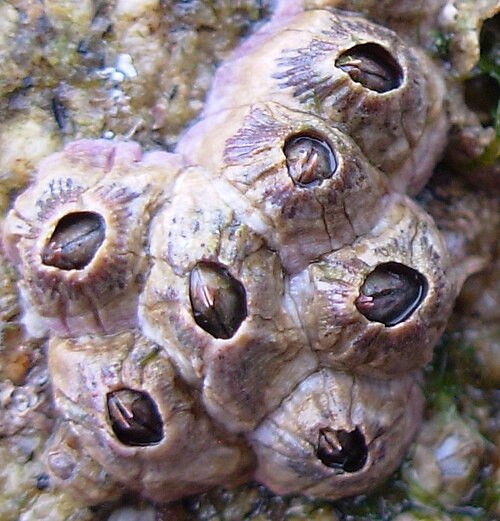
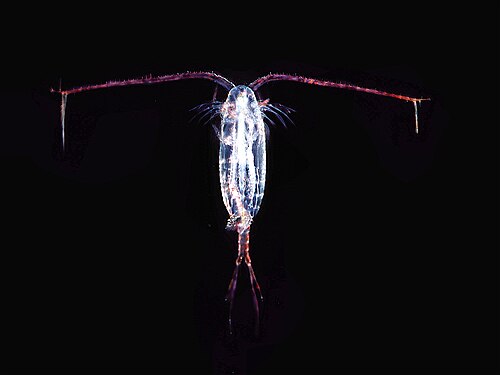
القشريات (من الكلمة اللاتينية "crustacea" التي تعني : "ذوي الأصداف" أو "المغطاة بالقشرة") هي مفصليات الأرجل ذات الفكوك ، وتُصنف تقليديًا ضمن شعيبة القشريات شبه العرقية ( Crstacea ) . وتعيش القشريات في الغالب في الماء ، وتشمل عشريات الأرجل ( الروبيان ، والجمبري ، وسرطان البحر ، وجراد البحر ، وجراد البحر ) ، وروبيان البذور ، وقشريات الأرجل الخيشومية، وقمل السمك ، والكريل ، وقشريات الأرجل الريميبيدية ، وقشريات الأرجل المتساوية ، والبرنقيل ، ومجدافيات الأرجل ، وروبيان الأبوسوم ، والبرمائيات ، وروبيان السرعوف . [ 4 ] من المقبول الآن على نطاق واسع أن سداسيات الأرجل ( الحشرات والقشريات الداخلية الفك ) تُصنف تصنيفياً ضمن القشريات، حيث تم دمج المجموعتين في فرع حيوي أحادي النمط يُعرف باسم بانكروستاسيا . [ 5 ] تُعتبر الطوائف الثلاث سيفالوكاريدا ، وبرانشيبودا ، وريميبيديا أقرب صلةً بسداسيات الأرجل منها بأي قشريات أخرى ( أوليغوستراكان ومتعددة القشريات ). [ 6 ]
تتراوح أحجام الأنواع الموصوفة البالغ عددها 67,000 نوعًا، بدءًا من Stygotantulus stocki الذي يبلغ طوله 0.1 ملم (0.004 بوصة) ، وصولًا إلى سرطان البحر العنكبوتي الياباني الذي يصل طول أرجله إلى 3.8 متر (12.5 قدمًا) وكتلته إلى 20 كيلوغرامًا (44 رطلًا) . ومثل المفصليات الأخرى ، تمتلك القشريات هيكلًا خارجيًا تنسلخ عنه لتنمو . وتتميز عن مجموعات المفصليات الأخرى ، كالحشرات ومتعددات الأرجل والكلابيات ، بامتلاكها أطرافًا ثنائية التفرع، وبأشكالها اليرقية ، مثل طور النوبليوس في القشريات الخيشومية والقشريات المجدافية .
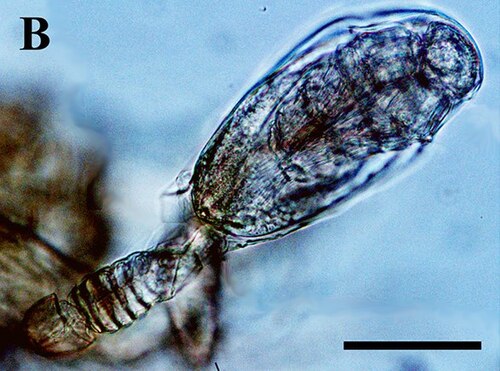
معظم القشريات حيوانات مائية حرة المعيشة ، لكن بعضها بري (مثل قمل الخشب ، وجنادب الرمل )، وبعضها طفيلي (مثل ديدان الرأس الجذري ، وقمل السمك ، وديدان اللسان )، وبعضها ثابت (مثل البرنقيل ). تمتلك هذه المجموعة سجلاً أحفورياً واسعاً ، يعود إلى العصر الكامبري . يُصطاد أكثر من 7.9 مليون طن من القشريات سنوياً عن طريق الصيد أو الاستزراع للاستهلاك البشري ، [ 7 ] ويتكون معظمها من الروبيان والقريدس . لا يُصطاد الكريل ومجدافيات الأرجل على نطاق واسع، لكنهما قد يكونان من أكثر الحيوانات كتلة حيوية على كوكب الأرض، ويشكلان جزءاً حيوياً من السلسلة الغذائية. يُعرف علم دراسة القشريات باسم علم القشريات (أو علم القشريات ، أو علم القشريات ) ، ويُطلق على العالم الذي يعمل في هذا المجال اسم عالم القشريات .
تشريح


يتكون جسم القشريات من حلقات، تُصنف إلى ثلاثة أجزاء: الرأس ( السيفالون )، [ 8 ] والصدر ( البيريون ) ، [ 9 ] والبطن ( البليون ) . [ 10 ] قد يندمج الرأس والصدر معًا لتكوين الرأس الصدري (السيفالوثيراك) ، [ 11 ] والذي قد يُغطى بدرع كبير واحد . [ 12 ] يحمي الهيكل الخارجي الصلب جسم القشريات ، والذي يجب أن ينسلخ ليتمكن الحيوان من النمو. يمكن تقسيم الصدفة المحيطة بكل حلقة إلى ظهرية (التيرجوم) ، وبطنية (القص) ، وجانبية (البلورون). قد تندمج أجزاء مختلفة من الهيكل الخارجي معًا. [ 13 ] : 289
يمكن لكل قطعة جسمية أن تحمل زوجًا من الزوائد : على قطع الرأس، تشمل هذه الزوائد زوجين من قرون الاستشعار ، والفكين السفلي والعلوي ؛ [ 8 ] وتحمل القطع الصدرية أرجلًا ، قد تكون متخصصة كأرجل المشي (بيريوبود) وأرجل التغذية ( ماكسيليبيد ). [ 9 ] تمتلك القشريات من رتبة القشريات العليا (مالاكوستراكا) ورتبة القشريات ذات الأرجل الطويلة (ريميبيديا) (والقشريات سداسية الأرجل) زوائد بطنية. جميع أصناف القشريات الأخرى لها بطن عديم الأطراف، باستثناء الذيل والفروع الذيلية الموجودة في العديد من المجموعات. [ 14 ] [ 15 ] يحمل البطن في القشريات العليا (مالاكوستراكا) أرجلًا بطنية (بليوبود) ، [ 10 ] وينتهي بذيل يحمل فتحة الشرج ، وغالبًا ما يكون محاطًا بأرجل ذيلية لتشكيل مروحة ذيلية . [ 16 ] قد يكون عدد وتنوع الزوائد في القشريات المختلفة مسؤولاً جزئياً عن نجاح هذه المجموعة. [ 17 ]
تتميز زوائد القشريات عادةً بأنها ثنائية التفرع ، أي أنها تنقسم إلى جزأين؛ ويشمل ذلك الزوج الثاني من قرون الاستشعار، ولكن ليس الزوج الأول الذي يكون عادةً أحادي التفرع ، باستثناء فئة القشريات العليا (Malacostraca) حيث قد تكون قرون الاستشعار ثنائية التفرع أو حتى ثلاثية التفرع. [ 18 ] [ 19 ] من غير الواضح ما إذا كانت حالة التفرع الثنائي حالة مشتقة تطورت في القشريات، أو ما إذا كان الفرع الثاني من الطرف قد فُقد في جميع المجموعات الأخرى. على سبيل المثال، امتلكت ثلاثيات الفصوص أيضًا زوائد ثنائية التفرع. [ 20 ]
The main body cavity is an open circulatory system, where blood is pumped into the haemocoel by a heart located near the dorsum.[21] Malacostraca have haemocyanin as the oxygen-carrying pigment, while copepods, ostracods, barnacles and branchiopods have haemoglobins.[22] The alimentary canal consists of a straight tube that often has a gizzard-like "gastric mill" for grinding food and a pair of digestive glands that absorb food; this structure goes in a spiral format.[23] Structures that function as kidneys are located near the antennae. A brain exists in the form of ganglia close to the antennae, and a collection of major ganglia is found below the gut.[24]
In many decapods, the first (and sometimes the second) pair of pleopods are specialised in the male for sperm transfer. Many terrestrial crustaceans (such as the Christmas Island red crab) mate seasonally and return to the sea to release the eggs. Others, such as woodlice, lay their eggs on land, albeit in damp conditions. In most decapods, the females retain the eggs until they hatch into free-swimming larvae.[25]
Ecology

Most crustaceans are aquatic, living in either marine or freshwater environments, but a few groups have adapted to life on land, such as terrestrial crabs, terrestrial hermit crabs, and woodlice. Marine crustaceans are as ubiquitous in the oceans as insects are on land.[26][27] Most crustaceans are also motile, moving about independently, although a few taxonomic units are parasitic and live attached to their hosts (including sea lice, fish lice, whale lice, tongue worms, and Cymothoa exigua, all of which may be referred to as "crustacean lice"), and adult barnacles live a sessile life – they are attached headfirst to the substrate and cannot move independently. Some branchiurans are able to withstand rapid changes of salinity and will also switch hosts from marine to non-marine species.[28]:672Krill are the bottom layer and most important part of the food chain in Antarctic animal communities.[29]:64 Some crustaceans are significant invasive species, such as the Chinese mitten crab, Eriocheir sinensis,[30] and the Asian shore crab, Hemigrapsus sanguineus.[31] Since the opening of the Suez Canal, close to 100 species of crustaceans from the Red Sea and the Indo-Pacific realm have established themselves in the eastern Mediterranean sub-basin, with often significant impact on local ecosystems.[32]
Life cycle

Mating system
Most crustaceans have separate sexes, and reproduce sexually. In fact, a recent study explains how the male T. californicus decide which females to mate with by dietary differences, preferring when the females are algae-fed instead of yeast-fed.[33] A small number are hermaphrodites, including barnacles, remipedes,[34] and Cephalocarida.[35] Some may even change sex during the course of their life.[35]Parthenogenesis is also widespread among crustaceans, where viable eggs are produced by a female without needing fertilisation by a male.[33] This occurs in many branchiopods, some ostracods, some isopods, and certain "higher" crustaceans, such as the Marmorkrebs crayfish.
Eggs
In many crustaceans, the fertilised eggs are released into the water column, while others have developed a number of mechanisms for holding on to the eggs until they are ready to hatch. Most decapods carry the eggs attached to the pleopods, while peracarids, notostracans, anostracans, and many isopods form a brood pouch from the carapace and thoracic limbs.[33] Female Branchiura do not carry eggs in external ovisacs but attach them in rows to rocks and other objects.[36]:788 Most leptostracans and krill carry the eggs between their thoracic limbs; some copepods carry their eggs in special thin-walled sacs, while others have them attached together in long, tangled strings.[33]
Larvae
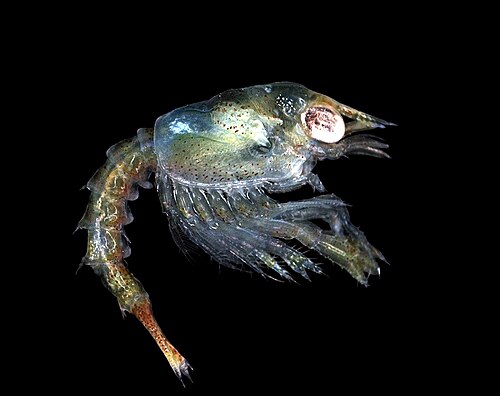
Crustaceans exhibit a number of larval forms, of which the earliest and most characteristic is the nauplius. This has three pairs of appendages, all emerging from the young animal's head, and a single naupliar eye. In most groups, there are further larval stages, including the zoea (pl. zoeæ or zoeas[37]). This name was given to it when naturalists believed it to be a separate species.[38] It follows the nauplius stage and precedes the post-larva. Zoea larvae swim with their thoracic appendages, as opposed to nauplii, which use cephalic appendages, and megalopa, which use abdominal appendages for swimming. It often has spikes on its carapace, which may assist these small organisms in maintaining directional swimming.[39] In many decapods, due to their accelerated development, the zoea is the first larval stage. In some cases, the zoea stage is followed by the mysis stage, and in others, by the megalopa stage, depending on the crustacean group involved.
Providing camouflage against predators, the otherwise black eyes in several forms of swimming larvae are covered by a thin layer of crystalline isoxanthopterin that gives their eyes the same color as the surrounding water, while tiny holes in the layer allow light to reach the retina.[40] As the larvae mature into adults, the layer migrates to a new position behind the retina where it works as a backscattering mirror that increases the intensity of light passing through the eyes, as seen in many nocturnal animals.[41]
DNA repair
In an effort to understand whether DNA repair processes can protect crustaceans against DNA damage, basic research was conducted to elucidate the repair mechanisms used by Penaeus monodon (black tiger shrimp).[42] Repair of DNA double-strand breaks was found to be predominantly carried out by accurate homologous recombinational repair. Another, less accurate process, microhomology-mediated end joining, is also used to repair such breaks. The expression pattern of DNA repair related and DNA damage response genes in the intertidal copepod Tigriopus japonicus was analyzed after ultraviolet irradiation.[43] This study revealed increased expression of proteins associated with the DNA repair processes of non-homologous end joining, homologous recombination, base excision repair and DNA mismatch repair.
Classification and phylogeny
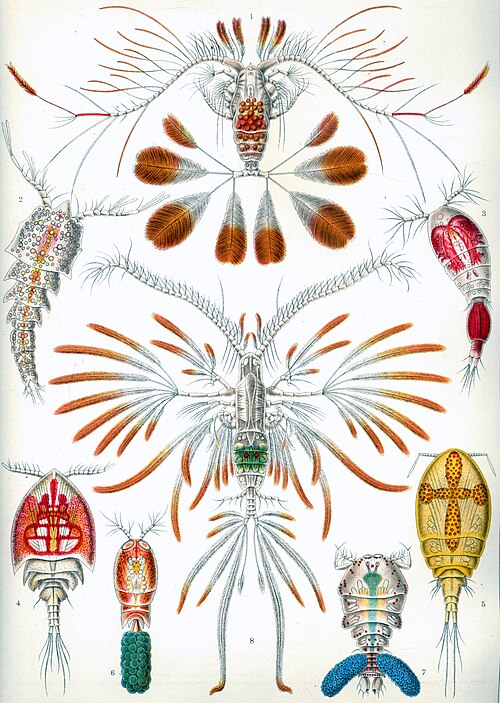
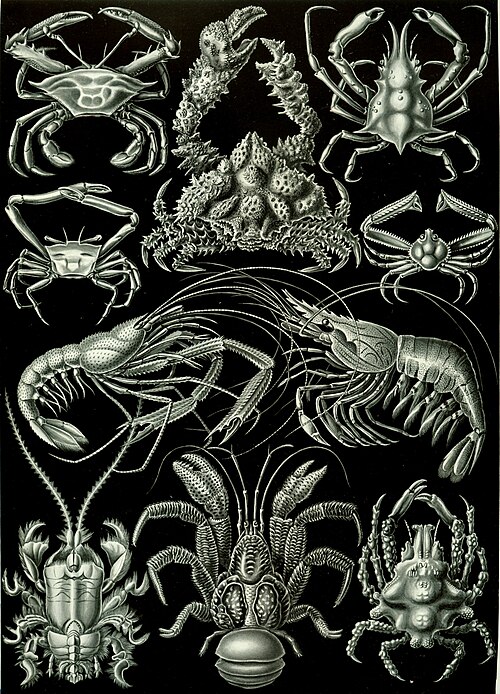
The name "crustacean" dates from the earliest works to describe the animals, including those of Pierre Belon and Guillaume Rondelet, but the name was not used by some later authors, including Carl Linnaeus, who included crustaceans among the "Aptera" in his Systema Naturae.[44] The earliest nomenclatural valid work to use the name "Crustacea" was Morten Thrane Brünnich's Zoologiæ Fundamenta in 1772,[45] although he also included chelicerates in the group.[44]
The subphylum Crustacea comprises almost 67,000 described species,[46] which is thought to be just 1⁄10 to 1⁄100 of the total number as most species remain as yet undiscovered.[47] Although most crustaceans are small, their morphology varies greatly and includes both the largest arthropod in the world – the Japanese spider crab with a leg span of 3.7 metres (12 ft)[48] – and the smallest, the 100-micrometre-long (0.004 in) Stygotantulus stocki.[49] Despite their diversity of form, crustaceans are united by the special larval form known as the nauplius.
The exact relationships of the Crustacea to other taxa are not completely settled as of April 2012. Studies based on morphology led to the Pancrustacea hypothesis,[50] in which Crustacea and Hexapoda (insects and allies) are sister groups. More recent studies using DNA sequences suggest that Crustacea is paraphyletic, with the hexapods nested within a larger Pancrustacea clade.[51][52]
The traditional classification of Crustacea based on morphology recognised four to six classes.[53] Bowman and Abele (1982) recognised 652 extant families and 38 orders, organised into six classes: Branchiopoda, Remipedia, Cephalocarida, Maxillopoda, Ostracoda, and Malacostraca.[53] Martin and Davis (2001) updated this classification, retaining the six classes but including 849 extant families in 42 orders. Despite outlining the evidence that Maxillopoda was non-monophyletic, they retained it as one of the six classes, although did suggest that Maxillipoda could be replaced by elevating its subclasses to classes.[54] Since then phylogenetic studies have confirmed the polyphyly of Maxillopoda and the paraphyletic nature of Crustacea with respect to Hexapoda.[55][56][57][58] Recent classifications recognise ten to twelve classes in Crustacea or Pancrustacea, with several former maxillopod subclasses now recognised as classes (e.g. Thecostraca, Tantulocarida, Mystacocarida, Copepoda, Branchiura and Pentastomida).[59][60]




يوضح المخطط التفرعي التالي العلاقات المحدثة بين المجموعات المختلفة الموجودة من القشريات شبه العرقية فيما يتعلق بفئة سداسيات الأرجل . [ 56 ]
| القشريات | القشريات | |
وفقًا لهذا الرسم التخطيطي، فإن سداسيات الأرجل تقع في عمق شجرة القشريات، وأي من سداسيات الأرجل أقرب بشكل واضح إلى القشريات المتعددة على سبيل المثال من القشريات قليلة القشريات.
السجل الأحفوري

Crustaceans have a rich and extensive fossil record, most of the major groups of crustaceans appear in the fossil record before the end of the Cambrian, namely the Branchiopoda, Maxillopoda (including barnacles and tongue worms) and Malacostraca; there is some debate as to whether or not Cambrian animals assigned to Ostracoda are truly ostracods, which would otherwise start in the Ordovician.[61] The only classes to appear later are the Cephalocarida,[62] which have no fossil record, and the Remipedia, which were first described from the fossil Tesnusocaris goldichi, but do not appear until the Carboniferous.[63] Most of the early crustaceans are rare, but fossil crustaceans become abundant from the Carboniferous period onwards.[64]
Within the Malacostraca, no fossils are known for krill,[65] while both Hoplocarida and Phyllopoda contain important groups that are now extinct as well as extant members (Hoplocarida: mantis shrimp are extant, while Aeschronectida are extinct;[66] Phyllopoda: Canadaspidida are extinct, while Leptostraca are extant).[67]Cumacea and Isopoda are both known from the Carboniferous,[68][69] as are the first true mantis shrimp.[70] In the Decapoda, prawns and polychelids appear in the Triassic,[71][72] and shrimp and crabs appear in the Jurassic.[73][74] The fossil burrow Ophiomorpha is attributed to ghost shrimps, whereas the fossil burrow Camborygma is attributed to crayfishes. The Permian–Triassic deposits of Nurra preserve the oldest (Permian: Roadian) fluvial burrows ascribed to ghost shrimps (Decapoda: Axiidea, Gebiidea) and crayfishes (Decapoda: Astacidea, Parastacidea), respectively.[75]
However, the great radiation of crustaceans occurred in the Cretaceous, particularly in crabs, and may have been driven by the adaptive radiation of their main predators, bony fish.[74] The first true lobsters also appear in the Cretaceous.[76]
Consumption by humans

Many crustaceans are consumed by humans, and nearly 10,700,000 tons were harvested in 2007; the vast majority of this output is of decapod crustaceans: crabs, lobsters, shrimp, crawfish, and prawns.[77] Over 60% by weight of all crustaceans caught for consumption are shrimp and prawns, and nearly 80% is produced in Asia, with China alone producing nearly half the world's total.[77] Non-decapod crustaceans are not widely consumed, with only 118,000 tons of krill being caught,[77] despite krill having one of the greatest biomasses on the planet.[78]
See also
References
- ↑"Crustacea". WoRMS. World Register of Marine Species. 2026. Retrieved 2 March 2026.
- 12Laville, Thomas; Forel, Marie-Béatrice; King, Andrew; Charbonnier, Sylvain (2025-11-01). "Synchrotron X-ray tomography sheds light on the phylogenetic affinities of the enigmatic thylacocephalans within Pancrustacea". Proceedings of the Royal Society B: Biological Sciences. 292 (2058) 20251612. doi:10.1098/rspb.2025.1612. PMC 12606224. PMID 41218778.
- ↑Frederick Schram (1979). "British Carboniferous Malacostraca". Fieldiana Geology. 40.
- ↑Calman, William Thomas (1911). . In Chisholm, Hugh (ed.). Encyclopædia Britannica. Vol. 7 (11th ed.). Cambridge University Press. p. 552.
- ↑Rota-Stabelli, Omar; Kayal, Ehsan; Gleeson, Dianne; et al. (2010). "Ecdysozoan Mitogenomics: Evidence for a Common Origin of the Legged Invertebrates, the Panarthropoda". Genome Biology and Evolution. 2: 425–440. doi:10.1093/gbe/evq030. PMC 2998192. PMID 20624745.
- ↑Koenemann, Stefan; Jenner, Ronald A.; Hoenemann, Mario; Stemme, Torben; von Reumont, Björn M. (March 2010). "Arthropod phylogeny revisited, with a focus on crustacean relationships". Arthropod Structure & Development. 39 (2–3): 88–110. Bibcode:2010ArtSD..39...88K. doi:10.1016/j.asd.2009.10.003. PMID 19854296.
- ↑"The State of World Fisheries and Aquaculture 2018 – Meeting the sustainable development goals"(PDF). fao.org. Rome: Food and Agriculture Organization of the United Nations. 2018.
- 12"Cephalon". Crustacean Glossary. Natural History Museum of Los Angeles County. Archived from the original on 2011-07-27. Retrieved 2016-09-10.
- 12"Thorax". Crustacean Glossary. Natural History Museum of Los Angeles County. Archived from the original on 2011-07-27. Retrieved 2016-09-10.
- 12"Abdomen". Crustacean Glossary. Natural History Museum of Los Angeles County. Archived from the original on 2011-07-27. Retrieved 2016-09-10.
- ↑"Cephalothorax". Crustacean Glossary. Natural History Museum of Los Angeles County. Archived from the original on 2011-07-27. Retrieved 2016-09-10.
- ↑"Carapace". Crustacean Glossary. Natural History Museum of Los Angeles County. Archived from the original on 2011-07-27. Retrieved 2016-09-10.
- ↑P. J. Hayward; J. S. Ryland (1995). Handbook of the marine fauna of north-west Europe. Oxford University Press. ISBN 978-0-19-854055-7. Retrieved 2016-09-10.
- ↑ فريتش، مارتن؛ ريختر، ستيفان (5 سبتمبر 2022). "كيف كان من الممكن أن يعمل تشكيل الجسم في تطور المفصليات - دراسة حالة على ديروشيلوكاريس ريماني (قشريات، قليلات الستراكا)" . مجلة علم الحيوان التجريبي، الجزء ب: التطور الجزيئي والنمائي . 338 (6): 342-359 . Bibcode : 2022JEZB..338..342F . doi : 10.1002/jez.b.23140 . PMID: 35486026. S2CID : 248430846 .
- ↑ "مورفولوجيا الدماغ في Hutchinsoniella macracantha (Cephalocarida, Crustacea)" (PDF) . ص 290.
- ↑ "تيلسون" . معجم القشريات . متحف التاريخ الطبيعي لمقاطعة لوس أنجلوس . مؤرشف من الأصل بتاريخ 27-07-2011 . تم الاطلاع عليه بتاريخ 10-09-2016 .
- ↑ إليزابيث بينيسي (4 يوليو 1997). "أرجل السلطعون ومخالب الكركند". مجلة ساينس . 277 (5322): 36. doi : 10.1126/science.277.5322.36 . S2CID 83148200 .
- ↑ "القرن الاستشعاري" . معجم القشريات . متحف التاريخ الطبيعي لمقاطعة لوس أنجلوس . مؤرشف من الأصل بتاريخ 2013-11-05 . تم الاطلاع عليه بتاريخ 2016-09-10 .
- ↑ "Crustaceamorpha: الزوائد" . جامعة كاليفورنيا، بيركلي . تم الاسترجاع في 10-09-2016 .
- ↑ إن سي هيوز (فبراير 2003). "تقسيم الترايلوبيت وتشكيل الجسم من منظور مورفولوجي ونمائي" . علم الأحياء التكاملي والمقارن . 43 (1): 185-206 . doi : 10.1093/icb/43.1.185 . PMID 21680423 .
- ↑ أكيرا ساكوراي. "الجهاز الدوري المغلق والمفتوح" . جامعة ولاية جورجيا . مؤرشف من الأصل بتاريخ 17 سبتمبر 2016. تم الاطلاع عليه بتاريخ 10 سبتمبر 2016 .
- ↑ كلاوس أوريش (1994). "أصباغ الجهاز التنفسي" . الكيمياء الحيوية المقارنة للحيوانات . سبرينغر . ص 249-287 . ISBN 978-3-540-57420-0.
- ↑H. J. Ceccaldi. Anatomy and physiology of digestive tract of Crustaceans Decapods reared in aquaculture(PDF). AQUACOP, IFREMER. Actes de Colloque 9. pp. 243–259.
- ↑Ghiselin, Michael T. (2005). "Crustacean". Encarta. Microsoft.
- ↑Burkenroad, M. D. (1963). "The evolution of the Eucarida (Crustacea, Eumalacostraca), in relation to the fossil record". Tulane Studies in Geology. 2 (1): 1–17.
- ↑"Crabs, lobsters, prawns and other crustaceans". Australian Museum. January 5, 2010. Retrieved 2016-09-10.
- ↑"Benthic animals". Icelandic Ministry of Fisheries and Agriculture. Archived from the original on 2014-05-11. Retrieved 2016-09-10.
- ↑Alan P. Covich; James H. Thorp (1991). "Crustacea: Introduction and Peracarida". In James H. Thorp; Alan P. Covich (eds.). Ecology and Classification of North American Freshwater Invertebrates (1st ed.). Academic Press. pp. 665–722. ISBN 978-0-12-690645-5. Retrieved 2016-09-10.
- ↑Virtue, P. D.; Nichols, P. D.; Nicols, S. (1997). "Dietary-related mechanisms of survival in Euphasia superba: biochemical changes during long term starvation and bacteria as a possible source of nutrition.". In Bruno Battaglia; Valencia, José; Walton, D. W. H. (eds.). Antarctic communities: species, structure, and survival. Cambridge University Press. ISBN 978-0-521-48033-8. Retrieved 2016-09-10.
- ↑Gollasch, Stephan (October 30, 2006). "Eriocheir sinensis"(PDF). Global Invasive Species Database. Invasive Species Specialist Group. doi:10.15468/ybwd3x. Archived from the original(PDF) on 2017-12-24. Retrieved 2016-09-10.
- ↑John J. McDermott (1999). "The western Pacific brachyuran Hemigrapsus sanguineus (Grapsidae) in its new habitat along the Atlantic coast of the United States: feeding, cheliped morphology and growth". In Schram, Frederick R.; Klein, J. C. von Vaupel (eds.). Crustaceans and the biodiversity crisis: Proceedings of the Fourth International Crustacean Congress, Amsterdam, the Netherlands, July 20–24, 1998. Koninklijke Brill. pp. 425–444. ISBN 978-90-04-11387-9. Retrieved 2016-09-10.
- ↑Galil, Bella; Froglia, Carlo; Noël, Pierre (2002). Briand, Frederic (ed.). CIESM Atlas of Exotic Species in the Mediterranean: Vol 2 Crustaceans. Paris, Monaco: CIESM Publishers. p. 192. ISBN 92-990003-2-8.
- 1234"Crustacean (arthropod)". Encyclopædia Britannica. 5 May 2023.
- ↑G. L. Pesce. "Remipedia Yager, 1981".
- 12D. E. Aiken; V. Tunnicliffe; C. T. Shih; L. D. Delorme. "Crustacean". The Canadian Encyclopedia. Archived from the original on 2011-06-07. Retrieved 2016-09-10.
- ↑Alan P. Covich; James H. Thorp (2001). "Introduction to the Subphylum Crustacea". In James H. Thorp; Alan P. Covich (eds.). Ecology and classification of North American freshwater invertebrates (2nd ed.). Academic Press. pp. 777–798. ISBN 978-0-12-690647-9. Retrieved 2016-09-10.
- ↑"Zoea". Oxford English Dictionary (online ed.). Oxford University Press.(Subscription or participating institution membership required.)
- ↑Calman, William Thomas (1911). . In Chisholm, Hugh (ed.). Encyclopædia Britannica. Vol. 7 (11th ed.). Cambridge University Press. p. 356.
- ↑ دبليو إف آر ويلدون (يوليو 1889). "ملاحظة حول وظيفة أشواك القشريات زوا" (ملف PDF) . مجلة الجمعية البيولوجية البحرية للمملكة المتحدة . 1 (2): 169-172 . رمز Bibcode : 1889JMBUK...1..169W . doi : 10.1017/S0025315400057994 . S2CID 54759780. مؤرشف من الأصل (ملف PDF) بتاريخ 17 يوليو 2011.
- ↑ شافيت، كيشيت؛ فاغنر، أفيتال؛ شيرتيل، لوكاس؛ فارستي، فيفيانا؛ اكيناك، دريا؛ تشانغ، غان. أتشر، الكسندر. ساجي، أمير؛ يالابراجادا، فينكاتا جاياسوريا؛ هاتاجا، يوهانس؛ بالمر ، بنيامين أ. (2023/02/17). "عاكس قابل للضبط يمكّن القشريات من الرؤية ولكن لا يمكن رؤيتها" . علوم . 379 (6633): 695–700 . بيب كود : 2023Sci...379..695S . دوى : 10.1126/science.add4099 . ISSN 0036-8075 . بميد 36795838 .
- ↑ داف، ميغ (16 فبراير 2023). ""بريق عيون الديسكو" يجعل صغار القشريات غير مرئية" . سلات - عبر slate.com.
- ^ سريفاستافا، شيخا؛ داهال، سوميدا؛ نايدو، شارانيا ج.؛ أناند، ديبيكا؛ جوبالاكريشنان، فيديا؛ كولوث فالابيل، راجيندران؛ راغافان ، ساتيس سي. (24 يناير 2017). "إصلاح كسر الحمض النووي المزدوج في Penaeus monodon يعتمد في الغالب على إعادة التركيب المتماثل" . أبحاث الحمض النووي . 24 (2): 117-128 . دوى : 10.1093/dnares/dsw059 . بمك 5397610 . بميد 28431013 .
- ↑ ري، جيه إس؛ كيم، بي إم؛ تشوي، بي إس؛ لي، جيه إس (2012). "تحليل نمط التعبير الجيني للجينات المرتبطة بإصلاح الحمض النووي والاستجابة لتلف الحمض النووي، كما كشف عنه تحليل المصفوفات الدقيقة 55 ألف جينومية عند التعرض للأشعة فوق البنفسجية-ب في مجدافيات الأرجل المدية، Tigriopus japonicus". الكيمياء الحيوية المقارنة وعلم وظائف الأعضاء. علم السموم وعلم الأدوية . 155 (2): 359-368 . doi : 10.1016/j.cbpc.2011.10.005 . PMID 22051804 .
- 1 2 ليبكي ب. هولثويس (1991). "مقدمة" . جراد البحر في العالم . كتالوج أنواع منظمة الأغذية والزراعة، المجلد 13. منظمة الأغذية والزراعة . الصفحات 1-2 . ISBN 978-92-5-103027-1.
- ^ إم تي برونيش (1772). Zoologiæ Fundamenta prælectionibus Academicis الإقامة. Grunde i Dyrelaeren (باللغة اللاتينية والدنماركية). كوبنهاغن ولايبزيغ: فريدريكوس كريستيانوس بيلت. ص 1 – 254.
- ↑ تشي-تشيانغ تشانغ (2011). تشانغ (محرر). "التنوع البيولوجي للحيوانات: مخطط للتصنيف عالي المستوى ومسح للثراء التصنيفي - شعبة مفصليات الأرجل فون سيبولد، 1848" (ملف PDF) . زوتاكسا . 4138 : 99-103 .
- ↑ "القشريات - حشرات البحر" . تي آرا: موسوعة نيوزيلندا . وزارة الثقافة والتراث . تاريخ الاسترجاع: 10 سبتمبر 2016 .
- ↑ "وصول سرطان البحر العنكبوتي الياباني إلى حوض أسماك" . حوض أسماك ساحل أوريغون . مؤرشف من الأصل بتاريخ 23 مارس 2010. تم الاطلاع عليه بتاريخ 10 سبتمبر 2016 .
- ↑ كريغ ر. ماكلين؛ أليسون ج. بوير (22 يونيو 2009). "التنوع البيولوجي وحجم الجسم مرتبطان عبر الحيوانات متعددة الخلايا" . وقائع الجمعية الملكية ب: العلوم البيولوجية . 276 (1665): 2209-2215 . Bibcode : 2009PBioS.276.2209M . doi : 10.1098/rspb.2009.0245 . PMC 2677615. PMID 19324730 .
- ↑ ج. زرزافي؛ ب. شتيس (مايو 1997). "المخطط الأساسي لجسم المفصليات: رؤى من علم التشكل التطوري وعلم الأحياء النمائي" . مجلة علم الأحياء التطوري . 10 (3): 353-367 . doi : 10.1046/j.1420-9101.1997.10030353.x . S2CID 84906139 .
- ↑ جيروم سي. ريغير؛ جيفري دبليو. شولتز؛ أندرياس زويك؛ أبريل هاسي؛ برنارد بول؛ ريجينا ويتزر؛ جويل دبليو. مارتن؛ كليفورد دبليو. كانينغهام (25 فبراير 2010). "علاقات المفصليات التي كشف عنها التحليل الجينومي التطوري لتسلسلات ترميز البروتين النووي". مجلة نيتشر . 463 (7284): 1079-1083 . Bibcode : 2010Natur.463.1079R . doi : 10.1038/nature08742 . PMID: 20147900. S2CID : 4427443 .
- ↑ بيورن م. فون ريومونت؛ رونالد أ. جينر؛ ماثيو أ. ويلز؛ إميليانو ديل أمبيو؛ غونتر باس؛ إنغو إيبرسبيرغر؛ بنجامين ماير؛ ستيفان كوينمان؛ توماس م. إيليف؛ ألكسندروس ستاماتاكيس؛ أوليفر نيهويس؛ كارين ميوزمان؛ برنارد ميسوف (مارس 2012). "علم تطور القشريات في ضوء بيانات علم الجينوم التطوري الجديدة: دعم اعتبار ريميبيديا المجموعة الشقيقة المحتملة لسداسيات الأرجل" . علم الأحياء الجزيئي والتطور . 29 (3): 1031-1045 . doi : 10.1093/molbev/msr270 . PMID 22049065 .
- 1 2 جويل دبليو مارتن؛ جورج إي ديفيس (2001). تصنيف مُحدَّث للقشريات الحديثة (ملف PDF) . متحف التاريخ الطبيعي لمقاطعة لوس أنجلوس . الصفحات 1-132 . مؤرشف من الأصل (ملف PDF) بتاريخ 12 مايو 2013. تم الاطلاع عليه بتاريخ 14 ديسمبر 2009 .
- ↑ هويس، روني (2003). "تصنيف مُحدَّث للقشريات الحديثة" . مراجعة. مجلة بيولوجيا القشريات . 23 (2): 495-497 . Bibcode : 2003JCBio..23..495H . doi : 10.1163/20021975-99990355 .
- ↑ أوكلي، تود هـ.؛ وولف، جوانا م.؛ ليندغرين، آني ر.؛ زاهاروف، ألكسندر ك. (يناير 2013). "علم النسخ الجيني لدمج ما لم يُدرس بشكل كافٍ: الأوستراكودا أحادية النمط، وتحديد موقع الأحافير، وعلم تطور القشريات الشاملة" . علم الأحياء الجزيئي والتطور . 30 (1): 215-233 . doi : 10.1093/molbev/mss216 . PMID 22977117 .
- 1 2 شوينتنر، م؛ كومبوش، د.ج؛ نيلسون، ج.ب؛ جيريبت، ج (2017). "حلٌّ فيلوجيني لأصل الحشرات من خلال تحديد العلاقات بين القشريات وسداسيات الأرجل" . علم الأحياء الحالي . 27 (12): 1818-1824.e5. Bibcode : 2017CBio...27E1818S . doi : 10.1016/j.cub.2017.05.040 . PMID 28602656 .
- ↑Lozano-Fernandez, Jesus; Giacomelli, Mattia; Fleming, James F.; Chen, Albert; Vinther, Jakob; Thomsen, Philip Francis; Glenner, Henrik; Palero, Ferran; Legg, David A.; Iliffe, Thomas M.; Pisani, Davide; Olesen, Jørgen (2019). "Pancrustacean Evolution Illuminated by Taxon-Rich Genomic-Scale Data Sets with an Expanded Remipede Sampling". Genome Biology and Evolution. 11 (8): 2055–2070. doi:10.1093/gbe/evz097. PMC 6684935. PMID 31270537.
- ↑Bernot, James P.; Owen, Christopher L.; Wolfe, Joanna M.; Meland, Kenneth; Olesen, Jørgen; Crandall, Keith A. (2023). "Major Revisions in Pancrustacean Phylogeny and Evidence of Sensitivity to Taxon Sampling". Molecular Biology and Evolution. 40 (8) msad175. doi:10.1093/molbev/msad175. PMC 10414812. PMID 37552897.
- ↑Brusca, Richard C. (2016). Invertebrates (3rd ed.). Sunderland, MA: Sinauer Associates. p. 222. ISBN 978-1-60535-375-3.
- ↑Giribet, G.; Edgecombe, G.D. (2020). The Invertebrate Tree of Life. Princeton University Press. p. 21. ISBN 978-0-6911-7025-1. Retrieved 27 May 2023.
- ↑Olney, Matthew. "Ostracods". An insight into micropalaeontology. University College, London. Retrieved 2016-09-10.
- ↑Hessler, R. R. (1984). "Cephalocarida: living fossil without a fossil record". In N. Eldredge; S. M. Stanley (eds.). Living Fossils. New York: Springer Verlag. pp. 181–186. ISBN 978-3-540-90957-6.
- ↑Koenemann, Stefan; Schram, Frederick R.; Hönemann, Mario; Iliffe, Thomas M. (12 April 2007). "Phylogenetic analysis of Remipedia (Crustacea)". Organisms Diversity & Evolution. 7 (1): 33–51. Bibcode:2007ODivE...7...33K. doi:10.1016/j.ode.2006.07.001.
- ↑"Fossil Record". Fossil Groups: Crustacea. University of Bristol. Archived from the original on 2016-09-07. Retrieved 2016-09-10.
- ↑"Antarctic Prehistory". Australian Antarctic Division. July 29, 2008. Archived from the original on September 30, 2009. Retrieved February 25, 2010.
- ↑Jenner, Ronald A.; Hof, Cees H. J.; Schram, Frederick R. (1998). "Palaeo- and archaeostomatopods (Hoplocarida: Crustacea) from the Bear Gulch Limestone, Mississippian (Namurian), of central Montana". Contributions to Zoology. 67 (3): 155–186. doi:10.1163/18759866-06703001.
- ↑Briggs, Derek (January 23, 1978). "The morphology, mode of life, and affinities of Canadaspis perfecta (Crustacea: Phyllocarida), Middle Cambrian, Burgess Shale, British Columbia". Philosophical Transactions of the Royal Society B. 281 (984): 439–487. Bibcode:1978RSPTB.281..439B. doi:10.1098/rstb.1978.0005.
- ↑Schram, Frederick; Hof, Cees H. J.; Mapes, Royal H. & Snowdon, Polly (2003). "Paleozoic cumaceans (Crustacea, Malacostraca, Peracarida) from North America". Contributions to Zoology. 72 (1): 1–16. doi:10.1163/18759866-07201001.
- ↑Schram, Frederick R. (August 28, 1970). "Isopod from the Pennsylvanian of Illinois". Science. 169 (3948): 854–855. Bibcode:1970Sci...169..854S. doi:10.1126/science.169.3948.854. PMID 5432581. S2CID 31851291.
- ↑Hof, Cees H. J. (1998). "Fossil stomatopods (Crustacea: Malacostraca) and their phylogenetic impact". Journal of Natural History. 32 (10 & 11): 1567–1576. Bibcode:1998JNatH..32.1567H. doi:10.1080/00222939800771101.
- ↑Crean, Robert P. D. (November 14, 2004). "Dendrobranchiata". Order Decapoda. University of Bristol. Archived from the original on February 29, 2012. Retrieved February 25, 2010.
- ↑Karasawa, Hiroaki; Takahashi, Fumio; Doi, Eiji; Ishida, Hideo (2003). "First notice of the family Coleiidae Van Straelen (Crustacea: Decapoda: Eryonoides) from the upper Triassic of Japan". Paleontological Research. 7 (4): 357–362. Bibcode:2003PalRe...7..357K. doi:10.2517/prpsj.7.357. S2CID 129330859.
- ↑Chace, Fenner A. Jr.; Manning, Raymond B. (1972). "Two new caridean shrimps, one representing a new family, from marine pools on Ascension Island (Crustacea: Decapoda: Natantia)". Smithsonian Contributions to Zoology. 131 (131): 1–18. doi:10.5479/si.00810282.131. S2CID 53067015.
- 12Wägele, J. W. (December 1989). "On the influence of fishes on the evolution of benthic crustaceans". Zeitschrift für Zoologische Systematik und Evolutionsforschung. 27 (4): 297–309. doi:10.1111/j.1439-0469.1989.tb00352.x.
- ↑Baucon, A.; Ronchi, A.; Felletti, F.; Neto de Carvalho, C. (2014). "Evolution of Crustaceans at the edge of the end-Permian crisis: ichnonetwork analysis of the fluvial succession of Nurra (Permian-Triassic, Sardinia, Italy)". Palaeogeography, Palaeoclimatology, Palaeoecology. 410: 74. Bibcode:2014PPP...410...74B. doi:10.1016/j.palaeo.2014.05.034. Archived from the original on July 6, 2022. Retrieved May 19, 2022.
- ↑Tshudy, Dale; Donaldson, W. Steven; Collom, Christopher; et al. (2005). "Hoploparia albertaensis, a new species of clawed lobster (Nephropidae) from the Late Coniacean, shallow-marine Bad Heart Formation of northwestern Alberta, Canada". Journal of Paleontology. 79 (5): 961–968. doi:10.1666/0022-3360(2005)079[0961:HAANSO]2.0.CO;2. S2CID 131067067.
- 123"FIGIS: Global Production Statistics 1950–2007". Food and Agriculture Organization. Retrieved 2016-09-10.
- ↑Nicol, Steven; Endo, Yoshinari (1997). Krill Fisheries of the World. Fisheries Technical Paper. Vol. 367. Food and Agriculture Organization. ISBN 978-92-5-104012-6.
Sources
- Schram, Frederick (1986). Crustaceans. Oxford University Press. ISBN 978-0-19-503742-5.
- Powers, Matthew J.; Hill, Geoffrey E.; Weaver, Ryan J. (March 2020). Goymann, Wolfgang (ed.). "An experimental test of mate choice for red carotenoid coloration in the marine copepod Tigriopus californicus". Ethology. 126 (3): 344–352. Bibcode:2020Ethol.126..344P. doi:10.1111/eth.12976. ISSN 0179-1613. An experimental test of mate choice for red carotenoid coloration in the marine copepod Tigriopus californicus]
External links
 Texts on Wikisource:
 - "Encyclopedia Americana - Wikipedia". Encyclopedia Americana. Vol. 8. 1920.
- Clark, Hubert Lyman; Ingersoll, Ernest (1905). "Crustacea". New International Encyclopedia. Vol. 5.
- Crustacea.net, an online resource on the biology of crustaceans
- CrustaceaArchived October 9, 2007, at the Wayback Machine: Natural History Museum of Los Angeles County
- Crustacea: Tree of Life Web Project
- The Crustacean SocietyArchived 2011-11-10 at the Wayback Machine
- Natural History Collections: Crustacea: University of Edinburgh
- Crustaceans (Crustacea) on the shore of Singapore
- Crustacea(crabs, lobsters, shrimps, prawns, barnacles)Archived 2012-01-11 at the Wayback Machine: Biodiversity Explorer
- Crustaceans
- Cambrian Series 2 first appearances
- Extant Cambrian first appearances
- Paraphyletic groups
- Pancrustacea