
التشكل الداخلي
في الجبر المجرد ، يُعرف التشاكل الداخلي بأنه تماثل من كائن رياضي إلى نفسه. [ 1 ] وبشكل أعم في نظرية الفئات ، يُعرف التشاكل الداخلي بأنه تماثل من كائن في فئة ما إلى نفسه. [ 2 ] ويُسمى التشاكل الداخلي الذي يكون أيضًا تماثلًا ذاتيًا بالتشاكل الذاتي . على سبيل المثال، التشاكل الداخلي للفضاء المتجهي V هو تطبيق خطي f: V → V، والتشاكل الداخلي للمجموعة G هو تماثل المجموعة f: G → G.
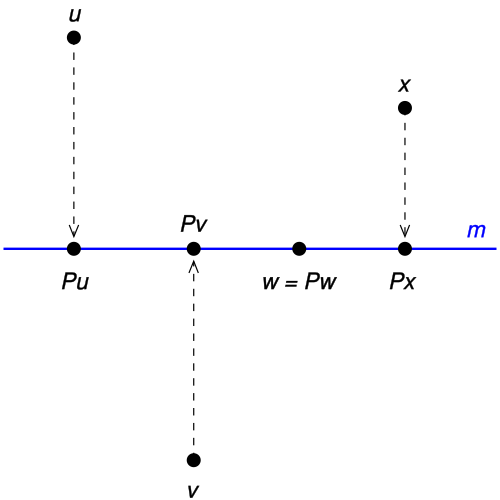
بشكل عام، يمكننا الحديث عن التشاكلات الداخلية في أي فئة . في فئة المجموعات ، التشاكلات الداخلية هي دوال من مجموعة S إلى نفسها.
في أي فئة، يكون تركيب أي اثنين من التشاكلات الداخلية لـ X تشاكلاً داخلياً لـ X مرة أخرى . ويترتب على ذلك أن مجموعة جميع التشاكلات الداخلية لـ X تشكل شبه زمرة ، وهي شبه الزمرة التحويلية الكاملة ، ويرمز لها بـ End ( X ) (أو EndC ( X ) للتأكيد على الفئة C ).
التماثل الذاتي
يُطلق على التشاكل الداخلي القابل للعكس لـ X اسم التشاكل الذاتي . مجموعة جميع التشاكلات الذاتية هي مجموعة جزئية من End( X ) ذات بنية زمرة ، تُسمى زمرة التشاكلات الذاتية لـ X ويُرمز لها بـ Aut( X ) . في الرسم التوضيحي التالي، تشير الأسهم إلى الاستلزام.
| التماثل الذاتي | ⇒ | التماثل |
| ⇓ | ⇓ | |
| التشكل الداخلي | ⇒ | (التماثل) |
حلقات التشكل الداخلي
يمكن جمع أي دالتين داخليتين من زمرة أبيلية A باستخدام القاعدة ( f + g )( a ) = f ( a ) + g ( a ) . وبموجب هذه القاعدة، ومع تعريف الضرب على أنه تركيب للدوال، تُشكل الدوال الداخلية للزمرة الأبيلية حلقة ( حلقة الدوال الداخلية ). على سبيل المثال، مجموعة الدوال الداخلية لـ is the ring of all n × nmatrices with integer entries. The endomorphisms of a vector space or module also form a ring, as do the endomorphisms of any object in a preadditive category. The endomorphisms of a nonabelian group generate an algebraic structure known as a near-ring. Every ring with one is the endomorphism ring of its regular module, and so is a subring of an endomorphism ring of an abelian group;[3] however there are rings that are not the endomorphism ring of any abelian group.

Operator theory
In any concrete category, especially for vector spaces, endomorphisms are maps from a set into itself, and may be interpreted as unary operators on that set, acting on the elements, and allowing the notion of element orbits to be defined, etc.
Depending on the additional structure defined for the category at hand (topology, metric, ...), such operators can have properties like continuity, boundedness, and so on. More details should be found in the article about operator theory.
Endofunctions
An endofunction is a function whose domain is equal to its codomain. A homomorphic endofunction is an endomorphism.
Let S be an arbitrary set. Among endofunctions on S one finds permutations of S and constant functions associating to every x in S the same element c in S. Every permutation of S has the codomain equal to its domain and is bijective and invertible. If S has more than one element, a constant function on S has an image that is a proper subset of its codomain, and thus is not bijective (and hence not invertible). The function associating to each natural numbern the floor of n/2 has its image equal to its codomain and is not invertible.
Finite endofunctions are equivalent to directed pseudoforests. For sets of size n there are nn endofunctions on the set.
Particular examples of bijective endofunctions are the involutions; i.e., the functions coinciding with their inverses.
See also
- التشكل الداخلي المرافق
- التشاكل الشامل (التشاكل الشمولي)
- التماثل الداخلي لفروبينيوس
- التماثل الأحادي (التماثل الحقني)
ملحوظات
مراجع
- جاكوبسون، ناثان (2009)، الجبر الأساسي ، المجلد 1 ( الطبعة الثانية)، دوفر، ISBN 978-0-486-47189-1
روابط خارجية
- "التشكل الداخلي" ، موسوعة الرياضيات ، دار نشر EMS، 2001 [1994]
- المورفيزمات