
Meromorphic function
In the mathematical field of complex analysis, a meromorphic function on an open subset of the complex plane is a function that is holomorphic on all of except for a set of isolated points, which are poles of the function.[1] The term comes from the Greekmeros (μέρος), meaning 'part'.[a]

Every meromorphic function on can be expressed as the ratio between two holomorphic functions (with the denominator not constant 0) defined on : any pole must coincide with a zero of the denominator.
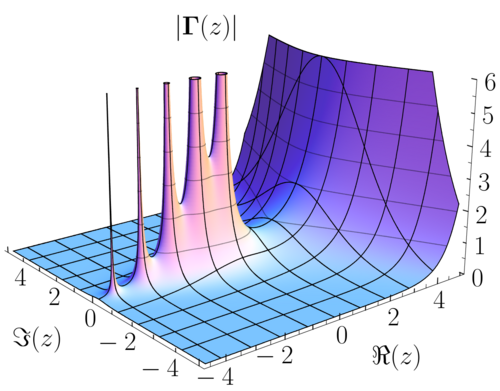
Heuristic description
Intuitively, a meromorphic function is a ratio of two well-behaved (holomorphic) functions. Such a function will still be well-behaved, except possibly at the points where the denominator of the fraction is zero. If the denominator has a zero at and the numerator does not, then the value of the function will approach infinity; if both parts have a zero at , then one must compare the multiplicity of these zeros.

From an algebraic point of view, if the function's domain is connected, then the set of meromorphic functions is the field of fractions of the integral domain of the set of holomorphic functions. This is analogous to the relationship between the rational numbers and the integers.
Terminology
The terms holomorphic and meromorphic were introduced in 1875 by Charles Briot and Jean-Claude Bouquet, two of Augustin-Louis Cauchy's students. Holomorphic derives from the Greek ὅλος (hólos) meaning "whole", and μορφή (morphḗ) meaning "form" or "appearance" or "type", while meromorphic derives from μέρος (méros) meaning "part". A holomorphic function resembles an entire function ("whole") in a domain of the complex plane while a meromorphic function, resembles a rational fraction ("part") of entire functions in a domain of the complex plane.[2]
In the 1930s, in group theory, the term meromorphic function (or meromorph) was used in a different sense: it meant a function from a group into itself that preserved the group operation.[3] This language is obsolete, and the term endomorphism is now used for such a function.
Properties
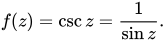
Since poles are isolated, there are at most countably many for a meromorphic function.[4] The set of poles can be infinite, as exemplified by the function
By using analytic continuation to eliminate removable singularities, meromorphic functions can be added, subtracted, multiplied, and the quotient can be formed unless on a connected component of D. Thus, if D is connected, the meromorphic functions form a field, in fact a field extension of the complex numbers.


Higher dimensions
In several complex variables, a meromorphic function is defined to be locally a quotient of two holomorphic functions. For example, is a meromorphic function on the two-dimensional complex affine space. Here it is no longer true that every meromorphic function can be regarded as a holomorphic function with values in the Riemann sphere: There is a set of "indeterminacy" of codimension two (in the given example this set consists of the origin ).


Unlike in dimension one, in higher dimensions there do exist compact complex manifolds on which there are no non-constant meromorphic functions, for example, most complex tori.
Examples
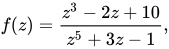
- All rational functions,[4] for example are meromorphic on the whole complex plane. Furthermore, they are the only meromorphic functions on the extended complex plane.
- The functions as well as the gamma function and the Riemann zeta function are meromorphic on the whole complex plane.[4]
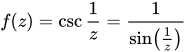
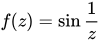
- The function is defined in the whole complex plane except for the origin, 0. However, 0 is not a pole of this function, rather an essential singularity. Thus, this function is not meromorphic in the whole complex plane. However, it is meromorphic (even holomorphic) on .
- The complex logarithm function ليست ميرومورفية على كامل المستوى المركب، إذ لا يمكن تعريفها على كامل المستوى المركب مع استبعاد مجموعة من النقاط المعزولة فقط. [ 4 ]
- الوظيفةليست ميرومورفية في المستوى بأكمله، لأن النقطة[ 4 ] هي نقطة تراكم للأقطاب، وبالتالي فهي ليست نقطة تفرد معزولة .
- الوظيفةكما أنها ليست ميرومورفية، حيث أن لها نقطة تفرد أساسية عند 0.




على أسطح ريمان
على سطح ريمان ، تقبل كل نقطة جوارًا مفتوحًا يكون ثنائي الشكل مع مجموعة جزئية مفتوحة من المستوى العقدي. وبذلك، يمكن تعريف مفهوم الدالة الميرومورفية لكل سطح ريمان.
عندما تكون D هي كرة ريمان بأكملها ، فإن حقل الدوال الميرومورفية هو ببساطة حقل الدوال الكسرية في متغير واحد على الحقل المركب، إذ يمكن إثبات أن أي دالة ميرومورفية على الكرة هي دالة كسرية. (هذه حالة خاصة مما يُسمى بمبدأ GAGA ).
لكل سطح ريمان ، تكون الدالة الميرومورفية هي نفسها الدالة الهولومورفية التي تُسقط على كرة ريمان والتي ليست دالة ثابتة تساوي ∞. وتتوافق الأقطاب مع تلك الأعداد المركبة التي تُسقط على ∞.
على سطح ريمان غير متراص ، يمكن تمثيل كل دالة ميرومورفية كحاصل قسمة دالتين هولومورفيتين (معرفتين عالميًا). في المقابل، على سطح ريمان متراص، تكون كل دالة هولومورفية ثابتة، بينما توجد دائمًا دوال ميرومورفية غير ثابتة.
انظر أيضاً
الحواشي
مراجع
- ↑ هازوينكل، ميشيل ، محرر. (2001) [1994]. "الدالة الميرومورفية" . موسوعة الرياضيات . سبرينغر ساينس + بيزنس ميديا بي في؛ كلوير أكاديميك بابليشرز. ISBN 978-1-55608-010-4.
- ↑ المصطلحات الفرنسية الأصلية هي holomorphe و méromorphe .Briot, Charles Auguste; Bouquet, Jean-Claude (1875). "§15 fonctions holomorphes". Théorie des fonctions elliptiques (2nd ed.). Gauthier-Villars. pp. 14–15.
Lorsqu'une fonction est continue, monotrope, et a une dérivée, quand la variable se meut dans une certaine partie du plan, nous dirons qu'elle est holomorphe dans cette partie du plan. Nous indiquons par cette dénomination qu'elle est semblable aux fonctions entières qui jouissent de ces propriétés dans toute l'étendue du plan. [...] ¶ Une fraction rationnelle admet comme pôles les racines du dénominateur; c'est une fonction holomorphe dans toute partie du plan qui ne contient aucun de ses pôles. ¶ Lorsqu'une fonction est holomorphe dans une partie du plan, excepté en certains pôles, nous dirons qu'elle est méromorphe dans cette partie du plan, c'est-à-dire semblable aux fractions rationnelles.
[When a function is continuous, monotropic, and has a derivative, when the variable moves in a certain part of the [complex] plane, we say that it is holomorphic in that part of the plane. We mean by this name that it resembles entire functions which enjoy these properties in the full extent of the plane. [...] ¶ A rational fraction admits as poles the roots of the denominator; it is a holomorphic function in all that part of the plane which does not contain any poles. ¶ When a function is holomorphic in part of the plane, except at certain poles, we say that it is meromorphic in that part of the plane, that is to say it resembles rational fractions.]Harkness, James; Morley, Frank (1893). "5. Integration". A Treatise on the Theory of Functions. Macmillan. p. 161. - ↑Zassenhaus, Hans (1937). Lehrbuch der Gruppentheorie (1st ed.). Leipzig; Berlin: B. G. Teubner Verlag. pp. 29, 41.
- 12345Lang, Serge (1999). Complex analysis (4th ed.). Berlin; New York: Springer-Verlag. ISBN 978-0-387-98592-3.
- Meromorphic functions