
فيتيس
العنب ( Vitis ) جنس نباتي يضم حوالي 80 نوعًا من النباتات المتسلقة التابعة للفصيلة العنبية (Vitaceae) . وتنتشر أنواع هذا الجنس بشكل رئيسي في نصف الكرة الشمالي. ويكتسب العنب أهمية اقتصادية كبيرة كمصدر للعنب، سواء للاستهلاك المباشر للثمار أو للتخمير لإنتاج النبيذ. ويُطلق على دراسة وزراعة كروم العنب اسم زراعة الكروم .
تُلقّح معظم أصناف العنب المزروعة بواسطة الرياح، وتتميز أزهارها بأنها خنثى، إذ تحتوي على أعضاء التكاثر الذكرية والأنثوية، بينما تكون الأنواع البرية ثنائية الجنس. تتجمع هذه الأزهار في عناقيد تُسمى النورات . في العديد من الأنواع، مثل العنب الأوروبي (Vitis vinifera )، تتحول كل زهرة مُلقّحة بنجاح إلى حبة عنب، وتتحول النورة إلى عنقود عنب. على الرغم من أن أزهار كروم العنب عادةً ما تكون صغيرة جدًا، إلا أن ثمار العنب غالبًا ما تكون كبيرة الحجم وذات ألوان زاهية ونكهة حلوة تجذب الطيور والحيوانات الأخرى لنشر البذور الموجودة داخلها. [ 5 ]
تُنتج كروم العنب عادةً ثمارًا على الأفرع التي نمت من البراعم التي تشكلت خلال موسم النمو السابق . في زراعة الكروم، يُعدّ هذا أحد المبادئ الأساسية لتقليم نمو العام السابق (أو "خشب العام الماضي")، والذي يشمل الأفرع التي أصبحت صلبة وخشبية خلال فصل الشتاء (بعد الحصاد في زراعة الكروم التجارية). تُقلم هذه الكروم إما لتشكيل ساق رئيسية تحمل من 8 إلى 15 برعمًا، أو لتشكيل فرع أصغر يحمل من 2 إلى 3 براعم. [ 5 ]
وصف

في البرية، تكون جميع أنواع العنب ثنائية المسكن عادةً ، ولكن في ظل الاستئناس، يبدو أنه تم اختيار أنواع ذات أزهار كاملة . تتشكل براعم الزهور في أواخر موسم النمو وتظل خلال فصل الشتاء لتزهر في ربيع العام التالي. وتنتج هذه البراعم نورة عنقودية متقابلة الأوراق . يتميز العنب عن الأجناس الأخرى في عائلة العنبية (Vitaceae) بتلاته، التي تبقى متصلة عند الطرف وتنفصل عن القاعدة لتسقط معًا على شكل غطاء أو "قلنسوة". الأزهار خماسية الأجزاء . الكأس صغير جدًا أو معدوم في معظم الأنواع. الثمرة عنبية من الناحية النباتية، بيضاوية الشكل وغنية بالعصارة، تحتوي على مبيض ثنائي الخلايا، كل خلية منها تحتوي على بويضتين، وبالتالي تنتج عادةً أربع بذور لكل زهرة (أو أقل بسبب الأجنة المجهضة). [ 6 ]
وتشمل الأجزاء الأخرى من الكرمة المحاليق التي تكون متقابلة مع الأوراق، ومتفرعة في نبات العنب الأوروبي (Vitis vinifera )، وتدعم النبات المتسلق عن طريق الالتفاف حول الهياكل المحيطة مثل الفروع أو تعريشة نظام تدريب الكرمة .
ينقسم جنس العنب (Vitis) إلى جنسين فرعيين: Euvitis Planch. ، الذي يحتوي على 38 كروموسومًا (n=19) وثماره محمولة على عناقيد [ 7 ]، و Muscadinia Planch.، الذي يحتوي على 40 كروموسومًا (n=20) وثماره محمولة على عناقيد صغيرة [ 8 ] [ 9 ] .
يمكن أن تشبه العنب البري نبات Menispermum canadense (بذور القمر) ذو البذرة الواحدة ، وهو نبات سام. [ 10 ]
صِنف
توجد معظم أنواع العنب في المناطق المعتدلة من نصف الكرة الشمالي، وتحديداً في أمريكا الشمالية وشرق آسيا، باستثناء بعض الأنواع التي تنمو في المناطق الاستوائية، وعنب النبيذ ( Vitis vinifera) الذي نشأ في جنوب أوروبا وجنوب غرب آسيا. وتنتشر أنواع العنب في مناطق جغرافية متباينة، وتتميز بتنوع كبير في أشكالها.
يُصعّب نموّها عملية جمع الأوراق، كما تُصعّب أشكالها المتعددة عملية تحديد أنواعها. يمكن أن يصل قطر كروم العنب الناضجة إلى 48 سنتيمترًا (19 بوصة) ، وأن تصل إلى قمة الأشجار التي يزيد ارتفاعها عن 35 مترًا (115 قدمًا) . [ 11 ]
تتشابه العديد من الأنواع في صلتها الوثيقة بما يكفي لتسهيل التزاوج بينها، وتكون الهجائن الناتجة بين الأنواع خصبة وقوية النمو دائمًا. لذا، فإن مفهوم النوع أقل تحديدًا، ويرجح أنه يمثل تحديد أنماط بيئية مختلفة من العنب تطورت في ظروف جغرافية وبيئية متباينة.
لا يُعرف العدد الدقيق للأنواع. تشير موسوعة نباتات العالم على الإنترنت إلى قبول 80 نوعًا وثلاثة أنواع هجينة. [ 2 ] أكثر من 65 نوعًا في آسيا غير محددة بدقة. [ 12 ] يُعرف حوالي 25 نوعًا في أمريكا الشمالية ، وقد دُرست هذه الأنواع على نطاق واسع في أواخر القرن التاسع عشر من قِبل عالم النبات الألماني الأمريكي جورج إنجلمان . [ 13 ] في المقابل، نوع واحد فقط، وهو V. vinifera، له أصول أوراسية . [ 14 ]
اعتبارًا من ديسمبر 2025 يقبل موقع Plants of the World Online الأنواع الـ 83 التالية: [ 2 ]
- Vitis acerifolia Raf.
- Vitis aestivalis Michx.
- Vitis amoena Z.H.Chen، Feng Chen & WYXie
- Vitis amurensis Rupr.
- Vitis arizonica Engelm.
- Vitis baihuashanensis M.S.Kang & DZLu
- وضعية فيتيس بالانسانا بلانش .
- Vitis bashanica P.C.He
- Vitis bellula (Rehder) WTWang
- Vitis berlandieri Planch.
- كرمة بيتوليفوليا ديلز وجيلج
- وردة فيتيس بيفورميس
- Vitis blancoi Munson
- Vitis bloodworthiana Comeaux
- Vitis bourgaeana Planch.
- Vitis bryoniifolia Bunge
- Vitis californica Benth.
- Vitis × champinii Planch.
- Vitis chunganensis Hu
- Vitis chungii F.P.Metcalf
- Vitis cinerea (Engelm.) ميلارديت
- Vitis coignetiae Pulliat ex Planch.
- Vitis davidii (Rom.Caill.) Foëx
- Vitis × doaniana Munson ex Viala
- Vitis erythrophylla W.T.Wang
- Vitis fengqinensis C.L.Li
- Vitis ficifolia Bunge
- كرمة فلافيكوستا ميكل وبيتل
- Vitis flexuosa Thunb.
- فيتيس جيرديانا مونسون
- Vitis hancockii Hance
- Vitis heyneana Schult.
- Vitis hissarica Vassilcz.
- Vitis hui W.C.Cheng
- فيتيس جاجيريانا كومو
- Vitis jinggangensis W.T.Wang
- Vitis jinzhainensis X.S.Shen
- Vitis kaihuaica Z.H.Chen، Feng Chen & WYXie
- Vitis kiusiana Momiy.
- Vitis labrusca L.
- Vitis lanceolatifoliosa C.L.Li
- Vitis longquanensis P.L.Chiu
- Vitis luochengensis W.T.Wang
- Vitis menghaiensis C.L.Li
- Vitis mengziensis C.L.Li
- فيتيس مونتيكولا باكلي
- Vitis mustangensis Buckley
- فيتيس نيسبيتيانا كومو
- الكرمة × المستعرات الإنجليزية فيرنالد
- كرمة novogranatensis مولدينكي
- Vitis nuristanica Vassilcz.
- Vitis palmata Vahl
- Vitis pedicellata M.A.Lawson
- Vitis peninsularis M.E.Jones
- Vitis piasezkii Maxim.
- التهاب الكرمة الشعرية عن طريق F.P.Metcalf
- Vitis popenoei J.L.Fennell
- التهاب الكرمة الكاذبة W.T.Wang
- Vitis qinlingensis P.C.He
- Vitis retordii Rom.Caill. ex Planch.
- Vitis riparia Michx.
- Vitis romanetii Rom.Caill.
- Vitis rotundifoliaMichx.
- Vitis rupestrisScheele
- Vitis ruyuanensisC.L.Li
- Vitis sacchariferaMakino
- Vitis shenxiensisC.L.Li
- Vitis shizishanensisZ.Y.Ma, J.Wen, Q.Fu & X.Q.Liu
- Vitis shuttleworthiiHouse
- Vitis silvestriiPamp.
- Vitis sinocinereaW.T.Wang
- Vitis sinoternataW.T.Wang
- Vitis tiliifoliaHumb. & Bonpl. ex Schult.
- Vitis tsoiMerr.
- Vitis viniferaL.
- Vitis vulpinaL.
- Vitis wenchowensisC.Ling
- Vitis wenxianensisW.T.Wang
- Vitis wilsoniaeH.J.Veitch
- Vitis wuhanensisC.L.Li
- Vitis xunyangensisP.C.He
- Vitis yunnanensisC.L.Li
- Vitis zhejiang-adstrictaP.L.Chiu
There are many cultivars of grapevines; most are cultivars of V. vinifera, including Vitis 'Ornamental Grape'.
Hybrid grapes also exist, and these are primarily crosses between V. vinifera and one or more of V. labrusca, V. riparia or V. aestivalis. Hybrids tend to be less susceptible to frost and disease (notably phylloxera), but wine from some hybrids may have a little of the characteristic "foxy" taste of V. labrusca.
The Latin word Vitis is feminine,[15] and therefore adjectival species names take feminine forms, such as V. vinifera.[16][a]
Ecology

Phylloxera is an American root aphid that devastated V. vinifera vineyards in Europe when accidentally introduced in the late 19th century.[13] Attempts were made to breed in resistance from American species, but many winemakers and customers did not like the unusual flavour profile of the hybrid vines. However, V. vinifera grafts readily onto rootstocks of the American species and their hybrids with V. vinifera, and most commercial production of grapes now relies on such grafts.
The black vine weevil is another root pest.
Grapevines are used as food plants by the larvae of some Lepidoptera species.
Commercial distribution


According to the UN's Food and Agriculture Organization (FAO), 75,866 square kilometres (29,292 sq mi) of the world is dedicated to grapes. Approximately 71% of world grape production is used for wine, 27% as fresh fruit, and 2% as dried fruit. A portion of grape production goes to producing grape juice to be used as a sweetener for fruits canned "with no added sugar" and "100% natural". The area dedicated to vineyards is increasing by about 2% per year.
The following list of top wine-producers shows the corresponding areas dedicated to grapes (regardless of the grapes' final destination):[18]
| Country | Area under vine (ha×103) | Grape production (metric ton×106) |
|---|---|---|
| World | 7511 | 75.7 |
 Spain Spain | 1021 | 6.0 |
 China China | 830 | 12.6 |
 France France | 786 | 6.3 |
 Italy Italy | 682 | 8.2 |
 Turkey Turkey | 497 | 3.6 |
 United States United States | 419 | 7.0 |
 Argentina Argentina | 225 | 2.4 |
 Iran Iran | 223 | 2.1 |
 Portugal Portugal | 217 | |
 Chile Chile | 211 | 3.1 |
 Romania Romania | 192 | |
 Australia Australia | 149 | 1.7 |
 Moldova Moldova | 140 | |
 South Africa South Africa | 130 | 2.0 |
 India India | 120 | 2.6 |
 Brazil Brazil | 85 | 1.5 |
 Bulgaria Bulgaria | 60 | |
 New Zealand New Zealand | 39 |
Domestic cultivation
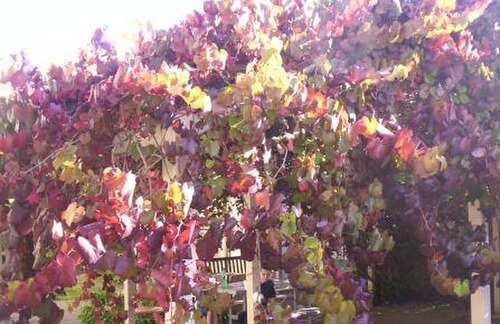
Grapevines are widely cultivated by gardeners, and numerous suppliers cater specifically for this trade. The plants are valued for their decorative foliage, often colouring brightly in autumn; their ability to clothe walls, pergolas and arches, thus providing shade; and their fruits, which may be eaten as dessert or provide the basis for homemade wines. Popular varieties include:-
- 'Buckland Sweetwater' (white dessert)
- 'Chardonnay' (white wine)
- 'Foster's Seedling' (white dessert)
- 'Grenache' (red wine)
- 'Muscat of Alexandria' (white dessert)
- 'Müller-Thurgau' (white wine)
- 'Phoenix' (white wine)
- 'Pinot noir' (red wine)
- 'Regent' (red wine)
- 'Schiava Grossa' (red dessert)
- 'Seyval blanc' (white wine)[19]
- 'Tempranillo' (red wine)
The following varieties have gained the Royal Horticultural Society's Award of Garden Merit:-[20]
Uses
The fruit of several Vitis species are grown commercially for consumption as fresh grapes and for fermentation into wine.[26]Vitis vinifera is the most important such species.[27]
The leaves of several species of grapevine are edible and are used in the production of dolmades and sometimes used in as a substitute for Vietnamese lốt leaves.[28]
Culture
Ancient Greece
The grapevine (typically Vitis vinifera) has been used as a symbol since ancient times. In Greek mythology, Dionysus (called Bacchus by the Ancient Romans) was god of the vintage and, therefore, a grapevine with bunches of the fruit are among his attributes. His attendants at the Bacchanalian festivals hence had the vine as an attribute. For the same reason, the Greek wine cup (cantharos) is commonly decorated with the vine and grapes, wine being drunk as a libation to the god.
Ancient Israel and Judaism

The grapevine has held profound symbolic significance in Jewish tradition and culture since antiquity.[29] It is referenced 55 times in the Hebrew Bible (Old Testament), along with grapes and wine, which are also frequently mentioned (55 and 19, respectively).[30] It is regarded as one of the Seven Species the land of Israel was blessed with,[30][31] and is employed several times in the Bible as a symbol of the Israelites as the chosen people. Along with the fig tree, the grapevine appears in biblical passages as a symbol of peace, stability, and prosperity.[31]
The grapevine has a prominent place in Jewish rituals: the wine was given a special blessing, "creator of the fruit of the vine", and the Kiddush blessing is recited over wine or grape juice on Shabbat and Jewish holidays.[30] It is also employed in various parables and sayings in rabbinic literature.[30] According to Josephus and the Mishnah, a golden vine was hung over the inner chamber of the Second Temple. The grapevine is featured on Hasmonean and Bar Kokhba revolt coinage, and as a decoration in mosaic floors of ancient synagogues.[29]
Christianity
In Christian iconography, the vine also frequently appears. It is mentioned several times in the New Testament. We have the parable of the kingdom of heaven likened to the father starting to engage laborers for his vineyard. The vine is used as symbol of Jesus Christ based on his own statement, "I am the true vine (John 15:1)." In that sense, a vine is placed as sole symbol on the tomb of Constantia, the sister of Constantine the Great, and elsewhere. In Byzantine art, the vine and grapes figure in early mosaics, and on the throne of Maximianus of Ravenna it is used as a decoration.
The vine and wheat ear have been frequently used as symbol of the blood and flesh of Christ, hence figuring as symbols (bread and wine) of the Eucharist and are found depicted on ostensories. Often the symbolic vine laden with grapes is found in ecclesiastical decorations with animals biting at the grapes. At times, the vine is used as symbol of temporal blessing.[32]
Mandaeism
In Mandaeism, uthras (angels or celestial beings) are often described as personified grapevines.[33]
See also
References
Notes
Citations
- ↑McIver, Elisabeth E (2002). "The paleoenvironment of Tyrannosaurus rex from southwestern Saskatchewan, Canada". Canadian Journal of Earth Sciences. 39 (2): 207–221. Bibcode:2002CaJES..39..207M. doi:10.1139/e01-073. ISSN 0008-4077.
- 12345"Vitis L."Plants of the World Online. Board of Trustees of the Royal Botanic Gardens, Kew. 2025. Retrieved 9 December 2025.
- ↑NRCS. "Vitis L.". PLANTS Database. United States Department of Agriculture (USDA). Retrieved 7 June 2022.
- ↑"Vitis L., Sp. Pl. [Linnaeus] 1: 202 (1753)". International Plant Names Index (IPNI). Royal Botanic Gardens, Kew. 2025. Retrieved 9 December 2025.
- 12Wine & Spirits Education Trust "Wine and Spirits: Understanding Wine Quality" pgs 2-5, Second Revised Edition (2012), London, ISBN 9781905819157
- ↑Gleason and Cronquist volume 2, New Britton and Brown Illustrated Flora of the Northeastern United States and Adjacent Canada, p. 517. LCCN 63-16478
- ↑Bennett, M.D.; Leitch, I.J. (2012). "Royal Botanic Gardens, Kew: Plant DNA C-values database, release 6.0". Royal Botanic Gardens, Kew. Archived from the original on 2016-03-19. Retrieved 2016-04-02.
- ↑"Vitis rotundifolia Muscadine Grape, Scuppernong". Plant of the Week: Vitis rotundifolia Muscadine Grape, Scuppernong. University of Arkansas. Archived from the original on 2019-08-06. Retrieved 2019-08-06.
- ↑Lu, Jiang; Lamikanra, Olusola (1996). "Barriers to Intersubgeneric Crosses between Muscadinia and Euvitis". HortScience. 31 (2). American Society for Horticultural Science: 269–271. doi:10.21273/hortsci.31.2.269. ISSN 0018-5345.
- ↑The Complete Guide to Edible Wild Plants. United States Department of the Army. New York: Skyhorse Publishing. 2009. p. 118. ISBN 978-1-60239-692-0. OCLC 277203364.
{{cite book}}: CS1 maint: others (link) - ↑Everhart SE (2010). "Upper Canopy Collection and Identification of Grapevines (Vitis) from Selected Forests in the Southeastern United States". Castanea (From University of Nebraska Digital Commons). 75 (1): 141–149.
- ↑Galet, Pierre (2000). Dictionnaire encyclopédique des cépages. Hachette Pratique. ISBN 2-01-236331-8.
- 12Hannickel, Erica (2023-10-20). "Vitis, Wine, and Medicine: The Other Careers of George Engelmann (1809–1884)". Annals of the Missouri Botanical Garden. 108: 465–478. Bibcode:2023AnMBG.108..465H. doi:10.3417/2023812.
- ↑"Distribution of the world's grapevine varieties"(PDF). Paris: OIV - International Organization of Vine and Wine. 2017. ISBN 979-10-91799-89-8.
- ↑Lewis, C.T.; Short, C. (1958), A Latin Dictionary, Oxford: Clarendon Press
- ↑McNeill, J.; Barrie, F.R.; Buck, W.R.; Demoulin, V.; Greuter, W.; Hawksworth, D.L.; Herendeen, P.S.; Knapp, S.; Marhold, K.; Prado, J.; Prud'homme Van Reine, W.F.; Smith, G.F.; Wiersema, J.H.; Turland, N.J. (2012), International Code of Nomenclature for algae, fungi, and plants (Melbourne Code) adopted by the Eighteenth International Botanical Congress Melbourne, Australia, July 2011, vol. Regnum Vegetabile 154, A.R.G. Gantner Verlag KG, ISBN 978-3-87429-425-6 Article 23.5
- ↑Stearn, W.T. (1992), Botanical Latin: History, grammar, syntax, terminology and vocabulary, Fourth edition, David and Charles
- ↑"OIV Statistical Report on World Vitiviniculture 2016"(PDF). Retrieved 7 September 2017.
- ↑Klein, Carol (2009). Grow your own fruit. United Kingdom: Mitchell Beazley. p. 224. ISBN 9781845334345.
- ↑"AGM Plants - Ornamental"(PDF). Royal Horticultural Society. July 2017. p. 107. Retrieved 18 February 2019.
- ↑ " Vitis 'Boskoop Glory'"" . RHS . تم الاطلاع عليه في 5 مارس 2021 .
- ↑ "محدد نبات RHS - فيتيس 'برانت'" . RHS . تم الاطلاع عليه في 5 مارس 2021 .
- ↑ " Vitis 'Claret Cloak' ('Frovit')" . RHS . تم الاطلاع عليه في 5 مارس 2021 .
- ↑ "مختار نباتات الجمعية الملكية للبستنة - فيتيس 'نيويورك مسقط'"" . RHS . تم الاطلاع عليه في 5 مارس 2021 .
- ↑ "محدد نبات RHS - Vitis 'Purpurea'"تم الاطلاع عليه بتاريخ 1 يونيو 2013 .
{{cite web}}: CS1 maint: deprecated archiveal service ( link ) - ↑ فرينكل، عمر؛ بروير، مارين تالبوت؛ ميلغروم، مايكل ج. (2010). "الاختلاف في قدرة فطر Erysiphe necator على إحداث المرض وشدته بين أنواع مختلفة من العنب (Vitis spp.) ومناطق جغرافية مختلفة في شرق الولايات المتحدة" . علم أمراض النبات . 100 (11): 1185-1193 . Bibcode : 2010PhPat.100.1185F . doi : 10.1094/PHYTO-01-10-0023 . ISSN 0031-949X . PMID 20932167 .
- ↑ براون، كيلي؛ سيمز، تشارلز؛ أوداباسي، أصلي؛ بارتوشوك، ليندا؛ كونر، باتريك؛ غراي، دينيس (2016). "مدى تقبّل المستهلكين لعنب المسكادين الطازج في الأسواق". مجلة علوم الأغذية . 81 (11): S2808– S2816. doi : 10.1111/1750-3841.13522 . ISSN 1750-3841 . PMID 27741360.
معظم عنب المائدة المباع في الأسواق التجارية هو من نوع V. vinifera
. - ↑ كوزمي، فرناندو؛ بينتو، تيريزا؛ فيليلا، أليس (2017). "علم صناعة النبيذ في المطبخ: التجربة الحسية التي تقدمها الأطباق المطبوخة بالمشروبات الكحولية والعنب وورق العنب" . المشروبات . 3 (4): 42. doi : 10.3390/beverages3030042 .
- 1 2 وولكان، ريبا، "العنب والكرمة: نقش في المنسوجات اليهودية المعاصرة" (1998). وقائع ندوة جمعية المنسوجات الأمريكية. 217.
- نتزر ، يشاي ؛ نتزر ، نيسان (2021). "مصطلحات الكرمة والنبيذ العبرية من العصور القديمة إلى الوقت الحاضر" . دراسات بحثية في يهودا والسامرة . 30 ( 1 ): 127-145 . doi : 10.26351/JSRS/30-1/5 . ISSN 2617-8737 . S2CID 241465067 .
- 1 2 شيفر-إليوت، سينثيا (2022)، "الفواكه والمكسرات والخضراوات والبقوليات" ، في فو، جانلينغ؛ شيفر-إليوت، سينثيا؛ مايرز، كارول (محررون)، دليل تي آند تي كلارك للطعام في الكتاب المقدس العبري وإسرائيل القديمة ، سلسلة أدلة تي آند تي كلارك ( الطبعة الأولى)، لندن: تي آند تي كلارك، ص 141، ISBN 978-0-567-67982-6تم الاطلاع عليه بتاريخ 27 يوليو 2025
- ↑ يتضمن هذا المقال نصًا من منشور أصبح الآن ملكًا عامًا : كليمنت دبليو. كومب (1920). . في راينز، جورج إدوين (محرر). موسوعة أمريكانا .
- ^ جيلبرت، كارلوس (2011). جينزا ربا . سيدني: كتب المياه الحية. رقم ISBN 9780958034630.
للمزيد من القراءة
- فرانشيسكو إيمانويلي، سيلفيا لورينزي، لوكاس غرزيسكوفياك، فالنتينا كاتالانو، ماركو ستيفانيني، ميكايلا تروجيو، شون مايلز، خوسيه إم. مارتينيز-زاباتر، إيفا زيبرايان، فلافيا إم. موريرا، وإم. ستيلا غراندو (2013). "التنوع الجيني وبنية التجمعات السكانية المُقَيَّمة بواسطة مؤشرات SSR وSNP في مجموعة كبيرة من الأصول الوراثية للعنب" . مجلة BMC لعلم الأحياء النباتية ، 13 (1)، 39. BioMed Central Ltd. Bibcode : 2013BMCPB..13...39E . doi : 10.1186/1471-2229-13-39 . PMC 3610244. PMID 23497049 .
- روبرتو باسيليري؛ تييري لاكومب؛ لويك لو كونف؛ مانويل دي فيكي ستاراز؛ فاليري لوكو؛ بليز جينا؛ جان بيير بيروس؛ باتريس تيس؛ جان ميشيل بورسيقو (2013). "التركيب الوراثي في كروم العنب المزروعة مرتبط بالجغرافيا والاختيار البشري" . مجلة BMC لبيولوجيا النبات . 13 (1). BioMed Central Ltd.: 25. Bibcode : 2013BMCPB..13...25B . doi : 10.1186/1471-2229-13-25 . PMC 3598926. PMID 23394135 .
روابط خارجية
 الوسائط المتعلقة بـ Vitis على ويكيميديا كومنز
 بيانات متعلقة بجنس العنب (Vitis) على ويكي الأنواع
- قائمة تضم 48 وصفًا تم تحديدها في مشروع GRAPEGEN06 (تم اختيارها من بين 151 وصفًا لمنظمة الأصناف النباتية الدولية (OIV ) تم نشرها في يونيو 2007)
- فيتيس
- أجناس الفصيلة العنبية
- الكروم
- زراعة الكروم
- التصنيفات النباتية التي سماها كارل لينيوس
- الظهور الأول لسكان سيلانديا الحاليين