
الأحجار الرونية اليونانية



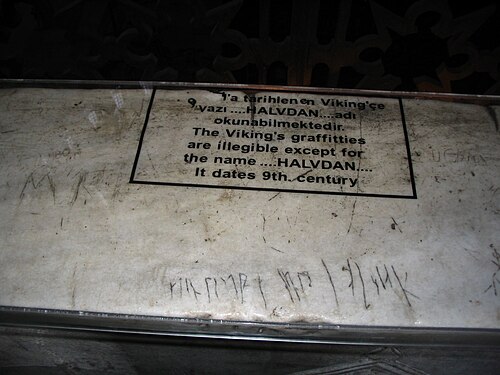
تُعرف الأحجار الرونية اليونانية ( بالسويدية : Greklandsstenarna ) بحوالي 30 حجرًا رونيًا تحمل معلوماتٍ تتعلق برحلات الفايكنج إلى الإمبراطورية البيزنطية . نُقشت هذه الأحجار خلال عصر الفايكنج حتى حوالي عام 1100، ونُقشت باللغة النوردية القديمة باستخدام الأحرف الرونية الإسكندنافية . عُثر على جميع هذه الأحجار في السويد الحالية ، ومعظمها في أوبلاند (18 حجرًا رونيًا) وسودرمانلاند (7 أحجار رونية). نُقشت معظمها تخليدًا لذكرى أفراد الحرس الفارانجي الذين لم يعودوا إلى ديارهم، لكن بعض النقوش تذكر رجالًا عادوا بثروات، كما نُقش حجرٌ كبير في إد بأمرٍ من ضابطٍ سابقٍ في الحرس.
تظهر كلمة "غريكلاند " (" اليونان ") على هذه الأحجار الرونية في ثلاثة نقوش، [ 1 ] وتظهر كلمة "غريكار" (" اليونانيون ") في 25 نقشًا، [ 2 ] ويشير حجران إلى الرجال بصفتهم "غريكفاري " ("المسافر إلى اليونان")، [ 3 ] ويشير حجر واحد إلى "غريخافنير " ("الموانئ اليونانية"). [ 4 ] ومن بين الأحجار الرونية الأخرى التي تشير إلى رحلات استكشافية خارجية، فإن المجموعات الوحيدة التي يمكن مقارنتها من حيث العدد هي ما يسمى " أحجار إنجلترا الرونية " التي تذكر رحلات استكشافية إلى إنجلترا، [ 5 ] وأحجار إنغفار الرونية الستة والعشرين التي تشير إلى رحلة استكشافية للفايكنج إلى الشرق الأوسط.
تتفاوت أحجام الأحجار، بدءًا من حجر الشحذ الصغير من تيمانس الذي يبلغ قياسه 8.5 سم × 4.5 سم × 3.3 سم ، وصولًا إلى الصخرة الضخمة في إد التي يبلغ محيطها 18 مترًا . معظمها مزين بأنماط مختلفة من الأحجار الرونية التي كانت شائعة الاستخدام خلال القرن الحادي عشر، ولا سيما الأنماط التي كانت جزءًا من أسلوب رينجيريك (ثمانية أو تسعة أحجار [ 6 ] ) وأسلوب أورنيس (ثمانية أحجار [ 7 ] ).
منذ اكتشافات يوهانس بوروس الأولى في أواخر القرن السادس عشر، دأب الباحثون على تحديد هذه الأحجار الرونية، حيث عُثر على العديد منها خلال بحث وطني عن الآثار التاريخية في أواخر القرن السابع عشر. ووثّق ريتشارد دايبك عدداً منها في القرن التاسع عشر. وكان آخر حجر عُثر عليه في نولينجه، بالقرب من ستوكهولم، عام ١٩٥٢.
الخلفية التاريخية

خدم الإسكندنافيون كمرتزقة في الجيش الروماني قبل قرون عديدة من عصر الفايكنج، [ 8 ] ولكن خلال الفترة التي صُنعت فيها هذه الأحجار، كانت العلاقات بين إسكندنافيا وبيزنطة أكثر كثافة من أي وقت مضى. [ 9 ] كانت سفن الفايكنج السويدية شائعة في البحر الأسود وبحر إيجة وبحر مرمرة والبحر الأبيض المتوسط . [ 9 ] كانت اليونان موطنًا للحرس الفارانجي ، الحرس الشخصي النخبوي للإمبراطور البيزنطي ، [ 10 ] وحتى عهد سلالة كومنينوس في أواخر القرن الحادي عشر، كان معظم أعضاء الحرس الفارانجي من السويديين . [ 11 ] وفي عام 1195، أرسل الإمبراطور ألكسيوس أنجيلوس مبعوثين إلى الدنمارك والنرويج والسويد يطلب منهم ألف محارب من كل مملكة من الممالك الثلاث. [ 12 ] تمركز الحرس في القسطنطينية ، التي أطلق عليها الإسكندنافيون اسم ميكلاغاردر (المدينة العظيمة)، وقد اجتذب الحرس الإسكندنافيين الشباب من النوع الذي شكله منذ إنشائه في أواخر القرن العاشر.
يدل العدد الكبير من الرجال الذين هاجروا إلى الإمبراطورية البيزنطية على أن القوانين الإسكندنافية في العصور الوسطى كانت لا تزال تتضمن بنودًا تتعلق بالرحلات إلى اليونان حتى بعد تدوينها عقب عصر الفايكنج. [ 9 ] وينص القانون القديم للغرب القوطي ، الذي دوّنه إسكيل ماغنوسون ، قاضي فاسترغوتلاند ( 1219-1225)، على أنه "لا يجوز لأي رجل أن يرث (في السويد) ما دام مقيمًا في اليونان". ويضيف القانون اللاحق، الذي دُوّن بين عامي 1250 و1300، أنه "لا يجوز لأحد أن يرث من شخص لم يكن وريثًا حيًا عند رحيله". كما يتضمن قانون غولاثينغسلوغ النرويجي القديم قانونًا مشابهًا: "ولكن إذا هاجر (رجل) إلى اليونان، فإن من يليه في ترتيب الورثة هو من يرث ممتلكاته". [ 11 ]

تم اكتشاف حوالي 3000 حجر روني من العصر الفايكنجي في الدول الإسكندنافية، نُصب منها نحو 2700 حجر في ما يُعرف اليوم بالسويد. [ 13 ] وقد نُصب منها 1277 حجرًا في مقاطعة أوبلاند وحدها. [ 14 ] تزامن العصر الفايكنجي مع تنصير الدول الإسكندنافية ، وفي العديد من المناطق، تحمل حوالي 50% من النقوش الحجرية آثارًا مسيحية . في أوبلاند، تُشير حوالي 70% من النقوش إلى المسيحية بشكل صريح، ويتضح ذلك من خلال الصلبان المنقوشة أو الصلوات المسيحية المضافة، بينما لا تحمل سوى قلة من الأحجار الرونية طابعًا وثنيًا صريحًا . [ 15 ] يُرجح أن تقليد الأحجار الرونية قد اندثر قبل عام 1100، وفي موعد أقصاه عام 1125. [ 14 ]
من بين الأحجار الرونية التي تعود إلى عصر الفايكنج، تشير نسبة تتراوح بين 9.1% و10% إلى أنها نُصبت تخليدًا لذكرى أشخاص هاجروا إلى الخارج، [ 16 ] وتشكل الأحجار الرونية التي تذكر اليونان المجموعة الأكبر منها. [ 17 ] إضافةً إلى ذلك، توجد مجموعة من ثلاثة أو أربعة أحجار رونية تُخلّد ذكرى رجال لقوا حتفهم في جنوب إيطاليا، والذين يُرجّح أنهم كانوا أعضاءً في الحرس الفارانجي. [ 18 ] أما المجموعة الوحيدة من الأحجار التي تُضاهي الأحجار الرونية اليونانية في العدد فهي تلك التي تذكر إنجلترا ، [ 5 ] تليها حوالي 26 حجرًا رونيًا من أحجار إنجفار، نُصبت في أعقاب حملة إنجفار المشؤومة إلى بلاد فارس . [ 19 ]
يشير بلوندال وبينيديكز (2007) إلى أن معظم الأحجار الرونية اليونانية تعود إلى أوبلاند، ويعزون ذلك إلى كونها المنطقة الأكثر شيوعًا لبدء الرحلات إلى اليونان، والمنطقة التي ينحدر منها معظم الروس . [ 20 ] مع ذلك، وكما أشار جانسون (1987)، فإن حقيقة أن معظم هذه الأحجار الرونية نُصبت في أوبلاند وسودرمانلاند لا تعني بالضرورة أن عددها يعكس تركيبة الإسكندنافيين في الحرس الفارانجي. فهاتان المقاطعتان هما اللتان تضمّان أكبر تجمعات من النقوش الرونية. [ 17 ]
لم يكن جميع من خُلدت ذكراهم على الأحجار الرونية اليونانية بالضرورة أعضاءً في الحرس الفارانجي، فربما ذهب بعضهم إلى اليونان كتجار أو لقوا حتفهم هناك أثناء مرورهم في رحلة حج . [ 11 ] ويشهد على أن السفر إلى اليونان كان محفوفًا بالمخاطر، قيام امرأة بنقش حجر روني (U 605) تخليدًا لذكراها قبل انطلاقها في رحلة حج إلى القدس: "نقشت إنجيرون هارداردوتير رونات لنفسها؛ كانت ستتجه شرقًا إلى القدس. وقد نقش فوتر هذه الرونية". ومع ذلك، يذكر بلوندال وبينيديكز (2007) أنه على الرغم من وجود أسباب أخرى للذهاب إلى اليونان، فمن المؤكد أن معظم الأحجار الرونية نُقشت تخليدًا لذكرى أعضاء الحرس الفارانجي الذين لقوا حتفهم هناك. ومع ذلك، فإن بعض الأحجار الرونية تحكي عن رجال عادوا بثروة متزايدة، [ 20 ] وقد تم تكليف نقش على صخرة في إد من قبل قائد سابق للحرس، راغنفالدر . [ 21 ]
غاية
تُعدّ أسباب تقليد الأحجار الرونية موضع نقاش، لكنها تشمل مسائل الميراث، والمكانة الاجتماعية، وتكريم الموتى. تُخلّد بعض الأحجار الرونية صراحةً ذكرى الميراث، مثل حجر أولوندا وحجر هانستا ، لكن الغالبية العظمى منها لا تُشير إلا إلى هوية من نصب الحجر وتخليد ذكرى من.
يرى بعض الباحثين مثل إريك مولتك وسفين بي إف جانسون أن الأحجار الرونية كانت في المقام الأول نتيجة للعديد من رحلات الفايكنج من الدول الاسكندنافية، [ 22 ] أو كما ذكر جانسون (1987):
عندما انتهت الحملات الكبرى، وأُغلقت طرق التجارة القديمة، ولم تعد سفن الفايكنج تُجهز كل ربيع لرحلاتها شرقًا وغربًا، كان ذلك يعني نهاية نحت ونصب أحجار الرون بالمعنى الحقيقي للكلمة. يمكن تسميتها آثار رحلات الفايكنج، وقد يلمح القارئ المتأمل في العديد من نقوشها حب الفايكنج للمغامرة ومغامراتهم الجريئة. [ 23 ]
من جهة أخرى، تُعارض سوير (2000) هذا الرأي الشائع، وتُشير إلى أن الغالبية العظمى من الأحجار الرونية نُصبت تخليدًا لذكرى أشخاص لم يُذكر أنهم توفوا في الخارج. [ 22 ] وتُجادل بأن قلةً من الرجال الذين سافروا إلى الخارج حظوا بتكريمٍ بنصبٍ تذكارية، والسبب في ذلك هو أن الأحجار الرونية نُصبت أساسًا بسبب مخاوف في الوطن، مثل مسائل الميراث. [ 24 ] وقد تنشأ هذه المخاوف عندما تعلم العائلة أن أحد أقاربها لن يعود من الخارج. [ 25 ]
الأحجار الرونية
فيما يلي عرضٌ للأحجار الرونية اليونانية استنادًا إلى معلومات جُمعت من مشروع Rundata ، مُرتبة حسب الموقع. نُقلت النصوص الرونية إلى اللغة النوردية القديمة القياسية باللغة النوردية الشرقية القديمة (OEN)، وهي اللهجة السويدية والدنماركية، لتسهيل المقارنة مع النقوش، بينما تُقدم الترجمة الإنجليزية التي وفرها مشروع Rundata الأسماء باللغة النوردية الغربية القديمة القياسية (OWN)، وهي اللهجة الأيسلندية والنرويجية.
الترجمة الصوتية والنسخ
هناك ممارسة راسخة لكتابة ترجمات الأحرف الرونية بأحرف لاتينية بخط غامق ، ثم نسخ النص إلى صيغة قياسية للغة بخط مائل . وتعود هذه الممارسة إلى ضرورة التمييز بين شكلي كتابة النص الروني. [ 26 ] فعندما لا يكتفي الباحثون بعرض النقش الأصلي، بل يقومون أيضًا بالترجمة الصوتية والنسخ والترجمة، يقدمون التحليل بطريقة تُمكّن القارئ من متابعة تفسيرهم للأحرف الرونية. ورغم أن كل خطوة تنطوي على تحديات، إلا أن معظم نقوش الأبجدية الرونية الصغرى تُعتبر سهلة التفسير. [ 27 ]
في الترجمة الصوتية، تُمثل الرموز * ، : ، × ، '، و + فواصل الكلمات الشائعة ، بينما يُمثل الرمز ÷ فواصل الكلمات الأقل شيوعًا. تُمثل الأقواس ( ) الأحرف الرونية التالفة التي لا يُمكن تحديدها بدقة، بينما تُمثل الأقواس المربعة [ ] سلاسل الأحرف الرونية المفقودة، ولكن يُمكن تحديدها بفضل الأوصاف المبكرة التي قدمها العلماء. تشير الشرطة القصيرة - إلى وجود حرف روني أو رمز آخر لا يُمكن تحديده. تُشير سلسلة من ثلاث نقاط ... إلى أنه يُفترض وجود أحرف رونية في هذا الموضع، ولكنها اختفت. يقسم الرمزان | | الحرف الروني إلى حرفين لاتينيين، لأن رسامي الرون غالبًا ما كانوا ينقشون حرفًا واحدًا بدلًا من حرفين متتاليين. يُقدم الرمزان §P و§Q قراءتين بديلتين لنقش يتعلق بكلمات متعددة، بينما يُقدم الرمز §A و§B و§C أجزاءً من نقش قد تظهر على جوانب مختلفة من حجر الرون. [ 28 ]
تشير الأقواس الزاوية، ⟨ ⟩ ، إلى وجود سلسلة من الأحرف الرونية التي لا يمكن تفسيرها بيقين. ومن العلامات الخاصة الأخرى þ و ð ، حيث يمثل الحرف الأول حرف الشوكة الذي يرمز إلى صوت احتكاكي سني مهموس مثل th في كلمة thing الإنجليزية . أما الحرف الثاني فهو eth الذي يرمز إلى صوت احتكاكي سني مجهور مثل th في كلمة them الإنجليزية . ويمثل الرمز ʀ حرف yr الروني ، بينما يمثل ô الحرف O caudata ǫ في اللغة الأيسلندية . [ 28 ]
التسمية
يُعرض كل نقش رونيك برمز التعريف المستخدم في المراجع العلمية للإشارة إليه، ويُشترط ذكر الجزأين الأولين منه فقط. يتكون الجزء الأول من حرف أو حرفين يُمثلان المنطقة التي يظهر فيها النقش، مثل U لأوبلاند ، وSö لسودرمانلاند ، وDR للدنمارك . أما الجزء الثاني فيُمثل ترتيب ظهور النقش في المنشورات الوطنية الرسمية (مثل Sveriges runinskrifter ). على سبيل المثال، U 73 تعني أن حجر الرون هو النقش الرونيك رقم 73 في أوبلاند الذي تم توثيقه في Sveriges runinskrifter . إذا تم توثيق النقش في وقت لاحق عن النشر الرسمي، فإنه يُدرج وفقًا للمنشور الذي وُصف فيه لأول مرة، على سبيل المثال Sö Fv1954;20 ، حيث يرمز Sö إلى سودرمانلاند، وFv إلى المنشور السنوي Fornvännen ، و1954 إلى عام إصدار Fornvännen ، و20 إلى رقم الصفحة في المنشور. [ 29 ]
أبلاند
يوجد في أوبلاند ما يصل إلى 18 حجرًا رونيًا تحمل معلومات عن الرجال الذين سافروا إلى اليونان ، والذين مات معظمهم هناك.
يو 73

ربما نُصب الحجر الروني U 73 ( الموقع ) لتوضيح ترتيب الميراث لرجلين توفيا وهما من الفارانجيين. [ 30 ] وهو مصمم على طراز Pr3 [ 31 ] الذي يُعد جزءًا من طراز أورنيس الأكثر شيوعًا . يبلغ ارتفاع الحجر، المصنوع من الجرانيت الرمادي، مترين (6 أقدام و7 بوصات) وعرضه 1.2 متر (3 أقدام و11 بوصة) ، [ 32 ] وهو مُقام على منحدر يبعد حوالي 100 متر (330 قدمًا) شمال مزرعة هاجرستالوند، التي كانت تُعرف سابقًا باسم هانستا(لوند). اكتشف الحجر يوهان بيرينغسكيولد خلال البحث الوطني عن الآثار التاريخية في أواخر القرن السابع عشر. يحمل الحجر نفس الرسالة التي يحملها الحجر U 72، والذي كان يشكل معه نصبًا تذكاريًا في السابق، [ 32 ] ولكن نُقل الحجر U 72 إلى سكانسن عام 1896. [ 33 ] ويشير الحجر الأخير إلى أن جيرذار ويوروندر أقاما "هذين الحجرين" تخليدًا لذكرى إرنموندر وإنجيموندر. وبناءً على ذلك، فإن عبارة "أبناء إنجا" و"ماتوا في اليونان" الواردة في الحجر U 73 تشير إلى إرنموندر وإنجيموندر. [ 32 ] كان إرنموندر وإنجيموندر قد ورثا عن والدهما، لكنهما رحلا إلى الإمبراطورية البيزنطية وتوفيا هناك كفارانجيين. ولأنهما لم يرزقا بأطفال، ورثت والدتهما إنجا ممتلكاتهما، وعندما توفيت، ورثها شقيقاها جيرذار ويوروندر. ثم أقام الشقيقان النصبين التذكاريين تكريمًا لابني أخيهما، وهو ما يُعزى على الأرجح إلى تميز ابني أخيهما في الجنوب. مع ذلك، ربما كان ذلك أيضًا تعبيرًا عن الامتنان للثروة التي جمعها أبناء الأخ في الخارج. وفي الوقت نفسه، مثّل النصب التذكاري توثيقًا لكيفية انتقال الملكية من عشيرة إلى أخرى. [ 32 ] [ 34 ] من جهة أخرى، يقترح سوير (2000) أنه نظرًا لعدم ذكر النقشين لمن أمر بنقشهما، فإن المطالب الوحيد بالثروة، والذي أمر بصنع الأحجار، ربما كان الكنيسة. [ 35 ] وقد تم تحديد هوية كاتب الرون باسم فيساتي . [ 31 ]
'
þisun
Þessun
'
ميركي
ماركي
'
إيرو
æʀu
'
غار
غار
'
إلى اليسار
بعد
'
سوني
مرادف
'
إيكور
إنجو.
'
هون
سعادة
كام
كفام
'
þeira
þæiʀa
×
في
في
أرفي
أرفي،
'
في
en
هُم
þæiʀ
×
أخي
brøðr
*
كامو
كفامو
حنا
هانار
:
في
في
'
أرفي
أرفي،
×
كياثار
جيرذار
b'reþr
brøðr.
'
þir
Þæiʀ
ل
مزدوج
أنا
أنا
كيريكيوم
غريكيوم.
' þisun ' Merki ' iru ' gar ' eftʀ ' suni ' ikur ' hon kam ' þeira × at arfi ' in þeir × brþr * kamu hnaa : at ' arfi × kiaþar b'reþr ' þir to i kirikium
{} Þessun {} mærki {} æʀu {} gar {} æftiʀ {} Syni {} Inguʀ. {} Hon kvam {} þæiʀa {} at arfi، {} en þæiʀ {} brøðr {} kvamu hænnaʀ {} at {} arfi، {} Gærðarr brøðr. {} Þæiʀ dou i Grikkium.
"أقيمت هذه المعالم تخليداً لذكرى أبناء إنجا. لقد ورثت منهم، ولكن هؤلاء الإخوة - جيرذار وإخوته - ورثوا منها. لقد ماتوا في اليونان." [ 31 ]
يو 104

يقع الحجر الروني U 104 ( موقعه الأصلي ) في حجر رملي أحمر، ويبلغ ارتفاعه 1.35 مترًا (4 أقدام و5 بوصات) وعرضه 1.15 مترًا (3 أقدام و9 بوصات) . [ 36 ] وقد وُثِّق لأول مرة من قِبَل يوهانس بوريوس عام 1594. [ 36 ] تم التبرع به كواحد من حجرين (الآخر هو U 1160 [ 28 ] ) إلى متحف أشموليان في أكسفورد عام 1687 بناءً على طلب الملك جيمس الثاني ملك إنجلترا من الملك تشارلز الحادي عشر ملك السويد ، الذي طلب حجرين رونيين لإضافتهما إلى مجموعة جامعة أكسفورد . [ 37 ] وهو مصمم على طراز أورنيس (Pr5) . أقامه ثورستين تخليدًا لذكرى والده سفين وشقيقه ثورير، اللذين هاجرا إلى اليونان، وأخيرًا تخليدًا لذكرى والدته. يحمل الحجر توقيع خبير الرون أوبير، الذي تتميز لغته النوردية القديمة باستخدامها غير المألوف لرونية هاغلاز (ᚼ)، كما في كلمة hut التي تعني "خارج" في اللغة النوردية القديمة . [ 38 ] يُعدّ الاستخدام غير المنتظم لصوت الهاء سمة لهجية باقية، ولا تزال سمة مميزة للهجة السويدية الحديثة في روسلاجن ، إحدى المناطق التي نشط فيها أوبير. [ 38 ]
'
þorstin
Þorstæinn
'
مضاء
يترك
×
كيرا
gæra
'
ميركي
ماركي
'
ftiʀ
بعد
'
سوين
سفين،
'
فاثور
faður
'
الخطيئة
سين،
'
المملكة المتحدة
نعم
'
ftiʀ
بعد
'
þori
Þori,
'
(ب) بروثور
برودور
'
الخطيئة
سين،
'
þiʀ
þæiʀ
'
هوارو
vaʀu
'
كوخ
ut
'
حتى
حتى
'
كيكا
جريكيا،
'
(المملكة المتحدة)
نعم
'
إفطار
بعد
'
إنكيثورو
إنجيثورو،
'
موثور
موذور
'
الخطيئة
سينا.
'
ybiʀ
أوبير
ريستي
ريستي.
'
' þorstin ' lit × kera ' merki ' ftiʀ ' suin ' faþur ' sin ' uk ' ftiʀ ' þori ' (b)roþur ' sin ' þiʀ ' huaru ' hut ' til ' k—ika ' (u)(k) ' iftiʀ ' inkiþuru ' moþur ' sin ' ybiʀ risti '
{} Þorstæinn {} Let {} gæra {} mærki {} æftiʀ {} Svæin، {} faður {} sinn، {} ok {} æftiʀ {} Þori، {} broður {} sinn، {} þæiʀ {} vaʀu {} ut {} til {} G[r]ikkia، {} ok {} æftiʀ {} Ingiþoru، {} moður {} سينا. {} Øpiʀ risti. {}
"أقام ثورستين هذا المعلم تخليداً لذكرى والده سفين وشقيقه ثورير. كانا قد ذهبا إلى اليونان. ونحته أيضاً تخليداً لذكرى والدته إنجيثورا." [ 39 ]
يو ١١٢


حجر الرون U 112 ( موقع مؤرشف في 13 مارس 2009 على موقع Wayback Machine )، وهو صخرة كبيرة يبلغ محيطها 18 مترًا (59 قدمًا) ، تقع بجوار ممر مشجر يُسمى Kyrkstigen ("ممر الكنيسة") في إد. [ 28 ] [ 40 ] وقد عُرف هذا الحجر للباحثين منذ أول رحلة استكشافية لعلم الرون قام بها يوهانس بوروس عام 1594، ويعود تاريخه إلى منتصف القرن الحادي عشر. [ 40 ] [ 41 ]
يحمل الصخر نقوشًا رونية على جانبين منه، يُشار إليهما بالرمزين U 112 A وB. [ 28 ] تكمن الأهمية اللغوية لهذه النقوش في استخدام رونية هاغلاز (ᚼ) للدلالة على الصوت الحنكي التقريبي /ɣ/ (كما في كلمة Ragnvaldr )، وهو أمرٌ شاع استخدامه بعد نهاية عصر الفايكنج. يتضمن النقش أيضًا بعض الرونية المنقطة ، وتُستخدم رونية أنسوز ( ᚬ ) للدلالة على الصوت /o/ . [ 42 ]
النقوش على طراز أورنيس (Pr4) ، [ 28 ] وقد كُلِّف بنقشها قائد سابق في الحرس الفارانجي يُدعى راغنڤالدر، تخليدًا لذكرى والدته وتكريمًا لنفسه. [ 28 ] [ 40 ] قلّما كان يُتاح لأحدٍ أن يتباهى بالعودة إلى دياره بشرف قيادة الحرس الفارانجي. علاوة على ذلك، يُشير اسم راغنڤالدر إلى انتمائه إلى الطبقات العليا في المجتمع النورسي القديم، وإلى احتمال كونه قريبًا من السلالة الحاكمة . [ 43 ]
ذُكر جد راغنڤالد لأمه، أونيمر، على حجرين رونيين إضافيين في أوبلاند ، هما U 328 و U 336. [ 44 ] يشير الحجر الروني U 328 إلى أن راغنڤالد كان لديه عمتان، هما غيريدر وغودلوغ. بالإضافة إلى ذلك، يضيف الحجر الروني U 336 أن أولف من بورستا ، الذي حصل على ثلاث هبات دانجيلد في إنجلترا، كان ابن أخ أونيمر من جهة الأب، وبالتالي ابن عم راغنڤالد. [ 44 ] من المحتمل أنه كان هو نفسه راغنڤالد الذي ورد ذكر وفاته في نقوش هارغس برو الرونية ، مما يربطه أيضًا بإستريد وعشيرة جارلابانك الثرية . [ 45 ]
*
rahnualtr
راغنفالدر
*
مضاء
يترك
*
ريستا
ريستا
*
رونار
رونار
*
إيفر
بعد
*
fastui
فاستفي،
*
موثور
موذور
*
سينا
سينا،
*
أونيمز
أسماء
*
إجمالي
دوتي،
*
ل
يفعل
أنا
أنا
*
aiþi
Æiði.
*
kuþ
غود
هيالبي
هيالبي
*
النمل
و
*
الحناء
hænnar.
*
* rahnualtr * lit * rista * runar * efʀ * fastui * moþur * sina * onems * totʀ * to i * aiþi * kuþ hialbi * ant * hena *
{} Ragnvaldr {} Let {} rista {} runaʀ {} æftiʀ {} Fastvi، {} moður {} sina، {} Onæms {} dottiʀ، {} do i {} Æiði. {} Guð hialpi {} و {} hænnaʀ. {}
"قام راغنفالدر بنقش الأحرف الرونية تخليداً لذكرى فاستفي، والدته، ابنة أونيمر، التي توفيت في إيد. فليرحمها الله."
رونا
رونار
*
ريستا
ريستا
*
مضاء
يترك
*
rahnualtr
راغنفالدر.
*
هوار
فار
أ
أ
×
غريكلانتي
غريكلاندي،
*
uas
فاس
*
ليس
liðs
*
فورنكي
فورونجي.
*
رونا * ريستا * مضاءة * rahnualtr * huar a × griklanti * uas * lis * forunki *
Runaʀ {} rista {} Let {} Ragnvaldr. {} Vaʀ a {} Grikklandi، {} vas {} liðs {} forungi. {}
"كان راغنفالدر قد نقش الأحرف الرونية؛ (كان) في اليونان، وكان قائد الحاشية." [ 46 ]
يو 136

يقع حجر الرون U 136 ( الموقع ) على طراز Pr2 (رينجيريك) ، [ 47 ] وكان يشكل في السابق نصبًا تذكاريًا مع U 135. وهو حجر رمادي داكن يبلغ ارتفاعه 1.73 مترًا (5 أقدام و8 بوصات) وعرضه 0.85 مترًا ( قدمان و9 بوصات) . [ 48 ] في عام 1857، لاحظ ريتشارد دايبك أنه تم اكتشافه في التربة قبل خمس سنوات. كان جزء صغير منه ظاهرًا فوق سطح الأرض، وعندما كان مالك الأرض يحرثها واكتشفه، أمر برفعه مرة أخرى في نفس المكان. وقد اقتلع مالك الأرض بعض أجزائه عن طريق الخطأ، وفُقدت الأجزاء العلوية من بعض الأحرف الرونية. [ 49 ]
أُقيم الحجر في الأصل على يد سيدة ثرية تُدعى أستريدر تخليدًا لذكرى زوجها إيستين، ويشير سوير (2000) إلى أنه كان أحد الأحجار العديدة التي نُصبت في صراع على الميراث. [ 50 ] يكتنف الغموض سبب ذهاب إيستين إلى اليونان والقدس ، نظرًا لتفسير كلمة sœkja (الموثقة بصيغة sotti في الماضي). فهي تعني "البحث"، ولكنها قد تعني "الهجوم" كما هو الحال في الحجرين Sö 166 و N 184 ، أو "الزيارة" أو "السفر". [ 51 ] وبناءً على ذلك، يُعتقد أن إيستين كان من أوائل السويديين الذين قاموا برحلة حج إلى القدس، [ 52 ] لكن ييش (2001) يُشير إلى أنه بالنظر إلى الأمثلة الرونية الأخرى، فإن معنى "الهجوم" هو الأرجح. [ 51 ] اختار مشروع Rundata ترجمة كلمة sœkja بمعنى "هجوم" (انظر أدناه). وهي إحدى حجرين من أحجار Jarlabanke Runestones يذكران المسافرين إلى الخارج، والآخر هو U140، المذكور أدناه .
×
astriþr
Æstriðr
×
لا(ت)
يترك
+
رايسا
رايسا
×
ستاينا
stæina
×
þasa
þessa
×
[في
في
أوستن
أويستاين،
×
بوتا
بوندا
الخطيئة
سين،
×
يكون
es
×
سوتي
سوتي
×
iursalir
Iorsaliʀ
أوك
نعم
أنتاثيس
ændaðis
ub
أعلى
أنا
أنا
×
كيركوم
غريكيوم.
× astriþr × la(t) + raisa × staina × þasa × [a]t austain × بوتا سين × is × suti × iursalir auk antaþis ub i × kirkum
{} Æstriðr {} Let {} ræisa {} stæina {} þessa {} at Øystæin، {} Bonda Sinn، {} es {} sotti {} Iorsaliʀ ok ændaðis upp i {} Grikkium.
"أقامت أستريدر هذه الأحجار تخليداً لذكرى إيستين، مزارعها، الذي هاجم القدس ولقي حتفه في اليونان." [ 47 ]
يو 140

يقع حجر الرون U 140 في بروبي ( الموقع )، بالقرب من أحجار رون بروبي برو و U 150. قطعة الجرانيت مصممة على طراز رينجريك (Pr 2). [ 53 ] اكتشفها ريتشارد دايبك بين أساسات مبنى صغير. بحث دايبك دون جدوى عن الأجزاء المتبقية. في البداية، نُقلت القطعة إلى منحدر بالقرب من الطريق بين هاغبي وكنيسة تابي، ولكن في عام 1930، نُقلت إلى جانب الطريق. وهو أحد أحجار رون جارلابانك ، ويذكر رجلاً سافر إلى الخارج [ 54 ] (قارن U 136، أعلاه ).
×
...la×b(a)...
[Iar]laba[nki]
...
...
هان
هان
:
entaþis
ændaðis
*
أنا
أنا
كيريكيوم
غريكيوم.
× ...la×b(a)... ... han : entaþis * i kirikium
{} [Iar]laba[nki] ... Hann {} ændaðis {} i Grikkium.
"جارلابانكي ... لقد لقي حتفه في اليونان." [ 53 ]
يو 201
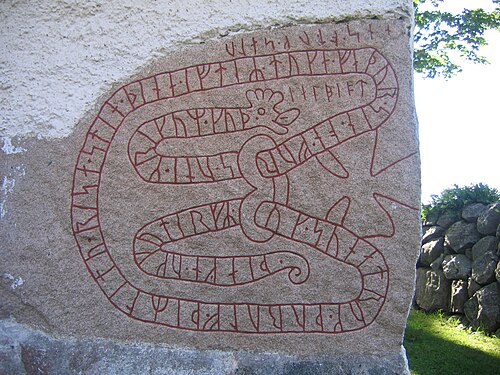
يقع حجر الرون U 201 ( الموقع ) ضمن النوع Pr1 (Ringerike) ، وقد صنعه نفس صانع الرون الذي صنع الحجر U 276. [ 55 ] يُثبّت حجر الجرانيت المحمر في جدار كنيسة أنجارن على ارتفاع 0.74 متر تقريبًا ( قدمان و5 بوصات) فوق سطح الأرض، ويبلغ ارتفاعه 1.17 متر (3 أقدام و10 بوصات) وعرضه 1.16 متر (3 أقدام و10 بوصات) . [ 56 ] ذكر يوهانس بوريوس (1568-1652) هذا الحجر، ولكن لأسباب غير معروفة، تم تجاهله خلال البحث الوطني عن المعالم التاريخية في الفترة 1667-1684. [ 56 ] اثنان من الرجال المذكورين على الحجر يحملان أسماءً غير معروفة؛ وقد تم إعادة بنائها على أنها Gautdjarfr و Sunnhvatr استنادًا إلى عناصر معروفة من أسماء نوردية أخرى. [ 57 ]
*
þiagn
Þiagn
*
المملكة المتحدة
نعم
*
كوتيرفر
Gautdiarfʀ(?)
*
المملكة المتحدة
نعم
*
سوناتر
Sunnhvatr(?)
*
المملكة المتحدة
نعم
*
ثورولف
ثورولفر
*
þiʀ
þæiʀ
*
ليتو
ليتو
*
ريسا
رايسا
*
ستين
شتاين
*
þina
þenna
*
إفطار
بعد
*
توكا
توكا،
*
فاثور
faður
*
الخطيئة
سين.
*
على
هان
*
الفراء
فورس
*
ut
ut
أنا
أنا
*
كريكوم
غريكيوم.
*
kuþ
غود
*
إيالبي
هيالبي
أو
و
الإجابة
هانز،
*
أو
و
*
المملكة المتحدة
نعم
*
سلام
سلام.
* þiagn * uk * kutirfʀ * uk * sunatr * uk * þurulf * þiʀ * litu * risa * stin * þina * iftiʀ * tuka * faþur * sin * on * furs * ut i * krikum * kuþ * ialbi ot ans * ot * uk * salu
{} Þiagn {} ok {} Gautdiarfʀ(?) {} ok {} Sunnhvatr(?) {} ok {} Þorulfʀ {} þæiʀ {} Letu {} ræisa {} stæin {} þenna {} æftiʀ {} Toka, {} faður {} sinn. {} Hann {} fors {} ut i {} Grikkium. {} Guð {} hialpi و hans، {} و {} ok {} salu.
«قام كل من ثيجن وغوتديارفر وسونهفاتر وثورولفر بنصب هذا الحجر تخليداً لذكرى توكي، والدهم. لقد توفي في اليونان. فليرحمه الله ويسكنه فسيح جناته.» [ 55 ]
يو 270

عُثر على الحجر الروني U 270 في سميدبي ( الموقع ) بالقرب من فالنتونا، ورسمه يوهان هادورف ومساعده، لصالح يوهان بيرينغسكيولد ، خلال البحث الوطني عن الآثار التاريخية في الفترة 1667-1684. أشار ريتشارد دايبك في عام 1867 إلى أنه رأى الحجر الروني سليمًا قبل ثلاث سنوات، ولكنه استُخدم في بناء قبو عام 1866. رفع دايبك دعوى قضائية ضد المزارع المُدان، وأكملت الأكاديمية الملكية السويدية للآداب والتاريخ والآثار إجراءات التقاضي . تُظهر وثائق القضية أن الحجر كان قائمًا في المزرعة، وأنه فُجّر ثلاث مرات إلى قطع صغيرة استُخدمت في بناء القبو. واعتُبرت إعادة بناء الحجر الروني مستحيلة. كان ارتفاع الحجر 2.5 متر (8 أقدام وبوصتين) وعرضه 1.2 متر (3 أقدام و11 بوصة) ، [ 58 ] وقد أقيم تخليداً لذكرى أب يبدو أنه سافر إلى اليونان. [ 59 ]
[ikiþur-
إنجيثور[ا]
إيسينا...
...
...–
...
* stiu
⟨ stiu ⟩
نوك
نعم
*
في
في
*
kiatilu...
كايتيل...,
فاثور
faður
*
الخطيئة
سين،
كريكفارن
غريكفارا (?)
*
ك...]
...
[ikiþur- isina... ...– {* stiu} nuk * at * kiatilu... faþur * sin krikfarn * k...]
Ingiþor[a] ... ... ⟨ stiu ⟩ ok {} at {} Kætil..., faður {} sinn, Grikkfara(?) {} ...
"إنجيثورا ... ... وإحياءً لذكرى كيتيل ... والدها، (أ) مسافر إلى اليونان (؟) ..." [ 60 ]
يو 358
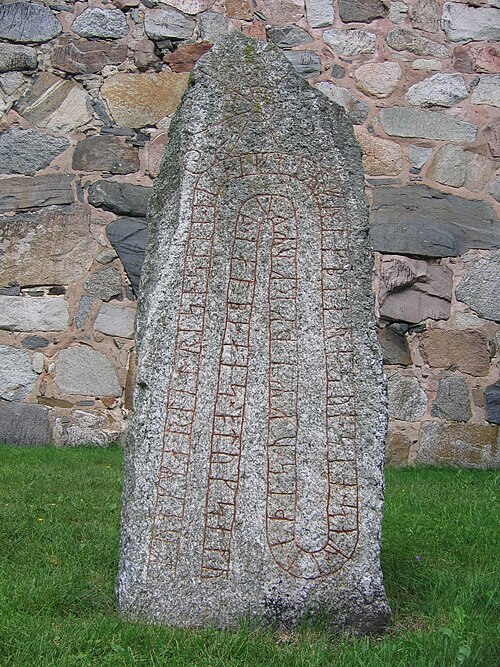
ذُكر حجر الرون U 358 ( الموقع ) المصمم على طراز RAK [ 61 ] لأول مرة من قِبل ريتشارد دايبك الذي اكتشفه في أساسات برج جرس كنيسة سكيبتونا . لم يسمح له أبناء الرعية بكشف النقش بالكامل، وقاموا لاحقًا بإخفاء الحجر تحت طبقة سميكة من التربة. لم يُنقل الحجر من برج الجرس إلا في عام 1942، حيث أُعيد رفعه على بُعد خطوات قليلة. الحجر مصنوع من الجرانيت الرمادي الفاتح، ويبلغ ارتفاعه 2.05 متر (6 أقدام و9 بوصات) فوق سطح الأرض، وعرضه 0.78 متر ( قدمان و7 بوصات) [ 62 ] . كان اسم صانع حجر الرون فولكمار ، وهو اسم غير معروف في الدول الإسكندنافية خلال عصر الفايكنج، على الرغم من أنه من المعروف أنه كان موجودًا بعد نهاية عصر الفايكنج. مع ذلك، كان الاسم شائعًا في اللغات الجرمانية الغربية ، وخاصة بين الفرنجة [ 62 ] .
فولكمار
فولكمار
×
مضاء
يترك
×
ريسا
رايسا
×
ستين
شتاين
×
þina
þenna
×
إفطار
بعد
×
فولكبيارن
مواليد الفولك،
×
شمس
شمس
×
الخطيئة
سين.
×
سار
سار
×
itaþis
ændaðis
×
المملكة المتحدة
نعم
مي
með
كركوم
غريكيوم.
×
kuþ
غود
×
إيالبي
هيالبي
×
الإجابة
هانز
×
أو
و
المملكة المتحدة
نعم
سلام
سلام.
فولكمار × ليت × ريسا × ستين × þina × iftiʀ × فولكبيارن × صن × سين × ساʀ × إيتايس × أوك ميþ كركوم × كوþ × إيلبي × آنس × أوت أوك سالو
Folkmarr {} Let {} ræisa {} stæin {} þenna {} æftiʀ {} Folkbiorn، {} sun {} sinn. {} Saʀ {} ændaðis {} ok með Grikkium. {} Guð {} hialpi {} hans {} وok salu.
"أقام فولكمار هذا الحجر تخليداً لذكرى ابنه فولكبيورن. وقد لقي حتفه أيضاً بين اليونانيين. فليرحمه الله ويسكنه فسيح جناته." [ 61 ]
يو 374


كان الحجر الروني U 374 حجرًا رونيًا موجودًا في أوربي ( الموقع ). في عام 1673، وخلال البحث الوطني عن المعالم التاريخية، أفاد أبراهام وينج بوجود حجرين رونيين في أوربي. في عام 1684، ذهب بيرينغسكيولد إلى أوربي لتوثيق الحجرين ورسمهما، لكنه لم يجد سوى حجر واحد قائم ( U 373 ). وبدلًا من ذلك، اكتشف الحجر الثاني، أو الثالث، U 374، كجزء سفلي من موقد نار. كان استخدام الحجر كموقد نار ضارًا بالنقش ، وآخر مرة كُتب فيها عن رؤيته كانت في عام 1728. وبالتالي، يُعد رسم بيرينغسكيولد التوثيق الوحيد الموجود للنقش. كان ارتفاع الحجر 1.5 متر (4 أقدام و11 بوصة) وعرضه 0.88 متر ( قدمان و11 بوصة) ، [ 63 ] وينسب إلى صانع الرون أسموند كاريسون . [ 64 ]
[...]
...
ليتو
ليتو
'
ريتا
ريتا
:
بقع
شتاين
þino
þenna
*
إفطار
بعد
*
أوهو...
...
...ان
...
هون
هان
فيلم
يسقط
o
أ
كريكلونتر
غريكلاندي.
kuþ
غود
هاي-لبي
hi[a]lpi
سال...]
sal[u].
[... litu 'rita : stain þino * iftiʀ * o-hu... ...an hon fil o kriklontr kuþ hi-lbi sal...]
... Letu {} retta {} stæin þenna {} æftiʀ {} ... ... سقط هان على Grikklandi. Guð hi[a]lpi sal[u].
"... أُقيم هذا الحجر تخليداً لذكرى ... ... سقط في اليونان. رحم الله روحه." [ 64 ]
يو 431

تم اكتشاف الحجر الروني U 431 ( الموقع ) مثل الحجر U 430، في حقل تابع لنُزُل آشوسبي عندما تم تفجير الأحجار لتجهيز الحقل لزراعة المحاصيل عام 1889. ولأن الحجر كان موضوعًا ووجهه المزخرف متجهًا للأسفل، فقد تم تفجيره، ولم تُكتشف الأحرف الرونية إلا بعد جمع شظاياه. تم ترميم الحجر الروني بالخرسانة ونُقل إلى بهو كنيسة نورسوندا. الحجر مصنوع من صخر النيس الرمادي المزرق ، ويبلغ ارتفاعه 1.95 مترًا (6 أقدام و5 بوصات) وعرضه 0.7 مترًا ( قدمان و4 بوصات) . [ 65 ] أسطحه ناعمة بشكل غير عادي. [ 65 ] وهو مصمم على طراز رينجريك (Pr2)، ويُنسب إلى صانع الأحرف الرونية آسموند كاريسون. [ 66 ] نشأ هذا المكان على يد أب وأم، توفا وهيمينجر، تخليداً لذكرى ابنهما غونار، الذي توفي "بين اليونانيين"، ومن غير المألوف ذكر الأم قبل الأب. [ 67 ]
التوفا
توفا
أوك
نعم
هومينكر
هامينغر
ليتو
ليتو
ريتا
ريتا
ستين
شتاين
þino
þenna
'
أبتير
بعد
كونور
غونار،
شمس
شمس
الخطيئة
سين.
'
في
إن
–
...
هون
هان
u(a)ʀ
فار
ta(u)-(r)
dau[ð]r
مير
ميذر
كريكيوم
غريكيوم
ut
ut.
'
kuþ
غود
هيالبي
هيالبي
مع مرتبة الشرف|
هانز
|سالو|
سلام
|uk|
نعم
|kuþs
غودس
م—(ي)(ر)
m[oð]iʀ.
tufa auk hominkr litu rita stin þino 'abtiʀ kunor sun sin' in – hon u(a)ʀ ta(u)-(r) miʀ krikium ut' kuþ hialbi hons| |سالو| |المملكة المتحدة| |kuþs م—(i)(ʀ)
Tofa ok Hæmingʀ Letu retta stæin þenna {} æftiʀ Gunnar, sun sinn. {} En ... hann vaʀ dau[ð]r meðr Grikkium ut. {} Guð hialpi hans salu ok Guðs m[oð]iʀ.
"أقام توفا وهيمينجر هذا الحجر تخليداً لذكرى غونار، ابنهما، و... توفي في الخارج بين اليونانيين. فليرحمه الله وليرحم أمه." [ 66 ]
يو 446
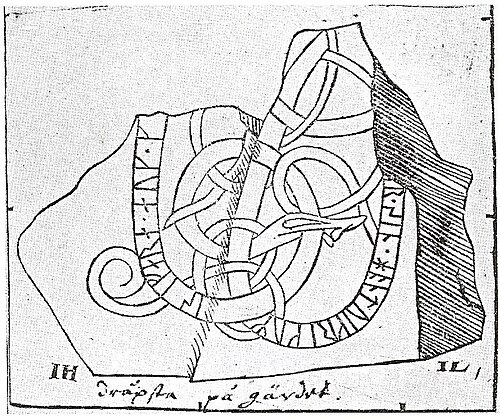
A fragment of the runestone U 446 in Droppsta (location) is only attested from a documentation made during the national search for historic monuments in the 17th century, and during the preparation of the Uppland section of Sveriges runinskrifter (1940–1943) scholars searched unsuccessfully for any remains of the stone. The fragment was what remained of the bottom part of a runestone. It appears to have been in two pieces, each containing one part of the inscription. The fragment appears to have been c. 1.10 m (3 ft 7 in) high and 1.2 m (3 ft 11 in) wide[68] and its Urnes style is attributed to either Pr3 or Pr4.[69] The runes isifara have been interpreted as æist-fari which means "traveller to Estonia",[70] which is known from an inscription in Södermanland,[68] but they are left as undeciphered by the Rundata project.[69]
[isifara
⟨isifara⟩
*
auk
ok
*
...r
...
*
sin
sinn.
*
hon
Hann
tu
do
i
i
krikum]
Grikkium.
[isifara * auk * ...r * sin * hon tu i krikum]
⟨isifara⟩ {} ok {} ... {} sinn. {} Hann do i Grikkium.
"⟨isifara⟩ and ... their. He died in Greece."[69]
U 518

Runestone U 518 (location) is in the RAK style[71] and is raised on the southern side of a piny slope some 700 m (2,300 ft) north-east of the main building of the homestead Västra Ledinge. The stone was made known by Richard Dybeck in several publications in the 1860s, and at the time it had recently been destroyed and was in several pieces, the bottom part still in the ground. In 1942, the stone was mended and raised anew at the original spot. The stone consists of grey and coarse granite.[72]
The runestone was made in memory of three men. Two of them died in Greece, while a third, Freygeirr, died at a debated location written as i silu × nur. Richard Dybeck suggested that this might either refer to the nearby estate of Skällnora or lake Siljan, and Sophus Bugge identified the location as "Saaremaa north" (Øysilu nor), whereas Erik Brate considered the location to have been Salo in present-day Finland.[73] The contemporary view, as presented in Rundata, derives from a more recent analysis by Otterbjörk (1961) who consider it to refer to a sound at the island Selaön in Mälaren.[71]
þurkir
Þorgærðr
×
uk
ok
×
suin
Svæinn
×
þu
þau
litu
letu
×
risa
ræisa
×
stin
stæin
×
þina
þenna
×
iftiʀ
æftiʀ
×
urmiʀ
Ormæiʀ
×
uk
ok
×
urmulf
Ormulf
×
uk
ok
×
frikiʀ
Frøygæiʀ.
×
on
Hann
×
etaþis
ændaðis
×
i
i
silu
Silu
×
nur
nor
×
ian
en
þiʀ
þæiʀ
antriʀ
andriʀ
×
ut
ut
i
i
×
krikum
Grikkium.
×
kuþ
Guð
ihlbi
hialpi
–ʀ(a)
[þæi]ʀa
ot
and
×
uk
ok
salu
salu.
þurkir × uk × suin × þu litu × risa × stin × þina × iftiʀ × urmiʀ × uk × urmulf × uk × frikiʀ × on × etaþis × i silu × nur × ian þiʀ antriʀ × ut i × krikum × kuþ ihlbi –ʀ(a) ot × uk salu
Þorgærðr {} ok {} Svæinn {} þau letu {} ræisa {} stæin {} þenna {} æftiʀ {} Ormæiʀ {} ok {} Ormulf {} ok {} Frøygæiʀ. {} Hann {} ændaðis {} i Silu {} nor {} en þæiʀ andriʀ {} ut i {} Grikkium. {} Guð hialpi [þæi]ʀa and {} ok salu.
"Þorgerðr and Sveinn, they had this stone raised in memory of Ormgeirr and Ormulfr and Freygeirr. He met his end in the sound of Sila (Selaön), and the others abroad in Greece. May God help their spirits and souls."[71]
U 540

Runestone U 540 (location) is in the Urnes (Pr4) style and it is attributed to the runemaster Åsmund Kåresson.[74] It is mounted with iron to the northern wall of the church of Husby-Sjuhundra, but when the stone was first documented by Johannes Bureus in 1638 he noted that it was used as a threshold in the atrium of the church. It was still used as a threshold when Richard Dybeck visited it in 1871, and he arranged for the entire inscription to be made visible in order to make a cast copy.[75] In 1887, the parishioners decided to extract both U 540 and U 541 from the church and with financial help from the Royal Swedish Academy of Letters, History and Antiquities the stones were removed and attached outside the northern wall. The stone is of red sandstone and it is 1.50 m (4 ft 11 in) high and 1.13 m (3 ft 8 in) wide.[76] Several parts of the stone and its inscription have been lost, and it is worn down due to its former use as a threshold.[76]
A theory, proposed by Germanist F. A. Braun (1910), which is based on the runestones U 513, U 540, Sö 179 and Sö 279, holds the grieving Ingvar to be the same person as Ingvar the Far-Travelled, the son of the Swedish king Emund the Old. Braun notes that the stones were raised at a Husby, a royal residence, and the names Eiríkr (Eric) and Hákon were rather rare in Sweden, but known from the royal dynasty. Önundr would be Anund Gårdske, who was raised in Russia, while Eiríkr would be one of the two pretenders named Eric, and Hákon would be Håkan the Red.[77] These identifications of the three men Eiríkr, Hákon and Ingvarr also appear in the reference work Nordiskt runnamnslexikon (2002), where it adds that Eiríkr is also considered to appear on the Hillersjö stone and runestone U 20. It also identifies Hákon with the one who commissioned the runestones Ög 162 and Ög Fv1970;310.[78]
airikr
Æirikʀ
'
auk
ok
hokun
Hakon
'
auk
ok
inkuar
Ingvarr
aukk
ok
rahn[ilt]r
Ragnhildr
'
þou
þau
h—...
...
...
...
...-ʀ
...
'
-na
...
hon
Hann
uarþ
varð
[tau]þ(r)
dauðr
[a]
a
kriklati
Grikklandi.
'
kuþ
Guð
hialbi
hialpi
hons|
hans
|salu|
salu
|uk|
ok
|kuþs
Guðs
muþi(ʀ)
moðiʀ.
airikr ' auk hokun ' auk inkuar aukk rahn[ilt]r ' þou h—... ... ...-ʀ ' -na hon uarþ [tau]þ(r) [a] kriklati ' kuþ hialbi hons| |salu| |uk| |kuþs muþi(ʀ)
Æirikʀ {} ok Hakon {} ok Ingvarr ok Ragnhildr {} þau ... ... ... {} ... Hann varð dauðr a Grikklandi. {} Guð hialpi hans salu ok Guðs moðiʀ.
"Eiríkr and Hákon and Ingvarr and Ragnhildr, they ... ... ... ... He died in Greece. May God and God's mother help his soul."[74]
U 792
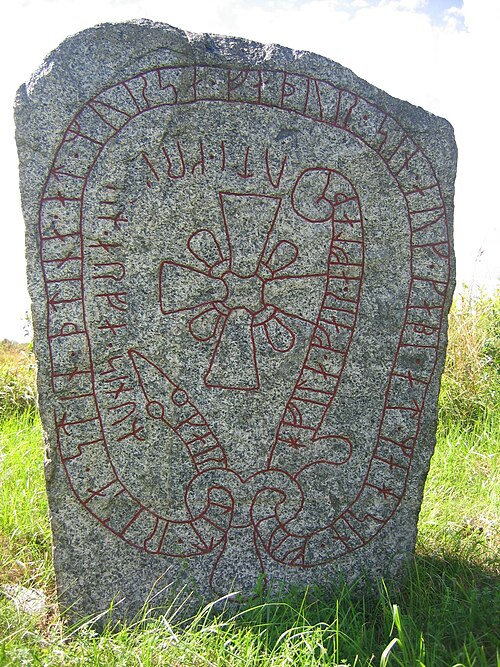
Runestone U 792 (location) is in the Fp style and is attributed to the runemaster Balli.[79] The stone is in grey granite and it measures 1.65 m (5 ft 5 in) in height and 1.19 m (3 ft 11 in) in width.[80] It was originally raised together with a second runestone, with one on each side of the Eriksgata where the road passed a ford,[38] c. 300 m (980 ft) west of where the farm Ulunda is today.[81] The Eriksgata was the path that newly elected Swedish kings passed when they toured the country in order to be accepted by the local assemblies.[38] The stone was first documented by Johannes Bureus in the 17th century, and later in the same century by Johan Peringskiöld, who considered it to be a remarkable stone raised in memory of a petty king, or war chief, in pagan times. When Richard Dybeck visited the stone, in 1863, it was reclining considerably,[81] and in 1925, the stone was reported to have completely fallen down at the bank of the stream. It was not until 1946 that the Swedish National Heritage Board arranged to have it re-erected.[80] It was raised in memory of a man (probably Haursi) by his son, Kárr, and his brother-in-law. Haursi had returned from Greece a wealthy man, which left his son heir to a fortune.[30][82]
kar
Karr
lit
let
*
risa
ræisa
*
stin
stæin
*
þtina
þenna
*
at
at
*
mursa
Horsa(?),
*
faþur
faður
*
sin
sinn,
*
auk
ok
*
kabi
Kabbi(?)/Kampi(?)/Kappi(?)/Gapi(?)
*
at
at
*
mah
mag
sin
sinn.
*
fu-
Fo[r]
hfila
hæfila,
*
far
feaʀ
*
aflaþi
aflaði
ut
ut
i
i
*
kri[k]um
Grikkium
*
arfa
arfa
*
sinum
sinum.
kar lit * risa * stin * þtina * at * mursa * faþur * sin * auk * kabi * at * mah sin * fu- hfila * far * aflaþi ut i * kri[k]um * arfa * sinum
Karr let {} ræisa {} stæin {} þenna {} at {} Horsa(?), {} faður {} sinn, {} ok {} Kabbi(?)/Kampi(?)/Kappi(?)/Gapi(?) {} at {} mag sinn. {} Fo[r] hæfila, {} feaʀ {} aflaði ut i {} Grikkium {} arfa {} sinum.
"Kárr had this stone raised in memory of Haursi(?), his father; and Kabbi(?)/Kampi(?)/Kappi(?)/Gapi(?) in memory of his kinsman-by-marriage. (He) travelled competently; earned wealth abroad in Greece for his heir."[79]
U 922

Runestone U 922 (location) is in the Pr4 (Urnes) style[83] and it measures 2.85 m (9 ft 4 in) in height and 1.5 m (4 ft 11 in) in width.[84] It is hidden inside the floor in Uppsala Cathedral, next to the tomb of king Gustav Vasa of Sweden. Its existence was first documented by Johannes Bureus in 1594, and in 1666, Johannes Schefferus commented on the stone as one of many runestones that had been perceived as heathen and which had therefore been used as construction material for the cathedral. Schefferus considered U 922 to be the most notable of these stones and regretted that it could not be read entirely, as parts were under the pillar.[85] In 1675, Olof Verelius discovered that it had been made in memory of a traveller to Greece,[86] but still the French traveller Aubrey de la Motraye wrote home, in 1712, that he had been informed that it had been made in memory of a traveller to Jerusalem.[87] The last scholar to report that the inscription was visible was Olof Celsius in 1729, and it appears that it was soon covered by a new layer of floor. In 1950, professor Elias Wessén and the county custodian of antiquities requested that it be removed for better analysis together with three other runestones, but the Royal Board of Construction (KBS) rejected the request because of safety concerns.[88]
Ígulbjörn also appears on a second runestone in Uppsala Cathedral, U 925, made by Ígulbjörn in memory of his son Gagʀ who died "in the South", with "South" likely referring to the Byzantine Empire.[89][90]
ikimuntr
Ingimundr
'
uk
ok
þorþr
Þorðr,
*
[iarl
Iarl
'
uk
ok
uikibiarn
Vigbiorn(?)
*
litu
letu
'
risa
ræisa
*
stain
stæin
'
at]
at
ikifast
Ingifast,
*
faþur
faður
[*
sin
sinn,
sturn*maþr
styrimaðr,
']
sum
sum
'
for
for
'
til
til
*
girkha
Girkia
'
hut
ut,
'
sun
sunn
'
ionha
Iona(?),
*
uk
ok
*
at
at
*
igulbiarn
Igulbiorn.
*
in
En
ybiʀ
Øpiʀ
[*
risti
risti.
*]
ikimuntr ' uk þorþr * [iarl ' uk uikibiarn * litu ' risa * stain ' at] ikifast * faþur [* sin sturn*maþr '] sum ' for ' til * girkha ' hut ' sun ' ionha * uk * at * igulbiarn * in ybiʀ [* risti *]
Ingimundr {} ok Þorðr, {} Iarl {} ok Vigbiorn(?) {} letu {} ræisa {} stæin {} at Ingifast, {} faður {} sinn, styrimaðr, {} sum {} for {} til {} Girkia {} ut, {} sunn {} Iona(?), {} ok {} at {} Igulbiorn. {} En Øpiʀ {} risti. {}
"Ingimundr and Þórðr (and) Jarl and Vígbjôrn(?) had the stone raised in memory of Ingifastr, their father, a captain who travelled abroad to Greece, Ióni's(?) son; and in memory of Ígulbjôrn. And Œpir carved."[83]
U 956
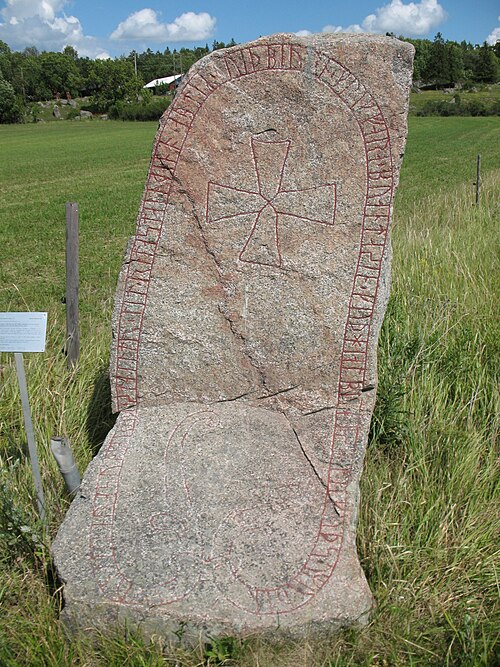
Runestone U 956 (location) was carved by the runemasterÅsmund Kåresson in runestone style Pr3 or Urnes style.[91] It is one of two surviving inscriptions that indicate Åsmund's patronym, the other being GS 11 in Järvsta.[92] This stone is raised at Vedyxa near Uppsala, about 80 m (260 ft) east of the crossroads of the road to Lövsta and the country road between Uppsala and Funbo.[93] The stone is in grey granite and it has an unusual shape with two flat surfaces and an obtuse angle between them. The inscription is 2.27 m (7 ft 5 in) high, of which the upper part is 1.37 m (4 ft 6 in) and the lower part 0.9 m (2 ft 11 in), and the width is 0.95 m (3 ft 1 in).[94]
U 956 was first documented by Johannes Haquini Rhezelius (d. 1666), and later by Johan Peringskiöld (1710), who commented that the inscription was legible in spite of the stone having been split in two parts. Unlike modern scholars, Peringskiöld connected this stone, like the other Greece runestones, to the Gothic wars in south-eastern Europe from the 3rd century and onwards.[95]Olof Celsius visited the stone three times, and the last time was in 1726 together with his nephew Anders Celsius. Olof Celsius noted that Peringskiöld had been wrong and that the stone was intact, although it gives an impression of being split in two,[96] and the same observation was made by Richard Dybeck in 1866.[93]
'
stniltr
Stæinhildr
'
lit
let
*
rita
retta
stain
stæin
þino
þenna
'
abtiʀ
æptiʀ
'
uiþbiurn
Viðbiorn
'
krikfara
Grikkfara,
'
buanta
boanda
sin
sinn.
kuþ
Guð
hialbi
hialpi
hos|
hans
|salu|
salu
|uk|
ok
|kuþs
Guðs
u
⟨u⟩
muþiʀ
moðiʀ.
osmuntr
Asmundr
kara
Kara
sun
sunn
markaþi
markaði.
' stniltr ' lit * rita stain þino ' abtiʀ ' uiþbiurn ' krikfara ' buanta sin kuþ hialbi hos| |salu| |uk| |kuþs u muþiʀ osmuntr kara sun markaþi
{} Stæinhildr {} let {} retta stæin þenna {} æptiʀ {} Viðbiorn {} Grikkfara, {} boanda sinn. Guð hialpi hans salu ok Guðs ⟨u⟩ moðiʀ. Asmundr Kara sunn markaði.
"Steinhildr had this stone erected in memory of Viðbjôrn, her husband, a traveller to Greece. May God and God's mother help his soul. Ásmundr Kári' son marked."[91]
U 1016

Runestone U 1016 (location) is in light grey and coarse granite, and it is 1.91 m (6 ft 3 in) high and 1.62 m (5 ft 4 in) wide.[97] The stone stands in a wooded field 5 m (16 ft) west of the road to the village Fjuckby, 50 m (160 ft) of the crossroads, and about 100 m (330 ft) south-south-east of the farm Fjuckby.[97] The first scholar to comment on the stone was Johannes Bureus, who visited the stone on 19 June 1638. Several other scholars visited the stone during the following centuries, such as Rhezelius in 1667, Peringskiöld in 1694, and Olof Celsius in 1726 and in 1738. In 1864, Richard Dybeck noted that the runestone was one of several in the vicinity that had been raised anew during the summer.[97]
Parts of the ornamentation have been lost due to flaking, which probably happened during the 17th century, but the inscription is intact.[97] The art on the runestone has tentatively been classified under style Pr2,[98] but Wessén & Jansson (1953–1958) comment that the ornamentation is considered unusual and it is different from that on most other runestones in the district. Other stones in the same style are the Vang stone and the Alstad stone in Norway, and Sö 280 and U 1146 in Sweden. The style was better suited for wood and metal and it is likely that only few runemasters ever tried to apply it on stone.[99]
Similar the inscription on U 1011, this runic inscription uses the term stýrimaðr as a title that is translated as "captain".[100] Other runestones use this term apparently to describe working as a steersman on a ship.[100] There have been several different interpretations of parts of the inscription,[101] but the following two interpretations appear in Rundata (2008):[98]
*
liutr
Liutr
:
sturimaþr
styrimaðr
*
riti
retti
:
stain
stæin
:
þinsa
þennsa
:
aftir
æftiʀ
:
sunu
sunu
*
sina
sina.
:
sa
Sa
hit
het
:
aki
Aki,
:
sims
sem's
uti
uti
furs
fors.
:
sturþ(i)
Styrði
*
-(n)ari
[k]nærri,
*
kuam
kvam
*:
hn
hann
krik*:hafnir
Grikkhafniʀ,
:
haima
hæima
tu
do
:
...-mu-...
...
...(k)(a)(r)...
...
(i)uk
hiogg(?)
(r)(u)-(a)
ru[n]aʀ(?)
*
...
...
* liutr : sturimaþr * riti : stain : þinsa : aftir : sunu * sina : sa hit : aki : sims uti furs : sturþ(i) * -(n)ari * kuam *: hn krik*:hafnir : haima tu : ...-mu-... ...(k)(a)(r)... (i)uk (r)(u)-(a) * ...
{} Liutr {} styrimaðr {} retti {} stæin {} þennsa {} æftiʀ {} sunu {} sina. {} Sa het {} Aki, {} sem's uti fors. {} Styrði {} [k]nærri, {} kvam {} hann Grikkhafniʀ, {} hæima do {} ... ... hiogg(?) ru[n]aʀ(?) {} ...
"Ljótr the captain erected this stone in memory of his sons. He who perished abroad was called Áki. (He) steered a cargo-ship; he came to Greek harbours; died at home ... ... cut the runes ..."
*
liutr
Liutr
:
sturimaþr
styrimaðr
*
riti
retti
:
stain
stæin
:
þinsa
þennsa
:
aftir
æftiʀ
:
sunu
sunu
*
sina
sina.
:
sa
Sa
hit
het
:
aki
Aki,
:
sims
sem's
uti
uti
furs
fors.
:
sturþ(i)
Styrði
*
-(n)ari
[k]nærri,
*
kuam
kvam
*:
hn
hann
krik
Grikkia.
*
:
hafnir
Hæfniʀ,
:
haima
hæima
tu
do
:
...-mu-...
...
...(k)(a)(r)...
...
(i)uk
hiogg(?)
(r)(u)-(a)
ru[n]aʀ(?)
*
...
...
* liutr : sturimaþr * riti : stain : þinsa : aftir : sunu * sina : sa hit : aki : sims uti furs : sturþ(i) * -(n)ari * kuam *: hn krik * : hafnir : haima tu : ...-mu-... ...(k)(a)(r)... (i)uk (r)(u)-(a) * ...
{} Liutr {} styrimaðr {} retti {} stæin {} þennsa {} æftiʀ {} sunu {} sina. {} Sa het {} Aki, {} sem's uti fors. {} Styrði {} [k]nærri, {} kvam {} hann Grikkia. {} {} Hæfniʀ, {} hæima do {} ... ... hiogg(?) ru[n]aʀ(?) {} ...
"Ljótr the captain erected this stone in memory of his sons. He who perished abroad was called Áki. (He) steered a cargo-ship; he came to Greece. Hefnir died at home ... ... cut the runes ..."[98]
U 1087

Runestone U 1087 (former location) was an unusually large and imposing runestone[102] in the Urnes (Pr4) style, but it has disappeared.[103] Before it was lost, it was studied and described by several scholars including Bureus, Rhezelius, Peringskiöld and lastly by Olof Celsius in 1726.[104]
Peringskiöld commented that the stone was reclining backwards in a hop-garden at the eastern farm of Lövsta, which was later confirmed by Celius in 1726. Stolpe tried to find it, but noted in 1869 that the landowner knew of the runestone, but that the latter had reported it to be completely covered in soil, and in 1951, a runologist tried to locate the runestone but failed.[105]
The inscription had an unusual dotted k-rune in girkium ("Greece") which it had in common with U 922, above,[102] but the only difficulty that has arisen in the interpretation of the runes is the sequence onar. Rhezelius read it as a name, Onarius, which would have belonged to a third son, whereas Verelius, Peringskiöld, Dijkman and Celsius interpreted it as the pronoun annarr meaning "the other" and referring to Ótryggr, an interpretation supported by Wessén and Jansson (1953–1958),[106] and by Rundata (see below).
[fastui
Fastvi
*
lit
let
*
risa
ræisa
stain
stæin
*
iftiʀ
æftiʀ
*
karþar
Gærðar
*
auk
ok
*
utirik
Otrygg,
suni
syni
*
sino
sina.
*
onar
Annarr
uarþ
varð
tauþr
dauðr
i
i
girkium
Grikkium.
*]
[fastui * lit * risa stain * iftiʀ * karþar * auk * utirik suni * sino * onar uarþ tauþr i girkium *]
Fastvi {} let {} ræisa stæin {} æftiʀ {} Gærðar {} ok {} Otrygg, syni {} sina. {} Annarr varð dauðr i Grikkium. {}
"Fastvé had the stone raised in memory of Gerðarr and Ótryggr, her sons. The other (= the latter) died in Greece."[103]
Södermanland
There are seven runestones in Södermanland that relate of voyages to Greece. Two of them appear to mention commanders of the Varangian Guard, and a second talks of a thegn, a high-ranking warrior, who fought and died alongside Greeks.
Sö Fv1954;20

The runestone Sö Fv1954;20 (location) was discovered in 1952 approximately 500 m (1,600 ft) west-south-west of Nolinge manor during the plowing of a field, together with an uninscribed stone. It was consequently part of a twin monument and they had been positioned about 2–3 m apart on both sides of a locally important road, where they had marked a ford. Both stones had lost their upper parts and the present height of the runestone is 1.52 m (5 ft 0 in) (of which 1.33 m (4 ft 4 in) is above ground) and it is 0.55 m (1 ft 10 in) wide.[107] It is classified as being carved in runestone style Fp.[108]
biurn
Biorn
:
lit
let
:
risa
ræisa
:
stin
stæin
:
i(f)...
æf[tiʀ]
...
...
...
...
...r
[dauð]r
:
austr
austr
:
i
i
:
kirikium
Grikkium.
:
biurn
Biorn
hik
hiogg.
biurn : lit : risa : stin : i(f)... ... ... ...r : austr : i : kirikium : biurn hik
Biorn {} let {} ræisa {} stæin {} æf[tiʀ] ... ... [dauð]r {} austr {} i {} Grikkium. {} Biorn hiogg.
"Bjôrn had the stone raised in memory of ... ... died in the east in Greece. Bjôrn cut."[108]
Sö 82
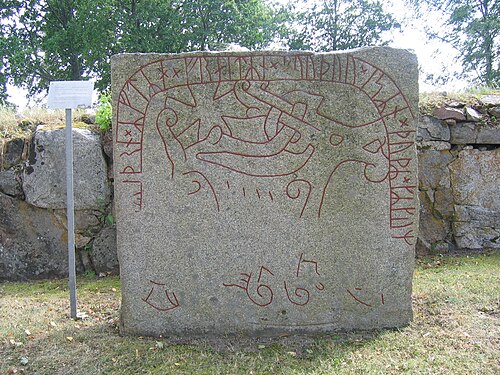
Runestone Sö 82 (location) is in granite, and it measures 1.18 m (3 ft 10 in) in height and it is 1.30 m (4 ft 3 in) wide.[109] It was formerly under a wooden threshold inside Tumbo church, and the upper part was hidden under the wall of the atrium. Most of the inscription and the artwork have been destroyed,[109] but what remains is classified as either style Fp or Pr1 (Ringerike style).[110] The inscription partly consists of cipher runes.[109]
The stone was raised by Vésteinn in memory of his brother Freysteinn who died in Greece, and according to Omeljan Pritsak, Freysteinn was the commander of a retinue.[89] The wolf-beast image in the center of Sö 82 touches the inscription at the name Freysteinn and has its jaws at the word for "was dead" or "died." Since one known kenning in Old Norse poetry for being killed in battle was that the "wolf was fed," the combination of the text and imagery suggests that Freysteinn had died in battle in Greece.[111]
Although the memorial stone image includes a Christian cross, the two personal names in the inscription both refer to Norse paganism. Þorsteinn includes as a name element the god Thor and means "Thor's stone,"[112] while Vésteinn includes the word vé, a temple or sanctuary, and when used in a personal name means "holy," giving the name the meaning "holy stone."[113]
[+]
ui—(a)n
Vi[st]æinn
[×
(b)a-]iʀ
⟨ba-iʀ⟩
×
(i)þrn
⟨iþrn⟩
+
ʀftʀh
æftiʀ
×
fraitʀn
Frøystæin,
×
bruþur
broður
×
[is](ʀ)n
sinn,
×
þuþʀ
dauðr
×
[i]
kʀkum
Grikkium.
(×)
[þulʀ
Þuli(?)/Þulʀ(?)
×
iuk
hiogg
×
uln
⟨uln⟩.
×]
[+] ui—(a)n [× (b)a-]iʀ × (i)þrn + ʀftʀh × fraitʀn × bruþur × [is](ʀ)n × þuþʀ × kʀkum (×) [þulʀ × iuk × uln ×]
{} Vi[st]æinn {} ⟨ba-iʀ⟩ {} ⟨iþrn⟩ {} æftiʀ {} Frøystæin, {} broður {} sinn, {} dauðr [i] Grikkium. {} Þuli(?)/Þulʀ(?) {} hiogg {} ⟨uln⟩. {}
"Vésteinn ... in memory of Freysteinn, his brother, (who) died in Greece. Þuli(?)/Þulr(?) cut ..."[110]
Sö 85

Runestone Sö 85 (location) is a runestone in style KB[114] that measures 1.23 m (4 ft 0 in) in height.[115] The granite stone was discovered at a small brook, but in 1835 the runestone was destroyed. Some pieces were brought to Munkhammar and Mälhammar where they were used for the construction of fireplaces. Seven remaining pieces were brought to Västerby in 1855 in order to be protected by a fence, but when a scholarly enquiry took place in 1897, only four pieces remained. An association of local antiquarians arranged for the four remaining parts to be reassembled at Västerby.[115]
:
ansuar
Andsvarr
:
auk
ok
:
ern...
Ærn...
...
...
[:
faþur
faður
sin
sinn.
:
han
Hann
:
enta]þis
ændaðis
:
ut
ut
i
i
:
krikum
Grikkium
(r)uþr
...
:
—...unk——an——
...
: ansuar : auk : ern... ... [: faþur sin : han : enta]þis : ut i : krikum (r)uþr : —...unk——an——
{} Andsvarr {} ok {} Ærn... ... {} faður sinn. {} Hann {} ændaðis {} ut i {} Grikkium ... {} ...
"Andsvarr and Ern-... ... their father. He met his end abroad in Greece. ... ..."[114]
Sö 163

Runestone Sö 163 (location) is in the style Fp[116] and it is of grey gneiss[117] measuring 1.22 m (4 ft 0 in) in height and 1 m (3 ft 3 in) in width.[118] The runestone was first documented during the national search for historic monuments in 1667–84 and Peringskiöld noted that it was near the village of Snesta between Ryckesta and the highway. In 1820, the stone was reported to be severely damaged and mostly hidden in the ground due to its being on the side of a local road. George Stephens reported in 1857 that its former position had been on a barrow at a small path near Ryckesta, but that it had been moved in 1830 to the avenue of the manor Täckhammar and reerected on a wooded slope some 14 paces from the entrance to the highway.[118]
The man who raised the stone is named with the runes þruʀikr and the name was identified as Þrýríkr by Sophus Bugge who identified the first element of the name as the noun þrýð- that would be derived from a *þrūði- and correspond to Old English þrýðu ("power", "force"). The Old English form is cognate with the Old Icelandic element þrúð- ("force") which appears in several Old Norse words in connection with the Norse god Thor. This analysis was accepted by Brate & Wessén although they noted that the name contains ʀ instead of the expected r,[117] whereas the Rundata corpus gives the slightly different form Þryðríkr.[116]
The stone was raised in memory of two sons, one of whom went to Greece where he "divided up gold", an expression that also appears on runestone Sö 165, below. This can either mean that he was responsible for distributing payment to the members of the Varangian Guard or that he took part in the division of loot.[119] Düwel has suggested that the expression is the eastern route equivalent of gjaldi skifti ("divided payment") which appears in the nearby stone Sö 166 that talks of payments to Vikings in England (see also U 194, U 241 and U 344). If so, the expression could mean that the man who was commemorated had received payment.[120]
þruʀikr
Þryðrikʀ
:
stain
stæin
:
at
at
:
suni
syni
:
sina
sina,
:
sniala
snialla
:
trakia
drængia,
:
for
for
:
ulaifr
Olæifʀ/Gullæifʀ
:
i
i
:
krikium
Grikkium
:
uli
gulli
:
sifti
skifti.
:
þruʀikr : stain : at : suni : sina : sniala : trakia : for : ulaifr : i : krikium : uli : sifti :
Þryðrikʀ {} stæin {} at {} syni {} sina, {} snialla {} drængia, {} for {} Olæifʀ/Gullæifʀ {} i {} Grikkium {} gulli {} skifti. {}
"Þryðríkr (raised) the stone in memory of his sons, able valiant men. Óleifr/Gulleifr travelled to Greece, divided (up) gold."[116]
Sö 165

Runestone Sö 165 (location) is tentatively categorised as being in the RAK style.[121] It is of grey granite and is 1.61 m (5 ft 3 in) tall and 0.57 m (1 ft 10 in) wide.[122] The runestone was first documented during the national search for historic monuments (1667–81) and then it was raised near a number of raised stones. Later the runestone was moved and raised beside Sö 166 at a ditch southwest of Grinda farm.[122]
It was raised by a mother, Guðrun, in memory of her son, Heðinn. Like runestone Sö 163, it also reports that the man concerned went to Greece and "divided up gold" which may refer to distributing payment to members of the Varangian guard, the division of loot[119] or having received payment (compare Sö 163, above).[120] The inscription itself is a poem in fornyrðislag.[119][122]
kuþrun
Guðrun
:
raisti
ræisti
:
stain
stæin
:
at
at
:
hiþin
Heðin,
:
uaʀ
vaʀ
:
nafi
nefi
suais
Svæins.
:
uaʀ
Vaʀ
:
han
hann
::
i
i
:
krikum
Grikkium,
iuli
gulli
skifti
skifti.
:
kristr
Kristr
:
hialb
hialp
:
ant
and
:
kristunia
kristinna.
:
kuþrun : raisti : stain : at : hiþin : uaʀ : nafi suais : uaʀ : han :: i : krikum iuli skifti : kristr : hialb : ant : kristunia :
Guðrun {} ræisti {} stæin {} at {} Heðin, {} vaʀ {} nefi Svæins. {} Vaʀ {} hann {} i {} Grikkium, gulli skifti. {} Kristr {} hialp {} and {} kristinna. {}
"Guðrún raised the stone in memory of Heðinn; (he) was Sveinn's nephew. He was in Greece, divided (up) gold. May Christ help Christians' spirits."[121]
Sö 170

Runestone Sö 170 in grey granite is raised north of the former road in Nälberga (location), and the stone is 1.85 m (6 ft 1 in) tall and 0.80 m (2 ft 7 in) wide.[123] Its style is tentatively given as RAK, and some of the runes are cipher runes in the form of branch runes.[124] The runic text tells that a man named Báulfr died with the Greeks at a location that has not been clearly identified through several analyses of the cipher runes. Läffler (1907) suggested that the location is to be read Ίθὡμη which is the Greek name for the town and stronghold Ithomi, Messenia, also called Θὡμη.[125] Báulfr is described as being þróttar þegn or a thegn of strength. The term thegn describes a class of retainer. The phrase þróttar þegn is used on six other runestones,[126] Sö 90 in Lövhulta, Sö 112 in Kolunda, Sö 151 in Lövsund, and Sö 158 in Österberga, and, in its plural form at Sö 367 in Släbro and Sö Fv1948;295 in Prästgården.
Omeljan Pritsak (1981) comments that among those who raised the memorial, the youngest son Guðvér would become the commander of the Varangian Guard in the mid-11th century, as shown in a second mention of Guðvér on the runestone Sö 217. That stone was raised in memory of one of the members of Guðvér's retinue.[41]
:
uistain
Vistæinn,
:
agmunr
Agmundr,
:
kuþuiʀ
Guðveʀ,
:
þaiʀ
þæiʀ
:
r...(s)þu
r[æi]sþu
:
stain
stæin
:
at
at
:
baulf
Baulf,
:
faþur
faður
sin
sinn,
þrutaʀ
þrottaʀ
þiagn
þiagn.
han
Hann
miþ
með
kriki
Grikki
uarþ
varð,
tu
do
o
a
/þum
/⟨þum⟩
þa/þumþa
þa/⟨þumþa⟩.
: uistain : agmunr : kuþuiʀ : þaiʀ : r...(s)þu : stain : at : baulf : faþur sin þrutaʀ þiagn han miþ kriki uarþ tu o /þum þa/þumþa
{} Vistæinn, {} Agmundr, {} Guðveʀ, {} þæiʀ {} r[æi]sþu {} stæin {} at {} Baulf, {} faður sinn, þrottaʀ þiagn. Hann með Grikki varð, do a /⟨þum⟩ þa/⟨þumþa⟩.
"Vésteinn, Agmundr (and) Guðvér, they raised the stone in memory of Báulfr, their father, a Þegn of strength. He was with the Greeks; then died with them(?) / at ⟨þum⟩."[124]
Sö 345

Runestone Sö 345 (location) was first documented during the national search for historic monuments in 1667, and it was then used as a doorstep to the porch of Ytterjärna church. It had probably been used for this purpose during a considerable period of time, because according to a drawing that was made a few years later, it was very worn down. In 1830 a church revision noted that it was in a ruined state and so worn that only a few runes remained discernible, and when Hermelin later depicted the stone, he noted that the stone had been cracked in two pieces. In 1896, the runologist Erik Brate visited the stone and discovered that one of the pieces had disappeared and that the only remaining part was reclining on the church wall. The remaining piece measured 1.10 m (3 ft 7 in) and 1.15 m (3 ft 9 in).[127] The stone has since then been reassembled and raised on the cemetery.
...
...
...in
[stæ]in
×
þinsa
þennsa
×
at
at
×
kai(r)...
Gæiʀ...
...
...
...-n
[Ha]nn
*
eʀ
eʀ
*
e[n-a]þr
æn[d]aðr
×
ut
ut
–
[i]
×
kr...
Gr[ikkium].
... ...in × þinsa × at × kai(r)... ... ...-n * eʀ * e[n-a]þr × ut – × kr...
... [stæ]in {} þennsa {} at {} Gæiʀ... ... [Ha]nn {} eʀ {} æn[d]aðr {} ut [i] {} Gr[ikkium].
"... this stone in memory of Geir-... ... He had met his end abroad in Greece."[128]
Parts B and C are probably not part of the monument and are not translated.[128]
...
...
...roþur
[b]roður
×
...
...
... ...roþur × ...
... [b]roður {} ...
...
...
...
[let]
raisa
ræisa
:
...
...
... ... raisa : ...
... [let] ræisa {} ...
Östergötland
In Östergötland, there are two runestones that mention Greece. One, the notable Högby Runestone, describes the deaths of several brothers in different parts of Europe.
Ög 81


The Högby runestone (location) is in Ringerike (Pr1) style,[129] and the reddish granite stone measures 3.45 m (11.3 ft) in height and 0.65 m (2 ft 2 in) in width.[130] It was formerly inserted into the outer wall of Högby church with the cross side (A) outwards. The church was demolished in 1874, and then side B of the inscription was discovered. The stone was raised anew on the cemetery of the former church.[130]
The runestone commemorates Özurr, one of the first Varangians known to have died in the service of the Byzantine Emperor, and he is estimated to have died around 1010,[131] or in the late 10th century.[28] He was one of the sons of the "good man" Gulli, and the runestone describes a situation that may have been common for Scandinavian families at this time: the stone was made on the orders of Özur's niece, Þorgerðr, in memory of her uncles who were all dead.[131]
Þorgerðr probably had the stone made as soon as she had learnt that Özurr, the last of her uncles, had died in Greece, and she likely did this to ensure her right of inheritance. The inscription on the reverse side of the stone, relating how her other uncles died, is in fornyrðislag.[132]
Her uncle Ásmundr probably died in the Battle of Fýrisvellir, in the 980s,[133] and it was probably at the side of king Eric the Victorious.[134] Özurr had entered into the service of a more powerful liege and died for the Byzantine Emperor.[135] Halfdan may have died either on Bornholm or in a holmgang, whereas where Kári died remains uncertain. The most likely interpretation may be that he died on Od, the old name for the north-western cape of Zealand,[136] but it is also possible that it was at Dundee in Scotland.[137] Búi's location of death is not given, but Larsson (2002) comments that it was probably in a way that was not considered as glorious as those of his brothers.[136]
*
þukir
Þorgærðr(?)
*
resþi
ræisþi
*
stin
stæin
*
þansi
þannsi
*
eftiʀ
æftiʀ
*
asur
Assur,
*
sen
sinn
*
muþur*bruþur
moðurbroður
*
sin
sinn,
*
iaʀ
eʀ
*
eataþis
ændaðis
*
austr
austr
*
i
i
*
krikum
Grikkium.
*
* þukir * resþi * stin * þansi * eftiʀ * asur * sen * muþur*bruþur * sin * iaʀ * eataþis * austr * i * krikum *
{} Þorgærðr(?) {} ræisþi {} stæin {} þannsi {} æftiʀ {} Assur, {} sinn {} moðurbroður {} sinn, {} eʀ {} ændaðis {} austr {} i {} Grikkium. {}
"Þorgerðr(?) raised this stone in memory of Ôzurr, her mother's brother. He met his end in the east in Greece."
*
kuþr
Goðr
*
karl
karl
*
kuli
Gulli
*
kat
gat
*
fim
fæm
*
syni
syni.
*
feal
Fioll
*
o
a
*
furi
Føri
*
frukn
frøkn
*
treks
drængʀ
*
asmutr
Asmundr,
*
aitaþis
ændaðis
*
asur
Assurr
*
austr
austr
*
i
i
krikum
Grikkium,
*
uarþ
varð
*
o
a
hulmi
Holmi
*
halftan
Halfdan
*
tribin
drepinn,
*
kari
Kari
*
uarþ
varð
*
at
at
uti
Uddi(?)
*
* kuþr * karl * kuli * kat * fim * syni * feal * o * furi * frukn * treks * asmutr * aitaþis * asur * austr * i krikum * uarþ * o hulmi * halftan * tribin * kari * uarþ * at uti *
{} Goðr {} karl {} Gulli {} gat {} fæm {} syni. {} Fioll {} a {} Føri {} frøkn {} drængʀ {} Asmundr, {} ændaðis {} Assurr {} austr {} i Grikkium, {} varð {} a Holmi {} Halfdan {} drepinn, {} Kari {} varð {} at Uddi(?) {}
"The good man Gulli got five sons. The brave valiant man Ásmundr fell at Fœri; Ôzurr met his end in the east in Greece; Halfdan was killed at Holmr (Bornholm?); Kári was (killed) at Oddr(?);"
auk
ok
*
tauþr
dauðr
*
bui
Boi.
*
þurkil
Þorkell
*
rist
ræist
*
runaʀ
runaʀ.
*
auk * tauþr * bui * þurkil * rist * runaʀ *
ok {} dauðr {} Boi. {} Þorkell {} ræist {} runaʀ. {}
"also dead (is) Búi. Þorkell carved the runes."[129]
Ög 94
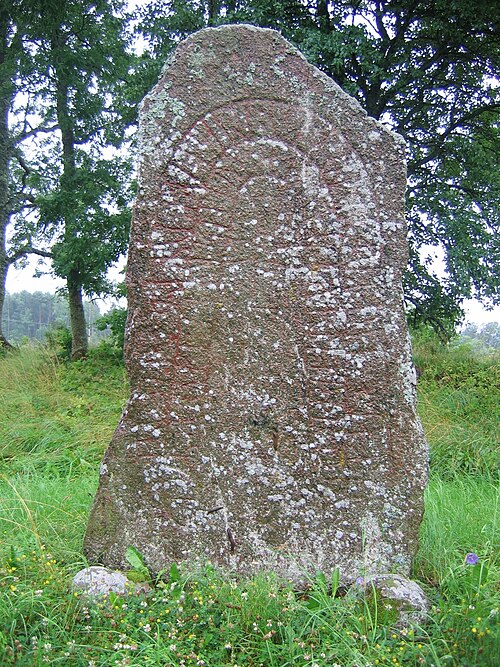
Runestone Ög 94 (location) in the style Ringerike (Pr1),[138] is in reddish granite and it raised on the former cemetery of Harstad church.[139] The stone is 2 m (6 ft 7 in) high and 1.18 m (3 ft 10 in) wide at its base.[140] The toponymHaðistaðir, which is mentioned in the inscription, refers to modern Haddestad in the vicinity, and it also appears to mention Greece as the location where the deceased died, and it was probably as a member of the Varangian guard. Additionally, the last part of the inscription that mentions the location of his death is probably a poem in fornyrðislag.[141]
:
askata
Asgauta/Askatla
:
auk
ok
:
kuþmutr
Guðmundr
:
þau
þau
:
risþu
ræisþu
:
kuml
kumbl
:
þ[i](t)a
þetta
:
iftiʀ
æftiʀ
:
u-auk
O[ddl]aug(?),
:
iaʀ
eʀ
:
buki|
byggi
|i
i
:
haþistaþum
Haðistaðum.
:
an
Hann
:
uaʀ
vaʀ
:
bunti
bondi
:
kuþr
goðr,
:
taþr
dauðr
:
i
i
:
ki[(r)]k[(i)(u)(m)]
Grikkium(?).
: askata : auk : kuþmutr : þau : risþu : kuml : þ[i](t)a : iftiʀ : u-auk : iaʀ : buki| |i : haþistaþum : an : uaʀ : bunti : kuþr : taþr : i : ki[(r)]k[(i)(u)(m)]
{} Asgauta/Askatla {} ok {} Guðmundr {} þau {} ræisþu {} kumbl {} þetta {} æftiʀ {} O[ddl]aug(?), {} eʀ {} byggi i {} Haðistaðum. {} Hann {} vaʀ {} bondi {} goðr, {} dauðr {} i {} Grikkium(?).
"Ásgauta/Áskatla and Guðmundr, they raised this monument in memory of Oddlaugr(?), who lived in Haðistaðir. He was a good husbandman; (he) died in Greece(?)"[138]
Västergötland
In Västergötland, there are five runestones that tell of eastern voyages but only one of them mentions Greece.[142]
Vg 178

Runestone Vg 178 (location) in style Pr1[143] used to be outside the church of Kölaby in the cemetery, some ten metres north-north-west of the belfry. The stone consists of flaking gneiss measuring 1.85 m (6 ft 1 in) in height and 1.18 m (3 ft 10 in) in width.[144]
The oldest annotation of the stone is in a church inventory from 1829, which says that the stone was illegible. Ljungström documented in 1861 that it was in the rock fence with the inscription facing the cemetery. When Djurklou visited the stone in 1869, it was still in the same spot. Djurklou considered its placement to be unhelpful because a part of the runic band was buried in the soil, so he commanded an honourable farmer to select a group of men and remove the stone from the wall. The next time Djurklou visited the location, he found the stone raised in the cemetery.[144]
:
agmuntr
Agmundr
:
risþi
ræisti
:
stin
stæin
:
þonsi
þannsi
:
iftiʀ
æftiʀ
:
isbiurn
Æsbiorn,
:
frinta
frænda
:
sin
sinn,
:
auk
ok
:
(a)(s)(a)
Asa(?)
:
it
at
:
buta
bonda
:
sin
sinn,
:
ian
en
:
saʀ
saʀ
:
uaʀ
vaʀ
:
klbins
Kulbæins
:
sun
sunn.
:
saʀ
Saʀ
:
uarþ
varð
:
tuþr
dauðr
:
i
i
:
krikum
Grikkium.
: agmuntr : risþi : stin : þonsi : iftiʀ : isbiurn : frinta : sin : auk : (a)(s)(a) : it : buta : sin : ian : saʀ : uaʀ : klbins : sun : saʀ : uarþ : tuþr : i : krikum
{} Agmundr {} ræisti {} stæin {} þannsi {} æftiʀ {} Æsbiorn, {} frænda {} sinn, {} ok {} Asa(?) {} at {} bonda {} sinn, {} en {} saʀ {} vaʀ {} Kulbæins {} sunn. {} Saʀ {} varð {} dauðr {} i {} Grikkium.
"Agmundr raised this stone in memory of Ásbjôrn, his kinsman; and Ása(?) in memory of her husbandman. And he was Kolbeinn's son; he died in Greece."[143]
Småland
Only one rune stone in Småland mentioned Greece (see Sm 46, below).
Sm 46

Runestone Sm 46 (location) was in the style RAK[145] and it was 2.05 m (6 ft 9 in) high and 0.86 m (2 ft 10 in) wide.[146]
The stone was already in a ruined state when Rogberg depicted the stone in 1763. Rogberg noted that it had been used as a bridge across a brook and because of this the runes had been worn down so much that most of them were virtually illegible,[147] a statement that is contradicted by later depictions. Since the runestone had passed unnoticed by the runologists of the 17th century, it is likely that it was used as a bridge. In a traveller's journal written in 1792 by Hilfeling, the bottom part of the stone is depicted for the first time, though the artist does not appear to have realised that the two parts belonged together. In 1822, Liljegren arrived to depict it. A surviving yet unsigned drawing is attributed to Liljegren (see illustration). In 1922, the runologist Kinander learnt from a local farmer that some 40 years earlier, the runestone had been seen walled into a bridge that was part of the country road, and the inscription had been upwards. Someone had decided to remove the runestone from the bridge and put it beside the road. Kinander wanted to see the stone and was shown a large worn down stone in the garden of Eriksstad.[148] However, Kinander noted it was not possible to find any remaining runes on what was supposed to be the runestone.[146]
[...nui
...vi
krþi
gærði
:
kubl
kumbl
:
þesi
þessi
:
iftiʀ
æftiʀ
suin
Svæin,
:
sun
sun
:
sin
sinn,
:
im
eʀ
÷
itaþisk
ændaðis
ou*tr
austr
i
i
krikum]
Grikkium.
[...nui krþi : kubl : þesi : iftiʀ suin : sun : sin : im ÷ itaþisk ou*tr i krikum]
...vi gærði {} kumbl {} þessi {} æftiʀ Svæin, {} sun {} sinn, {} eʀ {} ændaðis austr i Grikkium.
"...-vé made these monuments in memory of Sveinn, her son, who met his end in the east in Greece."[145]
Gotland
Only one runestone mentioning the Byzantine Empire has been found on Gotland. This may be because few rune stones were raised on Gotland in favour of image stones, as well as because the Gotlanders dealt mainly in trade, paying a yearly tribute to the Swedes for military protection.[149]
G 216
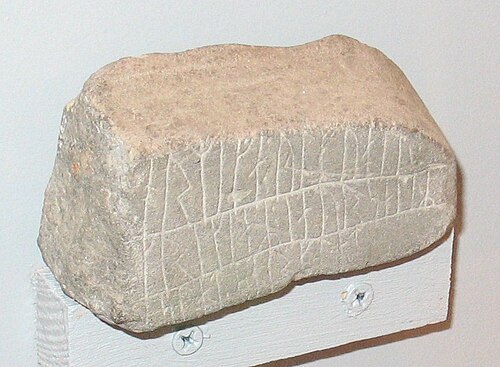
G 216 (original location) is an 8.5 cm (3.3 in) long, 4.5 cm (1.8 in) wide and 3.3 cm (1.3 in) thick sharpening stone with a runic inscription that was discovered in 1940. It was found by a worker at a depth of 40 cm (16 in) while he dug a shaft for a telephone wire in a field at Timans in Roma.[150] It is now at the museum Gotlands fornsal with inventory number C 9181.[150] It has been dated to the late 11th century,[151] and although the interpretation of its message is uncertain, scholars have generally accepted von Friesen's analysis that it commemorates the travels of two Gotlanders to Greece, Jerusalem, Iceland and the Muslim world (Serkland).[152]
The inscription created a sensation as it mentions four distant countries that were the targets of adventurous Scandinavian expeditions during the Viking Age. While it also stirred some doubts about whether it was a forgery, thorough geological and runological analyses corroborated its authenticity. The stone had the same patina as other Viking Age stones on all its surfaces and carvings, and it has the normal r-rune with an open side stroke, something that is usually overlooked by forgerers. Moreover, v Friesen commented that there could be no expert on Old Swedish that made a forgery while he correctly wrote krikiaʀ as all reference books of the time incorrectly told that the form was grikir.[153]
Jansson, Wessén & Svärdström (1978) comment that the personal name that is considered most interesting by scholars is Ormika, which is otherwise only known from the Gutasaga, where it was the name of a free farmer who was baptised by the Norwegian king Saint Olaf in 1029.[154] The first element ormr ("serpent") is well known from the Old Norse naming tradition, but the second element is the West Germanicdiminutive -ikan, and the lack of the final -n suggests a borrowing from Anglo-Saxon or Old Frisian, although the name is unattested in the West Germanic area. The runologists appreciate the appearance of the nominative form Grikkiaʀ ("Greece") as it is otherwise unattested while other case forms are found on a number of runestones. The place name Jerusalem appears in the Old Gutnish form iaursaliʀ while the westernmost dialect of Old Norse, Old Icelandic, has Jórsalir, and both represent a Scandinavian folk etymological rendering where the first element is interpreted as the name element jór- (from an older *eburaz meaning "boar"). The inscription also shows the only runic appearance of the name of Iceland, while there are five other runic inscriptions in Sweden that mention Serkland.[154]
:
ormiga
Ormika,
:
ulfua-r
Ulfhva[t]r(?),
:
krikiaʀ
Grikkiaʀ,
:
iaursaliʀ
Iorsaliʀ,
(:)
islat
Island,
:
serklat
Særkland.
: ormiga : ulfua-r : krikiaʀ : iaursaliʀ (:) islat : serklat
{} Ormika, {} Ulfhva[t]r(?), {} Grikkiaʀ, {} Iorsaliʀ, {} Island, {} Særkland.
"Ormika, Ulfhvatr(?), Greece, Jerusalem, Iceland, Serkland."[155]
See also
Notes
- ↑U 112, U 374, U 540, see Jesch 2001:99
- ↑Ög 81, Ög 94, Sö 82, Sö 163, Sö 165, Sö 170, Sö 345, Sö Fv1954;20, Sm 46, Vg 178, U 73, U 104, U 136, U 140, U 201, U 358, U 431, U 446, U 518, U 792, U 922, U 1016, U 1087, see Jesch 2001:99. Here G 216 is also included, whereas Jesch (2001:99) does not include it. She does not consider it to be monumental (2001:13).
- ↑U 270 and U 956, see Jesch 2001:100
- ↑U 1016, see Jesch 2001:100
- 12Jansson 1980:34
- ↑U 136, U 140, U 201, U 431, U 1016, Ög 81, Ög 94, Vg 178 and possibly on Sö 82 (see Rundata 2.5).
- ↑U 73, U 104, U 112, U 446, U 540, U 922, U 956, and U 1087 (see Rundata 2.5).
- ↑Harrison & Svensson 2007:37
- 123Jansson 1987:43
- ↑Larsson 2002:145
- 123Blöndal & Benedikz 2007:223
- ↑Brate 1922:64
- ↑Jesch 2001:12–13
- 12Jesch 2001:14
- ↑Harrison & Svensson 2007:192
- ↑For a low figure of 9.1% see Appendix 9 in Sawyer 2000, but for the higher figure of 10%, see Harrison & Svensson 2007:196.
- 12Jansson 1987:42
- ↑Jesch 2001:86–87
- ↑Jesch 2001:102–104
- 12Blöndal & Benedikz 2007:224
- ↑Jansson 1980:20–21
- 12Sawyer 2000:16
- ↑Jansson 1987:38, also cited in Sawyer 2000:16
- ↑Sawyer 2000:119
- ↑Sawyer 2000:152
- ↑Antonsen 2002:85
- ↑Att läsa runor och runinskrifter on the site of the Swedish National Heritage Board, retrieved 10 May 2008. Archived 15 June 2007 at the Wayback Machine
- 12345678Rundata
- ↑Rundata 2.5
- 12Harrison & Svensson 2007:34
- 123"U 73". Scandinavian Runic-text Database (2008 ed.).
- 1234Wessén & Jansson 1940–1943:96ff
- ↑Wessén & Jansson 1940–1943:95
- ↑Cf. Jesch (2001:99–100)
- ↑Sawyer 2000:115
- 12Wessén & Jansson 1940–1943:147
- ↑Jansson 1980:21
- 1234Jansson 1980:22
- ↑"U 104". Scandinavian Runic-text Database (2008 ed.).
- 123Enoksen 1998:131
- 12Pritsak 1981:376
- ↑Enoksen 1998:134
- ↑Enoksen 1998:134; Jansson 1980:20; Harrison & Svensson 2007:31; Pritsak 1981:376
- 12Pritsak 1981:389
- ↑Harrison & Svensson 2007:31ff
- ↑"U 112". Scandinavian Runic-text Database (2008 ed.).
- 12"U 136". Scandinavian Runic-text Database (2008 ed.).
- ↑Wessén & Jansson 1940–1943:203
- ↑Wessén & Jansson 1940–1943:202
- ↑Sawyer 2000:97
- 12Jesch 2001:66
- ↑Pritsak 1981:382
- 12"U 140". Scandinavian Runic-text Database (2008 ed.).
- ↑Wessén & Jansson 1940–1943:205
- 12"U 201". Scandinavian Runic-text Database (2008 ed.).
- 12Wessén & Jansson 1940–1943:302
- ↑Wessén & Jansson 1940–1943:304
- ↑Wessén & Jansson 1940–1943:440
- ↑Wessén & Jansson 1940–1943:440; Pritsak 1981:380
- ↑"U 270". Scandinavian Runic-text Database (2008 ed.).
- 12"U 358". Scandinavian Runic-text Database (2008 ed.).
- 12Wessén & Jansson 1943–1946:108ff
- ↑Wessén & Jansson 1943–1946:128
- 12"U 374". Scandinavian Runic-text Database (2008 ed.).
- 12Wessén & Jansson 1943–1946:221
- 12"U 431". Scandinavian Runic-text Database (2008 ed.).
- ↑Wessén & Jansson 1943–1946:222
- 12Wessén & Jansson 1943–1946:243
- 123"U 446". Scandinavian Runic-text Database (2008 ed.).
- ↑Pritsak 1981:362, 378
- 123"U 518". Scandinavian Runic-text Database (2008 ed.).
- ↑Wessén & Jansson 1943–1946:376
- ↑Wessén & Jansson 1943–1946:378
- 12"U 540". Scandinavian Runic-text Database (2008 ed.).
- ↑Wessén & Jansson 1943–1946:422
- 12Wessén & Jansson 1943–1946:423
- ↑E.g. Braun 1910:99–118, Wessén & Jansson 1943–1946:426ff, and Pritsak 1981:376, 425, 430ff
- ↑Nordisk runnamnslexikon
- 12"U 792". Scandinavian Runic-text Database (2008 ed.).
- 12Wessén & Jansson 1949–1951:380
- 12Wessén & Jansson 1949–1951:379
- ↑Jesch 2001:100
- 12"U 922". Scandinavian Runic-text Database (2008 ed.).
- ↑Wessén & Jansson 1953–1958:9
- ↑Wessén & Jansson 1953–1958:5
- ↑Wessén & Jansson 1953–1958:5ff
- ↑Wessén & Jansson 1953–1958:7
- ↑Wessén & Jansson 1953–1958:8
- 12Pritsak 1981:378
- ↑Pritsak 1981:381
- 12"U 956". Scandinavian Runic-text Database (2008 ed.).
- ↑Fuglesang 1998:208
- 12Wessén & Jansson 1953–1958:78ff
- ↑Wessén & Jansson 1953–1958:79
- ↑Wessén & Jansson 1953–1958:80ff
- ↑Wessén & Jansson 1953–1958:78
- 1234Wessén & Jansson 1953–1958:223
- 123"U 1016". Scandinavian Runic-text Database (2008 ed.).
- ↑Wessén & Jansson 1953–1958:231
- 12Jesch 2001:181–184
- ↑For an extensive seven-page discussion on various interpretations, see Wessén & Jansson 1953–1958:224–233
- 12Wessén & Jansson 1953–1958:395
- 12"U 1087". Scandinavian Runic-text Database (2008 ed.).
- ↑Wessén & Jansson 1953–1958:392ff
- ↑Wessén & Jansson 1953–1958:393
- ↑Wessén & Jansson 1953–1958:394ff
- ↑Jansson 1954:19–20
- 12"Sö Fv1954;20". Scandinavian Runic-text Database (2008 ed.).
- 123Brate & Wessén 1924–1936:60
- 12"Sö 82". Scandinavian Runic-text Database (2008 ed.).
- ↑Andrén 2003:411–412.
- ↑Yonge 1884:219, 301.
- ↑Cleasby & Vigfússon 1878:687.
- 12"Sö 85". Scandinavian Runic-text Database (2008 ed.).
- 12Brate & Wessén 1924–1936:62
- 123"Sö 163". Scandinavian Runic-text Database (2008 ed.).
- 12Brate & Wessén 1924–1936:124
- 12Brate & Wessén 1924–1936:123
- 123Pritsak 1981:379
- 12Jesch 2001:99
- 12"Sö 165". Scandinavian Runic-text Database (2008 ed.).
- 123Brate & Wessén 1924–1936:126
- ↑Brate & Wessén 1924–1936:130
- 12"Sö 170". Scandinavian Runic-text Database (2008 ed.).
- ↑Brate & Wessén 1924–1936:131
- ↑Gustavson 1981:196
- ↑Brate & Wessén 1924–1936:335
- 12"Sö 345". Scandinavian Runic-text Database (2008 ed.).
- 12"Ög 81". Scandinavian Runic-text Database (2008 ed.).
- 12Brate 1911–1918:80
- 12Pritsak 1981:375
- ↑Larsson 2002:141
- ↑Brate 1911–1918:81–82
- ↑Larsson 2002:142–143
- ↑Larsson 2002:143–144
- 12Larsson 2002:144
- ↑Brate 1911–1918:83
- 12"Ög 94". Scandinavian Runic-text Database (2008 ed.).
- ↑Brate 1911–1918:93
- ↑Brate 1911–1918:94
- ↑Brate 1911–1918:95
- ↑Jungner & Svärdström 1940–1971:321
- 12"Vg 178". Scandinavian Runic-text Database (2008 ed.).
- 12Jungner & Svärdström 1940–1971:320
- 12"Sm 46". Scandinavian Runic-text Database (2008 ed.).
- 12Kinander 1935–1961:145
- ↑Kinander 1935–1961:143
- ↑Kinander 1935–1961:144
- ↑See the Gutasaga.
- 12Jansson, Wessén & Svärdström 1978:233
- ↑Jansson, Wessén & Svärdström 1978:238
- ↑Jansson, Wessén & Svärdström 1978:236
- ↑Jansson, Wessén & Svärdström 1978:234
- 12Jansson, Wessén & Svärdström 1978:235
- ↑"G 216". Scandinavian Runic-text Database (2008 ed.).
Sources
- Andrén, Anders (2003). "The Meaning of Animal Art: An Interpretation of Scandinavian Rune-Stones". In Veit, Ulrich (ed.). Spuren und Botschaften: Interpretationen Materieller Kultur. Waxmann Verlag. ISBN 3-8309-1229-3.
- Antonsen, Elmer H. (2002). Runes and Germanic Linguistics. Mouton de Gruyter. ISBN 3-11-017462-6.
- Blöndal, S. & Benedikz, B. (2007). The Varangians of Byzantium. Cambridge University Press. ISBN 0-521-03552-X, 9780521035521
- (in Swedish) Brate, Erik. (1922). Sverges Runinskrifter. Natur & Kultur, Stockholm.
- Brate, Erik (1911–1918). "Sveriges Runinskrifter: II. Östergötlands Runinskrifter". Sveriges Runinskrifter (in Swedish). Stockholm: Kungl. Vitterhets Historie och Antikvitets Akademien. ISSN 0562-8016.
- Brate, Erik; Elias Wessen (1924–1936). "Sveriges Runinskrifter: III. Södermanlands Runinskrifter". Sveriges Runinskrifter (in Swedish). Stockholm: Kungl. Vitterhets Historie och Antikvitets Akademien. ISSN 0562-8016.
- Braun, F. (1910). "Hvem var Yngvarr enn Vidforli? ett Bidrag till Sveriges Historia Under xi århundradets Första Hälft". Fornvännen (in Swedish). 5. Swedish National Heritage Board: 99–118. ISSN 1404-9430. Retrieved 9 September 2010.
- Cleasby, Richard; Vigfússon, Guðbrandur (1878). An Icelandic–English Dictionary. Clarendon Press.
- Peterson, Lena; Elmevik, Lennart; Williams, Henrik, eds. (3 December 2008). Scandinavian Runic-text Database (2008 ed.). Department of Scandinavian Languages, Uppsala University.
- (in Swedish)Enoksen, Lars Magnar. (1998). Runor: Historia, Tydning, Tolkning. Historiska Media, Falun. ISBN 91-88930-32-7
- Fuglesang, Signe Horne (1998). "Swedish Runestones of the Eleventh Century". In Beck, Heinrich; Düwel, Klaus; et al. (eds.). Runeninschriften als Quellen Interdisziplinärer Forschung. Berlin: Walter de Gruyter. pp. 197–208. ISBN 3-11-015455-2.
- Gustavson, Helmer; Snaedal Brink, T. (1981). "Runfynd 1980"(PDF). Fornvännen. 76. Swedish National Heritage Board: 186–202. ISSN 1404-9430. Retrieved 24 August 2010.
- (in Swedish) Harrison, D. & Svensson, K. (2007). Vikingaliv. Fälth & Hässler, Värnamo. ISBN 978-91-27-35725-9.
- Jansson, Sven B. F. (1954). "Uppländska, Småländska och Sörmländska Runstensfynd"(PDF). Fornvännen (in Swedish). 49. Swedish National Heritage Board: 1–25. ISSN 1404-9430. Retrieved 4 September 2010.
- Jansson, Sven B. F.; Wessen, Elias; Svärdström, Elisabeth (1978). Sveriges Runinskrifter: XII. Gotlands Runinskrifter del 2 (in Swedish). Stockholm: Kungl. Vitterhets Historie och Antikvitets Akademien. ISBN 91-7402-056-0. ISSN 0562-8016.
- (in Swedish) Jansson, Sven B. F. (1980). Runstenar. STF, Stockholm. ISBN 91-7156-015-7.
- Jansson, Sven B. F. (1987, 1997). Runes in Sweden. Royal Academy of Letters, History and Antiquities. Central Board of National Antiquities. Gidlunds. ISBN 91-7844-067-X
- Jesch, Judith (2001). Ships and Men in the Late Viking Age: The Vocabulary of Runic Inscriptions and Skaldic Verse. Boydell Press. ISBN 0-85115-826-9.
- Jungner, Hugo; Elisabeth Svärdström (1940–1971). "Sveriges Runinskrifter: V. Västergötlands Runinskrifter". Sveriges Runinskrifter (in Swedish). Stockholm: Kungl. Vitterhets Historie och Antikvitets Akademien. ISSN 0562-8016.
- Kinander, Ragnar (1935–1961). "Sveriges Runinskrifter: IV. Smålands Runinskrifter". Sveriges Runinskrifter (in Swedish). Stockholm: Kungl. Vitterhets Historie och Antikvitets Akademien. ISSN 0562-8016.
- (in Swedish) Larsson, Mats G. (2002). Götarnas Riken : Upptäcktsfärder Till Sveriges Enande. Bokförlaget Atlantis AB ISBN 978-91-7486-641-4
- (in Swedish) Peterson, Lena (2002). Nordiskt Runnamnslexikon at the Swedish Institute for Linguistics and Heritage (Institutet för Språk och Folkminnen).
- Pritsak, Omeljan. (1981). The Origin of Rus'. Cambridge, Mass.: Distributed by Harvard University Press for the Harvard Ukrainian Research Institute. ISBN 0-674-64465-4.
- Sawyer, Birgit. (2000). The Viking-Age Rune-Stones: Custom and Commemoration in Early Medieval Scandinavia. Oxford: Oxford University Press. ISBN 0-19-926221-7
- Wessén, E.; Jansson, Sven B. F. (1940–1943). "Sveriges Runinskrifter: VI. Upplands Runinskrifter del 1". Sveriges Runinskrifter (in Swedish). Stockholm: Kungl. Vitterhets Historie och Antikvitets Akademien. ISSN 0562-8016.
- Wessén, Elias; Jansson, Sven B. F. (1943–1946). "Sveriges Runinskrifter: VII. Upplands Runinskrifter del 2". Sveriges Runinskrifter (in Swedish). Stockholm: Kungl. Vitterhets Historie och Antikvitets Akademien. ISSN 0562-8016.
- Wessén, Elias; Jansson, Sven B. F. (1949–1951). "Sveriges Runinskrifter: VIII. Upplands Runinskrifter del 3". Sveriges Runinskrifter (in Swedish). Stockholm: Kungl. Vitterhets Historie och Antikvitets Akademien. ISSN 0562-8016.
- Wessén, Elias; Jansson, Sven B. F. (1953–1958). "Sveriges Runinskrifter: IX. Upplands Runinskrifter del 4". Sveriges Runinskrifter (in Swedish). Stockholm: Kungl. Vitterhets Historie och Antikvitets Akademien. ISSN 0562-8016.
- Yonge, Charlotte Mary (1884). History of Christian Names. London: MacMillan & Company.
External links
- 16th-century archaeological discoveries
- Runestones in memory of Viking warriors
- Runestones in Östergötland
- Runestones in Södermanland
- Runestones in Uppland
- Varangian Guard
- Byzantine Empire-related inscriptions
- Archaeological discoveries in Sweden