
إشارة

الإشارة هي عملية ونتيجة نقل البيانات عبر وسائط معينة ، وذلك من خلال تضمين بعض التغيرات. وتكتسب الإشارات أهمية بالغة في مجالات متعددة، منها معالجة الإشارات ، ونظرية المعلومات ، وعلم الأحياء .
في معالجة الإشارات، تُعرَّف الإشارة بأنها دالة تنقل معلومات حول ظاهرة ما. [ 1 ] يمكن استخدام أي كمية قابلة للتغير مكانيًا أو زمنيًا كإشارة لتبادل الرسائل بين المراقبين. [ 2 ] تتضمن مجلة IEEE Transactions on Signal Processing أمثلة على الإشارات ، مثل الصوت والفيديو والكلام والصور والسونار والرادار . [ 3 ] يمكن أيضًا تعريف الإشارة بأنها أي تغيير ملحوظ في كمية ما مكانيًا أو زمنيًا ( سلسلة زمنية )، حتى لو لم تحمل معلومات. [ أ ]
في الطبيعة، تُعدّ الإشارات أفعالًا يقوم بها الكائن الحي لتنبيه الكائنات الأخرى، بدءًا من إطلاق النباتات مواد كيميائية لتحذير النباتات المجاورة من وجود مفترس، وصولًا إلى الأصوات أو الحركات التي تُصدرها الحيوانات لتنبيه حيوانات أخرى بوجود الطعام. تحدث الإشارات في جميع الكائنات الحية، حتى على المستوى الخلوي، من خلال الإشارات الخلوية . وتقترح نظرية الإشارات ، في علم الأحياء التطوري ، أن أحد المحركات الأساسية للتطور هو قدرة الحيوانات على التواصل فيما بينها عبر تطوير طرق للإشارات. في الهندسة البشرية، تُوفّر الإشارات عادةً بواسطة مستشعر ، وغالبًا ما يُحوّل الشكل الأصلي للإشارة إلى شكل آخر من أشكال الطاقة باستخدام محوّل طاقة . على سبيل المثال، يُحوّل الميكروفون الإشارة الصوتية إلى موجة جهد، بينما يقوم مكبر الصوت بالعكس. [ 1 ]
من الخصائص المهمة الأخرى للإشارة إنتروبيتها أو محتواها المعلوماتي . تُعنى نظرية المعلومات بالدراسة النظرية للإشارات ومحتواها. غالبًا ما تترافق معلومات الإشارة مع ضوضاء ، والتي تشير أساسًا إلى التعديلات غير المرغوب فيها للإشارات، ولكنها تُوسّع لتشمل الإشارات غير المرغوب فيها المتعارضة مع الإشارات المرغوبة ( التداخل ). يُغطّى تقليل الضوضاء جزئيًا تحت عنوان سلامة الإشارة . يُعدّ فصل الإشارات المرغوبة عن ضوضاء الخلفية مجال استعادة الإشارة ، [ 5 ] ومن فروعه نظرية التقدير ، وهي منهج احتمالي لكبح الاضطرابات العشوائية.
ساهمت فروع الهندسة، كالهندسة الكهربائية، في تطوير تصميم ودراسة وتنفيذ الأنظمة التي تتضمن نقل المعلومات وتخزينها ومعالجتها . وفي النصف الثاني من القرن العشرين، انقسمت الهندسة الكهربائية نفسها إلى عدة فروع: الهندسة الإلكترونية وهندسة الحاسوب، اللتان تخصصتا في تصميم وتحليل الأنظمة التي تعالج الإشارات الفيزيائية، بينما تخصصت هندسة التصميم في معالجة التصميم الوظيفي للإشارات في واجهات المستخدم والآلة .
التعريفات
تُعدّ التعريفات الخاصة بالحقول الفرعية شائعة:
- في مجال الإلكترونيات والاتصالات ، تشير الإشارة إلى أي جهد أو تيار أو موجة كهرومغناطيسية متغيرة مع الزمن تحمل المعلومات.
- في معالجة الإشارات ، الإشارات هي تمثيلات تناظرية ورقمية للكميات الفيزيائية التناظرية.
- في نظرية المعلومات ، الإشارة هي رسالة مشفرة، أي سلسلة الحالات في قناة اتصال تقوم بتشفير رسالة.
- في نظام الاتصالات، يقوم جهاز الإرسال بتشفير الرسالة لإنشاء إشارة، تُنقل إلى جهاز الاستقبال عبر قناة الاتصال. على سبيل المثال، قد تكون عبارة " كان لدى ماري خروف صغير " هي الرسالة المنطوقة في الهاتف . يقوم جهاز إرسال الهاتف بتحويل الأصوات إلى إشارة كهربائية. تُنقل الإشارة إلى الهاتف المُستقبِل عبر الأسلاك؛ وعند جهاز الاستقبال، تُعاد تحويلها إلى أصوات.
- في شبكات الهاتف، تشير الإشارة ، على سبيل المثال إشارة القناة المشتركة ، إلى رقم الهاتف ومعلومات التحكم الرقمية الأخرى بدلاً من إشارة الصوت الفعلية.
تصنيف
يمكن تصنيف الإشارات بطرق متنوعة. وأكثرها شيوعًا هو التمييز بين الفضاءات المنفصلة والمتصلة التي تُعرَّف عليها الدوال، على سبيل المثال، مجالات الزمن المنفصلة والمتصلة. غالبًا ما يُشار إلى إشارات الزمن المنفصلة بالسلاسل الزمنية في مجالات أخرى، بينما يُشار إلى إشارات الزمن المتصل بالإشارات المتصلة .
ثمة فرق مهم آخر يتمثل في التمييز بين القيم المنفصلة والقيم المتصلة. ففي معالجة الإشارات الرقمية تحديدًا ، يمكن تعريف الإشارة الرقمية على أنها سلسلة من القيم المنفصلة، ترتبط عادةً بعملية فيزيائية متصلة. أما في الإلكترونيات الرقمية ، فالإشارات الرقمية هي إشارات الموجة الزمنية المتصلة في النظام الرقمي، والتي تمثل تدفقًا من البتات.
يمكن أيضاً تصنيف الإشارات حسب توزيعاتها المكانية إما كإشارات مصدر نقطي (PSSs) أو إشارات مصدر موزعة (DSSs). [ 2 ]
في مجال الإشارات والأنظمة، يمكن تصنيف الإشارات وفقًا للعديد من المعايير، وخاصة: وفقًا للخصائص المختلفة للقيم، حيث تصنف إلى إشارات تناظرية وإشارات رقمية ؛ وفقًا لحتمية الإشارات، حيث تصنف إلى إشارات حتمية وإشارات عشوائية؛ وفقًا لقوة الإشارات ، حيث تصنف إلى إشارات طاقة وإشارات قدرة.
الإشارات التناظرية والرقمية

هناك نوعان رئيسيان من الإشارات التي تُصادف في التطبيقات العملية، وهما الإشارات التناظرية والإشارات الرقمية . يوضح الشكل إشارة رقمية ناتجة عن تقريب إشارة تناظرية بقيمها عند لحظات زمنية محددة. الإشارات الرقمية مُكمّمة ، بينما الإشارات التناظرية متصلة.
إشارة تناظرية
An analog signal is any continuous signal for which the time-varying feature of the signal is a representation of some other time-varying quantity, i.e., analogous to another time-varying signal. For example, in an analog audio signal, the instantaneous voltage of the signal varies continuously with the sound pressure. It differs from a digital signal, in which the continuous quantity is a representation of a sequence of discrete values which can only take on one of a finite number of values.[6][7]
The term analog signal usually refers to electrical signals; however, analog signals may use other mediums such as mechanical, pneumatic or hydraulic. An analog signal uses some property of the medium to convey the signal's information. For example, an aneroid barometer uses rotary position as the signal to convey pressure information. In an electrical signal, the voltage, current, or frequency of the signal may be varied to represent the information.
Any information may be conveyed by an analog signal; often, such a signal is a measured response to changes in physical phenomena, such as sound, light, temperature, position, or pressure. The physical variable is converted to an analog signal by a transducer. For example, in sound recording, fluctuations in air pressure (that is to say, sound) strike the diaphragm of a microphone, which induces corresponding electrical fluctuations. The voltage or the current is said to be an analog of the sound.
Digital signal

A digital signal is a signal that is constructed from a discrete set of waveforms of a physical quantity so as to represent a sequence of discrete values.[8][9][10] A logic signal is a digital signal with only two possible values,[11][12] and describes an arbitrary bit stream. Other types of digital signals can represent three-valued logic or higher-valued logics.
بدلاً من ذلك، يمكن اعتبار الإشارة الرقمية سلسلة من الرموز التي تمثلها كمية فيزيائية معينة. [ 13 ] قد تكون هذه الكمية الفيزيائية تيارًا أو جهدًا كهربائيًا متغيرًا، أو شدة أو طور أو استقطاب مجال كهرومغناطيسي بصري أو غيره ، أو ضغطًا صوتيًا، أو مغنطة وسائط تخزين مغناطيسية ، وما إلى ذلك. وتوجد الإشارات الرقمية في جميع الأجهزة الإلكترونية الرقمية ، ولا سيما معدات الحوسبة ونقل البيانات .
في حالة الإشارات الرقمية، فإن ضوضاء النظام، بشرط ألا تكون كبيرة جدًا، لن تؤثر على تشغيل النظام، في حين أن الضوضاء دائمًا ما تؤدي إلى تدهور تشغيل الإشارات التناظرية إلى حد ما.
تنشأ الإشارات الرقمية غالبًا من خلال أخذ عينات من الإشارات التناظرية، على سبيل المثال، الجهد المتذبذب باستمرار على خط كهربائي، والذي يمكن تحويله إلى إشارة رقمية بواسطة دائرة تحويل تناظرية إلى رقمية . تقوم هذه الدائرة بقراءة مستوى الجهد على الخط، على سبيل المثال، كل 50 ميكروثانية ، وتمثل كل قراءة بعدد ثابت من البتات. يتم تخزين سلسلة الأرقام الناتجة كبيانات رقمية على إشارة زمنية منفصلة وسعة مُكمّمة. تقتصر أجهزة الكمبيوتر والأجهزة الرقمية الأخرى على الزمن المنفصل.
الطاقة والقوة
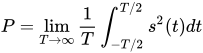
بحسب قوة الإشارات، يمكن تصنيف الإشارات العملية إلى فئتين: إشارات الطاقة وإشارات القدرة. [ 14 ]
إشارات الطاقة: طاقة تلك الإشارات تساوي قيمة موجبة محدودة، لكن متوسط قدراتها يساوي صفرًا؛
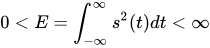
إشارات الطاقة: متوسط طاقة تلك الإشارات يساوي قيمة موجبة محدودة ، لكن طاقتها لا نهائية .
حتمية وعشوائية
الإشارات الحتمية هي تلك التي يمكن التنبؤ بقيمها في أي وقت ويمكن حسابها بواسطة معادلة رياضية.
الإشارات العشوائية هي إشارات تأخذ قيمًا عشوائية في أي لحظة زمنية معينة ويجب نمذجتها بشكل عشوائي . [ 15 ]
زوجي وفردي
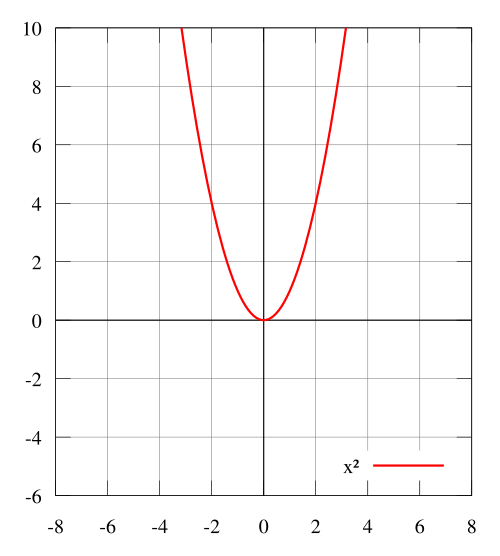


إشارة متساوية تحقق الشرط
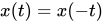
أو بصورة مكافئة إذا كانت المعادلة التالية صحيحة لجميعوفي مجال:



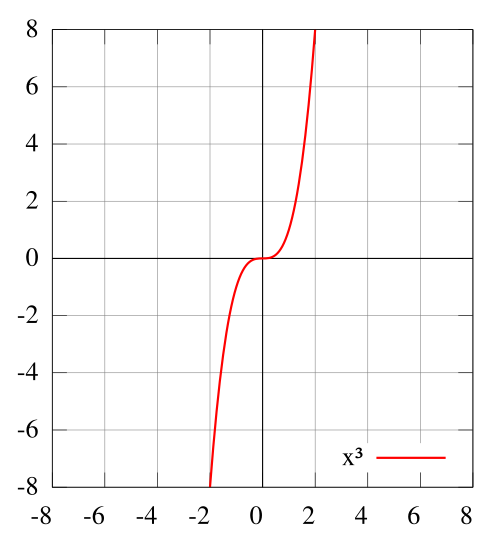
إشارة غير عادية تحقق الشرط

أو بصورة مكافئة إذا كانت المعادلة التالية صحيحة لجميعوفي مجال:

الدوري
يُقال إن الإشارة دورية إذا استوفت الشرط التالي:
أو
![{\displaystyle x(t)=x(t+T)\quad \forall t\in [t_{0},t_{max}]}](https://wikimedia.org/api/rest_v1/media/math/render/svg/5e7a8ab47f7f95ddc48458ad015914817fb2bdea)
![{\displaystyle x(n)=x(n+N)\quad \forall n\in [n_{0},n_{max}]}](https://wikimedia.org/api/rest_v1/media/math/render/svg/39c57e4c74c602caa13e4984a7b867260f09127c)
أين:
= الفترة الزمنية الأساسية ،

= التردد الأساسي .

وينطبق الشيء نفسه علىستتكرر الإشارة الدورية في كل دورة.

Time discretization
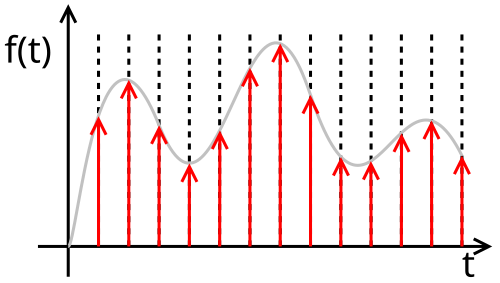
Signals can be classified as continuous or discrete time. In the mathematical abstraction, the domain of a continuous-time signal is the set of real numbers (or some interval thereof), whereas the domain of a discrete-time (DT) signal is the set of integers (or other subsets of real numbers). What these integers represent depends on the nature of the signal; most often, it is time.
A continuous-time signal is any function which is defined at every time t in an interval, most commonly an infinite interval. A simple source for a discrete-time signal is the sampling of a continuous signal, approximating the signal by a sequence of its values at particular time instants.
Amplitude quantization
If a signal is to be represented as a sequence of digital data, it is impossible to maintain exact precision – each number in the sequence must have a finite number of digits. As a result, the values of such a signal must be quantized into a finite set for practical representation. Quantization is the process of converting a continuous analog audio signal to a digital signal with discrete numerical values of integers.
Examples
Naturally occurring signals can be converted to electronic signals by various sensors. Examples include:
- Motion. The motion of an object can be considered to be a signal and can be monitored by various sensors to provide electrical signals.[16] For example, radar can provide an electromagnetic signal for following aircraft motion. A motion signal is one-dimensional (time), and the range is generally three-dimensional. Position is thus a 3-vector signal; the position and orientation of a rigid body is a 6-vector signal. Orientation signals can be generated using a gyroscope.[17]
- Sound. Since a sound is a vibration of a medium (such as air), a sound signal associates a pressure value to every value of time and possibly three space coordinates indicating the direction of travel. A sound signal is converted to an electrical signal by a microphone, generating a voltage signal as an analog of the sound signal. Sound signals can be sampled at a discrete set of time points; for example, compact discs (CDs) contain discrete signals representing sound, recorded at 44,100 Hz; since CDs are recorded in stereo, each sample contains data for a left and right channel, which may be considered to be a 2-vector signal. The CD encoding is converted to an electrical signal by reading the information with a laser, converting the sound signal to an optical signal.[18]
- Images. A picture or image consists of a brightness or color signal, a function of a two-dimensional location. The object's appearance is presented as emitted or reflected light, an electromagnetic signal. It can be converted to voltage or current waveforms using devices such as the charge-coupled device. A 2D image can have a continuous spatial domain, as in a traditional photograph or painting; or the image can be discretized in space, as in a digital image. Color images are typically represented as a combination of monochrome images in three primary colors.
- Videos. A video signal is a sequence of images. A point in a video is identified by its two-dimensional position in the image and by the time at which it occurs, so a video signal has a three-dimensional domain. Analog video has one continuous domain dimension (across a scan line) and two discrete dimensions (frame and line).
- Temperature, conveyed for example by a thermocouple output.[1]
- pH or acidity, provided by a pH meter.[1]
- Biosignals. A biosignal is any signal in a living organism that can be continually measured. The term biosignal is often used to refer to bioelectrical signals, but it may refer to both electrical and non-electrical signals. The usual understanding is to refer only to time-varying signals, although spatial parameter variations (e.g., the nucleotide sequence determining the genetic code) are sometimes subsumed as well.
- Membrane potential. This biosignal is the voltage across a biological membrane. The domain is more difficult to establish. Some cells or organelles have the same membrane potential throughout; neurons generally have different potentials at different points. These signals have very low energies, but are enough to make nervous systems work; they can be measured in aggregate by electrophysiology techniques.
Signal processing
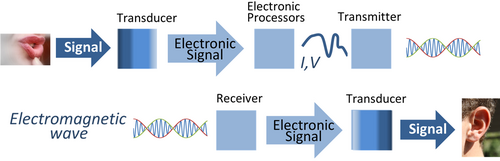
Signal processing is the analysis and manipulation of signals. A common example is signal transmission between different locations. The embodiment of a signal in electrical form is made by a transducer that converts the signal from its original form to a waveform expressed as a current or a voltage, or electromagnetic radiation, for example, an optical signal or radio transmission. Once expressed as an electronic signal, the signal is available for further processing by electrical devices such as electronic amplifiers and filters, and can be transmitted to a remote location by a transmitter and received using radio receivers.
Signals and systems
In electrical engineering (EE) programs, signals are covered in a class and field of study known as signals and systems. Depending on the school, undergraduate EE students generally take the class as juniors or seniors, normally depending on the number and level of previous linear algebra and differential equation classes they have taken.[19]
The field studies input and output signals, and the mathematical representations between them known as systems, in four domains: time, frequency, s and z. Since signals and systems are both studied in these four domains, there are 8 major divisions of study. As an example, when working with continuous-time signals (t), one might transform from the time domain to a frequency or s domain; or from discrete time (n) to frequency or z domains. Systems can also be transformed between these domains, like signals, with continuous to s and discrete to z.
Signals and systems is a subset of the field of mathematical modeling. It involves circuit analysis and design via mathematical modeling and some numerical methods, and was updated several decades ago with dynamical systems tools, including differential equations, and recently, Lagrangians. Students are expected to understand the modeling tools as well as the mathematics, physics, circuit analysis, and transformations between the 8 domains.
Because mechanical engineering (ME) topics like friction, dampening etc. have very close analogies in signal science (inductance, resistance, voltage, etc.), many of the tools originally used in ME transformations (Laplace and Fourier transforms, Lagrangians, sampling theory, probability, difference equations, etc.) have now been applied to signals, circuits, systems and their components, analysis and design in EE. Dynamical systems that involve noise, filtering and other random or chaotic attractors and repellers have now placed stochastic sciences and statistics between the more deterministic discrete and continuous functions in the field. (Deterministic, as used here, means signals that are completely determined as functions of time).
EE taxonomists are still not decided where signals and systems falls within the whole field of signal processing vs. circuit analysis and mathematical modeling, but the common link of the topics that are covered in the course of study has brightened boundaries with dozens of books, journals, etc. called "Signals and Systems", and used as text and test prep for the EE, as well as, recently, computer engineering exams.[20]
Gallery
 A signalman sends a semaphore message from a Pearl Harbor Control Tower, c.1960.
 A Finnish distant signal at the western approach to Muhos station is displaying Expect Stop.
 A woman hailing a cab is sending a signal of availability to be picked up.
 A flare is a common means to signal during dark or smoke-filled conditions.
See also
- A Mathematical Theory of Communication – 1948 scholarly article by Claude Shannon
- Beacon
- Current loop – a signaling system in widespread use for process control
- Signal-to-noise ratio
Notes
References
- 1234Roland Priemer (1991). Introductory Signal Processing. World Scientific. p. 1. ISBN 978-9971509194. Archived from the original on 2013-06-02.
A signal is a function that conveys information about the behavior of a system or attributes of some phenomenon.
- 1 2 تشاكرافورتي، براغنان (2018). " ما هي الإشارة؟ [ملاحظات المحاضرة]". مجلة معالجة الإشارات IEEE . 35 (5): 175-177 . Bibcode : 2018ISPM...35e.175C . doi : 10.1109/MSP.2018.2832195 . S2CID 52164353.
وبالتالي، يمكن تعريف الإشارة، المُمثلة كدالة لمتغير واحد أو أكثر، على أنها تغيير قابل للملاحظة في كيان قابل للقياس الكمي.
- ↑ "الأهداف والنطاق" . معاملات IEEE في معالجة الإشارات . IEEE . مؤرشف من الأصل في 17-04-2012.
- ^ بريابراتا سينها (2009). معالجة الكلام في الأنظمة المدمجة . سبرينغر. ص. 9. رقم ISBN 978-0387755809تمت أرشفة النسخة الأصلية بتاريخ 2013-06-02.
وبشكل عام، الإشارة هي أي كمية فيزيائية متغيرة مع الزمن
. - ↑ تي إتش ويلمشورست (1990). استعادة الإشارة من الضوضاء في الأجهزة الإلكترونية ( الطبعة الثانية). مطبعة سي آر سي. الصفحات 11 وما بعدها . رقم ISBN 978-0750300582تمت أرشفة النسخة الأصلية بتاريخ 19-03-2015 .
- ↑ "الإشارات الرقمية" . www.st-andrews.ac.uk . مؤرشف من الأصل بتاريخ 2017-03-02 . تم الاطلاع عليه بتاريخ 2017-12-17 .
- ↑ "التناظري مقابل الرقمي - learn.sparkfun.com" . learn.sparkfun.com . مؤرشف من الأصل بتاريخ 2017-07-05 . تم الاطلاع عليه بتاريخ 2017-12-17 .
- ↑ روبرت ك. ديوك (2005). التصميم الرقمي باستخدام تطبيقات CPLD ولغة VHDL . تومسون/ديلمار ليرنينج. ISBN 1401840302أُرشف من الأصل بتاريخ ١٧ ديسمبر ٢٠١٧.
لا يمكن أن يحتوي التمثيل الرقمي إلا على قيم منفصلة محددة.
- ↑ بروكيس، جون ج.؛ مانولاكيس، ديميتريس ج. (2007-01-01). معالجة الإشارات الرقمية . بيرسون برنتيس هول. ISBN 9780131873742تمت أرشفة النسخة الأصلية بتاريخ 20-05-2016 .
- ↑ سميلي، غراهام (2 أبريل 1999). تقنيات الاتصال التناظري والرقمي . إلسيفير. ISBN 9780080527147أُرشف من الأصل بتاريخ 17-12-2017.
الإشارة الرقمية هي شكل موجي معقد، ويمكن تعريفها بأنها شكل موجي منفصل ذو مجموعة محدودة من المستويات.
- ↑"Digital Signal". Archived from the original on 2019-04-02. Retrieved 2016-08-13.
- ↑Paul Horowitz; Winfield Hill (2015). The Art of Electronics. Cambridge University Press. ISBN 9780521809269.
- ↑Vinod Kumar Khanna (2009). Digital Signal Processing. S. Chand. p. 3. ISBN 9788121930956.
A digital signal is a special form of discrete-time signal which is discrete in both time and amplitude, obtained by permitting each value (sample) of a discrete-time signal to acquire a finite set of values (quantization), assigning it a numerical symbol according to a code ... A digital signal is a sequence or list of numbers drawn from a finite set.
- ↑Sklar, Bernard (2001). Digital communications : fundamentals and applications (2nd ed.). Upper Saddle River, N.J.: Prentice-Hall PTR. ISBN 0130847887. OCLC 45823120.
- ↑Ziemer, Rodger E.; Tranter, William H. (2014-03-17). Principles of communication: systems, modulation, and noise (Seventh ed.). Hoboken, New Jersey: Wiley. ISBN 9781118078914. OCLC 856647730.
- ↑ For an example from robotics, see K Nishio & T Yasuda (2011). "Analog–digital circuit for motion detection based on vertebrate retina and its application to mobile robot". In Bao-Liang Lu; Liqing Zhang & James Kwok (eds.). Neural Information Processing: 18th International Conference, Iconip 2011, Shanghai, China, November 13–17, 2011. Springer. pp. 506 ff. ISBN 978-3642249648. Archived from the original on 2013-06-02.
- ↑ For example, see M. N. Armenise; Caterina Ciminelli; Francesco Dell'Olio; Vittorio Passaro (2010). "§4.3 Optical gyros based on a fiber ring laser". Advances in Gyroscope Technologies. Springer. p. 47. ISBN 978-3642154935. Archived from the original on 2013-06-02.
- ↑ The optical reading process is described by Mark L. Chambers (2004). CD & DVD Recording for Dummies (2nd ed.). John Wiley & Sons. p. 13. ISBN 978-0764559563. Archived from the original on 2013-06-02.
- ↑David McMahon (2007). Signals & Systems Demystified. New York: McGraw Hill. ISBN 978-0-07-147578-5. Archived from the original on 2020-01-22. Retrieved 2017-09-11.
- ↑ إم جيه روبرتس (2011). الإشارات والأنظمة: التحليل باستخدام طرق التحويل و MATLAB . نيويورك: ماكجرو هيل. ISBN 978-0073380681.
للمزيد من القراءة
- مفاهيم هندسية
- معالجة الإشارات الرقمية
- معالجة الإشارات
- نظرية الاتصالات السلكية واللاسلكية