
Leprosy
Leprosy, also known as Hansen's disease (HD), is a long-term infection by the bacterium Mycobacterium leprae or Mycobacterium lepromatosis.[4][7] Infection can lead to damage of the nerves, respiratory tract, skin, and eyes.[4] This nerve damage may result in the loss of nociception, which can lead to the loss of parts of a person's extremities from repeated injuries or infection through unnoticed wounds.[3] An infected person may also experience muscle weakness and loss of eyesight.[3] Leprosy symptoms may begin within one year or take 20 years or more.[4]
Leprosy is spread between people, although extensive contact is necessary.[3][8] Leprosy has a low pathogenicity, and 95% of people who contract or who are exposed to M. leprae do not develop the disease.[9] Spread is likely through a cough or contact with fluid from the nose of a person infected by leprosy.[8][9] Genetic factors and baseline immune function play a role in how easily a person catches the disease.[9][10] Leprosy is not spread during pregnancy to the unborn child or through genital sexual contact.[8] There are two main types of the disease—paucibacillary and multibacillary, which differ in the number of bacteria present.[3] A person with paucibacillary disease has five or fewer poorly pigmented, numb skin patches, while a person with multibacillary disease has more than five skin patches.[3] The diagnosis is confirmed by finding acid-fast bacilli in a biopsy of the skin.[3]
Leprosy is curable with multidrug therapy.[4] Treatment of paucibacillary leprosy is with the medications dapsone, rifampicin, and clofazimine for six months.[9] Treatment for multibacillary leprosy uses the same medications for 12 months.[9] Several other antibiotics may also be used.[3] These treatments are provided free of charge by the World Health Organization.[4]
Leprosy is not highly contagious.[11] People with leprosy can live with their families and attend school and work.[12] In the 1980s, there were 5.2 million cases globally, but by 2020 this decreased to fewer than 200,000.[4][13][14] Most new cases occur in one of 14 countries, with India accounting for more than half of all new cases.[3][4] In the 20 years from 1994 to 2014, 16 million people worldwide were cured of leprosy.[4] Separating people affected by leprosy by placing them in leper colonies is not supported by evidence but still occurs in some areas of India,[15] China,[16] Japan,[17] Africa,[11] and Thailand.[18]
Leprosy has affected humanity for thousands of years.[3] The disease takes its name from the Greek word λέπρα (lépra), from λεπίς (lepís; 'scale'), while the term "Hansen's disease" is named after the Norwegian physician Gerhard Armauer Hansen.[3] Leprosy has historically been associated with social stigma, which continues to be a barrier to self-reporting and early treatment.[4] Leprosy is classified as a neglected tropical disease.[19]World Leprosy Day was started in 1954 to draw awareness to those affected by leprosy.[20][4] The study of leprosy and its treatment is known as leprology.[21]
Signs and symptoms
Common symptoms present in the different types of leprosy include a rhinorrhea; dry scalp; vision problems; skin lesions; muscle weakness; reddish skin; smooth, shiny, diffuse thickening of facial skin, ear, and hand tissues; loss of sensation in fingers and toes; thickening of peripheral nerves; a flat nose from the destruction of nasal cartilage; and changes in phonation and other aspects of speech production.[22] In addition, atrophy of the testes and erectile dysfunction may occur.[23]
Leprosy onset varies between individuals.[9] The average incubation period is five years. The infected may begin to notice symptoms within the first year or up to 20 years after infection.[4] Oftentimes, the first noticeable sign of leprosy is the development of pale or pink-coloured patches of skin that may be insensitive to temperature or pain.[24] Patches of discolored skin are sometimes accompanied or preceded by nerve problems, including numbness or tenderness in the hands or feet.[24][25]Secondary infections (bacterial or viral infections consequent to the primary infection) can result in tissue loss, causing fingers and toes to become shortened and deformed as cartilage is absorbed into the body.[26][27] Baseline immune function drives at least some parts of pathogenesis variability.[28]
Approximately 30% of individuals affected by leprosy experience nerve damage.[29] The nerve damage sustained is reversible when treated early, but becomes permanent when appropriate treatment is delayed by several months. Damage to nerves may cause loss of muscle function, leading to paralysis. It may also lead to sensation abnormalities or numbness, leading to additional infections, ulcerations, and joint deformities.[29]
 Face severely deformed by leprosy
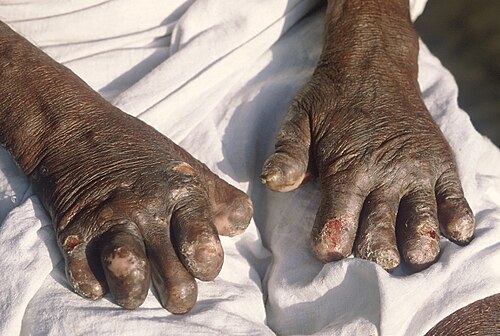 Hands deformed by leprosy
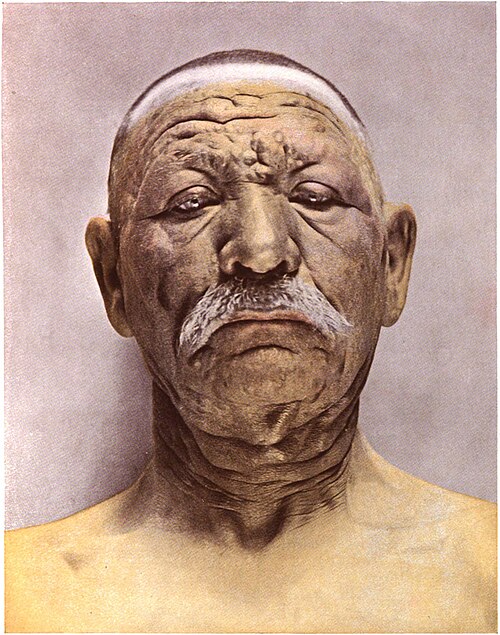 Face mildly deformed by leprosy
Cause
Mycobacterium leprae and M. lepromatosis

تُعدّ المتفطرة الجذامية (Mycobacterium leprae) والمتفطرة الجذامية الورمية (Mycobacterium lepromatosis) من أنواع المتفطرات المسببة لمرض الجذام. [ 29 ] تُعتبر المتفطرة الجذامية الورمية نوعًا حديثًا نسبيًا من المتفطرات، وقد عُزلت من حالة وفاة بمرض الجذام الورمي المنتشر عام 2008. [ 5 ] [ 30 ] لا يمكن التمييز سريريًا بين المتفطرة الجذامية والمتفطرة الجذامية . [ 31 ] المتفطرة الجذامية بكتيريا هوائية عصوية الشكل، مقاومة للأحماض، ذات غلاف خلوي شمعي،وهو ما يميز جنس المتفطرات . [ 32 ] تُعتبر كل من المتفطرة الجذامية والمتفطرة الجذامية الورمية من مسببات الأمراض الإجبارية داخل الخلايا ، ولا يمكنها النمو أو الاستزراع خارج أنسجة العائل. [ 5 ] [ 33 ] ومع ذلك، يمكن استزراعها باستخدام حيوانات التجارب مثل الفئران والمدرعات . [ 34 ] [ 35 ]
تم الإبلاغ عن حالات عدوى طبيعية في الرئيسيات غير البشرية (بما في ذلك الشمبانزي الأفريقي ، والمنغابي السخامي ، وقرد المكاك السيانومولغوس )، والمدرعات، [ 36 ] والسناجب الحمراء . [ 37 ] يشير تحليل تسلسل المواقع المتعددة لسلالات المتفطرة الجذامية في المدرعات إلى أنها كانت من أصل بشري لبضع مئات من السنين على الأكثر. [ 38 ] وبالتالي، يُشتبه في أن المدرعات قد اكتسبت الكائن الحي لأول مرة بشكل عرضي من المستكشفين الأوروبيين الأوائل للأمريكتين. [ 39 ] استمر هذا الانتقال العرضي في مجتمع المدرعات. وقد ينتقل مرة أخرى إلى البشر، مما يجعل الجذام مرضًا حيوانيًا (ينتقل بين البشر والحيوانات). [ 39 ]
Red squirrels (Sciurus vulgaris), a threatened species in Great Britain, were found to carry leprosy in November 2016.[40] It has been suggested that the trade in red squirrel fur, highly prized in the medieval period and intensively traded, may have been responsible for the leprosy epidemic in medieval Europe.[41] A pre-Norman era skull excavated in Hoxne, Suffolk, in 2017 was found to carry DNA from a strain of M. leprae which closely matched the strain carried by modern red squirrels on Brownsea Island.[41][42]
Risk factors
The greatest risk factor for developing leprosy is contact with another person infected with leprosy.[4] People who are exposed to a person who has leprosy are 5–8 times more likely to develop leprosy than members of the general population.[6] Leprosy occurs more commonly among those living in poverty.[3] Not all people who are infected with M. leprae develop symptoms.[43][44]
Conditions that reduce immune function, such as malnutrition, other illnesses, or genetic mutations, may increase the risk of developing leprosy.[6] Infection with HIV does not appear to increase the risk of developing leprosy.[45] Certain genetic factors in the person exposed have been associated with developing lepromatous or tuberculoid leprosy.[46]
Transmission
Transmission of leprosy occurs during close contact with those who are infected.[4] Transmission of leprosy is through the upper respiratory tract.[9][47] Older research suggested the skin as the main route of transmission, but research has increasingly favored the respiratory route.[48] Transmission occurs through inhalation of bacilli present in upper airway secretion.[49]
Leprosy is not sexually transmitted and is not spread through pregnancy to the unborn child.[4][8] The majority (95%) of people who are exposed to M. leprae do not develop leprosy; casual contact such as shaking hands and sitting next to someone with leprosy does not lead to transmission.[4][50] People are considered non-infectious 72 hours after starting appropriate multi-drug therapy.[51] Two exit routes of M. leprae from the human body that are often described are the skin and the nasal mucosa, although their relative importance is not clear. Lepromatous cases show large numbers of organisms deep in the dermis, but whether they reach the skin surface in sufficient numbers is doubtful.[52] Humans can acquire a leprosy infection from armadillos by handling them or consuming armadillo meat.[53][54] The mechanism is not fully understood.[8][55][56]
Genetics
| Name | Locus | OMIM | Gene |
|---|---|---|---|
| LPRS1 | 10p13 | 609888 | |
| LPRS2 | 6q25 | 607572 | PARK2, PACRG |
| LPRS3 | 4q32 | 246300 | TLR2 |
| LPRS4 | 6p21.3 | 610988 | LTA |
| LPRS5 | 4p14 | 613223 | TLR1 |
| LPRS6 | 13q14.11 | 613407 |
Not all people infected or exposed to M. leprae develop leprosy, and genetic factors are suspected to play a role in susceptibility to an infection.[57] Cases of leprosy often cluster in families, and several genetic variants have been identified.[57] In many who are exposed, the immune system can eliminate the leprosy bacteria during the early infection stage before severe symptoms develop.[58] A genetic defect in cell-mediated immunity may cause a person to be susceptible to develop leprosy symptoms after exposure to the bacteria.[59] The region of DNA responsible for this variability is also involved in Parkinson's disease, giving rise to current speculation that the two disorders may be linked at the biochemical level.[59]
Pathogenesis
Most leprosy complications are the result of nerve damage. The nerve damage occurs due to direct invasion by the M. leprae bacteria and a person's immune response, resulting in inflammation.[29] The molecular mechanism underlying how M. leprae produces the symptoms of leprosy is not clear,[14] but M. leprae has been shown to bind to Schwann cells, which may lead to nerve injury including demyelination and a loss of nerve function (specifically a loss of axonal conductance).[60] Numerous molecular mechanisms have been associated with this nerve damage including the presence of a laminin-binding protein and the glycoconjugate (PGL-1) on the surface of M. leprae that can bind to laminin on peripheral nerves.[60]
As part of the human immune response, white blood cell-derived macrophages may engulf M. leprae by phagocytosis.[60] In the initial stages, small sensory and autonomic nerve fibers in the skin of a person with leprosy are damaged.[29] This damage usually results in hair loss to the area, a loss of the ability to sweat, and numbness (decreased ability to detect sensations such as temperature and touch). Further peripheral nerve damage may result in skin dryness, more numbness, and muscle weakness or paralysis in the affected area.[29] The skin can crack, and if the skin injuries are not carefully cared for, there is a risk for a secondary infection that can lead to more severe damage.[29]
Immunology
Leprosy exhibits polarized host responses along a Th1–Th2 spectrum that underpins the Ridley–Jopling clinicopathological forms. At the tuberculoid pole (TT/BT), cellular immunity is dominated by Th1 cytokines—notably IL-12, IFN-γ and TNF-α—which activate macrophages, favor granuloma organization, and restrict bacillary multiplication; at the lepromatous pole (BL/LL), there is Th2/regulatory bias (e.g., IL-4, IL-10), weaker cell-mediated immunity, and high bacillary loads with widespread dissemination.[61] This polarization is shaped by antigen-presenting cell function and pattern-recognition events: recognition of mycobacterial ligands by Toll-like receptors—particularly TLR1/2 heterodimers on macrophages, dendritic cells, and Schwann cells—drives Th1-skewing in paucibacillary disease, whereas IL-10-rich regulatory circuits dampen effector responses at the multibacillary pole.[61]
Histopathology reflects these immune states. Tuberculoid lesions show well-formed granulomas composed of epithelioid macrophages and multinucleated giant cells with dense T-cell cuffs, consistent with attempts at bacillary containment; bacilli are scant and often absent on routine sections. By contrast, lepromatous lesions display diffuse sheets of vacuolated "foamy" macrophages packed with bacilli (including globi), fewer cytotoxic effectors, and more permissive tissue microenvironments.[62] Macrophage programs diverge across the spectrum: microbicidal, nitric-oxide–producing phenotypes are more characteristic of the Th1 side, whereas alternative (M2-like), lipid-rich programs prevail at the Th2/regulatory pole.[61]
Additional T-cell axes contribute to bacterial control and tissue damage: Th17/IL-17 responses, typically higher in tuberculoid disease, align with granulomatous inflammation, while FoxP3+ T-regulatory cells and TGF-β/IL-10 pathways are more prominent in multibacillary disease and can suppress protective immunity.[61][62] Superimposed acute "reactions" represent abrupt shifts on this immunologic continuum. Type 1 (reversal) reactions, usually in borderline disease, involve amplification of Th1-driven inflammation with edema of pre-existing lesions and neuritis. Type 2 reactions (erythema nodosum leprosum) are systemic inflammatory episodes linked to high antigen load and immune-complex formation, with fever, tender nodules, neutrophilia, and other organ involvement; their pathobiology features surges of TNF-α, IL-6, and IL-8, and neutrophil-rich infiltrates.[62][61]
Beyond T cells and macrophages, humoral immunity and B-cell subsets are also implicated. B-1–like cells (by PAX5/CD5 labeling) and marginal zone B cells in human cutaneous lesions—together with Be1 cells—were more abundant in tuberculoid and type 1 reaction lesions than in lepromatous, type 2 reaction, and indeterminate forms, consistent with Th1-skewed inflammation; IL-10–producing regulatory B cells were infrequent.[63] These findings expand the repertoire of cellular players involved at the paucibacillary/Th1 pole of the leprosy spectrum.[63]
Diagnosis
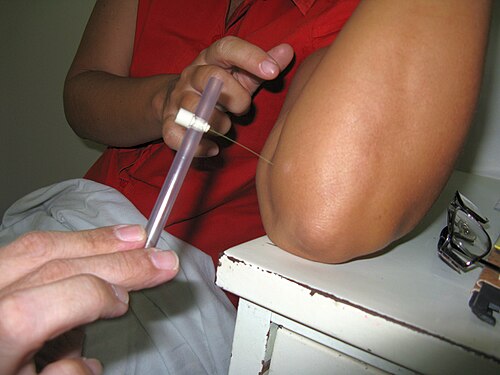
In countries where people are frequently infected, a person is considered to have leprosy if they have one of the following two signs:
Skin lesions can be single or multiple, usually hypopigmented, although occasionally reddish or copper-colored.[4] The lesions may be flat (macules), raised (papules), or solid elevated areas (nodular).[4] Experiencing sensory loss at the skin lesion is a feature that can help determine if the lesion is caused by leprosy or by another disorder such as tinea versicolor.[4][64] Thickened nerves are associated with leprosy and can be accompanied by loss of sensation or muscle weakness, but muscle weakness without the characteristic skin lesion and sensory loss is not considered a reliable sign of leprosy.[4] In some cases, the presence of acid-fast leprosy bacilli in skin smears is considered diagnostic; however, the diagnosis is typically made without laboratory tests, based on symptoms.[4] If a person has a new leprosy diagnosis and already has a visible disability caused by leprosy, the diagnosis is considered late.[29]
In countries or areas where leprosy is uncommon, such as the United States, diagnosis of leprosy is often delayed because healthcare providers are unaware of leprosy and its symptoms.[65] Early diagnosis and treatment prevent nerve involvement, the hallmark of leprosy, and the disability it causes.[4][65] There is no recommended test to diagnose latent leprosy in people without symptoms.[9] Few people with latent leprosy test positive for anti PGL-1.[43] The presence of M. leprae bacterial DNA can be identified using a polymerase chain reaction (PCR)-based technique.[66] This molecular test alone is not sufficient to diagnose a person, but this approach may be used to identify someone who is at high risk of developing or transmitting leprosy such as those with few lesions or an atypical clinical presentation.[66][67] New approaches propose tools to diagnose leprosy through artificial intelligence.[68]
Classification
Several approaches for classifying leprosy exist. There are similarities between the classification approaches.
- The World Health Organization (WHO) system distinguishes patients with five or fewer skin lesions and no bacilli in a skin smear as "paucibacillary" ("pauci-" refers to a small quantity) from patients with more lesions or detected bacilli as "multibacillary".[69]
- The Ridley-Jopling scale provides five gradations.[70][71][72]
- The ICD-10, though developed by the WHO, uses Ridley-Jopling, not the WHO system. It also adds an indeterminate ("I") entry.[52]
- In MeSH, three groupings are used.
| WHO | Ridley-Jopling | ICD-10 | MeSH | Description | Lepromin test |
|---|---|---|---|---|---|
| Paucibacillary | tuberculoid ("TT"),borderlinetuberculoid ("BT") | A30.1, A30.2 | Tuberculoid | It is characterized by one or more hypopigmented skin macules and patches where skin sensations are lost because of damaged peripheral nerves that have been attacked by the human host's immune cells. TT is characterized by the formation of epithelioid cell granulomas with a large number of epithelioid cells. In this form of leprosy, Mycobacterium leprae is either absent from the lesion or occurs in very small numbers. This type of leprosy is most benign.[60][73] | Positive |
| Multibacillary | midborderlineorborderline ("BB") | A30.3 | Borderline | Borderline leprosy is of intermediate severity and is the most common form. Skin lesions resemble tuberculoid leprosy, but are more numerous and irregular; large patches may affect a whole limb, and peripheral nerve involvement with weakness and loss of sensation is common. This type is unstable and may become more like lepromatous leprosy or may undergo a reversal reaction, becoming more like the tuberculoid form. | Negative |
| Multibacillary | borderline lepromatous ("BL"),and lepromatous ("LL") | A30.4, A30.5 | Lepromatous | It is associated with symmetric skin lesions, nodules, plaques, thickened dermis, and frequent involvement of the nasal mucosa resulting in nasal congestion and nose bleeds, but, typically, detectable nerve damage is late. Loss of eyebrows and lashes can be seen in advanced disease.[74] LL is characterized by the absence of epithelioid cells in the lesions. In this form of leprosy, Mycobacteria leprae are found in lesions in large numbers. This is the most unfavorable clinical variant of leprosy, which occurs with a generalized lesion of the skin, mucous membranes, eyes, peripheral nerves, lymph nodes, and internal organs.[60][73]Histoid leprosy is a rare variation of multibacillary, lepromatous leprosy. | Negative |
Leprosy may also occur with only neural involvement, without skin lesions.[4][75][76][77][78][79]
Complications
Leprosy causes tissue loss and deformity by attacking nerve endings, leading to loss of sensation and increased injury risk. Injuries can become infected, causing tissue damage and shortening of fingers, toes, and limbs.[80]
Prevention

Early disease detection is important, since physical and neurological damage may be irreversible even if cured.[4] Medications can decrease the risk of those living with people who have leprosy from acquiring the disease, and likely those with whom people with leprosy come into contact outside the home.[14] The WHO recommends that preventive medicine be given to people who are in close contact with someone who has leprosy.[9] The suggested preventive treatment is a single dose of rifampicin in adults and children over 2 years old who do not already have leprosy or tuberculosis.[9] Preventive treatment is associated with a 57% reduction in infections within 2 years and a 30% reduction in infections within 6 years.[9]
The Bacillus Calmette–Guérin (BCG) vaccine offers a variable amount of protection against leprosy in addition to its closely related target of tuberculosis.[81] It appears to be 26% to 41% effective (based on controlled trials) and about 60% effective based on observational studies, with two doses possibly working better than one.[82][83] The WHO concluded in 2018 that the BCG vaccine at birth reduces leprosy risk and is recommended in countries with high incidence of TB and people who have leprosy.[84] People living in the same home as a person with leprosy are suggested to take a BCG booster which may improve their immunity by 56%.[85][86] Development of a more effective vaccine is ongoing.[14][87][88][89]
A novel vaccine called LepVax entered clinical trials in 2017 with the first encouraging results reported on 24 participants published in 2020.[90][91] If successful, this would be the first leprosy-specific vaccine available.
Treatment

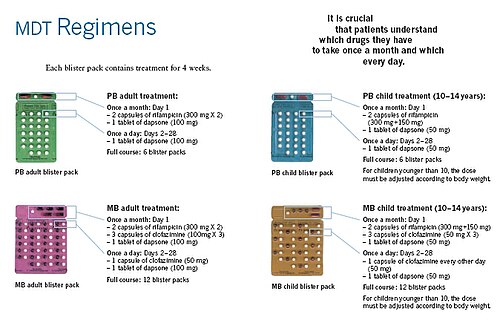
Several leprostatic agents are available for treatment. A three-drug regimen of rifampicin, dapsone, and clofazimine is recommended for all people with leprosy, for six months for paucibacillary leprosy and 12 months for multibacillary leprosy.[9] Multidrug therapy (MDT) remains highly effective, and people are no longer infectious after the first monthly dose.[4] MDT is safe and easy to use under field conditions because it is available in calendar-labelled blister packs.[4] The treatment does pose compliance challenges for young children who find swallowing multiple solid pills difficult.[94] Post-treatment relapse rates remain low.[4]
The combination treatment accelerates treatment and decreases the chance of creating drug-resistant bacteria. All three drugs in the three-drug regimen are antibacterial, with rifampicin being the most potent. Rifampicin is scheduled monthly since it interferes with dapsone by inducing its increased metabolism.[95]
Resistance to the three-drug regimen has been reported in several countries, although the number of cases is small.[96] People with rifampicin-resistant leprosy may be treated with second-line medications such as fluoroquinolones, minocycline, or clarithromycin, but the treatment duration is 24 months because of their lower bactericidal activity.[97] Evidence on the potential benefits and harms of alternative regimens for drug-resistant leprosy is not available.[9]
For people with nerve damage, protective footwear may help prevent ulcers and secondary infections.[29] Canvas shoes may be better than PVC boots.[29] There may be no difference between double rocker shoes and below-knee plaster.[29] Topical ketanserin seems to have a better effect on ulcer healing than clioquinol cream or zinc paste, but the evidence for this is weak.[29]Phenytoin applied to the skin improves skin changes to a greater degree when compared to saline dressings.[29]
Prognosis
Although leprosy has been curable since the mid-20th century, left untreated, it can cause permanent physical impairments and damage to a person's nerves, skin, eyes, and limbs.[4] Despite leprosy not being very infectious and having a low pathogenicity, there is still significant stigma and prejudice associated with the disease.[98] Because of this stigma, leprosy can affect a person's participation in social activities and may also affect the lives of their family and friends.[98] People with leprosy are also at a higher risk for problems with their mental well-being.[98] The social stigma may contribute to problems obtaining employment, financial difficulties, and social isolation.[98] Efforts to reduce discrimination and reduce the stigma surrounding leprosy may help improve outcomes for people with leprosy.[99]
Epidemiology

In 2018, 208,619 new cases of leprosy were recorded, a slight decrease from 2017.[100] In 2015, 94% of the new leprosy cases were confined to 14 countries.[101] India reported the greatest number of new cases (60% of reported cases), followed by Brazil (13%) and Indonesia (8%).[101] Although the number of cases worldwide continues to fall, there are parts of the world where leprosy is more common, including Brazil, South Asia (India, Nepal, Bhutan), some parts of Africa (Tanzania, Madagascar, Mozambique), and the western Pacific.[101] About 150 to 250 cases are diagnosed in the United States each year.[102]
In the 1960s, there were tens of millions of leprosy cases recorded when the bacteria started to develop resistance to dapsone, the most common treatment option at the time.[4][14] International (e.g., the WHO's "Global Strategy for Reducing Disease Burden Due to Leprosy" and the International Federation of Anti-Leprosy Associations) and national initiatives have reduced the total number and the number of new cases of the disease.[14][103]
يصعب قياس ومراقبة عدد حالات الجذام الجديدة نظرًا لطول فترة حضانة المرض، وتأخر التشخيص بعد ظهور الأعراض، ونقص الرعاية الطبية في المناطق المتضررة. [ 104 ] يُستخدم معدل انتشار المرض المُسجّل لتحديد عبء المرض . [ 105 ] يُعدّ معدل الانتشار المُسجّل مؤشرًا تقريبيًا مفيدًا لعبء المرض، إذ يعكس عدد حالات الجذام النشطة التي تم تشخيصها وتتلقى العلاج بالأدوية المتعددة في وقت محدد. [ 105 ] يُعرَّف معدل الانتشار بأنه عدد الحالات المُسجّلة لتلقي العلاج بالأدوية المتعددة بين السكان الذين ظهرت لديهم الحالات، وذلك أيضًا في وقت محدد. [ 105 ]
| سنة | عدد الحالات الجديدة [ 106 ] |
|---|---|
| 2005 | 296,479 |
| 2006 | 258,980 |
| 2007 | 252,541 |
| 2008 | 249,018 |
| 2009 | 244,797 |
| 2010 | 228,488 |
| 2011 | 224,344 |
| 2012 | 232,847 |
| 2013 | 215,636 |
| 2014 | 213,861 |
| 2015 | 211,945 |
| 2016 | 217,927 |
| 2017 | 210,973 |
| 2018 | 208,613 |
| 2019 | 202,166 |
| 2020 | 127,506 |
| 2021 | 140,546 |
| 2022 | 174,059 |
| 2023 | 182,792 |
| 2024 | 215,636 |
تاريخ
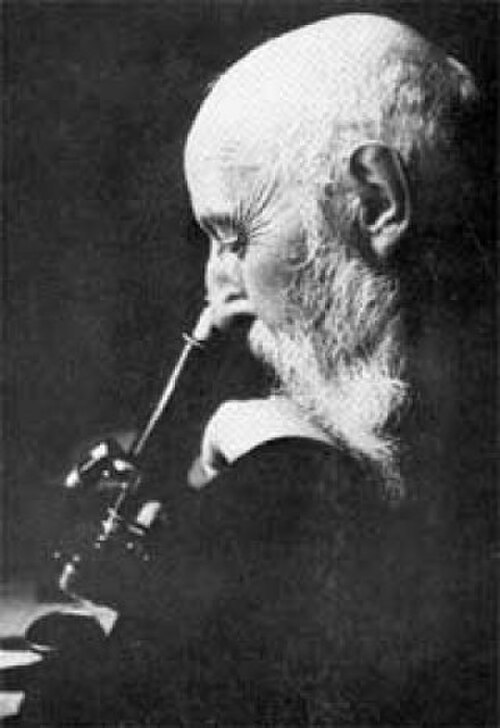
التوزيع التاريخي
باستخدام علم الجينوم المقارن ، تتبع علماء الوراثة في عام 2005 أصول مرض الجذام وانتشاره العالمي من شرق أفريقيا أو الشرق الأدنى على طول طرق الهجرة البشرية. ووجدوا أربع سلالات من بكتيريا المتفطرة الجذامية ( M. leprae) في مواقع جغرافية محددة: [ 107 ] وقد حدد مونوت وآخرون (2005) أن مرض الجذام نشأ في شرق أفريقيا أو الشرق الأدنى وانتقل مع البشر على طول طرق هجرتهم، بما في ذلك طرق تجارة البضائع والعبيد. وتتواجد سلالات المتفطرة الجذامية الأربع في مناطق جغرافية محددة حيث تنتشر كل منها بشكل رئيسي: [ 107 ]
- السلالة 1 في آسيا ومنطقة المحيط الهادئ وشرق أفريقيا؛
- السلالة 2 في إثيوبيا، وملاوي ، ونيبال، وشمال الهند، وكاليدونيا الجديدة ؛
- السلالة 3 في أوروبا وشمال إفريقيا والأمريكتين؛
- السلالة 4 في غرب إفريقيا ومنطقة البحر الكاريبي.
يؤكد هذا انتشار المرض على طول طرق الهجرة والاستعمار وتجارة الرقيق التي سلكتها أفريقيا من شرق أفريقيا إلى الهند، ومن غرب أفريقيا إلى العالم الجديد، ومن أفريقيا إلى أوروبا والعكس. [ 108 ]
Skeletal remains discovered in 2009 represent the oldest documented evidence for leprosy, dating to the 2nd millennium BC.[109][110] Located at Balathal, Rajasthan, in northwest India, the discoverers suggest that if the disease did migrate from Africa to India during the 3rd millennium BC "at a time when there was substantial interaction among the Indus Civilization, Mesopotamia, and Egypt, there needs to be additional skeletal and molecular evidence of leprosy in India and Africa to confirm the African origin of the disease".[111] A proven human case was verified by DNA taken from the shrouded remains of a man discovered by researchers from the Hebrew University of Jerusalem in a tomb in Akeldama, next to the Old City of Jerusalem dated by radiocarbon methods to the first half of the 1st century.[112]
The oldest strains of leprosy known from Europe are from Great Chesterford in southeast England and date back to AD 415–545. These findings suggest a different path for the spread of leprosy, meaning it may have originated in Western Eurasia. This study also indicates that there were more strains in Europe at the time than previously determined.[113]
Discovery and scientific progress

Literary attestation of leprosy is unclear because of the ambiguity of many early sources, including the Indian Atharvaveda and Kausika Sutra, the Egyptian Ebers Papyrus, and the Hebrew Bible's various sections regarding signs of impurity (tzaraath).[114] Leprotic symptoms are attested in the Indian doctor Sushruta's Compendium, originally dating to c.600 BC but only surviving in emended texts no earlier than the fifth century BC. Symptoms consistent with leprosy were possibly described by Hippocrates in 460 BC.[115] However, Hansen's disease probably did not exist in Greece or the Middle East before the Common Era.[116][117][118] In 1846, Francis Adams produced The Seven Books of Paulus Aegineta which included a commentary on all medical and surgical knowledge and descriptions and remedies to do with leprosy from the Romans, Greeks, and Arabs.[119]
The first known causative agent of leprosy, M. leprae, was discovered by Gerhard Armauer Hansen in Norway in 1873, making it one of the first species of pathogenic bacteria to be identified.[120] Leprosy was once believed to have been absent from the Americas before the age of Discovery and the arrival of Europeans.[121] In 2008, a different causative agent for leprosy, Mycobacterium lepromatosis was discovered. DNA studies have revealed that this pathogen exists primarily in the Americas and was already present before Europeans arrived.[122] It is believed that it did not exist in Polynesia until the middle of the 19th century.[123]
Treatment
Leprosy was once believed to be highly contagious and was treated with mercury.[124]Chaulmoogra tree oil was used topically to manage Hansen's disease for centuries. Chaulmoogra oil could not be taken orally without causing nausea or injected without forming an abscess. In 1915, Alice Ball discovered how to make the oil water-soluble, which produced marked improvements in patients with Hansen's disease.[125][126]
The first effective drug (promin) became available in the 1940s.[127] In the 1950s, dapsone was introduced. The search for further effective antileprosy drugs led to the use of clofazimine and rifampicin in the 1960s and 1970s.[128] Later, Indian scientist Shantaram Yawalkar and his colleagues formulated a combined therapy using rifampicin and dapsone, intended to mitigate bacterial resistance.[129] Combining all three drugs was first recommended by the WHO in 1981. These three drugs are still used in the standard MDT regimens.[130] Resistance has developed to initial treatment. Until the introduction of MDT in the early 1980s, leprosy could not be diagnosed and treated successfully within the community.[131]
The importance of the nasal mucosa in the transmission of M. leprae was recognized as early as 1898 by Schäffer, particularly the ulcerated mucosa.[132] The mechanism of plantar ulceration in leprosy and its treatment was first described by Ernest W. Price.[133]
Treatment cost
Between 1995 and 1999, the WHO, with the aid of the Nippon Foundation, supplied all endemic countries with free MDT in blister packs, channeled through ministries of health.[4] This free provision was extended in 2000 and again in 2005, 2010, and 2015 with donations by the MDT manufacturer Novartis through the WHO.[134][4] At the national level, non-governmental organizations (NGOs) affiliated with the national program will continue to be provided with an appropriate free supply.[135]
Etymology
The word "leprosy" comes from the Greek word "λέπος (lépos) – skin" and "λεπερός (leperós) – scaly man".[136]
Society and culture

Historical texts
Written accounts of leprosy date back thousands of years. By 600 BC, various skin diseases translated as leprosy appear in the Atharva Veda, a principal Hindu scripture.[137] Another Hindu scripture, the Manusmriti (200 BC), prohibits contact with those infected with the disease and makes marriage to a person infected with leprosy punishable.[138]
The Hebraic root tsara or tsaraath (צָרַע, – tsaw-rah' – to be struck with leprosy, to be leprous) and the Greek (λεπρός – lepros), are of broader classification than the more narrow use of the term related to Hansen's Disease.[139] Any progressive skin disease (a whitening or splotchy bleaching of the skin, raised manifestations of scales, scabs, infections, rashes, etc.)—as well as generalized molds and surface discoloration of any clothing, leather, or discoloration on walls or surfaces throughout homes—all came under the "law of leprosy" (Leviticus 14:54–57).[140] Ancient sources such as the Talmud (Sifra 63) make clear that tzaraath refers to various types of lesions or stains associated with ritual impurity and occurring on cloth, leather, or houses, as well as skin. Traditional Judaism and Jewish rabbinical authorities, both historical and modern, emphasize that the tsaraath of Leviticus is a spiritual ailment with no direct relationship to Hansen's disease or physical contagions. The relation of tsaraath to "leprosy" comes from translations of Hebrew Biblical texts into Greek and ensuing misconceptions.[141]
All three Synoptic Gospels of the New Testament describe instances of Jesus healing people with leprosy (Matthew 8:1–4, Mark 1:40–45, and Luke 5:12–16). The Bible's description of leprosy is congruous (if lacking detail) with the symptoms of modern leprosy, but the relationship between this disease, tzaraath, and Hansen's disease has been disputed.[142] The biblical perception that people with leprosy were unclean can be found in a passage from Leviticus 13:44–46. While this text defines the leper as impure, it does not explicitly make a moral judgement on those with leprosy.[143] Some early Christians believed that God was punishing those affected by leprosy for sinful behavior. Moral associations have persisted throughout history. In the 6th century, Pope Gregory the Great and Isidore of Seville considered people with the disease to be heretics.[144]
Middle Ages
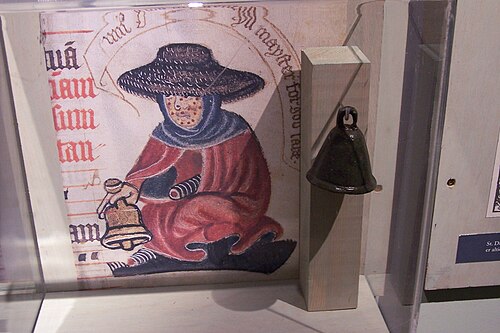
The general population's perception of leprosy was mixed. On one hand, people feared getting infected with the disease and thought of people suspected of leprosy to be unclean, untrustworthy, and occasionally morally corrupt.[144] On the other hand, Jesus' interaction with lepers, the writing of church leaders, and the Christian focus on charitable works led to viewing the lepers as "chosen by God"[145] or seeing the disease as a means of obtaining access to heaven.[146]
Early medieval understanding of leprosy was influenced by early Christian writers such as Gregory of Nazianzus and John Chrysostom, whose writings were later embraced by Byzantine and Latin writers.[147] Gregory, for example, composed sermons urging Christians to assist victims of the disease, and he condemned pagans or Christians who justified rejecting lepers on the allegation that God had sent them the disease to punish them. As cases of leprosy increased in the Eastern Roman Empire, becoming a major health issue, the ecclesiastic leaders discussed how to assist those affected as well as how to change the attitude of society towards them. They also tried this by using the name "holy disease" instead of the commonly used "elephant's disease" (elephantiasis), implying that God did not create this disease to punish people but to purify them for heaven.[148] Although not always successful in persuading the public and a cure was never found by Greek medicians, they created an environment where victims could get palliative care and were never expressly banned from society, as sometimes happened in western Europe. Theodore Balsamon, a 12th-century jurist in Constantinople, noted that lepers were allowed to enter the same churches, cities, and assemblies that healthy people attended.[147]
As the disease became more prevalent in Western Europe in the fifth century, efforts began to establish permanent institutions to house and feed lepers. These efforts were, inclusively, the work of bishops in France at the end of the sixth century, such as in Chalon-sur-Saône.[147] The increase in hospitals or leprosaria (sing. leprosarium) that treated people with leprosy in the 12th and 13th centuries seems to indicate a rise in cases,[149][150][151] possibly in connection with the increase in urbanisation[152] as well as returning crusaders from the Middle East.[147] France alone had nearly 2,000 leprosaria during this period.[153] Additionally to the new leprosia, further steps were taken by secular and religious leaders to prevent further spread of the disease. The third Lateran Council of 1179 required lepers to have their own priests and churches[152] and a 1346 edict by King Edward expelled lepers from city limits. Segregation from mainstream society became common, and people with leprosy were often required to wear clothing that identified them as such or carry a bell announcing their presence.[153] As in the East, it was the Church who took care of the lepers due to the persisting moral stigma and who ran the leprosaria.[144][154] Although the leprosaria in Western Europe removed the sick from society, they were never a place to quarantine them or from which they could not leave: lepers would go beg for alms for the upkeep of the leprosaria or meet with their families.[152][147]
Multiple groups in Western Europe from the Middle Ages faced social ostracization and discrimination that was justified, in part, due to claims that they were the descendants of lepers. These groups included the Cagots and the Caquins.[155][156][157]
19th century
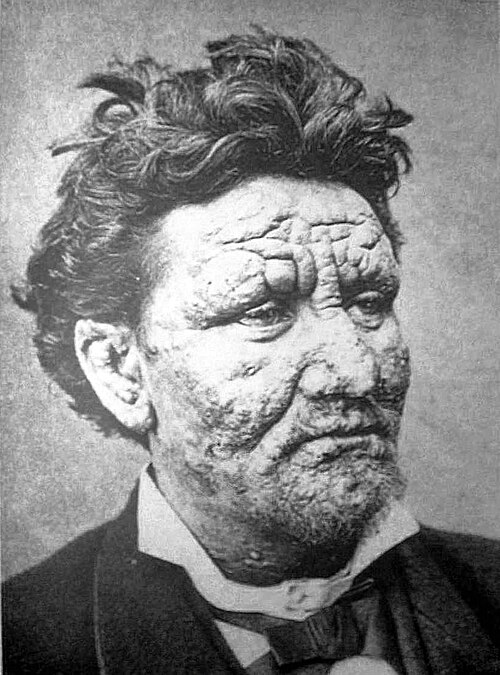
Norway was the location of a progressive stance on leprosy tracking and treatment, and played an influential role in European understanding of the disease. In 1832, Dr. JJ Hjort conducted the first leprosy survey, thus establishing a basis for epidemiological surveys. Subsequent surveys led to the establishment of a national leprosy registry to study the causes of leprosy and to track the rate of infection. Early leprosy research throughout Europe was conducted by Norwegian scientists Daniel Cornelius Danielssen and Carl Wilhelm Boeck. Their work resulted in the establishment of the National Leprosy Research and Treatment Center. Danielssen and Boeck believed the cause of leprosy transmission was hereditary. This stance was influential in advocating for the isolation of those infected by sex to prevent reproduction.[158][159][160]

Though leprosy rates were on the decline in the Western world by the 1860s, authorities frequently embraced isolation treatment due to a combination of reasons, including fears of the disease spreading from the Global South, efforts by Christian missionaries and a lack of understanding concerning bacteriology, medical diagnosis and how contagious the disease was.[161] The rapid expansion of Western imperialism during the Victorian era resulted in westerners coming into increasing contact with regions where the disease was endemic, including British India. English surgeon Henry Vandyke Carter observed isolation treatment for leprosy patients first-hand while visiting Norway, applying these methods in British India with the financial and logistical assistance of Protestant missionaries. Colonialist and religious viewpoints of the disease continued to be a major factor in the treatment and public perception of the disease in the Global South until decolonization in the mid-20th century.[161]
20th and 21st century
في عام 1898، سنّت الحكومة الاستعمارية في الهند البريطانية قانون الجذام لعام 1898، الذي فرض عزل المصابين بالجذام إجبارياً في ملاجئ مخصصة لهم، حيث تم فصلهم حسب الجنس لمنع النشاط الجنسي. وقد أُلغي هذا القانون، الذي ثبتت صعوبة تطبيقه، في عام 1983 من قبل الحكومة الهندية بعد أن أصبح العلاج متعدد الأدوية متاحاً على نطاق واسع في الهند. وفي عام 1983 أيضاً، غيّر البرنامج الوطني للقضاء على الجذام، الذي كان يُعرف سابقاً بالبرنامج الوطني لمكافحة الجذام، أساليبه من المراقبة إلى علاج المصابين. ولا تزال الهند تُسجّل أكثر من نصف العبء العالمي للمرض. ووفقاً لمنظمة الصحة العالمية، انخفضت الحالات الجديدة في الهند خلال عام 2019 إلى 114,451 مريضاً (57% من إجمالي الحالات الجديدة في العالم). [ 162 ] [ 161 ] وحتى عام 2019، كان بإمكان الهنود تبرير طلب الطلاق بتشخيص إصابة أزواجهم بالجذام. [ 163 ]
كان مستشفى كارڤيل الوطني للجذام في لويزيانا ، المعروف عام ١٩٥٥ باسم "دار لويزيانا للجذام"، المستشفى الوحيد لعلاج الجذام في الولايات المتحدة الأمريكية. كان يُرسل مرضى الجذام من جميع أنحاء الولايات المتحدة إلى كارڤيل لعزلهم بعيدًا عن العامة، نظرًا لقلة المعلومات المتوفرة آنذاك حول طرق انتقال المرض، وارتفاع مستوى الوصمة الاجتماعية ضد المصابين به . اشتهر مستشفى كارڤيل للجذام بابتكاراته في الجراحة الترميمية لمرضى الجذام. في عام ١٩٤١، خضع ٢٢ مريضًا في كارڤيل لتجارب سريرية على دواء جديد يُدعى برومين. وُصفت النتائج بالمعجزة، وبعد نجاح برومين بفترة وجيزة، ظهر دابسون، وهو دواء أكثر فعالية في مكافحة الجذام. [ ١٦٤ ] بلغ معدل الإصابة بالجذام ذروته في الولايات المتحدة عام ١٩٨٣، ثم انخفض بشكل حاد. [ 165 ] مع ذلك، عادت أعداد الحالات للارتفاع ببطء منذ عام 2000. وفي عام 2020، تم الإبلاغ عن 159 حالة في البلاد. [ 165 ]
وصمة العار


على الرغم من فعالية العلاج والتوعية، لا تزال وصمة العار المرتبطة بمرض الجذام مشكلةً في البلدان النامية حيث ينتشر المرض. ويُعدّ الجذام أكثر شيوعًا بين السكان الفقراء، حيث يتفاقم الوصم الاجتماعي بسبب الفقر. وقد تُسهم مخاوف النبذ الاجتماعي، أو فقدان الوظيفة، أو الطرد من الأسرة والمجتمع في تأخير التشخيص والعلاج. [ 166 ]
Folk beliefs, lack of education, and religious connotations of the disease continue to influence social perceptions of those affected in many parts of the world. In Brazil, for example, folklore holds that leprosy is a disease transmitted by dogs, or that it is associated with sexual promiscuity, or that it is a punishment for sins or moral transgressions (distinct from other diseases and misfortunes, which are in general thought of as being according to the will of God).[167] Socioeconomic factors also have a direct impact. Lower-class domestic workers who are often employed by those in a higher socioeconomic class may find their employment in jeopardy as physical manifestations of the disease become apparent. Skin discoloration and darker pigmentation resulting from the disease also have social repercussions.[168]
In extreme cases in northern India, leprosy is equated with an "untouchable" status that "often persists long after individuals with leprosy have been cured of the disease, creating lifelong prospects of divorce, eviction, loss of employment, and ostracism from family and social networks."[169]
Public policy
The World Health Organization maintains an Expert Committee on Leprosy since 1954, and a goal of the WHO is to "eliminate leprosy." In 2016 the organization launched "Global Leprosy Strategy 2016–2020: Accelerating towards a leprosy-free world".[170][171] Elimination of leprosy is defined as "reducing the proportion of (people with) leprosy in the community to very low levels, specifically to below one case per 10,000 population".[172] Diagnosis and treatment with multidrug therapy are effective, and a 45% decline in disease burden has occurred since MDT has become more widely available.[173] The organization emphasizes the importance of fully integrating leprosy treatment into public health services, effective diagnosis and treatment, and access to information.[173] The approach includes supporting an increase in health care professionals who understand the disease, and a coordinated and renewed political commitment that includes coordination between countries and improvements in the methodology for collecting and analysing data.[170]
Interventions include:[170]
- Early detection of cases focusing on children to reduce transmission and disabilities.
- Enhanced healthcare services and improved access for people who may be marginalized.
- For countries where leprosy is endemic, further interventions include improved screening of close contacts, improved treatment regimens, and interventions to reduce stigma and discrimination against people who have leprosy.
In some instances in India, community-based rehabilitation is embraced by local governments and NGOs alike. Often, the identity cultivated by a community environment is preferable to reintegration, and models of self-management and collective agency independent of NGOs and government support have been desirable and successful.[174]
Notable cases

- Baldwin IV of Jerusalem (1161–1185), Catholic king of Latin Jerusalem, also known as the "Leper King".[175]
- Henry IV of England (r.1399–1413) possibly had leprosy.[176]
- Ōtani Yoshitsugu (1558 or 1565–1600), a Japanese daimyō (feudal lord).[177]
- Ingeborg Grytten (c.1668 – after 1705), Norwegian writer whose leprosy is thought to have influenced her poetry, which is characterized by a strong religious faith in God's salvation.[178]
- Saint Damien De Veuster (1840–1889), a Catholic priest from Belgium, contracted leprosy and ministered to lepers who had been placed under a government-sanctioned medical quarantine on Molokaʻi in the Kingdom of Hawaiʻi.[179]
- Josephine Cafrine of Seychelles (1877–1907) had leprosy from age 12 and kept a journal that documented her struggles and suffering.[180][181][182] It was published as an autobiography in 1923.[180][181][182][183]
- British writer Peter Greave (1910–1977)
- Vietnamese poet Hàn Mặc Tử (1912–1940)[184]
- Josefina Guerrero (1917–1996), Filipino World War II spy who used the Japanese fear of her leprosy to listen to their battle plans and deliver the information to the American forces under Douglas MacArthur.[185]
- Hilarion Guia (1942–2016), Filipino educator who became the first mayor of Culion, Palawan which hosted the Culion leper colony.[186]
- Dimple Kapadia (1957–present), Indian actress, was diagnosed with leprosy a few months before the shoot of the 1973 musical romance film Bobby. She later recovered completely and went on to have a successful acting career.[187]
In media
- August 1891—the short story collection Life's HandicapbyRudyard Kipling has a story "The Mark of the Beast" in which a traveller on horseback literally stumbles into a leper colony in India.[188]
- 1909— Jack London published "Koolau the Leper" in his Tales of Hawaiʻi about Molokai and people consigned to it circa 1893.
- 1959—James Michener's novel Hawaii dramatizes Molokai's leper settlement, including Father Damien.
- 1959—Ben-Hur depicts the title character's mother, Miriam, and younger sister, Tirzah, are imprisoned by the Roman Empire. When they are freed years later, they have leprosy and leave town for the Valley of the Lepers, rather than stay and reunite with Ben-Hur. They leave the colony, and when Jesus dies on the cross, they are miraculously cured.
- 1960—English author Graham Greene's novel A Burnt-Out Case is set in a leper colony in Belgian Congo. The story is also predominantly about a disillusioned architect working with a doctor on devising new cures and amenities for mutilated victims of lepers; the title, too, refers to the condition of mutilation and disfigurement in the disease.[189]
- 1962— Forugh Farrokhzad made a 22-minute documentary about a leprosy colony in Iran titled The House Is Black. The film humanizes the people affected and opens by saying that "there is no shortage of ugliness in the world, but by closing our eyes on ugliness, we will intensify it."
- 1977— The lead character in The Chronicles of Thomas Covenant by Stephen R. Donaldson suffers from leprosy. His condition seems to be cured by the magic of the fantasy land he finds himself in. He resists believing in its reality, for example, by continuing to perform a regular visual surveillance of extremities as a safety check. Donaldson gained experience with the disease as a young man in India, where his father worked in a missionary for people with leprosy.
- 1988—The death metal band Death releases their second album titled Leprosy, with a song also titled "Leprosy", the lyrics of which talk about the progressive decay the disease causes, and the social isolation placed upon people infected.
- 2006— Moloka'i is a novel by Alan Brennert about a leper colony in Hawaii. This novel follows the story of a seven-year-old girl taken from her family and put on Molokai's leper settlement.
- 2009— Squint: My Journey with Leprosy is a memoir by Jose P. Ramirez.[190]
- 2026 - The Leprosy Official Scenario is added to Plague Inc: Evolved in the 'Aliens and Anti-Vaxxers' Update.[191]
Infection of animals
Between 15 and 20% of Mexican long-nosed armadillos(Dasypus mexicanus) in the south-central United States carry M. leprae.[192][193] As a result of their low body temperature, their tissues commonly contain massive numbers of organisms, which help in the dissemination of the infection. Armadillos were first demonstrated in 1971 to develop leprosy after inoculation with M. leprae.[194] Because of armadillos' armor, skin lesions are difficult to ascertain.[195] Abrasions around the eyes, nose, and feet are the most common signs. Infected armadillos make up a large reservoir of M. leprae. They may be a source of infection for some humans in the United States or other locations in the armadillos' home range. In armadillo leprosy, lesions do not persist at the site of entry in animals; M. leprae multiply in macrophages at the site of inoculation and lymph nodes.[196]
Armadillos have been used in immunological research to fight leprosy. Some notable reagents include recombinant interleukin-2 and recombinant interferon-gamma reagents.[194] Additionally, they have been key and have been useful models of leprosy for studies regarding neuropathy.[197] In clinical procedures such as electrophysiological nerve conduction tests Armadillo's nerve function has been properly assessed.[197] Despite the studies mentioned regarding Armadillo's relationship to neuropathy and other effects of leprosy, there is still a lack of proper study on armadillos, and in conducting more armadillo-specific regents, our understanding of leprosy's effects on armadillos and possibly, humans can be found. Armadillos are a key component of modern-day research on leprosy.
There is a stigma surrounding armadillos and the carrying of leprosy. Because many people do not understand armadillos very well, it is common for people to think of them as being dangerous to society and, as a result, valuing their lives less than other animals. It has become more common in parts of America for people to eat raw or undercooked armadillo, making the chances high that, if not properly handled with care, one may become infected.[198]
An outbreak in chimpanzees in West Africa showed that the bacteria can infect another species and may have additional rodent hosts.[199] Studies have demonstrated that the disease is endemic in the UK red Eurasian squirrel population, with M. leprae and M. lepromatosis appearing in different populations. The M. leprae strain discovered on Brownsea Island is equated to one thought to have died out in the human population in medieval times.[200] Despite this, and speculation regarding past transmission through trade in squirrel furs, there does not seem to be a high risk of squirrel to human transmission from the wild population. Although leprosy continues to be diagnosed in immigrants to the UK, the last known human case of leprosy arising in the UK was recorded over 200 years ago.[201]
It has been shown that leprosy can reprogram cells in mouse[202][203] and armadillo[204][205] models, similar to how induced pluripotent stem cells are generated by the transcription factorsMyc, Oct3/4, Sox2, and Klf4. A notable study conducted by Charles Shepard used mice to find how leprosy, an infection that has a preference for cooler areas of the body, would work in a warm-blooded animal. The main findings were that even in mice whose immune systems were severely impaired and at a perceived high risk of developing leprosy, the body was still, in most cases, able to fight off leprosy. There are a few other up-and-coming models for M. leprae, including the use of other animals, such as mammals, birds, and cold-blooded animals.[194] These animals do not tend to give as great results as armadillos and mice, as different animals have different levels of disease resistance.
References
- ↑Sophie M. Worobec (2008). "Treatment of leprosy/Hansen's disease in the early 21st century". Dermatologic Therapy. 22 (6): 518–537. doi:10.1111/j.1529-8019.2009.01274.x. ISSN 1396-0296. PMID 19889136. S2CID 42203681.
- ↑"Definition of leprosy". The Free Dictionary. Archived from the original on 22 February 2015. Retrieved 25 January 2015.
- 1234567891011121314Suzuki K, Akama T, Kawashima A, Yoshihara A, Yotsu RR, Ishii N (February 2012). "Current status of leprosy: epidemiology, basic science and clinical perspectives". The Journal of Dermatology. 39 (2): 121–129. doi:10.1111/j.1346-8138.2011.01370.x. PMID 21973237. S2CID 40027505.
- 1234567891011121314151617181920212223242526272829303132333435"Leprosy". World Health Organization (WHO). Archived from the original on 31 January 2021. Retrieved 10 February 2020.
- 123"New Leprosy Bacterium: Scientists Use Genetic Fingerprint To Nail 'Killing Organism'". ScienceDaily. 28 November 2008. Archived from the original on 13 March 2010. Retrieved 31 January 2010.
- 123Schreuder PA, Noto S, Richardus JH (January 2016). "Epidemiologic trends of leprosy for the 21st century". Clinics in Dermatology. 34 (1): 24–31. doi:10.1016/j.clindermatol.2015.11.001. PMID 26773620.
- ↑Sotiriou MC, Stryjewska BM, Hill C (September 2016). "Two Cases of Leprosy in Siblings Caused by Mycobacterium lepromatosis and Review of the Literature". The American Journal of Tropical Medicine and Hygiene. 95 (3): 522–527. doi:10.4269/ajtmh.16-0076. PMC 5014252. PMID 27402522.
- 12345"Hansen's Disease (Leprosy) Transmission". cdc.gov. 29 April 2013. Archived from the original on 13 March 2015. Retrieved 28 February 2015.
- 12345678910111213Guidelines for the diagnosis, treatment and prevention of leprosy. World Health Organization. Regional Office for South-East Asia. 2018. p. xiii. hdl:10665/274127. ISBN 978-92-9022-638-3.
- ↑Montoya D, Modlin RL (2010). Learning from leprosy: insight into the human innate immune response. Advances in Immunology. Vol. 105. pp. 1–24. doi:10.1016/S0065-2776(10)05001-7. ISBN 978-0-12-381302-2. PMID 20510728.
- 12Byrne JP (2008). Encyclopedia of pestilence, pandemics, and plagues. Westport, Conn.[u.a.]: Greenwood Press. p. 351. ISBN 978-0-313-34102-1.
- ↑CDC (26 January 2018). "World Leprosy Day". Centers for Disease Control and Prevention. Archived from the original on 15 June 2019. Retrieved 15 July 2019.
- ↑"Global leprosy situation, 2012". Weekly Epidemiological Record. 87 (34): 317–328. August 2012. PMID 22919737.
- 123456Rodrigues LC, Lockwood DN (June 2011). "Leprosy now: epidemiology, progress, challenges, and research gaps". The Lancet. Infectious Diseases. 11 (6): 464–470. doi:10.1016/S1473-3099(11)70006-8. PMID 21616456.
- ↑Walsh F (31 March 2007). "The hidden suffering of India's lepers". BBC News. Archived from the original on 29 May 2007.
- ↑Lyn TE (13 September 2006). "Ignorance breeds leper colonies in China". Independat News & Media. Archived from the original on 8 April 2010. Retrieved 31 January 2010.
- ↑Japan repealed its "Leprosy Prevention Laws" in 1996, but former patients still reside in sanatoriums.
- "Koizumi apologises for leper colonies". BBC News. 25 May 2001. Archived from the original on 17 April 2009.
- "Former Hansen's disease patients still struggling with prejudice". Japan Times. 7 June 2007. Archived from the original on 26 August 2009.
- ↑Pisuthipan A (6 July 2020). "Forgotten victims of the virus". Bangkok Post. Archived from the original on 28 August 2021. Retrieved 6 July 2020.
- ↑"Neglected Tropical Diseases". cdc.gov. 6 June 2011. Archived from the original on 4 December 2014. Retrieved 28 November 2014.
- ↑McMenamin D (2011). Leprosy and stigma in the South Pacific: a region-by-region history with first-person accounts. Jefferson, N.C.: McFarland. p. 17. ISBN 978-0-7864-6323-7. Archived from the original on 19 May 2016.
- ↑"Leprology". Merriam-Webster.com Medical Dictionary. Merriam-Webster. Retrieved 18 November 2024.
- ↑"Signs and Symptoms | Hansen's Disease (Leprosy) | CDC". www.cdc.gov. 22 October 2018. Archived from the original on 22 July 2019. Retrieved 22 July 2019.
- ↑"Pathogenesis and Pathology of Leprosy". International Textbook of Leprosy. 11 February 2016. Archived from the original on 22 July 2019. Retrieved 22 July 2019.
- 12WHO Expert Committee on Leprosy – Eighth report(PDF). World Health Organization (WHO). 2012. pp. 11–12. ISBN 978-92-4-120968-7. Archived from the original(PDF) on 5 August 2013. Retrieved 9 May 2018.
- ↑Talhari C, Talhari S, Penna GO (2015). "Clinical aspects of leprosy". Clinics in Dermatology. 33 (1): 26–37. doi:10.1016/j.clindermatol.2014.07.002. PMID 25432808.
- ↑Kulkarni GS (2008). Textbook of Orthopedics and Trauma (2nd ed.). Jaypee Brothers Publishers. p. 779. ISBN 978-81-8448-242-3.
- ↑"Q and A about leprosy". American Leprosy Missions. Archived from the original on 4 October 2012. Retrieved 22 January 2011.
Do fingers and toes fall off when someone gets leprosy? No. The bacillus attacks nerve endings and destroys the body's ability to feel pain and injury. Without feeling pain, people injure themselves on fire, thorns, rocks, and even hot coffee cups. Injuries become infected and result in tissue loss. Fingers and toes become shortened and deformed as the cartilage is absorbed into the body.
- ↑de Sousa JR, Sotto MN, Simões Quaresma JA (28 November 2017). "Leprosy As a Complex Infection: Breakdown of the Th1 and Th2 Immune Paradigm in the Immunopathogenesis of the Disease". Frontiers in Immunology. 8 1635. doi:10.3389/fimmu.2017.01635. PMC 5712391. PMID 29234318.
- 12345678910111213Reinar LM, Forsetlund L, Lehman LF, Brurberg KG (July 2019). "Interventions for ulceration and other skin changes caused by nerve damage in leprosy". The Cochrane Database of Systematic Reviews. 2019 (7) CD012235. doi:10.1002/14651858.CD012235.pub2. PMC 6699662. PMID 31425632.
- ↑Ryan KU, Ray CJ, eds. (2004). Sherris Medical Microbiology (4th ed.). McGraw Hill. pp. 451–53. ISBN 978-0-8385-8529-0. OCLC 61405904.
- ↑"Genomics Insights into the Biology and Evolution of Leprosy Bacilli". International Textbook of Leprosy. 11 February 2016. Archived from the original on 12 February 2019. Retrieved 11 February 2019.
- ↑McMurray DN (1996). "Mycobacteria and Nocardia". In Baron S, et al. (eds.). Baron's Medical Microbiology (4th ed.). Univ of Texas Medical Branch. ISBN 978-0-9631172-1-2. OCLC 33838234. Archived from the original on 12 February 2009.
- ↑Bhattacharya S, Vijayalakshmi N, Parija SC (October 2002). "Uncultivable bacteria: implications and recent trends towards identification". Indian Journal of Medical Microbiology. 20 (4): 174–177. doi:10.1016/S0255-0857(21)03184-4. PMID 17657065.
- ↑"WHO | Microbiology: culture in vitro". World Health Organization (WHO). Archived from the original on 9 August 2020. Retrieved 22 July 2019.
- ↑"The Armadillo Model for Leprosy". International Textbook of Leprosy. 11 February 2016. Archived from the original on 22 July 2019. Retrieved 22 July 2019.
- ↑Loughry WJ, Truman RW, McDonough CM, Tilak MK, Garnier S, et al. (2009) "Is leprosy spreading among nine-banded armadillos in the southeastern United States?" J Wildl Dis 45: 144–52.
- ↑Meredith A, Del Pozo J, Smith S, Milne E, Stevenson K, McLuckie J (September 2014). "Leprosy in red squirrels in Scotland". The Veterinary Record. 175 (11): 285–286. doi:10.1136/vr.g5680. PMID 25234460. S2CID 207046489.
- ↑Monot M, Honoré N, Garnier T, Araoz R, Coppee JY, et al. (2005). "On the origin of leprosy". Science 308: 1040–42.
- 12Han XY, Silva FJ (February 2014). "On the age of leprosy". PLOS Neglected Tropical Diseases. 8 (2) e2544. doi:10.1371/journal.pntd.0002544. PMC 3923669. PMID 24551248.
- ↑"Red squirrels in the British Isles are infected with leprosy bacilli"Archived 12 June 2022 at the Wayback Machine, Dr. Andrej Benjak, Prof Anna Meredith and others. Science, 11 November 2016. . Retrieved 11 November 2016.
- 12"Could squirrel fur trade have contributed to England's medieval leprosy outbreak?". ScienceDaily. Archived from the original on 22 November 2018. Retrieved 21 November 2018.
- ↑Inskip S, Taylor GM, Anderson S, Stewart G (November 2017). "Leprosy in pre-Norman Suffolk, UK: biomolecular and geochemical analysis of the woman from Hoxne". Journal of Medical Microbiology. 66 (11): 1640–1649. doi:10.1099/jmm.0.000606. PMID 28984227. S2CID 33997231.
- 12Penna ML, Penna GO, Iglesias PC, Natal S, Rodrigues LC (May 2016). "Anti-PGL-1 Positivity as a Risk Marker for the Development of Leprosy among Contacts of Leprosy Cases: Systematic Review and Meta-analysis". PLOS Neglected Tropical Diseases. 10 (5) e0004703. doi:10.1371/journal.pntd.0004703. PMC 4871561. PMID 27192199.
- ↑Alcaïs A, Mira M, Casanova JL, Schurr E, Abel L (February 2005). "Genetic dissection of immunity in leprosy". Current Opinion in Immunology. 17 (1): 44–48. doi:10.1016/j.coi.2004.11.006. PMID 15653309.
- ↑Lockwood DN, Lambert SM (January 2011). "Human immunodeficiency virus and leprosy: an update". Dermatologic Clinics. 29 (1): 125–128. doi:10.1016/j.det.2010.08.016. PMID 21095536.
- ↑"Epidemiology of Leprosy". International Textbook of Leprosy. 11 February 2016. Archived from the original on 23 July 2019. Retrieved 30 July 2019.
- ↑Chavarro-Portillo B, Soto CY, Guerrero MI (September 2019). "Mycobacterium leprae's evolution and environmental adaptation". Acta Tropica. 197 105041. doi:10.1016/j.actatropica.2019.105041. PMID 31152726. S2CID 173188912.
- ↑Eichelmann K, González González SE, Salas-Alanis JC, Ocampo-Candiani J (September 2013). "Leprosy. An update: definition, pathogenesis, classification, diagnosis, and treatment". Actas Dermo-Sifiliograficas. 104 (7): 554–563. doi:10.1016/j.adengl.2012.03.028. PMID 23870850. S2CID 3442319.
- ↑Joel Carlos Lastória JC, Milanez Morgado de Abreu MA (March–April 2014). "Leprosy: review of the epidemiological, clinical, and etiopathogenic aspects - Part 1". An Bras Dermatol. 89 (2): 205–218. doi:10.1590/abd1806-4841.20142450. PMC 4008049. PMID 24770495.
- ↑"Hansen's Disease (Leprosy) Transmission". cdc.gov. 29 April 2013. Archived from the original on 13 March 2015. Retrieved 28 February 2015.
- ↑Lockwood DN, Kumar B (June 2004). "Treatment of leprosy". BMJ. 328 (7454): 1447–1448. doi:10.1136/bmj.328.7454.1447. PMC 428501. PMID 15205269.
- 12"What Is Leprosy?"| from News-Medical.Net – Latest Medical News and Research from Around the World. Web. 20 November 2010. "What is Leprosy?". News-Medical.net. 18 November 2009. Archived from the original on 6 June 2013. Retrieved 14 May 2013..
- ↑Harris G (27 April 2011). "Armadillos Can Transmit Leprosy to Humans, Federal Researchers Confirm". The New York Times. ISSN 0362-4331. Retrieved 15 March 2025.
- ↑Guiden M (29 June 2018). "New evidence that wild armadillos spread leprosy to humans". News from the College of Veterinary Medicine and Biomedical Sciences. Archived from the original on 28 November 2024. Retrieved 15 March 2025.
- ↑Truman RW, Singh P, Sharma R, Busso P, Rougemont J, Paniz-Mondolfi A, et al. (April 2011). "Probable zoonotic leprosy in the southern United States". The New England Journal of Medicine. 364 (17): 1626–1633. doi:10.1056/NEJMoa1010536. PMC 3138484. PMID 21524213.
- ↑"Hansen's Disease (Leprosy) Transmission". cdc.gov. 29 April 2013. Archived from the original on 13 March 2015. Retrieved 28 February 2015.
- 1 2 كامبري جي، ميرا إم تي (20 يوليو 2018). "الاستعداد الوراثي للجذام - من الجينات المرشحة الكلاسيكية المرتبطة بالمناعة إلى مناهج الجينوم الكامل الخالية من الفرضيات" . فرونتيرز إن إيمونولوجي . 9 1674. doi : 10.3389/fimmu.2018.01674 . PMC 6062607. PMID 30079069 .
- ↑ كوك، جي سي (2009). أمراض مانسون الاستوائية ( الطبعة الثانية والعشرون). [إدنبرة]: سوندرز. ص 1056. ISBN 978-1-4160-4470-3تمت أرشفة هذا النص من المصدر الأصلي في 4 سبتمبر 2017.
- 1 2 بوشمان إي، سكامين إي (يونيو 2004). "ارتباط قابلية الإصابة بالجذام بجينات مرض باركنسون" . المجلة الدولية للجذام وأمراض المتفطرات الأخرى . 72 (2): 169-170 . doi : 10.1489/1544-581X(2004)072 < 0169:LOLSTP > 2.0.CO ; 2 (غير نشط في 12 يوليو 2025). PMID 15301585. S2CID 43103579 .
{{cite journal}}: صيانة CS1: رقم التعريف الرقمي غير نشط اعتبارًا من يوليو 2025 ( رابط ) - 1 2 3 4 5 بهات آر إم، براكاش سي (2012). "الجذام: نظرة عامة على الفيزيولوجيا المرضية" . وجهات نظر متعددة التخصصات حول الأمراض المعدية . 2012 181089. doi : 10.1155/2012/181089 . PMC 3440852. PMID 22988457 .
- 1 2 3 4 5 Fróes Júnior LA, Trindade MÂ, Sotto MN (2022). “علم المناعة من الجذام”. المراجعات الدولية لعلم المناعة . 41 (2): 72- 83. دوى : 10.1080/08830185.2020.1851370 . بميد 33241709 .
- 1 2 3 Fróes Júnior LA، Sotto MN، Trindade MÂ (2022). "الجذام: الخصائص السريرية والمناعية" . أنيس برازيليروس دي الأمراض الجلدية . 97 (3): 338-347 . دوى : 10.1016/j.abd.2021.08.006 . بمك 9133310 . بميد 35379512 .
- 12Fróes Júnior LA, Pagliari C, Trindade MÂ, Sotto MN (2025). "B-cell subsets in leprosy lesions: unraveling the complex interplay". Anais Brasileiros de Dermatologia. 100 (5) 501184. doi:10.1016/j.abd.2025.501184. PMC 12357089. PMID 40784052.
- ↑Moschella SL, Garcia-Albea V (September 2016). "International Textbook of Leprosy"(PDF). Differential Diagnosis of Leprosy. p. 3, Section 2.3. Archived(PDF) from the original on 16 July 2020. Retrieved 4 July 2019.
- 12U.S. Department of Health and Human Services, Health Resources and Services Administration. (n.d.). National Hansen's disease (leprosy) program. Retrieved from "National Hansen's Disease (Leprosy) Program". Archived from the original on 10 February 2011. Retrieved 12 May 2013.
- 12Martinez AN, Talhari C, Moraes MO, Talhari S (April 2014). "PCR-based techniques for leprosy diagnosis: from the laboratory to the clinic". PLOS Neglected Tropical Diseases. 8 (4) e2655. doi:10.1371/journal.pntd.0002655. PMC 3983108. PMID 24722358.
- ↑Tatipally S, Srikantam A, Kasetty S (October 2018). "Polymerase Chain Reaction (PCR) as a Potential Point of Care Laboratory Test for Leprosy Diagnosis-A Systematic Review". Tropical Medicine and Infectious Disease. 3 (4): 107. doi:10.3390/tropicalmed3040107. PMC 6306935. PMID 30275432.
- ↑Quilter EE, Butlin CR, Carrion C, Ruiz-Postigo JA (1 June 2024). "The WHO Skin NTD mobile application – a paradigm shift in leprosy diagnosis through Artificial Intelligence?". Leprosy Review. 95 (2) e2024030: 1–3. doi:10.47276/lr.95.2.2024030. ISSN 2162-8807. Archived from the original on 28 May 2024. Retrieved 27 May 2024.
- ↑ "الجذام" . www.who.int . تم الاطلاع عليه بتاريخ 13 فبراير 2025 .
- ↑ سينغ ن، مانوشا ف، بهاتاشاريا س ن، أرورا ف ك، بهاتيا أ (يونيو 2004). "مزالق التصنيف الخلوي للجذام الحدّي في مقياس ريدلي-جوبلينغ". علم الأمراض الخلوية التشخيصي . 30 (6): 386-388 . doi : 10.1002/dc.20012 . PMID 15176024. S2CID 29757876 .
- ↑ ريدلي دي إس، جوبلينج دبليو إتش (1966). "تصنيف الجذام وفقًا للمناعة. نظام من خمس مجموعات". المجلة الدولية للجذام والأمراض الفطرية الأخرى . 34 (3): 255-273 . PMID 5950347 .
- ↑ جيمس دبليو دي، بيرغر تي جي، إلستون دي إم، أودوم آر بي (2006). أمراض أندروز الجلدية: الأمراض الجلدية السريرية . سوندرز إلسيفير. الصفحات 344-346 . ISBN 978-0-7216-2921-6.
- 1 2 لاستوريا جي سي، أبرو إم إيه (2014). "الجذام: مراجعة للجوانب المخبرية والعلاجية - الجزء الثاني" . أنيس برازيليروس دي الأمراض الجلدية . 89 (3): 389-401 . دوى : 10.1590 / abd1806-4841.20142460 . بمك 4056695 . بميد 24937811 .
- ↑ كومار، بهوشان، أوبيريتي، شرادها، دوجرا، سونيل (11 فبراير 2016). "التشخيص السريري للجذام" . الكتاب الدولي للجذام . مؤرشف من الأصل في 13 فبراير 2019. تم الاطلاع عليه في 12 فبراير 2019 .
- ↑ جارديم إم آر، أنتونس إس إل، سانتوس إيه آر، ناسيمينتو أو جيه، نيري جيه إيه، ساليس إيه إم، وآخرون . (يوليو 2003). "معايير تشخيص الجذام العصبي النقي". مجلة علم الأعصاب . 250 (7): 806-809 . doi : 10.1007 / s00415-003-1081-5 . PMID 12883921. S2CID 20070335 .
- ↑ مينديراتا ف، خان أ، جاين أ (2006). "الجذام العصبي الأولي: إعادة تقييم في مستشفى رعاية ثالثية". المجلة الهندية للجذام . 78 (3): 261-267 . PMID 17120509 .
- ↑Ishida Y, Pecorini L, Guglielmelli E (July 2000). "Three cases of pure neuritic (PN) leprosy at detection in which skin lesions became visible during their course". Nihon Hansenbyo Gakkai Zasshi = Japanese Journal of Leprosy. 69 (2): 101–106. doi:10.5025/hansen.69.101. PMID 10979277.
- ↑Mishra B, Mukherjee A, Girdhar A, Husain S, Malaviya GN, Girdhar BK (1995). "Neuritic leprosy: further progression and significance". Acta Leprologica. 9 (4): 187–194. PMID 8711979.
- ↑Talwar S, Jha PK, Tiwari VD (September 1992). "Neuritic leprosy: epidemiology and therapeutic responsiveness". Leprosy Review. 63 (3): 263–268. doi:10.5935/0305-7518.19920031. PMID 1406021.
- ↑"Embrace a village - FAQ". 3 June 2021. Archived from the original on 2 February 2023. Retrieved 2 February 2023.
- ↑Duthie MS, Gillis TP, Reed SG (November 2011). "Advances and hurdles on the way toward a leprosy vaccine". Human Vaccines. 7 (11): 1172–1183. doi:10.4161/hv.7.11.16848. PMC 3323495. PMID 22048122.
- ↑Setia MS, Steinmaus C, Ho CS, Rutherford GW (March 2006). "The role of BCG in prevention of leprosy: a meta-analysis". The Lancet. Infectious Diseases. 6 (3): 162–170. doi:10.1016/S1473-3099(06)70412-1. PMID 16500597.
- ↑Merle CS, Cunha SS, Rodrigues LC (February 2010). "BCG vaccination and leprosy protection: review of current evidence and status of BCG in leprosy control". Expert Review of Vaccines. 9 (2): 209–222. doi:10.1586/ERV.09.161. PMID 20109030. S2CID 34309843.
- ↑ منظمة الصحة العالمية (يونيو 2018). " لقاح BCG: ورقة موقف منظمة الصحة العالمية، فبراير 2018 - التوصيات". اللقاح . 36 (24): 3408-3410 . doi : 10.1016/j.vaccine.2018.03.009 . PMID 29609965. S2CID 4570754 .
- ↑ مورايس، م. أ.، ودوبير، ن. س. (يناير 2021). "الوقاية من الجذام بعد التعرض: الابتكار والصحة العامة الدقيقة" . مجلة لانسيت للصحة العالمية . 9 (1): e8– e9. doi : 10.1016/S2214-109X(20)30512-X . PMID 33338461 .
- ^ يامازاكي-ناكاشيمادا إم إيه، أونزويتا أ، بيرينيس جاميز-غونزاليس إل، غونزاليس-سالدانيا إن، سورنسن آر يو (أغسطس 2020). "BCG: لقاح ذو وجوه متعددة" . اللقاحات البشرية والعلاج المناعي . 16 (8): 1841-1850 . دوى : 10.1080 / 21645515.2019.1706930 . بمك 7482865 . بميد 31995448 .
- ↑ "لقاح الجذام" . بعثات مكافحة الجذام الأمريكية. مؤرشف من الأصل في 15 نوفمبر 2015. تم الاطلاع عليه في 20 أكتوبر 2015 .
- ↑ «تجربة سريرية لأول لقاح في العالم ضد الجذام» . صحيفة الغارديان . 6 يونيو 2014. مؤرشف من الأصل في 11 أكتوبر 2015. تم الاطلاع عليه في 20 أكتوبر 2015 .
- ↑ "خطط الصين لاستكشاف المريخ، ولقاح الجذام، وسيارات الأجرة ذاتية القيادة" . مجلة نيتشر . 537 (7618): 12-13 . سبتمبر 2016. Bibcode : 2016Natur.537...12 . doi : 10.1038/537012a . PMID 27582199 .
- ↑ رقم التجربة السريرية NCT03302897 لـ "المرحلة الأولى من تجربة لقاح LEP-F1 + GLA-SE على متطوعين بالغين أصحاء" على موقع ClinicalTrials.gov
- ↑ دوثي إم إس، فريفول إيه، داي تي، كولر آر إن، فيرغارا جيه، رولف تي، وآخرون . (فبراير 2020). "تجربة المرحلة الأولى لزيادة جرعة المستضد لتقييم سلامة وتحمل ومناعة لقاح الجذام المرشح LepVax (LEP-F1 + GLA-SE) لدى البالغين الأصحاء". مجلة اللقاحات . 38 (7): 1700-1707 . doi : 10.1016/j.vaccine.2019.12.050 . PMID 31899025. S2CID 209677501 .
- ↑ د. هايزر، ف.، رحلة طبيب أمريكي. دبليو دبليو نورتون وشركاه، 1936
- ↑ فيكتور ج. هايزر، "الجذام في جزر الفلبين"، تقرير الصحة العامة، 24 (13 أغسطس 1909)
- ^ دا سيلفا سانتوس جيه، دا كوستا ألفيس إف، خوسيه دوس سانتوس جونيور إي، سواريس سوبرينيو جي إل، دي لا روكا سواريس إم إف (2 يناير 2023). "تطور الأشكال الصيدلانية للأطفال لعلاج مرض هانسن (الجذام)" . رأي الخبراء بشأن براءات الاختراع العلاجية . 33 (1): 1– 15. دوى : 10.1080/13543776.2023.2178301 . ردمك 1354-3776 . بميد 36755421 .
- ↑ جورج ج (2020). "استقلاب وتفاعلات أدوية الجذام". علم الأدوية الكيميائية الحيوية . 177 (يوليو) 113993. doi : 10.1016/j.bcp.2020.113993 . PMID 32339493 .
- ↑ " منظمة الصحة العالمية : العلاج متعدد الأدوية ومقاومة الأدوية" . منظمة الصحة العالمية. مؤرشف من الأصل في 4 أكتوبر 2014. تم الاطلاع عليه في 22 يوليو 2019 .
- ↑ ريبيل ف، كامبو إي، أوبيري أ (سبتمبر 2015). "تحديث حول وبائيات وتشخيص وعلاج الجذام" . الطب والأمراض المعدية . 45 (9): 383-393 . doi : 10.1016/j.medmal.2015.09.002 . PMID 26428602 .
- 1 2 3 4 سومار ب، والتز م م، فان براكيل و هـ (2020). "تأثير الجذام على الصحة النفسية للأشخاص المصابين بالجذام وأفراد أسرهم - مراجعة منهجية" . الصحة النفسية العالمية . 7 e15. doi : 10.1017/gmh.2020.3 . PMC 7379324. PMID 32742673 .
- ↑ راو د، الشافعي أ، نغوين م، هاتزنبويلر م ل، فراي س، غو ف ف (فبراير 2019). " مراجعة منهجية لتدخلات الوصم متعددة المستويات: الوضع الراهن للمعرفة والتوجهات المستقبلية" . مجلة BMC Medicine . 17 (1) 41. doi : 10.1186/s12916-018-1244-y . PMC 6377735. PMID 30770756 .
- ↑ منظمة الصحة العالمية | الجذام: بيانات جديدة تُظهر انخفاضًا مطردًا في الحالات الجديدة . منظمة الصحة العالمية . مؤرشف من الأصل في 22 أكتوبر 2019. تم الاطلاع عليه في 26 فبراير 2020 .
- ١ ٢ ٣ "منظمة الصحة العالمية | التحديث العالمي بشأن الجذام، ٢٠١٥: حان وقت العمل والمساءلة والشمول" . منظمة الصحة العالمية . مؤرشف من الأصل في ١٨ أكتوبر ٢٠١٦. تم الاطلاع عليه في ١٤ يناير ٢٠١٩ .
- ↑ ماغي فيتش (21 فبراير 2019). "دراسة: لا يزال مرض الجذام موجودًا في الولايات المتحدة" . سي إن إن . مؤرشف من الأصل في 20 أغسطس 2020. تم الاطلاع عليه في 24 فبراير 2019 .
- ↑ "نبذة عن معهد ILEP" . معهد ILEP. مؤرشف من الأصل بتاريخ 12 أغسطس 2014. تم الاطلاع عليه بتاريخ 25 أغسطس 2014 .
- ↑ "علم أوبئة الجذام" . الكتاب الدولي للجذام . 11 فبراير 2016. مؤرشف من الأصل في 23 يوليو 2019. تم الاطلاع عليه في 23 يوليو 2019 .
- ١ ٢ ٣ منظمة الصحة العالمية (١٩٨٥). وبائيات الجذام وعلاقتها بالمكافحة. تقرير فريق دراسة تابع لمنظمة الصحة العالمية . سلسلة التقارير الفنية لمنظمة الصحة العالمية. المجلد ٧١٦. منظمة الصحة العالمية. الصفحات ١-٦٠ . hdl : ١٠٦٦٥/٤٠١٧١ . ISBN 978-92-4-120716-4. OCLC 12095109 . PMID 3925646 .
- ↑ "عدد حالات الجذام الجديدة" . منظمة الصحة العالمية . 20 فبراير 2026. تم الاطلاع عليه بتاريخ 20 فبراير 2026 .
{{cite web}}: CS1 maint: url-status ( link ) - 1 2 مونو م، أونوريه ن، غارنييه ت، أراوز ر، كوبيه جيه واي، لاكروا س، وآخرون (2005). " حول أصل الجذام" ( ملف PDF) . مجلة ساينس . 308 (5724): 1040-1042 . doi : 10.1126/science/1109759 . PMID 15894530. S2CID 86109194. مؤرشف (ملف PDF) من الأصل في 25 يناير 2023. تم الاطلاع عليه في 22 نوفمبر 2022 .
- ↑ مونو م، أونوريه ن، غارنييه ت، أراوز ر، كوبيه جيه واي، لاكروا س، وآخرون . (مايو 2005). " حول أصل الجذام" ( ملف PDF) . مجلة ساينس . 308 (5724): 1040-1042 . doi : 10.1126/science/1109759 . PMID 15894530. S2CID 86109194. مؤرشف (ملف PDF) من الأصل في 25 يناير 2023. تم الاطلاع عليه في 22 نوفمبر 2022 .
- ↑ روبنز جي، تريباثي في إم، ميسرا في إن، موهانتي آر كيه، شيندي في إس، غراي كيه إم، وآخرون . (مايو 2009). "أدلة هيكلية قديمة على الإصابة بالجذام في الهند (2000 قبل الميلاد)" . PLOS ONE . 4 (5) e5669. Bibcode : 2009PLoSO...4.5669R . doi : 10.1371/journal.pone.0005669 . PMC 2682583. PMID 19479078 .
- ↑ روبنز شوج، جي، بليفنز، كيه إي، كوكس، بي، جراي، كيه، مشرف-تريباثي، في (ديسمبر 2013). "العدوى والمرض والعمليات البيولوجية الاجتماعية في نهاية حضارة وادي السند" . PLOS ONE . 8 (12) e84814. Bibcode : 2013PLoSO...884814R . doi : 10.1371/ journal.pone.0084814 . PMC 3866234. PMID 24358372 .
- ↑ روبنز جي، تريباثي في إم، ميسرا في إن، موهانتي آر كيه، شيندي في إس، غراي كيه إم، وآخرون . (مايو 2009). "أدلة هيكلية قديمة على الإصابة بالجذام في الهند (2000 قبل الميلاد)" . PLOS ONE . 4 (5) e5669. Bibcode : 2009PLoSO...4.5669R . doi : 10.1371/journal.pone.0005669 . PMC 2682583. PMID 19479078 .
- ↑ «الحمض النووي لرجل مُكفن من عصر السيد المسيح في القدس يكشف عن أقدم حالة إصابة بالجذام» . ساينس ديلي . ١٦ ديسمبر ٢٠٠٩. مؤرشف من الأصل في ٢٠ ديسمبر ٢٠٠٩. تم الاطلاع عليه في ٣١ يناير ٢٠١٠ .
- ↑Schuenemann VJ, Avanzi C, Krause-Kyora B, Seitz A, Herbig A, Inskip S, et al. (May 2018). "Ancient genomes reveal a high diversity of Mycobacterium leprae in medieval Europe". PLOS Pathogens. 14 (5) e1006997. doi:10.1371/journal.ppat.1006997. PMC 5944922. PMID 29746563.
- ↑Lendrum FC (1954). "The Name 'Leprosy'". Etc: A Review of General Semantics. Vol. 12. Institute of General Semantics. pp. 37–47. JSTOR 24234298. Archived from the original on 13 April 2022. Retrieved 13 April 2022.
- ↑Santacroce L, Del Prete R, Charitos IA, Bottalico L (10 December 2021). "Mycobacterium leprae: A historical study on the origins of leprosy and its social stigma"(PDF). Infezioni in Medicina. 29 (4): 623–632. doi:10.53854/liim-2904-18. hdl:11586/378031. PMC 8805473. PMID 35146374.
- ↑Haubrich WS (2003). Medical Meanings: A Glossary of Word Origins. ACP Press. p. 133. ISBN 978-1-930513-49-5.
- ↑Wilkins M, Evans CA, Bock D, Köstenberger AJ (1 October 2013). The Gospels and Acts. B&H. p. 194. ISBN 978-1-4336-8101-1. Archived from the original on 12 January 2023. Retrieved 15 July 2018.
- ↑"Skin Diseases in the Bible and the Talmud". Encyclopedia of Jewish Medical Ethics. Feldheim Publishers. 2003. p. 951. ISBN 978-1-58330-592-8.
- ↑Adams F (1678). The Seven Books of Paulus Aegineta: Translated from the Greek with Commentary Embracing a Complete View of the Knowledge Possessed by the Greeks, Romans and Arabians on all Subjects Connected with Medicine and Surgery. London: Sydenham Society.
- ↑Irgens LM (March 2002). "Oppdagelsen av leprabasillen" [The discovery of the leprosy bacillus]. Tidsskrift for den Norske Laegeforening (in Norwegian). 122 (7): 708–709. PMID 11998735.
- ↑ روتبرغ، ر. إ. (2001). تاريخ السكان والأسرة: مختارات من مجلة التاريخ متعدد التخصصات . مطبعة معهد ماساتشوستس للتكنولوجيا. ص 132. ISBN 978-0-262-68130-8.
- ↑ لوبوبولو م، وآخرون (2025). "مرض الجذام قبل وصول الأوروبيين إلى الأمريكتين واستمراره الحالي". مجلة ساينس . 389 (6758) eadu7144. Bibcode : 2025Sci...389u7144L . doi : 10.1126/science.adu7144 . PMID 40440428 .
- ↑ مونتغمري، ج . ز. (1988). "الجذام في نيوزيلندا" . مجلة الجمعية البولينيزية . 97 (2): 115-152 . PMID 11617451. مؤرشف من الأصل في 11 فبراير 2018. تم الاطلاع عليه في 3 سبتمبر 2019 .
- ↑ فيورين إي، بيرو الخامس، روبرتس كاليفورنيا، شابلين دي سيريفيل-نيل سي، غاو واي، سنويك سي، وآخرون . (يناير 2026). "علاج الزئبق في الجذام الأوروبي في أواخر العصور الوسطى؟ بيانات جديدة من حساب التفاضل والتكامل للأسنان البشرية " . مجلة العلوم الأثرية . 185 106444. دوى : 10.1016/j.jas.2025.106444 .
- ↑ مجلة سميثسونيان، وونغ كيه إم. "الكيميائية السوداء الرائدة التي اكتشفت علاجًا للجذام" . مجلة سميثسونيان . مؤرشف من الأصل في 11 ديسمبر 2023. تم الاطلاع عليه في 27 ديسمبر 2023 .
- ↑ مشتاق س، ورماجر ب (يناير 2023). "أليس أوغستا بول: الكيميائية الأمريكية من أصل أفريقي التي رائدة أول علاج فعال لمرض هانسن". عيادات الأمراض الجلدية . 41 (1): 147-158 . doi : 10.1016/j.clindermatol.2022.11.001 . PMID 36384187 .
- ↑ أندرو باوم وآخرون (1997). دليل كامبريدج لعلم النفس والصحة والطب . كامبريدج، المملكة المتحدة: مطبعة جامعة كامبريدج. ص 521. ISBN 978-0-521-43686-1تمت أرشفة هذا النص من المصدر الأصلي في 11 يونيو 2016.
- ↑Rees RJ, Pearson JM, Waters MF (January 1970). "Experimental and clinical studies on rifampicin in treatment of leprosy". British Medical Journal. 1 (5688): 89–92. doi:10.1136/bmj.1.5688.89. PMC 1699176. PMID 4903972.
- ↑Yawalkar SJ, McDougall AC, Languillon J, Ghosh S, Hajra SK, Opromolla DV, et al. (May 1982). "Once-monthly rifampicin plus daily dapsone in initial treatment of lepromatous leprosy". Lancet. 1 (8283): 1199–1202. doi:10.1016/S0140-6736(82)92334-0. PMID 6122970. S2CID 38629414.
- ↑"Treatment | Hansen's Disease (Leprosy)". Centers for Disease Control and Prevention. 22 October 2018. Archived from the original on 7 October 2022. Retrieved 7 October 2022.
- ↑"Communicable Diseases Department, Leprosy FAQ". World Health Organization (WHO). 25 May 2006. Archived from the original on 1 February 2010. Retrieved 31 January 2010.
- ↑Arch Dermato Syphilis 1898; 44:159–174
- ↑Vernon G (February 2022). "Dr E W Price, the discoverer of podoconiosis". Journal of Medical Biography. 30 (1): 2–5. doi:10.1177/0967772019888406. PMID 31735101. S2CID 208142196.
- ↑leprosyArchived 14 April 2021 at the Wayback Machine Novartis (accessed on 14 April 2021)
- ↑"WHO donated MDT". World Health Organization (WHO). Archived from the original on 11 October 2014. Retrieved 23 July 2019.
- ↑"Homeless, huddled under a roof". Greater Kashmir. Retrieved 13 May 2026.
- ↑Singh KS, Pandey BD (March 2012). "Leprosy – Hidden Disease?". Science Reporter. 49 (3). Archived from the original on 3 August 2020. Retrieved 4 August 2019.
- ↑Jacob JT, Franco-Paredes C (January 2008). "The stigmatization of leprosy in India and its impact on future approaches to elimination and control". PLOS Neglected Tropical Diseases. 2 (1) e113. doi:10.1371/journal.pntd.0000113. PMC 2217676. PMID 18235845.
- ↑Grzybowski A, Nita M (January 2016). "Leprosy in the Bible". Clinics in Dermatology. 34 (1): 3–7. doi:10.1016/j.clindermatol.2015.10.003. PMID 26773616.
- ↑[See: Orr, James, M.A., D.D. General Editor. "Entry for 'Leper; Leprosy'". "International Standard Bible Encyclopedia". 1915. Access-date=6 January 2017
- ↑Shurpin Y (6 April 2022). "Is Tzaraat Leprosy?". Chabad.org. Archived from the original on 6 April 2022. Retrieved 6 April 2022.
- ↑van der Loos H (1968). The Miracles of Jesus. Brill Archive. p. 464. Archived from the original on 1 May 2023. Retrieved 21 May 2022.
- ↑Lewis G (December 1987). "A Lesson from Leviticus: Leprosy". Man. 22 (4): 598. doi:10.2307/2803354. JSTOR 2803354.
- 123Covey HC (2001). "People with leprosy (Hansen's disease) during the Middle Ages"(PDF). Social Science Journal. 38 (2): 315–21. doi:10.1016/S0362-3319(01)00116-1. S2CID 145166840. Archived from the original(PDF) on 15 August 2016. Retrieved 25 June 2016.
- ↑Brenner E (2010). "Recent Perspectives on Leprosy in Medieval Western Europe". History Compass. 8 (5): 388–406. doi:10.1111/j.1478-0542.2009.00674.x.
- ↑Barber M (July 1994). "The Order of Saint Lazarus and the Crusades". The Catholic Historical Review. 80 (3): 439–456.
- 1 2 3 4 5 ميلر تي إس، سميث-سافاج آر (2006). "إعادة النظر في مرض الجذام في العصور الوسطى". المجلة الدولية للعلوم الاجتماعية . 81 (1/2): 16-28 . JSTOR 41887256 .
- ↑ ميلر، تي إس، ونيسبيت، جيه دبليو (19 أبريل 2014). الجثث المتحركة: الجذام في بيزنطة والغرب في العصور الوسطى . مطبعة جامعة كورنيل. ISBN 978-0-8014-7076-9.
- ↑ لو جوف، ج. (1990). العالم في العصور الوسطى . لندن: كولينز آند براون. ISBN 978-1-85585-081-1.
- ↑ كلاي آر إم (1909). مستشفيات العصور الوسطى في إنجلترا . ميثوين وشركاه. الصفحات 36-37 ، 277-337 . OCLC 4008302 – عبر أرشيف الإنترنت.
- ↑ روبين س (1974). الطب الإنجليزي في العصور الوسطى . نيويورك: كتب بارنز أند نوبل: نيوتن أبوت: ديفيد وتشارلز . ISBN 978-0-06-496016-8.
- 1 2 3 "الجذام في العصور الوسطى" . تاريخ مثير للاهتمام . 24 أبريل 2017. مؤرشف من الأصل في 6 ديسمبر 2022. تم الاطلاع عليه في 10 نوفمبر 2022 .
- 1 2 كوفي، إتش سي (1 يونيو 2001). "الأشخاص المصابون بالجذام (مرض هانسن) خلال العصور الوسطى". مجلة العلوم الاجتماعية . 38 (2): 315-321 . doi : 10.1016/S0362-3319(01)00116-1 . S2CID 145166840 .
- ↑ مور، ر. إ. (2007). تشكيل مجتمع مضطهد . أكسفورد: بلاكويل. ISBN 978-1-4051-2964-0.
- ^ فون زاك إف إكس (مارس 1798). "Einige Nachrichten von den Cagots in Frankreich" [ بعض أخبار الكاجوتس في فرنسا ] . Allgemeine Geographische Ephemeriden (في المانيا). 1 (5): 509– 524. مؤرشفة من الأصلي في 8 أكتوبر 2021.
- ↑ توك، د. هـ. ( 1880). "الكاغوتس" . مجلة المعهد الأنثروبولوجي لبريطانيا العظمى وأيرلندا . 9. وايلي : 376-385 . doi : 10.2307/2841703 . JSTOR 2841703. مؤرشف من الأصل في 27 يونيو 2022.
- ↑ المجلة الطبية البريطانية (11 مايو 1912). "الأورام الجلدية". المجلة الطبية البريطانية . 1 (2680): 1091-1092 . JSTOR 25297157 .
- ↑ ألتر أ. وآخرون (2010). الاستعداد الوراثي للجذام . جامعة ماكجيل. ISBN 978-0-494-72613-6.
- ^ سفين أتلي سكاليفاج. "دانيال كورنيليوس دانيلسين" . متجر نورسكي ليكسيكون. مؤرشف من الأصل في 13 يناير 2017 . تم الاسترجاع في 1 يناير 2017 .
- ^ سفين أتلي سكاليفاج (28 سبتمبر 2014). "كارل فيلهلم بويك" . متجر نورسكي ليكسيكون. مؤرشف من الأصل في 13 يناير 2017 . تم الاسترجاع في 1 يناير 2017 .
- 1 2 3 غوسو ز (2021) [1989]. الجذام والعنصرية والصحة العامة: السياسة الاجتماعية في مكافحة الأمراض المزمنة . روتليدج . ISBN 978-0-3670-0292-3.
- ↑ "تحديث عالمي حول مرض الجذام (مرض هانسن)، 2019: حان الوقت لتكثيف مبادرات الوقاية". السجل الوبائي الأسبوعي . 95 (36): 417-440 . 4 سبتمبر 2020. hdl : 10665/334140 .
- ↑ «قانون الزواج الهندوسي: البرلمان يُقرّ قانونًا يُلغي اعتبار الجذام سببًا للطلاق» . صحيفة إيكونوميك تايمز . ١٣ فبراير ٢٠١٩. مؤرشف من الأصل في ١٥ يوليو ٢٠٢٠. تم الاطلاع عليه في ١٤ يوليو ٢٠٢٠ .
- ↑ دوبسون م (2013) [2007]. الأمراض: القصص الاستثنائية وراء أخطر الأمراض فتكًا في التاريخ . المملكة المتحدة: دار نشر كويركوس المحدودة. الصفحات 26-27 . ISBN 978-1-4351-5166-6.
- 1 2 بوخان أ، دان س، ناثو ر (2023). "تقرير حالة عن الجذام في وسط فلوريدا، الولايات المتحدة الأمريكية، 2022" . الأمراض المعدية الناشئة . 29 (8): 1698-1700 . doi : 10.3201/eid2908.220367 . PMC 10370849. PMID 37486691 .
- ↑ المشرف (11 فبراير 2016). "وصمة العار المرتبطة بالجذام - نظرة علمية" . الكتاب الدولي عن الجذام . مؤرشف من الأصل في 7 أكتوبر 2022. تم الاطلاع عليه في 7 أكتوبر 2022 .
- ↑ وايت، سي (سبتمبر 2005). "شرح عملية مرضية معقدة: التحدث مع المرضى حول مرض هانسن (الجذام) في البرازيل" . مجلة الأنثروبولوجيا الطبية الفصلية . 19 (3): 310-330 . doi : 10.1525/maq.2005.19.3.310 . PMID 16222964 .
- ↑ "الجذام ووصمة العار المرتبطة به كلاهما قابل للشفاء" . مكتب العلوم والمجتمع . مؤرشف من الأصل في 7 أكتوبر 2022. تم الاطلاع عليه في 7 أكتوبر 2022 .
- ↑ باريت ر (يونيو 2005). "التعذيب الذاتي ووصمة الجذام في شمال الهند". مجلة الأنثروبولوجيا الطبية الفصلية . 19 (2): 216-230 . doi : 10.1525 / maq.2005.19.2.216 . JSTOR 3655487. PMID 15974328 .
- 1 2 3 "منظمة الصحة العالمية | الاستراتيجية العالمية لمكافحة الجذام" . منظمة الصحة العالمية . مؤرشف من الأصل في 17 سبتمبر 2006. تم الاطلاع عليه في 9 فبراير 2021 .
- ↑ "استراتيجية الدفعة الأخيرة للقضاء على الجذام كمشكلة صحية عامة: أسئلة وأجوبة" . منظمة الصحة العالمية . 18 سبتمبر/أيلول 2003. مؤرشف من الأصل في 28 مايو/أيار 2024. تم الاطلاع عليه في 28 مايو/أيار 2024 .
- ↑ "منظمة الصحة العالمية | الأسئلة الشائعة حول القضاء على الجذام" . منظمة الصحة العالمية . مؤرشف من الأصل بتاريخ 18 أكتوبر 2014. تم الاطلاع عليه بتاريخ 9 فبراير 2021 .
- 1 2 "القضاء على الجذام" . منظمة الصحة العالمية . مؤرشف من الأصل في 14 مارس 2014. تم الاطلاع عليه في 3 يوليو 2019 .
- ↑ ستابلز ، ج. (2014). " مجتمعات المصابين: تشكيل الجذام من خلال المكان في جنوب الهند" . الأنثروبولوجيا الطبية . 33 (1): 6-20 . doi : 10.1080/01459740.2012.714021 . PMID 24383749. S2CID 24595253. مؤرشف من الأصل في 13 فبراير 2023. تم الاسترجاع في 22 نوفمبر 2022 .
- ↑Hamilton, Bernard (2000). The leper king and his Heirs: Baldwin IV and the Crusader Kingdom of Jerusalem. Cambridge: Cambridge University Press. ISBN 978-0-521-64187-6.
- ↑Webber R (2015). Disease Selection: The Way Disease Changed the World. CABI. p. 8. ISBN 978-1-78064-682-4. Archived from the original on 8 September 2017.
- ↑Bryant A (1995). Sekigahara 1600: The Final Struggle for Power (Campaign Series, 40). Osprey Publishing (UK). ISBN 978-1-85532-395-7. Retrieved 28 February 2010.
- ↑Ring B, Aubert E, Winsnes H, Vogt J (1983). Aasen E (ed.). Fra gamle dage: memoarer, dagbøker, salmer og dikt av kvinner ca. 1660-1880 (in Norwegian). Universitetsforlaget. pp. 69–75. ISBN 82-00-06250-3.
- ↑Tayman J (2007). The Colony: The Harrowing True Story of the Exiles of Molokai. New York: Simon and Schuster. ISBN 978-0-7432-3301-9. Archived from the original on 2 January 2016.
- 12"A look at 6 contested historical events of Seychelles". Seychelles News Agency. Archived from the original on 17 November 2017. Retrieved 15 November 2017.
- 12"Seychelles: 14 Inspiring Women of Seychelles". Seychelles News Agency (Victoria). 9 March 2017. Archived from the original on 17 November 2017. Retrieved 15 November 2017.
- 12"Nation Home". Seychelles Nation. 14 January 2016. Archived from the original on 17 November 2017. Retrieved 16 November 2017.
- ↑"Diocesan committee prepares to commemorate Josephine Cafrine's 109th death anniversary". Seychelles Weekly. 8 January 2016. Archived from the original on 4 April 2016. Retrieved 15 November 2017.
- ↑Cung giu Nguyên (1955). "Contemporary Vietnamese Writing". Books Abroad. 29 (1). University of Oklahoma: 19–25. doi:10.2307/40093803. JSTOR 40093803.
- ↑ لازاتين هـ (8 يناير 2018). "5 جواسيس مشهورين صنعوا تاريخ الفلبين" . Esquiremag.ph . مؤرشف من الأصل في 22 سبتمبر 2021. تم الاطلاع عليه في 23 مارس 2022 .
- ↑ كونتريراس، ف. (8 مايو 2006). "شخص كان مصابًا بالجذام يقود حملة لجعل كوليون مدينة" . صحيفة فلبين ديلي إنكوايرر . ص. أ6 . تاريخ الاطلاع: 29 يناير 2026 .
- ↑ "ديمبل كاباديا: ممثلة بوليوود التي تغلبت على مرض الجذام" . مؤسسة مهمة مكافحة الجذام في الهند . ديسمبر 2018. تاريخ الاطلاع: 8 أبريل 2025 .
- ↑ فرنانديز ج (2016). "التعرف على الأبرص: الأسطورة الهندوسية، والطب البريطاني، وأزمة الواقعية في قصة روديارد كيبلينج "علامة الوحش""« مراجعة العصر الفيكتوري . 41 : 89-105 . doi : 10.1353/vcr.2016.0011 . S2CID 164335632. مؤرشفمن الأصل في 2 يونيو 2018. تم الاطلاع عليه في 21 فبراير 2024. »
- ↑ "قضية محترقة | رواية لغرين" . موسوعة بريتانيكا . مؤرشفة من الأصل في 16 أغسطس 2021. تم الاطلاع عليها في 16 أغسطس 2021 .
- ↑ تضييق العينين . مؤرشف من الأصل في 6 يوليو 2022. تم الاطلاع عليه في 20 يناير 2024 .
- ↑ url= https://www.ndemiccreations.com/en/news/251-aliens-anti-vaxxers-dlc-update-1-23-out-now
- ↑ ترومان ر (سبتمبر 2005). "الجذام في المدرعات البرية" . مجلة مراجعة الجذام . 76 (3): 198-208 . doi : 10.47276/lr.76.3.198 . PMID 16248207 .
- ↑ ليانغ جيه (16 أكتوبر 2023). "الجذام في فلوريدا: خبراء طبيون يرصدون حالات جديدة وغير عادية من مرض هانسن" . معهد الأمراض الناشئة بجامعة فلوريدا .
- 1 2 3 آدامز إل بي (2021). " الاستعداد والمقاومة في الجذام: دراسات على نموذج الفأر" . مراجعات المناعة . 301 (1): 157-174 . doi : 10.1111/imr.12960 . PMC 8252540. PMID 33660297 .
- ↑ شارما ر، لاهيري ر، سكولارد د.م، بينا م، ويليامز د.ل، آدامز ل.ب، وآخرون . (يناير 2013). "المدرع: نموذج لاعتلال الأعصاب في الجذام، وربما أمراض تنكسية عصبية أخرى" . نماذج وآليات الأمراض . 6 (1) dmm.010215: 19-24 . doi : 10.1242/dmm.010215 (غير نشط في 11 ديسمبر 2025) . PMC 3529335. PMID 23223615 .
{{cite journal}}: صيانة CS1: رقم التعريف الرقمي غير نشط اعتبارًا من ديسمبر 2025 ( رابط ) - ↑ جوب سي كيه، درين في، ترومان آر، ديمينغ إيه تي، سانشيز آر إم، هاستينغز آر سي (أبريل 1992). "آلية مرض الجذام في المدرع ذي التسعة أشرطة وأهمية الأجسام المضادة من نوع IgM لـ PGL-1". المجلة الهندية للجذام . 64 (2): 137-151 . PMID 1607712. INIST 4390813 .
- 1 2 ترومان، ر. و.، إبينزر، ج. ج.، بينا، م. ت.، شارما، ر.، بالامايوران، ج.، جيلينجووتر، ت. هـ.، وآخرون . (2014). "المدرع كنموذج للاعتلال العصبي المحيطي في الجذام" . مجلة ILAR . 54 (3): 304-314 . doi : 10.1093 / ilar/ilt050 . PMC 4158350. PMID 24615444 .
- ↑ بيتل ج (28 يونيو 2016). "البشر نقلوا مرض الجذام إلى المدرعات. والآن، يعيدونه إليها" . ناشيونال جيوغرافيك .
- ↑ كوبرشميدت ك (11 نوفمبر 2020). "الجذام، آفة قديمة للبشر، وُجد أنه يصيب الشمبانزي البري" . مجلة ساينس . مؤرشف من الأصل في 13 أكتوبر 2021. تم الاطلاع عليه في 1 يوليو 2021 .
- ↑ شيلينغ أ، ديل-بوزو ج، لورز ب.و، ستيفنسون ك، أفانزي س، شاتلوورث س.م، وآخرون . (30 مارس 2019). "الجذام في السناجب الحمراء في المملكة المتحدة" . السجل البيطري . 184 (13): 416. doi : 10.1136/vr.l1385 . PMID 30926706. تم الاطلاع عليه في 25 مايو 2022 .
- ↑ كينيدي م (25 أكتوبر 2017). "دراسة تكشف أن حبّ الناس لفراء السنجاب في العصور الوسطى ربما ساهم في انتشار مرض الجذام" . صحيفة الغارديان . مؤرشف من الأصل في 25 مايو 2022. تم الاطلاع عليه في 25 مايو 2022 .
- ↑ ماساكي تي، كو جيه، تشوليفا-واكلاو جيه، بور كيه، راوم آر، رامبوكانا إيه (يناير 2013). " إعادة برمجة خلايا شوان البالغة إلى خلايا شبيهة بالخلايا الجذعية بواسطة عصيات الجذام يعزز انتشار العدوى" . مجلة الخلية . 152 ( 1-2 ): 51-67 . doi : 10.1016/j.cell.2012.12.014 . PMC 4314110. PMID 23332746 .
- ↑ "تستخدم بكتيريا الجذام 'الكيمياء البيولوجية'"" بي بي سي نيوز . 17 يناير 2013. مؤرشف من الأصل في 18 نوفمبر 2022. تم الاطلاع عليه في 18 نوفمبر 2022. "
- ↑ هيس إس، وكيندال تي جيه، وبينا إم، وياماني كيه، وسونغ دي، وآدامز إل، وآخرون . (نوفمبر 2022). " إعادة البرمجة الجزئية في الجسم الحي بواسطة البكتيريا تعزز نمو عضو الكبد لدى البالغين دون تليف أو تكوّن أورام" . تقارير الخلية الطبية . 3 (11) 100820. doi : 10.1016/j.xcrm.2022.100820 . PMC 9729881. PMID 36384103. S2CID 253577148 .
- ↑ "الجذام: مرض قديم قادر على تجديد الأعضاء" . بي بي سي نيوز . ١٦ نوفمبر ٢٠٢٢. مؤرشف من الأصل في ١٨ نوفمبر ٢٠٢٢. تم الاطلاع عليه في ١٨ نوفمبر ٢٠٢٢ .
للمزيد من القراءة
- بام فيسلر (2020). علاج كارفيل: الجذام، والوصم، والنضال من أجل العدالة . ليفررايت. ISBN 978-1-63149-503-8.
- إرشادات تشخيص وعلاج والوقاية من الجذام . منظمة الصحة العالمية ( تقرير). أكتوبر 2018. hdl : 10665/274127 . ISBN 978-92-9022-638-3.
روابط خارجية
- جذام
- Bacterial diseases
- Tropical diseases
- Animal diseases
- Zoonoses
- Diseases named after discoverers