
تاريخ أستراليا
أُعلن عن قيام كومنولث أستراليا في الأول من يناير عام 1901 كاتحادٍ لست مستعمرات بريطانية سابقة تتمتع بالحكم الذاتي . إلا أن تاريخ أستراليا البشري يبدأ بوصول أسلاف السكان الأصليين الأوائل من جنوب شرق آسيا البحرية قبل ما بين 50,000 و65,000 عام، ويستمر حتى الديمقراطية متعددة الثقافات التي نشهدها اليوم.
استوطن السكان الأصليون الأستراليون في جميع أنحاء أستراليا القارية والعديد من الجزر المجاورة. وتُعدّ التقاليد الفنية والموسيقية والروحية التي أسسوها من بين أقدم التقاليد التي صمدت في تاريخ البشرية. [ 1 ] وصل أسلاف سكان جزر مضيق توريس الحاليين، الذين يتميزون بتنوعهم العرقي والثقافي ، من منطقة بابوا غينيا الجديدة الحالية قبل حوالي 2500 عام، واستقروا في الجزر الواقعة على الطرف الشمالي من الكتلة الأرضية الأسترالية.
استكشف الملاحون الهولنديون السواحل الغربية والجنوبية في القرن السابع عشر وأطلقوا على القارة اسم هولندا الجديدة . وزار صيادو الأنقليس من ماكاسان السواحل الشمالية لأستراليا منذ حوالي عام 1720، وربما قبل ذلك. وفي عام 1770، رسم الملازم جيمس كوك خريطة الساحل الشرقي لأستراليا وأعلنها تابعة لبريطانيا العظمى . وعاد إلى لندن بتقارير تدعم استعمار خليج بوتاني . وصل الأسطول البريطاني الأول إلى خليج سيدني في يناير 1788 وأسس مستعمرة عقابية . وفي القرن التالي، أنشأ البريطانيون مستعمرات أخرى في القارة، وغامر المستكشفون الأوروبيون بالدخول إلى داخلها. شهدت هذه الفترة انخفاضًا في عدد السكان الأصليين واضطرابًا في ثقافاتهم بسبب الأمراض الدخيلة والصراعات العنيفة والاستيلاء على أراضيهم التقليدية. ومنذ عام 1871، رحب سكان جزر مضيق توريس بالمبشرين المسيحيين ، وضُمت الجزر لاحقًا إلى كوينزلاند، واختارت البقاء جزءًا من أستراليا عندما نالت بابوا غينيا الجديدة استقلالها عن أستراليا بعد قرن من الزمان.
جلبت حمى الذهب والصناعات الزراعية الازدهار. وتوقف ترحيل المدانين البريطانيين إلى أستراليا تدريجيًا بين عامي 1840 و1868. وبدأت الديمقراطيات البرلمانية المستقلة بالظهور في جميع أنحاء المستعمرات البريطانية الست منذ منتصف القرن التاسع عشر. وفي عام 1901، صوتت المستعمرات في استفتاء عام على التوحد في اتحاد فيدرالي ، فظهرت أستراليا الحديثة. شاركت أستراليا في الحربين العالميتين كجزء من الإمبراطورية البريطانية ، ثم لاحقًا كجزء من الكومنولث، وأصبحت حليفًا قويًا للولايات المتحدة خلال الحرب الباردة وحتى يومنا هذا. ازداد التبادل التجاري مع آسيا، واستقبل برنامج الهجرة الذي أُطلق بعد الحرب أكثر من 7 ملايين مهاجر من جميع قارات العالم. وبفضل هجرة الناس من جميع دول العالم تقريبًا منذ نهاية الحرب العالمية الثانية، ارتفع عدد السكان إلى أكثر من 25.5 مليون نسمة بحلول عام 2021 ، حيث وُلد 30% منهم في الخارج.
تاريخ السكان الأصليين قبل التاريخ

انتقل أسلاف السكان الأصليين الأستراليين إلى ما يُعرف الآن بالقارة الأسترالية منذ حوالي 50,000 إلى 65,000 عام، [ 2 ] [ 3 ] [ 4 ] [ 5 ] خلال العصر الجليدي الأخير ، ووصلوا عبر الجسور البرية والممرات البحرية القصيرة من ما يُعرف الآن بجنوب شرق آسيا. [ 6 ]
يُعدّ ملجأ ماجدبيبي الصخري في أرض أرنهيم ، شمال القارة الأسترالية، ربما أقدم موقع استيطان بشري في أستراليا. [ 2 ] [ 7 ] ومن الشمال، انتشر السكان إلى بيئات شديدة التباين. فقد سُكنت منطقة ديفلز لير في أقصى جنوب غرب القارة قبل حوالي 47,000 عام، وتسمانيا قبل 39,000 عام. [ 8 ] أما أقدم البقايا البشرية المكتشفة فتوجد في بحيرة مونغو في نيو ساوث ويلز، ويعود تاريخها إلى حوالي 41,000 عام. ويشير هذا الموقع إلى واحدة من أقدم عمليات حرق الجثث المعروفة في العالم، مما يدل على وجود أدلة مبكرة على الطقوس الدينية لدى البشر. [ 9 ]
كما أدى انتشار السكان إلى تغيير البيئة. فمنذ 46 ألف عام، استُخدمت الزراعة بالعصي النارية في أجزاء كثيرة من أستراليا لإزالة الغطاء النباتي، وتسهيل التنقل، وإنشاء مراعي مفتوحة غنية بمصادر الغذاء الحيوانية والنباتية. [ 10 ]

واجه السكان الأصليون تغيرات كبيرة في المناخ والبيئة. فقبل حوالي 30 ألف عام، بدأ مستوى سطح البحر بالانخفاض، وانخفضت درجات الحرارة في جنوب شرق القارة بما يصل إلى 9 درجات مئوية (16 درجة فهرنهايت) ، وأصبحت المناطق الداخلية من أستراليا أكثر جفافاً. وقبل حوالي 20 ألف عام، كانت غينيا الجديدة وتسمانيا متصلتين بالقارة الأسترالية، التي كانت مساحتها آنذاك أكبر بأكثر من الربع مما هي عليه اليوم. [ 11 ]
قبل حوالي 19000 عام، بدأت درجات الحرارة ومستويات سطح البحر بالارتفاع. وانفصلت تسمانيا عن البر الرئيسي قبل حوالي 14000 عام، وبين 8000 و6000 عام مضت، تشكلت آلاف الجزر في مضيق توريس وحول سواحل أستراليا. [ 11 ]
ارتبط المناخ الأكثر دفئًا بظهور تقنيات جديدة. فقد ظهرت أدوات حجرية صغيرة ذات شفرات خلفية قبل 15-19 ألف عام. كما عُثر على رماح خشبية وبوميرانغ يعود تاريخها إلى 10 آلاف عام. وعُثر أيضًا على رؤوس رماح حجرية يعود تاريخها إلى 5-7 آلاف عام. ومن المرجح أن قاذفات الرماح طُوّرت في وقت أحدث من 6500 عام. [ 12 ]
عُزل سكان تسمانيا الأصليون عن البر الرئيسي منذ حوالي 14000 عام. ونتيجة لذلك، لم يمتلكوا سوى ربع الأدوات والمعدات المتوفرة في البر الرئيسي المجاور. تحوّل سكان تسمانيا الساحليون من صيد الأسماك إلى صيد الأذن البحرية وجراد البحر، وانتقل المزيد من سكان تسمانيا إلى المناطق الداخلية. [ 13 ]
قبل حوالي 4000 عام، بدأت المرحلة الأولى من استيطان جزر مضيق توريس. وبحلول 2500 عام مضت، استوطنت المزيد من الجزر، وبرزت ثقافة بحرية مميزة لسكان جزر مضيق توريس . كما تطورت الزراعة في بعض الجزر، وبحلول 700 عام مضت ظهرت القرى. [ 14 ]
كان مجتمع السكان الأصليين يتألف من مجموعات عائلية منظمة في جماعات وعشائر ، يبلغ متوسط عدد أفراد كل منها حوالي 25 فردًا، ولكل منها منطقة محددة للصيد وجمع الثمار. وكانت العشائر تابعة لقبائل أو أمم ، مرتبطة بلغات وبلدان معينة. عند وصول الأوروبيين، كان هناك حوالي 600 مجموعة من هذا القبيل و250 لغة متميزة بلهجات مختلفة. [ 15 ] [ 16 ] وتتراوح تقديرات عدد السكان الأصليين في ذلك الوقت بين 300 ألف ومليون نسمة. [ 17 ] [ 18 ] [ 19 ]

كان مجتمع السكان الأصليين في أستراليا مجتمعًا قائمًا على المساواة، يفتقر إلى حكومة رسمية أو زعماء. كانت السلطة في يد كبار السن، وكانت القرارات الجماعية تُتخذ عمومًا بتوافق آراء كبار السن. كان الاقتصاد التقليدي تعاونيًا، حيث كان الرجال يصطادون الطرائد الكبيرة، بينما كانت النساء يجمعن المواد الغذائية الأساسية المحلية، مثل الحيوانات الصغيرة والمحار والخضراوات والفواكه والبذور والمكسرات. كان الطعام يُتقاسم داخل المجموعات ويُتبادل فيما بينها. [ 20 ] مارست بعض مجموعات السكان الأصليين الزراعة باستخدام أعواد النار ، [ 21 ] وتربية الأسماك ، [ 22 ] وبنوا ملاجئ شبه دائمة . [ 23 ] [ 24 ] يُعد مدى انخراط بعض المجموعات في الزراعة أمرًا مثيرًا للجدل. [ 25 ] [ 26 ] [ 27 ] يصف بعض علماء الأنثروبولوجيا مجتمع السكان الأصليين التقليدي في أستراليا بأنه مجتمع "معقد يعتمد على الصيد وجمع الثمار". [ 24 ] [ 28 ]
كانت جماعات السكان الأصليين شبه بدوية، تتنقل عمومًا في منطقة محددة تُحددها معالم طبيعية. وكان أفراد الجماعة يدخلون أراضي جماعة أخرى بموجب حقوق مُثبتة بالزواج والقرابة، أو بدعوة لأغراض محددة كإقامة الاحتفالات وتبادل الأطعمة الموسمية الوفيرة. ولأن السكان الأصليين كانوا يعتقدون أن جميع المعالم الطبيعية للأرض من صنع الكائنات السلفية، فإن أرض الجماعة الخاصة كانت تُوفر لهم الغذاء المادي والروحي. [ 29 ] [ 16 ]
طوّر السكان الأصليون لأستراليا ثقافة فنية وروحية فريدة. تتألف أقدم فنونهم الصخرية من بصمات الأيدي، ورسومات يدوية، ونقوش دوائر ومسارات وخطوط وتجاويف، ويعود تاريخها إلى 35,000 عام. قبل حوالي 20,000 عام، كان الفنانون الأصليون يرسمون البشر والحيوانات. [ 30 ] ووفقًا لأساطير السكان الأصليين الأستراليين والإطار الروحاني ، فإنّ "زمن الأحلام" هو حقبة مقدسة شكّلت فيها الكائنات الروحية الطوطمية الأجدادية "الخلق" . وقد أرست "زمن الأحلام" قوانين وهياكل المجتمع والطقوس التي تُقام لضمان استمرارية الحياة والأرض. [ 31 ]
الاستكشاف الأوروبي المبكر
الاكتشاف والاستكشاف الهولندي


قامت سفينة شركة الهند الشرقية الهولندية ، دويفكن ، بقيادة القبطان ويليم جانزون ، بأول هبوط أوروبي موثق في أستراليا عام 1606. [ 32 ] وفي وقت لاحق من ذلك العام، أبحر لويس فاز دي توريس إلى شمال أستراليا عبر مضيق توريس ، على طول الساحل الجنوبي لغينيا الجديدة. [ 33 ]
في عام 1616، رست سفينة ديرك هارتوغ ، التي كانت تبحر خارج مسارها في طريقها من رأس الرجاء الصالح إلى باتافيا ، على جزيرة قبالة خليج القرش في غرب أستراليا. [ 34 ] وفي عامي 1622-1623، سجلت سفينة ليوين أول دوران حول الركن الجنوبي الغربي للقارة. [ 35 ]
في عام 1627، اكتشف فرانسوا تيسن الساحل الجنوبي لأستراليا وأطلق عليه اسم بيتر نويتس . [ 36 ] وفي عام 1628، استكشف سرب من السفن الهولندية الساحل الشمالي، وخاصة في خليج كاربنتاريا . [ 35 ]
كانت رحلة أبيل تاسمان عام 1642 أول رحلة استكشافية أوروبية معروفة تصل إلى أرض فان ديمن (تسمانيا لاحقًا) ونيوزيلندا، وتشهد فيجي . وفي رحلته الثانية عام 1644، ساهم بشكل كبير في رسم خرائط البر الرئيسي الأسترالي (الذي أطلق عليه اسم هولندا الجديدة )، حيث أجرى ملاحظات على الأرض وسكان الساحل الشمالي جنوب غينيا الجديدة. [ 37 ]
بعد رحلات تاسمان، تمكن الهولنديون من رسم خرائط شبه كاملة للسواحل الشمالية والغربية لأستراليا وجزء كبير من سواحلها الجنوبية والجنوبية الشرقية لتسمانيا . [ 38 ]
الاستكشاف البريطاني والفرنسي

وصل ويليام دامبير ، وهو قرصان ومستكشف إنجليزي، إلى الساحل الشمالي الغربي لنيو هولاند في عام 1688 ومرة أخرى في عام 1699، ونشر أوصافًا مؤثرة عن السكان الأصليين. [ 39 ]
في عام ١٧٦٩، سافر الملازم جيمس كوك، قائد سفينة إتش إم إس إنديفور ، إلى تاهيتي لرصد وتسجيل عبور كوكب الزهرة . كما حمل كوك تعليمات سرية من الأميرالية لتحديد موقع القارة الجنوبية المفترضة . [ ٤٠ ] ولعدم تمكنه من العثور على هذه القارة، قرر كوك مسح الساحل الشرقي لهولندا الجديدة، الجزء الرئيسي الوحيد من تلك القارة الذي لم يرسمه الملاحون الهولنديون. [ ٤١ ]
في 19 أبريل 1770، وصلت سفينة إنديفور إلى الساحل الشرقي لنيو هولاند، وبعد عشرة أيام رست في خليج بوتاني . رسم كوك خريطة للساحل حتى أقصى شماله، واستولى رسميًا على الساحل الشرقي لنيو هولاند في 21/22 أغسطس 1770 عندما كان في جزيرة بوسشن قبالة الساحل الغربي لشبه جزيرة كيب يورك . [ 42 ]
وقد دوّن في مذكراته أنه يستطيع ذلك؛ [ 43 ] [ 44 ]
لم أعد أطأ أرضًا على هذا الساحل الشرقي لهولندا الجديدة، وعلى الجانب الغربي لا يمكنني اكتشاف أي شيء جديد يعود شرفه إلى الملاحين الهولنديين، وعلى هذا النحو يحق لهم المطالبة به كملكية لهم [ أ ]، لكنني على ثقة من أن الساحل الشرقي من خط عرض 38 جنوبًا وصولًا إلى هذا المكان لم يره أو يزره أي أوروبي قبلنا، وبالتالي، وفقًا للقاعدة نفسها، ينتمي إلى بريطانيا العظمى [ أ ] [...].
في مارس 1772، وصل مارك جوزيف ماريون دو فريسن ، قائد سفينتين فرنسيتين، إلى أرض فان ديمن في طريقه إلى تاهيتي وبحار الجنوب. وأصبحت مجموعته أول مجموعة أوروبية مسجلة تلتقي بسكان تسمانيا الأصليين وتقتل أحدهم. [ 45 ]
في العام نفسه، أصبحت بعثة فرنسية بقيادة لويس ألينو دي سانت ألوارن أول أوروبي يطالب رسمياً بالسيادة على الساحل الغربي لأستراليا، ولكن لم تُبذل أي محاولة للاستعمار بعد ذلك. [ 46 ]
الاستعمار
خطط الاستعمار قبل عام 1788


على الرغم من تقديم مقترحات عديدة لاستعمار أستراليا قبل عام ١٧٨٨، إلا أنه لم يُنفذ أي منها. ففي عام ١٧١٧، أرسل جان بيير بوري خطةً إلى شركة الهند الشرقية الهولندية لاستعمار منطقة في جنوب أستراليا الحالية. رفضت الشركة الخطة معلقةً: "لا يوجد أي احتمال لاستخدامها أو تحقيق أي فائدة للشركة فيها، بل على العكس، ستكون لها تكاليف باهظة ومؤكدة". [ ٤٧ ]
وعلى النقيض من ذلك، قام إيمانويل بوين ، في عام 1747، بالترويج لفوائد استكشاف البلاد واستعمارها، وكتب: [ 48 ]
من المستحيل تصور بلدٍ يعد بموقعٍ أفضل من موقع تيرا أستراليس ، التي لم تعد مجهولة، كما توضح هذه الخريطة، بل القارة الجنوبية المكتشفة. تقع تيرا أستراليس تحديدًا في أغنى مناخات العالم... ولذلك، فمن يكتشفها ويستوطنها على أكمل وجه، سيملك حتمًا أراضيَ غنيةً وخصبةً وقابلةً للتطوير، تضاهي أي أراضٍ تم اكتشافها حتى الآن، سواء في جزر الهند الشرقية أو الغربية.
أوصى جون هاريس، في كتابه "Navigantium atque Itinerantium Bibliotheca" أو "الرحلات والأسفار " (1744-1748، 1764)، باستكشاف الساحل الشرقي لهولندا الجديدة، بهدف استعمارها بريطانيًا. [ 49 ] وقدّم جون كالندر اقتراحًا في عام 1766 لبريطانيا بتأسيس مستعمرة للمدانين المنفيين في بحر الجنوب أو في تيرا أستراليس . [ 50 ] وكان لدى ملك السويد غوستاف الثالث طموحات لإنشاء مستعمرة لبلاده على نهر سوان في عام 1786، لكن الخطة لم تُكتب لها النجاح. [ 51 ]
شهدت حرب الاستقلال الأمريكية ( 1775-1783) خسارة بريطانيا لمعظم مستعمراتها في أمريكا الشمالية، ما دفعها إلى التفكير في إنشاء أراضٍ بديلة. كانت بريطانيا قد نقلت نحو 50 ألف مدان إلى العالم الجديد بين عامي 1718 و1775، وكانت تبحث آنذاك عن بديل. وقد بلغ الحل المؤقت المتمثل في سفن السجون العائمة طاقته الاستيعابية القصوى، وشكّل خطرًا على الصحة العامة، بينما اعتُبر خيار بناء المزيد من السجون ودور العمل مكلفًا للغاية. [ 52 ] [ 53 ]
في عام 1779، أوصى السير جوزيف بانكس ، العالم البارز الذي رافق جيمس كوك في رحلته عام 1770، بخليج بوتاني كموقع مناسب لمستوطنة عقابية. وكانت خطة بانكس إرسال ما بين 200 و300 مدان إلى خليج بوتاني حيث يمكن تركهم وشأنهم دون أن يشكلوا عبئًا على دافعي الضرائب البريطانيين. [ 54 ]

بتوجيه من بانكس، وضع جيمس ماترا ، الموالي الأمريكي الذي سافر أيضًا مع كوك، خطة جديدة لاستعمار نيو ساوث ويلز عام ١٧٨٣. [ ٥٥ ] جادل ماترا بأن البلاد مناسبة لزراعة قصب السكر والقطن والتبغ؛ وأن أخشاب نيوزيلندا والقنب أو الكتان يمكن أن تكون سلعًا قيّمة؛ وأنها يمكن أن تشكل قاعدة للتجارة في المحيط الهادئ؛ وأنها يمكن أن تكون تعويضًا مناسبًا للموالين الأمريكيين الذين تم تهجيرهم. [ ٥٦ ] بعد مقابلة مع وزير الدولة اللورد سيدني عام ١٧٨٤، عدّل ماترا اقتراحه ليشمل المدانين كمستوطنين، معتبرًا أن هذا سيفيد "الاقتصاد العام، والإنسانية الفردية". [ ٥٧ ]
كان البديل الرئيسي لخليج بوتاني هو إرسال المدانين إلى أفريقيا. فمنذ عام 1775، أُرسل المدانون لحراسة الحصون البريطانية في غرب أفريقيا، لكن التجربة لم تنجح. وفي عام 1783، فكرت حكومة بيت في نفي المدانين إلى جزيرة نهرية صغيرة في غامبيا حيث يمكنهم تشكيل مجتمع يتمتع بالحكم الذاتي، أو ما يُسمى "مستعمرة اللصوص"، دون أي تكلفة على الحكومة. [ 58 ]
في عام ١٧٨٥، أوصت لجنة برلمانية مختارة برئاسة اللورد بيوشامب برفض خطة غامبيا، لكنها لم تُقرّ بديل خليج بوتاني. وفي تقرير ثانٍ، أوصى بيوشامب بإنشاء مستوطنة عقابية في خليج داس فولتا في ناميبيا الحالية. إلا أن الخطة أُسقطت بعد أن كشف تحقيق أُجري في الموقع عام ١٧٨٦ عن عدم ملاءمته. وبعد أسبوعين، في أغسطس ١٧٨٦، أعلنت حكومة بيت عزمها إرسال المدانين إلى خليج بوتاني. [ ٥٩ ] أدرجت الحكومة استيطان جزيرة نورفولك في خطتها، لما تتمتع به من جاذبية في مجال الأخشاب والكتان، وهو اقتراح قدمه زملاء بانكس في الجمعية الملكية، السير جون كال والسير جورج يونغ. [ ٦٠ ]
دار جدل طويل الأمد حول ما إذا كان الاعتبار الرئيسي في قرار إنشاء مستعمرة عقابية في خليج بوتاني هو الحاجة المُلحة لإيجاد حل لمشكلة إدارة السجون، أم أن أهدافًا إمبراطورية أوسع نطاقًا - كالتجارة، وتأمين إمدادات جديدة من الأخشاب والكتان للبحرية، وأهمية الموانئ الاستراتيجية في المنطقة - كانت هي الأهم. [ 61 ] ويجادل كريستوفر وماكسويل-ستيوارت بأنه مهما كانت دوافع الحكومة الأصلية في إنشاء المستعمرة، فقد حققت بحلول تسعينيات القرن الثامن عشر على الأقل الهدف الإمبراطوري المتمثل في توفير ميناء يمكن فيه صيانة السفن وإعادة تزويدها بالمؤن. [ 62 ]
مستعمرة نيو ساوث ويلز
تأسيس المستعمرة (1788 إلى 1792)

تأسست مستعمرة نيو ساوث ويلز بوصول الأسطول الأول المكون من 11 سفينة بقيادة الكابتن آرثر فيليب في يناير 1788. ضم الأسطول أكثر من ألف مستوطن، من بينهم 778 مدانًا (192 امرأة و586 رجلًا). [ 63 ] بعد أيام قليلة من وصول الأسطول إلى خليج بوتاني، انتقل إلى ميناء جاكسون الأكثر ملاءمة، حيث أُنشئت مستوطنة في سيدني كوف في 26 يناير 1788. [ 64 ] أصبح هذا التاريخ فيما بعد اليوم الوطني لأستراليا، يوم أستراليا . أعلن الحاكم فيليب رسميًا عن قيام المستعمرة في 7 فبراير 1788 في سيدني. وفرت سيدني كوف مصدرًا للمياه العذبة ومرفأً آمنًا، وصفه فيليب بأنه [ 65 ]
بلا استثناء، أفضل ميناء في العالم [...] هنا يمكن لألف سفينة حربية أن تبحر بأمان تام [...].
شملت أراضي نيو ساوث ويلز التي طالبت بها بريطانيا كامل أستراليا شرق خط طول 135 درجة شرقًا، بما في ذلك أكثر من نصف البر الرئيسي لأستراليا. [ 66 ] كما شمل الادعاء "جميع الجزر المجاورة في المحيط الهادئ" بين خطي عرض كيب يورك والطرف الجنوبي لأرض فان ديمن (تسمانيا). [ 67 ] في عام 1817، سحبت الحكومة البريطانية مطالبتها الإقليمية الواسعة النطاق على جنوب المحيط الهادئ، وحددت في قانون جرائم القتل في الخارج لعام 1817 ( 57 Geo. 3. c. 53) أن تاهيتي ونيوزيلندا وجزر أخرى في جنوب المحيط الهادئ لم تكن ضمن أراضي جلالة الملك. [ 66 ] ومع ذلك، فإنه من غير الواضح ما إذا كان الادعاء قد امتد يومًا إلى جزر نيوزيلندا الحالية. [ 68 ]


مُنح الحاكم فيليب سلطة كاملة على سكان المستعمرة. وكان هدفه إقامة علاقات متناغمة مع السكان الأصليين المحليين، ومحاولة إصلاح وتأديب المدانين. واجهت الجهود المبكرة في الزراعة صعوبات جمة، وكانت الإمدادات من الخارج شحيحة. بين عامي 1788 و1792، وصل إلى سيدني حوالي 3546 مدانًا من الذكور و766 من الإناث. كان العديد من الوافدين الجدد مرضى أو غير لائقين للعمل، كما تدهورت حالة المدانين الأصحاء بسبب العمل الشاق وسوء التغذية. بلغت أزمة الغذاء ذروتها عام 1790، وفقد الأسطول الثاني ، الذي وصل أخيرًا في يونيو 1790، ربع ركابه بسبب المرض، بينما أثارت حالة المدانين في الأسطول الثالث استياء فيليب. إلا أنه ابتداءً من عام 1791، ساهم وصول السفن بشكل أكثر انتظامًا وبداية التجارة في تخفيف الشعور بالعزلة وتحسين الإمدادات. [ 69 ]
في عام 1788، أنشأ فيليب مستوطنة فرعية في جزيرة نورفولك بجنوب المحيط الهادئ، حيث كان يأمل في الحصول على الأخشاب والكتان للبحرية. إلا أن الجزيرة لم تكن تحتوي على ميناء آمن، مما أدى إلى هجر المستوطنة وإجلاء المستوطنين إلى تسمانيا عام 1807. [ 70 ] ثم أعيد تأسيس الجزيرة لاحقًا كموقع للنقل الثانوي عام 1825. [ 71 ]
أرسل فيليب بعثات استكشافية بحثًا عن تربة أفضل، وركز على منطقة باراماتا باعتبارها منطقة واعدة للتوسع، ونقل العديد من المدانين منذ أواخر عام 1788 لتأسيس بلدة صغيرة، أصبحت المركز الرئيسي للحياة الاقتصادية في المستعمرة. وبذلك، لم يبقَ من سيدني كوف سوى ميناء هام ومركز للحياة الاجتماعية. استمر نقص المعدات وعدم ألفة التربة والمناخ في إعاقة توسع الزراعة من فارم كوف إلى باراماتا وتونغابي ، لكن برنامج البناء، بمساعدة عمالة المدانين، تقدم بثبات. بين عامي 1788 و1792، شكل المدانون وسجانوهم غالبية السكان؛ ومع ذلك، سرعان ما بدأ عدد من السكان الأحرار في النمو، يتألف من مدانين مُحررين، وأطفال مولودين محليًا، وجنود انتهت خدمتهم العسكرية، وأخيرًا، مستوطنين أحرار من بريطانيا. غادر الحاكم فيليب المستعمرة إلى إنجلترا في 11 ديسمبر 1792، بعد أن نجت المستوطنة الجديدة من مجاعة وعزلة شديدة لمدة أربع سنوات. [ 69 ]
التوحيد (1793 إلى 1821)
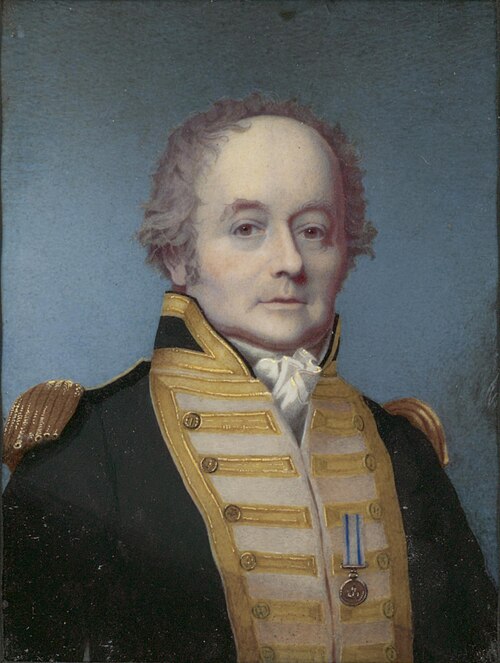
بعد رحيل فيليب، بدأ ضباط الجيش في المستعمرة بشراء الأراضي واستيراد السلع الاستهلاكية التي كانوا يحصلون عليها من السفن الزائرة. كما قام المدانون السابقون بزراعة الأراضي الممنوحة لهم وانخرطوا في التجارة. وانتشرت المزارع إلى الأراضي الأكثر خصوبة المحيطة بباراماتا وويندسور وريتشموند وكامدن ، وبحلول عام 1803 ، أصبحت المستعمرة مكتفية ذاتيًا من الحبوب. وتطورت صناعة بناء القوارب لتسهيل السفر واستغلال الموارد البحرية للمستوطنات الساحلية. وأصبحت صيد الفقمة والحيتان من الصناعات المهمة. [ 72 ]

تأسس فيلق نيو ساوث ويلز في إنجلترا عام 1789 كفوج دائم في الجيش البريطاني ليحل محل مشاة البحرية الذين رافقوا الأسطول الأول. وسرعان ما انخرط ضباط الفيلق في تجارة الروم الفاسدة والمربحة في المستعمرة. حاول الحاكم ويليام بلاي (1806-1808) قمع تجارة الروم والاستخدام غير القانوني لأراضي التاج، مما أدى إلى ثورة الروم عام 1808. ونظم الفيلق، بالتعاون الوثيق مع تاجر الصوف الجديد جون ماك آرثر ، عملية الاستيلاء المسلح الناجحة الوحيدة على الحكومة في تاريخ أستراليا، حيث أطاح ببلاي وأدى إلى فترة وجيزة من الحكم العسكري قبل وصول الحاكم لاكلان ماكواري من بريطانيا عام 1810. [ 73 ] [ 74 ]
شغل ماكواري منصب آخر حاكمٍ مُطلقٍ لولاية نيو ساوث ويلز ، من عام 1810 إلى عام 1821، ولعب دورًا رائدًا في التنمية الاجتماعية والاقتصادية للولاية، التي شهدت تحولها من مستعمرة عقابية إلى مجتمع مدني ناشئ. أسس بنكًا وعملةً ومستشفى. استعان بمخططٍ لتصميم تخطيط شوارع سيدني، وأمر ببناء الطرق والأرصفة والكنائس والمباني العامة. أرسل مستكشفين من سيدني، وفي عام 1815، اكتمل طريقٌ عبر الجبال الزرقاء ، مما مهد الطريق للزراعة والرعي على نطاق واسع في المراعي قليلة الأشجار غرب سلسلة جبال غريت ديفايدينغ رينج . [ 75 ] [ 76 ]
كان جوهر سياسة ماكواري معاملته للمحررين ، الذين رأى ضرورة معاملتهم على قدم المساواة الاجتماعية مع المستوطنين الأحرار في المستعمرة. عيّن ماكواري محررين في مناصب حكومية رئيسية، من بينهم فرانسيس غرينواي مهندسًا معماريًا للمستعمرة، وويليام ريدفيرن قاضيًا. لاقت سياسته تجاه المحررين معارضة من العديد من المستوطنين الأحرار ذوي النفوذ، والضباط، والمسؤولين، وأبدى لندن قلقه إزاء تكلفة مشاريعه العامة. في عام ١٨١٩، عيّن لندن جيه تي بيج لإجراء تحقيق في المستعمرة، واستقال ماكواري قبيل نشر تقرير التحقيق. [ ٧٧ ] [ ٧٨ ]
التوسع (1821 إلى 1850)

في عام 1820، انحصر الاستيطان البريطاني إلى حد كبير في دائرة نصف قطرها 100 كيلومتر (62 ميلاً) حول سيدني وفي السهل الأوسط لأرض فان ديمن. بلغ عدد المستوطنين 26,000 نسمة في البر الرئيسي و6,000 نسمة في أرض فان ديمن. بعد انتهاء الحروب النابليونية عام 1815، ازداد نقل المدانين بسرعة، ونما عدد المستوطنين الأحرار باطراد. [ 79 ] بين عامي 1821 و1840، وصل 55,000 مدان إلى نيو ساوث ويلز و60,000 إلى أرض فان ديمن. مع ذلك، بحلول عام 1830، تجاوز عدد المستوطنين الأحرار والمولودين محلياً عدد المدانين في نيو ساوث ويلز. [ 80 ]
ابتداءً من عشرينيات القرن التاسع عشر، أنشأ المستوطنون غير الشرعيين مراعي غير مرخصة للماشية والأغنام خارج الحدود الرسمية للمستعمرة. وفي عام ١٨٣٦، طُبِّق نظام تراخيص سنوية للرعي على أراضي التاج في محاولة للسيطرة على قطاع الرعي ، إلا أن ارتفاع أسعار الصوف وتكاليف الأراضي في المناطق المأهولة شجعا على المزيد من الاستيطان غير الشرعي. وبحلول عام ١٨٤٤، شكل الصوف نصف صادرات المستعمرة، وبحلول عام ١٨٥٠، كان معظم الثلث الشرقي من نيو ساوث ويلز تحت سيطرة أقل من ٢٠٠٠ راعٍ. [ ٨١ ] [ ٨٢ ]
في عام 1825، امتدت الحدود الغربية لولاية نيو ساوث ويلز إلى خط طول 129 درجة شرقًا، وهو ما يُمثل حاليًا الحدود الشرقية الاسمية لولاية غرب أستراليا . ونتيجةً لذلك، بلغت أراضي نيو ساوث ويلز أقصى اتساع لها، لتشمل مساحة الولاية الحالية بالإضافة إلى ولايات كوينزلاند وفيكتوريا وتسمانيا وجنوب أستراليا والإقليم الشمالي الحالية. [ 83 ] [ 68 ]
بحلول عام 1850، نما عدد المستوطنين في نيو ساوث ويلز إلى 180 ألف نسمة، باستثناء 70 ألف إلى 75 ألف نسمة الذين يعيشون في المنطقة التي أصبحت مستعمرة فيكتوريا المنفصلة في عام 1851. [ 84 ]
إنشاء مستعمرات أخرى
بعد استضافة الحملة البحرية الفرنسية بقيادة نيكولاس بودان في سيدني عام ١٨٠٢، قرر الحاكم فيليب جيدلي كينغ إنشاء مستوطنة في أرض فان ديمن ( تسمانيا الحالية ) عام ١٨٠٣، جزئيًا لمنع استيطان فرنسي محتمل. وسرعان ما تركز الاستيطان البريطاني في الجزيرة حول لونسيستون في الشمال وهوبارت في الجنوب. [ ٨٥ ] [ ٨٦ ] ومنذ عشرينيات القرن التاسع عشر، شُجع المستوطنون الأحرار بمنحهم أراضٍ تتناسب مع رأس المال الذي سيجلبونه. [ ٨٧ ] [ ٨٨ ] أصبحت أرض فان ديمن مستعمرة منفصلة عن نيو ساوث ويلز في ديسمبر ١٨٢٥، واستمرت في التوسع خلال ثلاثينيات القرن التاسع عشر، مدعومة بالزراعة ورعي الأغنام وصيد الحيتان. وبعد تعليق نقل المدانين إلى نيو ساوث ويلز عام ١٨٤٠، أصبحت أرض فان ديمن الوجهة الرئيسية للمدانين. انتهى النقل إلى أرض فان ديمن في عام 1853، وفي عام 1856 غيرت المستعمرة اسمها رسميًا إلى تسمانيا. [ 89 ]

بدأ الرعاة من أرض فان ديمن بالاستيطان في المناطق الداخلية لبورت فيليب على البر الرئيسي عام 1834، انجذبوا إلى مراعيها الخصبة. وفي عام 1835، تفاوض جون باتمان وآخرون على نقل 40,000 هكتار (100,000 فدان) من أراضي شعب كولين. إلا أن المعاهدة أُلغيت في العام نفسه عندما أصدر مكتب المستعمرات البريطاني إعلان الحاكم بورك . وبموجب هذا الإعلان، يُعتبر كل من يُضبط وهو يشغل أرضًا دون إذن من الحكومة متعديًا غير شرعي. [ 90 ]
في عام ١٨٣٦، اعتُرف رسميًا ببورت فيليب كمقاطعة تابعة لنيو ساوث ويلز، وفُتحت للاستيطان. تأسست مدينة ملبورن الرئيسية عام ١٨٣٧ كمدينة مخططة بناءً على تعليمات الحاكم بورك. وسرعان ما وصل إليها أعداد كبيرة من المستوطنين والمستوطنين من فان ديمن لاند ونيو ساوث ويلز. وفي عام ١٨٥١، انفصلت مقاطعة بورت فيليب عن نيو ساوث ويلز لتُصبح مستعمرة فيكتوريا. [ ٩١ ] [ ٩٢ ]
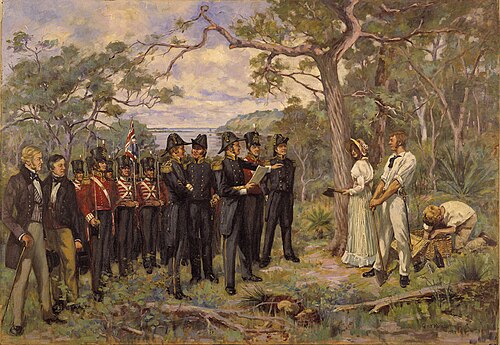
في عام 1826، أرسل حاكم نيو ساوث ويلز، رالف دارلينج ، حامية عسكرية إلى خليج الملك جورج لردع الفرنسيين عن إنشاء مستوطنة في نيو هولاند. وفي عام 1827، ضمّ قائد الحملة، الرائد إدموند لوكير ، رسميًا الجزء الغربي من القارة الذي لم تكن بريطانيا قد طالبت به بعد، كمستعمرة بريطانية. [ 93 ] وفي عام 1829، أُنشئت مستعمرة نهر سوان في موقعي فريمانتل وبيرث الحاليتين ، لتصبح أول مستعمرة أسترالية خالية من المدانين ومخصخصة. ومع ذلك، بحلول عام 1850، لم يتجاوز عدد المستوطنين 5000 بقليل. وبدأت المستعمرة باستقبال المدانين من ذلك العام بسبب النقص الحاد في الأيدي العاملة. [ 94 ] [ 95 ]

تأسست مقاطعة جنوب أستراليا عام 1836 كمستوطنة ممولة من القطاع الخاص، استنادًا إلى نظرية "الاستعمار المنهجي" التي وضعها إدوارد جيبون ويكفيلد . حُظر استخدام عمالة المدانين على أمل جعل المستعمرة أكثر جاذبية للعائلات "المحترمة" وتعزيز التوازن بين المستوطنين من الذكور والإناث. كان من المقرر تخطيط مدينة أديلايد مع توفير عدد وافر من الكنائس والحدائق والمدارس. وكان من المقرر بيع الأراضي بسعر موحد واستخدام العائدات لتأمين إمداد كافٍ من العمالة من خلال الهجرة الانتقائية المدعومة. [ 96 ] [ 97 ] [ 98 ] ضُمنت العديد من الحريات الدينية والشخصية والتجارية، وتضمن براءة التأسيس التي مكّنت قانون جنوب أستراليا لعام 1834 ضمانًا لحقوق السكان الأصليين في الأراضي. [ 99 ]
إلا أن المستعمرة تضررت بشدة من الكساد الاقتصادي الذي اجتاحها بين عامي 1841 و1844. كما أدى الصراع مع ملاك الأراضي الأصليين إلى تقليص الحماية التي وُعدوا بها. وفي عام 1842، أصبحت المستوطنة مستعمرة تابعة للتاج البريطاني، تُدار من قِبل الحاكم ومجلس تشريعي مُعيّن. تعافى الاقتصاد، وبحلول عام 1850، بلغ عدد المستوطنين 60 ألف نسمة. وفي عام 1851، نالت المستعمرة حكماً ذاتياً محدوداً من خلال مجلس تشريعي مُنتخب جزئياً. [ 96 ] [ 97 ] [ 100 ]

في عام ١٨٢٤، أُنشئت مستوطنة مورتون باي العقابية في موقع مدينة بريسبان الحالية . وفي عام ١٨٤٢، أُغلقت المستعمرة العقابية وفُتحت المنطقة للاستيطان الحر. وبحلول عام ١٨٥٠، بلغ عدد سكان بريسبان ٨٠٠٠ نسمة، وتزايد عدد الرعاة الذين كانوا يرعون الماشية والأغنام في دارلينج داونز غرب المدينة. وتصاعدت حدة العنف الحدودي بين المستوطنين والسكان الأصليين مع توسع الرعي شمال نهر تويد . وأدت سلسلة من النزاعات بين الرعاة الشماليين والحكومة في سيدني إلى تزايد مطالب المستوطنين الشماليين بالانفصال عن نيو ساوث ويلز. وفي عام ١٨٥٧، وافقت الحكومة البريطانية على الانفصال، وفي عام ١٨٥٩ أُعلن قيام مستعمرة كوينزلاند. [ ١٠١ ] [ ١٠٢ ] [ ١٠٣ ]
المدانون والمجتمع الاستعماري
المدانون والمحررون

بين عامي 1788 و1868، نُقل ما يقارب 161,700 مدان إلى المستعمرات الأسترالية في نيو ساوث ويلز، وفان ديمنز لاند، وغرب أستراليا. [ 104 ] كانت نسبة معرفة القراءة والكتابة بين المدانين أعلى من المتوسط، وجلبوا معهم مجموعة من المهارات المفيدة إلى المستعمرة الجديدة، بما في ذلك البناء والزراعة والإبحار وصيد الأسماك والصيد البري. [ 105 ] ونظرًا لقلة عدد المستوطنين الأحرار، اضطر الحكام الأوائل إلى الاعتماد على المدانين والمحررين في مهن مثل المحاماة والهندسة المعمارية والمساحة والتدريس. [ 106 ] عمل المدانون في البداية في المزارع الحكومية والأشغال العامة، مثل استصلاح الأراضي والبناء. بعد عام 1792، تم تكليف غالبيتهم بالعمل لدى أصحاب عمل من القطاع الخاص، بمن فيهم المحررون . مُنح المحررون قطعًا صغيرة من الأرض للزراعة وحصصًا غذائية حكومية لمدة عام. وفي وقت لاحق، تم تكليفهم بالعمل مع المدانين لمساعدتهم في إدارة مزارعهم. [ 107 ] تمّ تكليف بعض المدانين بالعمل لدى ضباط عسكريين لإدارة أعمالهم. وقد اكتسب هؤلاء المدانون مهارات تجارية مكّنتهم من العمل لحسابهم الخاص بعد انتهاء مدة عقوبتهم أو حصولهم على "إذن خروج" (وهو شكل من أشكال الإفراج المشروط). [ 108 ]
سرعان ما أنشأ المدانون نظامًا للعمل بالقطعة يسمح لهم بالعمل بأجر بعد إنجاز مهامهم الموكلة إليهم. [ 109 ] وبحلول عام 1821، كان المدانون والمحررون وأبناؤهم يمتلكون ثلثي الأراضي المزروعة، ونصف الماشية، وثلث الأغنام. [ 110 ] كما عملوا في الحرف والتجارة الصغيرة. ووظّف المحررون نحو نصف المدانين المعينين لدى أصحاب العمل من القطاع الخاص. [ 111 ]
أدت سلسلة من الإصلاحات التي أوصى بها جيه تي بيج في عامي 1822 و1823 إلى تدهور أوضاع المدانين. فقد خُفِّضت حصصهم الغذائية، وقُيِّدت فرصهم في العمل بأجر. [ 112 ] كما أُلحق المزيد من المدانين بفرق عمل ريفية، وأصبحت الرقابة البيروقراطية عليهم أكثر منهجية، وأُنشئت مستوطنات عقابية معزولة كأماكن للعقاب الثانوي، وجرى تشديد قواعد الحصول على تصاريح الإفراج، ووُزِّعت منح الأراضي لصالح المستوطنين الأحرار ذوي رؤوس الأموال الكبيرة. [ 113 ] ونتيجة لذلك، أصبح المدانون الذين وصلوا بعد عام 1820 أقل حظاً بكثير في امتلاك العقارات، والزواج، وتكوين الأسر. [ 114 ]
المستوطنون الأحرار
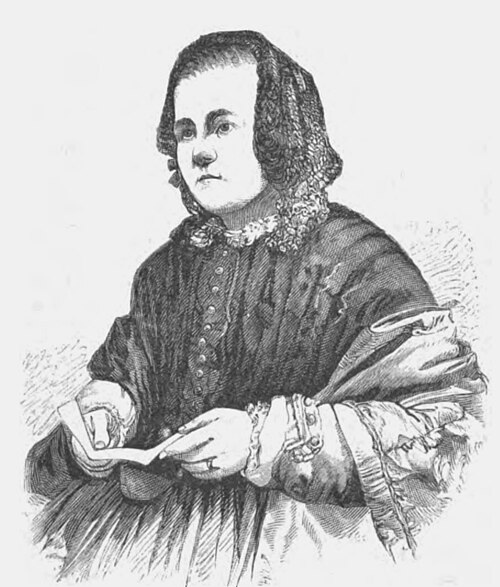
هدفت إصلاحات بيج أيضًا إلى تشجيع المستوطنين الأحرار من خلال منحهم أراضٍ تتناسب مع رؤوس أموالهم. ابتداءً من عام 1831، استبدلت المستعمرات منح الأراضي ببيعها بالمزاد العلني بسعر أدنى ثابت للفدان، واستُخدمت العائدات لتمويل هجرة العمال بمساعدة الدولة. بين عامي 1821 و1850، استقطبت أستراليا 200 ألف مهاجر من المملكة المتحدة. مع ذلك، أدى نظام تخصيص الأراضي إلى تركزها في أيدي عدد قليل من المستوطنين الأثرياء. [ 115 ]
تلقى ثلثا المهاجرين إلى أستراليا خلال هذه الفترة مساعدات من الحكومات البريطانية أو الاستعمارية. [ 116 ] كما عُرضت رحلات مجانية على عائلات المدانين، واختير نحو 3500 مهاجر بموجب قوانين الفقراء الإنجليزية . وقدمت برامج خيرية وأخرى ذات أغراض خاصة، مثل برامج كارولين تشيشولم وجون دنمور لانغ ، مساعدات للهجرة. [ 117 ]
نحيف
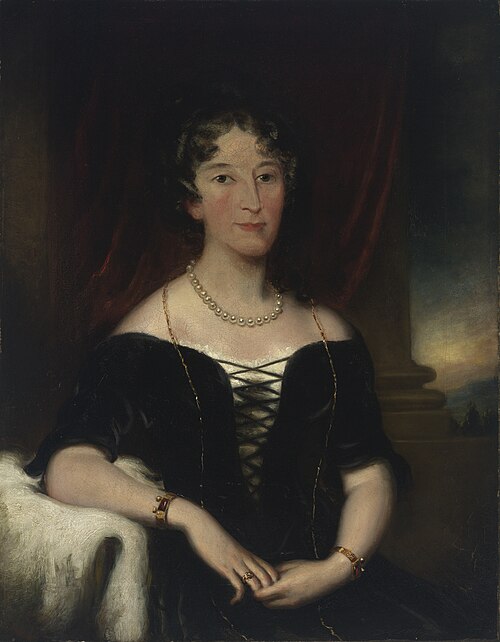
لم تشكل النساء سوى حوالي 15% من المدانين المنقولين. ونظرًا لقلة عدد النساء في المستعمرة، كنّ أكثر ميلًا للزواج من الرجال، وغالبًا ما اخترن أزواجًا أكبر سنًا وأكثر مهارةً وامتلاكًا للممتلكات. وقد فرضت المحاكم الاستعمارية الأولى حقوق ملكية النساء بشكل مستقل عن أزواجهن، كما وفر نظام التموين للنساء وأطفالهن بعض الحماية من الهجر. ونشطت النساء في مجالي التجارة والزراعة منذ السنوات الأولى للمستعمرة، ومن أبرزهن ماري ريبي، المدانة السابقة التي تحولت إلى رائدة أعمال، وإليزابيث ماك آرثر، الزراعية . [ 118 ] وشكّلت النساء ثلث مساهمي أول بنك استعماري (الذي تأسس عام 1817). [ 119 ]
كان من أهداف برامج الهجرة المدعومة منذ ثلاثينيات القرن التاسع عشر تشجيع هجرة النساء والعائلات لتحقيق توازن أكبر بين الجنسين في المستعمرات. أنشأت كارولين تشيشولم مأوىً ومركزًا لتبادل العمل للنساء المهاجرات في نيو ساوث ويلز في أربعينيات القرن التاسع عشر، وشجعت على استقرار النساء العازبات والمتزوجات في المناطق الريفية. [ 120 ] [ 121 ]
بين عامي 1830 و 1850، ارتفعت نسبة الإناث من السكان المستوطنين الأستراليين من 24 في المائة إلى 41 في المائة. [ 122 ]
دِين
كانت كنيسة إنجلترا الكنيسة الوحيدة المعترف بها قبل عام 1820، وكان رجال دينها يعملون بتعاون وثيق مع الحكام. وقد كلف الحاكم آرثر فيليب ريتشارد جونسون (كبير القساوسة 1788-1802) بتحسين "الأخلاق العامة" في المستعمرة، كما انخرط بشكل كبير في مجالي الصحة والتعليم. [ 123 ] واشتهر صموئيل مارسدن (الذي شغل مناصب دينية متنوعة 1795-1838) بعمله التبشيري، وقسوة عقوباته كقاضٍ، وشدة إداناته العلنية للكاثوليكية والمدانين الأيرلنديين. [ 124 ]

كان ربع المدانين تقريباً من الكاثوليك. وقد ترافق عدم الاعتراف الرسمي بالكاثوليكية مع الشكوك تجاه المدانين الأيرلنديين، والتي ازدادت بعد ثورة كاسل هيل التي قادها الأيرلنديون عام 1804. [ 125 ] [ 126 ] لم يعمل في المستعمرة سوى كاهنين كاثوليكيين بشكل مؤقت قبل أن يعيّن الحاكم ماكواري قساوسة كاثوليك رسميين في نيو ساوث ويلز وفان ديمنز لاند عام 1820. [ 127 ]
أوصت تقارير بيج بتعزيز مكانة الكنيسة الأنجليكانية. وفي عام ١٨٢٤، عُيّن رئيس شمامسة أنجليكاني، وخُصص له مقعد في أول مجلس تشريعي استشاري. كما تلقى رجال الدين والمدارس الأنجليكانية دعمًا حكوميًا. إلا أن هذه السياسة تغيرت في عهد الحاكم بيرك بموجب قانوني الكنيسة لعامي ١٨٣٦ و١٨٣٧. وأصبحت الحكومة تقدم الدعم الحكومي لرجال الدين ومباني الكنائس التابعة لأكبر أربع طوائف: الأنجليكانية، والكاثوليكية، والمشيخية، ولاحقًا الميثودية. [ ١٢٧ ]
رأى العديد من الأنجليكان دعم الدولة للكنيسة الكاثوليكية تهديدًا. كما روّج القس المشيخي البارز جون دنمور لانغ للانقسامات الطائفية في أربعينيات القرن التاسع عشر. [ 128 ] [ 129 ] ومع ذلك، أدى دعم الدولة إلى نمو أنشطة الكنيسة. فقد وفرت الجمعيات الخيرية، مثل جمعية راهبات المحبة الكاثوليكية التي تأسست عام 1838، مستشفيات ودور أيتام وملاجئ للمسنين وذوي الاحتياجات الخاصة. وكانت المنظمات الدينية أيضًا المزود الرئيسي للتعليم المدرسي في النصف الأول من القرن التاسع عشر، ومن الأمثلة البارزة على ذلك كلية لانغ الأسترالية التي افتُتحت عام 1831. وواصلت العديد من الجمعيات الدينية، مثل جمعية راهبات القديس يوسف التي شاركت في تأسيسها ماري ماكيلوب عام 1866، أنشطتها التعليمية بعد ازدياد عدد المدارس الحكومية العلمانية بدءًا من خمسينيات القرن التاسع عشر. [ 130 ] [ 131 ]
استكشاف القارة

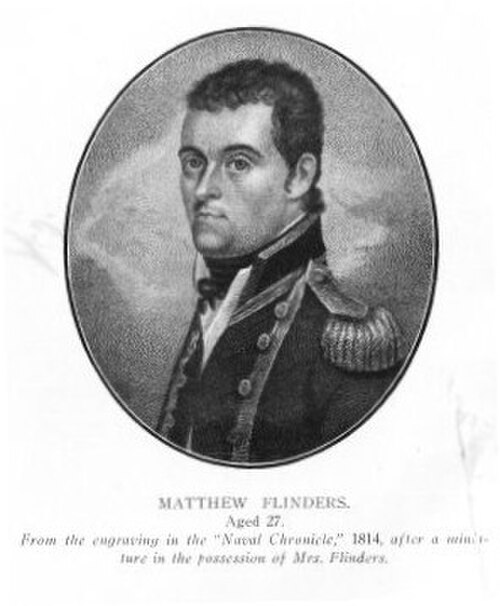
في عامي 1798-1799، انطلق جورج باس وماثيو فليندرز من سيدني على متن سفينة شراعية صغيرة، وطافا حول تسمانيا ، مُثبتين بذلك أنها جزيرة. [ 132 ] وفي عامي 1801-1802، قاد ماثيو فليندرز على متن سفينة إتش إم إس إنفستيجيتور أول رحلة حول أستراليا. وكان على متن السفينة المستكشف الأسترالي الأصلي بونغاري ، الذي أصبح أول شخص مولود في القارة الأسترالية يُبحر حولها. [ 132 ]
في عام ١٧٩٨، عبر السجين السابق جون ويلسون ورفيقاه جبال بلو ماونتينز، غرب سيدني، في رحلة استكشافية أمر بها الحاكم هنتر. أخفى هنتر خبر هذا الإنجاز خشية أن يشجع السجناء على الفرار من المستوطنة. وفي عام ١٨١٣، عبر غريغوري بلاكسلاند وويليام لوسون وويليام وينتورث الجبال عبر طريق مختلف، وسرعان ما شُقّ طريق إلى الهضاب الوسطى . [ ١٣٣ ]
في عام 1824، قاد هاميلتون هيوم وويليام هوفيل رحلة استكشافية للبحث عن مراعٍ جديدة في جنوب المستعمرة، وكذلك لمعرفة مسارات الأنهار الغربية في نيو ساوث ويلز. وعلى مدار 16 أسبوعًا في الفترة 1824-1825، سافروا إلى ميناء فيليب وعادوا. واكتشفوا نهر موراي (الذي أطلقوا عليه اسم هيوم ) والعديد من روافده، بالإضافة إلى أراضٍ زراعية ورعوية خصبة. [ 134 ]
قاد تشارلز ستورت رحلة استكشافية على طول نهر ماكواري عام 1828 واكتشف نهر دارلينج . وفي رحلة استكشافية ثانية عام 1829، تتبع ستورت نهر مورومبيدجي حتى وصل إلى نهر موراي. ثم سار فريقه على طول هذا النهر حتى التقائه بنهر دارلينج . وواصل ستورت رحلته مع التيار حتى وصل إلى بحيرة ألكسندرينا ، حيث يلتقي نهر موراي بالبحر في جنوب أستراليا. [ 135 ]
أجرى المساح العام السير توماس ميتشل سلسلة من الرحلات الاستكشافية منذ ثلاثينيات القرن التاسع عشر لمتابعة هذه الرحلات السابقة. استعان ميتشل بثلاثة مرشدين من السكان الأصليين وسجل العديد من أسماء الأماكن الأصلية. كما سجل مواجهة عنيفة مع الملاك التقليديين على نهر موراي عام 1836، حيث طاردهم رجاله وأطلقوا النار على أكبر عدد ممكن منهم. [ 136 ] [ 137 ]
أجرى العالم والمستكشف البولندي الكونت بول إدموند سترزيليكي أعمال مسح في جبال الألب الأسترالية عام 1839، وبقيادة دليلين من السكان الأصليين، أصبح أول أوروبي يصعد أعلى قمة في أستراليا، والتي أطلق عليها اسم جبل كوسييوسكو تكريماً للوطني البولندي تاديوش كوسييوسكو . [ 138 ] [ 139 ]

قاد العالم الألماني لودفيج ليخاردت ثلاث رحلات استكشافية في شمال أستراليا خلال أربعينيات القرن التاسع عشر، مستعيناً أحياناً بمرشدين من السكان الأصليين. اختفى هو ورفاقه عام ١٨٤٨ أثناء محاولتهم عبور القارة من الشرق إلى الغرب. [ ١٤٠ ] قاد إدموند كينيدي رحلة استكشافية إلى ما يُعرف الآن بأقصى غرب كوينزلاند عام ١٨٤٧ قبل أن يُقتل برماح على يد السكان الأصليين في شبه جزيرة كيب يورك عام ١٨٤٨. [ ١٤١ ]
في عام 1860، قاد بيرك وويلز أول رحلة عبور للقارة من الجنوب إلى الشمال، من ملبورن إلى خليج كاربنتاريا . وبسبب افتقارهما لمهارات البقاء في البرية، وعدم رغبتهما في التعلم من السكان الأصليين، توفي بيرك وويلز عام 1861، بعد عودتهما من الخليج إلى نقطة الالتقاء في كوبرز كريك، ليكتشفا أن بقية أفراد مجموعتهما قد غادروا المكان قبل ساعات قليلة. أصبحا بطلين مأساويين في نظر المستوطنين الأوروبيين، وجذبت جنازتهما حشدًا يزيد عن 50 ألف شخص، وألهمت قصتهما العديد من الكتب والأعمال الفنية والأفلام، كما ظهرت في العديد من الأعمال الفنية والتصويرات في الثقافة الشعبية. [ 142 ] [ 143 ]
في عام 1862، نجح جون ماكدوغال ستيوارت في عبور وسط أستراليا من الجنوب إلى الشمال. وقد رسمت رحلته الاستكشافية خريطة للمسار الذي اتبعته فيما بعد خط التلغراف البري الأسترالي . [ 144 ]
ارتبط إنجاز خط التلغراف هذا عام 1872 بمزيد من استكشاف صحراء جيبسون وسهل نولاربور . أثناء استكشافه لوسط أستراليا عام 1872، رصد إرنست جايلز كاتا تجوتا من موقع بالقرب من كينغز كانيون وأطلق عليه اسم جبل أولغا . [ 145 ] وفي العام التالي ، رصد ويليام جوس أولورو وأطلق عليه اسم صخرة آيرز ، تكريمًا للسكرتير العام لجنوب أستراليا ، السير هنري آيرز . [ 146 ]
في عام 1879، قام ألكسندر فورست برحلة من الساحل الشمالي لغرب أستراليا إلى خط التلغراف البري، واكتشف أرضًا مناسبة للرعي في منطقة كيمبرلي. [ 144 ]
تأثير الاستيطان البريطاني على السكان الأصليين
عندما وصل الأسطول الأول إلى خليج سيدني حاملاً نحو 1300 مستوطن في يناير 1788، قُدِّر عدد السكان الأصليين في منطقة سيدني بنحو 3000 نسمة. [ 147 ] وصل أول حاكم لنيو ساوث ويلز، آرثر فيليب، ومعه تعليماتٌ إلى: [ 148 ]
نسعى بكل الوسائل الممكنة لفتح علاقات مع السكان الأصليين، وكسب ودهم، ونحث جميع رعايا بلادنا على العيش في وئام ولطف معهم.

مرض
أدى العزل النسبي للسكان الأصليين لنحو 60 ألف عام إلى ضعف مناعتهم ضد العديد من الأمراض الدخيلة. وفي أبريل 1789، أودى تفشي مرض الجدري بحياة نصف سكان منطقة سيدني الأصليين تقريبًا. ولا يزال مصدر هذا التفشي محل جدل ؛ إذ يرى بعض الباحثين أنه نشأ عن احتكاك مع صيادين إندونيسيين في أقصى الشمال، بينما يرجح آخرون أنه انتشر عن غير قصد، أو عمدًا، على يد المستوطنين. [ 149 ] [ 150 ] [ 151 ]
شهدت أستراليا تفشيات أخرى لمرض الجدري، ألحقت أضرارًا بالغة بالسكان الأصليين، بدءًا من أواخر عشرينيات القرن التاسع عشر (حيث أصابت جنوب شرق أستراليا)، ثم في أوائل ستينيات القرن التاسع عشر (وانتشر المرض من شبه جزيرة كوبورغ شمالًا إلى خليج أستراليا الكبير جنوبًا)، وأخيرًا في أواخر ستينيات القرن التاسع عشر (من كيمبرلي إلى جيرالدتون). ووفقًا لجوزفين فلود، قُدِّر معدل وفيات السكان الأصليين بسبب الجدري بنسبة 60% عند أول تعرض للمرض، و50% في المناطق الاستوائية، و25% في المناطق الداخلية القاحلة. [ 152 ]
تسببت أمراض أخرى دخيلة، كالحصبة والإنفلونزا والتيفوئيد والسل، في ارتفاع معدلات الوفيات في مجتمعات السكان الأصليين. ويُقدّر بوتلين أن عدد السكان الأصليين في منطقة فيكتوريا الحالية كان حوالي 50,000 نسمة عام 1788، قبل أن يُخفّض تفشي وباء الجدري عددهم إلى حوالي 12,500 نسمة عام 1830. وبين عامي 1835 و1853، انخفض عدد السكان الأصليين في فيكتوريا من 10,000 نسمة إلى حوالي 2,000 نسمة. ويُقدّر أن حوالي 60% من هذه الوفيات كانت بسبب أمراض دخيلة، و18% لأسباب طبيعية، و15% بسبب عنف المستوطنين. [ 153 ]
كانت الأمراض المنقولة جنسياً أيضاً عاملاً في انخفاض عدد السكان الأصليين، حيث خفضت معدلات الخصوبة لدى السكان الأصليين في جنوب شرق أستراليا بنسبة تقدر بنحو 40% بحلول عام 1855. وبحلول عام 1890، تأثر ما يصل إلى 50% من السكان الأصليين في بعض مناطق كوينزلاند. [ 154 ]
الصراع والتجريد من الممتلكات

كان من المخطط في البداية أن تكون المستوطنة البريطانية مستعمرة عقابية مكتفية ذاتيًا تعتمد على الزراعة. ويجادل كارسكينز بأن الصراع اندلع بين المستوطنين وأصحاب الأرض الأصليين بسبب افتراضات المستوطنين حول تفوق الحضارة البريطانية وحقهم في الأرض التي "حسّنوها" من خلال البناء والزراعة. [ 155 ]
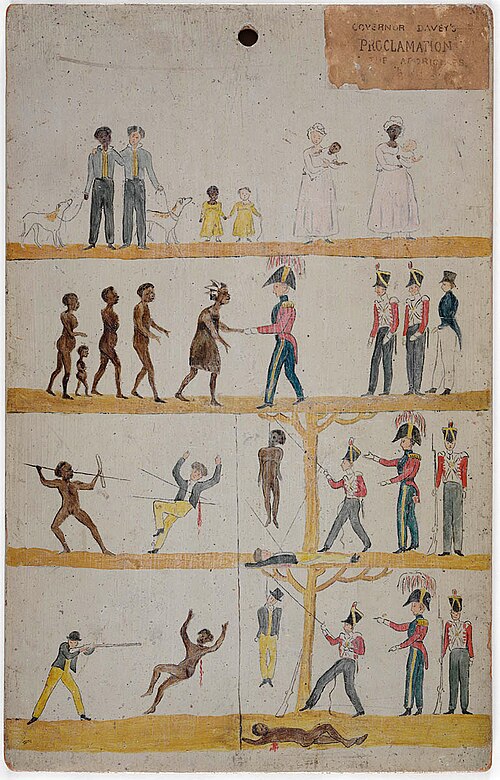
نشأ الصراع أيضًا من سوء الفهم بين الثقافات، ومن أعمال انتقامية لأفعال سابقة كاختطاف رجال ونساء وأطفال السكان الأصليين. وقد ارتكب المستعمرون وجماعات السكان الأصليين على حد سواء هجمات انتقامية وعقوبات جماعية. [ 157 ] وكانت الهجمات المتواصلة التي شنها السكان الأصليون على المستوطنين، وحرق المحاصيل، والقتل الجماعي للماشية، أعمال مقاومة واضحة لفقدان الأراضي والموارد الغذائية التقليدية. [ 158 ]
شهدت منطقة سيدني صراعات خطيرة بين المستوطنين والسكان الأصليين ( شعب داروغ ) بين عامي 1794 و1800، أسفرت عن مقتل 26 مستوطنًا وما يصل إلى 200 من شعب داروغ. [ 159 ] [ 160 ] كما اندلع صراع جنوب غرب سيدني (في أراضي داروال) بين عامي 1814 و1816، وبلغ ذروته في مذبحة أبين (أبريل 1816) التي راح ضحيتها 14 شخصًا على الأقل من السكان الأصليين. [ 161 ] [ 162 ]
في عشرينيات القرن التاسع عشر، امتدت المستعمرة عبر سلسلة جبال غريت ديفايدينغ ، مما مهد الطريق للزراعة والرعي على نطاق واسع في أراضي قبيلة ويراجوري . [ 75 ] بين عامي 1822 و1824، قاد ويندرادين مجموعة من 50 إلى 100 رجل من السكان الأصليين في غارات أسفرت عن مقتل ما بين 15 و20 مستوطنًا. وتتراوح تقديرات عدد قتلى السكان الأصليين في هذا الصراع بين 15 و100. [ 163 ] [ 164 ]
في أرض فان ديمن، اندلعت الحرب السوداء عام 1824، إثر التوسع السريع في أعداد المستوطنين ورعي الأغنام في المناطق الداخلية للجزيرة. أُعلن الأحكام العرفية في نوفمبر 1828، وفي أكتوبر 1830، اجتاح "الخط الأسود" الذي ضم حوالي 2200 جندي ومستوطن الجزيرة بهدف طرد السكان الأصليين من المناطق المأهولة. بين عامي 1830 و1834، قاد جورج أوغسطس روبنسون وسفراء من السكان الأصليين، من بينهم تروغانيني، سلسلة من "البعثات الودية" إلى قبائل السكان الأصليين، والتي أنهت الحرب فعليًا. [ 165 ] قُتل حوالي 200 مستوطن وما بين 600 و900 من سكان تسمانيا الأصليين في الصراع، ونُقل الناجون من السكان الأصليين في نهاية المطاف إلى جزيرة فليندرز. [ 166 ] [ 167 ]

أدى انتشار المستوطنين والرعاة في منطقة فيكتوريا الحالية في ثلاثينيات القرن التاسع عشر إلى اندلاع صراع مع ملاك الأراضي التقليديين. ويُقدّر بروم أن 80 مستوطنًا وما بين 1000 و1500 من السكان الأصليين لقوا حتفهم في صراع الحدود في فيكتوريا بين عامي 1835 و1853. [ 168 ]
أدى نمو مستعمرة نهر سوان في ثلاثينيات القرن التاسع عشر إلى صراع مع السكان الأصليين، بلغ ذروته في مذبحة بينجارا التي قُتل فيها ما بين 15 و30 شخصًا من السكان الأصليين. [ 169 ] [ 170 ] ووفقًا لنفيل غرين، فقد لقي 30 مستوطنًا و121 من السكان الأصليين حتفهم في صراع عنيف في غرب أستراليا بين عامي 1826 و1852. [ 171 ]

أدى انتشار رعي الأغنام والماشية بعد عام 1850 إلى تفاقم الصراع مع القبائل الأصلية الأبعد عن المناطق المأهولة. وارتفعت معدلات سقوط ضحايا من السكان الأصليين في الصراعات مع ازدياد استخدام المستوطنين للشرطة الخيالة ووحدات الشرطة الأصلية والمسدسات والبنادق الحديثة. وبلغ الصراع ذروته في نيو ساوث ويلز خلال أربعينيات القرن التاسع عشر، وفي كوينزلاند بين عامي 1860 و1880. وفي وسط أستراليا، تشير التقديرات إلى مقتل ما بين 650 و850 من السكان الأصليين، من أصل 4500 نسمة، على يد المستوطنين بين عامي 1860 و1895. وفي منطقة الخليج بشمال أستراليا، قُتل خمسة مستوطنين و300 من السكان الأصليين قبل عام 1886. [ 172 ] وكانت آخر مذبحة موثقة للسكان الأصليين على يد المستوطنين في كونيستون بالإقليم الشمالي عام 1928، حيث قُتل ما لا يقل عن 31 من السكان الأصليين. [ 173 ]
أدى انتشار الاستيطان البريطاني أيضًا إلى ازدياد الصراع بين القبائل الأصلية، حيث أُجبر المزيد من الناس على ترك أراضيهم التقليدية والانتقال إلى أراضي قبائل أخرى، غالبًا ما تكون معادية. وقدّر بوتلين أن 200 حالة وفاة من بين 8000 حالة وفاة بين السكان الأصليين في فيكتوريا بين عامي 1835 و1855 كانت نتيجة للعنف بين القبائل. [ 174 ]
يُقدّر بروم إجمالي عدد القتلى جراء الصراع بين المستوطنين والسكان الأصليين بين عامي 1788 و1928 بنحو 1700 مستوطن و17-20 ألفًا من السكان الأصليين. وقد اقترح رينولدز تقديرًا أعلى، وهو 3000 مستوطن وما يصل إلى 30 ألف قتيل من السكان الأصليين. [ 175 ] وتوصل فريق بحثي في جامعة نيوكاسل بأستراليا إلى تقدير أولي لوفاة 8270 من السكان الأصليين في مجازر الحدود بين عامي 1788 و1930. [ 176 ]
الإقامة والحماية

في أول عامين من الاستيطان، تجنب السكان الأصليون في سيدني الوافدين الجدد في الغالب. في نوفمبر 1790، قاد بينيلونغ الناجين من عدة قبائل إلى سيدني، بعد 18 شهرًا من وباء الجدري الذي فتك بالسكان الأصليين. [ 177 ] انضم بونغاري ، وهو رجل من قبيلة كورينغاي، إلى ماثيو فليندرز في رحلته حول أستراليا بين عامي 1801 و1803، ولعب دورًا هامًا كمبعوث إلى مختلف الشعوب الأصلية التي التقوا بها. [ 178 ]
حاول الحاكم ماكواري دمج السكان الأصليين في المجتمع، فمنحهم أراضٍ، وأنشأ مزارع خاصة بهم، وأسس مؤسسة تعليمية لتوفير التعليم لأطفالهم. [ 179 ] إلا أنه بحلول عشرينيات القرن التاسع عشر، فشلت المؤسسة والمزارع. واستمر السكان الأصليون في العيش على أراضٍ شاغرة على الواجهة البحرية وعلى أطراف مدينة سيدني، مُكيّفين ممارساتهم التقليدية مع البيئة شبه الحضرية الجديدة. [ 180 ] [ 181 ]
في أعقاب تصاعد الصراع الحدودي، عُيّن حماة السكان الأصليين في جنوب أستراليا ومنطقة بورت فيليب عام 1839، وفي غرب أستراليا عام 1840. وكان الهدف هو توسيع نطاق حماية القانون البريطاني ليشمل السكان الأصليين، وتوزيع الحصص الغذائية، وتوفير التعليم، وتعليم المسيحية، والتدريب المهني. إلا أنه بحلول عام 1857، أُغلقت مكاتب الحماية بسبب تكلفتها الباهظة وعدم تحقيقها لأهدافها. [ 182 ] [ 183 ]

في عام ١٨٢٥، منح حاكم نيو ساوث ويلز ٤٠٠٠ هكتار (١٠٠٠٠ فدان) لبعثة مسيحية للسكان الأصليين في بحيرة ماكواري. [ ١٨٤ ] وفي ثلاثينيات وأوائل أربعينيات القرن التاسع عشر، كانت هناك أيضًا بعثات في وادي ويلينغتون، وبورت فيليب، وخليج مورتون. وقد عملت مستوطنة السكان الأصليين من تسمانيا في جزيرة فليندرز كبعثة فعالة تحت إدارة جورج روبنسون من عام ١٨٣٥ إلى عام ١٨٣٨. [ ١٨٥ ]
في نيو ساوث ويلز، أُنشئت 116 محمية للسكان الأصليين بين عامي 1860 و1894. وقد منحت معظم هذه المحميات السكان الأصليين قدرًا من الاستقلالية وحرية الدخول والخروج. في المقابل، تمتعت هيئة حماية السكان الأصليين في ولاية فيكتوريا (التي أُنشئت عام 1869) بصلاحيات واسعة لتنظيم عمل وتعليم وإقامة السكان الأصليين في فيكتوريا، وأدارت عن كثب المحميات والبعثات الخمس التي أُنشئت منذ الحكم الذاتي عام 1858. وفي عام 1886، مُنحت الهيئة صلاحية استبعاد السكان الأصليين من ذوي الأصول المختلطة من البعثات والمراكز. وكان التشريع الفيكتوري بمثابة مقدمة لسياسات الفصل العنصري التي انتهجتها حكومات أسترالية أخرى منذ تسعينيات القرن التاسع عشر. [ 186 ]
في المناطق الأكثر كثافة سكانية، عاش معظم السكان الأصليين الذين فقدوا السيطرة على أراضيهم في محميات ومراكز تبشيرية، أو على أطراف المدن والبلدات. وفي المناطق الرعوية، منح قانون الأراضي البور البريطاني لعام 1848 ملاك الأراضي التقليديين حقوقًا محدودة للعيش والصيد وجمع الطعام على أراضي التاج بموجب عقود إيجار رعوية. وقد أقامت العديد من جماعات السكان الأصليين مخيمات في محطات الرعي حيث كان رجال السكان الأصليين يعملون غالبًا كرعاة ومربي ماشية. وقد تمكنت هذه الجماعات من الحفاظ على ارتباطها بأراضيها والحفاظ على جوانب من ثقافتها التقليدية. [ 187 ]
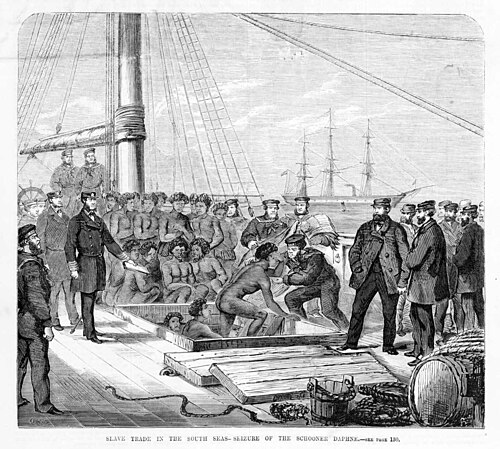
بدأ صيادو اللؤلؤ الأجانب بالتوافد على جزر مضيق توريس منذ عام 1868، حاملين معهم أمراضًا غريبة أدت إلى انخفاض عدد السكان الأصليين إلى النصف. وفي عام 1871، بدأت جمعية لندن التبشيرية عملها في الجزر، واعتنق معظم سكان جزر مضيق توريس المسيحية التي اعتبروها متوافقة مع معتقداتهم. وضمّت ولاية كوينزلاند الجزر عام 1879. [ 188 ]
من الاستقلال الذاتي إلى الاتحاد
الحكم الذاتي في ظل الاستعمار وحمى الذهب
نحو حكومة تمثيلية

نصّ التشريع الإمبراطوري الصادر عام ١٨٢٣ على إنشاء مجلس تشريعي يُرشّحه حاكم نيو ساوث ويلز، ومحكمة عليا جديدة، ما فرض قيودًا إضافية على سلطة الحكام. وقد ناضل عدد من الشخصيات الاستعمارية البارزة، بمن فيهم ويليام وينتورث ، من أجل منح نيو ساوث ويلز قدرًا أكبر من الحكم الذاتي، على الرغم من وجود انقسامات حول مدى ضرورة انتخاب الهيئة التشريعية المستقبلية انتخابًا شعبيًا. وشملت القضايا الأخرى الحقوق السياسية البريطانية التقليدية، وسياسة الأراضي، والنقل، ومدى إمكانية الوثوق بسكان نيو ساوث ويلز، الذين يُشكّلون شريحة واسعة من المدانين والمفرج عنهم، في إدارة شؤونهم. وفي عام ١٨٣٥، أسّس وينتورث وويليام بلاند الجمعية الوطنية الأسترالية لتعزيز الحكم التمثيلي في نيو ساوث ويلز. [ ١٨٩ ] [ ١٩٠ ] [ ١٩١ ]

تم تعليق النقل إلى نيو ساوث ويلز عام 1840. وفي عام 1842، منحت بريطانيا المستعمرة حكومة تمثيلية محدودة بإصلاح المجلس التشريعي بحيث يتم انتخاب ثلثي أعضائه من قبل الناخبين الذكور. ومع ذلك، فإن شرط امتلاك العقار يعني أن 20% فقط من الذكور كانوا مؤهلين للتصويت في أول انتخابات للمجلس التشريعي عام 1843. [ 192 ]
أدى تزايد أعداد المستوطنين الأحرار والأشخاص المولودين في المستعمرات إلى مزيد من المطالبات بالإصلاحات الليبرالية والديمقراطية. [ 193 ] وفي مقاطعة بورت فيليب، تصاعدت المطالبات بحكومة تمثيلية واستقلال عن نيو ساوث ويلز. [ 194 ] وفي عام 1850، منحت بريطانيا أرض فان ديمن وجنوب أستراليا ومستعمرة فيكتوريا المنشأة حديثًا مجالس تشريعية شبه منتخبة على غرار نموذج نيو ساوث ويلز. [ 195 ]
حمى الذهب في خمسينيات القرن التاسع عشر

في فبراير 1851، اكتشف إدوارد هارجريفز الذهب بالقرب من باثورست، نيو ساوث ويلز . وتحققت اكتشافات أخرى في وقت لاحق من ذلك العام في فيكتوريا، حيث عُثر على أغنى حقول الذهب. وقد فرضت نيو ساوث ويلز وفيكتوريا ترخيصًا للتنقيب عن الذهب برسوم شهرية، واستُخدمت عائداته لتغطية تكاليف توفير البنية التحتية والإدارة والأمن في حقول الذهب. [ 196 ]
تسببت حمى الذهب في البداية في التضخم ونقص العمالة نتيجةً لانتقال العمال الذكور إلى مناجم الذهب. وتدفق المهاجرون من بريطانيا وأوروبا والولايات المتحدة والصين، وكان العديد منهم يسعى للعمل في مناجم الذهب. وارتفع عدد سكان أستراليا من 430 ألف نسمة عام 1851 إلى 1.17 مليون نسمة عام 1861. وأصبحت ولاية فيكتوريا أكثر المستعمرات اكتظاظًا بالسكان، وملبورن أكبر مدنها. [ 197 ] [ 198 ]
كانت الهجرة الصينية مصدر قلق خاص لمسؤولي المستعمرات، نظراً للاعتقاد السائد بأنها تشكل خطراً على مستوى معيشة البيض الأستراليين وأخلاقهم. وردّت حكومات المستعمرات بفرض ضرائب وقيود على المهاجرين والمقيمين الصينيين. واندلعت أعمال شغب معادية للصينيين في حقول الذهب في ولاية فيكتوريا عام 1856، وفي نيو ساوث ويلز عام 1860. [ 199 ]
حصن يوريكا

في مواجهة المنافسة المتزايدة، اشتكى عمال المناجم في فيكتوريا بشكل متزايد من رسوم الترخيص، والفساد، وسوء معاملة المسؤولين، وحرمان عمال المناجم المتنقلين من حق التصويت. تصاعدت الاحتجاجات في أكتوبر 1854 عندما أُلقي القبض على ثلاثة عمال مناجم إثر أعمال شغب في بالارات. شكّل المحتجون رابطة بالارات الإصلاحية لدعم الرجال المعتقلين، وطالبوا بحق الاقتراع العام للرجال، وإصلاح نظام تراخيص التعدين وإدارته، وإصلاح الأراضي لتشجيع المزارع الصغيرة. تلت ذلك احتجاجات أخرى، وقام المحتجون ببناء حصن في حقل يوريكا في بالارات. في 3 ديسمبر، اقتحمت القوات الحصن، مما أسفر عن مقتل حوالي 20 محتجًا. كما قُتل خمسة جنود وأُصيب 12 آخرون بجروح خطيرة. [ 200 ]
عقب تشكيل لجنة ملكية، استُبدل الترخيص الشهري بحق تعدين سنوي أقل تكلفة، يمنح حامليه حق التصويت وبناء مسكن في مناجم الذهب. كما أُعيد تنظيم إدارة مناجم الذهب في ولاية فيكتوريا. وسرعان ما أصبح تمرد يوريكا جزءًا من التراث القومي الأسترالي. [ 201 ] [ 202 ]
الحكم الذاتي والديمقراطية

أسفرت انتخابات المجالس التشريعية شبه التمثيلية، التي أُجريت في نيو ساوث ويلز وفيكتوريا وجنوب أستراليا وفان ديمنز لاند عام 1851، عن زيادة عدد الأعضاء الليبراليين الذين سعوا جاهدين لتحقيق الحكم الذاتي الكامل. وفي عام 1852، أعلنت الحكومة البريطانية وقف نقل المدانين إلى فان ديمنز لاند، ودعت المستعمرات الشرقية إلى صياغة دساتير تُمكّنها من الحكم الذاتي. [ 203 ]
حصلت دساتير نيو ساوث ويلز وفيكتوريا وفان ديمنز لاند (التي أعيد تسميتها تسمانيا عام 1856) على الموافقة الملكية عام 1855، بينما حصل دستور جنوب أستراليا على الموافقة الملكية عام 1856. تنوعت الدساتير، لكن جميعها أنشأت مجلسًا أدنى يُنتخب على أساس حق الاقتراع العام للذكور، ومجلسًا أعلى يُعيّن أعضاؤه مدى الحياة (نيو ساوث ويلز) أو يُنتخب على أساس حق الاقتراع الخاص بالملكية. عندما أصبحت كوينزلاند مستعمرة مستقلة عام 1859، نالت الحكم الذاتي فورًا. مُنحت غرب أستراليا الحكم الذاتي عام 1890. [ 204 ]
اعتُمد الاقتراع السري في تسمانيا وفيكتوريا وجنوب أستراليا عام 1856، ثم في نيو ساوث ويلز (1858)، وكوينزلاند (1859)، وغرب أستراليا (1877). وفي جنوب أستراليا، أُقرّ حق الاقتراع العام للذكور في مجلس النواب عام 1856، تلتها فيكتوريا عام 1857، ثم نيو ساوث ويلز (1858)، وكوينزلاند (1872)، وغرب أستراليا (1893)، وتسمانيا (1900). وفي كوينزلاند، مُنع الذكور من السكان الأصليين من التصويت عام 1885. [ 205 ] أما في غرب أستراليا، فقد كان هناك شرط امتلاك العقار للتصويت بالنسبة للذكور من السكان الأصليين والآسيويين والأفارقة وذوي الأصول المختلطة. [ 204 ]
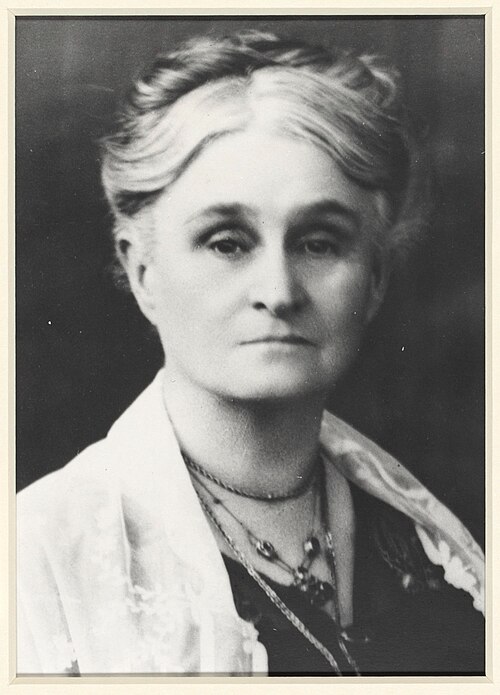
تأسست جمعياتٌ لتعزيز حق المرأة في التصويت في فيكتوريا عام ١٨٨٤، وجنوب أستراليا عام ١٨٨٨، ونيو ساوث ويلز عام ١٨٩١. كما أنشأ الاتحاد المسيحي النسائي للاعتدال فروعًا له في معظم المستعمرات الأسترالية في ثمانينيات القرن التاسع عشر، مُروّجًا لحق المرأة في التصويت ومجموعة من القضايا الاجتماعية. [ ٢٠٦ ] نالت المرأة حق التصويت، وحق الترشح للمناصب العامة، لأول مرة في جنوب أستراليا عام ١٨٩٥. [ ٢٠٧ ] وحصلت النساء على حق التصويت في غرب أستراليا عام ١٨٩٩، مع وجود قيود عنصرية. أما في بقية أنحاء أستراليا، فلم تنل النساء حقوقهن الكاملة في التصويت والترشح للمناصب المنتخبة إلا في العقد الذي تلى قيام الاتحاد، على الرغم من وجود بعض القيود العنصرية. [ ٢٠٨ ] [ ٢٠٩ ]
الازدهار الطويل (1860 إلى 1890)
من خمسينيات القرن التاسع عشر وحتى عام ١٨٧١، كان الذهب أكبر صادرات أستراليا، مما مكّن المستعمرات من استيراد مجموعة واسعة من السلع الاستهلاكية والرأسمالية. وقد حفّزت الزيادة السكانية في العقود التي تلت حمى الذهب الطلب على المساكن والسلع الاستهلاكية والخدمات والبنية التحتية الحضرية. [ ٢١٠ ]
في ستينيات القرن التاسع عشر، سنّت ولايات نيو ساوث ويلز وفيكتوريا وكوينزلاند وجنوب أستراليا قوانين اختيار تهدف إلى تشجيع المزارع العائلية والزراعة المختلطة والرعي. [ 211 ] وأدى تحسين تقنيات الزراعة وإدخال محاصيل متأقلمة مع الظروف الأسترالية في نهاية المطاف إلى تنويع استخدام الأراضي الريفية. كما سمح توسع شبكة السكك الحديدية منذ ستينيات القرن التاسع عشر بنقل القمح بكميات كبيرة وبتكلفة زهيدة، مما حفز إنشاء حزام زراعة القمح الممتد من جنوب أستراليا إلى كوينزلاند. [ 212 ] [ 213 ]

شهدت الفترة من عام 1850 إلى عام 1880 انتعاشًا في أعمال قطاع الطرق . وقد استند هذا الانتعاش، الذي بدأ في خمسينيات القرن التاسع عشر، إلى مظالم فقراء الريف (إذ كان العديد من أعضاء عصابة كيلي ، أشهر قطاع الطرق، أبناء مزارعين صغار فقراء). حظيت مغامرات نيد كيلي وعصابته بدعم كبير من المجتمع المحلي وتغطية إعلامية وطنية واسعة النطاق في ذلك الوقت. بعد القبض على كيلي وإعدامه بتهمة القتل عام 1880، ألهمت قصته العديد من الأعمال الفنية والأدبية والثقافية الشعبية، وأثارت جدلًا مستمرًا حول ما إذا كان متمردًا يناضل ضد الظلم الاجتماعي وقمع الشرطة، أم مجرمًا قاتلًا. [ 214 ]
بحلول ثمانينيات القرن التاسع عشر، كان نصف سكان أستراليا يعيشون في المدن، مما جعل أستراليا أكثر تحضرًا من المملكة المتحدة والولايات المتحدة وكندا. [ 215 ] وبين عامي 1870 و1890، كان متوسط دخل الفرد في أستراليا أعلى بنسبة تزيد عن 50% من نظيره في الولايات المتحدة، مما منح أستراليا أحد أعلى مستويات المعيشة في العالم. [ 216 ]
تضاعف حجم القطاع الحكومي تقريبًا من 10% من الإنفاق الوطني عام 1850 إلى 19% عام 1890. أنفقت الحكومات الاستعمارية مبالغ طائلة على البنية التحتية، كالسكك الحديدية والموانئ والبرق والمدارس والخدمات الحضرية. وقد تم اقتراض جزء كبير من الأموال اللازمة لهذه البنية التحتية من أسواق لندن المالية، إلا أن الحكومات الغنية بالأراضي باعت أيضًا بعضًا منها لتمويل النفقات والحفاظ على انخفاض الضرائب. [ 217 ] [ 218 ]
في عام 1856، كان عمال البناء في سيدني وملبورن أول من نال في العالم حق العمل ثماني ساعات يوميًا. وشهدت ثمانينيات القرن التاسع عشر نمو النقابات العمالية وانتشارها بين العمال ذوي المهارات المتدنية، بل وتجاوزت حدود المستعمرات. وبحلول عام 1890، كان نحو 20% من العمال الذكور أعضاءً في نقابات عمالية، وهي من أعلى النسب في العالم. [ 219 ] [ 220 ]
ترافق النمو الاقتصادي مع التوسع في شمال أستراليا. اكتُشف الذهب في شمال كوينزلاند خلال ستينيات وسبعينيات القرن التاسع عشر، وفي منطقتي كيمبرلي وبيلبارا في غرب أستراليا خلال ثمانينيات القرن نفسه. وانتشرت قطعان الأغنام والماشية إلى شمال كوينزلاند، ثم إلى منطقة الخليج في الإقليم الشمالي، ومنطقة كيمبرلي في غرب أستراليا خلال سبعينيات وثمانينيات القرن التاسع عشر. كما توسعت مزارع قصب السكر في شمال كوينزلاند خلال الفترة نفسها. [ 221 ] [ 222 ]
منذ أواخر سبعينيات القرن التاسع عشر، شنت النقابات العمالية والروابط المناهضة للصينيين وجماعات مجتمعية أخرى حملات ضد الهجرة الصينية والعمالة الصينية منخفضة الأجر. وعقب مؤتمرات مشتركة بين المستعمرات حول هذه القضية في عامي 1880-1881 و1888، ردت الحكومات الاستعمارية بسلسلة من القوانين التي قيدت تدريجياً الهجرة الصينية وحقوق المواطنة. [ 223 ]
الكساد الاقتصادي في تسعينيات القرن التاسع عشر

أدى انخفاض أسعار الصوف وانهيار فقاعة المضاربة العقارية في ملبورن إلى نهاية فترة الازدهار الطويلة. أوقفت العديد من البنوك الكبرى أعمالها، وانكمش الاقتصاد بنسبة 20% بين عامي 1891 و1895. وارتفعت نسبة البطالة إلى ما يقارب ثلث القوى العاملة. وأعقب هذا الكساد ما يُعرف بـ" جفاف الاتحاد " الذي استمر من عام 1895 إلى عام 1903. [ 224 ]
في عام 1890، امتد إضراب عمال صناعة الشحن إلى الأرصفة والسكك الحديدية والمناجم وحظائر جز الصوف. وردّ أصحاب العمل بإغلاق أماكن عمل العمال وتوظيف عمال غير منضمين إلى النقابات، وتدخلت الحكومات الاستعمارية بالشرطة والجيش. وقد فشل الإضراب، كما فشلت إضرابات لاحقة لجزازي الصوف في عامي 1891 و1894، وعمال المناجم في عامي 1892 و1896. [ 225 ]
أدت هزيمة إضراب عمال الموانئ عام 1890 إلى تشكيل النقابات العمالية لأحزاب سياسية. في نيو ساوث ويلز، فاز حزب الرابطة الانتخابية العمالية بربع المقاعد في انتخابات عام 1891، وحافظ على ميزان القوى بين حزب التجارة الحرة وحزب الحمائيين . كما فازت أحزاب العمال بمقاعد في انتخابات جنوب أستراليا وكوينزلاند عام 1893. وشُكّلت أول حكومة عمالية في العالم في كوينزلاند عام 1899، لكنها لم تستمر سوى أسبوع واحد. [ 226 ]
في مؤتمر بين المستعمرات عام ١٨٩٦، اتفقت المستعمرات على توسيع نطاق القيود المفروضة على الهجرة الصينية لتشمل "جميع الأعراق الملونة". دعم حزب العمال حكومة ريد في نيو ساوث ويلز في إقرار قانون تقييد وتنظيم الأعراق الملونة ، الذي كان بمثابة مقدمة لسياسة أستراليا البيضاء. ومع ذلك، وبعد أن أعربت بريطانيا واليابان عن اعتراضهما على التشريع، قامت نيو ساوث ويلز وتسمانيا وغرب أستراليا بدلاً من ذلك بتطبيق اختبارات اللغة الأوروبية لتقييد المهاجرين "غير المرغوب فيهم". [ ٢٢٧ ]
نمو النزعة القومية

بحلول أواخر ثمانينيات القرن التاسع عشر، كان غالبية سكان المستعمرات الأسترالية من مواليد أستراليا، على الرغم من أن أكثر من 90% منهم كانوا من أصول بريطانية وأيرلندية. [ 228 ] وقد ناضلت جمعية السكان الأصليين الأستراليين من أجل إقامة اتحاد أسترالي ضمن الإمبراطورية البريطانية، وروّجت للأدب والتاريخ الأستراليين، ونجحت في الضغط من أجل اعتماد يوم 26 يناير يومًا وطنيًا لأستراليا. [ 229 ]
تحدث العديد من القوميين عن أن الأستراليين يتشاركون دماً مشتركاً باعتبارهم أعضاء في "العرق" البريطاني. [ 230 ] صرّح هنري باركس في عام 1890 قائلاً: "إن خيط القرابة القرمزي يربطنا جميعاً... يجب أن نتحد كشعب أسترالي واحد عظيم." [ 231 ]
رأت أقلية من القوميين أن الهوية الأسترالية المتميزة، بدلاً من الهوية البريطانية المشتركة، هي الأساس لأستراليا موحدة. وكان بعضهم، مثل مجلة " ذا بوليتين " الراديكالية والمدعي العام لولاية تسمانيا أندرو إنجليس كلارك ، جمهوريين، بينما كان آخرون مستعدين لقبول دولة أسترالية مستقلة تماماً، مع دور شرفي فقط للملك البريطاني. [ 232 ]
كانت أستراليا الموحدة تُربط عادةً بأستراليا البيضاء. ففي عام ١٨٨٧، أعلنت صحيفة "ذا بوليتين" أن جميع الرجال البيض الذين تخلوا عن الانقسامات الدينية والطبقية للعالم القديم هم أستراليون. [ ٢٣٣ ] كما أن أستراليا البيضاء كانت تعني استبعاد العمالة الآسيوية الرخيصة، وهي فكرة روجت لها الحركة العمالية بقوة. [ ٢٣٤ ]
ارتبط تنامي النزعة القومية في ثمانينيات وتسعينيات القرن التاسع عشر بتطور فن وأدب أستراليين مميزين. وقد حذا فنانو مدرسة هايدلبرغ ، مثل آرثر ستريتون وفريدريك مكوبين وتوم روبرتس، حذو الانطباعيين الأوروبيين بالرسم في الهواء الطلق. وكرسوا جهودهم لتجسيد ضوء وألوان المناظر الطبيعية الأسترالية، واستكشاف الجوانب المميزة والعالمية في "الحياة المختلطة للمدينة والحياة المميزة للمزارع والأراضي الريفية". [ 235 ]
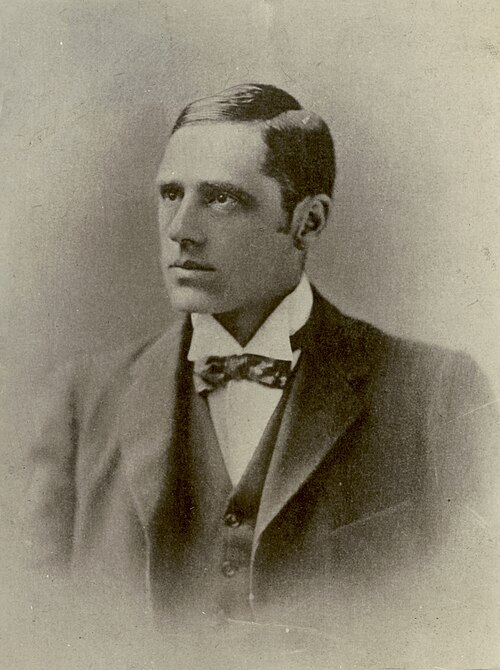
في تسعينيات القرن التاسع عشر، أنتج هنري لوسون وبانجو باترسون وكتاب آخرون مرتبطون بصحيفة "ذا بوليتين" قصائد ونصوصًا نثرية استكشفت طبيعة الحياة في الأدغال ومواضيع الاستقلال والصبر والعمل الشاق والمساواة ومناهضة السلطوية والصداقة الحميمة. وكان أبطال هذه الأعمال غالبًا من جزازي الأغنام وحراس الحدود والعمال المتجولين في الأدغال. وفي العقد التالي، ساهم لوسون وباترسون وكتاب آخرون مثل ستيل رود ومايلز فرانكلين وجوزيف فورفي في صياغة أدب وطني مميز. وحققت قصيدة باترسون " الرجل من نهر سنووي" (1890) شهرة واسعة، وساعدت كلماته لأغنية " والتزنج ماتيلدا " ( حوالي 1895 ) في جعلها النشيد الوطني غير الرسمي لكثير من الأستراليين. [ 236 ]
حركة الاتحاد
تزامن تنامي النزعة القومية مع مخاوف قطاع الأعمال بشأن عدم جدوى الحواجز الجمركية بين المستعمرات، وازدواجية الخدمات التي تقدمها الحكومات الاستعمارية، وغياب سوق وطنية موحدة للسلع والخدمات. [ 237 ] كما أدت مخاوف المستعمرات من الطموحات الألمانية والفرنسية في المنطقة إلى ضغوط بريطانية لإنشاء قوة دفاعية أسترالية موحدة وشبكة سكك حديدية موحدة ذات مقياس واحد لأغراض الدفاع. [ 238 ]
تم تشكيل مجلس اتحادي لأستراليا في عام 1885، لكن صلاحياته كانت محدودة، ورفضت نيو ساوث ويلز وجنوب أستراليا الانضمام إليه. [ 239 ]

كان من بين العقبات التي واجهت الاتحاد مخاوف المستعمرات الصغيرة من هيمنة نيو ساوث ويلز وفيكتوريا عليها. كوينزلاند على وجه الخصوص، رغم تأييدها لسياسة أستراليا البيضاء عموماً، رغبت في الإبقاء على استثناء لعمال جزر جنوب المحيط الهادئ في صناعة قصب السكر. [ 240 ]
كان من بين العوائق الرئيسية الأخرى سياسات التجارة الحرة في نيو ساوث ويلز، والتي تعارضت مع السياسات الحمائية السائدة في فيكتوريا ومعظم المستعمرات الأخرى. ومع ذلك، كان رئيس وزراء نيو ساوث ويلز، هنري باركس، من أشد المؤيدين للاتحاد ، وكان لخطابه في تينترفيلد عام 1889 دور محوري في حشد الدعم لهذه القضية. [ 241 ]
في عام 1891، عُقد مؤتمر وطني أسترالي في سيدني، بمشاركة جميع المستعمرات ونيوزيلندا. وتم اعتماد مشروع قانون دستوري، إلا أن تفاقم الكساد الاقتصادي والمعارضة في برلمانات المستعمرات أدى إلى تأخير التقدم. [ 242 ]
تأسست روابط اتحاد المواطنين، وفي مؤتمر عُقد في كوروا في يوليو 1893، وضعوا خطة جديدة للاتحاد تتضمن مؤتمراً دستورياً يضم مندوبين منتخبين مباشرة، واستفتاءً في كل مستعمرة للموافقة على الدستور المقترح. وقد أيّد رئيس وزراء نيو ساوث ويلز الجديد، جورج ريد ، "خطة كوروا"، وفي عام 1895 أقنع غالبية رؤساء الوزراء الآخرين بتبنيها. [ 243 ]
أرسلت جميع المستعمرات باستثناء كوينزلاند ممثلين إلى مؤتمر دستوري عُقدت جلساته في عامي 1897 و1898. وقد صاغ المؤتمر دستورًا مقترحًا لكومنولث من الولايات الفيدرالية تحت التاج البريطاني. [ 244 ]
أسفرت الاستفتاءات التي أُجريت عام ١٨٩٨ عن أغلبية ساحقة لصالح الدستور في فيكتوريا وجنوب أستراليا وتسمانيا. إلا أن الاستفتاء لم يحقق الأغلبية المطلوبة في نيو ساوث ويلز. [ ٢٤٥ ] وافق رؤساء وزراء المستعمرات الأخرى على عدد من التنازلات لنيو ساوث ويلز (لا سيما أن عاصمة الكومنولث المستقبلية ستكون في تلك الولاية)، وفي عام ١٨٩٩ أُجريت استفتاءات أخرى في جميع المستعمرات باستثناء غرب أستراليا. وأسفرت جميعها عن تصويت بنعم. [ ٢٤٦ ]
في مارس 1900، أُرسل مندوبون إلى لندن، من بينهم أبرز دعاة الاتحاد إدموند بارتون وألفريد ديكين . وبعد مفاوضات مع الحكومة البريطانية، أقر البرلمان الإمبراطوري قانون الاتحاد في 5 يوليو 1900، وحصل على الموافقة الملكية في 9 يوليو. وصوّتت ولاية غرب أستراليا لاحقًا للانضمام إلى الاتحاد الجديد. [ 247 ]
من الاتحاد إلى الحرب (1901-1914)
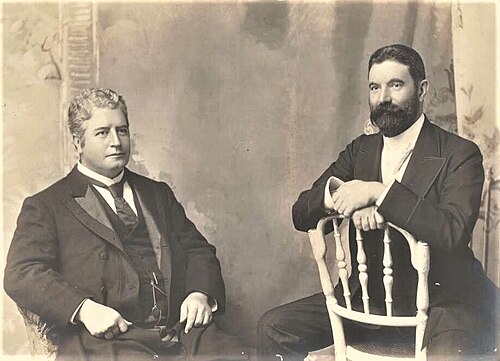
أعلن الحاكم العام ، اللورد هوبتون ، قيام كومنولث أستراليا في الأول من يناير عام ١٩٠١، وأدى بارتون اليمين الدستورية كأول رئيس وزراء لأستراليا. [ ٢٤٧ ] أُجريت أول انتخابات فيدرالية في مارس عام ١٩٠١ ، وأسفرت عن فوز طفيف لحزب الحمائيين على حزب التجارة الحرة، بينما حلّ حزب العمال الأسترالي في المركز الثالث. أعلن حزب العمال دعمه للحزب الذي يُقدم تنازلات لبرنامجه، وشكّل الحمائيون بزعامة بارتون حكومة، وتولى ديكين منصب المدعي العام . [ ٢٤٨ ]
كان قانون تقييد الهجرة لعام 1901 من أوائل القوانين التي أقرها البرلمان الأسترالي الجديد . وقد شكّل هذا القانون حجر الزاوية في سياسة أستراليا البيضاء، إذ استخدم اختبار إملاء بلغة أوروبية لاستبعاد المهاجرين الآسيويين، الذين اعتُبروا تهديدًا لمستويات المعيشة في أستراليا وللثقافة البريطانية السائدة. [ 249 ] [ 250 ]
مع قيام الاتحاد، ورثت الكومنولث قوات الدفاع الصغيرة للمستعمرات الأسترالية الست السابقة. وبحلول عام ١٩٠١، كانت وحدات من الجنود من جميع المستعمرات الأسترالية الست قد شاركت في حرب البوير ضمن القوات البريطانية . وعندما طلبت الحكومة البريطانية المزيد من القوات من أستراليا في أوائل عام ١٩٠٢، استجابت الحكومة الأسترالية بإرسال فرقة وطنية. وبحلول نهاية الحرب في يونيو ١٩٠٢، كان نحو ١٦٥٠٠ رجل قد تطوعوا للخدمة. [ ٢٥١ ] [ ٢٥٢ ]
في عام 1902، أقرت الحكومة حق المرأة في التصويت في نطاق اختصاص الكومنولث، لكنها في الوقت نفسه استبعدت السكان الأصليين من حق الاقتراع ما لم يكن لديهم بالفعل حق التصويت في ولاية أخرى. [ 253 ]


فرضت الحكومة أيضًا تعريفة جمركية على الواردات، بهدف زيادة الإيرادات وحماية الصناعة الأسترالية. [ 254 ] إلا أن الخلافات حول تشريعات العلاقات الصناعية أدت إلى سقوط حكومة ديكين الحمائية في أبريل 1904، وتشكيل أول حكومة عمالية وطنية برئاسة كريس واتسون . وسقطت حكومة واتسون نفسها في أبريل، ونجحت حكومة التجارة الحرة برئاسة رئيس الوزراء ريد في سن تشريع لإنشاء محكمة الكومنولث للتوفيق والتحكيم لتسوية النزاعات الصناعية بين الولايات. [ 255 ]
في يوليو/تموز 1905، شكّل ديكين حكومة حمائية بدعم من حزب العمال. شرعت الحكومة الجديدة في سلسلة من الإصلاحات الاجتماعية وبرنامج أُطلق عليه اسم " الحماية الجديدة" ، والذي بموجبه رُبطت الحماية الجمركية للصناعات الأسترالية بتوفيرها أجورًا "عادلة ومعقولة". في قضية هارفيستر عام 1907، حدّد إتش بي هيغينز، من محكمة التوفيق والتحكيم، أجرًا أساسيًا بناءً على احتياجات المعيل الذكر الذي يعيل زوجة وثلاثة أطفال. وبحلول عام 1914، كانت الكومنولث وجميع الولايات قد أدخلت أنظمة لتسوية النزاعات الصناعية وتحديد الأجور وشروط العمل. [ 256 ] [ 257 ]
كانت الحركة النقابية الأسترالية هي القاعدة الشعبية لحزب العمال، حيث نما عدد أعضائها من أقل من 100,000 عضو عام 1901 إلى أكثر من نصف مليون عضو عام 1914. [ 258 ] كما حظي الحزب بدعم كبير من العاملين في المجال الديني والكاثوليك وصغار المزارعين. [ 259 ] وفي عام 1905، تبنى حزب العمال أهدافًا على المستوى الفيدرالي شملت "تنمية شعور أسترالي قائم على الحفاظ على نقاء العرق" و"الملكية الجماعية للاحتكارات". وفي العام نفسه، تبنى فرع الحزب في كوينزلاند هدفًا اشتراكيًا صريحًا . [ 260 ]
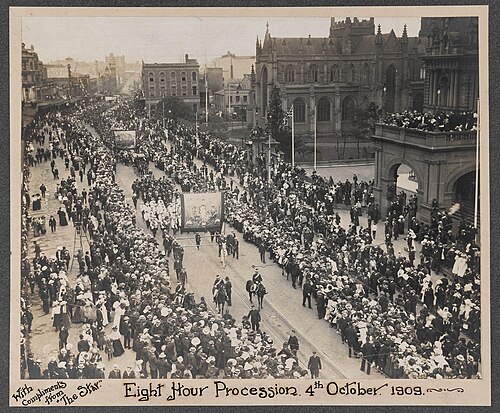
بعد انتخابات ديسمبر 1906، بقيت حكومة ديكين الحمائية في السلطة، ولكن بعد إقرار تشريعات معاشات الشيخوخة وفرض تعريفة جمركية حمائية جديدة عام 1908، سحب حزب العمال دعمه للحكومة. وفي نوفمبر، أصبح أندرو فيشر ثاني رئيس وزراء من حزب العمال. وردًا على ذلك، شكلت أحزاب المعارضة ائتلافًا مناهضًا لحزب العمال، وتولى ديكين رئاسة الوزراء في يونيو 1909. [ 261 ]
في انتخابات مايو 1910 ، فاز حزب العمال بأغلبية في مجلسي البرلمان، وعاد فيشر رئيسًا للوزراء. أدخلت حكومة حزب العمال سلسلة من الإصلاحات، شملت ضريبة تصاعدية على الأراضي (1910)، ومعاشات العجز (1910)، وبدل الأمومة (1912). أنشأت الحكومة بنك الكومنولث (1911)، لكن الاستفتاءات التي دعت إلى تأميم الاحتكارات وتوسيع صلاحيات الكومنولث في التجارة والصناعة باءت بالفشل في عامي 1911 و1913. تولى الكومنولث مسؤولية الإقليم الشمالي من جنوب أستراليا عام 1911. [ 262 ] [ 263 ] زادت الحكومة الإنفاق الدفاعي، ووسعت نظام التدريب العسكري الإلزامي الذي كانت قد أدخلته الحكومة السابقة، وأنشأت البحرية الملكية الأسترالية. [ 264 ] [ 265 ] [ 266 ]
فاز حزب الكومنولث الليبرالي الجديد في انتخابات مايو 1913 ، وتولى جوزيف كوك، زعيم حزب العمال السابق، منصب رئيس الوزراء. وأدت محاولة حكومة كوك تمرير تشريع يلغي المعاملة التفضيلية لأعضاء النقابات في الخدمة العامة للكومنولث إلى حل البرلمان مرتين . وفاز حزب العمال بسهولة في انتخابات سبتمبر 1914، وعاد فيشر إلى منصبه. [ 267 ]
شهدت فترة ما قبل الحرب نموًا قويًا في عدد السكان والاقتصاد. نما الاقتصاد بنسبة 75%، وكان للصناعات الريفية والبناء والتصنيع والخدمات الحكومية دورٌ رائد في هذا النمو. [ 268 ] ازداد عدد السكان من أربعة ملايين نسمة عام 1901 إلى خمسة ملايين نسمة عام 1914. وفي الفترة من 1910 إلى 1914، وصل ما يقارب 300 ألف مهاجر، جميعهم من البيض، ومعظمهم من بريطانيا. [ 269 ]
الحرب العالمية الأولى
أستراليا في حالة حرب ( 1914-1918 )
عندما أعلنت المملكة المتحدة الحرب على ألمانيا في 4 أغسطس 1914، شمل الإعلان تلقائيًا جميع مستعمرات بريطانيا ومناطقها التابعة. [ 270 ] عرض الحزبان الرئيسيان على بريطانيا إرسال 20,000 جندي أسترالي. ولأن قانون الدفاع لعام 1903 كان يمنع إرسال المجندين إلى الخارج، فقد تم تشكيل قوة تطوعية جديدة، هي القوة الإمبراطورية الأسترالية (AIF)، للوفاء بهذا الالتزام. [ 271 ] [ 272 ]
كان الحماس الشعبي للحرب عالياً، وسرعان ما تم استيفاء الحصة الأولية للقوات الأسترالية الإمبراطورية. غادرت القوات إلى مصر في 1 نوفمبر 1914، وقامت إحدى سفن المرافقة، وهي السفينة الحربية الأسترالية " سيدني" ، بإغراق الطراد الألماني "إمدن" في طريقها. في غضون ذلك، في سبتمبر، استولت قوة استكشافية أسترالية منفصلة على غينيا الجديدة الألمانية. [ 273 ]

بعد وصولها إلى مصر، تم دمج القوات الأسترالية الإمبراطورية في فيلق الجيش الأسترالي والنيوزيلندي (أنزاك). وشكّلت قوات أنزاك جزءًا من قوة الحملة المتوسطية، التي كُلّفت بفتح مضيق الدردنيل أمام سفن الحلفاء الحربية، مُهددةً بذلك القسطنطينية ، عاصمة الإمبراطورية العثمانية التي دخلت الحرب إلى جانب دول المحور . نزلت قوات أنزاك، إلى جانب القوات الفرنسية والبريطانية والهندية، على شبه جزيرة غاليبولي في 25 أبريل 1915. كان موقع القوات الأسترالية والنيوزيلندية في خليج أنزاك عرضةً للهجوم، وتكبّدت القوات خسائر فادحة في سبيل إنشاء رأس جسر ضيق. وبعد أن تبيّن عجز قوة الحملة عن تحقيق أهدافها، تم إجلاء قوات أنزاك في ديسمبر، وتبعتها القوات البريطانية والفرنسية في أوائل يناير. [ 274 ] [ 275 ]
تكبّد الأستراليون نحو 8000 قتيل في الحملة. [ 276 ] وقد ركّز مراسلو الحرب الأستراليون، بدرجات متفاوتة، على شجاعة الأستراليين وقدراتهم القتالية، وعلى أخطاء قادتهم البريطانيين. وسرعان ما أصبح يوم 25 أبريل/نيسان عطلة وطنية أسترالية تُعرف بيوم أنزاك ، وتتمحور حول مفاهيم "الوطنية والأخوة والتضحية". [ 277 ] [ 278 ]
في عام 1916، أُرسلت خمس فرق مشاة من القوات الإمبراطورية الأسترالية إلى الجبهة الغربية. وفي يوليو/تموز من العام نفسه، في معركة فروميل ، تكبدت القوات الإمبراطورية الأسترالية 5533 إصابة خلال 24 ساعة، في أكثر المعارك دموية في تاريخ الجيش الأسترالي. [ 279 ] وفي مناطق أخرى من نهر السوم ، قُتل أو جُرح 23000 جندي أسترالي خلال سبعة أسابيع من الهجمات على المواقع الألمانية. وفي ربيع عام 1917، تكبدت القوات الأسترالية 10000 إصابة في معركتي بوليكورت الأولى والثانية . وفي صيف وخريف عام 1917، تكبدت القوات الأسترالية أيضًا خسائر فادحة خلال الهجوم البريطاني حول مدينة يبرس . وبشكل عام، قُتل ما يقرب من 22000 جندي أسترالي في عام 1917. [ 280 ]

في نوفمبر 1917، تم توحيد الفرق الأسترالية الخمس في الفيلق الأسترالي ، وفي مايو 1918 تولى الجنرال الأسترالي جون موناش القيادة. شارك الفيلق الأسترالي بشكل كبير في إيقاف الهجوم الربيعي الألماني عام 1918 وفي الهجوم المضاد للحلفاء في أغسطس من ذلك العام. [ 281 ]
في الشرق الأوسط، برزت كتائب الخيالة الأسترالية الخفيفة في معركة روماني في أغسطس 1916. وفي عام 1917، شاركت في تقدم قوات الحلفاء عبر شبه جزيرة سيناء وصولاً إلى فلسطين. وفي عام 1918، واصلت تقدمها عبر فلسطين وصولاً إلى سوريا، في تقدم أدى إلى استسلام الدولة العثمانية في 31 أكتوبر. [ 282 ]
بحلول نهاية الحرب في 11 نوفمبر 1918، كان 324 ألف أسترالي قد خدموا في الخارج. وشملت الخسائر 60 ألف قتيل و150 ألف جريح ، وهي أعلى نسبة خسائر بين جميع قوات الحلفاء. كما سجلت القوات الأسترالية معدلات غياب غير مصرح به، وجرائم، وسجن أعلى من غيرها من قوات الحلفاء. [ 283 ]
الجبهة الداخلية

في أكتوبر/تشرين الأول 1914، أصدرت حكومة فيشر العمالية قانون تدابير الحرب الذي منحها صلاحية وضع لوائح "لضمان السلامة العامة والدفاع عن الكومنولث". [ 284 ] بعد أن حلّ بيلي هيوز محل فيشر كرئيس للوزراء في أكتوبر/تشرين الأول 1915، ازداد استخدام اللوائح الصادرة بموجب هذا القانون لفرض رقابة على المنشورات، ومعاقبة الخطاب العام، وقمع المنظمات التي اعتبرتها الحكومة ضارة بالمجهود الحربي. [ 285 ] [ 286 ] شُكّلت روابط مناهضة للألمان، وأُرسل 7000 ألماني وغيرهم من "الأجانب الأعداء" إلى معسكرات الاعتقال خلال الحرب. [ 287 ] [ 285 ]
انكمش الاقتصاد بنسبة 10% خلال فترة الحرب. وارتفع التضخم في أول عامين من الحرب، بينما انخفضت الأجور الحقيقية. [ 288 ] [ 289 ] وأدى انخفاض الأجور، بالإضافة إلى تصورات استغلال بعض الشركات للوضع لتحقيق الربح، إلى موجة من الإضرابات في عام 1916، شارك فيها عمال المناجم وعمال الموانئ وجزّازو الأغنام. [ 290 ]
كما انخفضت أعداد المجندين في الجيش، من 35 ألف مجند شهريًا في ذروتها عام 1915 إلى 6 آلاف مجند شهريًا عام 1916. [ 291 ] ردًا على ذلك، قرر هيوز إجراء استفتاء على التجنيد الإجباري للخدمة في الخارج. بعد الهزيمة الطفيفة في استفتاء التجنيد الذي أُجري في أكتوبر 1916 ، غادر هيوز و23 من مؤيديه حزب العمال البرلماني وشكلوا حكومة قومية جديدة مع المعارضة السابقة. فاز القوميون بسهولة في انتخابات مايو 1917، واستمر هيوز في منصبه كرئيس للوزراء. [ 292 ]
في الفترة من أغسطس إلى أكتوبر 1917، شهدت نيو ساوث ويلز إضرابًا كبيرًا لعمال السكك الحديدية والنقل والموانئ ومناجم الفحم، والذي تم قمعه بعد أن اعتقلت حكومتا الكومنولث ونيو ساوث ويلز قادة الإضراب ونظمتا قوات شرطة خاصة وعمالًا غير منضمين إلى نقابات. [ 293 ] كما رُفض استفتاء ثانٍ على التجنيد الإجباري في ديسمبر. وكانت أعداد المجندين في عام 1918 هي الأدنى خلال الحرب، مما أدى إلى حلّ 12 كتيبة ووقوع تمردات في القوات الإمبراطورية الأسترالية. [ 294 ]
مؤتمر باريس للسلام
حضر هيوز مؤتمر الحرب الإمبراطوري ومجلس الحرب الإمبراطوري في لندن ابتداءً من يونيو 1918، حيث نالت أستراليا ونيوزيلندا وكندا وجنوب إفريقيا دعمًا بريطانيًا لتمثيلها المنفصل في مؤتمر السلام الذي عُقد لاحقًا. [ 295 ] [ 296 ] وفي مؤتمر باريس للسلام عام 1919، جادل هيوز بضرورة أن تتحمل ألمانيا التكلفة الكاملة للحرب، لكنها لم تحصل في نهاية المطاف إلا على 5 ملايين جنيه إسترليني كتعويضات حرب لأستراليا. فازت أستراليا والمستعمرات البريطانية الأخرى ذات الحكم الذاتي بحق العضوية الكاملة في عصبة الأمم الجديدة ، وحصلت أستراليا على تفويض خاص من عصبة الأمم على غينيا الجديدة الألمانية، مما سمح لها بالتحكم في التجارة والهجرة. كما حصلت أستراليا على 42% من جزيرة ناورو التي كانت خاضعة للحكم الألماني سابقًا، مما أتاح لها الوصول إلى احتياطياتها الغنية من السوبرفوسفات. نجحت أستراليا في معارضة اقتراح ياباني بإدراج بند المساواة العرقية في ميثاق عصبة الأمم، إذ خشي هيوز من أن يُعرّض ذلك سياسة أستراليا البيضاء للخطر. [ 297 ] بصفتها دولة موقعة على معاهدة فرساي وعضواً كاملاً في عصبة الأمم، اتخذت أستراليا خطوة مهمة نحو الاعتراف الدولي بها كدولة ذات سيادة. [ 298 ]
سنوات ما بين الحربين
الرجال والمال والأسواق (عشرينات القرن العشرين)


بعد الحرب، قاد رئيس الوزراء بيلي هيوز قوة محافظة جديدة، هي الحزب الوطني ، الذي تشكل من الحزب الليبرالي القديم وعناصر منشقة عن حزب العمال (وكان هو أبرزها)، وذلك بعد الانقسام الحاد والمرير حول التجنيد الإجباري . وتشير التقديرات إلى أن 12,000 أسترالي لقوا حتفهم نتيجة جائحة الإنفلونزا الإسبانية عام 1919، والتي يُرجح أنها نُقلت إلى الوطن عن طريق الجنود العائدين. [ 299 ]

شكّل نجاح الثورة البلشفية في روسيا تهديدًا في نظر العديد من الأستراليين، بينما كان مصدر إلهام لمجموعة صغيرة من الاشتراكيين. تأسس الحزب الشيوعي الأسترالي عام ١٩٢٠، ورغم أنه ظلّ ضعيفًا انتخابيًا، إلا أنه اكتسب بعض النفوذ في الحركة النقابية، وحُظر خلال الحرب العالمية الثانية لدعمه اتفاقية مولوتوف-ريبنتروب ، وحاولت حكومة مينزيس حظره مجددًا خلال الحرب الكورية ، لكن محاولتها باءت بالفشل . وعلى الرغم من الانقسامات، ظلّ الحزب نشطًا حتى حلّه في نهاية الحرب الباردة . [ ٣٠٠ ] [ ٣٠١ ]
تأسس حزب الريف ( الحزب الوطني حاليًا ) عام 1920 لنشر رؤيته الخاصة للزراعة ، والتي أطلق عليها اسم " العقلية الريفية ". وكان الهدف هو تعزيز مكانة رعاة الماشية (أصحاب مزارع الأغنام الكبيرة) وصغار المزارعين، وتأمين الدعم المالي لهم. [ 302 ] وباعتباره الحزب الأطول عمرًا بين الأحزاب الرئيسية باستثناء حزب العمال، فقد عمل عمومًا في ائتلاف مع الحزب الليبرالي (منذ أربعينيات القرن العشرين)، ليصبح حزبًا رئيسيًا في الحكومة الأسترالية، وخاصة في ولاية كوينزلاند.
من بين الآثار اللاحقة الهامة الأخرى للحرب، استمرار الاضطرابات العمالية، بما في ذلك إضراب شرطة ولاية فيكتوريا عام 1923. [ 303 ] اتسمت عشرينيات القرن العشرين في أستراليا بالنزاعات العمالية . وشهدت أواخر عشرينيات القرن العشرين إضرابات كبرى أخرى في الموانئ، وفي صناعات تعدين الفحم والأخشاب. وكانت الحركة النقابية قد أسست مجلس نقابات العمال الأسترالي (ACTU) عام 1927 ردًا على مساعي الحكومة القومية لتغيير ظروف العمل وتقليص نفوذ النقابات.
كانت النزعة الاستهلاكية وثقافة الترفيه والتقنيات الجديدة التي ميزت عشرينيات القرن الماضي في الولايات المتحدة موجودة أيضاً في أستراليا. لم يُطبّق حظر الكحول في أستراليا، على الرغم من نجاح قوى مكافحة الكحول في إغلاق الفنادق بعد الساعة السادسة مساءً، وإغلاقها تماماً في بعض ضواحي المدن. [ 304 ]
تراجعت صناعة السينما الناشئة خلال العقد، على الرغم من ارتياد أكثر من مليوني أسترالي دور السينما أسبوعيًا في 1250 موقعًا. ولم تُفلح لجنة ملكية أُنشئت عام 1927 في تقديم المساعدة، وتراجعت الصناعة التي بدأت بدايةً واعدةً مع إصدار أول فيلم روائي طويل في العالم، " قصة عصابة كيلي " (1906)، حتى انتعشت في سبعينيات القرن العشرين . [ 305 ] [ 306 ]
تولى ستانلي بروس رئاسة الوزراء عام 1923، عندما صوّت أعضاء حكومة الحزب الوطني على إقالة ويليام هيوز. وفي خطاب ألقاه مطلع عام 1925، لخّص بروس أولويات وتفاؤل العديد من الأستراليين، قائلاً إن "الرجال والمال والأسواق تُحدّد بدقة الاحتياجات الأساسية لأستراليا"، وأنه يسعى إلى الحصول على مثل هذه الاحتياجات من بريطانيا. [ 307 ] جلبت حملة الهجرة في عشرينيات القرن العشرين، التي أشرفت عليها لجنة التنمية والهجرة، ما يقرب من 300 ألف بريطاني إلى أستراليا، [ 308 ] على الرغم من أن خطط توطين المهاجرين والجنود العائدين "في الأراضي" لم تكن ناجحة بشكل عام. "أثبتت مناطق الري الجديدة في غرب أستراليا ووادي داوسون في كوينزلاند أنها كارثية". [ 309 ]
في أستراليا، جرت العادة أن تتحمل حكومات الولايات والحكومة الفيدرالية تكاليف الاستثمارات الكبرى، ولجأت الحكومات في عشرينيات القرن الماضي إلى الاقتراض بكثافة من الخارج. وفي عام ١٩٢٨، أُنشئ مجلس القروض لتنسيق هذه القروض، التي جاء ثلاثة أرباعها من الخارج. [ ٣١٠ ] وعلى الرغم من سياسة التفضيل الإمبراطوري ، لم يتحقق التوازن التجاري مع بريطانيا بنجاح. "في السنوات الخمس من ١٩٢٤ إلى ١٩٢٨، اشترت أستراليا ٤٣.٤٪ من وارداتها من بريطانيا، وباعت ٣٨.٧٪ من صادراتها. وشكّل القمح والصوف أكثر من ثلثي إجمالي الصادرات الأسترالية"، وهو اعتماد خطير على سلعتين تصديريتين فقط. [ ٣١١ ]
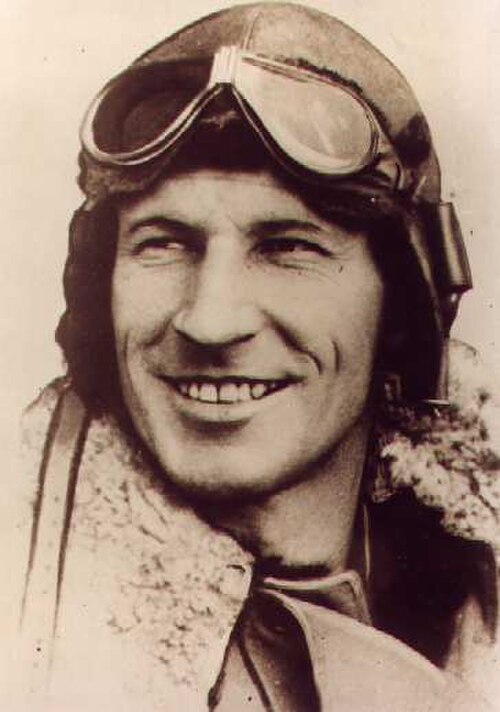
تبنّت أستراليا التقنيات الحديثة في النقل والاتصالات. وتم التخلي نهائياً عن السفن الشراعية الساحلية لصالح السفن البخارية، وأحدثت التحسينات في النقل بالسكك الحديدية والسيارات تغييرات جذرية في العمل والترفيه. في عام 1918، بلغ عدد السيارات والشاحنات في أستراليا 50,000 سيارة. وبحلول عام 1929، وصل العدد إلى 500,000. [ 312 ] أُغلقت شركة كوب وشركاه ، المتخصصة في نقل الركاب بالعربات، والتي تأسست عام 1853، نهائياً عام 1924. [ 313 ] وفي عام 1920، تأسست شركة كوينزلاند والإقليم الشمالي للخدمات الجوية (التي أصبحت فيما بعد شركة الطيران الأسترالية كانتاس ). [ 314 ] أسس القس جون فلين خدمة الأطباء الطائرين الملكية ، أول خدمة إسعاف جوي في العالم عام 1928. [ 315 ] دفع الطيار الجريء، السير تشارلز كينغسفورد سميث، الطائرات الجديدة إلى أقصى حدودها، فأكمل رحلة حول أستراليا عام 1927، وفي عام 1928 عبر المحيط الهادئ، مرورًا بهاواي وفيجي من الولايات المتحدة إلى أستراليا على متن طائرة " ساوثرن كروس" . وحقق شهرة عالمية وسلسلة من الأرقام القياسية في مجال الطيران قبل أن يختفي في رحلة ليلية إلى سنغافورة عام 1935. [ 316 ]
حالة السيادة
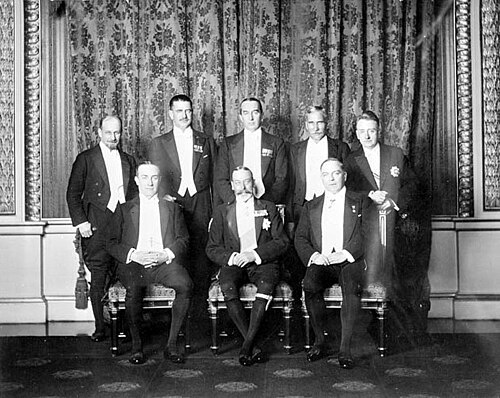
نالت أستراليا استقلالها كدولة ذات سيادة بعد الحرب العالمية الأولى، بموجب قانون وستمنستر . وقد أضفى هذا القانون طابعًا رسميًا على إعلان بلفور لعام 1926 ، وهو تقرير صادر عن مؤتمر قادة الإمبراطورية البريطانية في لندن عام 1926 ، والذي عرّف دومينيونات الإمبراطورية البريطانية على النحو التالي: "هي مجتمعات تتمتع بالحكم الذاتي داخل الإمبراطورية البريطانية ، متساوية في المكانة، ولا تخضع إحداها للأخرى بأي شكل من الأشكال في أي جانب من جوانب شؤونها الداخلية أو الخارجية، على الرغم من اتحادها بولاء مشترك للتاج ، وارتباطها الحر كأعضاء في الكومنولث البريطاني ". ومع ذلك، لم تصادق أستراليا على قانون وستمنستر حتى عام 1942. [ ب ] ووفقًا للمؤرخ فرانك كراولي ، يعود ذلك إلى قلة اهتمام الأستراليين بإعادة تعريف علاقتهم مع بريطانيا حتى اندلاع أزمة الحرب العالمية الثانية. [ 318 ]
أدى قانون أستراليا لعام 1986 إلى إزالة أي روابط متبقية بين البرلمان البريطاني والولايات الأسترالية.
من 1 فبراير 1927 حتى 12 يونيو 1931، قُسِّم الإقليم الشمالي إلى شمال أستراليا ووسط أستراليا عند خط عرض 20° جنوبًا . وتنازلت نيو ساوث ويلز عن إقليم آخر، وهو إقليم خليج جيرفيس الذي تبلغ مساحته 6677 هكتارًا، في عام 1915. وأُضيفت الأقاليم الخارجية التالية: جزيرة نورفولك (1914)؛ جزيرة أشمور وجزر كارتييه (1931)؛ إقليم أنتاركتيكا الأسترالي الذي نُقل من بريطانيا (1933)؛ جزيرة هيرد وجزر ماكدونالد وجزيرة ماكواري التي نُقلت إلى أستراليا من بريطانيا (1947).
تم تشكيل إقليم العاصمة الفيدرالية ( FCT) من ولاية نيو ساوث ويلز عام 1911 ليكون موقعًا للعاصمة الفيدرالية الجديدة المقترحة، كانبرا ( كانت ملبورن مقر الحكومة من عام 1901 إلى عام 1927). أُعيد تسمية إقليم العاصمة الفيدرالية إلى إقليم العاصمة الأسترالية (ACT) عام 1938. نُقل الإقليم الشمالي من سيطرة حكومة جنوب أستراليا إلى الكومنولث عام 1911.
الكساد الكبير

قبل انهيار وول ستريت عام 1929 بفترة طويلة ، كان الاقتصاد الأسترالي يواجه ديونًا خارجية مرتفعة وتباطؤًا اقتصاديًا. [ 319 ] [ 320 ] ومع تباطؤ الاقتصاد عام 1927، تراجع قطاع التصنيع، وانزلقت البلاد إلى الركود الاقتصادي مع انخفاض الأرباح وارتفاع معدلات البطالة. [ 321 ] تأثرت أستراليا بشدة بالكساد الكبير في ثلاثينيات القرن العشرين، لا سيما بسبب اعتمادها الكبير على صادرات الصوف والقمح، وعلى الاقتراض من لندن. انخفضت أسعار الصوف والقمح العالمية إلى النصف، وتوقفت عمليات الإقراض. [ 322 ] [ 323 ]

في الانتخابات التي جرت في أكتوبر 1929 ، اكتسح حزب العمال السلطة بفوز ساحق ، وخسر رئيس الوزراء السابق، ستانلي بروس ، مقعده. وواجه رئيس الوزراء الجديد، جيمس سكلين ، وحكومته التي كانت تفتقر إلى الخبرة إلى حد كبير، سلسلة من الأزمات. وبسبب افتقارهم للسيطرة على مجلس الشيوخ، وعدم سيطرتهم على النظام المصرفي، والانقسامات داخل الحزب حول أفضل السبل للتعامل مع الوضع، اضطرت الحكومة إلى قبول حلول أدت في النهاية إلى انقسام الحزب. وانحاز بعض الأعضاء إلى رئيس وزراء نيو ساوث ويلز، لانغ ، بينما انحاز آخرون إلى رئيس الوزراء سكلين.
طُرحت عدة "خطط" لحل الأزمة؛ فقد اقترح السير أوتو نيمير ، ممثل البنوك الإنجليزية الذي زار المنطقة في منتصف عام 1930، خطة انكماشية تتضمن خفض الإنفاق الحكومي والأجور. واقترح وزير الخزانة تيد ثيودور خطة تضخمية معتدلة، بينما اقترح رئيس وزراء ولاية نيو ساوث ويلز العمالي ، جاك لانغ ، خطة جذرية ترفض الديون الخارجية. [ 324 ] واتبعت "خطة رئيس الوزراء"، التي قُبلت أخيرًا من قبل الحكومة الفيدرالية وحكومات الولايات في يونيو 1931، النموذج الانكماشي الذي دعا إليه نيمير، وشملت خفضًا بنسبة 20% في الإنفاق الحكومي، وخفضًا في أسعار الفائدة المصرفية، وزيادة في الضرائب. [ 325 ] وفي مارس 1931، أعلن لانغ أنه لن يتم سداد الفوائد المستحقة في لندن، وتدخلت الحكومة الفيدرالية لسداد الدين. وفي مايو، أُجبر بنك الادخار الحكومي في نيو ساوث ويلز على الإغلاق. وافق مؤتمر رؤساء وزراء ملبورن على خفض الأجور والمعاشات التقاعدية كجزء من سياسة انكماشية حادة، لكن لانغ تراجع عن الخطة. لم يُخفف الافتتاح الكبير لجسر ميناء سيدني عام 1932 من حدة الأزمة المتفاقمة التي كانت تُرهق الاتحاد الفتيّ. مع تراكم ديون بملايين الجنيهات، والمظاهرات العامة، والمناورات والتحركات المضادة من قبل حكومات لانغ ثم سكلين ثم ليونز الفيدرالية، كان حاكم نيو ساوث ويلز ، فيليب غيم ، يُراجع تعليمات لانغ بعدم دفع الأموال إلى الخزانة الفيدرالية. اعتبر غيم أن ذلك غير قانوني. رفض لانغ سحب أمره، وفي 13 مايو، عزله الحاكم غيم . في انتخابات يونيو، انهارت مقاعد حزب العمال التي كان لانغ يرأسها. [ 326 ]
شهد شهر مايو/أيار من عام 1931 ظهور قوة سياسية محافظة جديدة، هي حزب أستراليا المتحدة، الذي تشكّل من أعضاء منشقين عن حزب العمال، متحالفين مع الحزب الوطني . وفي الانتخابات الفيدرالية التي جرت في ديسمبر/كانون الأول من العام نفسه ، فاز حزب أستراليا المتحدة ، بقيادة جوزيف ليونز ، العضو السابق في حزب العمال ، بسهولة. وبقي الحزب في السلطة حتى سبتمبر/أيلول من عام 1940. وكثيراً ما يُنسب الفضل لحكومة ليونز في قيادة عملية التعافي من الكساد، على الرغم من أن مدى تأثير سياساتها في هذا التعافي لا يزال محل جدل. [ 327 ] ويشير ستيوارت ماكنتاير أيضاً إلى أنه على الرغم من نمو الناتج المحلي الإجمالي الأسترالي من 386.9 مليون جنيه إسترليني إلى 485.9 مليون جنيه إسترليني بين عامي 1931-1932 و1938-1939، إلا أن الناتج المحلي الحقيقي للفرد كان لا يزال "أعلى ببضعة شلنات فقط في عام 1938-1939 (70.12 جنيه إسترليني) مما كان عليه في عام 1920-1921 (70.04 جنيه إسترليني)". [ 328 ]

تعافت أستراليا بسرعة نسبية من الأزمة المالية التي عصفت بها في الفترة 1929-1930، حيث بدأ التعافي حوالي عام 1932. وقد أيّد رئيس الوزراء آنذاك، جوزيف ليونز، الإجراءات الاقتصادية الصارمة لخطة رؤساء الوزراء، واتبع سياسة مالية تقليدية، ورفض مقترحات رئيس وزراء نيو ساوث ويلز، جاك لانغ، بالتخلف عن سداد الديون الخارجية. ووفقًا للمؤلفة آن هندرسون من معهد سيدني ، كان ليونز يؤمن إيمانًا راسخًا بـ"ضرورة تحقيق التوازن في الميزانيات، وخفض التكاليف على الشركات، واستعادة الثقة". وقد منحت فترة حكم ليونز أستراليا "الاستقرار والنمو في نهاية المطاف" بين مأساة الكساد الكبير واندلاع الحرب العالمية الثانية. وتم فرض خفض للأجور مع الحفاظ على الحماية الجمركية للصناعات، الأمر الذي، إلى جانب انخفاض أسعار المواد الخام خلال ثلاثينيات القرن العشرين، ساهم في تحول الاقتصاد الأسترالي من الزراعة إلى الصناعة التحويلية لتصبح القطاع الرئيسي الموظِّف، وهو تحول تعزز بزيادة استثمارات الحكومة الفيدرالية في الصناعات الدفاعية والتسليحية. ورأى ليونز أن استعادة الصادرات الأسترالية هي مفتاح الانتعاش الاقتصادي. [ 329 ]
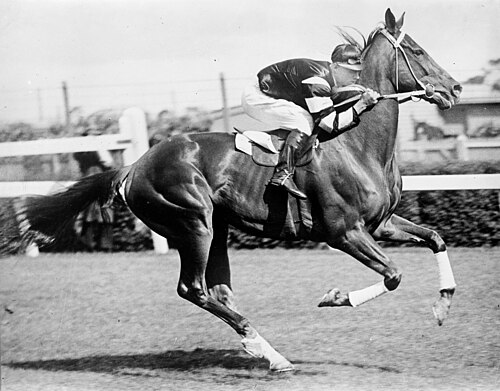
The extent of unemployment in Australia, often cited as peaking at 29 per cent in 1932 is debated. "Trade union figures are the most often quoted, but the people who were there...regard the figures as wildly understating the extent of unemployment" wrote historian Wendy Lowenstein in her collection of oral histories of the depression; however, David Potts argued that "over the last thirty years ...historians of the period have either uncritically accepted that figure (29% in the peak year 1932) including rounding it up to 'a third', or they have passionately argued that a third is far too low."[330][331] Potts himself though suggested a peak national figure of 25 per cent unemployed.[332] Measurement is difficult in part because there was great variation, geographically, by age and by gender, in the level of unemployment. Statistics collected by historian Peter Spearritt show 17.8 per cent of men and 7.9 per cent of women unemployed in 1933 in the comfortable Sydney suburb of Woollahra. This is not to say that 81.9 per cent of women were working but that 7.9 per cent of the women interested/looking for work were unable to find it, a much lower figure than maybe first thought, as many women stayed home and were not in the job force in those years, especially if they were unable to find work.
In the working class suburb of Paddington, 41.3 per cent of men and 20.7 per cent of women were listed as unemployed.[333] Geoffrey Spenceley stated that apart from variation between men and women, unemployment was also much higher in some industries, such as the building and construction industry, and comparatively low in the public administrative and professional sectors.[334] In country areas, worst hit were small farmers in the wheat belts as far afield as north-east Victoria and Western Australia, who saw more and more of their income absorbed by interest payments.[335]
Extraordinary sporting successes did something to alleviate the spirits of Australians during the economic downturn. In a Sheffield Shield cricket match at the Sydney Cricket Ground in 1930, Don Bradman, a young New South Welshman of just 21 years of age wrote his name into the record books by smashing the previous highest batting score in first-class cricket with 452 runs not out in just 415 minutes.[336] The rising star's world beating cricketing exploits were to provide Australians with much needed joy through the emerging Great Depression in Australia and post-World War II recovery. Between 1929 and 1931 the racehorse Phar Lap dominated Australia's racing industry, at one stage winning fourteen races in a row.[337] Famous victories included the 1930 Melbourne Cup, following an assassination attempt and carrying 9 stone 12 pounds weight.[338] Phar Lap sailed for the United States in 1931, going on to win North America's richest race, the Agua Caliente Handicap in 1932. Soon after, on the cusp of US success, Phar Lap developed suspicious symptoms and died. Theories swirled that the champion race horse had been poisoned and a devoted Australian public went into shock.[339] The 1938 British Empire Games were held in Sydney from 5–12 February, timed to coincide with Sydney's sesqui-centenary (150 years since the foundation of British settlement in Australia).
Indigenous policy
Following federation Aboriginal affairs was a state responsibility, although the Commonwealth became responsible for the Aboriginal population of the Northern Territory from 1911. By that date the Commonwealth and all states except Tasmania had passed legislation establishing Protectors of Aborigines and Protection Boards with extensive powers to regulate the lives of Aboriginal Australians including their ownership of property, place of residence, employment, sexual relationships and custody of their children. Reserves were established, ostensibly for the protection of the Aboriginal population who had been dispossessed of their land. Church groups also ran missions throughout Australia providing shelter, food, religious instruction and elementary schooling for Indigenous people.[340]
Some officials were concerned by the growing number of Aboriginal children of mixed heritage, particularly in northern Australia where large Indigenous, South Sea Islander and Asian populations were seen as inconsistent with the white Australia policy. Laws concerning Aboriginal Australians were progressively tightened to make it easier for officials to remove Aboriginal children of mixed descent from their parents and place them in reserves, missions, institutions and employment with white employers.[341]
The segregation of Aboriginal people on reserves and in institutions was never systematically accomplished due to funding constraints, differing policy priorities in the states and territories, and resistance from Aboriginal people. In the more densely settled areas of Australia, about 20 per cent of Aboriginal people lived on reserves in the 1920s. The majority lived in camps on the fringes of country towns and a small percentage lived in cities. During the Great Depression more Aboriginal people moved to reserves and missions for food and shelter. By 1941 almost half of the Aboriginal population of New South Wales lived on reserves.[342]
In northern Australia, the majority of employed Aboriginal people worked in the pastoral industry where they lived in camps, often with their extended families. Many also camped on the margins of towns and reserves where they could avoid most of the controls imposed by the administrators of reserves, compounds and missions.[343]
The 1937 Native Welfare conference of state and Commonwealth officials endorsed a policy of biological absorption of mixed-descent Aboriginal Australians into the white community.
[T]he destiny of the natives of aboriginal origin, but not of the full blood, lies in their ultimate absorption by the people of the Commonwealth and it therefore recommends that all efforts be directed to that end.[344]
The officials saw the policy of Aboriginal assimilation by absorption into the white community as progressive, aimed at eventually achieving civil and economic equality for mixed-descent Aboriginal people.[344]
... efforts of all State authorities should be directed towards the education of children of mixed aboriginal blood at white standards, and their subsequent employment under the same conditions as whites with a view to their taking their place in the white community on an equal footing with the whites.[345]
The following decades saw an increase in the number of Aboriginal Australians of mixed descent removed from their families, although the states and territories progressively adopted a policy of cultural, rather than biological, assimilation, and justified removals on the grounds of child welfare.[346] In 1940, New South Wales became the first state to introduce a child welfare model whereby Aboriginal children of mixed descent were removed from their families under general welfare provisions by court order. Other jurisdictions introduced a welfare model after the war.[345]
World War II
Defence policy in the 1930s

Until the late 1930s, defence was not a significant issue for Australians. At the 1937 elections, both political parties advocated increased defence spending, in the context of increased Japanese aggression in China and Germany's aggression in Europe; however, there was a difference in opinion about how the defence spending should be allocated. The United Australia Party government emphasised co-operation with Britain in "a policy of imperial defence". The lynchpin of this was the British naval base at Singapore and the Royal Navy battle fleet "which, it was hoped, would use it in time of need".[347] Defence spending in the inter-war years reflected this priority. In the period 1921–1936 totalled £40 million on the Royal Australian Navy, £20 million on the Australian Army and £6 million on the Royal Australian Air Force (established in 1921, the "youngest" of the three services). In 1939, the Navy, which included two heavy cruisers and four light cruisers, was the service best equipped for war.[348]

Fearing Japanese intentions in the Pacific, Menzies established independent embassies in Tokyo and Washington to receive independent advice about developments.[349]Gavin Long argues that the Labor opposition urged greater national self-reliance through a build-up of manufacturing and more emphasis on the Army and RAAF, as Chief of the General Staff, John Lavarack also advocated.[350] In November 1936, Labor leader John Curtin said "The dependence of Australia upon the competence, let alone the readiness, of British statesmen to send forces to our aid is too dangerous a hazard upon which to found Australia's defence policy."[351] According to John Robertson, "some British leaders had also realised that their country could not fight Japan and Germany at the same time." But "this was never discussed candidly at...meeting(s) of Australian and British defence planners", such as the 1937 Imperial Conference.[352]
By September 1939 the Australian Army numbered 3,000 regulars.[353] A recruiting campaign in late 1938, led by Major-General Thomas Blamey increased the reserve militia to almost 80,000.[354] The first division raised for war was designated the 6th Division, of the 2nd AIF, there being 5 Militia Divisions on paper and a 1st AIF in the First World War.[355]
War


On 3 September 1939, the prime minister, Robert Menzies, made a national radio broadcast: "My fellow Australians. It is my melancholy duty to inform you, officially, that, in consequence of the persistence by Germany in her invasion of Poland, Great Britain has declared war upon her, and that, as a result, Australia is also at war."[356]
Thus began Australia's involvement in the six-year global conflict. Australians were to fight in an extraordinary variety of locations, including withstanding the advance of German Panzers in the Siege of Tobruk, turning back the advance of the Imperial Japanese Army in the New Guinea Campaign, undertaking bomber missions over Europe, engaging in naval battles in the Mediterranean. At home, Japanese attacks included mini-submarine raids on Sydney Harbour and very heavy air raids on and near the Northern Territory's capital, Darwin.[357]
The recruitment of a volunteer military force for service at home and abroad was announced, the 2nd Australian Imperial Force and a citizen militia organised for local defence. Troubled by Britain's failure to increase defences at Singapore, Menzies was cautious in committing troops to Europe. By the end of June 1940, France, Norway, Denmark and the Low Countries had fallen to Nazi Germany. Britain stood alone with its dominions. Menzies called for "all-out war", increasing federal powers and introducing conscription. Menzies' minority government came to rely on just two independents after the 1940 election.[358]
In January 1941, Menzies flew to Britain to discuss the weakness of Singapore's defences. Arriving in London during The Blitz, Menzies was invited into Winston Churchill's British War Cabinet for the duration of his visit. Returning to Australia, with the threat of Japan imminent and with the Australian army suffering badly in the Greek and Crete campaigns, Menzies re-approached the Labor Party to form a War Cabinet. Unable to secure their support, and with an unworkable parliamentary majority, Menzies resigned as prime minister. The coalition held office for another month, before the independents switched allegiance and John Curtin was sworn in as prime minister.[349] Eight weeks later, Japan attacked Pearl Harbor.

From 1940 to 1941, Australian forces played prominent roles in the fighting in the Mediterranean theatre, including Operation Compass, the Siege of Tobruk, the Greek campaign, the Battle of Crete, the Syria–Lebanon Campaign and the Second Battle of El Alamein.
A garrison of around 14,000 Australian soldiers, commanded by Lieutenant General Leslie Morshead was besieged in Tobruk, Libya, by the German-Italian army of General Erwin Rommel between April and August 1941. The Nazi propagandist Lord Haw Haw derided the defenders as 'rats', a term the soldiers adopted as an ironic compliment: "The Rats of Tobruk".[359] Vital in the defence of Egypt and the Suez Canal, the siege saw the advance of the German army halted for the first time and provided a morale boost for the British Commonwealth, which was then standing alone against Hitler.
The war came closer to home when HMAS Sydney was lost with all hands in battle with the German raider Kormoran in November 1941.
With most of Australia's best forces committed to fight against Hitler in the Middle East, Japan attacked Pearl Harbor, the US naval base in Hawaii, on 8 December 1941 (eastern Australia time). The British battleship HMS Prince of Wales and battlecruiser HMS Repulse sent to defend Singapore were sunk soon afterwards. Australia was ill-prepared for an attack, lacking armaments, modern fighter aircraft, heavy bombers, and aircraft carriers. While demanding reinforcements from Churchill, on 27 December 1941 Curtin published an historic announcement:[360] "The Australian Government... regards the Pacific struggle as primarily one in which the United States and Australia must have the fullest say in the direction of the democracies' fighting plan. Without inhibitions of any kind, I make it clear that Australia looks to America, free of any pangs as to our traditional links or kinship with the United Kingdom."[361]
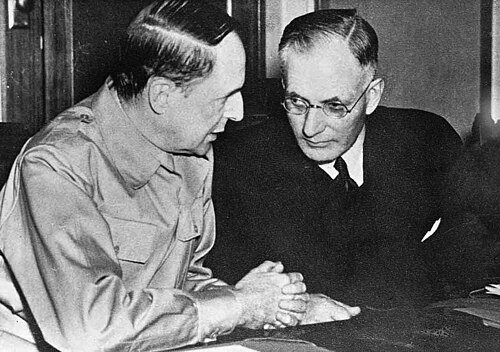
British Malaya quickly collapsed, shocking the Australian nation. British, Indian and Australian troops made a disorganised last stand at Singapore, before surrendering on 15 February 1942. Around 15,000 Australian soldiers became prisoners of war. Curtin predicted that the "battle for Australia" would now follow. On 19 February, Darwin suffered a devastating air raid, the first time the Australian mainland had ever been attacked by enemy forces. For the following 19 months, Australia was attacked from the air almost 100 times.

Two battle-hardened Australian divisions were already steaming from the Middle East for Singapore. Churchill wanted them diverted to Burma, but Curtin refused, and anxiously awaited their return to Australia. US president Franklin D. Roosevelt ordered his commander in the Philippines, General Douglas MacArthur, to formulate a Pacific defence plan with Australia in March 1942. Curtin agreed to place Australian forces under the command of General MacArthur, who became "Supreme Commander of the South West Pacific". Curtin had thus presided over a fundamental shift in Australia's foreign policy. MacArthur moved his headquarters to Melbourne in March 1942 and American troops began massing in Australia. In late May 1942, Japanese midget submarines sank an accommodation vessel in a daring raid on Sydney Harbour. On 8 June 1942, two Japanese submarines briefly shelled Sydney's eastern suburbs and the city of Newcastle.[362]
In an effort to isolate Australia, the Japanese planned a seaborne invasion of Port Moresby, in the Australian Territory of New Guinea. In May 1942, the US Navy engaged the Japanese in the Battle of the Coral Sea and halted the attack. The Battle of Midway in June effectively defeated the Japanese navy and the Japanese army launched a land assault on Moresby from the north.[132] Between July and November 1942, Australian forces repulsed Japanese attempts on the city by way of the Kokoda Track, in the highlands of New Guinea. The Battle of Milne Bay in August 1942 was the first Allied defeat of Japanese land forces.

Meanwhile, in North Africa, the Axis powers had driven Allies back into Egypt. A turning point came between July and November 1942, when Australia's 9th Division played a crucial role in some of the heaviest fighting of the First and Second Battle of El Alamein, which turned the North Africa Campaign in favour of the Allies.[363]
The Battle of Buna–Gona, between November 1942 and January 1943, set the tone for the bitter final stages of the New Guinea campaign, which persisted into 1945. The offensives in Papua and New Guinea of 1943–44 were the single largest series of connected operations ever mounted by the Australian armed forces.[364] On 14 May 1943, the Australian Hospital Ship Centaur, though clearly marked as a medical vessel, was sunk by Japanese raiders off the Queensland coast, killing 268, including all but one of the nursing staff, further enraging popular opinion against Japan.[365][366]
Australian prisoners of war were at this time suffering severe ill-treatment in the Pacific Theatre. In 1943, 2,815 Australian Pows died constructing Japan's Burma-Thailand Railway.[367] In 1944, the Japanese inflicted the Sandakan Death March on 2,000 Australian and British prisoners of war—only 6 survived. This was the single worst war crime perpetrated against Australians in war.[368]
MacArthur largely excluded Australian forces from the main push north into the Philippines and Japan. It was left to Australia to lead amphibious assaults against Japanese bases in Borneo. Curtin suffered from ill health from the strains of office and died weeks before the war ended, replaced by Ben Chifley.
Of Australia's wartime population of seven million, almost one million men and women served in a branch of the services during the six years of warfare. By war's end, gross enlistments totalled 727,200 men and women in the Australian Army (of whom 557,800 served overseas), 216,900 in the RAAF and 48,900 in the RAN. More than 39,700 were killed or died as prisoners of war, about 8,000 of whom died as prisoners of the Japanese.[369][370]
Australian home front

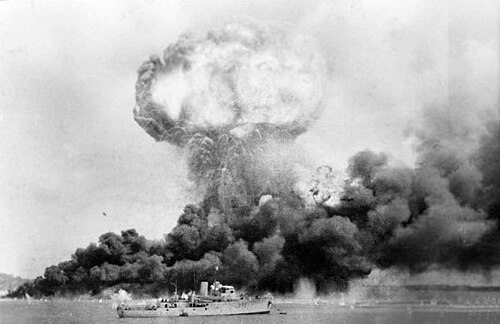
While the Australian civilian population suffered less at the hands of the Axis powers than did other Allied nations in Asia and Europe, Australia nevertheless came under direct attack by Japanese naval forces and aerial bombardments, particularly through 1942 and 1943, resulting in hundreds of fatalities and fuelling fear of Japanese invasion. Axis naval activity in Australian waters also brought the war close to home for Australians. Austerity measures, rationing and labour controls measures were all implemented to assist the war effort.[371] Australian civilians dug air raid shelters, trained in civil defence and first aid, and Australian ports and cities were equipped with anti-aircraft and sea defences.[372]
The Australian economy was markedly affected by World War II.[373] Expenditure on war reached 37 per cent of GDP by 1943–44, compared to 4 per cent expenditure in 1939–1940.[374] Total war expenditure was £2,949 million between 1939 and 1945.[375]

Although the peak of army enlistments occurred in June–July 1940, when more than 70,000 enlisted, it was the Curtin Labor government, formed in October 1941, that was largely responsible for "a complete revision of the whole Australian economic, domestic and industrial life".[376] Rationing of fuel, clothing and some food was introduced (although less severely than in Britain), Christmas holidays curtailed, "brown outs" introduced and some public transport reduced. From December 1941, the Government evacuated all women and children from Darwin and northern Australia, and more than 10,000 refugees arrived from South East Asia as Japan advanced.[377] In January 1942, the Manpower Directorate was set up "to ensure the organisation of Australians in the best possible way to meet all defence requirements."[376] Minister for War Organisation of Industry, John Dedman introduced a degree of austerity and government control previously unknown, to such an extent that he was nicknamed "the man who killed Father Christmas".
In May 1942 uniform tax laws were introduced in Australia, ending state governments' control of income taxation. "The significance of this decision was greater than any other... made throughout the war, as it added extensive powers to the Federal Government and greatly reduced the financial autonomy of the states."[378]
Manufacturing grew significantly because of the war. "In 1939, there were only three Australian firms producing machine tools, but by 1943 there were more than one hundred doing so."[379] From having few front line aircraft in 1939, the RAAF had become the fourth largest allied Air force by 1945. A number of aircraft were built under licence in Australia before the war's end, notably the Beaufort and Beaufighter, although the majority of aircraft were from Britain and later, the US.[380] The Boomerang fighter, designed and built in four months of 1942, emphasised the desperate state Australia found itself in as the Japanese advanced.
Australia also created, virtually from nothing, a significant female workforce engaged in direct war production. Between 1939 and 1944 the number of women working in factories rose from 171,000 to 286,000.[381] Dame Enid Lyons, widow of former prime minister Joseph Lyons, became the first woman elected to the House of Representatives in 1943, joining the Robert Menzies' new centre-right Liberal Party of Australia, formed in 1945. At the same election, Dorothy Tangney became the first woman elected to the Senate.
Post-war boom
Menzies and Liberal dominance (1949–72)

Politically, Robert Menzies and the Liberal Party of Australia dominated much of the immediate post war era, defeating the Labor government of Ben Chifley in 1949, in part because of a Labor proposal to nationalise banks[382] and following a crippling coal strike led by the Australian Communist Party. Menzies became the country's longest-serving prime minister and the Liberal party, in coalition with the rural based Country Party, won every federal election until 1972.
As in the United States in the early 1950s, allegations of communist influence in society saw tensions emerge in politics. Refugees from Soviet dominated Eastern Europe immigrated to Australia, while to Australia's north, Mao Zedong's Chinese Communist Party won the Chinese Civil War in 1949 and in June 1950, Communist North Korea invaded South Korea. The Menzies government responded to a United States led United Nations Security Council request for military aid for South Korea and diverted forces from occupied Japan to begin Australia's involvement in the Korean War. After fighting to a bitter standstill, the UN and North Korea signed a ceasefire agreement in July 1953. Australian forces had participated in such major battles as Kapyong and Maryang San. 17,000 Australians had served and casualties amounted to more than 1,500, of whom 339 were killed.[383]

During the course of the Korean War, the Liberal government attempted to ban the Communist Party of Australia, first by legislation in 1950 and later by referendum, in 1951.[384] While both attempts were unsuccessful, further international events such as the defection of minor Soviet Embassy official Vladimir Petrov, added to a sense of impending threat that politically favoured Menzies' Liberal-CP government, as the Labor Party split over concerns about the influence of the Communist Party on the trade union movement. The tensions led to another bitter split and the emergence of the breakaway Democratic Labor Party (DLP). The DLP remained an influential political force, often holding the balance of power in the Senate, until 1974. Its preferences supported the Liberal and Country Party.[385] The Labor party was led by H.V. Evatt after Chifley's death in 1951. Evatt had served as President of the United Nations General Assembly during 1948–49 and helped draft the United Nations Universal Declaration of Human Rights (1948). Evatt retired in 1960 amid signs of mental ill-health, and Arthur Calwell succeeded him as leader, with a young Gough Whitlam as his deputy.[386]
Menzies presided during a period of sustained economic boom and the beginnings of sweeping social change, which included youth culture and its rock and roll music and, in the late 1950s, the arrival of television broadcasting. In 1958, Australian country music singer Slim Dusty, who would become the musical embodiment of rural Australia, had Australia's first international music chart hit with his bush ballad "Pub With No Beer",[387] while rock and rollerJohnny O'Keefe's "Wild One" became the first local recording to reach the national charts, peaking at No. 20.[388][389]Australian cinema produced little of its own content in the 1950s, but British and Hollywood studios produced a string of successful epics from Australian literature, featuring home grown stars Chips Rafferty and Peter Finch.
Menzies remained a staunch supporter of links to the monarchy and Commonwealth of Nations and formalised an alliance with the United States, but also launched post-war trade with Japan, beginning a growth of Australian exports of coal, iron ore and mineral resources that would steadily climb until Japan became Australia's largest trading partner.[390]
When Menzies retired in 1965, he was replaced as Liberal leader and prime minister by Harold Holt. Holt drowned while swimming at a surf beach in December 1967 and was replaced by John Gorton (1968–1971) and then by William McMahon (1971–1972).
Post-war immigration

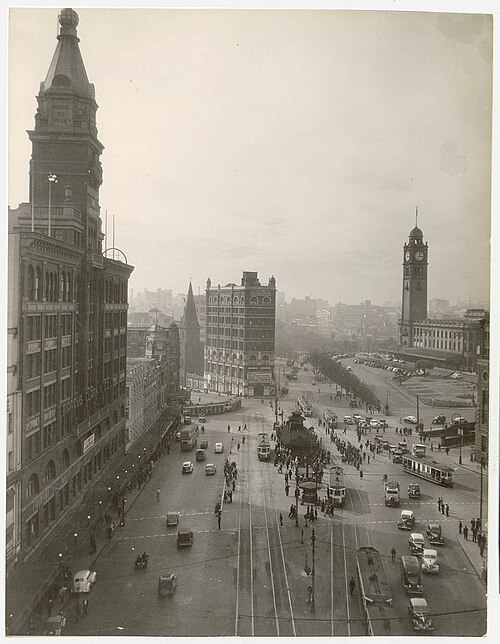
Following World War II, the Chifley Labor government instigated a massive programme of European immigration. In 1945, Minister for Immigration, Arthur Calwell wrote "If the experience of the Pacific War has taught us one thing, it surely is that seven million Australians cannot hold three million square miles of this earth's surface indefinitely."[391] All political parties shared the view that the country must "populate or perish". Calwell stated a preference for ten British immigrants for each one from other countries; however, the numbers of British migrants fell short of what was expected, despite government assistance.[392]
Migration brought large numbers of southern and central Europeans to Australia for the first time. A 1958 government leaflet assured readers that unskilled non-British migrants were needed for "labour on rugged projects ... work which is not generally acceptable to Australians or British workers".[393] The Australian economy stood in sharp contrast to war-ravaged Europe, and newly arrived migrants found employment in a booming manufacturing industry and government assisted programmes such as the Snowy Mountains Scheme. This hydroelectricity and irrigation complex in south-east Australia consisted of sixteen major dams and seven power stations constructed between 1949 and 1974. It remains the largest engineering project undertaken in Australia. Necessitating the employment of 100,000 people from more than 30 countries, to many it denoted the birth of multicultural Australia.[394] Some 4.2 million immigrants arrived between 1945 and 1985, about 40 per cent of whom came from Britain and Ireland.[395] The 1957 novel They're a Weird Mob was a popular account of an Italian migrating to Australia, although written by Australian-born author John O'Grady. The Australian population reached 10 million in 1959–with Sydney its most populous city.
In May 1958, the Menzies Government passed the Migration Act 1958 which replaced the Immigration Restriction Act's arbitrarily applied dictation test with an entry permit system, that reflected economic and skills criteria.[396][397] Further changes in the 1960s effectively ended the White Australia policy. It legally ended in 1973.
Economic growth and suburban living
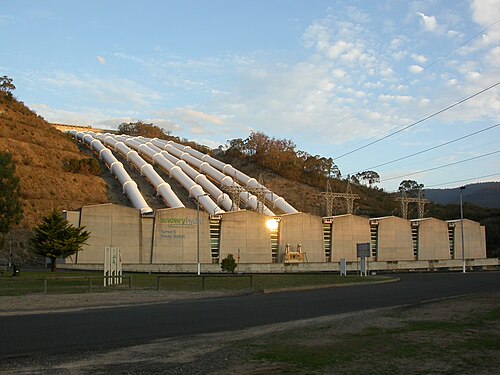
Australia enjoyed significant growth in prosperity in the 1950s and 1960s, with increases in both living standards and in leisure time.[398][399] The manufacturing industry, previously playing a minor part in an economy dominated by primary production, greatly expanded. The first Holden motor car came out of General Motors-Holden's Fisherman's Bend factory in November 1948. Car ownership rapidly increased—from 130 owners in every 1,000 in 1949 to 271 owners in every 1,000 by 1961.[400] By the early 1960s, four competitors to Holden had set up Australian factories, employing between 80,000 and 100,000 workers, "at least four-fifths of them migrants".[401]
In the 1960s, about 60 per cent of Australian manufacturing was protected by tariffs. Pressure from business interests and the union movement ensured these remained high. Historian Geoffrey Bolton suggests that this high tariff protection of the 1960s caused some industries to "lapse into lethargy", neglecting research and development and the search for new markets.[401] The CSIRO was expected to fulfil research and development.
Prices for wool and wheat remained high, with wool the mainstay of Australia's exports. Sheep numbers grew from 113 million in 1950 to 171 million in 1965. Wool production increased from 518,000 to 819,000 tonnes in the same period.[402] Wheat, wool and minerals ensured a healthy balance of trade between 1950 and 1966.[403]
The great housing boom of the post war period saw rapid growth in the suburbs of the major Australian cities. By the 1966 census, only 14 per cent lived in rural Australia, down from 31 per cent in 1933, and only 8 per cent lived on farms.[404] Virtual full employment meant high standards of living and dramatic increases in home ownership, and by the sixties, Australia had the most equitable spread of income in the world.[405] By the beginning of the sixties, an Australia-wide McNair survey estimated that 94% of homes had a fridge, 50% a telephone, 55% a television, 60% a washing machine, and 73% a vacuum cleaner. In addition, most households had now acquired a car.[406] According to one study, "In 1946, there was one car for every 14 Australians; by 1960, it was one to 3.5. The vast majority of families had access to a car."[398]
Car ownership flourished during the postwar period, with 1970/1971 census data estimating that 96.4 per cent of Australian households in the early Seventies owned at least one car; however, not all felt the rapid suburban growth was desirable.[407] Distinguished Architect and designer Robin Boyd, a critic of Australia's built surroundings, described Australia as "'the constant sponge lying in the Pacific', following the fashions of overseas and lacking confidence in home-produced, original ideas".[408] In 1956, dadaist comedian Barry Humphries performed the character of Edna Everage as a parody of a house-proud housewife of staid 1950s Melbourne suburbia (the character only later morphed into a critique of self-obsessed celebrity culture). It was the first of many of his satirical stage and screen creations based around quirky Australian characters: Sandy Stone, a morose elderly suburbanite, Barry McKenzie a naive Australian expat in London and Sir Les Patterson, a vulgar parody of a Whitlam-era politician.[409]
Some writers defended suburban life. Journalist Craig Macgregor saw suburban life as a "...solution to the needs of migrants..." Hugh Stretton argued that "plenty of dreary lives are indeed lived in the suburbs... but most of them might well be worse in other surroundings".[410] Historian Peter Cuffley has recalled life for a child in a new outer suburb of Melbourne as having a kind of joyous excitement. "Our imaginations saved us from finding life too humdrum, as did the wild freedom of being able to roam far and wide in different kinds of (neighbouring) bushland...Children in the suburbs found space in backyards, streets and lanes, playgrounds and reserves..."[411]
In 1954, the Menzies Government formally announced the introduction of the new two-tiered TV system—a government-funded service run by the ABC, and two commercial services in Sydney and Melbourne, with the 1956 Summer Olympics in Melbourne being a major driving force behind the introduction of television to Australia.[412] Colour TV began broadcasting in 1975.
Indigenous assimilation and child removal
The 1951 Native Welfare Conference of state and Commonwealth officials had agreed on a policy of cultural assimilation for all Aboriginal Australians. Paul Hasluck, the Commonwealth Minister for Territories, stated: "Assimilation means, in practical terms, that, in the course of time, it is expected that all persons of aboriginal blood or mixed blood in Australia will live like other white Australians do."[345][346]
Controls over the daily lives of Aboriginal people and the removal of Aboriginal children of mixed descent continued under the policy of assimilation, although the control was now largely exercised by Welfare Boards and removals were justified on welfare grounds. The number of Aboriginal people deemed to be wards of the state under Northern Territory welfare laws doubled to 11,000 from 1950 to 1965.[413]
During this period, the policy of assimilation attracted increasing criticism from Aboriginal people and their supporters on the grounds of its negative effects on Aboriginal families and its denial of Aboriginal cultural autonomy. Removals of Aboriginal children of mixed descent from their families slowed by the late 1960s and by 1973 the Commonwealth had adopted a policy of self-determination for Indigenous Australians.[414]
In 1997, the Human Rights and Equal Opportunity Commission estimated that between 10 per cent and one-third of Aboriginal children had been removed from their families from 1910 to 1970. Regional studies indicate that 15 per cent of Aboriginal children were removed in New South Wales from 1899 to 1968, while the figure for Victoria was about 10 per cent.[415] Robert Manne estimates that the figure for Australia as a whole was closer to 10 per cent.[416]
Summarising the policy of assimilation and forced removals of Aboriginal children of mixed descent, Richard Broome concludes: "Even though the children's material conditions and Western education may have been improved by removal, even though some removals were necessary, and even though some people were thankful for it in retrospect, overall it was a disaster....It was a rupturing of tens of thousands of Aboriginal families, aimed at eradicating Aboriginality from the nation in the cause of homogeneity and in fear of difference."[415]
Alliances (1950–1972)
In the early 1950s, the Menzies government saw Australia as part of a "triple alliance" in concert with both the US and traditional ally Britain.[417] At first, "the Australian leadership opted for a consistently pro-British line in diplomacy", while at the same time looking for opportunities to involve the US in South East Asia.[418] Thus, the government committed military forces to the Korean War and the Malayan Emergency and hosted British nuclear tests after 1952.[419] Australia was also the only Commonwealth country to offer support to the British during the Suez Crisis.[420]
Menzies oversaw an effusive welcome to Queen Elizabeth II on the first visit to Australia by a reigning monarch, in 1954. He made the following remarks during a light-hearted speech to an American audience in New York, while on his way to attend her coronation in 1953: "We in Australia, of course, are British, if I may say so, to the boot heels...but we stand together – our people stand together – till the crack of doom."[421]

As British influence declined in South East Asia, the US alliance came to have greater significance for Australian leaders and the Australian economy. British investment in Australia remained significant until the late 1970s, but trade with Britain declined through the 1950s and 1960s. In the late 1950s the Australian Army began to re-equip using US military equipment. In 1962, the US established a naval communications station at North West Cape, the first of several built during the next decade.[422][423] Most significantly, in 1962, Australian Army advisors were sent to help train South Vietnamese forces, in a developing conflict in which the British had no part.
According to diplomat Alan Renouf, the dominant theme in Australia's foreign policy under Australia's Liberal–Country Party governments of the 1950s and 1960s was anti-communism.[424] Another former diplomat, Gregory Clark, suggested that it was specifically a fear of China that drove Australian foreign policy decisions for twenty years.[425] The ANZUS security treaty, which had been signed in 1951, had its origins in Australia's and New Zealand's fears of a rearmed Japan. Its obligations on the US, Australia and New Zealand are vague, but its influence on Australian foreign policy thinking, at times has been significant.[426] The SEATO treaty, signed only three years later, clearly demonstrated Australia's position as a US ally in the emerging Cold War.[427]
As Britain struggled to enter the Common Market in the 1960s, Australia saw that its historic ties with the mother country were rapidly fraying. Canberra was alarmed but kept a low profile, not wanting to alienate London. Russel Ward states that the implications of British entry into Europe in 1973: "seemed shattering to most Australians, particularly to older people and conservatives."[428] Carl Bridge, however, points out that Australia had been "hedging its British bets" for some time. The ANZUS treaty and Australia's decision to enter the Vietnam War did not involve Britain and by 1967 Japan was Australia's leading export partner and the US her largest source of imports. According to Bridge, Australia's decision not to follow Britain's devaluation of her currency in 1967 "marked the demise of British Australia."[427]
Vietnam War

By 1965, Australia had increased the size of the Australian Army Training Team Vietnam (AATTV), and in April the Government made a sudden announcement that "after close consultation with the United States", a battalion of troops was to be sent to South Vietnam.[429] In parliament, Menzies emphasised the argument that "our alliances made demands on us". The alliance involved was presumably, the Southeast Asia Treaty Organization (SEATO), and Australia was providing military assistance because South Vietnam, a signatory to SEATO, had apparently requested it.[430]Documents released in 1971 indicated that the decision to commit troops was made by Australia and the US, not at the request of South Vietnam.[431] By 1968, there were three Australian Army battalions at any one time at the 1st Australian Task Force (1ATF) base at Nui Dat in addition to the advisers of the AATTV placed throughout Vietnam, and personnel reached a peak total of almost 8,000, comprising about one third of the Army's combat capacity. Between 1962 and 1972 almost 60,000 personnel served in Vietnam, including ground troops, naval forces and air assets.[432]
In July 1966, new prime minister Harold Holt expressed his government's support for the US and its role in Vietnam in particular. "I don't know where people would choose to look for the security of this country were it not for the friendship and strength of the United States."[433] While on a visit in the same year to the US, Holt assured President Lyndon B. Johnson "...I hope there is corner of your mind and heart which takes cheer from the fact that you have an admiring friend, a staunch friend, [Australia] that will be all the way with LBJ."[434]
The Liberal-CP Government was returned with a massive majority in elections held in December 1966, fought over national security issues including Vietnam. The opposition Labor Party had advocated the withdrawal of all conscripts from Vietnam, but its deputy leader Gough Whitlam had stated that a Labor government might maintain regular army troops there.[435] Arthur Calwell, who had been leader of the Labor Party since 1960, retired in favour of Whitlam a few months later.
Despite Holt's sentiments and his government's electoral success in 1966, the war became unpopular in Australia, as it did in the United States. The movements to end Australia's involvement gathered strength after the Tet Offensive of early 1968 and compulsory national service (selected by ballot) became increasingly unpopular. In the 1969 elections, the government hung on despite a significant decline in popularity. Moratorium marches held across Australia in mid-1970 attracted large crowds—the Melbourne march of 100,000 being led by Labor MP Jim Cairns. As the Nixon administration proceeded with Vietnamization of the war and began the withdrawal of troops, so did the Australian Government. In November 1970 1st Australian Task Force was reduced to two battalions and in November 1971, 1ATF was withdrawn from Vietnam. The last military advisers of the AATTV were withdrawn by the Whitlam Labor government in mid-December 1972.[432]
The Australian military presence in Vietnam had lasted 10 years, and in purely human cost, more than 500 had been killed and more than 2,000 wounded. The war cost Australia $218 million between 1962 and 1972.[432]
Reform and reaction (1972–1996)
Whitlam government (1972–75)

Elected in December 1972 after 23 years in opposition, Labor won office under Gough Whitlam, introducing significant reforms and expanding the federal budget. Welfare benefits were extended and payment rates increased, a national health insurance scheme was introduced, and divorce laws liberalised. Commonwealth expenditure on schools trebled in the two years to mid-1975 and the Commonwealth assumed responsibility for funding higher education, abolishing tuition fees. In foreign affairs, the new government prioritised the Asia Pacific region, formally abolishing the White Australia policy, recognising Communist China and enhancing ties with Indonesia. Conscription was abolished and the remaining Australian troops in Vietnam withdrawn. The Australian national anthem was changed from God Save the Queen to Advance Australia Fair, the imperial honours system was replaced at the Commonwealth level by the Order of Australia, and Queen Elizabeth II was officially styled Queen of Australia. Relations with the US, however, became strained after government members criticised the resumption of the US bombing campaign in North Vietnam.[436]
In Indigenous affairs, the government introduced a policy of self-determination for Aboriginal people in economic, social and political affairs. Federal expenditure on Aboriginal services increased from $23 million to $141 million during the three years of the government.[437] One of the first acts of the Whitlam government was to establish a Royal Commission into land rights in the Northern Territory under Justice Woodward. Legislation based on its findings was passed into law by the Fraser government in 1976, as the Aboriginal Land Rights Act 1976.[437]
The government granted Papua New Guinea independence on 16 September 1975, after Australia had been the colonial administrator of Papua since 1902, and of New Guinea since 1914.[438][439][440]
As the Whitlam government did not control the Senate, much of its legislation was rejected or amended. After Labor was re-elected with a reduced majority at elections in May 1974, the Senate remained an obstacle to its political agenda. The government's popularity was also harmed by deteriorating economic conditions and a series of political scandals. Increased government spending, rapid wage growth, booming commodity prices and the first OPEC oil shock led to economic instability. The unemployment rate reached post-war high of 3.6 per cent in late 1974 and the annual inflation rate hit 17 per cent.[441]
In 1974–75 the government began negotiations for US$4 billion in foreign loans to fund state development of Australia's mineral and energy resources. Minister Rex Connor conducted secret discussions with a loan broker from Pakistan, and Treasurer Jim Cairns misled parliament about the issue. Arguing the government was incompetent following the Loans Affair, the opposition Liberal-Country Party Coalition delayed passage of the government's money bills in the Senate, until the government would promise a new election. Whitlam refused and the deadlock ended when his government was controversially dismissed by the Governor-General, John Kerr on 11 November 1975. Opposition leader Malcolm Fraser was installed as caretaker prime minister, pending an election.[442]
Fraser government (1975–83)

The Federal elections of December 1975 resulted in a landslide victory for the Liberal-Country Party coalition and Malcolm Fraser continued as prime minister. The coalition government won subsequent elections in 1977 and 1980, making Fraser the second longest serving Australian prime minister up to that time.[443] The Fraser government espoused a policy of administrative competence and economic austerity leavened by progressive humanitarian, social and environmental interventions. The government enacted the Whitlam government's land rights bill with few changes, increased immigration, and resettled Indochinese refugees. It promoted multiculturalism and in 1978 established the Special Broadcasting Service (SBS) as a multicultural broadcaster. In foreign policy, the government continued Labor's friendly relations with China and Indonesia, repaired the frayed relationship with the US and opposed white minority rule in South Africa and Rhodesia. Environmental policies included banning resource development on Fraser Island and the Great Barrier Reef, creating Kakadu National Park and banning whaling. However, the government refused to use Commonwealth powers to stop the construction of the Franklin Dam in Tasmania in 1982 and the resulting grassroots campaign against the dam contributed to the emergence of an influential environmental movement in Australia.[444][443]
On the economic front, the Fraser government followed a "fight inflation first" strategy centred on budget cuts and wage restraint. Welfare benefits were restricted, the universal healthcare system was partially dismantled, and university funding per student cut. However, by the early 1980s economic conditions were deteriorating. The second oil shock in 1979 increased inflation which was exacerbated by a boom in commodity prices and a sharp increase in real wages. An international recession, the collapse of the resources boom and a severe drought in eastern Australia saw unemployment rise. The government responded with Keynesian deficit spending in its 1982 Budget, but by 1983 both unemployment and annual inflation exceeded 10 per cent. At the Federal elections in March 1983 the coalition government was comfortably defeated by Labor under its popular new leader Bob Hawke.[445]
Labor governments (1983–1996)

The Hawke government pursued a mixture of free market reforms and consensus politics featuring "summits" of government representatives, business leaders, trade unions and non-government organisations in order to reach consensus on key issues such as economic policy and tax reform. The centrepiece of this policy mix was an Accord with trade unions under which wage demands would be curtailed in return for increased social benefits. Welfare payments were increased and better targeted to those on low incomes, and a retirement benefits scheme (superannuation) was extended to most employees. A new universal health insurance scheme, Medicare, was introduced.[446] The Treasurer Paul Keating oversaw a program of deregulation and micro-economic reforms which broke with the Keynesian economics that had traditionally been favoured by the Labor party.[447] These reforms included floating the Australian dollar, deregulating capital markets and allowing competition from foreign banks. Business regulation and competition policy was streamlined, tariffs and quotas on imports were reduced, and a number of government enterprises were privatised. The higher education system was restructured and significantly expanded, partly funded by the reintroduction of fees in the form of student loans and "contributions" (HECS).[448] Paul Kelly concludes that, "In the 1980s both Labor and non-Labor underwent internal philosophical revolutions to support a new set of ideas—faith in markets, deregulation, a reduced role for government, low protection and the creation of a new cooperative enterprise culture."[449]
The government's environmental interventions included stopping the Franklin Dam in Tasmania, banning new uranium mines at Jabiluka, and proposing Kakadu National park for world heritage listing.[446] In foreign policy, the government maintained strong relations with the US and was instrumental in the formation of the Asia Pacific Economic Cooperation (APEC) group. Australia contributed naval ships and troops to UN forces in the Gulf War after Iraq had invaded Kuwait in 1990.[446][450]

The government took other initiatives aimed at fostering national unity. The Australia Act 1986 eliminated the last vestiges of British legal authority at the federal level. The Australian Bicentenary in 1988 was the focus of year-long celebrations with multicultural themes. The World Expo 88 was held in Brisbane and a new Parliament House in Canberra was opened.[451]
Strong economic growth, falling unemployment, an unstable opposition, and Bob Hawke's popularity with the public contributed to the re-election of the Hawke government in 1984, 1987 and 1990. However, the economy went into recession in 1990 and by late 1991 the unemployment rate had risen above 10 per cent. With the government's popularity falling, Paul Keating successfully challenged for the leadership and became prime minister in December 1991.[446]
The Keating government's first priority was economic recovery. In February 1992 it released the "One Nation" job creation package and later legislated tax cuts to corporations and individuals to boost economic growth. Unemployment reached 11.4 per cent in 1992—the highest since the Great Depression in Australia. The Liberal-National opposition had proposed an ambitious plan of economic reform to take to the 1993 Election, including the introduction of a Goods and Services Tax. Keating campaigned strongly against the tax and was returned to office in March 1993.[452]

In May 1994 a more ambitious "Working Nation" jobs program was introduced. The Keating government also pursued a number of "big picture" issues throughout its two terms including increased political and economic engagement in the Asia Pacific region, Indigenous reconciliation, and an Australian republic. The government engaged closely with the Indonesian president, Suharto and other regional partners, and successfully campaigned to increase the role of APEC as a major forum for strategic and economic co-operation.[453] A Council for Aboriginal Reconciliation was established and, following the High Court of Australia's historic Mabo decision in 1992, the first national Native Title legislation was introduced to regulate claims and provide compensation for loss of native title.[454] In 1993, Keating established a Republic Advisory Committee to examine options for Australia becoming a republic. The government also introduced family payments and a superannuation guarantee with compulsory employer contributions.[455]
Under the Hawke government the annual migration intake had more than doubled from 54,500 in 1984–85 to more than 120,000 in 1989–90. The Keating government responded to community concerns about the pace of immigration by cutting the immigration intake and introducing mandatory detention for illegal immigrants arriving without a valid visa. Immigration fell to 67,900 in 1992–93.[456][457]
With foreign debt, inflation and unemployment still stubbornly high, Keating lost the March 1996 Election to the Liberals' John Howard.[458][459]
Australia in a globalised world (1996–2022)
Howard government (1996–2007)


John Howard with a Liberal–National Party coalition served as Prime Minister from 1996 until 2007, winning re-election in 1998, 2001 and 2004 to become the second-longest-serving prime minister after Menzies. The Howard government introduced a nationwide gun control scheme following a mass shooting at Port Arthur. The coalition introduced industrial relations reforms in 1996 which promoted individual contracts and enterprise bargaining. In 2006, it introduced the WorkChoices legislation, which made it easier for small businesses to terminate employment. After the 1996 election, Howard and treasurer Peter Costello proposed a Goods and Services Tax (GST) which they successfully took to the electorate in 1998 and implemented in July 2000.[460]
The government responded to the populist anti-immigration policies of Pauline Hanson and her One Nation party by publicly criticising elites and political correctness and emphasising Australian values.[461][462] The coalition initially cut immigration intakes, abolished the Office of Multicultural Affairs and other multicultural agencies, and introduced citizenship tests for migrants.[463] Following a sharp increase in unauthorised arrivals by boat from 1999, the government opened new mandatory detention centres in remote areas of Australia and issued temporary visas for those found to be refugees. Following the Children Overboard affair and the Tampa Affair in 2001, the government introduced the Pacific Solution, which involved moving unauthorised immigrants to detention centres in Nauru and Papua New Guinea while their refugee status was determined, as well as a policy of turning back vessels intercepted at sea.[464]
In Indigenous affairs the Prime Minister rejected calls for a treaty with Indigenous Australians and an apology for past actions which had harmed them. Instead, the government pursued a policy of "practical reconciliation" involving specific measures to improve Indigenous education, health, employment and housing. In response to the High Court's decision in Wik Peoples v Queensland, in 1996, the government amended native title legislation to limit native title claims. In 2007, following the release of the "Little Children are Sacred" report detailing widespread abuse in Aboriginal communities, the Howard government launched the Northern Territory Intervention in order to create a safe environment for Indigenous children. The government's response was criticised by the co-chairs of the report, but was supported by the Labor opposition.[465]
Honouring an election commitment, the Howard government set up a people's convention on an Australian republic. The resulting 1999 referendum on a republic failed. Howard, a monarchist, became the only Australian prime minister to publicly oppose a constitutional amendment he had put to the people.[466][467]


In 1999, Australia led a United Nations force into East Timor to help establish democracy and independence for that nation, following political violence. Australia also committed to other peacekeeping and stabilisation operations: notably in Bougainville, including Operation Bel Isi (1998–2003); as well as Operation Helpem Fren and the Australian-led Regional Assistance Mission to Solomon Islands (RAMSI) in the early 2000s; and the 2006 East Timorese crisis.[468] Following the September 2001 terrorist attacks on the US and the subsequent War on Terror, Australia committed troops to the Afghanistan War and the Iraq War. These events, along with the 2002 Bali Bombings and other terrorist incidents, led to the creation of a National Security Committee and further anti-terrorist legislation.[460]
In foreign affairs, the government advocated a policy of "Asia first, but not Asia only", emphasising traditional links to the Commonwealth and the US. Relations with Indonesia became strained over East Timor but generally improved after the Bali bombings. Australia's support of US policy during the War on Terror was followed by an Australia-United States Free Trade Agreement in 2004. Trade agreements with Singapore and Thailand were also secured and relations with China improved. Australia joined the US in refusing to ratify the Kyoto Protocol on greenhouse gas emissions, arguing that it would harm Australia's economy and would be ineffective without the participation of China and India.[469]
After initial cuts, the immigration intake increased steadily, with a bias towards skilled workers to meet the needs of a rapidly growing economy. Immigration also became more diverse, with the proportion of immigrants from South Asia increasing from 8 per cent in 1996–97 to 20 per cent in 2007–08. Inbound tourism also grew, helped by the Sydney Olympic games in 2000.[470]
The economy continued its uninterrupted expansion since the early 1990s recession, with record jobs growth and the lowest unemployment rates since the 1970s. Exports, imports and foreign investment grew, and China became Australia's second largest trading partner after Japan. The coalition delivered budget surpluses in most years which, along with the proceeds of government asset sales, were partly invested in a Future Fund to reduce the national debt. Income inequality and private debt increased as the economy expanded, with the biggest increase in incomes accruing to the top 10 per cent of income earners.[471]
By 2007, the Howard government was consistently trailing the Labor opposition in opinion polls, with key issues being rising interest rates, the unpopular Work Choices industrial relations reforms, and climate change policy. There were also leadership tensions between Howard and Costello, and opinion polls indicated a desire for a generational change in leadership. Labor won the November 2007 election with a swing of more than 5 per cent and Howard became only the second sitting prime minister to lose his seat in an election.[472]
Labor governments (2007–2013)

The Rudd government moved quickly to ratify the Kyoto protocols, dismantle the previous government's Work Choices industrial relations reforms, and issue an apology to Aboriginal Australians for past policies, particularly the removal of Aboriginal children from their families.[473] The government was soon confronted by the 2008 financial crisis and the Great Recession, responding with a series of economic stimulus measures worth A$75 billion. Although economic growth slowed in 2008, Australia was one of the few advanced economies in the world to avoid recession.[474]
The Rudd government proposed an emissions trading scheme (ETS) to address climate change, but the legislation was twice rejected in the Senate. After the failed December 2009 UN Climate Change Conference in Copenhagen, the government decided to postpone its ETS until 2013, a decision which saw Labor lose some electoral support to the Greens.[475] The government's proposed a Resources Super Profits Tax adversely affected Labor's support in the resource-rich states of Queensland and Western Australia.[476]

The government changed its predecessor's asylum seeker policy by closing the Nauru processing centre, abolished temporary protection visas and improving the legal rights and processing time for applicants for asylum. However, unauthorised arrivals by boat increased sharply from 2009 and the number in mandatory detention stretched capacity. The new leader of the opposition, Tony Abbot, promised that a coalition government would "stop the boats."[477][478]
In June 2010, with the government behind the opposition in polls and Rudd's popularity falling, the Labor caucus replaced Rudd with Julia Gillard as leader: Australia's first female prime minister.[478] The new leader was able to negotiate concessions on a new mining tax with large mining companies but failed to reach agreement with East Timor on a proposed migration processing centre there.[479]
Following the August 2010 federal election, Gillard formed a minority Labor government with the support of the Australian Greens and three independents.[480] The Gillard government passed enabling legislation for a National Broadband Network, a carbon pricing scheme, a mining tax, a National Disability Insurance Scheme, and school funding reforms.[480] The government negotiated an agreement with Malaysia to process some asylum seekers there but the plan was struck down by the High Court. In response, the government reopened offshore processing centres on Manus Island and Nauru.[481]
Following mounting leadership speculation and poor polling for the government, Rudd defeated Gillard in a leadership ballot in June 2013 and returned as prime minister, promising to replace the carbon tax with an emissions trading scheme and to ensure that people arriving without authority by boat would not be settled in Australia.[482] The opposition, promising to "stop the boats," abolish the carbon tax and mining tax, and reduce the Budget deficit and government debt, won the September 2013 election.[483]
Liberal-National Coalition governments (2013–2022)
The return of the Liberal-National Coalition to power after six years in opposition initially failed to restore stability to the office of prime minister. Prime Minister Tony Abbott's rival Malcolm Turnbull challenged for and won the leadership of the Liberals within Abbott's first term. After Turnbull narrowly returned the coalition to office in 2016, Party dissatisfaction with his leadership saw him replaced by Scott Morrison in 2018.
Abbott government (2013–2015)

Prime Minister Tony Abbott's government began implementing its policies on unauthorised maritime arrivals, including Operation Sovereign Borders, boat turnbacks, the reintroduction of temporary protection visas, and the resettlement in third countries of those found to be refugees. The number of people arriving by boat fell from 20,587 in 2013 to none in 2015.[484][485] The government continued Australia's economic engagement with Asia, signing trade agreements with China, South Korea and Japan. The government also embraced the intervention against Islamic State in Iraq and Syria, joining the air campaign, sending special forces and providing training for the Iraqi army.[486]
The government's May 2014 Budget proved unpopular, with the perception that it had involved breaking a number of election promises.[487] The government secured the passage of legislation abolishing the carbon tax (July 2014) and the mining tax (September 2014).[486]
The Prime Minister announced a number of decisions – most notably the reintroduction of knighthoods and a knighthood for Prince Philip, Duke of Edinburgh – which had not been approved by cabinet and which were widely criticised in the media.[488][489] By September 2015 the government had lost 30 Newspolls in a row and Malcolm Turnbull successfully challenged for the leadership.[490]
Turnbull government (2015–2018)

The new Turnbull government announced a National Innovation and Science Agenda and delivered a Budget featuring cuts to company tax.[491] However, the elections of July 2016 saw the government returned with a majority on only one and a minority in the Senate. Following a national postal plebiscite, the government legalised same-sex marriage in December 2017.[492]
In foreign affairs, Australia signed a refugee exchange deal with the US in September 2016, allowing those in detention on Manus Island and Nauru to be settled in the US.[493] There was increased tension with China over its policies in the South China Sea, Australia's new laws targeting foreign influence in domestic politics, and a ban, on national security grounds, on Chinese companies supplying Australia's 5G communications network.[494]
In 2017, the United States, Japan, India and Australia agreed to revive the Quadrilateral Security Dialogue in order to counter Chinese ambitions in the South China Sea.[495] Australia signed a modified Trans-Pacific Partnership trade agreement with 10 other nations in March 2018 after the US withdrew from the original agreement.[496]
The government lost five by-elections in July 2018. When, in August, the government made a commitment to meet Australia's emissions target under the Paris Agreement, a number of coalition members rebelled. The controversy harmed the government, which had already lost more than 30 consecutive Newspolls. The parliamentary Liberal Party elected Scott Morrison as its new leader and he was sworn in as prime minister.[497]
Morrison government (2018–2022)

The Morrison government committed to remaining in the Paris Agreement, but promised a greater focus on reduction of energy prices.[499] In foreign affairs the government signed the Indonesia–Australia Comprehensive Economic Partnership Agreement (IA-CEPA) in March 2019.[500] The government was returned at the elections of May 2019 with a three-seat majority.
In 2017, a convention of 250 Aboriginal and Torres Strait Islander delegates had issued the Uluru Statement from the Heart, calling for constitutional recognition of Indigenous Australians and a "voice to parliament". In 2019, the government announced a process to ensure that Indigenous Australians would be heard at all levels of government.[501]
In 2020, the government was confronted with the world COVID-19 pandemic and the subsequent recession, Australia's first in 29 years.[502] The government banned foreign nationals entering Australia and formed a National Cabinet to address the crisis.[503][504] The national cabinet announced restrictions on non-essential business, travel and gatherings of people. These restrictions were eased from May, although individual states and territories reimposed restrictions in response to particular outbreaks of COVID-19.[505][506]
The Australian government made provision for $267 billion in economic stimulus measures, and $16.6 billion in health measures in response to COVID-19.[507] As a result of the COVID-19 recession, the unemployment rate peaked at 7.5 per cent in July 2020 before falling to 5.6 per cent in March 2021.[506][508][509]

In June 2021, Australia and the United Kingdom announced that they had struck a preliminary deal on a free-trade agreement.[510] On 16 September 2021, the government announced that Australia, the United Kingdom and the United States had agreed to the creation of an enhanced trilateral security partnership, dubbed AUKUS. The first initiative under AUKUS would be for Australia to acquire nuclear-powered submarine technology. As a result of the agreement, Australia cancelled its 2016 contract for the diesel-electric Attack-class submarine with the French company Naval Group.[511] The decision drew rebukes from China and France.[512][513]
Post-pandemic (2022–present)
Albanese government (2022–present)

On 23 May 2022, Anthony Albanese was sworn in as Australia's new prime minister. His Labor Party defeated Scott Morrison's conservative government in the election. Prime Minister Albanese formed Australia's first Labor government in almost a decade.[514]
The global surge in inflation that began in 2021, continued. Australia's inflation rate, which had peaked at 7.8% in late 2022, declined steadily through 2023 and 2024, falling to around 3.3% before edging higher again in late 2025, reaching 3.8% in October.[515][516][517]
A referendum on an Indigenous Voice to Parliament was held on 14 October 2023 and was rejected nationally.[518] The Yes23 campaign co-chair Rachel Perkins called for a week of silence "to grieve this outcome and reflect on its meaning and significance".[519]
On 6 October 2025, Australia and Papua New Guinea signed a landmark security and defence cooperation treaty — Australia's first new defence treaty in more than 70 years — aimed at strengthening regional stability, joint military training, and maritime security operations.[520][521]
Society and culture (1960s–present)
Social developments
Indigenous Australians
The 1960s proved a key decade for Indigenous rights in Australia, with the demand for change led by Indigenous activists and organisations such as the Federal Council for the Advancement of Aborigines and Torres Strait Islanders, and embraced by the wider population as citizenship rights were extended.[522]
At the start of the decade, Aboriginal affairs were still regulated by state governments and, in the Northern Territory, by the Australian government. In most states Aboriginal Australians were banned from drinking alcohol and their freedom of association, movement and control of property was restricted. Queensland, Western Australia and the Northern Territory banned Aboriginal people from voting and Queensland and Western Australia controlled their right to marry. Aboriginals were often subjected to unofficial "colour bars" restricting their access to many goods, services and public facilities, especially in country towns.[523]
The official policy of the Australian government and most state governments, however, was the assimilation of Aboriginal people into mainstream culture.[524] In 1962, the Menzies Government's Commonwealth Electoral Act gave Indigenous people the right to vote at federal elections. In 1965, Queensland became the last state to confer state voting rights on Aboriginal people.[525][526]
In 1963, the Yolngu people of Arnhem Land sent a bark petition to the Australian parliament asking for recognition of their traditional land rights. They subsequently took their case to the Supreme Court of the Northern Territory which ruled against them in September 1971.[527] In 1965, Charles Perkins, helped organise freedom rides into parts of Australia to expose discrimination and inequality. In 1966, the Gurindji people of Wave Hill station commenced the Gurindji strike in a quest for equal pay and recognition of land rights.[528]
In 1966, the Australian government gave Aboriginal people the same rights to social security benefits as other Australians.[529] A 1967 referendum changed the Australian constitution to include all Aboriginal Australians in the national census and allow the Federal parliament to legislate on their behalf.[530] A Council for Aboriginal Affairs was established.[531]

Popular acclaim for Aboriginal artists, sportspeople and musicians also grew over the period. In 1968, boxer Lionel Rose was proclaimed Australian of the Year.[532] That same year, artist Albert Namatjira was honoured with a postage stamp.[533] Singer-songwriter Jimmy Little's 1963 Gospel song "Royal Telephone" was the first No.1 hit by an Aboriginal artist.[534] Women's Tennis World No. 1 Evonne Goolagong Cawley was celebrated as Australian of the Year in 1971.[535]
Neville Bonner was appointed Liberal Senator for QLD in 1971, becoming the first federal parliamentarian to identify as Aboriginal. Eric Deeral (QLD) and Hyacinth Tungutalum (NT) followed at a state and territory level in 1974.[536] In 1976, Sir Doug Nicholls was appointed Governor of South Australia, the first indigenous Australian to hold vice-regal office.[537] By the 2020s, Aboriginal representation in the federal parliament had exceeded the proportion of Aboriginal people in the general population, and Australia had its first Aboriginal leader of a state or territory in 2016, when the Country Liberal Party's Adam Giles became Chief Minister of the Northern Territory.[538]
In January 1972, Aboriginal activists erected an Aboriginal "tent embassy" on the lawns of parliament house, Canberra and issued a number demands including land rights, compensation for past loss of land and self-determination. The leader of the opposition Gough Whitlam was among those who visited the tent embassy to discuss their demands.[539]

The Whitlam government came to power in December 1972 with a policy of self-determination for Aboriginal people.[437] The government also passed legislation against racial discrimination and established a Royal Commission into land rights in the Northern Territory, which formed the basis for the Fraser government's Aboriginal Land Rights Act 1976.[437]

Following this, some states introduced their own land rights legislation; however, there were significant limitations on the returned lands, or that available for claim.[540] In 1985, the Hawke government handed over Uluru (Ayers Rock) to traditional owners with a lease back to the Commonwealth.[541]
In 1992, the High Court of Australia handed down its decision in the Mabo Case, holding that Indigenous native title survived reception of English law and continued to exist unless extinguished by conflicting law or interests in land. The Keating government passed a Native Title Act in 1993 to regulate native title claims and established a Native Title Tribunal to hear those claims. In the subsequent Wik decision of 1996, the High Court found that a pastoral lease did not necessarily extinguish native title. In response, the Howard government amended the Native Title Act to provide better protection for pastoralists and others with an interest in land.[542] By March 2019 the Native Titles Tribunal had determined that 375 Indigenous communities had established native title over 39 per cent of the Australian continent, with one third under exclusive title.[543]
From 1960 the Indigenous population grew faster than the Australian population as a whole. The Aboriginal population was 106,000 in 1961 (1 per cent of the total population) but by 2016 had grown to 786,900 (3 per cent of the population) with a third living in major cities.[544] Despite the drift to large cities, the period from 1965 to 1980 also saw a movement of Indigenous Australians away from towns and settlements to small outstations (or homelands), particularly in Arnhem Land and Central Australia. The movement to outstations was associated with a wider trend for the revival of traditional culture. However, the expense of providing infrastructure to small remote communities has seen pressure from federal, state and territory governments to redirect funding towards larger Indigenous communities.[545]
From 1971 to 2006, indicators for Indigenous employment, median incomes, home ownership, education and life expectancy all improved, although they remained well below the level for those who were not indigenous.[546] High rates of Indigenous incarceration and deaths in custody were highlighted by the report of the Royal Commission into Aboriginal Deaths in Custody in April 1991. The Keating government responded with $400 million in new spending to address some of the recommendations of the report. However, by 2001 Indigenous incarceration rates and deaths in custody had increased. Deaths in custody continued at an average of 15 per year during the decade to 2018.[547]
Richard Broome has concluded: "To close the gap [between Indigenous and other Australians] on inequality and well being will take many years; some despairingly say generations. Compensation for lost wages, for missing out on native title settlements and for being removed from one's family and kin remain unresolved."[548]
Women

Holmes and Pinto point out that in 1960 domesticity and motherhood were still the dominant conceptions of femininity. In 1961, women made up only 25 per cent of employed adults and twice as many women described their occupation as "home duties" compared with those in paid employment. The fertility rate fell from a post-war high of 3.5 to less than 2 in the 1970s and 1980s.[549][550]
The reforming drive of the 1960s and the increasing influence of the women's movement led to a series of legislative and institutional changes. These included the abolition of the "marriage bar" in the Australian public service in 1966, the Arbitration Commission's equal pay decisions of 1969 and 1972, the introduction of paid maternity leave in the Australian public service in 1973, and the enactment of the federal Sex Discrimination Act in 1984 and the Affirmative Action Act of 1986.[551]
Single mothers' benefits were introduced in 1973 and the Family Law Act 1975 bought in no-fault divorce. From the 1980s there was an increase in government funding of women's refuges, health centres, rape crisis centres and information services.[549] The Australian government began funding child care with the Child Care Act of 1972, although state, territory and local government were still the main providers of funding. In 1984, the Australian government introduced standardised fee relief for child care, and funding was greatly expanded in 1990 by the decision to extend fee relief to commercial child care centres.[552]
According to Holmes and Pinto, reliable birth control, increased employment opportunities, and improved family welfare and childcare provision increased opportunities for women outside motherhood and domesticity.[549] In 2019–20, women were more likely than men to hold a bachelor's degree or higher qualification. 68 per cent of women aged 20–74 years old participated in the labour force, compared with 78 per cent of men. However, 43 per cent of employed women were working part-time, compared with 16 per cent of men, and the average earnings of women working full-time was 14 per cent below that of men.[553]
In the five-to-ten years to 2020, the number of women in private sector leadership roles, female federal Justices and Judges, and federal parliamentarians have all increased gradually.[553] However, between 1999 and 2021, Australia has fallen from ninth to 50th in the Inter-Parliamentary Union's ranking of countries by women's representation in national parliaments.[554]
Migrants and cultural diversity

In 1961, just over 90 per cent of the Australian population had been born in Australia, New Zealand, the UK or Ireland. Another eight per cent had been born in continental Europe.[555] The White Australia policy was in force and migrants were expected to assimilate into the Australian way of life. As the White Australia policy was gradually dismantled in the 1960s and formally abolished in 1973, governments developed a policy of multiculturalism to manage Australia's increasing cultural diversity. In August 1973 Labor's immigration minister Al Grassby announced his vision of A Multi‐Cultural Society for the Future and a policy of cultural pluralism based on principles of social cohesion, equality of opportunity and cultural identity soon gained bipartisan support. The Galbally Report on migrant services in 1978 recommended that: "every person should be able to maintain his or her culture without prejudice or disadvantage and should be encouraged to understand and embrace other cultures." In response to the report, the Fraser government expanded funding for settlement services, established the Australian Institute of Multicultural Affairs (AIMA), funded multicultural and community language education programs in schools and established the multi-lingual Special Broadcasting Service (SBS). State and territory government programs to support multiculturalism followed.[556]
By the late 1980s Australia had a high migrant intake which included significant numbers of new arrivals from Asian and Middle‐Eastern countries, leading to public debate on immigration policy. In 1984, the historian Geoffrey Blainey called for a reduction in Asian immigration in the interests of social cohesion. In 1988, the opposition Leader, John Howard called for the abandonment of multiculturalism, a reduction in Asian immigration, and a focus on 'One Australia'. In the same year, the government's FitzGerald review of immigration recommended a sharper economic focus in the selection of immigrants. In 1989, the Hawke government released its National Agenda for a Multicultural Australia which endorsed respect for cultural diversity and the need for settlement services, but indicated that pluralism was limited by the need for "an overriding and unifying commitment to Australia".[557]


Multicultural programs continued to expand between 1986 and 1996 with an emphasis on addressing disadvantage in migrant communities as well as settlement services for recent migrants.[557] James Walter argues that the Hawke and Keating governments (1983–96) also promoted high migration as a means of improving Australia's competitive advantage in a globalised market.[558]
In 1996, Pauline Hanson, a newly elected independent member of parliament, called for a cut in Asian immigration and an end to multiculturalism. In 1998, her One Nation Party gained 23 per cent of the vote in the Queensland elections. The Howard government (1996 to 2007) initially abolished a number of multicultural agencies and reduced funding to some migrant services as part of a general program of budget cuts. In 1999, the government adopted a policy of "Australian multiculturalism" with an emphasis on citizenship and adherence to "Australian values".[559]
Following 11 September 2001 terrorist attacks in the US, the Bali bombings and other terrorist incidents, some media and political commentary sought to link terrorism with Islam. In 2004, the Human Rights and Equal Opportunity Commission (HREOC) reported an increase in vilification and violence against Australian Muslims and some other minority ethnic groups. The government increased funding for multicultural, citizenship and settlement programs, with an emphasis on the promotion of social cohesion and security.[560] The annual immigration intake also increased substantially as the economy boomed, from 67,900 in 1998–99 to 148,200 in 2006–07. The proportion of migrants selected for their skills increased from 30 per cent in 1995–96 to 68 per cent in 2006–07.[457]
Immigration continued to grow under the Labor government (2007–13) with prime minister Kevin Rudd proclaiming a "big Australia" policy. The immigration intake averaged around 190,000 a year from 2011–12 to 2015–16, a level based on research indicating the optimum level to increase economic output per head of population. India and China became the largest source countries of new migrants.[561] The immigration intake was reduced to 160,000 in 2018–19 as some State governments complained that high immigration was adding to urban congestion. The opposition also linked high immigration with low wages growth while the One Nation party continued to oppose high immigration while proclaiming: "It's okay to be white.".[562]
By 2020, 30 per cent of the Australian population were born overseas. The top five countries of birth for those born overseas were England, China, India, New Zealand and the Philippines. Australia's population encompassed migrants born in almost every country in the world.[563]
Arts and culture

The 1960s and 1970s saw increased government support for the arts and the flourishing of distinctively Australian artistic works. The Gorton government (1968–71) established the Australian Council for the Arts, the Australian Film Development Corporation (AFDC) and the National Film and Television Training School.[564] The Whitlam government (1972–75) established the Australia Council with funding to promote crafts, Aboriginal arts, literature, music, visual arts, theatre, film and television.[565]
In 1966, a television drama quota was introduced requiring broadcasters to show 30 minutes of locally produced drama each week. The police series Homicide (1964–67) became the highest rating program and the family drama Skippy the Bush Kangaroo became a local and international success. By 1969 eight of the twelve most popular television programs were Australian. With these successes, locally produced dramas became a staple of Australian television in the 1970s and 1980s. Notable examples include Rush (1973–76), The Sullivans (1976–83) and Neighbours (1985–present).[566]
From the late 1960s a "new wave" of Australian theatre emerged, initially centred on small theatre groups such as the Pram Factory, La Mama and the Australian Performing Group in Melbourne and the Jane Street Theatre and Nimrod Theatre Company in Sydney. Playwrights associated with the new wave included David Williamson, Alex Buzo, Jack Hibberd and John Romeril. Features of the new wave were the extensive use of Australian colloquial speech (including obscenities), the exploration of the Australian identity, and the critique of cultural myths. By the end of the 1970s new Australian plays were a feature of small and large theatre companies in most states.[567]

Support through the AFDC (from 1975 the Australian Film Commission) and state funding bodies, and generous tax concessions for investors introduced in 1981, led to a large increase in Australian produced films. Almost 400 were produced between 1970 and 1985. Notable films include The Adventures of Barry McKenzie (1972), Picnic at Hanging Rock (1975), My Brilliant Career (1979), Breaker Morant (1980), Gallipoli (1981), the Mad Max trilogy (1979–85) and Crocodile Dundee (1986).[568]
In 1973, Patrick White became the first Australian to win a Nobel Prize for Literature.[569] While there were only around twenty Australian novels published in 1973, this had grown to around 300 in 1988.[570] By 1985 more than 1,000 writers had received grants and more than 1,000 books had been subsidised by the Literature Board. Writers who published their first book between 1975 and 1985 include Peter Carey, David Malouf, Murray Bail, Elizabeth Jolley, Helen Garner and Tim Winton.[571]
There was also a growing recognition of Indigenous cultural movements. In the early 1970s Aboriginal elders at Papunya began using acrylic paints to make "dot" paintings based on the traditional Honey Ant Dreaming. Indigenous artists from other regions also developed distinctive styles based on a fusion of modern art materials and traditional stories and iconography.[571] Indigenous writers such as Oodgeroo Noonuccal (Kath Walker), Jack Davis and Kevin Gilbert produced significant work in the 1970s and 1980s. A National Black Theatre was established in Sydney in the early 1970s. The Aboriginal Islander Dance Theatre was established in 1976 and the Bangarra Dance Theatre in 1989. In 1991, the rock band Yothu Yindi, which drew on traditional Aboriginal music and dance, achieved commercial and critical success.[572]
In music, ABC television's popular music show Countdown (1974–87) helped promote Australian music while radio station 2JJ (later JJJ) in Sydney promoted live performances and recordings by Australian independent artists and record labels.[573]
Carter and Griffen-Foley state that by the end of the 1970s: "There was a widely shared sense of Australian culture as independent, no longer troubled by its relationship with Britain."[571] However, by 1990 commentators as diverse as P. P. McGuiness and Geoffrey Serle were complaining that the large increase in artistic works had led to the celebration of mediocrity. Poet Chris Wallace-Crabbe questioned whether Australia had overcome its former "cultural cringe" only to fall into cultural overconfidence.[574]
In the new millennium, the globalisation of the Australian economy and society, and developments in jet travel and the internet have largely overcome the "tyranny of distance" which had influenced Australian arts and culture. Overseas cultural works could be more readily accessed in person or virtually. Australian performers such as the Australian Ballet and Australian Chamber Orchestra frequently toured abroad. The growing number of international art exhibitions, such as Art Basel Hong Kong and the Queensland Art Gallery's Asia-Pacific Triennial of Contemporary Art, have increased the exposure of Australian art in the region and the wider global market.[575][576]
In film, the number of Australian productions averaged 14 per year in the 1970s but grew to 31 per year in the 2000s and 37 per year in the 2010s.[577] A number of Australian directors and actors, including Baz Luhrmann, George Miller, Peter Weir, Cate Blanchett, Nicole Kidman, Geoffrey Rush and others, have been able to establish careers both in Australia and abroad. The technical expertise developed in the Australian industry, and the increasing number of internationally successful Australian directors and actors, encouraged foreign producers to make more films in Australia.[575] Major international productions made in Australia in the past decade include Mad Max: Fury Road and The Great Gatsby.
Carter and Griffen-Follet conclude: "Australia is no longer a Dominion or client state within a closed imperial market, but a medium-sized player, exporter as well as importer, within globalised cultural industries and markets."[578]
Historiography
The first Australian histories, such as those by William Wentworth and James Macarthur, were written to influence public opinion and British policy in the colony. After the Australian colonies became self-governing in the 1850s, colonial governments commissioned histories aimed at promoting migration and investment from Britain. The beginning of professional academic history in Australian universities from 1891 saw the dominance of an Imperial framework for interpreting Australian history, in which Australia emerged from the successful transfer of people, institutions, and culture from Britain. Typical of the imperial school of Australian history was the Australian volume of the Cambridge History of the British Empire published in 1933.[579][580]
Military history received government support after the First World War, most prominently with Charles Bean's 12 volume History of Australia in the War of 1914–1918 (1921–42). Bean's earlier work as Australia's official war correspondent had helped establish the Anzac legend which, according to McKenna: "immediately supplanted all other narratives of nationhood – the march of the explorers, the advance of settlement, Eureka, Federation and Australia's record of progressive democratic legislation."[581]
Radical nationalist interpretations of Australian history became more prominent from the 1930s. Brian Fitzpatrick published a series of histories from 1939 to 1941 which sought to demonstrate the exploitative nature of Britain's economic relationship with Australia and the role of the labour movement in a struggle for social justice and economic independence. Russel Ward'sThe Australian Legend (1958) sought to trace the origins of a distinctive democratic national ethos from the experiences of the convicts, bushrangers, gold-diggers, drovers and shearers. In the 1960s, Marxist historians such as Bob Gollan and Ian Turner explored the relationship of the labour movement to radical nationalist politics.[582]
In the first two volumes of his History of Australia (1962, 1968) Manning Clark developed an idiosyncratic interpretation of Australian history telling the story of "epic tragedy" in which "the explorers, Governors, improvers, and perturbators vainly endeavoured to impose their received schemes of redemption on an alien, intractable setting".[585]Donald Horne'sThe Lucky Country (1964) was scathing in its observations of a complacent, dull, anti-intellectual and provincial Australia, with a swollen suburbia and absence of innovation. Geoffrey Blainey's The Tyranny of Distance (1966) argued that Australia's distance from Britain had shaped its history and identity.[586][587]
Humphrey McQueen'sA New Britannia (1970) attacked radical nationalist historical narratives from a Marxist New Left perspective. Anne Summers in Damned Whores and God's Police (1975) and Miriam Dixson in The Real Matilda (1976) analysed the role of women in Australian history. Others explored the history of those marginalised because of their sexuality or ethnicity.[588] Oral histories, such as Wendy Lowenstein's Weevils in the Flour (1978) became more prominent.[589]
From the 1970s, histories of the Aboriginal–settler relationship became prominent. Charles Rowley's The Destruction of Aboriginal Society (1970), Henry Reynolds' The Other Side of the Frontier (1981) and Peter Reid's work on the "stolen generations" of Aboriginal children are notable.[590][591]
Post-structuralist ideas on the relationship between language and meaning were influential in the 1980s and 1990s, for example, in Greg Dening's Mr Bligh's Bad Language (1992).[592] Memory studies and Pierre Nora's ideas on the relationship between memory and history influenced work in a number of fields including military history, ethnographic history, oral history and historical work in Australian museums.[593] Interdisciplinary histories drawing on the insights of fields such as sociology, anthropology, cultural studies and environmental studies have become more common since the 1980s.[594] Transnational approaches which analyse Australian history in a global and regional context have also flourished in recent decades.[595]
In the 21st century, most historical works are not created by academic historians, and public conceptions of Australia's history are more likely to be shaped by popular histories, historical fiction and drama, the media, the internet, museums and public institutions. Popular histories by amateur historians regularly outsell work by academic historians. Local histories and family histories have proliferated in recent decades.[596][597]
See also
- Outline of Australia
- History of Australia (1788–1850)
- History of Australia (1851–1900)
- History of Australia (1901–1945)
- History of Australia (1945–present)
- History of Australia (1901–1945)
- History of the Australian Capital Territory
- History of New South Wales
- History of the Northern Territory
- History of Queensland
- History of South Australia
- History of Tasmania
- History of Victoria
- History of Western Australia
- Diplomatic history of Australia
- Australian archaeology
- Economic history of Australia
- History of broadcasting#Australia
- History of monarchy in Australia
- Immigration history of Australia
- LGBTQ history in Australia
- List of conflicts in Australia
- List of towns and cities in Australia by year of foundation
- Military history of Australia
Notes
- 12Words crossed out in the original.
- ↑It has also been argued that the signing of the Treaty of Versailles by Australia shows de facto recognition of sovereign nation status. See Sir Geoffrey Butler KBE, MA and Fellow, Librarian and Lecturer in International Law and Diplomacy of Corpus Christi College, Cambridge author of A Handbook to the League of Nations.[317]
References
- ↑Rasmussen, M.; et al. (22 September 2011). "An Aboriginal Australian Genome Reveals Separate Human Dispersals into Asia". Science. 334 (6052): 94–98. Bibcode:2011Sci...334...94R. doi:10.1126/science.1211177. PMC 3991479. PMID 21940856.
- 12Williams, Martin A. J.; Spooner, Nigel A.; McDonnell, Kathryn; O'Connell, James F. (January 2021). "Identifying disturbance in archaeological sites in tropical northern Australia: Implications for previously proposed 65,000-year continental occupation date". Geoarchaeology. 36 (1): 92–108. Bibcode:2021Gearc..36...92W. doi:10.1002/gea.21822. ISSN 0883-6353. S2CID 225321249. Archived from the original on 4 October 2023. Retrieved 16 October 2023.
- ↑Clarkson, Chris; Jacobs, Zenobia; Marwick, Ben; Fullagar, Richard; Wallis, Lynley; Smith, Mike; Roberts, Richard G.; Hayes, Elspeth; Lowe, Kelsey; Carah, Xavier; Florin, S. Anna; McNeil, Jessica; Cox, Delyth; Arnold, Lee J.; Hua, Quan; Huntley, Jillian; Brand, Helen E. A.; Manne, Tiina; Fairbairn, Andrew; Shulmeister, James; Lyle, Lindsey; Salinas, Makiah; Page, Mara; Connell, Kate; Park, Gayoung; Norman, Kasih; Murphy, Tessa; Pardoe, Colin (2017). "Human occupation of northern Australia by 65,000 years ago". Nature. 547 (7663): 306–310. Bibcode:2017Natur.547..306C. doi:10.1038/nature22968. hdl:2440/107043. ISSN 0028-0836. PMID 28726833. S2CID 205257212.
- ↑Veth, Peter; O'Connor, Sue (2013). "The past 50,000 years: an archaeological view". In Bashford, Alison; MacIntyre, Stuart (eds.). The Cambridge History of Australia, Volume 1, Indigenous and Colonial Australia. Cambridge: Cambridge University Press. p. 19. ISBN 978-1-1070-1153-3.
- ↑Fagan, Brian M.; Durrani, Nadia (2018). People of the Earth: An Introduction to World Prehistory. Taylor & Francis. pp. 250–253. ISBN 978-1-3517-5764-5. Archived from the original on 3 December 2023. Retrieved 17 July 2023.
- ↑Oppenheimer, Stephen (2013). Out of Eden: The Peopling of the World. Little, Brown Book Group. pp. 111–. ISBN 978-1-7803-3753-1. Archived from the original on 3 December 2023. Retrieved 17 July 2023.
- ↑Gilligan, Ian (2018). Climate, Clothing, and Agriculture in Prehistory: Linking Evidence, Causes, and Effects. Cambridge University Press. p. 237. ISBN 978-1-1084-7008-7. Archived from the original on 3 December 2023. Retrieved 17 July 2023.
- ↑Veth, Peter; O'Connor, Sue (2013). pp. 19, 23
- ↑Castillo, Alicia (2015). Archaeological Dimension of World Heritage: From Prevention to Social Implications. Springer Science. p. 41. ISBN 978-1-4939-0283-5. Archived from the original on 3 December 2023. Retrieved 17 July 2023.
- ↑Flood, Josephine (2019). pp. 229–30
- 12Veth, Peter; O'Connor, Sue (2013). pp. 29–32
- ↑Flood, Josephine (2019). pp. 233–35
- ↑Veth, Peter; O'Connor, Sue (2013). p. 32
- ↑Veth, Peter; O'Connor, Sue (2013). pp. 34–35
- ↑Flood, Josephine (2019). pp. 21–22, 37
- 12Broome, Richard (2019). Aboriginal Australians. Sydney: Allen and Unwin. p. 12. ISBN 9781760528218.
- ↑"1301.0 – Year Book Australia, 2002"Archived 16 January 2022 at the Wayback Machine. Australian Bureau of Statistics. 25 January 2002.
- ↑McCalman, Janet; Kipen, Rebecca (2013). "Population and health". The Cambridge History of Australia, volume 1. p. 294.
- ↑Flood, Josephine (2019). The Original Australians. Sydney: Allen and Unwin. pp. 30–35. ISBN 9781760527075.
- ↑Flood, Josephine (2019). pp. 27, 189–91, 194–97
- ↑Wyrwoll, Karl-Heinz (11 January 2012). "How Aboriginal burning changed Australia's climate". The Conversation. Archived from the original on 15 July 2023. Retrieved 1 November 2023.
- ↑Clark, Anna (31 August 2023). "Friday essay: traps, rites and kurrajong twine – the incredible ingenuity of Indigenous fishing knowledge". The Conversation. Archived from the original on 11 February 2024. Retrieved 1 November 2023.
- ↑Flood, Josephine (2019). pp. 239–40
- 12Williams, Elizabeth (2015). "Complex hunter-gatherers: a view from Australia". Antiquity. 61 (232). Cambridge University Press: 310–321. doi:10.1017/S0003598X00052182. S2CID 162146349.
- ↑Flood, Josephine (2019). pp. 25–27, 146
- ↑Gammage, Bill (October 2011). The Biggest Estate on Earth: How Aborigines made Australia. Allen & Unwin. pp. 281–304.
- ↑Sutton, Peter; Walshe, Keryn (2021). Farmers or Hunter-Gatherers? The Dark Emu Debate. Melbourne: Melbourne University Publishing. ISBN 9780522877854.
- ↑Flood, Josephine (2019). The Original Australians: The Story of the Aboriginal People (2nd ed.). Crows Nest, NSW: Allen and Unwin. pp. 237–38. ISBN 9781760527075.
- ↑Flood, Josephine (2019). pp. 161–62
- ↑Flood, Josephine (2019). pp. 213–14, 235–37
- ↑Flood, Josephine (2019). pp. 163–69
- ↑J.P. Sigmond and L.H. Zuiderbaan (1979) Dutch Discoveries of Australia. Rigby Ltd, Australia. pp. 19–30 ISBN 0-7270-0800-5
- ↑"Luis Vaez de Torres". Australian Dictionary of Biography. Vol. 2. National Centre of Biography, Australian National University. 1967. ISBN 978-0-522-84459-7. ISSN 1833-7538. OCLC 70677943. Retrieved 8 August 2025.
- ↑Manning Clark; A Short History of Australia; Penguin Books; 2006; p. 6
- 12"Interesting Historical Notes". The Mercury. Hobart, Tas. 9 October 1923. p. 5. Retrieved 29 January 2012– via National Library of Australia.
- ↑"Nuyts Tercentenary". The Register. Adelaide. 24 May 1927. p. 11. Retrieved 31 January 2012– via National Library of Australia.
- ↑
- Serle, Percival (1949). "Tasman, Abel". Dictionary of Australian Biography. Sydney: Angus & Robertson.
- Edward Duyker (ed.) The Discovery of Tasmania: Journal Extracts from the Expeditions of Abel Janszoon Tasman and Marc-Joseph Marion Dufresne 1642 & 1772, St David's Park Publishing/Tasmanian Government Printing Office, Hobart, 1992, p. 106, ISBN 0-7246-2241-1.
- ↑National Library of Australia, Maura O'Connor, Terry Birtles, Martin Woods and John Clark, Australia in Maps: Great Maps in Australia's History from the National Library's Collection, Canberra, National Library of Australia, 2007, p. 32; this map is reproduced in Gunter Schilder, Australia Unveiled, Amsterdam, Theatrum Orbis Terrarum, 1976, p. 402; and in William Eisler and Bernard Smith, Terra Australis: The Furthest Shore, Sydney, International Cultural Corporation of Australis, 1988, pp. 67–84. Image at: home
- ↑Konishi, Shino; Nugent, Maria (2013). "Newcomers, c. 1600–1800". The Cambridge History of Australia, Volume I. pp. 49–50
- ↑Admiralty instructions cited in A.G.L. Shaw (1972) The Story of Australia. p. 32 Faber and Faber, London. ISBN 0-571-04775-0
- ↑J.C. Beaglehole and R.A. Skelton (eds.), The Journals of Captain James Cook on His Voyages of Discovery, Vol. 1, The Voyage of the Endeavour, 1768–1771, Cambridge University Press for the Hakluyt Society, 1955, pp. 288–91; J.C. Beaglehole, The Life of Captain James Cook, London, The Hakluyt Society, 1955, pp. 273–74.
- ↑Cook, James, Journal of the HMS Endeavour, 1768–1771, National Library of Australia, Manuscripts Collection, MS 1, 22 August 1770
- ↑J.C. Beaglehole and R.A. Skelton (eds.), The Journals of Captain James Cook on His Voyages of Discovery, Vol. 1, The Voyage of the Endeavor, 1768–1771, Cambridge University Press for the Hakluyt Society, 1955, p. 387.
- ↑Bill Gammage, "Early Boundaries of New South Wales", Historical Studies, Vol.19, No.77, 1981, pp. 524–31.
- ↑Konishi, Shino; Nugent, Maria (2013). "Newcomers, c. 1600–1800". The Cambridge History of Australia, Volume I. pp. 60–61.
- ↑Ducksey C. C. Cowan and John C. Camm, Objects & History of the Voyage of Mm. Yves de Kerguelen and François Alesne de Saint Allouarn in the Australian Seas, Paris, 1934. Walter R. Bloom, "The role of a French ecu in the colonization of Western Australia", Journal of the Numismatic Association of Australia, Vol. 9, July 1998, pp. 34–42.
- ↑Macknight, Campbell (2008). "A Useless Discovery? Australia and its People in the Eyes of Others from Tasman to Cook"(PDF). The Globe. 61: 1–10. Archived(PDF) from the original on 9 October 2022.
- ↑Bowen, Emanuel (1747) Complete System of Geography. London.
- ↑John Harris, Navigantium atque Itinerantium Bibilotheca or A Complete Collection of Voyages and Travels, revised by John Campbell, London, 1764, p. 332; cited in J.C. Beaglehole and R.A. Skelton (eds.), The Journals of Captain James Cook on His Voyages of Discovery, Vol. 1, The Voyage of the Endeavor, 1768–1771, Cambridge University Press and the Hakluyt Society, 1955, p. lxxvi.
- ↑Terra Australis Cognita, Edinburgh, 1766, Vol. I, pp. 10, 20–23.
- ↑Robert J. King, "Gustaf III's Australian Colony", The Great Circle, Vol. 27, No. 2, 2005, pp. 3–20. Also through APAFT at: search.informit.com.au/fullText;dn=200600250;res=APAFT
- ↑Christopher, Emma; Maxwell-Stewart, Hamish (2013). "Convict transportation in global context c. 1700–88". The Cambridge History of Australia, Volume I. pp. 70–74.
- ↑David Hill. (2008) 1788; The Brutal Truth of the First Fleet. pp. 9,11. William Heinemann, Australia ISBN 978-1-74166-797-4
- ↑Christopher, Emma; Maxwell-Stewart, Hamish (2013). "Convict transportation in global context c. 1700–88". The Cambridge History of Australia, Volume I. pp. 78, 81
- ↑Harold B. Carter, "Banks, Cook and the Eighteenth Century Natural History Tradition", in Tony Delamotte and Carl Bridge (eds.), Interpreting Australia: British Perceptions of Australia since 1788, London, Sir Robert Menzies Centre for Australian Studies, 1988, pp. 4–23.
- ↑James Matra, 23 August 1783, National Archives, Kew, Colonial Office, Original Correspondence, CO 201/1: 57 61; reproduced in Jonathan King, "In the Beginning..." The Story of the Creation of Australia, From the Original Writings, Melbourne, Macmillan, 1985, p. 18.
- ↑Matra to Fox, 2 April 1784. British Library, Add. Ms 47568; an abridgement of this second version of Matra's proposal was published in issues of The General Advertiser of 12, 13, 17 and 14October 1786, accessible at: www.nla.gov.au/app/eresources/item/3304
- ↑Christopher, Emma; Maxwell-Stewart, Hamish (2013). "Convict transportation in global context c. 1700–88". The Cambridge History of Australia, Volume I. pp. 75–77
- ↑Christopher, Emma; Maxwell-Stewart, Hamish (2013). "Convict transportation in global context c. 1700–88". The Cambridge History of Australia, Volume I. pp. 77–78
- ↑Robert J. King, "Norfolk Island: Phantasy and Reality, 1770–1814", The Great Circle, Vol. 25, No. 2, 2003, pp. 20–41.
- ↑Christopher, Emma; Maxwell-Stewart, Hamish (2013). "Convict transportation in global context c. 1700–88". The Cambridge History of Australia, Volume I. pp. 70, 83–89
- ↑Christopher, Emma; Maxwell-Stewart, Hamish (2013). "Convict transportation in global context c. 1700–88". The Cambridge History of Australia, Volume I. pp. 89
- ↑Alan Frost, The First Fleet: The Real Story, Melbourne, Black Inc., 2011. Rosalind Miles (2001) Who Cooked the Last Supper: The Women's History of the World Three Rivers Press. ISBN 0-609-80695-5google books
- ↑Peter Hill (2008) pp.141–50
- ↑"SL/nsw.gov.au". SL/nsw.gov.au. 9 October 2009. Archived from the original on 3 February 2013. Retrieved 14 July 2011.
- 12Robert J. King, "Terra Australis, New Holland and New South Wales: the Treaty of Tordesillas and Australia", The Globe, No. 47, 1998, pp. 35–55.
- ↑Robert J. King, "Terra Australis, New Holland and New South Wales: the Treaty of Tordesillas and Australia", The Globe, No. 47, 1998, pp. 35–55, 48–49.
- 12Kingston, Beverley (2006). A History of New South Wales. Cambridge: Cambridge University Press. pp. 1–2.
- 12Fletcher, B.H. (1967). "Arthur Phillip (1738–1814)". Australian Dictionary of Biography. Vol. 2. National Centre of Biography, Australian National University. ISBN 978-0-522-84459-7. ISSN 1833-7538. OCLC 70677943. Retrieved 8 August 2025.
- ↑King, Robert J. "Norfolk Island: Phantasy and Reality, 1770–1814." The Great Circle, Vol. 25, No. 2, 2003, pp. 20–41.
- ↑Macintyre (2020). p. 78
- ↑Karskens, Grace (2013). "The early colonial presence, 1788-1822". In Bashford, Alison; MacIntyre, Stuart (eds.). The Cambridge History of Australia, Volume I, Indigenous and colonial Australia. Cambridge: Cambridge University Press. pp. 90–114. ISBN 9781107011533.
- ↑Shaw, A. G. L. (1966). "William Bligh (1754–1817)". Australian Dictionary of Biography. National Centre of Biography, Australian National University. pp. 118–122. ISBN 978-0-522-84459-7. ISSN 1833-7538. OCLC 70677943. Retrieved 8 August 2025.
- ↑Macintyre (2020). p. 65.
- 12Kingston, Beverley (2006). A History of New South Wales. Cambridge: Cambridge University Press. pp. 118–19. ISBN 9780521833844.
- ↑Karskens, Grace (2013). pp. 115–17
- ↑McLachlan, N. D. (1967). "Lachlan Macquarie (1762–1824)". Australian Dictionary of Biography. Vol. 2. National Centre of Biography, Australian National University. ISBN 978-0-522-84459-7. ISSN 1833-7538. OCLC 70677943. Retrieved 8 August 2025.
- ↑Macintyre (2020). pp. 54–59
- ↑Macintrye (2020). pp. 55, 60, 77
- ↑McCalman, Janet; Kippen, Rebecca (2013). "Population and health". The Cambridge History of Australia, Volume I. p. 297.
- ↑Ford, Lisa; Roberts, David Andrew (2013). "Expansion, 1820–1850". The Cambridge History of Australia, Volume I. pp. 128–135.
- ↑W.P. Driscoll and E.S. Elphick (1982) Birth of A Nation p. 147-48. Rigby, Australia. ISBN 0-85179-697-4
- ↑Historical Records of Australia, Series III, Vol. V, 1922, pp. 743–47, 770.
- ↑Ford, Lisa; Roberts, David Andrew (2013). p.138
- ↑Macintyre (2020). pp. 46–48,
- ↑Karskens, Grace (2013). "The early colonial presence, 1788–1822". In The Cambridge History of Australia, Volume I. p. 108.
- ↑Russell, Penny (2013). "Gender and colonial society". The Cambridge History of Australia, Volume I. pp. 464–65.
- ↑Macintyre (2020). p. 65
- ↑Macintyre (2020). pp. 84–85
- ↑"Governor Bourke's proclamation 1835 (UK)". Museum of Australian Democracy. Retrieved 22 July 2021.
- ↑Shaw (1983), pp. 118–119.
- ↑Macintyre (2020). pp. 85-86
- ↑"King George's Sound Settlement". State Records. State Records Authority of New South Wales. Archived from the original on 24 June 2014. Retrieved 14 May 2014.
- ↑Ford, Lisa; Roberts, David Andrew (2013). p.73
- ↑Macintyre (2020). pp. 86–87
- 12Ford, Lisa; Roberts, David Andrew (2013). pp. 139–40
- 12Macintyre (2020). pp. 87–88
- ↑"Foundingdocs.gov.au". Foundingdocs.gov.au. Archived from the original on 2 June 2011. Retrieved 14 July 2011.
- ↑"Foundingdocs.gov.au". Foundingdocs.gov.au. Archived from the original on 2 June 2011. Retrieved 14 July 2011.
- ↑"Parliament.sa.gov.au". Parliament.sa.gov.au. 21 August 2006. Archived from the original on 6 July 2011. Retrieved 14 July 2011.
- ↑Macintyre (2020). p. 88
- ↑Curthoys, Ann; Mitchell, Jessie (2013). "The advent of self-government". The Cambridge History of Australia, Volume I. pp. 163–64.
- ↑Shaw (1983), pp. 137–38.
- ↑Bassett (1986), p. 258.
- ↑Karskens, Grace (2013). p. 93
- ↑Hirst, John (2014). Australian History in 7 Questions. Melbourne: Black Inc. p. 31. ISBN 9781863956703.
- ↑Karskens, Grace (2013). pp. 91–97, 104
- ↑Karskens, Grace (2013). pp. 91–97
- ↑Karskens, Grace (2013). p. 113
- ↑Karskens, Grace (2013). p. 104
- ↑Hirst, John (2014). p. 44
- ↑Hirst, John (2014). pp. 39–40
- ↑Karskens, Grace (2013). pp. 116, 122–125
- ↑McCalman, Janet; Kippen, Rebecca (2013). "Population and health". The Cambridge History of Australia, Volume I. p. 296–97
- ↑Ford, Lisa; Roberts, David Andrew (2013). pp. 122, 126–7, 131, 135–36
- ↑Haines, Robin, and Ralph Shlomowitz. "Nineteenth century government-assisted and total immigration from the United Kingdom to Australia: quinquennial estimates by colony." Journal of the Australian Population Association, vol. 8, no. 1, 1991, pp. 50–61. JSTOR, www.jstor.org/stable/41110599. Accessed 20 July 2021.
- ↑Richards, Eric (July 1993). "How Did Poor People Emigrate from the British Isles to Australia in the Nineteenth Century?". Journal of British Studies. 32 (3): 250–279. doi:10.1086/386032. JSTOR 176082. S2CID 162223882.
- ↑Karskens, Grace (2013). pp. 94, 112.
- ↑Frost, Lionel (2013). "The economy". The Cambridge History of Australia, Volume I. p. 323.
- ↑Iltis, Judith (1966). "Caroline Chisholm (1808–1877)". Australian Dictionary of Biography. Vol. 1. National Centre of Biography, Australian National University. ISBN 978-0-522-84459-7. ISSN 1833-7538. OCLC 70677943. Retrieved 8 August 2025.
- ↑Macintyre (2020). p. 89
- ↑"3105.0.65.001 Australian Historical Population Statistics, 2014, Table 1.1". Australian Bureau of Statistics. 2014. Retrieved 21 July 2021.
- ↑Cable, K. J. (1967). "Richard Johnson (1753–1827)". Australian Dictionary of Biography. Vol. 2. National Centre of Biography, Australian National University. ISBN 978-0-522-84459-7. ISSN 1833-7538. OCLC 70677943. Retrieved 8 August 2025.
- ↑Yarwood, A. T. (1967). "Samuel Marsden (1765–1838)". Australian Dictionary of Biography. Vol. 2. National Centre of Biography, Australian National University. ISBN 978-0-522-84459-7. ISSN 1833-7538. OCLC 70677943. Retrieved 20 August 2025.
- ↑"Catholicaustralia.com.au". Catholicaustralia.com.au. Archived from the original on 24 March 2012. Retrieved 14 July 2011.
- ↑O'Brien, Anne (2013). "Religion". The Cambridge History of Australia, Volume I. pp. 417–18.
- 12O'Brien, Anne (2013). "Religion". The Cambridge History of Australia, Volume I. pp. 419–20
- ↑O'Brien, Anne (2013). p. 421
- ↑Macintyre (2020), p. 90
- ↑Macintyre (2020), pp. 123–27
- ↑O'Brien, Anne (2013). "Religion". The Cambridge History of Australia, Volume I. pp. 422–23
- 123Macrae, Keith (1966). "George Bass (1771–1803)". Australian Dictionary of Biography. Vol. 1. National Centre of Biography, Australian National University. ISBN 978-0-522-84459-7. ISSN 1833-7538. OCLC 70677943. Retrieved 8 August 2025.
- ↑Karskens, Grace (2013). pp. 102, 108, 116
- ↑Hume, Stuart H. (1966). "Hamilton Hume (1797–1873)". Australian Dictionary of Biography. Vol. 1. National Centre of Biography, Australian National University. ISBN 978-0-522-84459-7. ISSN 1833-7538. OCLC 70677943. Retrieved 8 August 2025.
- ↑Gibbney, H. J. (1967). "Charles Sturt (1795–1869)". Australian Dictionary of Biography. Vol. 2. National Centre of Biography, Australian National University. ISBN 978-0-522-84459-7. ISSN 1833-7538. OCLC 70677943. Retrieved 8 August 2025.
- ↑Macintyre (2020). pp. 64–65
- ↑Baker, D. W. A. (1967). "Sir Thomas Livingstone Mitchell (1792–1855)". Australian Dictionary of Biography. Vol. 2. National Centre of Biography, Australian National University. ISBN 978-0-522-84459-7. ISSN 1833-7538. OCLC 70677943. Retrieved 8 August 2025.
- ↑Heney, Helen (1967). "Sir Paul Edmund de Strzelecki (1797–1873)". Australian Dictionary of Biography. Vol. 2. National Centre of Biography, Australian National University. ISBN 978-0-522-84459-7. ISSN 1833-7538. OCLC 70677943. Retrieved 8 August 2025.
- ↑"Paul Edmund de Strzelecki". Australian Museum. 11 June 2021. Retrieved 22 July 2021.
- ↑Gascoigne, John; Maroske, Sara (2013). "Science and technology". The Cambridge History of Australia, Volume I. pp. 444, 449.
- ↑Macintyre (2020). p. 109
- ↑Macintyre (2020). pp. 109–10
- ↑McDonald, John (2008). Art of Australia, Volume I, exploration to Federation. Sydney: Pan Macmillan. pp. 271–80. ISBN 9781405038690.
- 12Macintyre (2020). p. 110
- ↑Green, Louis (1972). "Giles, Ernest (1835–1897)". Australian Dictionary of Biography. National Centre of Biography, Australian National University. Retrieved 23 July 2021.
- ↑Gosse, Fayette (1972). "Gosse, William Christie (1842–1881)". Australian Dictionary of Biography. National Centre of Biography, Australian National University. Retrieved 23 July 2021.
- ↑Broome, Richard (2019). Aboriginal Australians, A history since 1788 (Fifth ed.). NSW: Allen and Unwin. p. 15. ISBN 9781760528218.
- ↑George (1914), p. 13.
- ↑MacKnight, Campbell (2011). "The view from Marege': Australian knowledge of Makassar and the impact of the trepang industry across two centuries". Aboriginal History. 35: 121–43. doi:10.22459/AH.35.2011.06. JSTOR 24046930.
- ↑"Was Sydney's smallpox outbreak of 1789 an act of biological warfare against Aboriginal tribes?". ABC listen. 17 April 2014. Retrieved 21 December 2023.
- ↑Warren Christopher (2013). "Smallpox at Sydney Cove – Who, When, Why". Journal of Australian Studies. 38: 68–86. doi:10.1080/14443058.2013.849750. S2CID 143644513.
- ↑Flood, Josephine (2019). pp. 153–55
- ↑Broome, Richard (2019). pp. 76–77
- ↑Flood, Josephine (2019). p. 156
- ↑Karskens, Grace (2013). "The early colonial presence, 1788–1822". In Bashford, Alison; MacIntyre, Stuart (eds.). The Cambridge History of Australia, Volume 1, Indigenous and Colonial Australia. Cambridge: Cambridge University Press. p. 106. ISBN 9781107011533.
- ↑The Amazing 250-Year Adventure of Australian History 4 February 2024 Adventure of Australian History
- ↑Flood, Josephine (2019). pp. 124–25
- ↑Broome, Richard (2019). pp. 46–47
- ↑Flood, Josephine (2019). p. 66
- ↑Broome, Richard (2019). pp. 25–26
- ↑Flood, Josephine (2019). p. 70
- ↑Banivanua Mar, Tracey; Edmonds, Penelope (2013). "Indigenous and settler relations". The Cambridge History of Australia, Volume I. p. 344.
- ↑Flood, Josephine (2019). pp. 120–23
- ↑Broome, Richard (2019). p. 42
- ↑Banivanua Mar, Tracey; Edmonds, Penelope (2013). "Indigenous and settler relations". The Cambridge History of Australia, Volume I. pp. 346–49
- ↑Clements, Nicholas (2013), Frontier Conflict in Van Diemen's Land (PhD thesis)(PDF), University of Tasmania, pp. 329–31, archived(PDF) from the original on 18 May 2015
- ↑Flood, Josephine (2019). pp. 105–107
- ↑Broome, Richard (2019). pp. 44–45, 54, 77
- ↑Banivanua Mar, Tracey; Edmonds, Penelope (2013). "Indigenous and settler relations". The Cambridge History of Australia, Volume I. p. 350
- ↑Broome, Richard (2019). pp. 44
- ↑Flood, Josephine (2019). p. 127
- ↑Flood, Josephine (2019), pp. 125–30, 138
- ↑Broome, Richard (2019). p. 202
- ↑Broome, Richard (2019). pp. 74–77
- ↑Broome, Richard (2019). pp. 54–55
- ↑Ryan, L. (2020). Digital map of colonial frontier massacres in Australia 1788–1930. Teaching History, 54(3), p. 18
- ↑Karskens, Grace (2013). "The early colonial presence, 1788–1822". In The Cambridge History of Australia, Volume 1. pp. 106, 117–19
- ↑Broome, Richard. (2019). p. 33
- ↑Flood, Josephine (2019). pp. 69–70
- ↑Banivanua Mar, Tracey; Edmonds, Penelope (2013). "Indigenous and settler relations". The Cambridge History of Australia, Volume I. p. 344–45
- ↑Karskens, Grace (2013). "The early colonial presence, 1788–1822". In The Cambridge History of Australia, Volume 1. pp. 117–19
- ↑Broome, Richard (2019). pp. 52–53
- ↑Nettelbeck, Amanda (2012). "'A Halo of Protection': Colonial Protectors and the Principle of Aboriginal Protection through Punishment". Australian Historical Studies. 43 (3): 396–411. doi:10.1080/1031461X.2012.706621. S2CID 143060019.
- ↑Banivanua Mar, Tracey; Edmonds, Penelope (2013). "Indigenous and settler relations". The Cambridge History of Australia, Volume I. p. 345
- ↑Broome, Richard (2019). pp. 31–32,72
- ↑Banivanua Mar, Tracey; Edmonds, Penelope (2013). "Indigenous and settler relations". The Cambridge History of Australia, Volume I. p. 355–58, 363–64
- ↑Banivanua Mar, Tracey; Edmonds, Penelope (2013). "Indigenous and settler relations". The Cambridge History of Australia, Volume I. p. 355–58, 358–60
- ↑Flood (2019) pp. 199–200
- ↑Curthoys, Ann; Mitchell, Jessie (2013). "The advent of self-government". The Cambridge History of Australia, Volume I. pp. 152–55.
- ↑Shaw (1983), pp. 89–93.
- ↑Tink, Andrew (2009). William Charles Wentworth : Australia's greatest native son. Allen & Unwin. ISBN 978-1-74175-192-5.
- ↑Hirst, John (2014), pp. 51–54
- ↑Curthoys, Ann; Mitchell, Jessie (2013). "The advent of self-government". The Cambridge History of Australia, Volume I. pp. 155–56.
- ↑Blainey, Geoffrey (2013). A History of Victoria. Melbourne: Cambridge University Press. pp. 40–41. ISBN 9781107691612.
- ↑Curthoys, Ann; Mitchell, Jessie (2013). "The advent of self-government". The Cambridge History of Australia, Volume I. pp. 157–58.
- ↑Goodman, David (2013). "The gold rushes of the 1850s". The Cambridge History of Australia, Volume I. pp. 170–76.
- ↑Macintyre, Stuart (2020). pp. 95–96
- ↑Goodman, David (2013). "The gold rushes of the 1850s". The Cambridge History of Australia, Volume I. pp. 180–81
- ↑Goodman, David (2013). "The gold rushes of the 1850s". The Cambridge History of Australia, Volume I. pp. 182–84
- ↑Goodman, David (2013). "The gold rushes of the 1850s". The Cambridge History of Australia, Volume I. pp. 177–78
- ↑Macintyre, Stuart (2020), p. 97
- ↑Shaw (1983), pp. 126–27.
- ↑Curthoys, Ann; Mitchell, Jessie (2013). "The advent of self-government". The Cambridge History of Australia, Volume I. pp. 159–60.
- 12Curthoys, Ann; Mitchell, Jessie (2013). "The advent of self-government". The Cambridge History of Australia, Volume I. pp. 160–65, 168
- ↑"Women's right to vote in Queensland". Queensland Government. 4 April 2019. Retrieved 20 January 2022.
- ↑Bellanta, Melissa (2013). "Rethinking the 1890s". The Cambridge History of Australia, Volume I. p. 233-34
- ↑Museum of Australian Democracy, Old Parliament House. "Constitution (Female Suffrage) Act 1895 (SA)". Documenting a Democracy. Retrieved 26 August 2021.
- ↑Hirst, John (2014. p. 58
- ↑Bellanta 2013, p. 220
- ↑Goodman, David (2013). "The gold rushes of the 1850s". The Cambridge History of Australia, Volume I. pp. 180–81.
- ↑Frost, Lionel (2013). "The economy". The Cambridge History of Australia, Volume I. pp. 327–28.
- ↑Hirst, John (2014), pp. 74–77
- ↑Macintyre, Stuart (2020). p. 108
- ↑Macintyre, Stuart (2020). pp. 47, 107–08
- ↑Macintyre, Stuart (2020). p. 118
- ↑Frost, Lionel (2013). "The economy". The Cambridge History of Australia, Volume I. p. 318
- ↑Hirst, John (2014). pp. 79–81
- ↑Macintyre, Stuart (2020). p. 103
- ↑Hirst, John (2014). pp. 82–86
- ↑Macintyre, Stuart (2020). p. 134
- ↑Goodman, David (2013). "The gold rushes of the 1850s". The Cambridge History of Australia, Volume I. pp. 187
- ↑Macintyre, Stuart; Scalmer, Sean (2013). "Colonial states and civil society". The Cambridge History of Australia, Volume I. pp. 213–16.
- ↑Willard, Myra (1967). History of the White Australia Policy to 1920. Melbourne: Melbourne University Press. pp. 56–94.
- ↑Macintyre, Stuart (2020). pp. 138–39
- ↑Macintyre, Stuart (2020). pp. 131–34
- ↑Bellanta, Melissa (2013). "Rethinking the 1890s". The Cambridge History of Australia, Volume I. pp. 229–30.
- ↑Willard, Myra (1967). pp. 109–17
- ↑D.M. Gibb (1982) National Identity and Consciousness. p. 33. Thomas Nelson, Melbourne. ISBN 0-17-006053-5
- ↑Hirst, John (2000). The Sentimental Nation, the making of the Australian Commonwealth. South Melbourne: Oxford University Press. pp. 38–39. ISBN 0195506200.
- ↑Hirst, John (2000). p. 16
- ↑Parkes, Henry (1890). The federal government of Australasia : speeches delivered on various occasions (November, 1889 – May, 1890). Sydney: Turner and Henderson. pp. 71–76.
- ↑Hirst, John (2000). pp. 11–13, 69–71, 76
- ↑Russell, Penny (2013). "Gender and colonial society". The Cambridge History of Australia, Volume I. pp. 479–80.
- ↑Irving, Helen (2013). "Making the federal Commonwealth". The Cambridge History of Australia, Volume I. p. 248.
- ↑Dixon, Robert; Hoorn (2013). "Art and literature". The Cambridge History of Australia, Volume I. Jeanette. pp. 500, 508.
- ↑Macintyre, Stuart (2020), p. 140-41
- ↑Hirst, John (2020). pp. 45–61
- ↑Irving, Helen (2013). p. 252
- ↑Irving, Helen (2013). pp. 250–51
- ↑Hirst, John (2000). pp. 107, 171–73, 204–11
- ↑Irving, Helen (2013). "Making the federal Commonwealth". The Cambridge History of Australia, Volume I. pp. 249–51.
- ↑Irving, Helen (2013). "Making the federal Commonwealth". The Cambridge History of Australia, Volume I. pp. 252–55
- ↑Irving, Helen (2013). pp. 255–59
- ↑Irving, Helen (2013). pp. 259–61.
- ↑Irving, Helen (2013). p. 262
- ↑Irving, Helen (2013). p. 263
- 12Irving, Helen (2013). pp. 263–65
- ↑Norris, R. (1981). "Alfred Deakin (1856–1919)". Australian Dictionary of Biography. Vol. 8. National Centre of Biography, Australian National University. ISBN 978-0-522-84459-7. ISSN 1833-7538. OCLC 70677943. Retrieved 8 August 2025.
- ↑Hirst, John (2013). "Nation building, 1901-14". In Bashford, Alison; Macintyre, Stuart (eds.). The Cambridge History of Australia, Volume 2. Melbourne: Cambridge University Press. pp. 21–23. ISBN 9781107011540.
- ↑MacIntyre, Stuart (1993). The Oxford History of Australia, Volume 4, The Succeeding Age 1901–1942. Melbourne: Oxford University Press. pp. 123–25. ISBN 0195535189.
- ↑Frank Crowley (1973) p. 22
- ↑Macintyre (1993). pp. 130–32
- ↑Hirst (2013). pp. 20–21
- ↑Hirst (2013). p. 24
- ↑Hirst (2013). pp. 25–26
- ↑Hirst (2013). pp. 29–31
- ↑Macintyre (1993). p. 101
- ↑Stuart MacIntyre (1986) p. 86.
- ↑Hirst (2013). p. 35
- ↑McMullin (1991). pp. 55–57
- ↑Macintyre (1993). pp. 92–93.
- ↑Macintyre (1993). pp. 93–95
- ↑Hirst (2013). pp. 35–37
- ↑McMullin (1991). p. 64
- ↑Macintyre (1993). pp. 139–40
- ↑"Andrew Fisher, during office". Australian Prime Ministers, National Archives of Australia. Archived from the original on 25 October 2021. Retrieved 25 October 2021.
- ↑Crowly, F. K. (2006). "Cook, Sir Joseph (1860–1947)". Australian Dictionary of Biography. Retrieved 25 October 2021.
- ↑Macintyre (1993). pp. 26–34
- ↑Macintyre (1993). pp. 34–35
- ↑Frank Crowley (1973) p. 214
- ↑Macintyre (2020). pp. 166–67
- ↑Lowe (2013). pp. 506–08
- ↑Garton, Stephen; Stanley, Peter (2013). "The Great War and its aftermath, 1914-22". In Bashford, Alison; Macintyre, Stuart (eds.). The Cambridge History of Australia, Volume 2, The Commonwealth of Australia. Port Melbourne: Cambridge University Press. pp. 41–42, 48. ISBN 9781107011540.
- ↑Garton and Stanley (2013). pp. 42–43
- ↑Macintyre (1993). pp. 147–49
- ↑Macintyre (2020). p. 168
- ↑Macintyre (2020). p. 168-69
- ↑Garton and Stanley (2013). p. 43
- ↑Bill Gammage (1974) The Broken Years. pp. 158–162 Penguin Australia ISBN 0-14-003383-1
- ↑Garton and Stanley (2013). p. 44-46
- ↑Macintyre (1993). pp. 175–76
- ↑Garton and Stanley (2013). pp. 46–47
- ↑Garton and Stanley (2013). pp. 40–45
- ↑Macintyre (1993). pp. 142, 161
- 12Garton and Stanley (2013). p. 49
- ↑Macintyre (2020). pp. 172–73
- ↑Macintyre (1993). pp. 155–57
- ↑Garton and Stanley (2013). p. 51
- ↑Macintyre (1993). p. 155
- ↑Macintyre (1993). pp. 161–63
- ↑Garton and Stanley (2013). p. 52
- ↑Macintyre (1993). pp. 162–67
- ↑Macintyre (1993). pp. 170–72
- ↑Garton and Stanley (2013). p. 47
- ↑Fitzhardinge, L. F. (2006). "Hughes, William Morris (Billy) (1862–1952)". Australian Dictionary of Biography. Retrieved 5 November 2021.
- ↑Garton and Stanley (2013). p. 39
- ↑Bridge, Carl (2013). "Australia, Britain and the British Commonwealth". In Bashford, Alison; Macintyre, Stuart (eds.). The Cambridge History of Australia, Volume 2, The Commonwealth of Australia. Port Melbourne: Cambridge University Press. pp. 522–24. ISBN 9781107011540.
- ↑"Treaty of Versailles 1919 (including Covenant of the League of Nations)". Documenting a Democracy, Museum of Australian Democracy. Retrieved 5 November 2021.
- ↑Bassett (1986), p. 236.
- ↑Murray, Robert (2002). "Ernest Thornton (1907–1969)". Australian Dictionary of Biography. Vol. 16. National Centre of Biography, Australian National University. ISBN 978-0-522-84459-7. ISSN 1833-7538. OCLC 70677943. Retrieved 8 August 2025.
- ↑"Australian Communist Party". Britannica.com. Retrieved 14 July 2011.
- ↑Rae Wear, "Countrymindedness Revisited", (Australian Political Science Association, 1990) online editionArchived 23 July 2011 at the Wayback Machine
- ↑Lloyd Robson (1980) p. 18
- ↑Lloyd Robson (1980) p. 45
- ↑Lloyd Robson (1980) p. 48
- ↑Also see for example – Eric Reade (1979) History and Heartburn; The Saga of Australian Film 1896–1978. Harper and Row, Sydney. ISBN 0-06-312033-X
- ↑The Argus, 9 April 1925, cited in Lloyd Robson (1980) p. 76
- ↑Stuart MacIntyre (1986) pp. 200–201
- ↑Josie Castle, "The 1920s" in R. Willis, et al. (eds.) (1982), p. 285
- ↑Josie Castle, "The 1920s" in R. Willis, et al. (eds.) (1982), p. 253
- ↑Stuart MacIntyre (1986) p. 204
- ↑Josie Castle, "The 1920s" in R. Willis, et al. (eds.) (1982), p. 273
- ↑Bassett (1986), pp. 56–57.
- ↑Bassett (1986), p. 213.
- ↑Bucknall, Graeme (1981). "John Flynn (1880–1951)". Australian Dictionary of Biography. Vol. 8. National Centre of Biography, Australian National University. ISBN 978-0-522-84459-7. ISSN 1833-7538. OCLC 70677943. Retrieved 8 August 2025.
- ↑Howard, Frederick (1983). "Sir Charles Edward Kingsford Smith (1897–1935)". Australian Dictionary of Biography. Vol. 9. National Centre of Biography, Australian National University. ISBN 978-0-522-84459-7. ISSN 1833-7538. OCLC 70677943. Retrieved 8 August 2025.
- ↑Bassett (1986), p. 271.
- ↑Frank Crowley (1973) p. 417
- ↑Australian Finance, London, 1926, cited in Geoff Spenceley (1981) p. 14
- ↑Geoff Spenceley (1981) pp. 15–17
- ↑Henry Pook (1993) Windows on our Past; Constructing Australian History. p. 195 Oxford University Press, Melbourne. ISBN 0-19-553544-8
- ↑L.F. Giblin (28 April 1930). "Australia, 1930: An inaugural lecture". Archived from the original on 4 June 2012. Retrieved 21 October 2008.
- ↑Geoff Spenceley (1981) The Depression Decade. p. 14,
- ↑Bassett (1986), pp. 118–119.
- ↑John Close "The Depression Decade" in R. Willis, et al. (eds.) (1982), p. 318
- ↑Nairn, Bede (1983). "John Thomas (Jack) Lang (1876–1975)". Australian Dictionary of Biography. Vol. 9. National Centre of Biography, Australian National University. ISBN 978-0-522-84459-7. ISSN 1833-7538. OCLC 70677943. Retrieved 8 August 2025.
- ↑See for example John Close "The Depression Decade" in R. Willis, et al. (eds.) (1982), p. 318
- ↑Stuart MacIntyre (1986) p. 287
- ↑Anne Henderson; Joseph Lyons: The People's Prime Minister; NewSouth; 2011.
- ↑Wendy Lowenstein (1978) Weevils in the Flour: an oral record of the 1930s depression in Australia. p. 14, Scribe Publications, Fitzroy. ISBN 0-908011-06-7
- ↑David Potts. "A Reassessment of the extent of Unemployment in Australia during the Great Depression" in Australian Historical Studies. Vol. 24, No. 7, p. 378. Also see David Potts (2006) "The Myth of the Great Depression." Scribe Press, Carlton North. ISBN 1-920769-84-6
- ↑David Potts p. 395
- ↑Spearritt cited in Henry Pook (1993) pp. 211–12. See Also Drew Cottle (1979) "The Sydney Rich and the Great Depression" in Bowyang magazine, September 1979
- ↑Geoff Spenceley (1981) p. 46
- ↑Geoff Spenceley (1981) p. 52
- ↑"Cultureandrecreation.gov.au". Cultureandrecreation.gov.au. 7 April 2008. Archived from the original on 8 April 2011. Retrieved 14 July 2011.
- ↑Museum Victoria. "Museumvictoria.com.au". Museumvictoria.com.au. Archived from the original on 6 July 2011. Retrieved 14 July 2011.
- ↑Museum Victoria. "Museumvictoria.com.au". Museumvictoria.com.au. Archived from the original on 11 July 2011. Retrieved 14 July 2011.
- ↑Museum Victoria (6 April 1932). "Museumvictoria.com.au". Museumvictoria.com.au. Archived from the original on 6 July 2011. Retrieved 14 July 2011.
- ↑Haebich, Anna; Kinnane, Steve. "Indigenous Australia". Cambridge History of Australia, Volume 2. pp. 333–34.
- ↑Broome, Richard (2019). pp. 195–98
- ↑Broome, Richard (2019). pp. 172
- ↑Broome, Richard (2019). pp. 122–36
- 12Broome, Richard (2019). pp. 210–11
- 123"Bringing them Home Report of the National Inquiry into the Separation of Aboriginal and Torres Strait Islander Children from Their Families". humanrights.gov.au. April 1997. Retrieved 27 June 2021.
- 12Broome, Richard (2019). p. 212
- ↑John Robertson (1984) Australia goes to War, 1939–1945. p. 12. Doubleday, Sydney. ISBN 0-86824-155-5
- ↑Department of Defence (Navy) (1976) An Outline of Australian Naval History. p. 33 Australian Government Publishing Service, Canberra. ISBN 0-642-02255-0
- 12"Primeministers.naa.gov.au". Primeministers.naa.gov.au. Archived from the original on 13 November 2013. Retrieved 14 July 2011.
- ↑Gavin Long (1952) To Benghazi. Australia in the War of 1939–1945. Vol. 1. Series One; Army. pp. 22–23. Australian War Memorial, Canberra.
- ↑John Robertson (1984) p. 12
- ↑John Robertson "The Distant War: Australia and Imperial defence 1919–1914." In M. McKernan and M. Browne (1988) p. 225
- ↑John Robertson (1984) p. 17
- ↑Gavin Long (1952) p. 26
- ↑John Robertson (1984) p. 20. Thus Australian battalions of World War II carried the prefix 2/ to distinguish them from battalions of World War I
- ↑Frank Crowley (1973) Modern Australia in Documents 1939–1970. p. 1. Wren Publishing, Melbourne. ISBN 978-0-17-005300-6
- ↑John Robertson (1984) pp. 9–11
- ↑David Littlewood, "Conscription in Britain, New Zealand, Australia and Canada during the Second World War," History Compass 18#4 (2020) online
- ↑"Encyclopedia | Australian War Memorial". Awm.gov.au. Retrieved 14 July 2011.
- ↑"Primeministers.naa.gov.au". Primeministers.naa.gov.au. Archived from the original on 17 January 2012. Retrieved 14 July 2011.
- ↑Cited in Frank Crowley (1973) Vol 2, p. 51
- ↑"Midget Submarines history at". Home.st.net.au. Archived from the original on 13 April 2010. Retrieved 29 April 2010.
- ↑"Encyclopedia | Australian War Memorial". Awm.gov.au. 23 October 1942. Archived from the original on 14 May 2011. Retrieved 14 July 2011.
- ↑"Wartime Issue 23 – New Guinea Offensive | Australian War Memorial". Awm.gov.au. Retrieved 14 July 2011.
- ↑The sinking of the Centaur | Australian War Memorial
- ↑Centaur (Hospital ship) | Australian War Memorial
- ↑"Stolen Years: Australian prisoners of war | Australian War Memorial". Awm.gov.au. Retrieved 14 July 2011.
- ↑"Stolen Years: Australian prisoners of war | Australian War Memorial". Awm.gov.au. 20 May 1945. Retrieved 14 July 2011.
- ↑Bassett (1986), pp. 228–229.
- ↑Gavin Long (1963) The Final Campaigns, Australia in the War of 1939–1945, Series 1, Volume 7, pp. 622–37. Australian War Memorial, Canberra.
- ↑Home front: Second World War | Australian War Memorial
- ↑Australia under attack | Australian War Memorial
- ↑Bolton cited in John Close "Australians in Wartime" in Ray Willis et al. (eds.) (1982) p. 209
- ↑John Robertson (1984) p. 198.
- ↑Gavin Long (1973) The Six Years War p. 474. Australian War Memorial, Canberra. ISBN 0-642-99375-0
- 12John Robertson (1984) p. 195
- ↑John Robertson (1984) pp. 202–03
- ↑Frank Crowley (1973) Vol 2, p. 55
- ↑John Close "Australians in Wartime" in Ray Willis et al. (eds.) (1982) p. 210
- ↑John Robertson (1984) pp.189–90
- ↑John Close "Australians in Wartime" in Ray Willis et al. (eds.) (1982) p. 211
- ↑Bassett (1986), p. 18.
- ↑"AWM.gov.au". AWM.gov.au. Archived from the original on 7 January 2012. Retrieved 14 July 2011.
- ↑See Menzies in Frank Crowley (1973) Modern Australia in Documents, 1939–1970. pp. 222–26. Wren Publishing, Melbourne. ISBN 978-0-17-005300-6
- ↑Bassett (1986), pp. 75–76.
- ↑Biography – Herbert Vere (Bert) EvattAustralian Dictionary of Biography
- ↑Laing, Dave (20 September 2003). "Slim Dusty". The Guardian. London.
- ↑Kent, David (2005). Australian Chart Book 1940–1970. Turramurra, N.S.W.: Australian Chart Book, 2005. ISBN 0-646-44439-5.
- ↑"Long Way to the Top". Australian Broadcasting Corporation. Archived from the original on 30 May 2008. Retrieved 28 May 2008.
- ↑Chris Uhlmann (30 April 2010). "Conviction? Clever Kevin is no Pig Iron Bob". The Drum. Australia. Archived from the original on 3 May 2010. Retrieved 14 July 2011.
- ↑House of Representatives Hansard, 2 August 1945, pp. 4911–15. Arthur Calwell – White Paper on Immigration. john.curtin.edu.auArchived 6 March 2011 at the Wayback Machine
- ↑Michal Dugan and Josef Swarc (1984) There Goes the Neighbourhood! Australia's Migrant Experience. p. 138 Macmillan, South Melbourne. ISBN 0-333-35712-4
- ↑cited in Michael Dugan and Josef Swarc (1984) p. 139
- ↑"The Snowy Mountains Scheme". Cultureandrecreation.gov.au. 20 March 2008. Archived from the original on 30 August 2007. Retrieved 14 July 2011.
- ↑Bassett (1986), pp. 138–139.
- ↑Bassett (1986), pp. 273.
- ↑Frank Crowley (1973) p. 358
- 12Hosking, Susan; et al., eds. (2009). Something Rich and Strange: Sea Changes, Beaches and the Littoral in the Antipodes. Wakefield Press. p. 6. ISBN 978-1-86254-870-1.
- ↑Hodge, Brian; Whitehurst, Allen (1967). Nation and People: An Introduction to Australia in a Changing World. Hicks, Smith. p. 184.
- ↑Lynn Kerr and Ken Webb (1989) Australia and the World in the Twentieth Century. pp. 123–24 McGraw Hill Australia. ISBN 0-07-452615-4
- 12Geoffrey Bolton (1990) The Oxford History of Australia, Volume 5, 1942–1988, p. 99 Oxford University Press, Melbourne. ISBN 0-19-554613-X
- ↑Geoffrey Bolton (1990) p. 92
- ↑Geoffrey Bolton (1990) p. 97
- ↑Geoffrey Bolton (1990) p. 122
- ↑The New Rulers of the World by John Pilger
- ↑Crawford, Robert; Humphery, Kim (9 June 2010). Consumer Australia: Historical Perspectives. Cambridge Scholars Publishing. p. 174. ISBN 978-1-4438-2305-0.
- ↑Kemeny, Jim (1 January 1981). The Myth of Home-ownership: Private Versus Public Choices in Housing Tenure. Routledge & Kegan Paul. pp. 50–. ISBN 978-0-7100-0634-9.
- ↑Geoffrey Bolton (1990) p. 123
- ↑"Cultureandrecreation.gov.au". Cultureandrecreation.gov.au. 7 February 2007. Archived from the original on 10 April 2011. Retrieved 14 July 2011.
- ↑Cited in Geoffrey Bolton (1990) p. 124
- ↑Peter Cuffley (1993) Australian Houses of the Forties and Fifties. p. 26. The Five Mile Press, Victoria. ISBN 0-86788-578-5
- ↑Australian Television: the first 24 years, Melbourne: Nelsen/Cinema Papers, 1980, p. 3
- ↑Broome, Richard (2019). p. 212-13
- ↑Broome, Richard (2019). p. 215-17, 230
- 12Broome, Richard (2015). p. 215
- ↑Flood, Josephine (2019). p. 285
- ↑Glen Barclay and Joseph Siracusa (1976) Australian American Relations Since 1945, pp. 35–49. Holt, Rinehart and Winston, Sydney. ISBN 0-03-900122-9
- ↑Glen Barclay and Joseph Siracusa (1976) p. 35
- ↑See Adrian Tame and F.P.J. Robotham (1982) Maralinga; British A-Bomb, Australian legacy, p. 179, Fontana Books, Melbourne, ISBN 0-00-636391-1
- ↑E.M. Andrews (1979) A History of Australian Foreign Policy, p. 144, Longman Cheshire, Melbourne. ISBN 0-582-68253-3
- ↑cited in Glen Barclay and Joseph Siracusa (1976) pp. 36–38
- ↑Glen Barclay and Joseph Siracusa (1976) p. 63
- ↑Also see Desmond Ball (1980) A suitable piece of real estate; American Installations in Australia. Hale and Iremonger. Sydney. ISBN 0-908094-47-7
- ↑Alan Renouf (1979) The Frightened Country. pp. 2–3.
- ↑See Gregory Clark (1967) In fear of China. Lansdowne Press.
- ↑See discussion on the role of ANZUS in Australia's commitment to the Vietnam War in Paul Ham (2007) Vietnam; The Australian War. pp. 86–87 HarperCollins Publishers, Sydney. ISBN 978-0-7322-8237-0
- 12Bridge, Carl (2013). "Australia, Britain and the British Commonwealth". In Bashford, Alison; MacIntyre, Stuart (eds.). The Cambridge History of Australia, Volume 2, The Commonwealth of Australia. Melbourne: Cambridge University Press. p. 531. ISBN 9781107011540.
- ↑Russell Ward, A Nation for a Continent: the history of Australia, 1901–1975 (1977) p 343
- ↑E.M. Andrews (1979) p. 160
- ↑Glen Barclay and Joseph Siracusa (1976) p. 74
- ↑See discussion in E.M. Andrews (1979) pp. 172–73
- 123Ashley Elkins, Australian War Memorial: Overview of Australian military involvement in the Vietnam War, 1962–1975. AWM.gov.au
- ↑Glen Barclay and Joseph Siracusa (1976) p. 79
- ↑Bassett (1986), p. 265.
- ↑Lavelle, Ashley (May 2006). "Labor and Vietnam: A Reappraisal". Labour History. 90 (90): 119–36. doi:10.2307/27516117. hdl:10072/13911. JSTOR 27516117.
- ↑Strangio, Paul (2013). "Instability, 1966-82". In Bashford, Alison; MacIntyre, Stuart (eds.). The Cambridge History of Australia, Volume 2, The Commonwealth of Australia. Melbourne: Cambridge University Press. pp. 145–7. ISBN 978-1-107-01154-0.
- 1234Haebich, Anna; Kinnane, Steve. "Indigenous Australians". The Cambridge History of Australia, Volume 2. p. 349
- ↑"National Museum of Australia - Papua New Guinea". National Museum of Australia.
- ↑Kerr, Alan (2009). A federation in these seas: An account of the acquisition by Australia of its external territories(PDF). Commonwealth of Australia.
- ↑"Australia as a Colonial Power". Whitlam Institute. 11 July 2022. Retrieved 7 January 2026.
- ↑Strangio (2013) pp 148–9
- ↑Strangio (2013) pp 149–51
- 12"Primeministers.naa.gov.au". Primeministers.naa.gov.au. Archived from the original on 15 March 2011. Retrieved 14 July 2011.
- ↑Strangio (2013) pp 156–9
- ↑Strangio (2013) pp 159–60
- 1234"Australia's Prime Ministers, Hawke in Office". National Archives of Australia. Archived from the original on 14 November 2011. Retrieved 11 April 2021.
- ↑Tim Battin, "A Break from the Past: The Labor Party and the Political Economy of Keynesian Social Democracy", Australian Journal of Political Science, July 1993, Vol. 28 Issue 2, pp. 221–41
- ↑Walter, James (2013). "Growth resumed, 1983-2000". In Bashford, Alison; MacIntyre, Stuart (eds.). The Cambridge History of Australia, Volume 2, The Commonwealth of Australia. Melbourne: Cambridge University Press. pp. 166, 179. ISBN 9781107011540.
- ↑Paul Kelly, The end of certainty: The story of the 1980s (1992) p. 660
- ↑David Lowe (2013) "Security". In Bashford and Macintyre (eds) The Cambridge History of Australia, Volume 2, pp 511–12
- ↑Bashford and MacIntyre (eds) The Cambridge History of Australia, Volume 2, pp 178–9, 532
- ↑"Australia's Prime Ministers, Keating in Office". National Archives of Australia. Archived from the original on 15 March 2011. Retrieved 11 April 2021.
- ↑Day, David (2016). "Paul John Keating". In Grattan, Michelle (ed.). Australian Prime Ministers. Sydney: New Holland. p. 424. ISBN 9781742579337.
- ↑Bashford and MacIntyre (eds). The Cambridge History of Australia, Volume 2. pp. 182, 353–4
- ↑Walter, James (2013). "Growth resumed, 1983–2000". In Bashford and MacIntyre (eds.). The Cambridge History of Australia, Volume 2. pp. 167–8, 179.
- ↑Walter (2013). pp. 177–78
- 12Spinks, Harriet (29 October 2010). "Australia's Migration Program". Parliament of Australia, Parliamentary Library. Retrieved 12 April 2021.
- ↑Day, David (2016). "Paul John Keating". In Grattan, Michelle (ed.). Australian Prime Ministers. Sydney: New Holland. pp 432–4. ISBN 9781742579337.
- ↑"Primeministers.naa.gov.au". Primeministers.naa.gov.au. Archived from the original on 2 December 2010. Retrieved 14 July 2011.
- 12"Primeministers.naa.gov.au". Primeministers.naa.gov.au. Archived from the original on 15 March 2011. Retrieved 14 July 2011.
- ↑Walter (2013). pp. 169, 178
- ↑Grattan, Michelle (2016). "John Winston Howard". Australian Prime Ministers. pp. 452–3.
- ↑Bashford and MacIntyre (eds) (2013). pp 178, 205–7
- ↑Goot, Murray (2013). "The new millenium". In Bashford, Alison; MacIntyre, Stuart (eds.). The Cambridge History of Australia, Volume 2, The Commonwealth of Australia. Melbourne: Cambridge University Press. pp. 203–4. ISBN 9781107011540.
- ↑Bashford and MacIntyre (eds) The Cambridge History of Australia, Volume 2. (2013). pp. 182, 207–09.
- ↑Walter, James (2013). p 179
- ↑Grattan, Michelle (2016). "John Winston Howard". p. 457
- ↑"Official History of Peacekeeping, Humanitarian and Post–Cold War Operations | Australian War Memorial". Awm.gov.au. Archived from the original on 23 June 2011. Retrieved 14 July 2011.
- ↑Goot, Murray (2013), In Bashford and MacIntye (eds) Cambridge History of Australia, Vol 2. pp. 200–02
- ↑Groot, Murray (2013). pp 191, 195, 205
- ↑Goot, Murray (2013), pp 188–94
- ↑Grattan, Michelle (2013). "John Winston Howard". pp 462–67
- ↑"Australia's Prime Ministers, Kevin Rudd: During Office". National Archives of Australia. Archived from the original on 14 April 2021. Retrieved 14 April 2021.
- ↑Goot, Murray (2013). pp 188–89
- ↑Goot, Murray (2003). pp 202–03
- ↑Grattan, Michelle (2016) "Kevin Michael Rudd." In Australian Prime Ministers. p 484
- ↑Goot, Murray (2013). pp 204–5
- 12Grattan, Michelle (2016). "Kevin Michael Rudd." p 483-8
- ↑Wallace, Chris (2016) "Julia Eileen Gillard". In Grattan (ed) Australian Prime Ministers. p 498.
- 12"Australia's Prime Ministers, Julia Gillard: During Office". National Archives of Australia. Archived from the original on 14 April 2021. Retrieved 14 April 2021.
- ↑Goot, Murray (2013) pp 204–05
- ↑Grattan, Michelle (2013). "Kevin Michael Rudd". In Australian Prime Ministers. p 488.
- ↑Grattan, Michelle (2016). "Anthony John Abbott". Australian Prime Ministers. pp. 512–13.
- ↑Phillips, Janet (17 January 2017). "Boat arrivals and boat 'turnbacks' in Australia since 1976: a quick guide to the statistics". Parliament of Australia, Parliamentary Library. Retrieved 17 April 2021.
- ↑Grattan, Michelle (2016), "Anthony John Abbott". In Australian Prime Ministers. pp 513–15
- 12Grattan, Michelle (2016). "Anthony John Abbott". Australian Prime Ministers. pp. 513–15.
- ↑Grattan, Michelle (2016). "Anthony John Abbott". Australian Prime Ministers. pp. 514
- ↑Uhlmann, Chris (27 January 2015). "ony Abbott under fire from Cabinet colleagues over decision to grant knighthood to Prince Philip". Australia: ABC News. Retrieved 12 September 2021.
- ↑Macintyre, Stuart (2020). p. 319
- ↑Grattan, Michelle (2016). "Anthony John Abbott". Australian Prime Ministers. pp. 516–20
- ↑Turnbull (2020), pp. 179–181, 321–323.
- ↑Turnbull (2020), pp. 516–519.
- ↑Turnbull (2020), p. 400.
- ↑Turnbull (2020), pp. 422–435.
- ↑Power, John (24 February 2021). "What is the Quad, and how will it impact US-China relations under the Biden administration?". South China Morning Post. Retrieved 13 April 2021.
- ↑"Comprehensive and Progressive Agreement for Trans-Pacific Partnership (CPTPP)". Australian Government, Department of Foreign Affairs and Trade. Archived from the original on 30 April 2021. Retrieved 18 April 2021.
- ↑Bongiorno, Frank (2019). "A tale of two leaders: Malcolm Turnbull and Scott Morrison in Historical perspective". In Evans, Mark; Grattan, Michelle; McCaffrie, Brendan (eds.). From Turnbull to Morrison: The trust divide. Melbourne: Melbourne University Press. pp. 325–26. ISBN 9780522876130.
- ↑Rendall, Jessica; Cansdale, Dominic (2 April 2020). "Buses checked and motorists denied entry to Queensland amid border crackdown". Australia: ABC News. Retrieved 23 September 2021.
- ↑Murphy, Katherine (3 September 2018). "Scott Morrison contradicts energy advice, saying Paris targets can be met 'at a canter'". The Guardian Australia. Retrieved 19 April 2021.
- ↑Septiari, Dian (4 March 2019). "IA-CEPA deal to take IR-Australia ties to new level". The Kakarta Post. Retrieved 19 April 2021.
- ↑SCRGSP (Steering Committee for the Review of Government Service Provision) 2020, Overcoming Indigenous Disadvantage: Key Indicators 2020, Productivity Commission, Canberra. Section 1.11
- ↑"Explainers: Recession". Reserve Bank of Australia. Retrieved 19 April 2021.
- ↑"Advice on Coronavirus". Prime Minister of Australia. 13 March 2020. Archived from the original on 8 April 2020. Retrieved 19 April 2021.
- ↑"Australia blocks arrival of all non-citizens, non-residents in expanded coronavirus travel ban". Australia: ABC News. 19 March 2020. Retrieved 19 April 2021.
- ↑"Update on Coronavirus measures". Prime Minister of Australia. 8 May 2020. Archived from the original on 19 April 2021. Retrieved 19 April 2021.
- 12"One year of COVID-19: Aussie jobs, business and the economy". Australian Bureau of Statistics. 17 March 2021. Retrieved 19 April 2021.
- ↑"Policy responses to COVID-19, Australia". International Monetary Fund. 4 March 2021. Retrieved 19 April 2021.
- ↑"Hours worked recover to pre-COVID level". Australian Bureau of Statistics. 15 April 2021. Retrieved 19 April 2021.
- ↑"Mortality analysis". Johns Hopkins University, Coronavirus Resource Centre. 17 April 2021. Retrieved 19 April 2021.
- ↑"Australia-United Kingdom Free Trade Agreement". Australian Government, Department of Foreign Affairs and Trade. 15 June 2021. Archived from the original on 3 September 2021. Retrieved 4 September 2021.
- ↑Senator the Hon Marise Payne (16 September 2021). "Australia to pursue nuclear-powered submarines through new trilateral enhanced security partnership". Minister for Foreign Affairs, Minister for Women. Archived from the original on 24 September 2021. Retrieved 24 September 2021.
- ↑Dalzell, Stephanie (17 September 2021). "China condemns AUKUS pact, Tony Abbott flags a 'common danger', Kevin Rudd urges caution". Australia: ABC News. Retrieved 24 September 2021.
- ↑"France withdraws ambassadors to Australia and US over submarines deal". Australia: ABC News. 18 September 2021. Retrieved 24 September 2021.
- ↑"Anthony Albanese: Australia's new PM sworn in ahead of Quad meeting". BBC News. 23 May 2022.
- ↑"Consumer Price Index, Australia – December Quarter 2022". Australian Bureau of Statistics. 25 January 2023. Archived from the original on 25 January 2023. Retrieved 26 November 2025.
- ↑"Monthly Consumer Price Index Indicator, December 2023". Australian Bureau of Statistics. 10 January 2024. Archived from the original on 11 January 2024. Retrieved 26 November 2025.
- ↑"Inflation rises to 3.8pc in October as ABS releases first full monthly CPI". ABC News. 26 November 2025. Retrieved 26 November 2025.
- ↑"Australia rejects historic Indigenous referendum". BBC News. 14 October 2023. Archived from the original on 14 October 2023. Retrieved 14 October 2023.
- ↑"Indigenous yes advocates have called for a week of silence post-referendum". NITV. 16 October 2023. Archived from the original on 19 October 2023. Retrieved 20 October 2023.
- ↑"Australia and Papua New Guinea sign landmark defence treaty — Australia's first in more than 70 years". ABC News. Australian Broadcasting Corporation. 6 October 2025. Retrieved 6 October 2025.
- ↑"Australia and Papua New Guinea sign Defence Cooperation Treaty". Canberra: Department of Defence (Australia). 6 October 2025. Retrieved 6 October 2025.
- ↑Haebich, Anna; Kinnane, Steve. "Indigenous Australians". The Cambridge History of Australia, Volume 2. p. 344-5
- ↑Broome, Richard (2019). Aboriginal Australians (fifth ed.). Sydney: Allen and Unwin. pp. 219–25. ISBN 9781760528218.
- ↑Haebich, Anna; Kinnane, Steve. "Indigenous Australians". The Cambridge History of Australia, Volume 2. p. 344.
- ↑"AEC.gov.au". AEC.gov.au. Retrieved 14 July 2011.
- ↑Geoffrey Bolton (1990) p.190
- ↑Broome, Richard (2021). pp. 227–9
- ↑Geoffrey Bolton (1990) pp. 193, 195
- ↑SCRGSP (Steering Committee for the Review of Government Service Provision) 2020, Overcoming Indigenous Disadvantage: Key Indicators 2020, Productivity Commission, Canberra. Section 1.7
- ↑Geoffrey Bolton (1990) pp. 190–94. The vote represented a record in terms of support for constitutional change.
- ↑Geoffrey Bolton (1990) pp. 190–94.
- ↑Lionel Rose obituary; The Guardian; 11 May 2011
- ↑Albert (Elea) Namatjira (1902–1959); Australian Dictionary of Biography
- ↑Jimmy Little; Encyclopedia Britannica online
- ↑Lewis, Wendy (2010). Australians of the Year. Pier 9 Press. ISBN 978-1-74196-809-5.
- ↑Indigenous parliamentarians, federal and state: a quick guide; Parliament of Australia
- ↑Sir Douglas Ralph (Doug) Nicholls (1906–1988); Australian Dictionary of Biography
- ↑Indigenous Australian parliamentarians in federal and state/territory parliaments: a quick guide; Parliament of Australia
- ↑Haebich, Anna; Kinnane, Steve. "Indigenous Australians". The Cambridge History of Australia, Volume 2. p. 345-49
- ↑"Land rights". Australian Institute of Aboriginal and Torres Strait Islander Studies. 3 June 2015. Retrieved 21 July 2020.
- ↑Broome, Richard (2109). pp. 237–44
- ↑Haebich, Anna; Kinnane, Steve. "Indigenous Australians". The Cambridge History of Australia, Volume 2. pp. 352–54
- ↑Broom, Richard (2019). p. 361-62
- ↑Broome, Richard (2019). pp. 216, 320–21, 352–3
- ↑Broome, Richard (2019). pp. 247–48, 367–68
- ↑Broome, Richard (2019). p. 353-54
- ↑Broome, Richard (2019). pp. 274–78, 363–4
- ↑Broome, Richard (2019). p. 378
- 123Holmes, Katie; Pinto, Sarah (2016). "Gender and sexuality". The Cambridge History of Australia, volume 2. pp.324–28.
- ↑Census of the Commonwealth 30 June 1961, Census Bulletin No. 21. Canberra: Commonwealth Bureau of Census and Statistics. 1962. Table 9: Occupational Status
- ↑Holmes, Katie; Pinto, Sarah (2016). "Gender and sexuality". The Cambridge History of Australia, volume 2. p 324
- ↑McIntosh, Greg (1998). "Childcare in Australia: current provision and recent developments". Parliament of Australia, Parliamentary Library. Retrieved 26 April 2021.
- 12"Gender Indicators, Australia". Australian Bureau of Statistics. 16 December 2020. Retrieved 26 April 2021.
- ↑Rachel Nolan and James Pawluk (3 March 2021). "More women will fix Parliament's 'culture' problem. Here's how to do it". The Sydney Morning Herald. Retrieved 26 April 2021.
- ↑Census of the Commonwealth 30 June 1961, Census Bulletin No. 21. Canberra: Commonwealth Bureau of Census and Statistics. 1962. Table 4: Birthplace
- ↑Koleth (2010), pp. 4–8.
- 12Koleth (2010), pp. 9–11.
- ↑Walter, James (2013). p.177
- ↑Goot, Murray (2013). pp. 205–06
- ↑Koleth (2010), pp. 15–16, 31–32.
- ↑Australian Government, Department of Home Affairs. "Migration program statistics". homeaffairs.gov.au. Retrieved 28 April 2021.
- ↑Allen, Liz (2019). "Population, immigration and policy". From Turnbull to Morrison. p. 180.
- ↑"30% of Australia's population born overseas". Australian Bureau of Statistics. 23 April 2021. Retrieved 28 April 2021.
- ↑"Primeministers.naa.gov.au". Primeministers.naa.gov.au. Archived from the original on 15 March 2011. Retrieved 14 July 2011.
- ↑Carter, David; Griffen-Foley, Bridget (2013). "Culture and media". The Cambridge History of Australia, volume 2. p.255
- ↑Carter, David; Griffen-Foley, Bridget (2013). "Culture and media". The Cambridge History of Australia, volume 2. pp. 253–54, 258.
- ↑Radic, Leonard (2006). Contemporary Australian Drama. NSW: Brandl and Schlesinger. pp. 12, 16–19, 34–64. ISBN 1876040432.
- ↑Carter, David; Griffen-Foley, Bridget (2013). "Culture and media". The Cambridge History of Australia, volume 2. pp.257–58
- ↑Geoffrey Bolton (1990) pp. 229–30
- ↑Wallace-Crabbe, Chris (1990). Beyond the Cringe: Australia's Cultural Overconfidence?. London: University of London. p. 10. ISBN 1855070162.
- 123Carter, David; Griffen-Foley, Bridget (2013). p 256-57
- ↑Broome, Richard (2019). pp. 248–52, 280
- ↑Carter, David; Griffen-Foley, Bridget (2013). p 254-60
- ↑Wallace-Crabbe, Chris (1990). Beyond the Cringe: Australia's Cultural Overconfidence? pp. 12–13
- 12Rickard, John (2017). Australia, a cultural history (Third ed.). Melbourne: Monash University Publishing. pp. 268–69. ISBN 9781921867606.
- ↑O'Sullivan, Jane (25 February 2016). "Why Australian artists find it so hard to get international recognition". Australian Financial Review. Retrieved 3 May 2021.
- ↑"Australian Feature Film Production Activity". Screen Australia. December 2020. Archived from the original on 7 May 2021. Retrieved 3 May 2021.
- ↑Carter, David; Griffen-Foley, Bridget (2013). p 261
- ↑MacIntyre, Stuart; Clark, Anna (2004). The History Wars (2nd ed.). Melbourne: Melbourne University Press. pp. 31–35. ISBN 0522851282.
- ↑Stuart MacIntyre, "Australia and the Empire," in Robin Winks, ed., The Oxford History of the British Empire: Historiography (1999) 5:163–81
- ↑McKenna, Mark (2013). "The history anxiety". The Cambridge History of Australia, Volume 2. p. 564-7
- ↑MacIntyre, Stuart; Clark, Anna (2004). pp 38–39
- ↑"China and the Tyranny of Proximity". Quadrant. 28 October 2020. Retrieved 20 January 2023.
- ↑"Forever misquoted, Donald Horne dies". The Sydney Morning Herald. 9 September 2005.
- ↑Macintyre, Stuart (1999). "Australia and the Empire". In Winks, Robin (ed.). The Oxford History of the British Empire: Volume V: Historiography. Oxford University Press. p. 175. doi:10.1093/acprof:oso/9780198205661.003.0009. ISBN 9780191542411.
- ↑MacIntyre, Stuart; Clark, Anna (2004). pp 39–40
- ↑McKenna, Mark (2013). "The history anxiety". The Cambridge History of Australia, Volume 2. p. 573.
- ↑MacIntyre, Stuart; Clark, Anna (2004). pp 41–2
- ↑Thomson, Alistair (2013). "Oral history". In Clark, Anna; Ashton, Paul (eds.). Australian History Now. Sydney: NewSouth Publishing. p. 75. ISBN 9781742233710.
- ↑MacIntyre, Stuart; Clark, Anna (2004). pp 43–45
- ↑Read, Peter (2013). "Making Aboriginal History". Australian History Now. p. 38-39
- ↑Boucher, Leigh (2013). "New cultural history and Australia's colonial past". Australian History Now. pp. 288–294
- ↑Clark, Anna; Ashton, Paul (eds.) (2013). Australian History Now. pp. 81–82, 101, 114–15, 143–44.
- ↑Clark, Anna; Ashton, Paul (2013). Australian History Now. p. 19
- ↑Lake, Marilyn (2013). "Histories across borders". Australian History Now. pp. 270–73.
- ↑McKenna, Mark (2013). "The history anxiety". The Cambridge History of Australia, Volume 2. pp. 579–80.
- ↑MacIntyre, Stuart; Clark, Anna (2004). The History Wars. pp. 20–23.
Reference books
- Bach, John (1976). A Maritime History of Australia. Melbourne: Nelson. ISBN 0-17005087-4.
- Barker, Anthony. What Happened When: A Chronology of Australia from 1788. Allen & Unwin. 2000. online editionArchived 23 November 2011 at the Wayback Machine
- Bambrick, Susan ed. The Cambridge Encyclopedia of Australia (1994)
- Bassett, Jan (1998). The Oxford Illustrated Dictionary of Australian History. Oxford University Press. ISBN 0195540832.
- Bassett, Jan (1986). The concise Oxford dictionary of Australian history. Oxford University Press. ISBN 0195544226.
- Broeze, Frank (1998). Island Nation: A History of Australians and the Sea. Sydney: Allen & Unwin. ISBN 9781864484243.
- Connor, John (2002). The Australian frontier wars, 1788–1838. Sydney: UNSW Press. ISBN 0-86840-756-9.
- Davison, Graeme, John Hirst, and Stuart Macintyre, eds. The Oxford Companion to Australian History (2001) online at many academic libraries; ISBN 019551503X
- Galligan, Brian, and Winsome Roberts, eds. Oxford Companion to Australian Politics (2007); online at many academic libraries
- George R. (1914) [25 April 1787]. "Governor Phillip's Instructions". In Watson, Frederick (ed.). Historical records of Australia. 1, Governors' Despatches to and from England. Vol. 1, 1788–1796. Sydney: Library Committee of the Commonwealth Parliament. pp. 9–16. Retrieved 20 April 2025– via Trove.
- Kepars, I. Australia: World Bibliographical Series (ABC-CLIO, 1994) print isbn13: 9781851091225 ebook isbn13: 9780585058108 Annotated bibliography of hundreds of books.
- Lewis, Wendy; Balderstone, Simon; Bowan, John (2006). Events That Shaped Australia. New Holland. ISBN 978-1-74110-492-9.
- Mennell, Philip (1892). . The Dictionary of Australasian Biography. London: Hutchinson & Co. p. 1 – via Wikisource. (1892)
- O'Shane, Pat et al. Australia: The Complete Encyclopedia (2001)
- Serle, Percival (1949). Dictionary of Australian Biography. Project Gutenberg Australia. LCCN 49006289. OCLC 1956219. OL 7423467W. Wikidata Q5273962.
- Shaw, A. G. L. (1983). The Story of Australia (5th ed.). London: Faber and Faber. ISBN 0571180744.
- Shaw, John, ed. Collins Australian Encyclopedia (1984)
- Taylor, Peter. The Atlas of Australian History (1991)
Historical surveys
- Atkinson, Alan. The Europeans in Australia: A History. Volume 2: Democracy. (2005). 440 pp.
- vol 3 online
- Boehm, E. S. Twentieth century economic development in Australia (1971) online
- Bolton, Geoffrey. The Oxford History of Australia: Volume 5: 1942–1995. The Middle Way (2005) online
- Clarke, Frank G. The History of Australia (2002). online
- Day, David. Claiming a Continent: A New History of Australia (2001)
- Dickey, Brian. No charity there: A short history of social welfare in Australia (Routledge, 2020). online
- Edwards, John. Curtin's Gift: Reinterpreting Australia's Greatest Prime Minister, (2005) online
- Firth, Stewart. Australia in international politics: an introduction to Australian foreign policy (Routledge, 2020).
- Hughes, Robert. The Fatal Shore: The Epic of Australia's Founding (1988). ISBN 0099448548online
- Irving, Terry and Connell, Raewyn. Class Structure in Australian History (1992), Longman Cheshire: Melbourne.
- Kelly, Paul. The End of Certainty: Power, Politics & Business in Australia (2008); originally published as The End of Certainty: The Story of the 1980s (1994)
- Kingston, Beverley. The Oxford History of Australia: Volume 3: 1860–1900 Glad, Confident Morning (1993)
- Kociumbas, Jan The Oxford History of Australia: Volume 2: 1770–1860 Possessions (1995)
- Koleth, Elsa (2010). Multiculturalism: a review of Australian policy statements and recent debates in Australia and overseas(PDF) (Report). Canberra: Department of Parliamentary Services, Parliament of Australia. ISSN 1834-9854. Retrieved 20 April 2025.
- Laidlaw, Ronald W. Mastering Australian history (Macmillan, 1988).
- Macintyre, Stuart. The Oxford History of Australia: Volume 4: 1901–42, the Succeeding Age (1993) online
- Macintyre, Stuart (2020). A Concise History of Australia (5th ed.). Port Melbourne: Cambridge University Press. ISBN 9781108728485.
- Martin, A. W. Robert Menzies: A Life (2 vol 1993–99), online at ACLS e-books
- McQueen, Humphrey. A New Britannia (1970) University of Queensland Press, Brisbane.
- Megalogenis, George. The Longest Decade (2nd ed. 2008), politics 1990–2008; online
- Millar, T. B. Australia in peace and war : external relations 1788–1977 (1978) online, 612pp
- Raby, Geoff. Making rural Australia : an economic history of technical and institutional creativity, 1788–1860 (Oxford UP, 1996) online
- Schreuder, Deryck, and Stuart Ward, eds. Australia's Empire (Oxford History of the British Empire Companion Series) (2008) excerpt and text search DOI:10.1093/acprof:oso/9780199563739.001.0001 online
- Taflaga, Marija. A short political history of Australia. In Peter J. Chen, et al. eds. Australian politics and policy (Sydney UP, 2019). . online
- Welsh, Frank. Australia: A New History of the Great Southern Land (2008)
- White, Richard. Inventing Australia (Routledge, 2020), historiography. online
Early recorded history
Books
- Anderson, Grahame: The Merchant of the Zeehaen: Isaac Gilsemans and the Voyages of Abel Tasman. (Wellington: Te Papa Press, 2001)
- Ariese, Csilla: Databases of the People Aboard the VOC Ships Batavia (1629) & Zeewijk (1727): An Analysis of the Potential for Finding the Dutch Castaways' Human Remains in Australia. (Australian National Centre of Excellence for Maritime Archaeology, Department of Maritime Archaeology, Western Australian Museum, 2012)
- Bonke, H.: De zeven reizen van de Jonge Lieve: Biografie van een VOC-schip, 1760–1781 [The seven voyages of the Jonge Lieve: A biography of a VOC ship]. (Nijmegen: SUN, 1999) [in Dutch]
- Bontekoe, Willem Ysbrandsz: Memorable Description of the East Indian Voyage, 1618–25. Translated from the Dutch by C.B. Bodde-Hodgkinson, with an introduction and notes by Pieter Geyl. (London: G. Routledge & Sons, 1929)
- Dash, Mike: Batavia's Graveyard: The True Story of the Mad Heretic Who Led History's Bloodiest Mutiny. (New York: Crown, 2002, ISBN 9780609607664)
- Day, Alan: The A to Z of the Discovery and Exploration of Australia. (Scarecrow Press, 2009, ISBN 978-0-8108-6810-6)
- De Vlamingh, Willem: De ontdekkingsreis van Willem Hesselsz. de Vlamingh in de jaren 1696–1697. Edited by Günter Schilder. 2 vols. "WLV," Vols. LXXVIII, LXXIX. (The Hague: Martinus Nijhoff, 1976) [in Dutch]
- Drake-Brockman, Henrietta: Voyage to Disaster: The Life of Francisco Pelsaert Covering His Indian Report to the Dutch East India Company and the Wreck of the Ship 'Batavia' in 1629 Off the Coast of Western Australia Together With the Full Text of His Journals, Concerning the Rescue Voyages, the Mutiny on the Abrolhos Islands and the Subsequent Trials of the Mutineers. [Translated from the Dutch by E. D. Drok]. (Sydney: Angus & Robertson, 1963)
- Duyker, Edward: The Dutch in Australia [Australian Ethnic Heritage series]. (Melbourne: AE Press, 1987)
- Duyker, Edward (ed.): The Discovery of Tasmania: Journal Extracts from the Expeditions of Abel Janszoon Tasman and Marc-Joseph Marion Dufresne 1642 & 1772. (Hobart: St David's Park Publishing/Tasmanian Government Printing Office, 1992, pp. 106)
- Duyker, Edward: Mirror of the Australian Navigation by Jacob Le Maire: A Facsimile of the 'Spieghel der Australische Navigatie.' Being an Account of the Voyage of Jacob Le Maire and Willem Schouten (1615–1616), published in Amsterdam in 1622. Hordern House for the Australian National Maritime Museum, Sydney, 1999, 202 pp
- Edwards, Hugh: Islands of Angry Ghosts: Murder, Mayhem and Mutiny: The Story of the Batavia. Originally published in 1966. (New York: William Morrow & Co., 1966; HarperCollins, 2000)
- Edwards, Hugh: The Wreck on the Half-Moon Reef. (Adelaide: Rigby Limited, 1970)
- Fitzsimons, Peter: Batavia: Betrayal, Shipwreck, Murder, Sexual Slavery, Courage: A Spine-Chilling Chapter in Australian History. (Sydney: Random House Australia, 2011)
- Gerritsen, Rupert; Cramer, Max; Slee, Colin: The Batavia Legacy: The Location of the First European Settlement in Australia, Hutt River, 1629. (Geraldton: Sun City Print, 2007)
- Godard, Philippe: The First and Last Voyage of the Batavia. (Perth: Abrolhos, 1994)
- Green, Jeremy N.: Treasures from the 'Vergulde Draeck' (Gilt Dragon). (Perth: Western Australian Museum, 1974)
- Green, Jeremy N.: The Loss of the Verenigde Oostindische Compagnie Jacht 'Vergulde Draeck', Western Australia 1656. An Historical Background and Excavation Report With an Appendix on Similar Loss of the Fluit 'Lastdrager' [2 volumes]. (Oxford: British Archaeological Reports, 1977)
- Green, Jeremy N.: The Loss of the Verenigde Oostindische Compagnie Retourschip 'Batavia', Western Australia, 1629. An Excavation Report and Catalogue of Artefacts. (Oxford: British Archaeological Reports, 1989)
- Heeres, Jan Ernst (1899). The Part Borne by the Dutch in the Discovery of Australia 1606-1765 (in Dutch and English). Leiden, London: Brill Publishers. hdl:2027/njp.32101073851337. LCCN 05012045. OCLC 13214159. OL 52349613M. Wikidata Q133908667.
- Heeres J. E. (ed.): Abel Janszoon Tasman's Journal of His Discovery of Van Diemens Land and New Zealand in 1642: With Documents Relating to His Exploration of Australia in 1644. (Amsterdam: Frederick Muller, 1898)
- Henderson, Graeme: Unfinished Voyages: Western Australian Shipwrecks, 1622–1850. (Nedlands: University of Western Australia Press, 1980)
- Henderson, J.: Sent Forth a Dove: The Discovery of Duyfken. (Nedlands: University of Western Australia Press, 1999, 232pp)
- Hiatt, Alfred; Wortham, Christopher; et al. (eds.): European Perceptions of Terra Australis. (Farnham: Ashgate, 2011)
- Hoving, Ab; Emke, Cor: De schepen van Abel Tasman [The Ships of Abel Tasman]. (Hilversum: Uitgeverij Verloren, 2000) [in Dutch]
- Kenny, John: Before the First Fleet: European Discovery of Australia, 1606–1777. Kangaroo Press, 1995, 192 pp
- Leys, Simon: The Wreck of the Batavia. A True Story. (New York: Thunder's Mouth Press, 2005)
- McHugh, Evan: 1606: An Epic Adventure. (Sydney: University of New South Wales Press, 2006)
- Mundle, Rob: Great South Land: How Dutch Sailors found Australia and an English Pirate almost beat Captain Cook. (ABC Books, 2016, ISBN 978-0733332371)
- Murdoch, Priscilla: Duyfken and the First Discoveries of Australia. Artarmon, N.S.W.: Antipodean Publishers, 1974
- Mutch, T. D.: The First Discovery of Australia – With an Account of the Voyage of the "Duyfken" and the Career of Captain Willem Jansz. (Sydney, 1942) Reprinted from the Journal of the Royal Australian Historical Society, Vol. XXVIII., Part V
- Nichols, Robert; Woods, Martin (eds.): Mapping Our World: Terra Incognita to Australia. (Canberra: National Library of Australia, 2013, ISBN 978-0-642-27809-8)
- Pelsaert, Francisco: The Batavia Journal of Francisco Pelsaert (1629). Edited and translated by Marit van Huystee. (Fremantle, W.A.: Western Australian Maritime Museum, 1998)
- Peters, Nonja: The Dutch Down Under, 1606–2006. (Nedlands: University of Western Australia Press, 2006)
- Playford, Phillip: The Wreck of the Zuytdorp on the Western Australian Coast in 1712. (Nedlands: Royal Western Australian Historical Society, 1960)
- Playford, Phillip (1996). Carpet of Silver: The Wreck of the Zuytdorp. Nedlands: UWA Publishing. ISBN 1-875560-85-8. LCCN 97120219. OCLC 36222362. OL 730821M. Wikidata Q134879530.
- Playford, Phillip: Voyage of Discovery to Terra Australis by Willem de Vlamingh in 1696–97. [Includes journal of Willem Vlamingh translated from an early 18th-century manuscript held in the Archives Nationales de France]. (Perth: Western Australian Museum, 1998)
- Pearson, Michael: Great Southern Land: The Maritime Exploration of Terra Australis. (Canberra: Department of Environment and Heritage, 2005)
- Quanchi, Max; Robson, John: Historical Dictionary of the Discovery and Exploration of the Pacific Islands. (Lanham, MD and Oxford: Scarecrow Press, 2005)
- Richards, Michael; O'Connor, Maura (eds.): Changing Coastlines: Putting Australia on the World Map, 1493–1993. (Canberra: National Library of Australia, 1993)
- Robert, Willem C. H.: The Explorations, 1696–1697, of Australia by Willem de Vlamingh. Extracts from Two Log-Books Concerning the Voyage to and Explorations on the Coast of Western Australia and from Other Documents Relating to this Voyage. [Original Dutch texts]. (Amsterdam: Philo Press, 1972)
- Robert, Willem C. H.: The Dutch Explorations, 1605–1756, of the North and Northwest Coast of Australia. Extracts from Journals, Log-books and Other Documents Relating to These Voyages. [Original Dutch texts]. (Amsterdam: Philo Press, 1973)
- Ryan, Simon: The Cartographic Eye: How Explorers Saw Australia. (Cambridge: Cambridge University Press, 1996)
- Schilder, Günter: Australia Unveiled: The Share of the Dutch Navigators in the Discovery of Australia. Translated from the German by Olaf Richter. (Amsterdam: Theatrum Orbis Terrarum, 1976)
- Schilder, Günter: Voyage to the Great South Land, Willem de Vlamingh, 1696–1697. Translated by C. de Heer. (Sydney: Royal Australian Historical Society, 1985)
- Schilder, Günter: In the Steps of Tasman and De Vlamingh. An Important Cartographic Document for the Discovery of Australia. (Amsterdam: Nico Israel, 1988)
- Schilder, Günter; Kok, Hans: Sailing for the East: History and Catalogue of Manuscript Charts on Vellum of the Dutch East India Company (VOC), 1602–1799. (BRILL, 2010, ISBN 9789061942603)
- Sharp, Andrew: The Discovery of Australia. (New York: Oxford University Press, 1963)
- Sharp, Andrew: The Voyages of Abel Janszoon Tasman. (Oxford: Clarendon Press, 1968)
- Shaw, Lindsey; Wilkins, Wendy (eds.): Dutch Connections: 400 Years of Australian-Dutch Maritime Links, 1606–2006. (Sydney: Australian National Maritime Museum, 2006)
- Sigmond, J. P.; Zuiderbaan, L. H.: Dutch Discoveries of Australia: Shipwrecks, Treasures and Early Voyages off the West Coast. (Adelaide: Rigby, 1979)
- Sigmond, J. P.; Zuiderbaan, L. H.: Nederlanders ontdekken Australië: Scheepsarcheologische vondsten op het Zuidland. (Amsterdam: De Bataafsche Leeuw, 1988) [in Dutch]
- Stapel, F.W.: De Oostindische Compagnie en Australië. (Amsterdam: Van Kampen, 1937) [in Dutch]
- Stein, Stephen K.: The Sea in World History: Exploration, Travel, and Trade. (Santa Barbara, California: ABC-CLIO, 2017)
- Suárez, Thomas: Early Mapping of the Pacific: The Epic Story of Seafarers, Adventurers, and Cartographers Who Mapped the Earth's Greatest Ocean. (Singapore: Periplus Editions, 2004)
- Tasman, Abel: The Journal of Abel Jansz Tasman, 1642; with Documents Relating to His Exploration of Australia in 1644. Edited by G.H. Kenihan. (Adelaide: Australian Heritage Press, 1960)
- Tasman, Abel: Het Journaal van Abel Tasman, 1642–1643. [eds.: Vibeke Roeper & Diederick Wilderman]. (The Hague: Nationaal Archief, 2006) [in Dutch]
- Van Duivenvoorde, Wendy: The Batavia Shipwreck: An Archaeological Study of an Early Seventeenth-Century Dutch East Indiaman. (PhD diss., Texas A&M University, Dept of Anthropology, 2008)
- Van Zanden, Henry: 1606: Discovery of Australia. (Perth: Rio Bay Enterprises, 1997)
- Veth, Peter; Sutton, Peter; Neale, Margo: Strangers on the Shore: Early Coastal Contacts in Australia. (Canberra: National Museum of Australia Press, 2008, ISBN 9781876944636)
- Walker, James Backhouse: Abel Janszoon Tasman: His Life and Voyages, and The Discovery of Van Diemen's Land in 1642. (Hobart: Government Printer, 1896)
Journal articles, scholarly papers, essays
- Beaumont, Joan. "Australian military historiography" War & Society 42#1 (2023) pp. 99–121 doi.org/10.1080/07292473.2023.2150485
- Broomhall, Susan (2014), "Emotional Encounters: Indigenous Peoples in the Dutch East India Company's Interactions with the South Lands," Australian Historical Studies 45(3): pp. 350–367
- Broomhall, Susan (2015), " 'Quite indifferent to these things': The Role of Emotions and Conversion in the Dutch East India Company's Interactions with the South Lands,". Journal of Religious History 39(4): 524–44. doi:10.1111/1467-9809.12267
- Broomhall, Susan (2016), 'Dishes, Coins and Pipes: The Epistemological and Emotional Power of VOC Material Culture in Australia,'. In The Global Lives of Things: The Material Culture of Connections in the Early Modern World, edited by Anne Gerritsen & Giorgio Riello. (London: Routledge, 2016), pp. 145–61
- Broomhall, Susan (2017), 'Fire, Smoke and Ashes: Communications of Power and Emotions by Dutch East India Company Crews on the Australian Continent,'. In Fire Stories, edited by G. Moore. (New York: Punctum Books, 2017)
- Broomhall, Susan (2017), 'Shipwrecks, Sorrow, Shame and the Great Southland: The Use of Emotions in Seventeenth-Century Dutch East India Company Communicative Ritual,'. In Emotion, Ritual and Power in Europe, 1200–1920: Family, State and Church, edited by M. Bailey and K. Barclay. (Basingstoke: Palgrave Macmillan, 2017), pp. 83–103
- Broomhall, Susan (2018), 'Dirk Hartog's Sea Chest: An Affective Archaeology of VOC Objects in Australia,'; in Feeling Things: Objects and Emotions through History, edited by Stephanie Downes, Sally Holloway and Sarah Randles. (Oxford: Oxford University Press, 2018), pp. 175–91
- Donaldson, Bruce (2006), 'The Dutch Contribution to the European Discovery of Australia,'. In Nonja Peters (ed.), The Dutch Down Under, 1606–2006. (Crawley: University of Western Australia Press, 2006)
- Gaastra, Femme (1997), 'The Dutch East India Company: A Reluctant Discoverer,'. Great Circle – Journal of the Australian Association for Maritime History 19(2): 109–123
- Gentelli, Liesel (2016), 'Provenance Determination of Silver Artefacts from the 1629 VOC Wreck Batavia using LA-ICP-MS,'. Journal of Archaeological Science [Reports] 9: 536–542. doi:10.1016/j.jasrep.2016.08.044
- Gerritsen, Rupert (2006), 'The evidence for cohabitation between Indigenous Australians, marooned Dutch mariners and VOC passengers,'; in Nonja Peters (ed.), The Dutch Down Under: 1606–2006. (University of WA Press, Sydney, 2006), pp. 38–55
- Gerritsen, Rupert (2008), 'The landing site debate: Where were Australia's first European residents marooned in 1629?', pp. 105–129; in P. Hornsby & J. Maschke (eds.) Hydro 2007 Conference Proceedings: Focus on Asia. (International Federation of Hydrographic Societies, Belrose)
- Gerritsen, Rupert (2009), 'The Batavia Mutiny: Australia's first military conflict in 1629,'. Sabretache: Journal and Proceedings of the Military Historical Society of Australia 50(4): 5–10
- Gerritsen, Rupert (2011), 'Australia's First Criminal Prosecutions in 1629'. (Canberra: Batavia Online Publishing)
- Gibbs, Martin (2002), 'Maritime Archaeology and Behavior during Crisis: The Wreck of the VOC Ship Batavia (1629),'; in John Grattan & Robin Torrence (eds.), Natural Disasters and Cultural Change. (New York: Routledge, 2002), pp. 66–86
- Green, Jeremy N. (1975), 'The VOC ship Batavia wrecked in 1629 on the Houtman Abrolhos, Western Australia,'. International Journal of Nautical Archaeology 4(1): 43–63. doi:10.1111/j.1095-9270.1975.tb00902.x
- Green, Jeremy N. (2006), 'The Dutch Down Under: Sailing Blunders,'. In Nonja Peters (ed.), The Dutch Down Under, 1606–2006. (Crawley: University of Western Australia Press, 2006)
- Guy, Richard (2015), 'Calamitous Voyages: the social space of shipwreck and mutiny narratives in the Dutch East India Company,'. Itinerario 39(1): 117–140. doi:10.1017/S0165115315000157
- Ketelaar, Eric (2008), 'Exploration of the Archived World: From De Vlamingh's Plate to Digital Realities,'. Archives and Manuscripts 36(2): 13–33
- McCarthy, M. (2006), 'Dutch place names in Australia,'. In Nonja Peters (ed.), The Dutch Down Under, 1606–2006. (Crawley: University of Western Australia Press, 2006)
- McCarthy, M. (2006), 'The Dutch on Australian shores: The Zuytdorp tragedy – unfinished business,'. In L. Shaw & W. Wilkins (eds.), Dutch Connections: 400 Years of Australian–Dutch Maritime Links, 1606–2006 (Sydney: Australian National Maritime Museum, 2006), pp. 94–109
- Mutch, T. D. (1942), 'The First Discovery of Australia with an Account of the Voyages of the Duyfken and the Career of William Jansz.,'. JRAHS 28(5): 303–352
- Schilder, Günter (1976), 'Organisation and Evolution of the Dutch East India Company's Hydrographic Office in the Seventeenth Century,'. Imago Mundi 28: 61–78
- Schilder, Günter (1988), 'New Holland: The Dutch Discoveries,'; in Glyndwr Williams and Alan Frost (eds.), Terra Australis to Australia. (Melbourne: Oxford University Press, 1988), pp. 83–115
- Schilder, Günter (1984), 'The Dutch Conception of New Holland in the Seventeenth and Early Eighteenth Centuries,'. The Globe: Journal of the Australian Map Circle 22: 38–46
- Schilder, Günter (1989), 'From Secret to Common Knowledge – The Dutch Discoveries,'; in John Hardy and Alan Frost (eds.), Studies from Terra Australis to Australia. (Canberra, 1989)
- Schilder, Günter (1993), 'A Continent Takes Shape: The Dutch mapping of Australia,'; in Changing Coastlines, edited by Michael Richards & Maura O'Connor. (Canberra: National Library of Australia, 1993), pp. 10–16
- Sheehan, Colin (2008), 'Strangers and Servants of the company: The United East India Company and the Dutch Voyages to Australia,'; in Peter Veth, Margo Neale, et al. (eds.), Strangers on the Shore: Early Coastal Contacts in Australia. (Canberra: National Museum of Australia Press, ISBN 9781876944636)
- Sigmond, Peter (2006), 'Cultural Heritage and a Piece of Pewter,'; in L. Shaw & W. Wilkins (eds.), Dutch Connections: 400 Years of Australian–Dutch Maritime Links, 1606–2006. (Sydney: Australian National Maritime Museum, 2006)
- Van Duivenvoorde, Wendy; Kaiser, Bruce; Megens, Luc; van Bronswijk, Wilhelm (2015), 'Pigments from the Zuiddorp (Zuytdorp) ship sculpture: red, white and blue?,'. Post-Medieval Archaeology 49(2): 268–290
- Yahya, Padillah; Gaudieri, Silvana; Franklin, Daniel (2010), 'DNA Analysis of Human Skeletal Remains Associated with the Batavia Mutiny of 1629,'. Records of the Western Australian Museum 26: 98–108
Primary sources
- Clark, C.M.H. ed. Select Documents in Australian History (2 vol. 1950)
- Kemp, Rod, and Marion Stanton, eds. Speaking for Australia: Parliamentary Speeches That Shaped Our Nation Allen & Unwin, 2004 online editionArchived 23 November 2011 at the Wayback Machine
- Crowley, Frank, ed. A Documentary History of Australia (5 vol. Melbourne: Wren, 1973); v.1. Colonial Australia, 1788–1840 – v.2. Colonial Australia, 1841–1874 -v.3. Colonial Australia, 1875–1900 -v.4. Modern Australia, 1901–1939 -v.5. Modern Australia, 1939–1970
- Daniels, Kay, ed. Australia's Women, a Documentary History: From a Selection of Personal Letters, Diary Entries, Pamphlets, Official Records, Government and Police Reports, Speeches, and Radio Talks (2nd ed. U of Queensland Press, 1989) 335pp. The first edition was entitled Uphill All the Way: A Documentary History of Women in Australia (1980).
- Teale, Ruth, ed. Colonial Eve: Sources on Women in Australia, 1788–1914 (Melbourne : Oxford University Press, 1978)
- Turnbull, Malcolm (2020). n.t.
Further reading
External links
- Australia: The Official History, by John Hirst, February 2008, The Monthly
- History of the Australian nation – State Library of NSW
- صفحة التاريخ الأسترالي في مشروع غوتنبرغ الأسترالي
- الشعر الشعبي مصدر من مصادر التاريخ الأسترالي
- مجلة الدراسات التاريخية الأسترالية ، وهي مجلة أكاديمية
- المصادر التاريخية الأولية
- "مجموعات مكتبة ولاية نيو ساوث ويلز الإلكترونية"
- "مجموعات النصب التذكارية الأسترالية للحرب" مؤرشفة في 7 ديسمبر 2013 على موقع Wayback Machine
- "بعض الشخصيات الأسترالية الملهمة" بقلم لورانس ماكدونالد موير .
- "الإمبراطورية الأسترالية" بقلم روب روبنسون، 2009
- من تيرا أستراليس إلى أستراليا ، مكتبة ولاية نيو ساوث ويلز
- الاكتشاف الأوروبي واستعمار أستراليا – الحكومة الأسترالية
- البحث عن بلاكفيلاس بوينت: تاريخ الاستيطان الأوروبي والعلاقات مع السكان الأصليين في جنوب شرق أستراليا، هيئة الإذاعة الأسترالية
- الجمعية التاريخية الملكية الأسترالية
- تاريخ أستراليا